
Combined Heat and Power Installation Market Size and Share
Market Overview
| Study Period | 2027 - 2032 |
|---|---|
| Market Size (2027) | USD 21.38 Billion |
| Market Size (2032) | USD 29.97 Billion |
| Growth Rate (2027 - 2032) | 6.99 % |
| Fastest Growing Market | Asia-Pacific |
| Largest Market | Europe |
| Market Concentration | Medium |
Major Players *Disclaimer: Major Players sorted in no particular order Image © Mordor Intelligence. Reuse requires attribution under CC BY 4.0. | |
Combined Heat and Power Installation Market Analysis by Mordor Intelligence
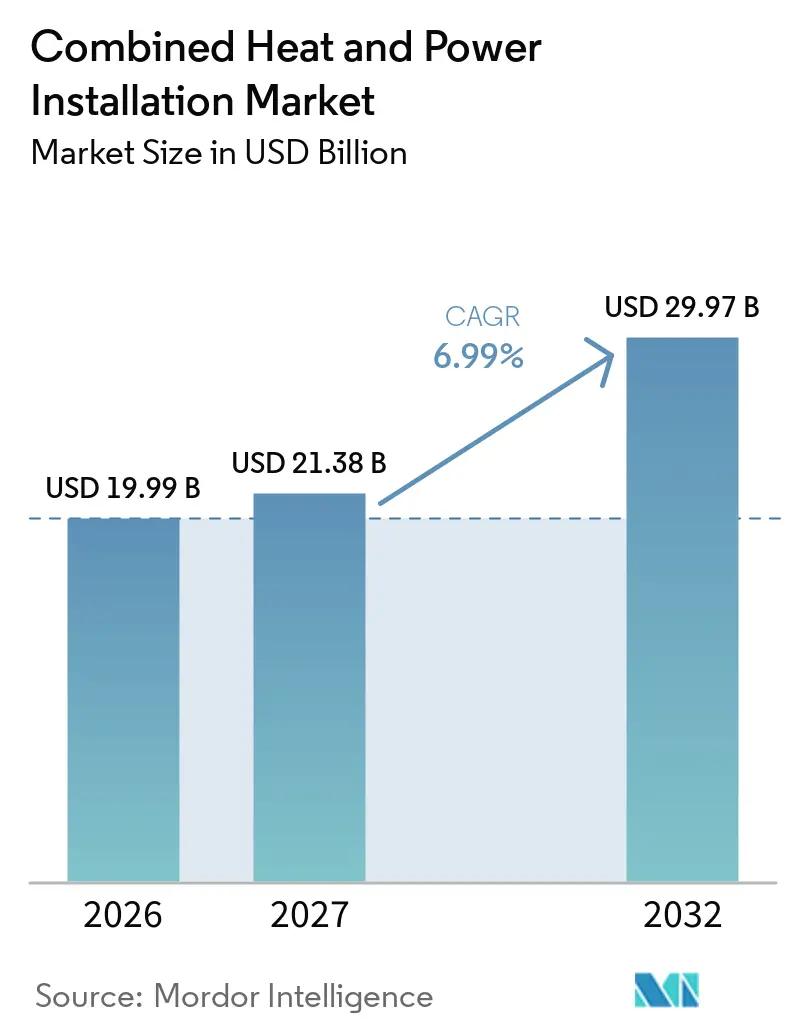
The Combined Heat and Power Installation Market size was valued at USD 19.99 billion in 2026 and is estimated to grow from USD 21.38 billion in 2027 to reach USD 29.97 billion by 2032, at a CAGR of 6.99% during the forecast period (2027-2032). The global combined heat & power installation market benefits from the ability of CHP systems to produce electricity and usable heat from one fuel stream. CHP can convert 65% to 80% of fuel input into usable energy, compared with 50% when grid electricity and standalone boilers are used separately. This advantage supports investment where power and heat demand occur at the same site and at the same time. Data-center electricity demand, tighter emissions rules, and hydrogen-ready equipment are shaping procurement decisions across the global combined heat & power installation market. Companies are also pairing equipment supply with service agreements, which can improve project certainty for customers and create recurring revenue for suppliers. Fuel costs, connection delays, and permitting remain material limits, particularly for smaller projects.
Key Report Takeaways
- By installation type, large-scale CHP installations held 60.1% of the global combined heat & power installation market in 2026, while small-scale installations are forecast to grow at a 7.1% CAGR through 2032.
- By capacity, the 10 to 50 MW range accounted for 28.4% of revenue in 2026, while installations below 1 MW are forecast to grow at a 7.9% CAGR through 2032.
- By prime mover, reciprocating engines held 32.5% of revenue in 2026, while microturbines are forecast to grow at an 8.2% CAGR through 2032.
- By end user, industrial customers accounted for 81.3% of revenue in 2026, while utilities and district-energy operators are forecast to grow at a 7.6% CAGR through 2032.
- By geography, Europe held 51.9% of revenue in 2026, while Asia-Pacific is forecast to grow at a 7.3% CAGR through 2032.
Note: Market numbers in this report are based on Mordor Intelligence's proprietary estimation framework, which combines nine months of actuals with Q4 projections for base year 2026.
Market Trends and Insights
Drivers Impact Analysis of Combined Heat and Power Installation Market*
| Driver | (~) % Impact on CAGR Forecast | Geographic Relevance | Impact Timeline |
|---|---|---|---|
| Rising Demand for Efficient Onsite Heat and Power | +1.3% | Global | Short term (≤ 2 years) |
| Energy Security and Grid Resilience Requirements | +1.1% | Global, concentrated in Europe and North America | Medium term (2-4 years) |
| Industrial Decarbonization and Emissions Reduction Policies | +0.9% | Europe and North America, with spillover to Asia-Pacific | Medium term (2-4 years) |
| Expansion of District Heating and Cooling Networks | +0.7% | Europe and Asia-Pacific, with spillover to the Middle East and Africa | Medium term (2-4 years) |
| CHP Integration With Renewable Fuels and Hydrogen | +0.5% | Global, with early activity in Europe and Japan | Long term (≥ 4 years) |
| Flexible CHP and Thermal Storage for Renewable Balancing | +0.4% | Europe and Asia-Pacific | Long term (≥ 4 years) |
| Source: Mordor Intelligence | |||
Rising Demand for Efficient Onsite Heat and Power
The global combined heat & power installation market is supported by facilities that need heat and electricity throughout the day. CHP systems can achieve 65% to 75% efficiency, while a separate supply of electricity and heat can deliver 50% efficiency.[1] Higher retail electricity prices strengthen the case for on-site generation where thermal demand is stable. Chemical, food and beverage, pharmaceutical, and pulp and paper facilities are well-suited because their process heat needs are predictable. Packaged systems have reduced engineering requirements and installation time for medium-sized commercial and institutional sites. The U.S. Department of Energy found that packaged equipment represented more than 85% of reciprocating-engine CHP installations through the early 2020s.[2]
Energy Security and Grid Resilience Requirements
Grid reliability has become a larger operational concern for hospitals, campuses, industrial parks, and data centers. CHP can provide dispatchable on-site electricity when transmission constraints or outages affect the wider system. A January 2025 study presented by B.KWK identified a 17 to 21 GW need for dispatchable capacity in Germany by 2030 as coal-fired capacity retires. A B.KWK analysis published in February 2026 found that CHP plants largely operate when renewable output cannot meet residual load. This operating pattern supports the role of flexible generation alongside variable renewable power. District heating networks and thermal storage can also help operators use CHP heat output when electricity system needs are highest.
Industrial Decarbonization and Emissions Reduction Policies
The global combined heat & power installation market is influenced by policies aimed at lowering industrial emissions. The European Commission launched the Clean Industrial Deal on February 26, 2025, with a 90% net greenhouse-gas emissions reduction target for 2040. CHP can reduce fuel use where it displaces separate power generation and boiler-based heat production. It also provides on-site infrastructure that can support a later switch to renewable gas or hydrogen. The CHP Alliance states that hydrogen can lower emissions from CHP when equipment and fuel supply are prepared for the transition. These policy conditions favor projects that combine energy efficiency, grid flexibility, and a credible path to lower-carbon fuels.
District Energy, Renewable Fuels, and Hydrogen Integration
District heating and cooling systems create a stable outlet for CHP heat and support larger projects in dense urban areas. The EU LIFE Programme included a 2025 funding call for district heating and cooling networks within a EUR 600 million funding round. Renewable natural gas and biogas can reduce reliance on conventional natural gas without replacing all existing CHP equipment. Capstone Green Energy announced a 6.6 MW biogas project in North Carolina in January 2026 that uses swine waste converted through pyrolysis. Hydrogen-ready engines and turbines can extend the useful life of newly installed equipment, although the timing depends on hydrogen availability and cost. Flexible plants and thermal storage also help align power and heat production with changing renewable output.
Restraints Impact Analysis of Combined Heat and Power Installation Market*
| Restraint | (~) % Impact on CAGR Forecast | Geographic Relevance | Impact Timelin |
|---|---|---|---|
| High Upfront Installation and Grid Integration Costs | -0.7% | Global, most acute in North America and emerging Asia-Pacific markets | Short term (≤ 2 years) |
| Natural Gas Price, Supply, and Pipeline Exposure | -0.5% | North America and Europe | Medium term (2-4 years) |
| Permitting, Interconnection, and Local Heat Market Complexity | -0.4% | North America and Europe | Medium term (2-4 years) |
| Biogas Impurity Management and Prime Mover Degradation | -0.3% | Global, most acute in biogas-heavy markets | Long term (≥ 4 years) |
| Source: Mordor Intelligence | |||
High Upfront Costs, Permitting, and Interconnection Complexity
Capital requirements remain a major constraint for smaller CHP users. U.S. Department of Energy guidance published in 2024 identified interconnection costs and delays as obstacles that can make viable CHP and waste-heat projects financially unattractive. Large industrial and utility projects can spread fixed design, permitting, and grid-connection costs across more capacity. Smaller commercial and residential projects face a more difficult financing case and may depend on local incentives or power-purchase agreements. Local heat-demand conditions also matter because a project needs a reliable use for recovered thermal energy. Packaged and containerized units reduce on-site engineering work, but they do not remove utility fees or approval requirements.
Fuel Price, Supply, and Biogas Quality Exposure
Natural gas remains the primary fuel for much of the global combined heat & power installation market. This dependence exposes projects to fuel-price swings and pipeline availability, especially when small users cannot hedge costs as effectively as larger industrial customers. Germany's 2025 B.KWK-backed study identified volatile gas prices as a reason financing for CHP expansion can be difficult. Biogas and renewable natural gas can provide an alternative fuel source, but feedstock supply and gas-cleaning costs vary by location. Impurities can affect equipment performance and increase maintenance requirements for engines and turbines. These conditions can delay decisions to shift away from fossil gas even when equipment is technically capable of using alternative fuels.
*Our forecasts treat driver/restraint impacts as directional, not additive. The impact forecasts reflect baseline growth, mix effects, and variable interactions.
Combined Heat and Power Installation Market Segment Analysis
By Installation Type:
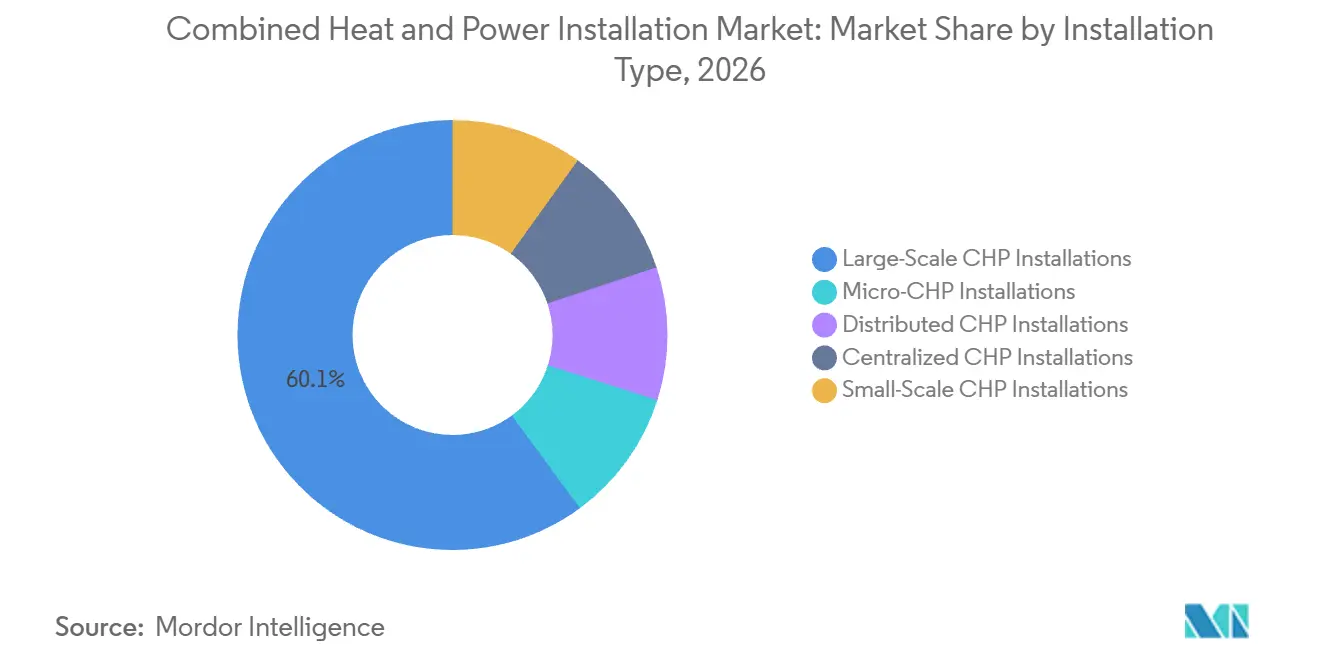
Large-Scale Plants Provide the Largest Revenue BaseLarge-scale plants accounted for a 60.1% of the global combined heat & power installation market share in 2026. Utilities, industrial groups, and district-energy operators use these facilities because high output can dilute fixed grid-connection and permitting costs. Large plants are also more likely to have defined thermal offtake arrangements with industrial or municipal customers. GE Vernova began commercial operations at the Jafurah Cogeneration ISPP in Saudi Arabia in November 2025, supplying up to 320 MW of electricity and 314 tonnes of steam per hour.
Centralized CHP supports city-scale district heating networks and major industrial sites. Distributed configurations serve industrial parks, campuses, and multi-site commercial operators seeking a degree of power independence. The global combined heat & power installation market, therefore, retains distinct roles for centralized and distributed assets. Large systems can accommodate more complex turbine, heat-recovery, and service configurations. Their economics depend on sustained power and heat demand rather than electricity output alone.
Small-scale installations are forecast to grow at a 7.1% CAGR through 2032. Lower packaged-system costs and higher electricity prices improve their fit for commercial buildings, hospitals, and smaller industrial facilities. Demand for behind-the-meter power at data centers and healthcare sites also supports adoption. The U.S. standards in 40 CFR Part 60 Subpart KKKKa influence equipment selection for new combustion-turbine projects commissioned after December 2024.
Micro-CHP remains smaller by revenue but has support in Japan and South Korea through building-level efficiency programs. Small systems can be installed with less site-specific engineering than major plants. The global combined heat & power installation market can benefit when hospitals pair reliable heat demand with resilience needs. These projects remain exposed to financing and interconnection costs.

By Capacity:
Mid-Range Capacity Leads While Small Units Grow FasterThe 10 to 50 MW range accounted for a 28.4% of the global combined heat & power installation market in 2026. This band matches the energy requirements of many chemical, food-processing, pulp-and-paper, and automotive facilities. It offers sufficient scale for meaningful heat recovery without the engineering complexity of the largest projects. The 1 to 10 MW band serves commercial and light-industrial customers, while the 50 to 150 MW band supports heavy industry and district-energy applications.
Projects above 150 MW are fewer in number but carry high value per installation. They are concentrated among utilities, integrated industrial complexes, and national energy programs. Capacity choice depends on heat demand, gas supply, local network conditions, and the desired level of power independence. The global combined heat & power installation market includes all these capacity classes because end-user loads differ widely. Large capacity does not automatically produce better economics when thermal demand is limited.
Installations below 1 MW are forecast to grow at a 7.9% CAGR through 2032. Packaged reciprocating engines and microturbines make this range relevant for hospitals, hotels, universities, and smaller data-center locations. Capstone Green Energy received a 5.8 MW microturbine order for food-manufacturing facilities in Mexico in August 2025. Its April 2026 hospitality installation in Utah also used waste-heat recovery.
Small systems can act as an early testing ground for hydrogen blends and dedicated hydrogen operation. They may require less infrastructure change than very large turbine installations. INNIO states that its J-series engines are ready for hydrogen blends up to 25% by volume and can be converted for 100% hydrogen operation. The global combined heat & power installation industry can use these units to gain operating experience before wider hydrogen infrastructure is available. Fuel supply and conversion costs will determine how quickly this pathway develops.
By Prime Mover:
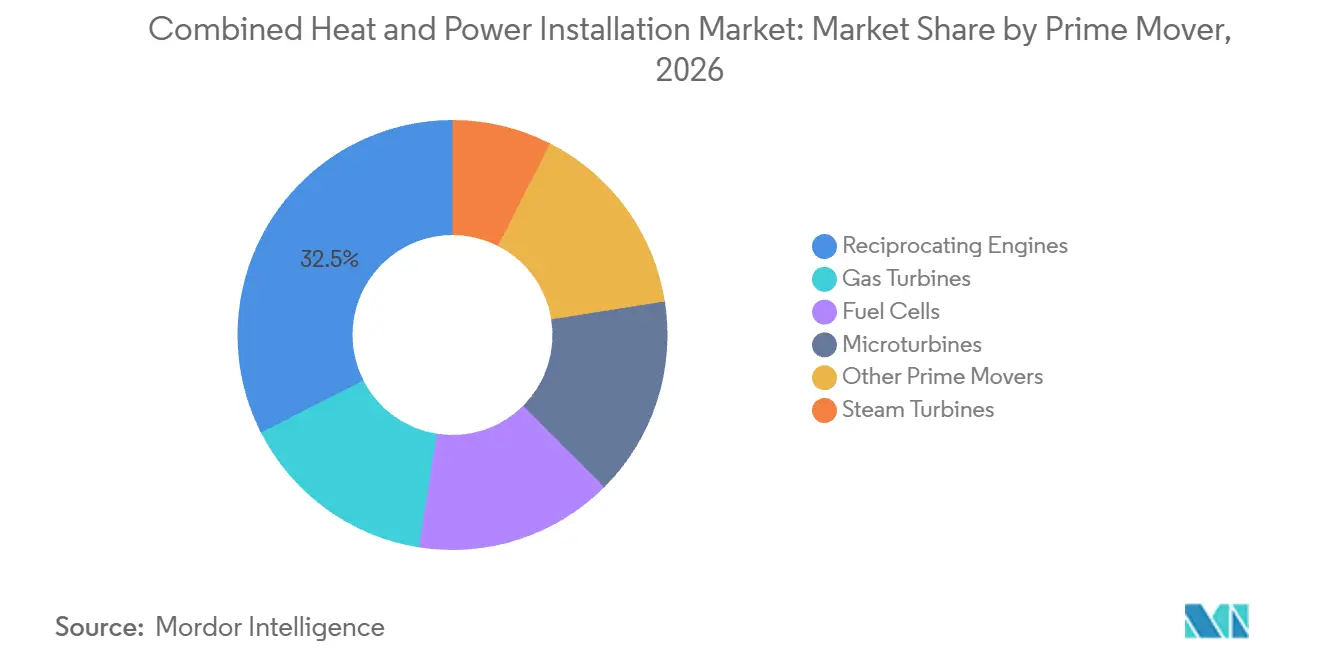
Reciprocating Engines Lead and Microturbines Grow FastestReciprocating engines held a 32.5% of prime-mover revenue in 2026. Their position reflects part-load efficiency, broad fuel compatibility, and lower capital cost at small and medium scales. They can operate on natural gas, biogas, landfill gas, and hydrogen blends when equipment specifications permit. This makes them suitable for sites with variable electrical loads and accessible fuel supplies.
Gas turbines retain a strong role in applications above 10 MW because of power density and their fit with combined-cycle configurations. GE Vernova reported that its H-class fleet exceeded 200 units in the fourth quarter of 2025. Steam turbines remain relevant where industrial facilities already have high-pressure steam systems. Fuel cells have a smaller installed base but can suit locations with strict air-quality requirements. Prime-mover selection continues to depend on capacity, thermal use, fuel quality, and emissions needs.
Microturbines are forecast to grow at an 8.2% CAGR through 2032, the highest rate among prime movers. Demand comes from behind-the-meter data-center projects, hospitality sites, commercial buildings, and biogas-to-power applications. A 2024 journal study reported that micro gas turbines historically represented 25% of CHP installations in the 100 kW to 1 MW range. Packaged and containerized designs can reduce site-preparation requirements.
Siemens Energy's Leipzig Süd CHP plant uses 2 SGT-800 gas turbine packages, has 94% fuel-utilization efficiency, produces 125 MW of electricity and 163 MW of heat, and is certified hydrogen-ready by TÜV Süd. This project illustrates the role of hydrogen-ready systems in larger CHP projects. The global combined heat & power installation market also uses renewable natural gas as a practical near-term fuel option. The CHP Alliance identifies hydrogen and renewable natural gas as pathways for existing prime-mover fleets. These routes depend on fuel availability, local standards, and project economics.
By End User:
Industrial Demand Leads While District Energy ExpandsIndustrial users accounted for a 81.3% of the global combined heat & power installation market in 2026. Chemical, refining, metals, food-processing, and pharmaceutical sites have continuous thermal loads close to generation equipment. This allows high heat recovery and supports the financial case for cogeneration. Industrial CHP in eastern China, the Ruhr Valley, and the U.S. Gulf Coast reflects long-term co-location of electricity and process heat needs.
This demand base is structural because separate grid power and boiler heat can use more fuel than an integrated supply. Commercial buyers, including offices, retail facilities, and data centers, represent a smaller but growing source of incremental demand. Large industrial assets may remain in service through fuel transitions because their heat networks and on-site generation infrastructure are already established. The global combined heat & power installation market is therefore likely to keep industrial users at its center. Commercial demand is more sensitive to grid charges, construction costs, and local resilience needs.
Utilities and district-energy operators are forecast to grow at a 7.6% CAGR through 2032. They combine CHP electricity with heat distribution networks that can serve dense urban areas. Large urban projects can require substantial capital and multi-party planning. The global combined heat & power installation market can gain from established heat networks that increase the use of recovered energy.
The EU LIFE funding call provides support for district heating and cooling network projects. Residential and institutional users remain smaller categories. Japanese residential fuel-cell systems and CHP at universities in Europe and North America show targeted demand rather than broad adoption. Utilities require stable local heat demand and clear network economics before committing capital. The global combined heat & power installation market remains constrained where district-heating systems are not established.
Geography Analysis
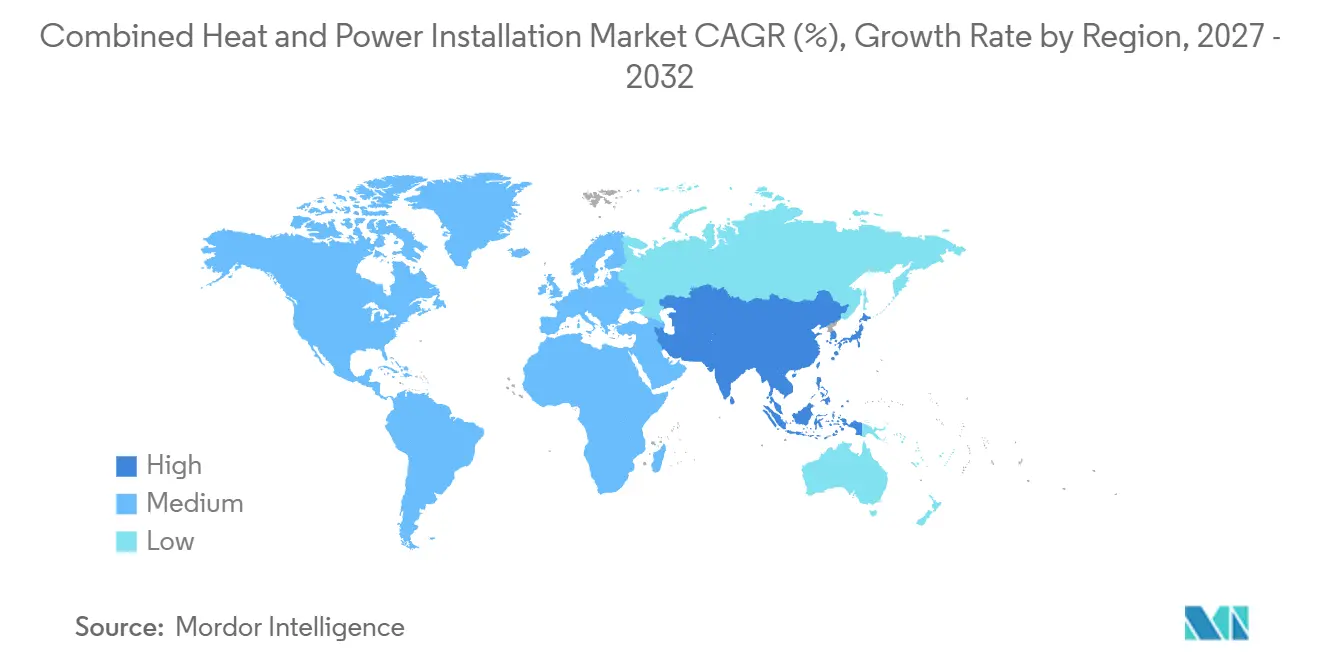
Europe held a 51.9% of revenue in the global combined heat & power installation market in 2026. District-heating infrastructure, high retail electricity prices, and policy support provide the basis for regional demand. This policy context affects whether planned sites progress to construction. In September 2026, Germany's Federal Ministry for Economic Affairs and Energy introduced a framework for a further amendment that would extend CHP commissioning eligibility through 2035 and encourage flexible operation. Germany also faces a 17 to 21 GW dispatchable-capacity need by 2030, according to the B.KWK-supported study.
Approval activity in Germany fell between 2020 and 2023, which showed how policy uncertainty can delay projects. Siemens Energy's Leipzig Süd facility shows the use of hydrogen-ready gas turbines in the region. Poland's Bydgoszcz II project uses a 52.6 MWe and 50.8 MWt cogeneration unit to replace coal boilers. France, Italy, the United Kingdom, and Nordic countries also support industrial and district-energy demand. The global combined heat & power installation market in Europe also benefits from established heat networks.
Asia-Pacific is forecast to grow at a 7.3% CAGR through 2032, the fastest rate among regions. China has extensive CHP use in steel, chemicals, and cement, and is shifting toward natural-gas and biomass-fired systems as environmental standards tighten. India, South Korea, and Southeast Asia add demand through industrial growth and energy-security needs. Japan supports gas-engine and fuel-cell micro-CHP in commercial buildings through efficiency requirements. Vietnam, Indonesia, and Thailand provide openings for biomass and gas-fired equipment in agribusiness, cement, and textiles.
North America has gained demand from data-center and artificial-intelligence infrastructure. Cummins signed a multi-year supply contract with Circe Energy in June 2026 for natural-gas generator sets for high-performance computing data centers in West Texas. South America has a demand for flexible power assets as hydroelectric output varies, illustrated by Wärtsilä's 371 MW agreements with Origem Energia in Brazil. The Middle East and Africa demand is concentrated in industrial utility projects, including the Jafurah facility in Saudi Arabia.
North America has gained demand from data-center and artificial-intelligence infrastructure in the global combined heat & power installation market. Cummins signed a multi-year supply contract with Circe Energy in June 2026 for natural-gas generator sets for high-performance computing data centers in West Texas. South America has a demand for flexible power assets as hydroelectric output varies, illustrated by Wärtsilä's 371 MW agreements with Origem Energia in Brazil. The Middle East and Africa demand is concentrated in industrial utility projects, including the Jafurah facility in Saudi Arabia.
Competitive Landscape
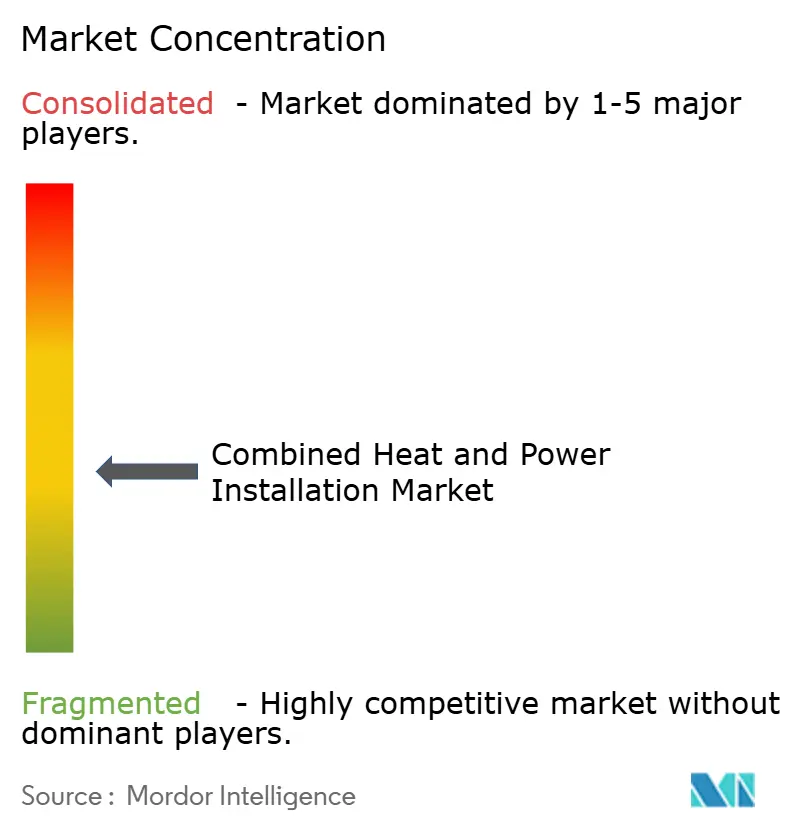
The global combined heat & power installation market is moderately fragmented. The global combined heat & power installation market has a concentrated group of major suppliers for large gas-turbine and steam-turbine projects, while smaller capacity ranges remain more fragmented. GE Vernova, Siemens Energy, Mitsubishi Heavy Industries, and Wärtsilä compete in large equipment applications. Specialists, including 2G Energy and Capstone Green Energy, compete in engines, microturbines, service, and packaged systems. Fuel-cell providers compete where local emissions and urban siting requirements are important. Competition is shaped by equipment efficiency, fuel flexibility, delivery schedules, and the ability to support the asset after installation.
Long-term service agreements are central to supplier strategy. GE Vernova's Jafurah project included a 20-year service agreement. Such contracts provide customers with structured maintenance support while giving manufacturers recurring revenue over the equipment's life. Suppliers are also developing hydrogen-ready and containerized platforms for sites that value speed and resilience. INNIO secured a 1.1 GW gas-engine order for a U.S. data-center campus in July 2026.
The global combined heat & power installation market offers opportunities in fuel-cell systems for urban sites, thermal-storage hybrids, and upgrades of aging coal-fired cogeneration plants. Siemens Energy's hydrogen-ready certification at Leipzig Süd provides a model for converting gas-turbine CHP equipment. Remote monitoring and optimized dispatch are becoming important ways to differentiate service offerings as core equipment becomes more widely available, although a concentration score cannot be assigned without combined leading-player shares.
Combined Heat and Power Installation Industry Leaders
-
Siemens Energy AG
-
GE Vernova Inc.
-
MITSUBISHI HEAVY INDUSTRIES, LTD.
-
Wärtsilä Oyj Abp
-
Veolia Environnement S.A.
- *Disclaimer: Major Players sorted in no particular order
Combined Heat and Power Installation Market Companies Covered in this Report
- 2G Energy AG
- ABB Ltd.
- BDR Thermea Group
- Capstone Green Energy Holdings, Inc.
- Caterpillar Inc.
- CENTRAX Gas Turbines
- Centrica plc
- Clarke Energy
- Cummins Inc.
- Doosan Fuel Cell Co., Ltd.
- E.ON SE
- FuelCell Energy, Inc.
- GE Vernova Inc.
- INNIO Group
- Kawasaki Heavy Industries, Ltd.
- Mitsubishi Electric Corporation
- MITSUBISHI HEAVY INDUSTRIES, LTD.
- Robert Bosch GmbH
- Siemens Energy AG
- Tecogen Inc.
- Veolia Environnement S.A.
- Viessmann Climate Solutions Berlin GmbH
- Wartsila Oyj Abp
Recent Industry Developments in Combined Heat and Power Installation Market
- July 2026: INNIO secured a 1.1 GW gas-engine order for a major undisclosed data-center campus in the United States, with more than 200 Jenbacher J624 engines providing entirely behind-the-meter prime power. Deliveries are phased, providing multi-year revenue visibility and representing one of the largest orders in INNIO's history.
- June 2026: Cummins signed a multi-year strategic supply contract with Circe Energy to deliver high-efficiency natural-gas generator sets (HSK78 and QSK60 platforms) for an AI high-performance computing data center campus in West Texas. Deliveries are scheduled from 2026 through 2030, with the first batch entering trial operation in Q4 2026.
- June 2026: GE Vernova secured an order for two 9HA.02 gas turbines for Vietnam Electricity's Quang Trach II LNG-based combined-cycle power plant, expected to generate more than 1.6 GW with commercial operations targeted by 2030.
Global Combined Heat and Power Installation Market Report Scope
Combined Heat and Power (CHP), also known as cogeneration, is an energy-efficient technology that simultaneously generates electricity and useful thermal energy (heat) from a single fuel source through an integrated system. Unlike conventional power plants, which discard approximately 60% of their energy as waste heat into the atmosphere, CHP systems capture this thermal byproduct and use it for space heating, hot water, steam generation, or industrial processes.
The global combined heat & power installation market is segmented by installation type, capacity, prime mover, end-user, and geography. By installation type, the market is segmented into large-scale CHP installations, small-scale CHP installations, micro-CHP installations, distributed CHP installations, and centralized CHP installations. By capacity, the market is segmented into up to 1 MW, 1–10 MW, 10–50 MW, 50–150 MW, 151–300 MW, and above 300 MW. By prime mover, the market is segmented into gas turbines, steam turbines, reciprocating engines, fuel cells, microturbines, and other prime movers. By end-user, the market is segmented into industrial, commercial, residential, utilities and district energy, and institutional and government facilities. The report also covers the market size and forecasts for the global combined heat & power installation market across 26 countries in the key regions. For each segment, market sizing and forecasts are provided in terms of value (USD).
Segmentation Overview
| Large-Scale CHP Installations |
| Small-Scale CHP Installations |
| Micro-CHP Installations |
| Distributed CHP Installations |
| Centralized CHP Installations |
| Up to 1 MW |
| 1-10 MW |
| 10-50 MW |
| 50-150 MW |
| 151-300 MW |
| Above 300 MW |
| Gas Turbines |
| Steam Turbines |
| Reciprocating Engines |
| Fuel Cells |
| Microturbines |
| Other Prime Movers |
| Industrial |
| Commercial |
| Residential |
| Utilities and District Energy |
| Institutional and Government Facilities |
| North America | United States |
| Canada | |
| Mexico | |
| Europe | Germany |
| France | |
| Italy | |
| Spain | |
| United Kingdom | |
| Poland | |
| Russia | |
| Rest of Europe | |
| Asia-Pacific | China |
| India | |
| Japan | |
| South Korea | |
| Australia | |
| Indonesia | |
| Vietnam | |
| Thailand | |
| Rest of Asia-Pacific | |
| South America | Brazil |
| Argentina | |
| Chile | |
| Rest of South America | |
| Middle East and Africa | Saudi Arabia |
| United Arab Emirates | |
| Egypt | |
| South Africa | |
| Morocco | |
| Rest of Middle East and Africa | |
| Africa | South Africa |
| Egypt | |
| Morocco | |
| Nigeria | |
| Rest of Africa |
| By Installation Type | Large-Scale CHP Installations | |
| Small-Scale CHP Installations | ||
| Micro-CHP Installations | ||
| Distributed CHP Installations | ||
| Centralized CHP Installations | ||
| By Capacity | Up to 1 MW | |
| 1-10 MW | ||
| 10-50 MW | ||
| 50-150 MW | ||
| 151-300 MW | ||
| Above 300 MW | ||
| By Prime Mover | Gas Turbines | |
| Steam Turbines | ||
| Reciprocating Engines | ||
| Fuel Cells | ||
| Microturbines | ||
| Other Prime Movers | ||
| By End User | Industrial | |
| Commercial | ||
| Residential | ||
| Utilities and District Energy | ||
| Institutional and Government Facilities | ||
| By Geography | North America | United States |
| Canada | ||
| Mexico | ||
| Europe | Germany | |
| France | ||
| Italy | ||
| Spain | ||
| United Kingdom | ||
| Poland | ||
| Russia | ||
| Rest of Europe | ||
| Asia-Pacific | China | |
| India | ||
| Japan | ||
| South Korea | ||
| Australia | ||
| Indonesia | ||
| Vietnam | ||
| Thailand | ||
| Rest of Asia-Pacific | ||
| South America | Brazil | |
| Argentina | ||
| Chile | ||
| Rest of South America | ||
| Middle East and Africa | Saudi Arabia | |
| United Arab Emirates | ||
| Egypt | ||
| South Africa | ||
| Morocco | ||
| Rest of Middle East and Africa | ||
| Africa | South Africa | |
| Egypt | ||
| Morocco | ||
| Nigeria | ||
| Rest of Africa | ||
Key Questions Answered in the Report
What is the forecast for the global combined heat and power installation market?
The Combined Heat & Power Installation Market size was valued at USD 19.99 billion in 2026 and is estimated to grow from USD 21.38 billion in 2027 to reach USD 29.97 billion by 2032, at a CAGR of 6.99% during the forecast period (2027-2032).
Which installation type generates the most revenue?
Large-scale installations led with 60.1% of revenue in 2026 because industrial, utility, and district-energy projects can spread fixed costs across greater capacity.
Which CHP capacity range is growing the fastest?
Systems below 1 MW are projected to grow at a 7.9% CAGR through 2032, supported by packaged units for hospitals, hotels, universities, and smaller data centers.
Why do industrial facilities use combined heat and power systems?
Industrial customers accounted for 81.3% of 2026 revenue because continuous process heat demand improves the value of recovering thermal energy on site.
Which region is expected to grow the fastest?
Asia-Pacific is forecast to grow at a 7.3% CAGR through 2032, led by industrial activity in China and demand growth in India, South Korea, and Southeast Asia.
How do hydrogen-ready CHP systems affect purchasing decisions?
Hydrogen-ready engines and turbines can allow operators to use gas today and shift to higher hydrogen blends or hydrogen later when fuel supply and project economics permit.