
Cold Climate Heat Pump Market Size and Share
Market Overview
| Study Period | 2021 - 2032 |
|---|---|
| Market Size (2027) | USD 24.31 Billion |
| Market Size (2032) | USD 40.06 Billion |
| Growth Rate (2027 - 2032) | 10.52 % |
| Fastest Growing Market | North America |
| Largest Market | Europe |
| Market Concentration | Medium |
Major Players *Disclaimer: Major Players sorted in no particular order Image © Mordor Intelligence. Reuse requires attribution under CC BY 4.0. | |
Cold Climate Heat Pump Market Analysis by Mordor Intelligence
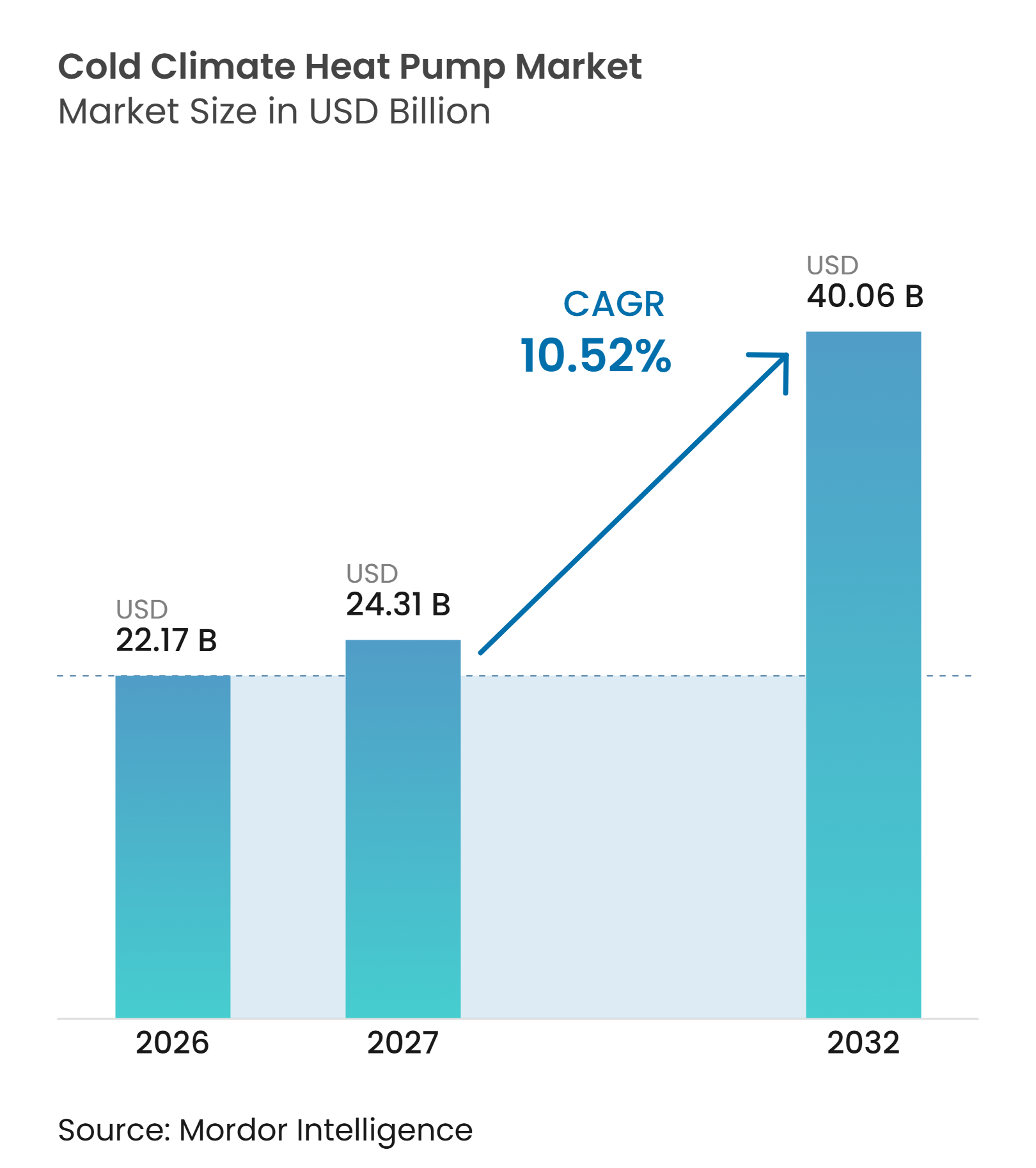
The Cold Climate Heat Pump Market size is projected to be USD 22.17 billion in 2026, USD 24.31 billion in 2027, and reach USD 40.06 billion by 2032, growing at a CAGR of 10.52% from 2027 to 2032.
Building electrification mandates, variable natural gas prices, and improved low-temperature equipment performance support demand across cold regions. Variable-speed compressors and enhanced vapor injection have widened the operating range of air-source systems below -25°C, reducing a longstanding performance concern in colder locations. The cold climate heat pump market also benefits as grid operators and policymakers treat building electrification as part of energy security planning rather than solely an emissions measure. Refrigerant rules are accelerating product replacement cycles and favoring suppliers that can coordinate compliance, certification, and product launches. Electricity pricing, distribution-grid constraints, and the high cost of retrofit work remain important limits on adoption in parts of North America and Europe.
Key Report Takeaways
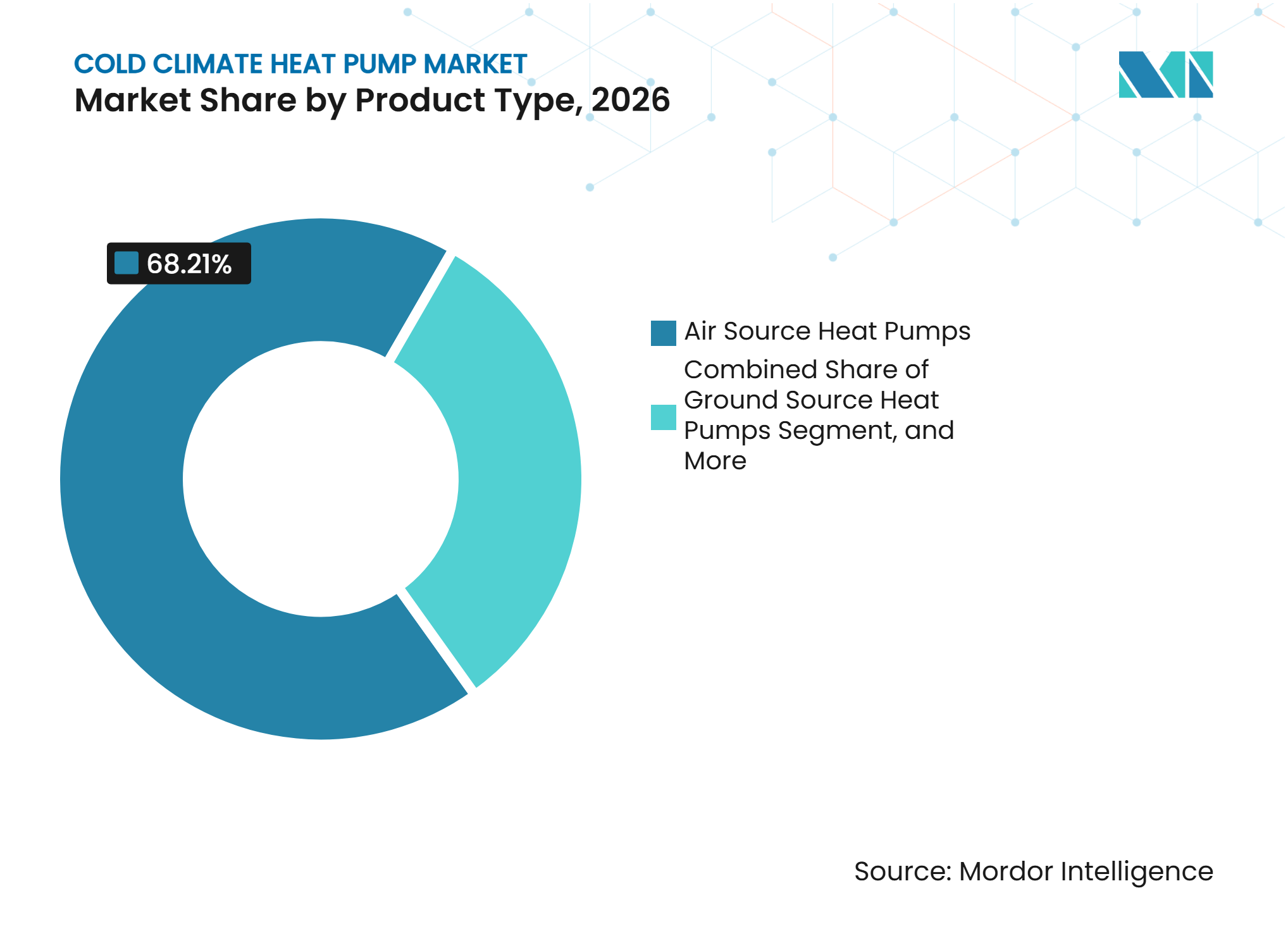
- By product type, air-source heat pumps held 68.21% of the cold climate heat pump market share in 2026, while ground-source heat pumps are projected to expand at an 11.32% CAGR through 2032.
- By system configuration, split systems held 48.74% of market value in 2026, while cascade and multi-unit systems are projected to expand at an 11.27% CAGR through 2032.
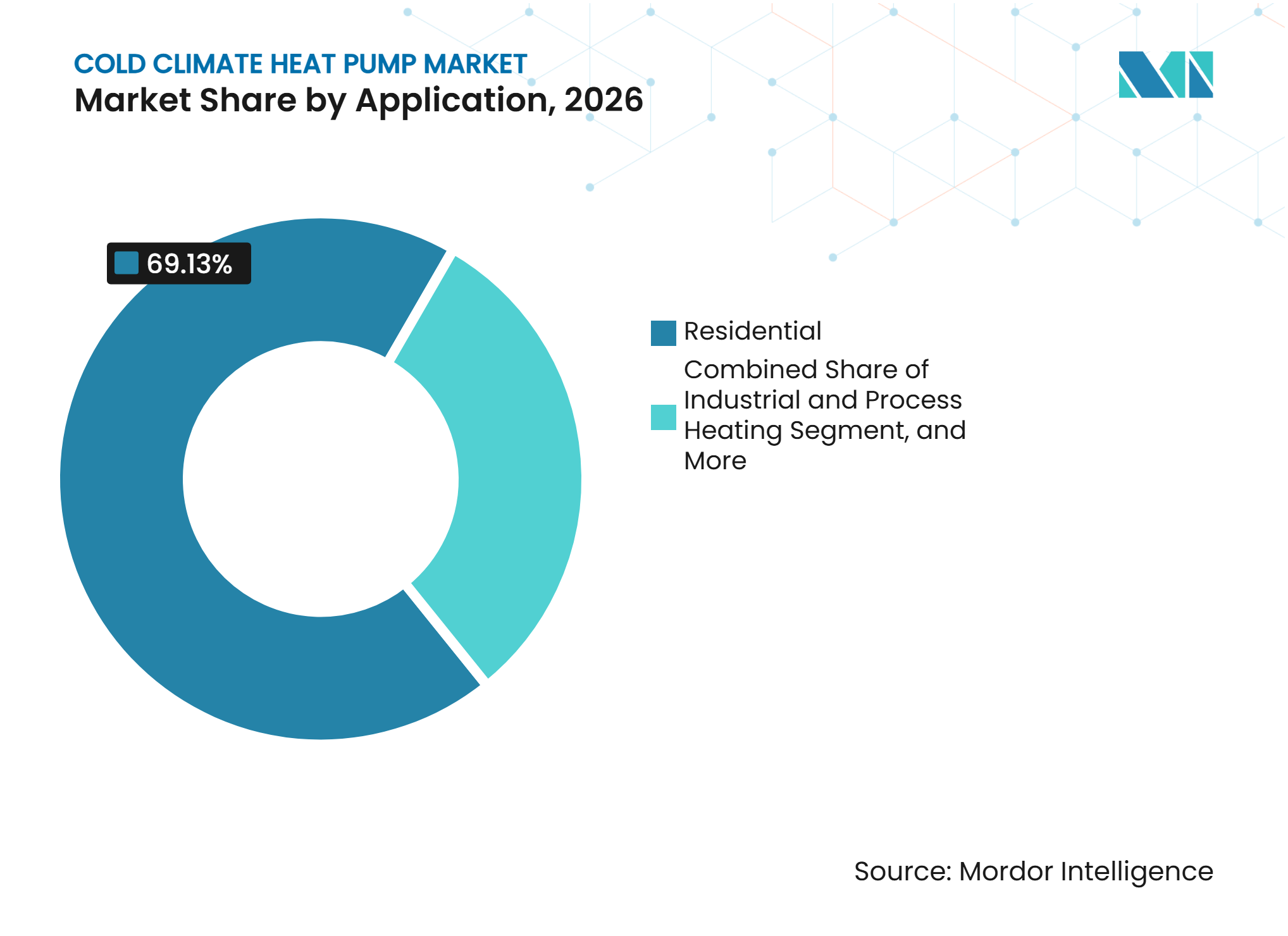
- By application, residential systems held 69.13% of the cold climate heat pump market share in 2026, while district heating and community energy are projected to expand at an 11.19% CAGR through 2032.
- By capacity, the up-to-10 kW segment held 49.83% of market value in 2026, while above-100 kW and megawatt-scale systems are projected to expand at an 11.24% CAGR through 2032.
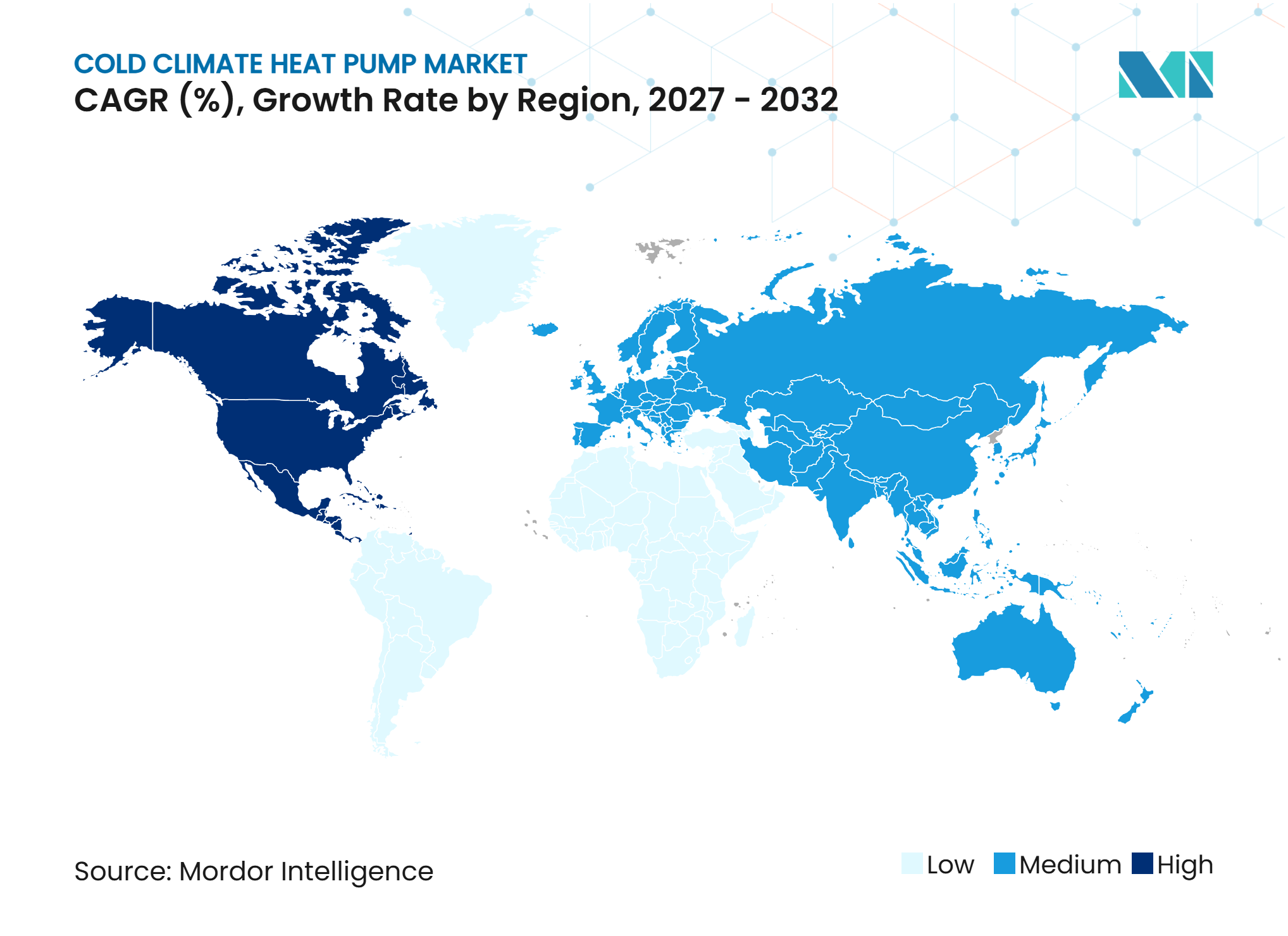
- By geography, Europe held 36.29% of the cold climate heat pump market share in 2026, while North America is projected to expand at an 11.36% CAGR through 2032.
Note: Market numbers in this report are based on Mordor Intelligence's proprietary estimation framework, which combines nine months of actuals with Q4 projections for base year 2026.
Market Trends and Insights
Drivers Impact Analysis of Cold Climate Heat Pump Market*
| Driver | (~) % Impact on CAGR Forecast | Geographic Relevance | Impact Timeline |
|---|---|---|---|
| Building Electrification Policies and Consumer Rebates | +2.8% | Global, with concentrated near-term effect in North America and Europe | Short term (≤ 2 years) |
| Fossil-Fuel Price Volatility and Energy Security Priorities | +2.3% | Global, with highest intensity in Europe, the United Kingdom, and Northeast North America | Medium term (2-4 years) |
| Variable-Speed Compression and Enhanced Vapor Injection Gains | +1.9% | Global, particularly North America and Europe | Medium term (2-4 years) |
| Replacement Demand in Aging Boiler and Furnace Fleets | +1.6% | Europe and North America, with spillover to Asia-Pacific | Long term (≥ 4 years) |
| Cold-Climate Qualification and Installer Confidence From Standardized Testing | +1.2% | North America and Europe, with early gains in South Korea and Japan | Medium term (2-4 years) |
| Dual-Use Heating and Cooling Demand in Warming Northern Regions | +0.9% | North America, Northern Europe, and cold Asia-Pacific regions | Medium term (2-4 years) |
| Source: Mordor Intelligence | |||
Building Electrification Policies and Consumer Rebates
Policy programs are moving beyond broad efficiency support toward certification and incentives for equipment proven in low temperatures. The New York State Clean Heat program offered incentives of up to 85% of project costs in designated disadvantaged communities for qualifying air-source and ground-source systems.[1] California enacted SB222 in 2026 to streamline heat pump permitting statewide, reducing a practical barrier to installation. The revised EU Energy Performance of Buildings Directive removed fossil fuel boiler subsidies and reinforced minimum building energy performance requirements. These measures favor products that satisfy both cold-weather performance expectations and installer qualification requirements. They also create clearer demand conditions for the cold climate heat pump market. South Korea allocated KRW 36.1 billion (USD 26.5 million) in national and local subsidies for single-family homes in 2026 and linked future eligibility to EN 14825-based Eco-label certification.
Fossil-Fuel Price Volatility and Energy Security Priorities
Energy security has become a major basis for heat pump policy in Europe and North America. Heat pumps avoided 53 bcm of natural gas use for building heating in Europe and Japan during 2025. This installed base continues to displace fuel use even when annual equipment sales vary. The European Union's plan to end Russian pipeline gas imports by 2027 keeps energy security central to the case for electrified heating. Systems that shift electricity use to lower-price periods and store heat can also reduce exposure to changing electricity prices. NIBE identified recovery signals in Germany, the Netherlands, and Sweden during 2025, showing that this rationale is relevant in established northern European markets.
Variable-Speed Compression and Enhanced Vapor Injection Performance Gains
The U.S. Department of Energy Cold Climate Heat Pump Challenge set a target for residential systems to retain 100% of rated capacity at 5°F, or -15°C, compared with 47°F, or 8.3°C. Meeting that target requires improved compressor control and low-temperature refrigerant management. Copeland launched its YAW variable-speed scroll platform in August 2025 with enhanced vapor injection technology. The company stated that the platform can increase low-ambient heating capacity by up to 25% and efficiency by up to 10%, while operating down to -25°F, or -31.7°C. A 2025 IEEE study found that enhanced vapor injection improved performance by an average of 11.0% under matched ambient conditions. Wider availability of these components makes cold-climate capability more accessible to equipment manufacturers.
Replacement Demand in Aging Boiler and Furnace Fleets
Replacement demand is a central route to adoption because aging boilers and furnaces need renewal regardless of new construction activity. The installed stock includes many older non-condensing boilers that are approaching the end of their service life. Heat pump sales exceeded gas furnace sales in the United States by 26% through July 2025, with 2.4 million heat pumps sold compared with 1.9 million gas furnaces. The UK Boiler Upgrade Scheme reported more than 125,000 heat pump sales in 2025 and a 40% increase in scheme-supported installations. Northern homes that replace oil or gas systems require equipment rated for sub-zero conditions. This requirement supports the premium portion of the cold climate heat pump market during the broader replacement cycle.
Restraints Impact Analysis of Cold Climate Heat Pump Market*
| Restraint | (~) % Impact on CAGR Forecast | Geographic Relevance | Impact Timeline |
|---|---|---|---|
| High Installed Cost and Retrofit Balance-of-System Work | -1.8% | Global, with the highest barrier intensity in North America and the United Kingdom renovation sector | Short term (≤ 2 years) |
| Winter Peak Electricity and Distribution-Grid Constraints | -1.3% | North America, Northern Europe, and cold Asia-Pacific regions | Medium term (2-4 years) |
| Skilled Installer and Commissioning Capacity Shortages | -0.9% | Global, most acute in North America and the United Kingdom | Medium term (2-4 years) |
| Defrost, Condensate, Noise, and Extreme-Cold Performance Penalties | -0.6% | North America, Northern Europe, and cold Asia-Pacific regions | Long term (≥ 4 years) |
| Source: Mordor Intelligence | |||
High Installed Cost and Retrofit Balance-of-System Work
Installation cost remains a larger barrier than the equipment price for many cold-climate projects. Oregon documented residential installation costs of USD 9,000 to USD 11,000 for single-family heat pump systems in 2025. The report found that this cost was 57.7% higher than an equivalent gas furnace installation. Electrical panel upgrades, duct changes, envelope improvements, and cold-climate commissioning account for much of the difference. The UK government also reported a GBP 9,000 pre-grant cost difference between a heat pump and a fossil fuel heating replacement, while installation costs had fallen only 11% since 2022. Precise sizing for subzero conditions adds labor and can extend retrofit project timelines.
Winter Peak Electricity and Distribution-Grid Constraints
Cold snaps create a concentrated electricity load that distribution networks may not be prepared to serve. Cold-climate heat pumps use less peak electricity than resistance heating, but large-scale adoption can still increase winter demand materially. Acadia Center found that heat pumps can operate at a coefficient of performance of 2.0 during extreme cold and use 50% less peak electricity per household than electric resistance heating. A University of Victoria study found that hybrid systems can reduce required peak electrical capacity by up to 20% in colder regional grids.[2] Ontario's system planning identifies space-heating electrification as an important long-term demand uncertainty. Distribution upgrades often require years of planning and construction.
*Our forecasts treat driver/restraint impacts as directional, not additive. The impact forecasts reflect baseline growth, mix effects, and variable interactions.
Cold Climate Heat Pump Market Segment Analysis
By Product Type:
Air Source Leads While Ground Source AcceleratesAir-source systems held 68.21% of market value in 2026 because they have lower installation costs and fit existing residential infrastructure. They are widely used in homes where owners are replacing furnaces or boilers without undertaking a full building retrofit. Cold-rated air-source models now operate at -25°C or below, reducing concerns about their use during severe winter weather. Daikin introduced Altherma 4 H with R290 in September 2025 for higher water-temperature applications. Mitsubishi Heavy Industries expanded its Hydrolution EZY R290 range in December 2025.[3] LG also received a 2025 AHR Innovation Award for a residential cold-climate product. These launches show why air-source products remain central to the cold climate heat pump market.
Ground-source systems are projected to expand at an 11.32% CAGR through 2032 because they offer stable seasonal performance in severe weather. Their higher upfront cost limits household adoption, but they are well suited to institutional sites, district networks, and projects with long operating horizons. Sweden had 690,000 installed shallow geothermal systems that delivered 28.4 TWh of heat each year. Every 4th single-family home in Sweden used a ground-source system, indicating the scale possible in a mature cold-climate setting. These conditions create a stable foundation for the cold climate heat pump market in locations with suitable drilling resources. Exhaust-air systems serve a narrower role in passive houses where mechanical ventilation is standard. Water-source products are gaining attention as district operators use lake, river, and wastewater heat sources at a larger scale.



By System Configuration:
Split Systems Lead While Cascades Enable Larger ProjectsSplit systems held 48.74% of the cold climate heat pump market size in 2026, supported by installer familiarity and flexible installation layouts. Their design aligns with established residential HVAC systems in North America and Europe. The exterior and interior units can be arranged to suit different building forms and renovation constraints. Monobloc and packaged products are gaining traction in European homes because they simplify refrigerant handling. The EU F-Gas framework is making refrigerant choice and product compliance more important in the selection process. Hybrid and dual-fuel systems remain relevant where gas infrastructure cannot be retired immediately. They also provide an interim option in locations with high electricity prices or limited grid capacity.
Cascade and multi-unit systems are projected to expand at an 11.27% CAGR through 2032, reflecting demand for staged, larger-capacity projects. Commercial property owners and municipalities use multiple units where a single machine cannot meet the required heating load. This configuration supports redundancy and phased capacity additions in district and commercial settings. EGEC reported more than 500 geothermal district heating projects under development in Europe, representing 6 GWth of planned capacity. These projects will need network-side equipment and arrangements that work with multiple heat pump units. NIBE acquired Cetetherm's Pioneer heat interface unit and substation product lines in August 2025 to strengthen that integration capability. This makes cascade systems an important route for the cold climate heat pump market to serve larger sites.
By Application:
Residential Anchors Demand While District Heating AdvancesResidential applications held 69.13% of market value in 2026, making them the largest application in the cold climate heat pump industry. Single-family homes in colder regions provide a large installed base for oil and gas heating replacement. Household rebate programs also concentrate much of the near-term demand in this application. Commercial buildings are adopting heat pumps as energy performance requirements become more demanding. Offices, hotels, healthcare campuses, and retail sites can use one system for space heating, hot water, and cooling. Industrial and process applications remain smaller, though systems that provide water temperatures up to 75°C are opening applications that were previously difficult to serve. The application mix therefore extends from household equipment replacement to integrated heating and cooling systems for larger buildings.
District heating and community energy are projected to expand at an 11.19% CAGR through 2032. Municipal decarbonization programs and geothermal network development support this application. The European Commission reported that large-scale heat pumps increased their share of the district heating fuel mix by 44% year over year in 2023. Lower-temperature geothermal resources can supply networks when paired with suitable large heat pumps. Denmark had 14 operating termonet grids and 2 major projects under development. These systems show how community-scale networks can connect multiple buildings to shared thermal infrastructure. The cold climate heat pump market can therefore benefit when municipalities combine network investment with building-level replacement programs. The model is being applied across Northern and Central Europe, where municipal planning supports network deployment.

By Capacity:
Residential Scale Holds Volume While Megawatt Systems AdvanceThe up-to-10 kW category held 49.83% of market value in 2026 because it aligns directly with single-family home demand. Major original equipment manufacturers offer broad product ranges at this capacity level. Smaller units are particularly relevant to new homes and well-insulated properties. Mitsubishi Electric introduced 4 kW and 6 kW Ecodan R290 models in November 2026 for UK new homes. These products target smaller residential loads and support preparation for the 2027 Future Homes Standard. The 10-20 kW category serves larger homes, small multifamily properties, and light commercial buildings. The 20-100 kW range supports schools, hotels, and commercial retrofit projects that require higher flow temperatures and wider part-load operation.
Above-100 kW and megawatt-scale systems are projected to expand at an 11.24% CAGR through 2032. This capacity range supports district heating networks, universities, hospitals, and large commercial sites. Such projects need modular capacity and reliable operation across changing heating loads. The European Commission identified large-scale heat pumps as a major development in the district heating fuel mix. Mitsubishi Electric Trane HVAC US launched ecodan Pro CAHV in the first half of 2026 for scalable commercial and institutional systems. These projects often use several units and require stronger coordination between equipment suppliers, contractors, and network operators. The capacity shift gives the cold climate heat pump market a larger project pipeline beyond household replacements. Suppliers must support both equipment selection and system integration.
Geography Analysis
Europe
Europe held 36.29% of the cold climate heat pump market share in 2026. The region had 25.5 million installed heat pump units across 19 countries by the end of 2024, equal to 12% of European households.[4] Sales declined to 2.31 million units in 2024, but the IEA reported a return to double-digit growth during 2025 and the first quarter of 2026. This installed base gives the cold climate heat pump market a substantial replacement and service opportunity across Europe. The planned end of Russian pipeline gas imports by 2027 continues to reinforce the energy security case for electrified heating. The revised Energy Performance of Buildings Directive also removes fossil fuel boiler subsidies. Geothermal district heating is expanding, with more than 500 projects under development representing 6 GWth of planned capacity. Product strategy is also shaped by F-Gas compliance. The European Commission provided a temporary exemption through the end of 2027 for certain indoor-installed 20-50 kW monobloc heat pumps without market-ready low-GWP alternatives.
North America
North America is projected to expand at an 11.36% CAGR through 2032, the highest rate among the listed regions. Federal tax credits and state programs are supporting conversions in cold-climate locations. These measures improve project visibility for contractors participating in the cold climate heat pump market. Heat pumps outsold gas furnaces in the United States by 26% through July 2025. New York's Clean Heat program offered incentives of up to 85% in qualifying locations, while California's SB222 simplified statewide permitting. Quebec has a high reliance on electric baseboard heating, with 54-56% of households using this system. Acadia Center estimated that converting half of Quebec's 2 million baseboard-heated homes could reduce winter peak demand by 5,346 MW. WaterFurnace International and Enertech Global remain relevant in ground-source systems, while Carrier's Texas manufacturing investment reflects rising commercial demand.
New Frontiers Beyond Core Markets
Japan has a mature and stable profile, with Eco-cute CO₂ heat pump water heaters accounting for close to 15% of residential water heating demand. South Korea is working toward 3.5 million high-efficiency heat pumps by 2035 and has tied future subsidy eligibility to EN 14825-based Eco-label certification. China is supporting distributed electrified heating in northern urban districts through coal-to-electricity programs. China Academy of Building Research reported CO₂ cascade air-source prototypes with a coefficient of performance above 2.2 at -30°C. These results can improve the technical case for the cold climate heat pump market in northern Chinese cities. South America has a smaller opportunity concentrated in southern Brazil, Patagonia, and the Andean foothills, where colder conditions create demand. Turkey is the most active Middle East location for cold-climate equipment, while South Africa's Highveld plateau is the main viable area in Africa. These regions have less developed incentives and installer training than core markets, which limits short-term volume. Equipment capable of retaining performance at lower temperatures may widen the addressable geography over time.
Competitive Landscape
Market Concentration
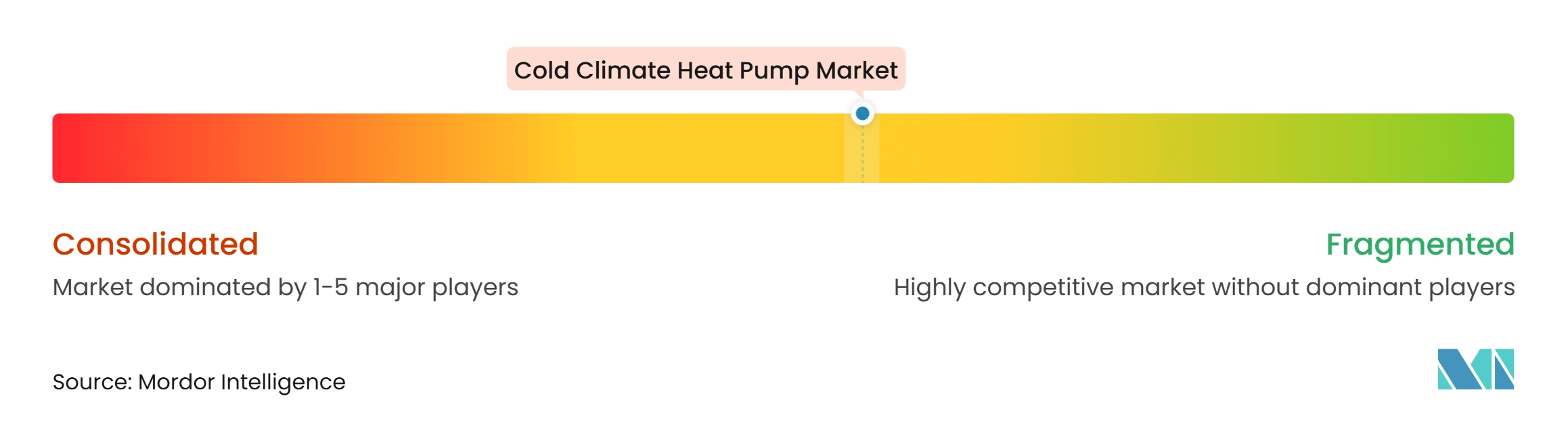
The cold climate heat pump market has a moderately fragmented original equipment manufacturer structure. Daikin, Mitsubishi Electric, Panasonic, and Fujitsu General have a strong combined presence in air-source equipment. NIBE, Vaillant, and Viessmann Climate Solutions are prominent in hydronic and ground-source categories. Longer sales cycles and service relationships reinforce positions in those categories. Midea is moving into higher-performance cold-climate equipment from a vertically integrated manufacturing base. The IEA stated that Chinese manufacturing can produce heat pumps at levelized costs 35-50% below other regions. This cost structure supports competition in mid-tier residential and commercial equipment. It also makes pricing and local service important competitive considerations in the cold climate heat pump market.
The refrigerant transition is shaping company product plans and creating a barrier for smaller suppliers. Daikin launched Altherma 4 H with R290 in September 2025, placing a natural refrigerant product in its European portfolio. Mitsubishi Heavy Industries added 6 kW and 7.1 kW Hydrolution EZY R290 monobloc models in December 2025. LG earned a 2025 AHR Innovation Award for a cold-climate residential system and linked its development to research across 12 universities in 5 countries. These actions show how product validation, refrigerant readiness, and research partnerships are becoming commercial differentiators in the cold climate heat pump market. Suppliers with the resources to manage compliance and testing can bring revised products to market faster. Smaller suppliers face a narrower window when product changes and regulatory deadlines occur together.
Competition is also extending from original equipment manufacturers to components and system integration. Copeland's YAW platform gives equipment makers access to enhanced vapor injection capability for low-temperature systems. NIBE's Cetetherm acquisition expands its ability to provide network-side equipment alongside heat pumps. Specialized firms, including Kensa Heat Pumps, Arctic Heat Pumps, and WaterFurnace International, continue to serve ground-source and extreme-cold niches. This part of the cold climate heat pump market depends on product knowledge, local drilling or installation capability, and long-term service support. Large-capacity projects increasingly require equipment, building-management connectivity, and grid dispatch capability in the same proposal. The cold climate heat pump market therefore gives additional weight to suppliers that can support complex commercial and municipal tenders.
Cold Climate Heat Pump Industry Leaders
-
Daikin Industries, Ltd.
-
Mitsubishi Electric Corporation
-
NIBE Industrier AB
-
Fujitsu General Limited
-
Robert Bosch GmbH
- *Disclaimer: Major Players sorted in no particular order
Cold Climate Heat Pump Market Companies Covered in this Report
- Daikin Industries, Ltd.
- Mitsubishi Electric Corporation
- NIBE Industrier AB
- Panasonic Holdings Corporation
- Fujitsu General Limited
- LG Electronics Inc.
- Vaillant GmbH
- Viessmann Climate Solutions Berlin GmbH
- Robert Bosch GmbH
- STIEBEL ELTRON GmbH & Co. KG
- Rheem Manufacturing Company
- Carrier Global Corporation
- Trane Technologies plc
- Lennox International Inc.
- Midea Group Co., Ltd.
- Arçelik Anonim Şirketi
- Glen Dimplex Thermal Solutions
- Kensa Heat Pumps Ltd.
- WaterFurnace International, Inc.
- Enertech Global, LLC
- Thermia AB
- Alpha-Innotec GmbH
- ait-deutschland GmbH
- Hoval Aktiengesellschaft
- OCHSNER Wärmepumpen GmbH
- Arctic Heat Pumps Inc.
Recent Industry Developments in Cold Climate Heat Pump Market
- November 2026: Mitsubishi Electric announced the Ecodan "Little One," a compact R290 air-to-water heat pump in 4 kW and 6 kW models designed specifically for UK new homes, achieving A+++ energy efficiency ratings with a patented Bossless Fan design that reduces unit weight to 58 kg. The product targets the 2027 Future Homes Standard and removes protective zone installation restrictions through an odorant-incorporated R290 charge, expanding developer flexibility on compact urban plots.
- October 2026: Trane Technologies launched advanced residential cold climate heat pumps across its Trane® and American Standard® Heating & Air Conditioning brands: Trane’s 20 TruComfort™ Cold Climate Heat Pump with WeatherGuard™ and American Standard’s AccuComfort™ Platinum 20 Cold Climate Heat Pump with All Weather®. The launch marks Trane Technologies’ first cold climate heat pumps engineered and manufactured for the residential market.
- July 2026: Daikin Industries introduced the X Series, its first residential heat pump system integrating air-to-air heating and cooling with air-to-water hydronic heating and domestic hot water from a single outdoor unit. The product launched across European markets in September 2026, targeting properties up to 150 m² in new-build and retrofit applications, expanding Daikin's total residential system offering beyond single-function configurations.
- February 2026: Samsung HVAC North America LLC introduced the next generation of Hylex™, its advanced electric heat pump system designed to deliver reliable heating performance in cold and variable climates while supporting the region's growing shift toward electrification.
Global Cold Climate Heat Pump Market Report Scope
A cold climate heat pump refers to an advanced electric heating and cooling system engineered to maintain high thermal efficiency and full heating capacity in sub-freezing ambient temperatures. Unlike conventional heat pumps that lose significant efficiency in extreme cold, this market segment encompasses specialized air-source and variable-speed inverter technologies utilized across residential, commercial, and industrial applications to replace fossil-fuel-based heating systems.
The Cold Climate Heat Pump Market Report is segmented by Product Type (Air Source Heat Pumps, Ground Source Heat Pumps, Exhaust Air Heat Pumps, Water Source Heat Pumps), System Configuration (Split Systems, Monobloc and Packaged Systems, Hybrid and Dual-Fuel Systems, and Cascade and Multi-Unit Systems), Application (Residential, Commercial, Industrial and Process Heating, and District Heating and Community Energy), Capacity (Up to 10 kW, 10-20 kW, 20-100 kW, and Above 100 kW and Megawatt-Scale Systems), and Geography (North America, South America, Europe, Asia-Pacific, Middle East, and Africa). The Market Forecasts are Provided in Terms of Value (USD).
Segmentation Overview
| Air Source Heat Pumps |
| Ground Source Heat Pumps |
| Exhaust Air Heat Pumps |
| Water Source Heat Pumps |
| Split Systems |
| Monobloc and Packaged Systems |
| Hybrid and Dual-Fuel Systems |
| Cascade and Multi-Unit Systems |
| Residential |
| Commercial |
| Industrial and Process Heating |
| District Heating and Community Energy |
| Up to 10 kW |
| 10-20 kW |
| 20-100 kW |
| Above 100 kW |
| North America | United States |
| Canada | |
| Mexico | |
| South America | Brazil |
| Argentina | |
| Rest of South America | |
| Europe | Germany |
| France | |
| Italy | |
| United Kingdom | |
| Russia | |
| Rest of Europe | |
| Asia-Pacific | China |
| Japan | |
| South Korea | |
| India | |
| ASEAN | |
| Rest of Asia-Pacific | |
| Middle East | Saudi Arabia |
| United Arab Emirates | |
| Turkey | |
| Rest of Middle East | |
| Africa | South Africa |
| Nigeria | |
| Rest of Africa |
| By Product Type | Air Source Heat Pumps | |
| Ground Source Heat Pumps | ||
| Exhaust Air Heat Pumps | ||
| Water Source Heat Pumps | ||
| By System Configuration | Split Systems | |
| Monobloc and Packaged Systems | ||
| Hybrid and Dual-Fuel Systems | ||
| Cascade and Multi-Unit Systems | ||
| By Application | Residential | |
| Commercial | ||
| Industrial and Process Heating | ||
| District Heating and Community Energy | ||
| By Capacity | Up to 10 kW | |
| 10-20 kW | ||
| 20-100 kW | ||
| Above 100 kW | ||
| By Geography | North America | United States |
| Canada | ||
| Mexico | ||
| South America | Brazil | |
| Argentina | ||
| Rest of South America | ||
| Europe | Germany | |
| France | ||
| Italy | ||
| United Kingdom | ||
| Russia | ||
| Rest of Europe | ||
| Asia-Pacific | China | |
| Japan | ||
| South Korea | ||
| India | ||
| ASEAN | ||
| Rest of Asia-Pacific | ||
| Middle East | Saudi Arabia | |
| United Arab Emirates | ||
| Turkey | ||
| Rest of Middle East | ||
| Africa | South Africa | |
| Nigeria | ||
| Rest of Africa | ||
Key Questions Answered in the Report
What is the size of the cold climate heat pump market?
The cold climate heat pump market size is projected to be USD 22.17 billion in 2026, USD 24.31 billion in 2027, and USD 40.06 billion by 2032, at a 10.52% CAGR. The reported figures use the USD billion unit and retain the stated forecast years. It covers the stated 2026, 2027, and 2032 years without adjustment.
Which product type leads cold-climate heat pump adoption?
Air-source systems led with 68.21% of market value in 2026 because they have lower installation costs and work with existing residential infrastructure.
Which application is projected to expand fastest through 2032?
District heating and community energy are projected to expand at an 11.19% CAGR through 2032, supported by municipal decarbonization and geothermal network projects.
Why do cold-climate systems cost more to install?
Electrical upgrades, ductwork changes, building-envelope improvements, and detailed low-temperature commissioning add cost to retrofit projects.
Which region is projected to expand fastest?
North America is projected to expand at an 11.36% CAGR through 2032, supported by federal tax credits, state rebates, and streamlined permitting programs.
How do refrigerant rules affect heat pump suppliers?
F-Gas requirements increase the need for low-GWP product redesigns, testing, and compliance planning, which can favor suppliers with stronger product development resources.