
Cogeneration Equipment Market Size and Share
Market Overview
| Study Period | 2022 - 2032 |
|---|---|
| Market Size (2027) | USD 36.38 Billion |
| Market Size (2032) | USD 55.08 Billion |
| Growth Rate (2027 - 2032) | 8.65 % |
| Fastest Growing Market | Middle East and Africa |
| Largest Market | Asia-Pacific |
| Market Concentration | Medium |
Major Players *Disclaimer: Major Players sorted in no particular order Image © Mordor Intelligence. Reuse requires attribution under CC BY 4.0. | |
Cogeneration Equipment Market Analysis by Mordor Intelligence
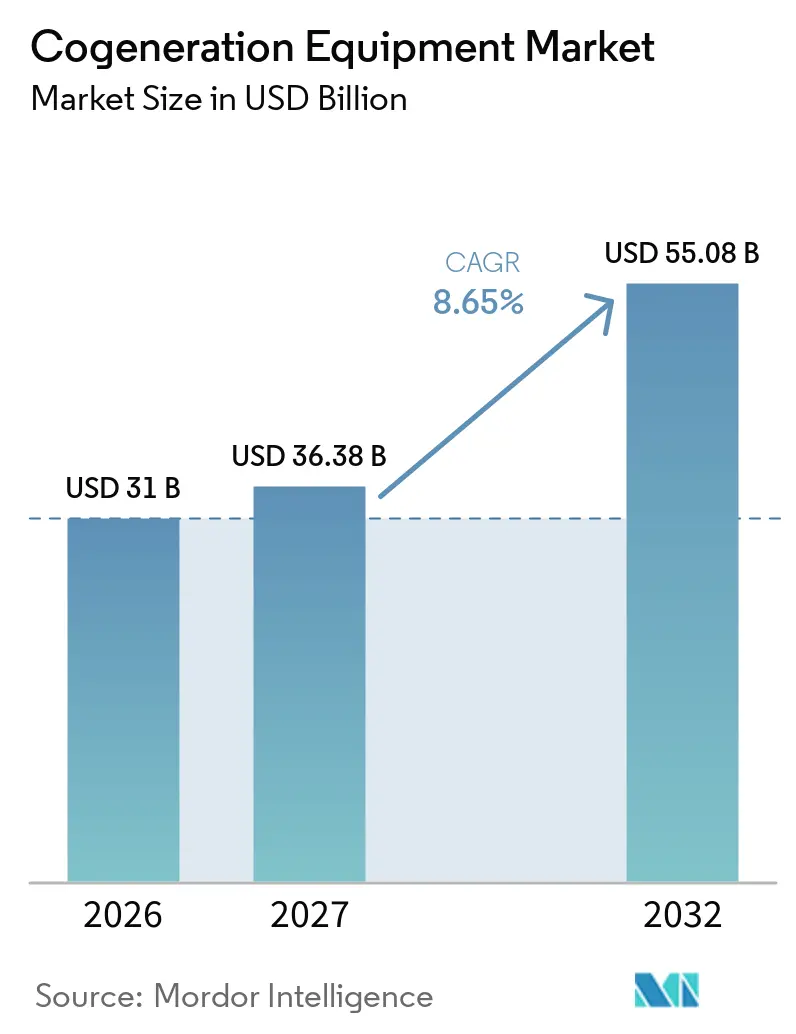
The cogeneration equipment market size was valued at USD 31 billion in 2026 and is estimated to grow from USD 36.38 billion in 2027 to reach USD 55.08 billion by 2032, at a CAGR of 8.65% during the forecast period (2027-2032). Cogeneration systems recover heat that conventional generation would otherwise release, allowing facilities to use fuel for electricity and thermal loads together. This operating model supports demand where industrial tariffs and carbon compliance costs aff Doosan Fuel Cell showcased its PureCell Model 400, a 460 kW compact phosphoric acid fuel cell system fect energy decisions. The cogeneration equipment market also benefits when industrial sites need dependable on-site power and process heat at the same time. Equipment suppliers are increasingly competing on fuel flexibility, service coverage, and the ability to support distributed installations. Long development timelines for permits and grid connections remain a constraint, particularly for projects that require coordination with several authorities.
Key Report Takeaways
- By technology, reciprocating engines held 40.3% of the cogeneration equipment market share in 2026, while fuel cells are projected to record the highest CAGR at 10.7% through 2032.
- By capacity, the 1 MW to 10 MW range accounted for 29.4% of the cogeneration equipment market size in 2026, while the up to 50 kW range is forecast to grow at a 9.1% CAGR through 2032.
- By end user, industrial users held 49.3% revenue share in 2026, while utilities and district energy operators are projected to record the highest CAGR at 8.9% through 2032.
- By geography, Asia-Pacific held 41.2% revenue share in 2026, while the Middle East and Africa is forecast to grow at a 9.3% CAGR through 2032.
Note: Market numbers in this report are based on Mordor Intelligence's proprietary estimation framework, which combines nine months of actuals with Q4 projections for base year 2026.
Global Cogeneration Equipment Market Trends and Insights
Drivers Impact Analysis*
| Driver | (~) % Impact on CAGR Forecast | Geographic Relevance | Impact Timeline |
|---|---|---|---|
| Industrial Energy Efficiency and Operating Cost Pressure | +1.8% | Global | Medium term (2-4 years) |
| Rising Industrial and Commercial Electricity and Thermal Energy Demand | +1.5% | APAC core, spillover to MEA and South America | Medium term (2-4 years) |
| Grid Resilience and Distributed Generation Requirements | +1.3% | North America and EU | Short term (≤ 2 years) |
| Energy Transition Policies and Emissions Reduction Mandates | +1.0% | EU, global | Long term (≥ 4 years) |
| Data Center Load Growth and Grid Interconnection Bottlenecks | +1.2% | North America, with early spillover to EU and APAC | Short term (≤ 2 years) |
| Hydrogen, Biogas, and Renewable Gas Compatibility | +0.7% | Europe, APAC | Long term (≥ 4 years) |
| Source: Mordor Intelligence | |||
Industrial Energy Efficiency and Operating Cost Pressure
Industrial facilities can reduce energy costs by using heat and power from the same fuel input, especially where operations have steady thermal demand. Combined Heat and Power (CHP) systems can recover heat from electricity generation for process use, reducing the need for separate boilers and grid purchases.[1] The EU Energy Efficiency Directive requires cost-benefit assessments for new or substantially refurbished thermal installations above 20 MW.[2] The directive also sets an EU final energy consumption reduction target of 11.7% by 2030. Facilities in chemicals, cement, and refining can use this configuration because their heat and electricity loads often operate in parallel. India’s Carbon Credit Trading Scheme notified greenhouse gas emission intensity targets for 490 entities across 7 energy-intensive sectors between October 2025 and January 2026.[3]
Data Center Load Growth and Grid Interconnection Bottlenecks
Data centers are evaluating on-site generation when grid connection timelines delay new capacity. Bloom Energy delivered a solid oxide fuel cell system to Oracle in 55 days, faster than its standard 90-day schedule.[4] In April 2026, Bloom Energy and Oracle expanded their arrangement to deploy up to 2.8 GW of fuel cell capacity. The agreement included an initial 1.2 GW of contracted capacity across Oracle sites. This demand gives fuel-cell suppliers a route into facilities that need firm power without waiting for new utility infrastructure. The cogeneration equipment market may therefore see more interest in modular systems that can be installed alongside critical computing loads.
Energy Transition Policies and Emissions Reduction Mandates
Policy support can improve the investment case for plants that supply electricity and useful heat together. Germany's Kraft-Wärme-Kopplungsgesetz (KWKG) 2025 amendment took effect on April 1, 2025, and extended support eligibility beyond December 2026 for qualifying projects. Projects could retain eligibility when permits or binding commissioning orders were in place by the end of 2026. The amendment also introduced a limit of 270 g CO₂ per kWh for new plants. These rules provide a clearer basis for developers that link Combined Heat and Power (CHP) assets with heat networks and thermal storage. India’s efficiency obligations broaden the group of industrial sites that must address emissions intensity, supporting consideration of CHP equipment.
Hydrogen, Biogas, and Renewable Gas Compatibility
Fuel flexibility is becoming more relevant as operators assess the useful life of natural-gas assets. Clarke Energy reported a 1.4 GW installed biogas base, showing the existing scale of generation using agricultural and waste-based fuel streams. Biogas can support projects where an operator has a local waste stream and a continuing thermal demand. Equipment that accepts different gaseous fuels can reduce concerns that an asset will become unsuitable as emissions rules tighten. This capability matters to refineries and food processors that consider fuel choices in ownership-cost evaluations. The cogeneration equipment market is likely to reward suppliers that can combine proven performance with clear fuel conversion options.
Restraints Impact Analysis*
| Restraint | (~) % Impact on CAGR Forecast | Geographic Relevance | Impact Timeline |
|---|---|---|---|
| High Upfront Capital and Long Payback Periods | -1.2% | Global, acute in MEA and South America | Medium term (2-4 years) |
| Grid Interconnection and Permitting Complexity | -0.8% | North America and EU | Short term (≤ 2 years) |
| Thermal Load Mismatch and Heat Dumping Risk | -0.5% | Global | Medium term (2-4 years) |
| Fuel Quality, Critical Component, and Specialized Service Constraints | -0.4% | MEA and South America | Long term (≥ 4 years) |
| Source: Mordor Intelligence | |||
High Upfront Capital and Long Payback Periods
Installed costs for reciprocating-engine and gas-turbine Combined Heat and Power (CHP) systems can reach USD 1,500 to USD 3,000 per kW. This level of capital spending can deter facilities that lack long-term project finance or green lending access. Corporate buyers may favor projects with shorter payback periods, even when CHP can deliver benefits over a longer operating life. The financing issue is more pronounced in regions without mature energy-service company structures. Warranty and maintenance arrangements can also raise expected ownership costs for developers. Energy-as-a-service models can reduce the initial burden, but these arrangements remain less established outside North America and Western Europe.
Grid Interconnection and Permitting Complexity
Grid connection procedures can delay projects after a facility has approved an investment. The process may require reviews by utilities, environmental agencies, and building-code authorities. Combustion-based systems can also require separate permits for nitrogen oxides and carbon dioxide. These requirements create a larger burden for smaller buyers because regulatory costs do not decline in line with unit size. The constraint can affect demand for smaller systems in the up to 50 kW and 50 kW to 500 kW ranges. As a result, practical deployment timing can depend as much on local administration as on equipment performance.
*Our forecasts treat driver/restraint impacts as directional, not additive. The impact forecasts reflect baseline growth, mix effects, and variable interactions.
Segment Analysis
By Technology: Reciprocating Engines Hold the Largest Position, While Fuel Cells Grow Fastest
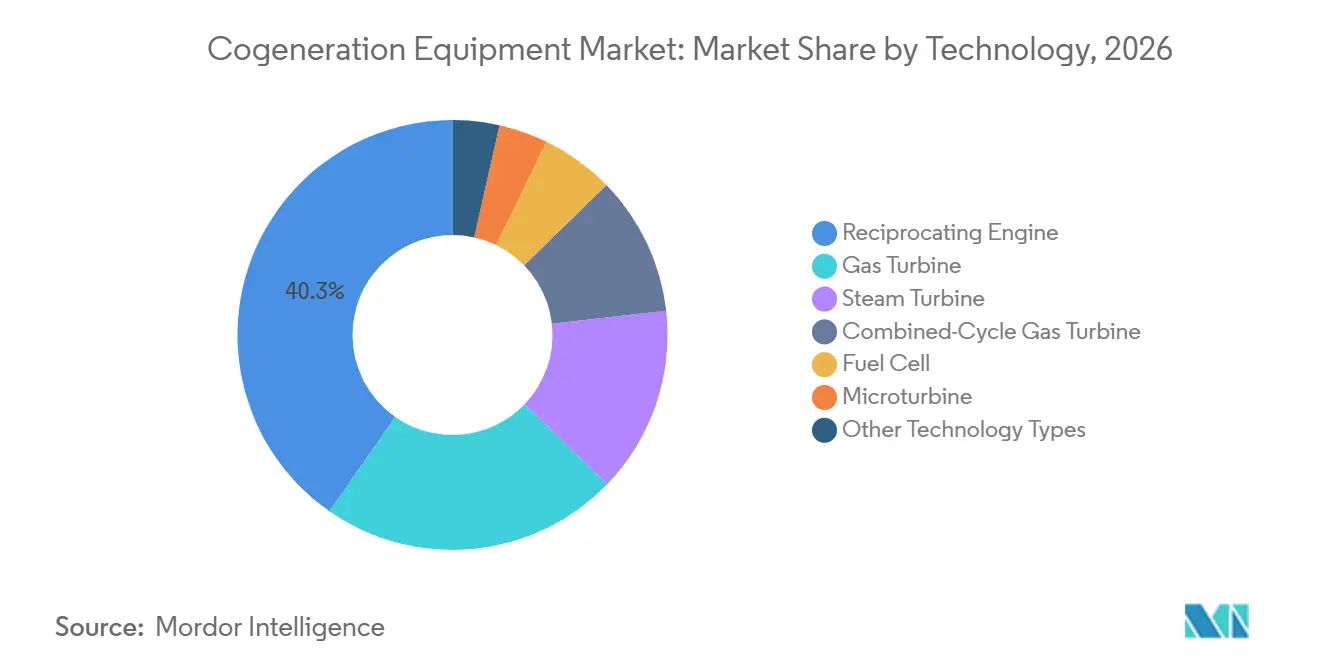
Reciprocating engines held 40.3% of the technology segment in 2026. Their installed base spans pulp and paper facilities, chemical complexes, food processors, and hospital campuses with consistent load profiles. The equipment can be supplied in modular blocks from 500 kW to 20 MW. This modularity allows operators to stage investment across greenfield projects and existing site expansions. It also helps facilities align generating capacity with available heat-recovery infrastructure. The technology remains relevant for industrial loads below 50 MW because the equipment has a well-established operating record.
Fuel cells are forecast to grow at a 10.7% CAGR from 2027 to 2032. Bloom Energy’s April 2026 Oracle agreement covers deployment of up to 2.8 GW of solid oxide fuel cell capacity. The company reported an initial 1.2 GW commitment under the arrangement. Fuel cells avoid combustion at the point of use, which can help projects near urban air-quality restrictions. Gas turbines continue to serve larger industrial and utility applications, particularly above 50 MW. Steam turbines retain use in refining and petrochemicals where surplus steam is available. Microturbines remain relevant for remote and commercial applications that value lower maintenance requirements and biogas compatibility.

By Capacity: The 1 MW to 10 MW Range Leads Revenue, While Micro-CHP Expands
The 1 MW to 10 MW band represented 29.4% of the cogeneration equipment market size by capacity in 2026. This range serves facilities whose heat and power needs justify CHP but do not require utility-scale financing. It includes many chemical, food-processing, textile, and pharmaceutical sites. Heat-recovery steam generators in these facilities can provide steam for process lines. The capacity range also suits users that want phased development rather than a single large installation. Its broad fit across mid-scale users supports its leading position within the cogeneration equipment industry.
The up to 50 kW category is forecast to expand at a 9.1% CAGR from 2027 to 2032. Demand is linked to commercial buildings, district-energy nodes, and residential clusters. Smaller units can combine into distributed capacity across a campus or local network. Doosan Fuel Cell showcased its PureCell Model 400, a 400 kW compact phosphoric acid fuel cell system, at CES 2026 through its U.S. subsidiary HyAxiom. The 50 kW to 500 kW band supports commercial and light-industrial users that need on-site generation. The 500 kW to 1 MW range often serves food-processing clusters and multi-building campuses. Capacity tiers from 10 MW to 50 MW and above 50 MW remain more closely associated with turbines and combined-cycle systems for utilities and large industrial sites.
By End User: Industrial Sites Lead Revenue, While Utilities and District Energy Grow Fastest
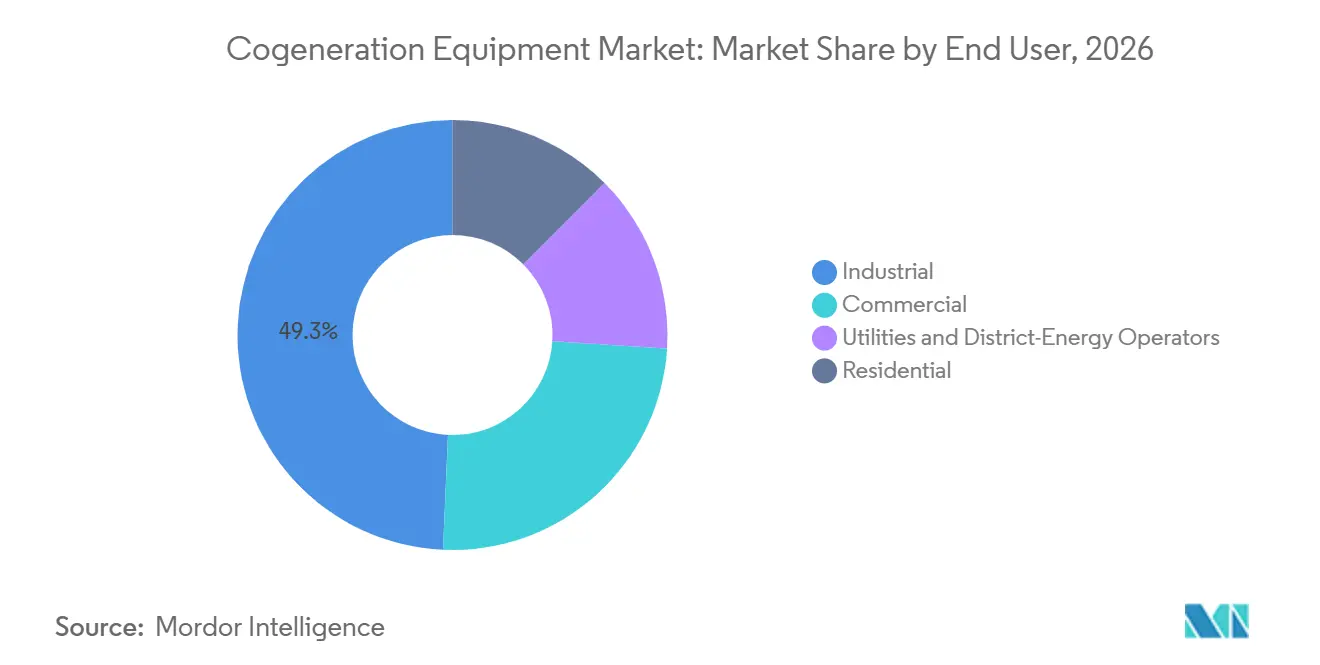
Industrial users held 49.3% of the end-user segment in 2026. Chemicals, refining, pulp and paper, and cement require electricity and heat during long production cycles. These sectors can operate for more than 7,000 hours each year. High operating hours can improve the financial case for recovering heat at the production site. This user group also has steady thermal demand that supports equipment utilization. The industrial base therefore provides a consistent source of demand for the cogeneration equipment market.
Utilities and district-energy operators are forecast to grow at an 8.9% CAGR through 2032. Their demand is linked to heat networks that seek higher shares of renewable and recovered heat. This application supports larger CHP systems that can provide dispatchable output alongside thermal supply. Commercial users, including hospitals, data centers, universities, and hotels, also value on-site energy resilience. Residential adoption remains smaller globally but continues in Japan, Germany, and the Netherlands. Feed-in structures and established gas networks support micro-CHP use in multifamily buildings. The end-user mix gives suppliers opportunities to serve both centralized heat systems and individual facilities.
Geography Analysis
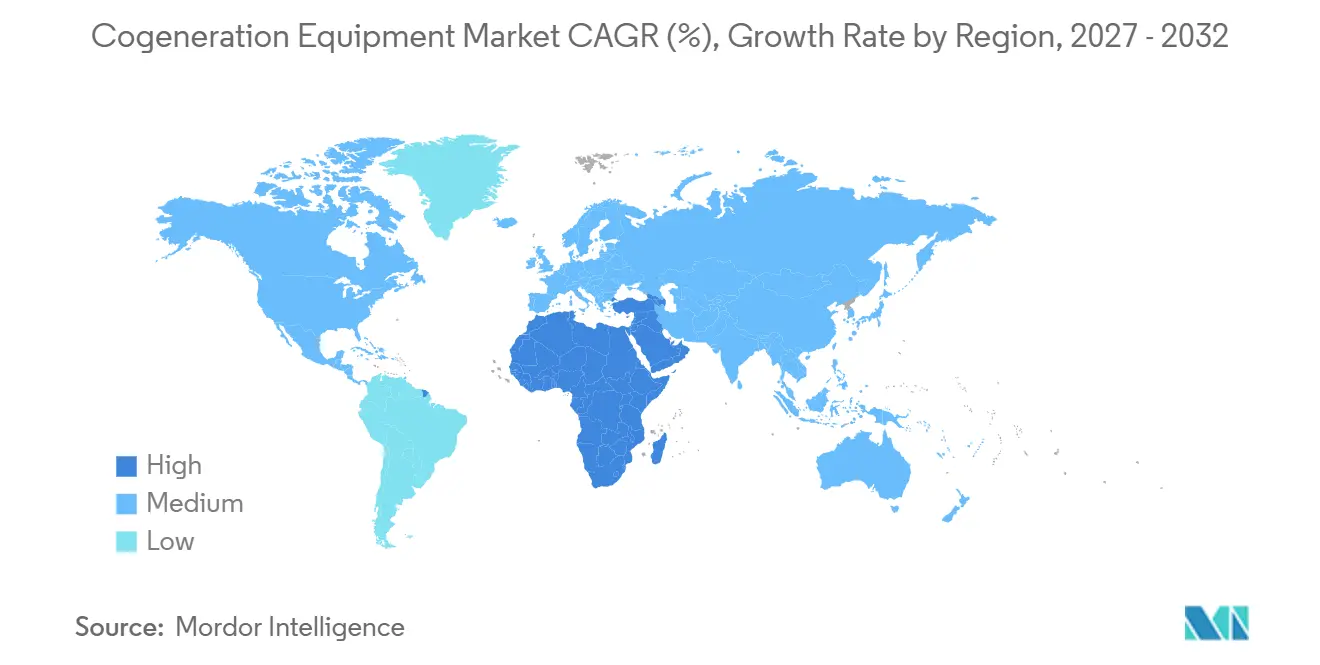
Asia-Pacific held 41.2% of global revenue in 2026. China’s CHP base is concentrated in chemicals, steel, and district heating. Tighter nitrogen oxides limits encourage replacement of coal-fired boilers with gas-fired CHP systems. India is expanding CHP use across textiles, pharmaceuticals, and food processing. The Carbon Credit Trading Scheme notified greenhouse gas intensity targets for 490 entities in 7 energy-intensive sectors. These obligations increase the importance of energy-efficiency investments at covered sites. Vietnam, Thailand, and Indonesia use biomass and natural-gas CHP in sugar, palm oil, and cement operations.
Europe and North America form the second major demand block for the cogeneration equipment market. Europe has a high share of replacement and upgrade work, supported by district-heating infrastructure. Germany's Combined Heat and Power Act (KWKG) 2025 amendment extended eligibility for qualifying CHP projects beyond 2026.[5] In March 2026, Atlas Energy Solutions agreed to purchase 1.4 GW of natural-gas reciprocating generator sets from Caterpillar for USD 840 million.[6] In April 2026, ProPetro’s PROPWR unit entered a framework agreement with Caterpillar for up to 2.1 GW of generation assets through 2031. Brazil also received a 371 MW Wärtsilä order for flexible generation capacity in 2026.
The Middle East and Africa is forecast to grow at a 9.3% CAGR from 2027 to 2032. Gulf industrial corridors are assessing captive CHP systems as governments reform subsidies and apply efficiency targets. Petrochemical and desalination users have substantial and concurrent power and thermal requirements. In July 2026, Clarke Energy secured a contract for a 4 MW natural-gas trigeneration plant at Capraci’s pasta facility in Abidjan. The system will recover exhaust heat at 130 °C for processing and produce chilled water at 11 °C through an absorption chiller. A 2026 scientific study found that photovoltaic thermal (PVT)-based cogeneration systems in rural MENA settings can produce 9 kW to 55 kW of electricity and 18 kW to 143 kW of thermal energy. The study also reported freshwater output of 8 m³ to 14 m³ per day.
Competitive Landscape
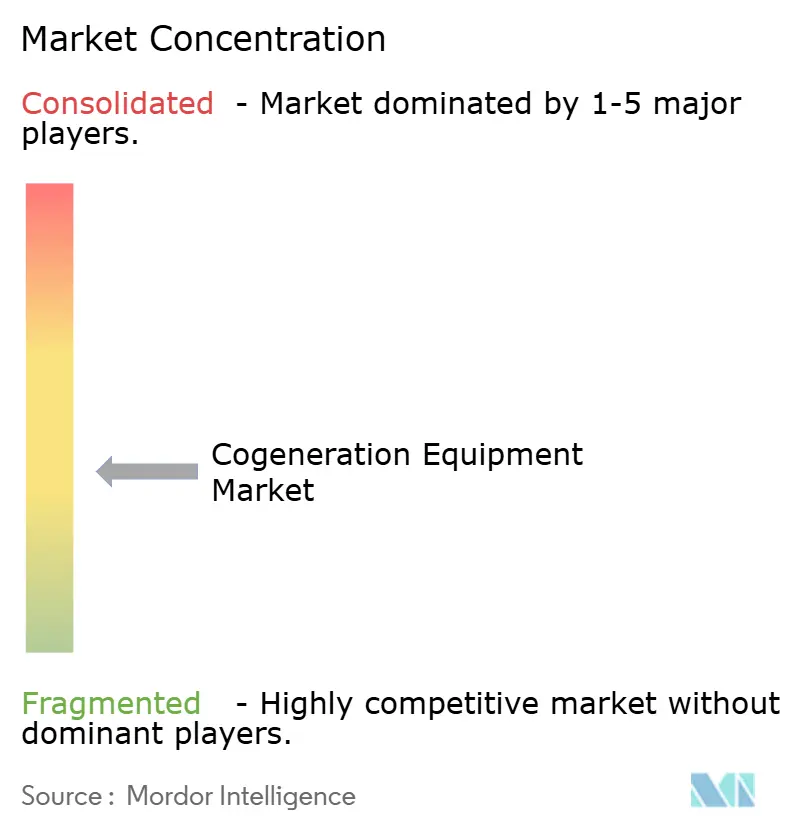
The global cogeneration equipment market includes large equipment manufacturers and regional technology specialists. Caterpillar, GE Vernova, Siemens Energy, Bloom Energy, and Mitsubishi Heavy Industries compete across different equipment types. Suppliers such as INNIO Group, Wärtsilä, MAN Energy Solutions, 2G Energy, Yanmar, Tedom, and BDR Thermea have focused positions in selected technologies or regions. Competition in the cogeneration equipment market increasingly centers on fuel flexibility, hydrogen readiness, and ongoing operations and maintenance support. Equipment reliability remains important because buyers require continuous heat and power at critical sites. The cogeneration equipment market also rewards suppliers that can match equipment design with a customer’s fuel, thermal, and service requirements.
Wärtsilä combined equipment supply with a 10-year operations and maintenance agreement for its 452 MW Pecos, Texas project. This approach gives the supplier an ongoing operating role after commissioning. Bloom Energy’s expanded agreement with Oracle places solid oxide fuel cells within planned power infrastructure for major computing capacity. It also shows how a supplier can use a master agreement rather than a single equipment order. Siemens Energy secured contracts for 6 F-class gas turbines and 20-year service agreements for projects in Oman totaling 2.6 GW. These contracts show the value of long service arrangements for large power projects.
Smaller industrial and commercial installations below 500 kW remain an important opening for turnkey providers. These projects sit between the economics of large turbines and residential micro-CHP systems. Suppliers that package equipment, installation, and service can reduce complexity for buyers with limited technical resources. Trigeneration systems that connect heat recovery with absorption chillers are another area of focus. Such systems can supply electricity, heat, and cooling where a site has demand for all 3 outputs. The 4 MW Capraci project in Côte d’Ivoire combines engine generation, 130 °C process heat, and 11 °C chilled water. This type of installation highlights the role of integrated thermal design in competitive offerings.
Cogeneration Equipment Industry Leaders
-
Caterpillar Inc.
-
GE Vernova, Inc.
-
Siemens Energy AG
-
Bloom Energy Corporation
-
Mitsubishi Heavy Industries Ltd.
- *Disclaimer: Major Players sorted in no particular order
Recent Industry Developments
- July 2026: Clarke Energy, a Rehlko company, secured a contract to deliver a 4 MW natural gas-fired trigeneration plant for Capraci's pasta manufacturing facility in Abidjan, Côte d'Ivoire. The facility utilizes INNIO Jenbacher gas engine technology to simultaneously produce electricity, 130°C process heat, and 11°C chilled water from a single fuel source, improving overall energy efficiency and reliability.
- June 2026: Siemens Energy AG announced contracts to supply power generation equipment and 20-year service agreements for the Misfah and Duqm Independent Power Producer (IPP) projects in Oman, which will add nearly 2.6 GW of combined-cycle power generation capacity to the country's electricity network. The two plants are expected to increase Oman's total power generation capacity by almost 20% and provide electricity for more than 2 million people. Siemens Energy's scope includes the delivery of six SGT5-4000F gas turbines, six SGen5-2000P generators, and long-term maintenance services, with the equipment manufactured in Germany.
- May 2026: Wärtsilä signed two equipment supply contracts with Origem Energia to support the development of 371 MW of balancing power projects in Brazil, supplying a total of 36 Wärtsilä 34SG natural gas engines across multiple power plants. The projects, awarded under Brazil's Reserve Capacity Auction 2026 (LRCAP), include the Pilar and Pilar Nova power plants scheduled to begin operations in October 2028, and the Manguaba I-V projects expected to commence operations in August 2029.
- April 2026: Bloom Energy and Oracle expanded their strategic partnership through a master services agreement under which Oracle intends to procure up to 2.8 GW of Bloom Energy fuel cell capacity to support the expansion of its AI and cloud computing infrastructure. An initial 1.2 GW has been contracted, with deployments underway across Oracle projects in the United States and continuing into the following year. Bloom Energy's solid oxide fuel cell systems provide reliable, on-site power capable of supporting high-density AI workloads, enabling faster deployment than traditional grid infrastructure while reducing project risks.
Global Cogeneration Equipment Market Report Scope
Cogeneration equipment refers to a set of machinery, such as turbines, engines, and heat recovery systems, used to simultaneously produce electricity and useful thermal energy from a single fuel source. Also known as Combined Heat and Power (CHP) systems, this equipment captures the byproduct heat that conventional power plants typically discard into the environment. By utilizing this heat for industrial processes, space heating, or hot water, the equipment operates at higher efficiency levels than conventional standalone power systems.
The global cogeneration equipment market is segmented by technology into reciprocating engines, gas turbines, steam turbines, and others. By capacity, the market is segmented into up to 50 kW, 50 kW to 500 kW, 500 kW to 1 MW, 1 MW to 10 MW, 10 MW to 50 MW, and more than 50 MW. By end user, the market is segmented into industrial, commercial, residential, and utilities & district-energy operators. The report also covers the market size and forecasts for the global cogeneration equipment market across 26 countries in key regions. For each segment, the market sizing and forecasts have been provided on the basis of value (USD).
| Reciprocating Engine |
| Gas Turbine |
| Steam Turbine |
| Combined-Cycle Gas Turbine |
| Fuel Cell |
| Microturbine |
| Other Technology Types |
| Up to 50 kW |
| 50 kW to 500 kW |
| 500 kW to 1 MW |
| 1 MW to 10 MW |
| 10 MW to 50 MW |
| More Than 50 MW |
| Industrial |
| Commercial |
| Residential |
| Utilities and District-Energy Operators |
| North America | United States |
| Canada | |
| Mexico | |
| Europe | Germany |
| France | |
| Italy | |
| Spain | |
| United Kingdom | |
| Poland | |
| Russia | |
| Rest of Europe | |
| Asia-Pacific | China |
| India | |
| Japan | |
| South Korea | |
| Australia | |
| Indonesia | |
| Vietnam | |
| Thailand | |
| Rest of Asia-Pacific | |
| South America | Brazil |
| Argentina | |
| Chile | |
| Rest of South America | |
| Middle East and Africa | Saudi Arabia |
| United Arab Emirates | |
| Egypt | |
| South Africa | |
| Morocco | |
| Rest of Middle East and Africa |
| By Technology | Reciprocating Engine | |
| Gas Turbine | ||
| Steam Turbine | ||
| Combined-Cycle Gas Turbine | ||
| Fuel Cell | ||
| Microturbine | ||
| Other Technology Types | ||
| By Capacity | Up to 50 kW | |
| 50 kW to 500 kW | ||
| 500 kW to 1 MW | ||
| 1 MW to 10 MW | ||
| 10 MW to 50 MW | ||
| More Than 50 MW | ||
| By End User | Industrial | |
| Commercial | ||
| Residential | ||
| Utilities and District-Energy Operators | ||
| By Geography | North America | United States |
| Canada | ||
| Mexico | ||
| Europe | Germany | |
| France | ||
| Italy | ||
| Spain | ||
| United Kingdom | ||
| Poland | ||
| Russia | ||
| Rest of Europe | ||
| Asia-Pacific | China | |
| India | ||
| Japan | ||
| South Korea | ||
| Australia | ||
| Indonesia | ||
| Vietnam | ||
| Thailand | ||
| Rest of Asia-Pacific | ||
| South America | Brazil | |
| Argentina | ||
| Chile | ||
| Rest of South America | ||
| Middle East and Africa | Saudi Arabia | |
| United Arab Emirates | ||
| Egypt | ||
| South Africa | ||
| Morocco | ||
| Rest of Middle East and Africa | ||
Key Questions Answered in the Report
What is the projected size of the cogeneration equipment market by 2032?
The cogeneration equipment market is projected to reach USD 55.08 billion by 2032, growing at an 8.65% CAGR from 2027.
What is driving demand for cogeneration equipment?
Demand is supported by industrial energy efficiency, grid resilience, rising thermal and electricity needs, and emissions policies that encourage efficient heat supply.
Which technology is growing fastest in cogeneration equipment?
Fuel cells are forecast to grow at a 10.7% CAGR through 2032. Their role is expanding where customers need on-site power and lower point-of-use emissions.
Which capacity range leads cogeneration equipment revenue?
The 1 MW to 10 MW range held a 29.4% share of capacity-segment revenue in 2026. This range serves mid-scale facilities that need both process heat and power.
Which end user has the largest demand for cogeneration equipment?
Industrial users held a 49.3% share in 2026 because manufacturing sites need electricity and process heat together. Their long operating hours can support higher equipment utilization.