
Code Signing Market Size and Share
Market Overview
| Study Period | 2020 - 2031 |
|---|---|
| Market Size (2026) | USD 408.70 Million |
| Market Size (2031) | USD 888.73 Million |
| Growth Rate (2026 - 2031) | 16.81 % |
| Fastest Growing Market | North America |
| Largest Market | Asia-Pacific |
| Market Concentration | Medium |
Major Players *Disclaimer: Major Players sorted in no particular order Image © Mordor Intelligence. Reuse requires attribution under CC BY 4.0. | |
Code Signing Market Analysis by Mordor Intelligence
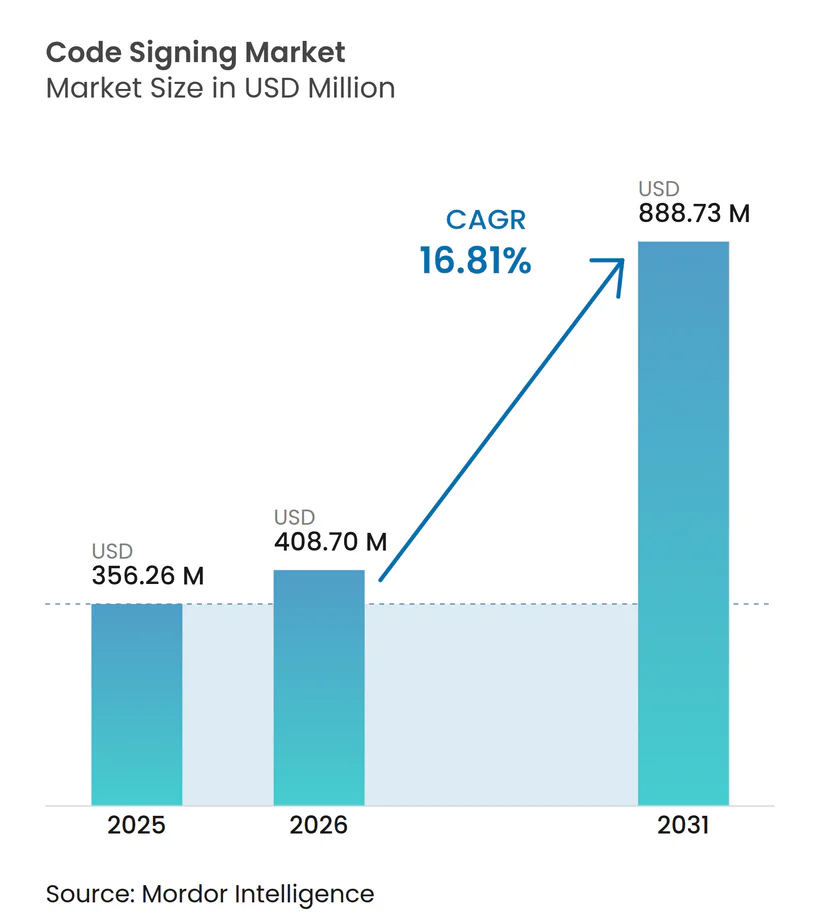
The code signing market size is projected to expand from USD 356.26 million in 2025 to USD 408.70 million in 2026, and to USD 888.73 million by 2031, registering a CAGR of 16.81% from 2026 to 2031. Federal procurement rules, European product-security requirements, and shorter certificate lifecycles are moving signing from a discretionary security control to an operating requirement. The code signing market is also benefiting from the broader adoption of cloud-native delivery methods, which increases the number of releases requiring verified signatures. Providers are responding by pairing certificate issuance with lifecycle automation, hosted key management, and audit capabilities. This shift makes recurring services more important than one-time certificate purchases and creates room for platforms that fit directly into development workflows. High hardware costs and the ongoing risk of private-key compromise remain material barriers, especially for smaller publishers and organizations in regions with limited availability of cloud HSMs.
Key Report Takeaways
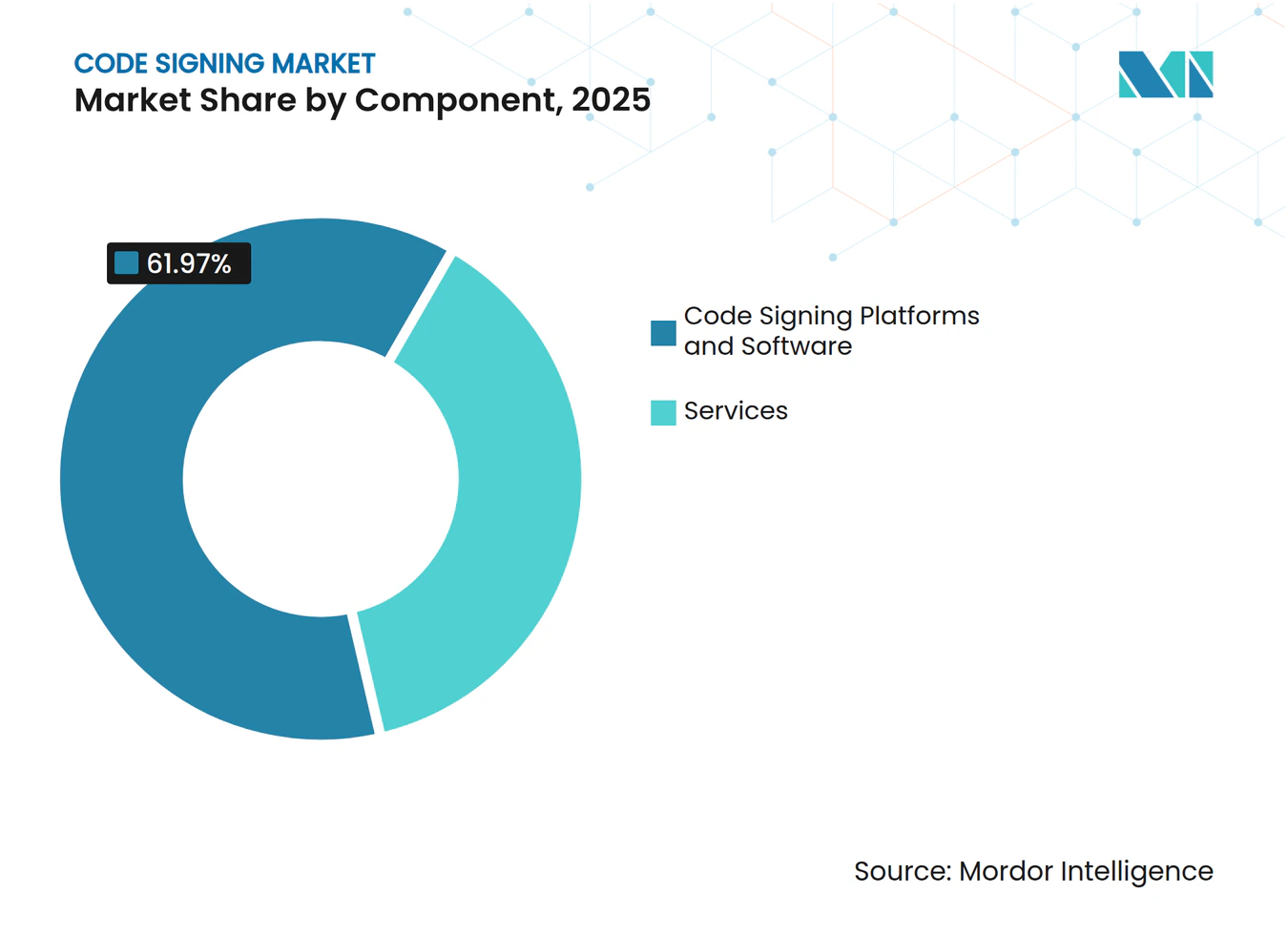
- By component, code signing platforms and software held 61.97% of the code signing market in 2025, while Services are projected to expand at a CAGR of 19.64% through 2031.
- By deployment mode, cloud-based deployment accounted for 63.84% of the code signing market in 2025 and is expected to expand at a CAGR of 18.93% through 2031.
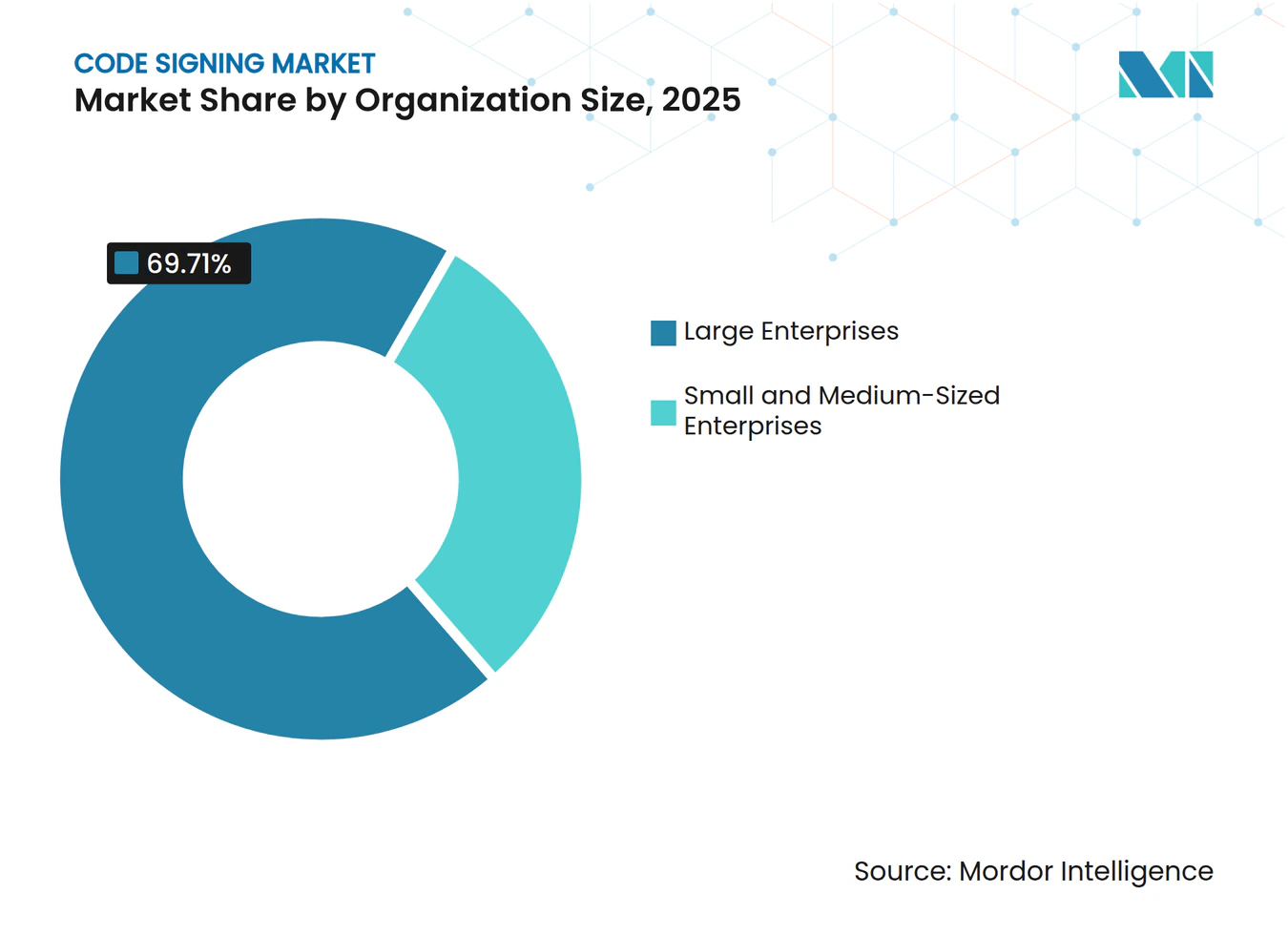
- By organization size, large enterprises held 69.71% of the code signing market in 2025, while small and medium-sized enterprises are projected to expand at a CAGR of 20.21% through 2031.
- By end user, information technology and telecommunications held 31.28% of the code signing market in 2025, while BFSI is projected to expand at a 19.76% CAGR through 2031.
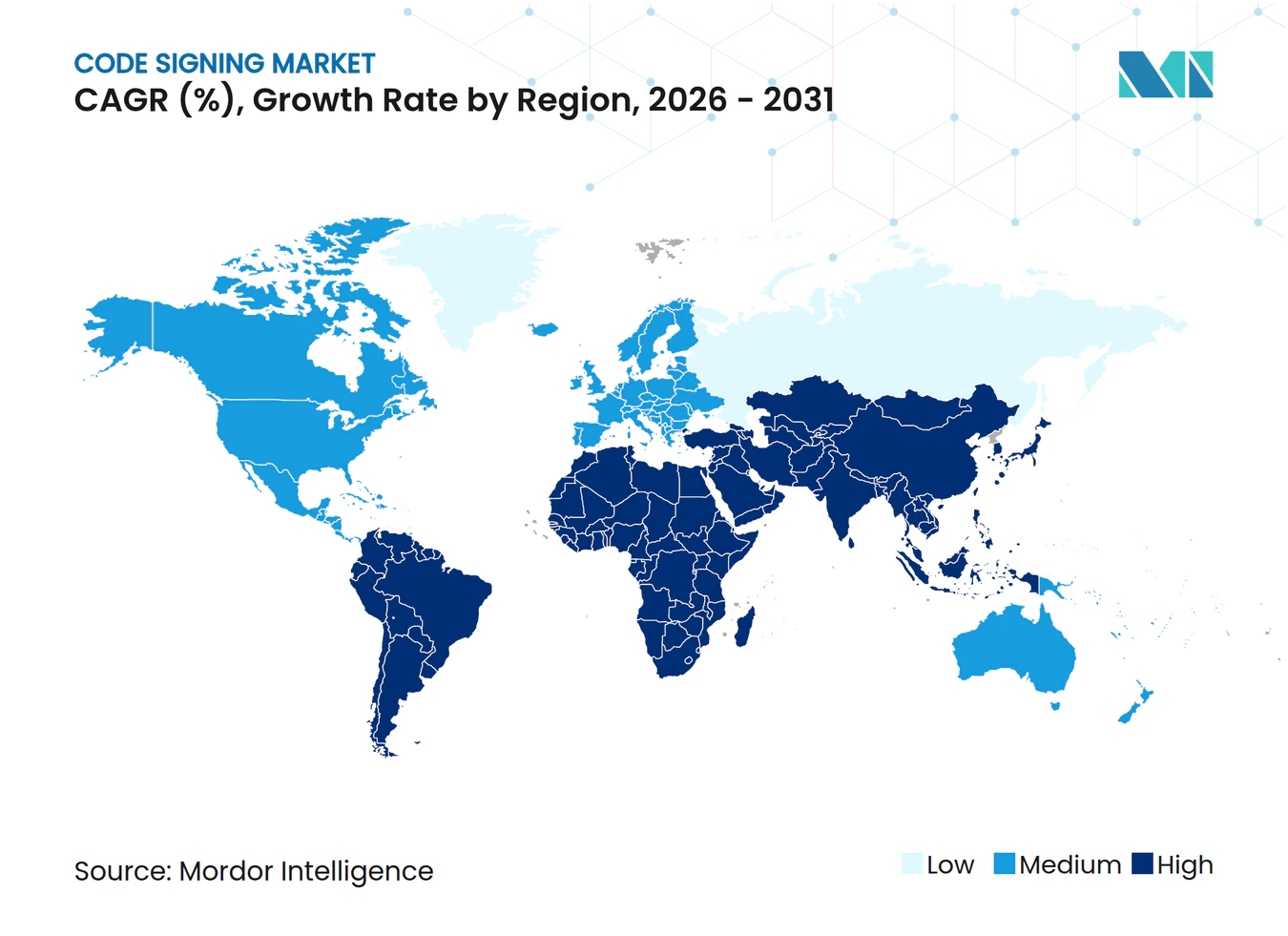
- By geography, North America held 34.71% of the code signing market in 2025, while Asia-Pacific is projected to expand at a CAGR of 21.86% through 2031.
Note: Market size and forecast figures in this report are generated using Mordor Intelligence’s proprietary estimation framework, updated with the latest available data and insights as of January 2026.
Market Trends and Insights
Drivers Impact Analysis of Code Signing Market*
| Driver | (~) % Impact on CAGR Forecast | Geographic Relevance | Impact Timeline |
|---|---|---|---|
| Software Supply-Chain Security Mandates | +5.2% | Global, with North America and EU leading | Short term (≤ 2 years) |
| DevSecOps and CI/CD Signing Automation | +3.9% | North America, Europe, APAC | Medium term (2-4 years) |
| Growth of Cloud-Native, Container and Edge Software Releases | +2.8% | North America, APAC | Medium term (2-4 years) |
| Connected-Device and Embedded-Firmware Integrity Requirements | +2.3% | APAC, North America, Europe | Long term (≥ 4 years) |
| Rising Trust Warnings and Publisher-Reputation Requirements | +1.6% | North America, Europe | Short term (≤ 2 years) |
| Shorter Certificate Validity and Recurring Rotation Demand | +1.3% | Global | Short term (≤ 2 years) |
| Source: Mordor Intelligence | |||
Software Supply-Chain Security Mandates
Federal procurement requirements and sector-specific obligations are creating sustained demand for the code signing market. NIST’s Secure Software Development Framework identifies signed artifacts as an integrity practice for software used by U.S. federal agencies. Executive Order 14144 directed the Federal Acquisition Regulation Council to incorporate secure software practices into procurement requirements in January 2025. The July 2026 FBI and CISA update stated that SBOM author signatures should use existing code-signing infrastructure.[1] These requirements extend beyond large federal contractors because suppliers serving state, municipal, and defense customers must also demonstrate reliable software provenance. The code signing market, therefore, serves both direct government suppliers and smaller vendors that need compatible controls to participate in public-sector procurement.
DevSecOps and CI/CD Signing Automation
High-velocity engineering teams increasingly need signing processes that do not interrupt release schedules. Sigstore’s Cosign supports keyless signing with short-lived OIDC-based certificates and integrates with common CI/CD environments.[2] This approach reduces reliance on long-lived private keys stored on developer workstations. AWS introduced Managed Signing in Amazon Elastic Container Registry in November 2025, embedding container-image signing into a cloud delivery workflow. The Code signing market gains when signing becomes a standard pipeline step rather than a manual task handled shortly before release. Subscription services become more relevant because teams need continuous integration, policy management, and renewal support across repeated releases.
Growth of Cloud-Native, Container and Edge Software Releases
Containers, microservices, and serverless functions increase the number of digital artifacts that need an authenticated origin. A single release can include container images, Helm charts, SBOMs, OCI artifacts, and related configuration files. The SLSA framework calls for provenance that can be verified and signed as software supply-chain assurance matures. Organizations running large Kubernetes estates can consequently generate many signing events during each release cycle. Remote edge environments also need verification methods that can operate without persistent cloud connectivity. The code signing market can address this need through architectures that distribute public keys in advance and through services that design governance for disconnected deployments.
Connected-Device and Embedded-Firmware Integrity Requirements
Connected products require trustworthy firmware updates throughout their operating lives. The EU Cyber Resilience Act, which entered into force in December 2024, requires manufacturers to address cybersecurity risks for products with digital elements. Its reporting obligations apply from September 2026, while the broader application date is December 2027. Manufacturers need protected signing keys, audit trails, and release workflows that can prevent a vulnerable build from being signed. Automotive and industrial-device producers also need long-duration key hierarchies that fit extended product lifecycles. These conditions support demand in the code signing market for managed key infrastructure and specialized implementation services.
Restraints Impact Analysis of Code Signing Market*
| Restraint | (~) % Impact on CAGR Forecast | Geographic Relevance | Impact Timeline |
|---|---|---|---|
| Private-Key Compromise and Malicious Signing Risk | -1.9% | Global | Short term (≤ 2 years) |
| Hardware-Backed Key Storage and HSM Cost Burden | -1.5% | APAC, South America, MEA | Medium term (2-4 years) |
| Complex Validation, Renewal and Reissuance Workflows | -1.0% | Global, SME-heavy markets | Medium term (2-4 years) |
| Legacy Build-Pipeline Integration and Developer Friction | -0.8% | North America, Europe | Long term (≥ 4 years) |
| Source: Mordor Intelligence | |||
Private-Key Compromise and Malicious Signing Risk
Private-key compromise can damage confidence in the code signing market because software signed with a stolen key can appear legitimate to recipients. The supplied incident record identified 14 confirmed compromises involving commercially significant publishers during 2025 and 5 further incidents during the first quarter of 2026. Code-signing requirements require subscribers to protect keys in compliant hardware or cloud services, but procedural declarations cannot independently prove every application-level control.[3] An organization can therefore meet certificate rules while still exposing a signing workflow to misuse. This risk raises the importance of policy enforcement, access control, monitoring, and rapid revocation procedures. It also makes buyers more cautious about treating a signature alone as a complete integrity guarantee.
Hardware-Backed Key Storage and HSM Cost Burden
Hardware-backed key storage can be costly for independent developers and small software publishers. A dedicated on-premises HSM appliance can exceed USD 36,000 before deployment, power, and maintenance costs. Cloud HSM options reduce the initial capital requirement but incur recurring charges for key management and signing operations. These charges can become significant for companies that sign large numbers of artifacts or operate several development environments. Limited local cloud-HSM availability and latency concerns make this issue more pronounced in South America and Middle East, and Africa. The code signing market must therefore offer accessible hosted options without imposing the same operational burden as dedicated hardware.
*Our forecasts treat driver/restraint impacts as directional, not additive. The impact forecasts reflect baseline growth, mix effects, and variable interactions.
Code Signing Market Segment Analysis
By Component:
Platform Dominance Masks a Services InflectionCode signing platforms and software held 61.97% of the code signing market share within the component segment in 2025. This position reflected the installed base of enterprise signing tools and certificate-authority platform licenses. Services are projected to record a CAGR of 19.64% through 2031. These services include managed signing, implementation consulting, lifecycle automation subscriptions, and support for key-management processes. The 460-day certificate validity requirement makes manual renewal processes harder to sustain. Organizations that previously managed occasional renewals now need more regular certificate rotation and workflow oversight.
The resulting change favors services that keep signing pipelines available without manual intervention. AppViewX’s Summer 2026 release extended certificate governance to agentic AI workflows, broadening the range of managed use cases. Vendors can combine signing orchestration, CI/CD integration, HSM management, and audit reporting into a single offering. This combination can support more durable customer relationships than certificate issuance alone. The code signing industry is therefore shifting part of its value toward ongoing lifecycle work. Platform products remain central, but service delivery is becoming more closely linked to reliable software release operations.


By Deployment Mode:
Cloud HSMs Establish a Structural LeadCloud-based deployment held 63.84% within the deployment segment in 2025. Its lead reflected the fit between hosted HSMs and CI/CD workflows that need scalable access to signing keys. Cloud deployment also removes physical token logistics from many software release processes. On-premises systems remain relevant in government, defense, and regulated financial institutions. These organizations may require data residency, sovereign key control, or continued use of dedicated HSM investments. Hybrid deployment offers another option for companies operating legacy build systems alongside cloud-native environments.
AWS launched Managed Signing in Amazon Elastic Container Registry in November 2025, reducing a major setup hurdle for cloud-native teams.[4] The service illustrates the direction of deployment in the code signing market, where signing capabilities are integrated into existing infrastructure. Cloud systems can support centralized policy enforcement while allowing development teams to sign at release speed. Hybrid arrangements can preserve established controls during gradual migration. The lack of an on-premises option with comparable operational simplicity gives hosted services a practical advantage for many organizations. Sovereignty needs and regulatory constraints will nevertheless preserve demand for local and mixed environments.
By Organization Size:
SME Growth Reshapes the Customer ProfileLarge enterprises accounted for 69.71% of the code signing market in the organization-size segment in 2025. Mature PKI programs, specialist security teams, and funding for HSMs supported this position. Small and Medium-Sized Enterprises are projected to expand at a CAGR of 20.21% through 2031. Operating-system requirements for signed binaries are extending governance expectations to independent developers and smaller publishers. These companies often need a simpler path to compliant signing than a full enterprise certificate-management program. Their requirements create demand for cloud subscriptions and developer-focused onboarding.
Microsoft’s trusted signing supports organization validation and targets smaller publishers with tiered service access. Keyfactor’s Signum offering also provides a signing-as-a-service approach designed for DevOps workflows.[5] Smaller organizations can generate substantial certificate volume even if their average contract value is lower than that of large enterprises. They are less likely to purchase comprehensive lifecycle management platforms at the outset. The code signing market is consequently attracting both certificate authorities and machine identity providers to the developer and mid-market segments. Ease of adoption, support quality, and workflow compatibility will shape competition for this customer base.

By End User:
BFSI Velocity Conceals Structural DiversificationInformation technology and telecommunications accounted for 31.28% of the end-user segment in 2025. The sector uses signing for software distribution, driver updates, container images, and device firmware. BFSI is projected to grow at a CAGR of 19.76% through 2031. The ASC X9 PKI activated its production root certificate authority in June 2025 for financial-sector uses, including payment networks, ATM authentication, and fintech applications. This sector-specific infrastructure expands the role of signing in financial workflows operating outside commercial browser-certificate constraints.
The healthcare and life sciences industry also requires cryptographic signing for clinical software and medical device firmware. ISO 17090-4:2026 sets requirements for digital signatures in healthcare documents, including cross-border certificate validation. Government and Public Administration organizations are expanding the use of software attestations and signed SBOM requirements. Retail and E-Commerce organizations have mobile application integrity needs, while Industrial Manufacturing organizations need protected industrial control system firmware. These use cases diversify the code signing market beyond its traditional software-publisher base. Each vertical brings distinct policies, operational systems, and audit requirements that can support specialized services.
Geography Analysis
North America Code Signing Market
North America accounted for 34.71% of the code signing market share in 2025. The region combines a high concentration of software development with a mature base of enterprise security buyers. U.S. procurement requirements have also raised the importance of signed artifacts for suppliers serving federal agencies. The United States accounts for much of the regional demand, as technology companies and large enterprises adopt centralized signing governance. Canada contributes through cross-border software exports and cybersecurity practices aligned with U.S. standards. The code signing market in North America also benefits from dense cloud-native development activity and established DevSecOps programs.
Europe and the Americas Code Signing Market
Europe is the second-largest geography in the supplied analysis. Germany, the United Kingdom, and France support demand through enterprise software activity, digital financial infrastructure, and the use of established PKI. Germany’s automotive manufacturing base needs secure signing for vehicle software and over-the-air firmware updates. These requirements can create specialized demand for embedded-firmware signing and long-duration key hierarchies. The Cyber Resilience Act provides a regional policy backdrop for manufacturers placing digitally enabled products on the EU market. South America remains smaller, with Brazil and Mexico supporting adoption through software exports and financial-sector digitalization.
APAC and MEA Code Signing Market
Asia-Pacific is projected to grow at a CAGR of 21.86% through 2031, the highest rate among the geographic segments. Rapid cloud adoption, government cybersecurity requirements, and expanding software-development activity support the region’s growth. India’s export-oriented software and IT services firms need signing practices that meet international buyers' requirements. China’s critical infrastructure security rules impose ongoing signing requirements for relevant software deployments. Japan and South Korea are investing in post-quantum-ready signing infrastructure, supporting demand for approved algorithm capabilities. Malaysia, Indonesia, and Thailand are expanding digital-government and fintech programs, which increases the relevance of managed signing services. Demand in the Middle East and Africa is concentrated in the United Arab Emirates and Saudi Arabia, driven by national digital transformation programs.
Competitive Landscape
Market Concentration
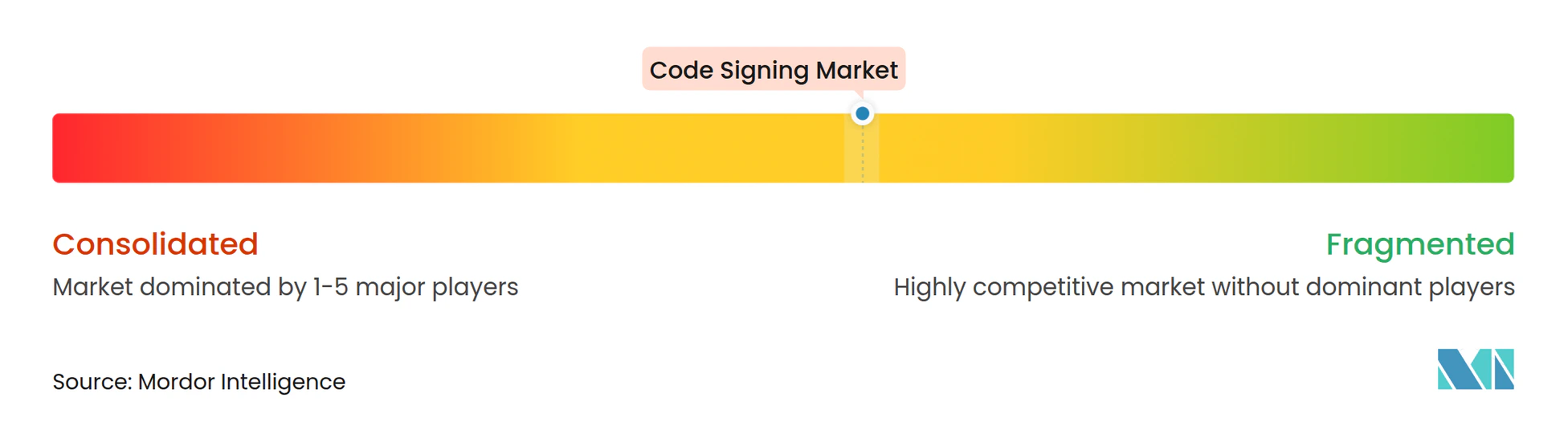
The code signing market is moderately concentrated, with a dual structure comprising certificate authorities and machine-identity management platforms. Certificate authorities compete through trust-store coverage, issuing capacity, and established customer relationships. Machine-identity platforms compete through lifecycle automation, policy management, and integration with development processes. The 460-day certificate validity limit raises the importance of renewal automation and audit-trail management. This requirement reduces the relative value of a long certificate term and places greater weight on operational support. Providers that connect issuance, key management, and governance can offer a more complete response to recurring lifecycle work.
Sectigo acquired Entrust’s public certificate business in January 2025. Sectigo subsequently completed the migration of more than 500,000 certificates to Sectigo Certificate Manager by September 2025. The transaction showed how certificate authorities can use consolidation to increase enterprise scale and strengthen automation capabilities. Keyfactor announced its intention to acquire Cofide in July 2026, extending its trust-control approach to workload and AI-agent identities.[6] AppViewX launched Agent Identity Security in June 2026, combining agent governance with its PKI capabilities. These actions show that major platforms are widening their scope beyond conventional certificate issuance.
CyberArk-Venafi introduced support for ML-DSA and SLH-DSA for post-quantum code signing in October 2024. This supports organizations that need to test post-quantum approaches alongside existing RSA workflows. Automotive firmware signing remains an area where long device lifecycles require specialized management of key hierarchies. Organizations moving toward post-quantum methods will also need to manage parallel signing environments during transition. These needs create room for vendors with strong cryptographic agility and implementation capabilities. The available information describes a moderate-to-high competitive environment, rather than a market led by a single provider. The concentration score is therefore based on the market’s multi-provider structure rather than unreported combined-share data.
Code Signing Industry Leaders
-
DigiCert, Inc.
-
Sectigo Limited
-
GlobalSign NV
-
SSL Corporation
-
Entrust Corporation
- *Disclaimer: Major Players sorted in no particular order
Code Signing Market Companies Covered in this Report
- DigiCert, Inc.
- Sectigo Limited
- GlobalSign NV
- SSL Corporation
- Entrust Corporation
- Asseco Data Systems S.A.
- IdenTrust, Inc.
- ACTALIS S.p.A.
- SwissSign AG
- HARICA S.A.
- Buypass AS
- WISeKey International Group AG
- Trustwave Holdings, Inc.
- Keyfactor, Inc.
- Venafi, Inc.
- Fortanix, Inc.
- AppViewX, Inc.
- SignPath GmbH
- Codemagic, Inc.
- Appdome Ltd.
- InfoCert S.p.A.
- Camerfirma S.A.
- Certigna SAS
- Intesi Group S.p.A.
- Ascertia Limited
Recent Industry Developments in Code Signing Market
- September 2026: Fujitsu entered a partnership with DigiCert to deliver implementation, integration, and managed services for the DigiCert ONE platform across Australia and New Zealand, extending automated certificate lifecycle management to Fujitsu's approximately 6,000 ANZ enterprise clients.
- August 2026: Microsoft published guidance on next-generation Windows code signing, confirming a transition to RSA-3072 and SHA-384 configurations by end-2026 and a planned shift to post-quantum signing defaults in 2027. Application vendors were advised to update certificate validation logic ahead of the Windows Production CA replacement coinciding with the PCA 2011 expiration in October 2026.
- July 2026: Keyfactor announced its intent to acquire UK-based Cofide, an open-standards workload identity platform issuing short-lived, cryptographic identities to cloud workloads and AI agents using SPIFFE, OAuth, and OIDC. The acquisition extends Keyfactor's Trust Control Plane from code signing and machine identity into AI-agent governance, positioning the company at the convergence of PKI infrastructure and autonomous workload security.
- June 2026: AppViewX launched Agent Identity Security, a product that discovers, governs, and monitors AI agents enterprise-wide using native PKI capabilities. The product integrates AI Bill of Materials management, posture assessment against NIST AI RMF and EU AI Act requirements, and adaptive, task-based access controls into AppViewX's existing code signing and certificate lifecycle management platform.
Global Code Signing Market Report Scope
The code signing market consists of certificate authorities and related tools that issue code signing certificates and enable developers to cryptographically sign software binaries, scripts, drivers, and updates. These certificates verify the publisher’s identity and ensure code integrity, helping to prevent tampering and malware distribution while meeting platform requirements set by vendors such as Microsoft, Apple, and Google.
The Code Signing Market Report is Segmented by Component (Code Signing Platforms and Software, and Services), Deployment Mode (Cloud-Based, On-Premises, and Hybrid), Organization Size (Large Enterprises, and Small and Medium Enterprises), End User (Information Technology and Telecommunications, Banking, Financial Services, and Insurance (BFSI), Healthcare and Life Sciences, Government and Public Administration, Retail and E-Commerce, Industrial Manufacturing, and Other End Users), and Geography (North America, South America, Europe, Asia-Pacific, and Middle East and Africa). The Market Forecasts are Provided in Terms of Value (USD).
Segmentation Overview
| Code Signing Platforms and Software |
| Services |
| Cloud-Based |
| On-Premises |
| Hybrid |
| Large Enterprises |
| Small and Medium Enterprises |
| Information Technology and Telecommunications |
| Banking, Financial Services, and Insurance (BFSI) |
| Healthcare and Life Sciences |
| Government and Public Administration |
| Retail and E-Commerce |
| Industrial Manufacturing |
| Other End Users |
| North America | United States | |
| Canada | ||
| South America | Brazil | |
| Mexico | ||
| Rest of South America | ||
| Europe | Germany | |
| United Kingdom | ||
| France | ||
| Italy | ||
| Rest of Europe | ||
| Asia-Pacific | China | |
| Japan | ||
| India | ||
| Rest of Asia-Pacific | ||
| Middle East and Africa | Middle East | United Arab Emirates |
| Saudi Arabia | ||
| Rest of Middle East | ||
| Africa | South Africa | |
| Rest of Africa | ||
| By Component | Code Signing Platforms and Software | ||
| Services | |||
| By Deployment Mode | Cloud-Based | ||
| On-Premises | |||
| Hybrid | |||
| By Organization Size | Large Enterprises | ||
| Small and Medium Enterprises | |||
| By End User | Information Technology and Telecommunications | ||
| Banking, Financial Services, and Insurance (BFSI) | |||
| Healthcare and Life Sciences | |||
| Government and Public Administration | |||
| Retail and E-Commerce | |||
| Industrial Manufacturing | |||
| Other End Users | |||
| By Geography | North America | United States | |
| Canada | |||
| South America | Brazil | ||
| Mexico | |||
| Rest of South America | |||
| Europe | Germany | ||
| United Kingdom | |||
| France | |||
| Italy | |||
| Rest of Europe | |||
| Asia-Pacific | China | ||
| Japan | |||
| India | |||
| Rest of Asia-Pacific | |||
| Middle East and Africa | Middle East | United Arab Emirates | |
| Saudi Arabia | |||
| Rest of Middle East | |||
| Africa | South Africa | ||
| Rest of Africa | |||
Key Questions Answered in the Report
What is the code signing market size?
The code signing market size is projected to be USD 356.26 million in 2025, USD 408.7 million in 2026, and reach USD 888.73 million by 2031, growing at a CAGR of 16.81% from 2026 to 2031.
What is driving demand for code signing services?
Federal procurement practices, EU product-security rules, CI/CD automation, and increased releases of cloud-native software are expanding demand.
Which code signing component is growing fastest?
Services are projected to grow at a CAGR of 19.64% through 2031 as organizations need managed signing and lifecycle automation.
Why are cloud-based code signing platforms widely used?
Cloud-Based deployment held 63.84% share in 2025 because it supports scalable signing within CI/CD workflows and reduces physical-token management.
Which region is expected to grow fastest for code signing?
Asia-Pacific is projected to grow at a CAGR of 21.86% through 2031, supported by cloud adoption and expanding software-development activity.
What can limit adoption of code signing solutions?
Private-key compromise risk and the cost of hardware-backed key storage can limit adoption, particularly among smaller publishers.