
Camera Link HS Interface Components Market Size and Share
Market Overview
| Study Period | 2020 - 2031 |
|---|---|
| Market Size (2026) | USD 0.99 Billion |
| Market Size (2031) | USD 1.60 Billion |
| Growth Rate (2026 - 2031) | 10.11 % |
| Fastest Growing Market | Asia-Pacific |
| Largest Market | Asia-Pacific |
| Market Concentration | Medium |
Major Players *Disclaimer: Major Players sorted in no particular order Image © Mordor Intelligence. Reuse requires attribution under CC BY 4.0. | |
Camera Link HS Interface Components Market Analysis by Mordor Intelligence
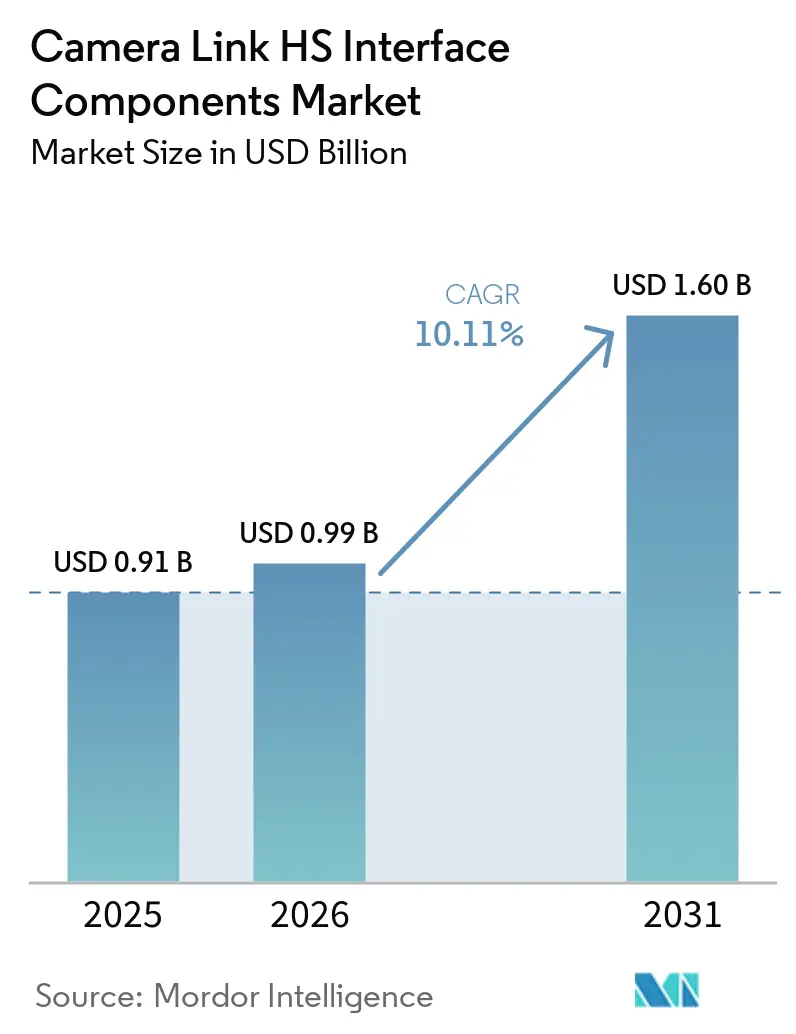
The Camera Link HS Interface Components Market size is projected to be USD 0.91 billion in 2025, USD 0.99 billion in 2026, and reach USD 1.60 billion by 2031, expanding at a CAGR of 10.11% from 2026 to 2031. The Camera Link HS Interface Components Market serves inspection systems that need high data throughput with predictable timing, particularly in semiconductor, electronics, scientific, and aerospace applications. Sensor resolution and frame rates are increasing the data-handling requirements of machine vision equipment, which is driving demand for fiber-based interfaces with controlled trigger timing. New fabrication plants and advanced packaging lines are also expanding the installed base of inspection equipment that uses high-bandwidth image acquisition. Suppliers are responding by combining cameras, frame grabbers, FPGA processing, and software tools in broader product offerings. Competition from CoaXPress and high-speed Ethernet is strongest where simple cabling and power delivery matter more than precise timing.
Key Report Takeaways
- By component type, CLHS cameras held 35.87% of the Camera Link HS Interface Components Market share in 2025, while CLHS FPGA IP cores and development kits are projected to expand at a 13.27% CAGR through 2031.
- By protocol, M Protocol accounted for 62.53% of revenue in 2025, while X Protocol is projected to advance at a 13.83% CAGR through 2031.
- By channel count, multi-channel configurations accounted for 48.67% of Camera Link HS Interface Components Market revenue in 2025 and are projected to grow at a 12.67% CAGR through 2031.
- By end-user industry, electronics and semiconductor manufacturers accounted for 28.73% of revenue in 2025, while aerospace and defense is projected to advance at a 12.91% CAGR through 2031.
- By geography, Asia-Pacific held 39.81% of the Camera Link HS Interface Components Market in 2026 and is projected to expand at a 12.47% CAGR through 2031.
Note: Market size and forecast figures in this report are generated using Mordor Intelligence’s proprietary estimation framework, updated with the latest available data and insights as of January 2026.
Global Camera Link HS Interface Components Market Trends and Insights
Drivers Impact Analysis*
| Driver | (~) % Impact on CAGR Forecast | Geographic Relevance | Impact Timeline |
|---|---|---|---|
| Rising Demand for High-Resolution, High-Frame-Rate Machine Vision | +3.5% | Global, with Asia-Pacific and North America as core demand centers | Short term (≤ 2 years) |
| Expansion of Semiconductor and Electronics Inspection | +2.8% | Asia-Pacific core, including Taiwan, South Korea, China, and Japan, with spillover to North America | Short term (≤ 2 years) |
| Growth of AI-Enabled Industrial Automation and Edge Processing | +2.0% | Global, concentrated in Asia-Pacific and Europe | Medium term (2-4 years) |
| Increasing Adoption of Deterministic, Low-Latency Imaging Links | +1.5% | Global, particularly high-precision sectors in North America and Europe | Medium term (2-4 years) |
| Radiation-Hard and Long-Reach Imaging Requirements in Aerospace and Defense | +0.8% | North America and Europe, with early gains in Middle East defense procurement | Long term (≥ 4 years) |
| Reusable Open CLHS IP Cores Lowering Design-In Barriers | +0.5% | Global, with rapid uptake among Asia-Pacific camera OEMs | Short term (≤ 2 years) |
| Source: Mordor Intelligence | |||
Rising Demand for High-Resolution, High-Frame-Rate Machine Vision
Camera sensors with smaller pixels and higher resolutions place greater strain on the interface between the sensor and the acquisition system. Parallel LVDS Camera Link systems become less practical when production environments require sustained high data transfer rates. Teledyne DALSA launched the Falcon4-CLHS M8200-Scientific in August 2026 with an 8,192 × 8,192 sensor, 2.5-micrometer pixels, and frame rates up to 65 fps. Its stated specifications demonstrate the throughput requirement for large-format imaging in life sciences and metrology. The Camera Link HS Interface Components Market benefits when users require predictable image transfer rather than only high bandwidth. CLHS packetization also allows the region of interest to vary from frame to frame, enabling a single camera to support varied inspection tasks on the same line. The standard’s GenICam and message protocol support helps system builders pair equipment from different vendors.[1]
Expansion of Semiconductor and Electronics Inspection
Semiconductor inspection equipment must identify smaller surface defects while maintaining the throughput needed in advanced manufacturing. Onto Innovation introduced the Dragonfly G5 inspection system in March 2026, with defect sensitivity down to 150 nm and throughput up to 5 times higher than predecessor tools. Advanced packaging, gate-all-around structures, and high-bandwidth memory stacks require wide image coverage and precise measurements. This supports the Camera Link HS Interface Components Market because camera and frame-grabber choices are often set when an inspection platform is designed. Equipment installed in fabrication plants can sustain demand for replacement components during its operating life. The Japan Industrial Imaging Association remains one of the organizations associated with the Camera Link HS standard, helping to raise its visibility among Japanese equipment suppliers. Chinese suppliers are also developing protocol stacks to reduce reliance on imported components.[2]
Growth of AI-Enabled Industrial Automation and Edge Processing
Image analysis is moving closer to the point of acquisition as users seek shorter decision times in automated inspection. Gidel’s FantoVision20-CL combines an NVIDIA Jetson Orin NX with an Altera Arria 10 FPGA and performs image preprocessing on the FPGA before passing data to the GPU. This design elevates the role of the frame grabber from data-transport hardware to an active processing component. It can increase the value of FPGA resources and firmware in the Camera Link HS Interface Components Market. A3 has made a VHDL IP core available for CLHS implementations, which lowers the development burden for specialized manufacturers. Cognex introduced the In-Sight 3900 in May 2026, featuring edge AI inference on Qualcomm hardware, illustrating the broader shift toward embedded vision analysis.
Increasing Adoption of Deterministic, Low-Latency Imaging Links
Some imaging applications require a predictable hardware trigger rather than timing that varies with network traffic. CLHS trigger Mode 1 supports latency below 1 microsecond with 0 nanosecond jitter, according to the standard’s technical description. Pulsed-beam facilities, free-electron lasers, and plasma research systems need tightly synchronized image capture. Teledyne DALSA CLHS cameras have been deployed at the SwissFEL X-ray free-electron laser at the Paul Scherrer Institute. Similar requirements apply to precision metrology systems that synchronize several cameras over long cable runs. CLHS v1.2 supports aggregate bandwidth of up to 100 Gbps via an MPO connector with 4 × 25 Gbps lanes. This provides a pathway to increase capacity without changing the full fiber installation.
Restraints Impact Analysis*
| Restraint | (~) % Impact on CAGR Forecast | Geographic Relevance | Impact Timeline |
|---|---|---|---|
| Migration to CoaXPress and High-Speed Ethernet Alternatives | -1.5% | Global, strongest in Asia-Pacific and Europe factory automation | Short term (≤ 2 years) |
| High System Integration and Validation Costs | -0.8% | Global, disproportionately affecting Southeast Asia and South America | Medium term (2-4 years) |
| Limited Availability of Native CLHS Cameras and Qualified Integrators | -0.5% | Emerging markets in Middle East and Africa and South America | Long term (≥ 4 years) |
| Interface Chipset Obsolescence and Specialized Firmware Dependency | -0.3% | Global, most acute for legacy M Protocol installations | Long term (≥ 4 years) |
| Source: Mordor Intelligence | |||
Migration to CoaXPress and High-Speed Ethernet Alternatives
CoaXPress v2.0 can aggregate up to 50 Gbps over 4 Micro-BNC connections and deliver power over the same coaxial cable. This can reduce installation work in factory environments that would otherwise require separate power infrastructure. Basler introduced a CoaXPress-over-Fiber TDI vision system in April 2026, including the imaFlex 2 Dual 100 frame grabber and a 500 kHz, 16K-line-rate camera. Emergent Vision Technologies also began shipping 100GigE cameras with QSFP28 fiber interfaces in June 2026.[3] These alternatives can compete for systems that accept Ethernet scheduling behavior or prioritize power over cable. The Camera Link HS Interface Components Market retains its position where low jitter and long fiber reach are essential.
High System Integration and Validation Costs
A CLHS installation requires compatible cameras, frame grabbers, cable assemblies, and FPGA firmware. The move to 25 Gbps speeds under CLHS v1.2 may require users to validate optical module compatibility again. Custom processing firmware also requires RTL engineering capabilities that are unevenly available among integrators. Medical and aerospace platforms may face additional compliance requirements under IEC 62443 and DO-254. BitFlow stated in July 2026 that its DDR-free StreamSync architecture helped it remain available during DRAM shortages that extended some competitor lead times to 20-30 weeks. The Camera Link HS Interface Components Market may face longer project cycles in Southeast Asia and South America, where specialized engineering support is less readily available.[4]
*Our forecasts treat driver/restraint impacts as directional, not additive. The impact forecasts reflect baseline growth, mix effects, and variable interactions.
Segment Analysis
By Component Type: Cameras Lead Revenue While IP Cores Advance Fastest
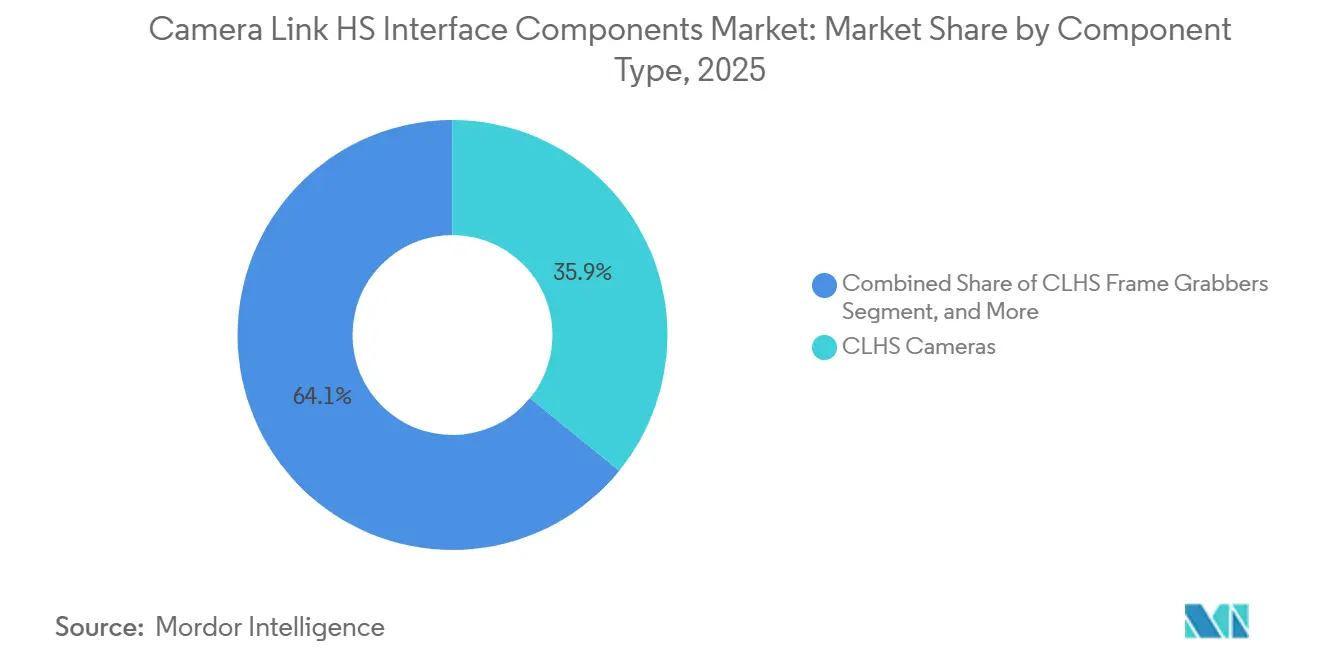
CLHS cameras held 35.87% of the Camera Link HS Interface Components Market share in 2025. Their position reflected the high unit value of area-scan and line-scan cameras and the usual order of equipment upgrades, where cameras are replaced before frame grabbers. Teledyne DALSA’s Falcon4-CLHS family covers resolutions from 2.8 megapixels to 67 megapixels and frame rates up to 1,200 fps in its fastest configuration. The Linea HS2 8K camera, released in June 2026, combines a backside-illuminated TDI CMOS sensor with a maximum line rate of 1 MHz for low-light, high-speed imaging. Frame grabbers are the next major component group because they connect cameras to host systems and can support FPGA processing. KAYA Instruments, Gidel, BitFlow, and Euresys offer programmable platforms that can support acquisition and preprocessing.
CLHS FPGA IP cores and development kits are projected to expand at a 13.27% CAGR between 2026 and 2031. A3’s VHDL-93 IP core supports CLHS development on Altera, Xilinx, and Microsemi FPGA platforms and can reduce dependency on proprietary chipsets. The Camera Link HS Interface Components Industry also includes cables, optical assemblies, interface boards, mezzanine cards, signal converters, range extenders, simulators, and test equipment. Signal converters and range extenders are relevant in aerospace and scientific systems where cable runs exceed 300 meters. Camera simulators allow engineers to test acquisition pipelines using controlled data patterns before procuring cameras. This can reduce validation risk in systems that integrate multiple hardware and software suppliers. The broader component set gives users options to build systems around a common CLHS interface.

By Protocol: M Protocol Leads While X Protocol Gains Momentum
M Protocol held 62.53% of protocol revenue in 2025. Its installed base was built around designs that operated at 3.125-5 Gbps over copper CX4 runs up to 15 meters. Its 8b/10b encoding can be simpler to implement in cost-sensitive FPGA designs. Many inspection equipment suppliers adopted the M Protocol when 10 Gbps fiber deployments were more expensive. This installed base continues to support demand for M Protocol in replacement and upgrade programs. It also gives equipment owners a familiar interface for modest-distance applications.
X Protocol is projected to expand at a 13.83% CAGR from 2026 to 2031. The A3 CLHS v1.2 specification supports migration from 10 Gbps to 25 Gbps with the same IP core and commercial SFP28, QSFP28, and MPO optical modules. It's 64b/66b encoding and forward error correction suit long fiber links in scientific instruments, large factory layouts, and aerospace imaging. A3 has also described a path toward 50 Gbps per lane using the same core with a bridge to a 128-bit SerDes input. This may help suppliers improve capacity without a full interface redesign. The protocol’s suitability for deterministic fiber links supports its role in the Camera Link HS Interface Components Market.
By Channel Count: Multi-Channel Systems Lead Demand
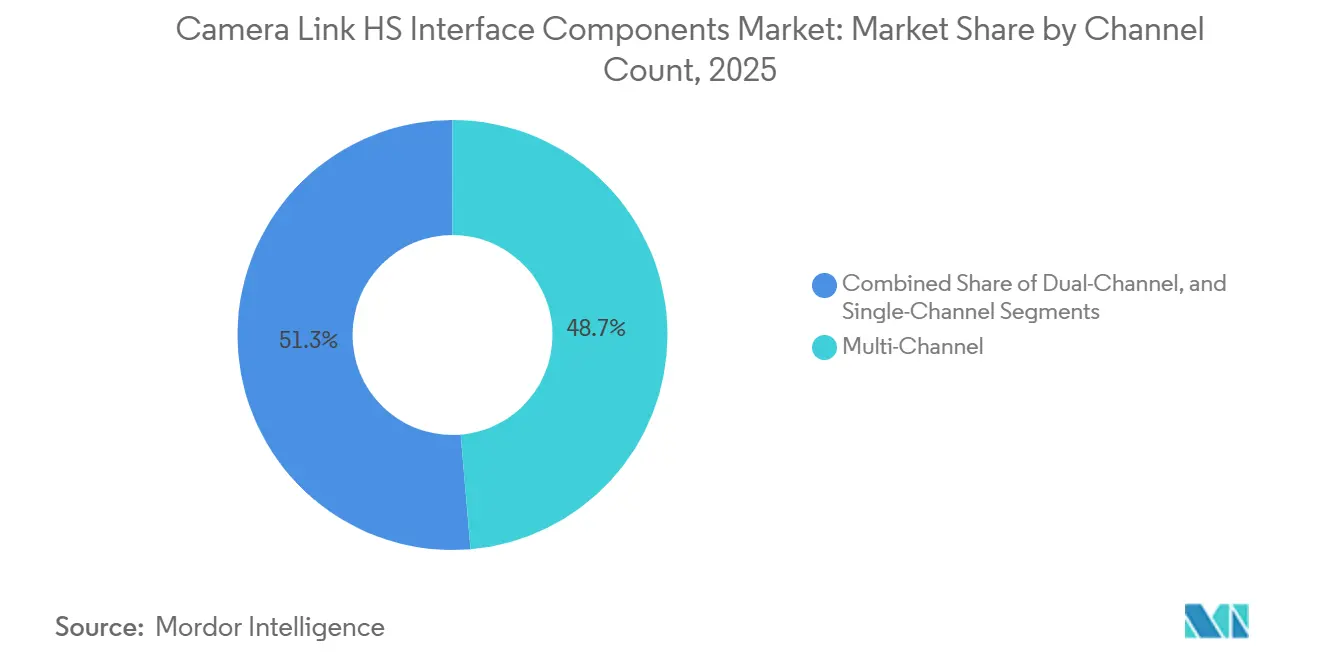
Multi-channel configurations held 48.67% of revenue in 2025. They are widely used in semiconductor wafer and flat-panel display inspection lines, where several cameras send data to a single acquisition host. CLHS supports up to 8 lanes per cable and allows multiple cables within a system. This lets equipment makers increase bandwidth as sensor capability rises without rebuilding the platform. It is useful for inspection equipment with long qualification periods. Multi-channel systems support synchronized imaging from multiple viewpoints in the Camera Link HS Interface Components Market.
Multi-channel configurations are projected to expand at a 12.67% CAGR through 2031. AI-based defect classification increasingly uses parallel image streams to construct 3D views of advanced packaging, including high-bandwidth memory stacks and silicon photonics modules. Single-channel products remain relevant for laboratory instruments, medical imaging, and lower-volume inspection cells. Dual-channel systems fit an intermediate need in dual-die inspection and scientific CMOS cameras. They can aggregate 2 CLHS lanes for sensors operating at 100+ fps. JIIA requirements support certified CLHS configurations in Japanese semiconductor facilities. This mix gives the Camera Link HS Interface Components Market coverage across production, research, and medical requirements.
By End-User Industry: Semiconductor Users Lead While Aerospace and Defense Accelerates
Electronics and semiconductor manufacturers accounted for 28.73% of revenue in 2025. Their demand is linked to investment in inspection capacity for gate-all-around devices and advanced packaging. The Camera Link HS Interface Components Market size for this user group is supported by the need to inspect wafers, interconnects, and package structures at high throughput. Vieworks stated that semiconductors represented 65% of its industrial camera revenue mix in the first half of 2026. It targeted revenue above KRW 55 billion (USD 40 million) for 2026. This shift shows how camera suppliers are aligning their products with demand for chip inspection.
Aerospace and defense is projected to expand at a 12.91% CAGR from 2026 to 2031. Launch vehicle monitoring, airborne surveillance, hyperspectral imaging, and directed-energy targeting can require radiation tolerance and tightly controlled trigger performance. Imperx cameras with Camera Link interfaces were aboard NASA’s Artemis II mission, which launched on April 1, 2026, to monitor the 4 RS-25 engines and stage separation. Industrial automation and machine builders also use CLHS in AI-enabled inspection cells. Medical and life sciences users are applying the interface in whole-slide imaging and genomics flow-cell analysis. Automotive suppliers, research institutes, and system integrators add demand with different requirements for bandwidth and latency. The Camera Link HS Interface Components Industry has therefore developed around specialized use cases in the Camera Link HS Interface Components Market.
Geography Analysis
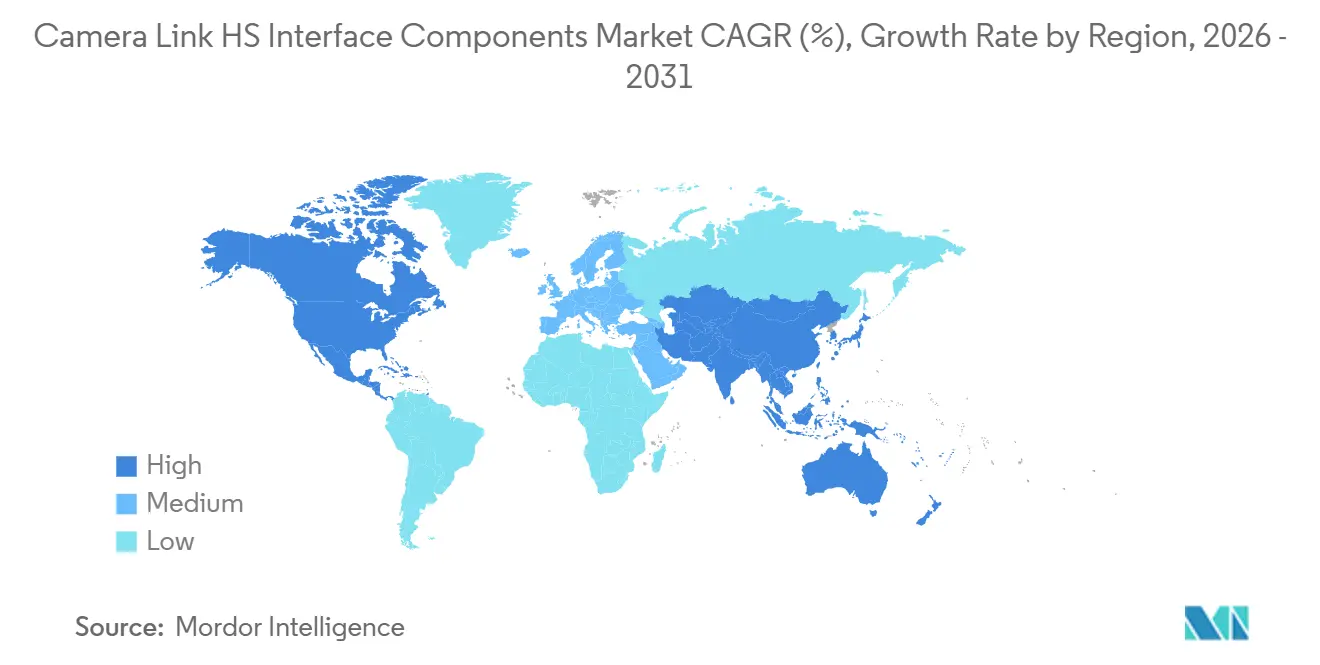
Asia-Pacific accounted for 39.81% of revenue in 2026, the largest regional share in the Camera Link HS Interface Components Market. The region is projected to expand at a 12.47% CAGR through 2031, the fastest rate among regions. Its position reflects the locations of major semiconductor and electronics production centers in China, South Korea, Taiwan, and Japan. New fabrication capacity and advanced packaging investment support demand for inspection systems. Teledyne Vision Solutions presented CLHS-equipped imaging products at Vision China in Shanghai in March 2026. The presentation addressed applications including wafer metrology, display inspection, and factory automation.
North America and Europe accounted for much of the remaining revenue in the Camera Link HS Interface Components Market due to their scientific imaging, aerospace, defense, and specialized integration activities. North American procurement includes BitFlow’s Axion-CL frame grabber selection by NASA’s Goddard Space Flight Center for ground-based radiation testing of an InGaAs shortwave infrared camera. Europe has a concentrated machine vision ecosystem that includes Silicon Software, Euresys, and equipment suppliers in Germany. EMVA co-ratified the CLHS standard, which supports its use among European inspection equipment developers. Gidel presented its FantoVision FPGA platform during the aerospace and defense innovation tour at VISION 2026 in Stuttgart.
South America has early adoption of CLHS in Brazil’s automotive supplier base and in Argentine electronics assembly operations. The Middle East and Africa are emerging procurement areas in the Camera Link HS Interface Components Market, with defense demand in Saudi Arabia and the UAE for airborne surveillance and long-range reconnaissance systems. These systems can require fiber links exceeding 300 meters. The market faces a shortage of qualified integrators in these regions. Local system builders may need external support for commissioning and validation. A3’s VHDL IP core and product registration program give developers a route to build CLHS products without proprietary protocol dependencies. This can gradually improve local implementation capability.
Competitive Landscape
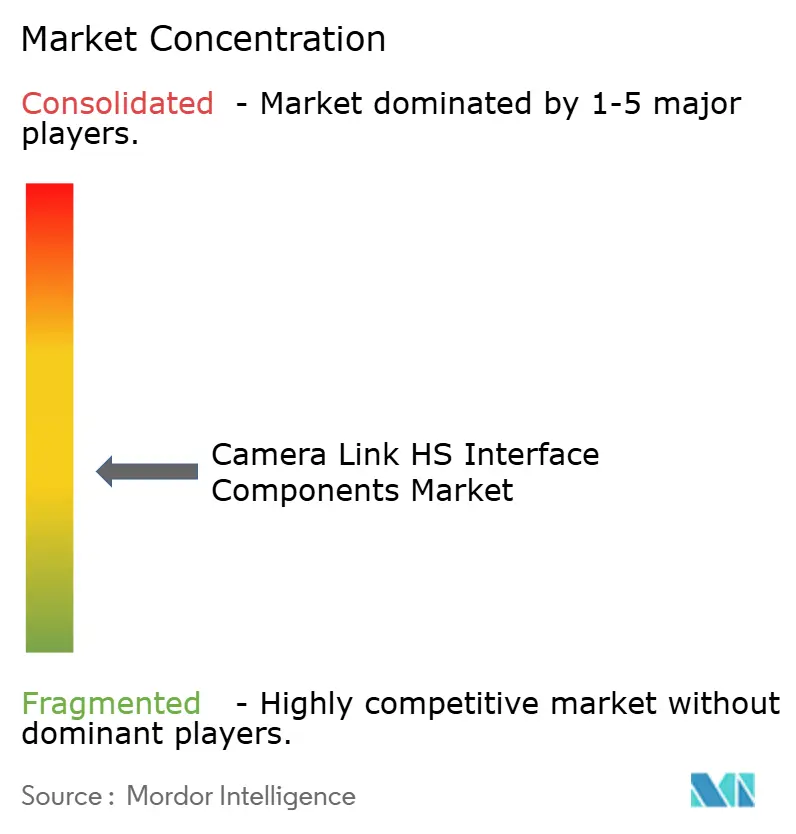
The Camera Link HS Interface Components Market is moderately fragmented in cameras and frame grabbers. Teledyne Digital Imaging has a broad position across image sensors, line-scan and area-scan cameras, industrial cameras, and PCIe frame grabbers through Teledyne e2v, Teledyne DALSA, and Teledyne Adimec. Teledyne’s Xtium3-CLHS PX8 supports the company’s frame-grabber offering. KAYA Instruments, Gidel, BitFlow, and Euresys compete on FPGA capabilities, software tools, and support for multiple protocols. KAYA Instruments maintains a portfolio of industrial frame grabbers for high-performance acquisition requirements. The Camera Link HS Interface Components Market is less concentrated in peripheral components and application-specific engineering.
Suppliers are adding value through pre-validated processing functions that run at the frame-grabber layer. These functions can include Bayer demosaicing, shading correction, lossless compression, and lightweight neural network inference. Gidel’s Quality+ Compression IP and ProcVision Suite SDK reduce image data during acquisition and prepare data for downstream processing. In May 2026, Gidel also presented the FantoVision20-CL system at ChipEx 2026, showing multi-camera Camera Link acquisition with FPGA preprocessing and GPU inference. This approach can help Camera Link HS Interface Components Market suppliers compete on workflow performance rather than only hardware specifications. It can also increase switching costs once a customer has validated firmware on a production line.
Chinese vendors such as Beijing Daheng Image Vision and NED Image Technology are developing products for domestic semiconductor inspection accounts. IO Industries and Optronis address high-speed scientific imaging applications where frame rate is central to system selection. Active Silicon and Pleora Technologies offer multi-protocol frame-grabber and IP-to-camera bridging solutions for integration projects. Photonfocus and Mikrotron serve compact camera applications with space and power constraints. Requirements related to IEC 62443 and ISO 13849 can favor suppliers with established experience in validation and certification. These requirements can also slow the entry of smaller camera and frame-grabber suppliers in the Camera Link HS Interface Components Market.
Camera Link HS Interface Components Industry Leaders
-
Teledyne Digital Imaging, Inc.
-
Euresys SA
-
Matrox Electronic Systems Ltd.
-
Active Silicon Limited
-
KAYA Instruments Ltd.
- *Disclaimer: Major Players sorted in no particular order
Recent Industry Developments
- August 2026: Teledyne DALSA launched the Falcon4-CLHS M8200-Scientific, a 67 MP (8,192 × 8,192) area-scan camera with 3 e⁻ read noise, 64 dB dynamic range, and 70% quantum efficiency at 550 nm, targeting whole-slide imaging, genomics, spatial omics, and semiconductor metrology. The camera's pixel-level factory calibration and CLHS fiber interface address OEM developers of next-generation life-science and industrial systems requiring long-term measurement reproducibility.
- June 2026: Teledyne DALSA released the Linea HS2 8K backside-illuminated TDI camera with a 1 MHz maximum line rate and 5-micrometer pixels, equipped with Camera Link HS CX4 connectors for active optical cables providing complete EMI immunity. The camera targets semiconductor wafer inspection, high-density interconnect boards, and genomics flow-cell analysis, extending CLHS line-scan coverage at the highest line-rate tier.
- June 2026: BitFlow, an Advantech division, announced full production availability of its Claxon CXP-12 CoaXPress frame-grabber family, spanning Claxon CXP1, CXP4, and Claxon Fiber models, validated with NVIDIA GPU platforms and Advantech edge-AI computers for real-time deep-learning inference pipelines in high-speed machine vision.
- April 2026: Imperx cameras were aboard NASA's Artemis II mission at launch on April 1, 2026, monitoring the 4 RS-25 engines and stage separation on the Space Launch System, demonstrating aerospace-grade Camera Link imaging in a demanding radiation and vibration environment.
Global Camera Link HS Interface Components Market Report Scope
Camera Link HS Interface Components refers to the specialized hardware and software ecosystem that supports the Camera Link High Speed (CLHS) standard, enabling ultra-high-bandwidth, low-latency, and deterministic data transmission for high-performance machine vision applications requiring rapid image acquisition and processing.
The Camera Link HS Interface Components Market Report is Segmented by Component Type (CLHS Cameras, CLHS Frame Grabbers, CLHS Interface Boards and Mezzanine Cards, CLHS Cables and Optical Assemblies, CLHS Signal Converters and Range Extenders, CLHS FPGA IP Cores and Development Kits, and CLHS Camera Simulators and Test Equipment), Protocol (M Protocol and X Protocol), Channel Count (Single-Channel, Dual-Channel, and Multi-Channel), End-User Industry (Industrial Automation and Machine Builders, Electronics and Semiconductor Manufacturers, Automotive Manufacturers and Tier Suppliers, Medical Device and Life Sciences Organizations, Aerospace and Defense Organizations, Research Institutes and Universities, System Integrators and Contract Inspection Providers, and Other End-User Industries), and Geography (North America, South America, Europe, Asia-Pacific, Middle East and Africa). The Market Forecasts are Provided in Terms of Value (USD).
| CLHS Cameras |
| CLHS Frame Grabbers |
| CLHS Interface Boards and Mezzanine Cards |
| CLHS Cables and Optical Assemblies |
| CLHS Signal Converters and Range Extenders |
| CLHS FPGA IP Cores and Development Kits |
| CLHS Camera Simulators and Test Equipment |
| M Protocol |
| X Protocol |
| Single-Channel |
| Dual-Channel |
| Multi-Channel |
| Industrial Automation and Machine Builders |
| Electronics and Semiconductor Manufacturers |
| Automotive Manufacturers and Tier Suppliers |
| Medical Device and Life Sciences Organizations |
| Aerospace and Defense Organizations |
| Research Institutes and Universities |
| System Integrators and Contract Inspection Providers |
| Other End-User Industries |
| North America | United States | |
| Canada | ||
| Mexico | ||
| South America | Brazil | |
| Argentina | ||
| Rest of South America | ||
| Europe | Germany | |
| United Kingdom | ||
| France | ||
| Italy | ||
| Spain | ||
| Rest of Europe | ||
| Asia-Pacific | China | |
| Japan | ||
| India | ||
| South Korea | ||
| Rest of Asia-Pacific | ||
| Middle East and Africa | Middle East | Saudi Arabia |
| United Arab Emirates | ||
| Turkey | ||
| Rest of the Middle East | ||
| Africa | South Africa | |
| Nigeria | ||
| Rest of Africa | ||
| By Component Type | CLHS Cameras | ||
| CLHS Frame Grabbers | |||
| CLHS Interface Boards and Mezzanine Cards | |||
| CLHS Cables and Optical Assemblies | |||
| CLHS Signal Converters and Range Extenders | |||
| CLHS FPGA IP Cores and Development Kits | |||
| CLHS Camera Simulators and Test Equipment | |||
| By Protocol | M Protocol | ||
| X Protocol | |||
| By Channel Count | Single-Channel | ||
| Dual-Channel | |||
| Multi-Channel | |||
| By End-User Industry | Industrial Automation and Machine Builders | ||
| Electronics and Semiconductor Manufacturers | |||
| Automotive Manufacturers and Tier Suppliers | |||
| Medical Device and Life Sciences Organizations | |||
| Aerospace and Defense Organizations | |||
| Research Institutes and Universities | |||
| System Integrators and Contract Inspection Providers | |||
| Other End-User Industries | |||
| By Geography | North America | United States | |
| Canada | |||
| Mexico | |||
| South America | Brazil | ||
| Argentina | |||
| Rest of South America | |||
| Europe | Germany | ||
| United Kingdom | |||
| France | |||
| Italy | |||
| Spain | |||
| Rest of Europe | |||
| Asia-Pacific | China | ||
| Japan | |||
| India | |||
| South Korea | |||
| Rest of Asia-Pacific | |||
| Middle East and Africa | Middle East | Saudi Arabia | |
| United Arab Emirates | |||
| Turkey | |||
| Rest of the Middle East | |||
| Africa | South Africa | ||
| Nigeria | |||
| Rest of Africa | |||
Key Questions Answered in the Report
What is the Camera Link HS Interface Components Market size?
The Camera Link HS Interface Components Market is projected to be USD 0.99 billion in 2026 and reach USD 1.60 billion by 2031 at a 10.11% CAGR.
What is driving demand for Camera Link HS components?
High-resolution machine vision, semiconductor inspection, edge AI processing, and deterministic trigger requirements are supporting demand.
Which component holds the largest share?
CLHS cameras held 35.87% of revenue in 2025, supported by their role in inspection system upgrades.
Which protocol is expected to expand the fastest?
X Protocol is projected to expand at a 13.83% CAGR through 2031 because it supports high-speed fiber links and forward error correction.
Which end-user group is projected to expand the fastest?
Aerospace and defense is projected to advance at a 12.91% CAGR through 2031, supported by surveillance and mission-critical imaging needs.
Which region leads demand for these components?
Asia-Pacific held 39.81% of revenue in 2026 and is projected to expand at a 12.47% CAGR through 2031.