
Cloud RAN Infrastructure Market Size and Share
Market Overview
| Study Period | 2021 - 2032 |
|---|---|
| Market Size (2027) | USD 3.82 Billion |
| Market Size (2032) | USD 8.75 Billion |
| Growth Rate (2027 - 2032) | 18.03 % |
| Fastest Growing Market | Asia-Pacific |
| Largest Market | North America |
| Market Concentration | Medium |
Major Players *Disclaimer: Major Players sorted in no particular order Image © Mordor Intelligence. Reuse requires attribution under CC BY 4.0. | |
Cloud RAN Infrastructure Market Analysis by Mordor Intelligence
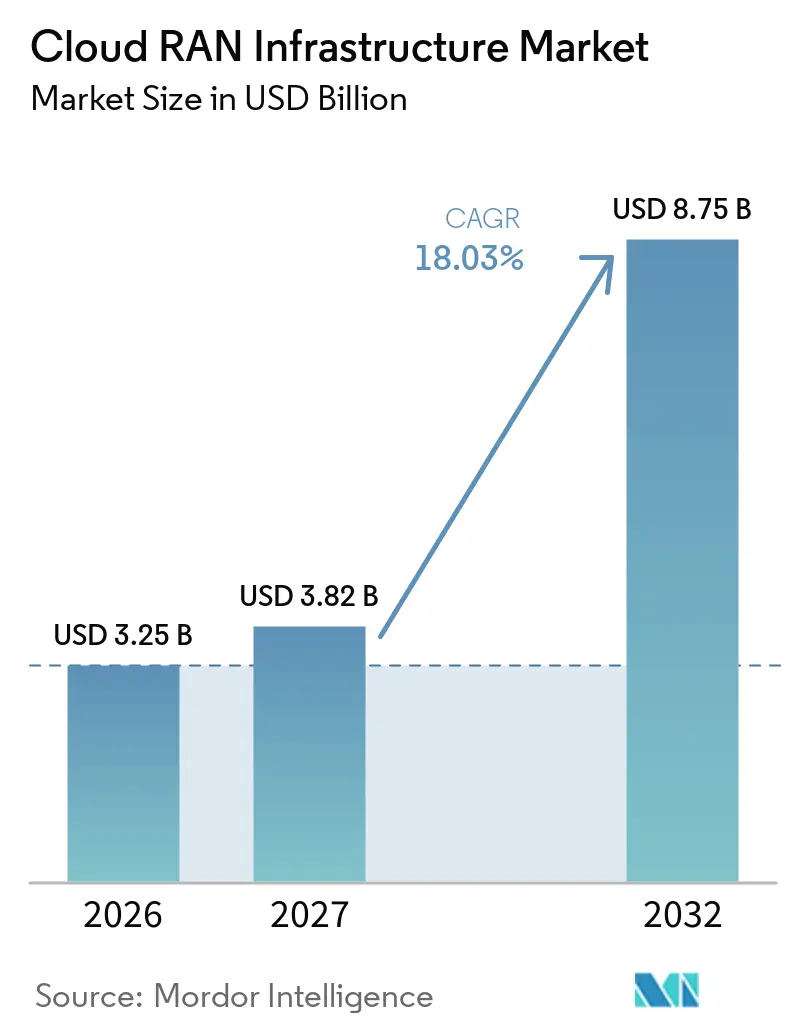
The Cloud RAN Infrastructure Market size is projected to be USD 3.25 billion in 2026, USD 3.82 billion in 2027, and reach USD 8.75 billion by 2032, growing at a CAGR of 18.03% from 2027 to 2032. The cloud RAN infrastructure market is moving operators away from proprietary baseband units toward software-defined centralized and distributed functions on commercial servers. This shift follows the broader 5G Standalone deployment, which provides operators with the cloud-native foundation needed for centralized baseband pooling. Rising mobile traffic also increases the need for flexible capacity, especially where traffic patterns change by location and time. Vendors are responding by pairing cloud RAN software with automation, AI processing, and shared infrastructure capabilities. The cloud RAN infrastructure market still faces questions around energy use, performance consistency, integration costs, fiber availability, and data sovereignty.
Key Report Takeaways
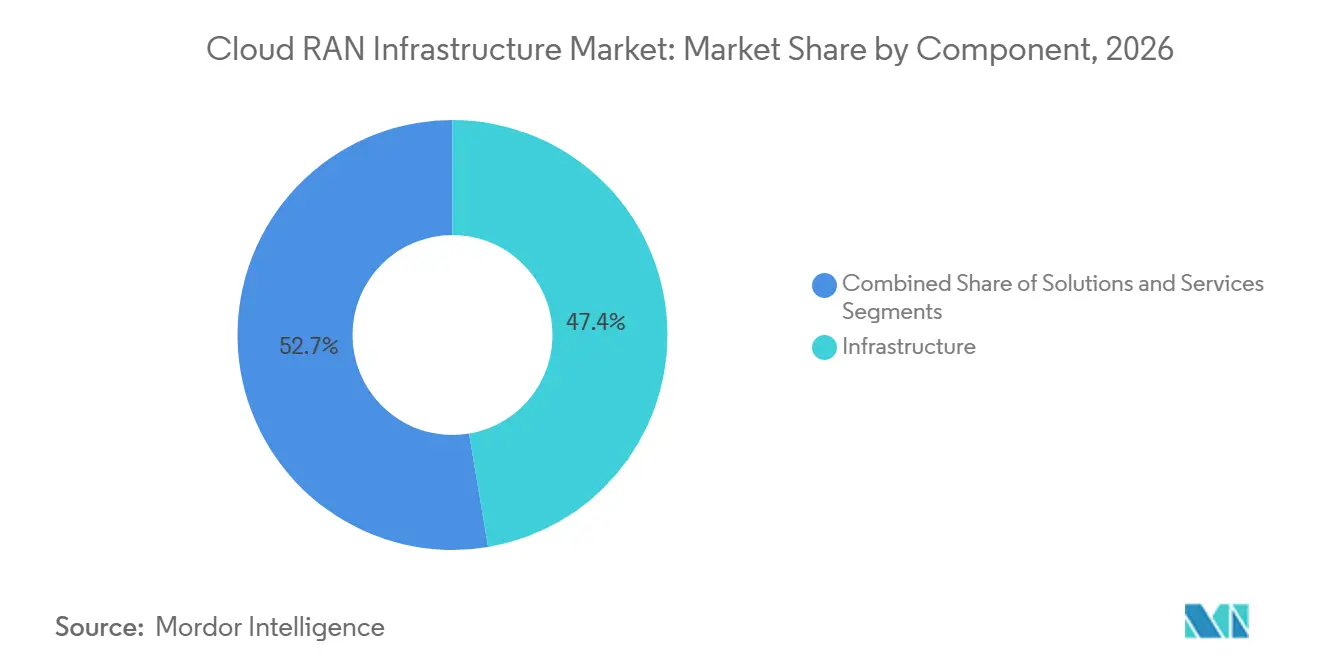
- By component, infrastructure held 47.35% of the cloud RAN infrastructure market share in 2026, while the solutions segment is projected to expand at a 19.58% CAGR through 2032.
- By deployment model, private cloud RAN held 45.65% of the cloud RAN infrastructure market share in 2026, while public cloud-hosted RAN is projected to expand at a 19.94% CAGR through 2032.
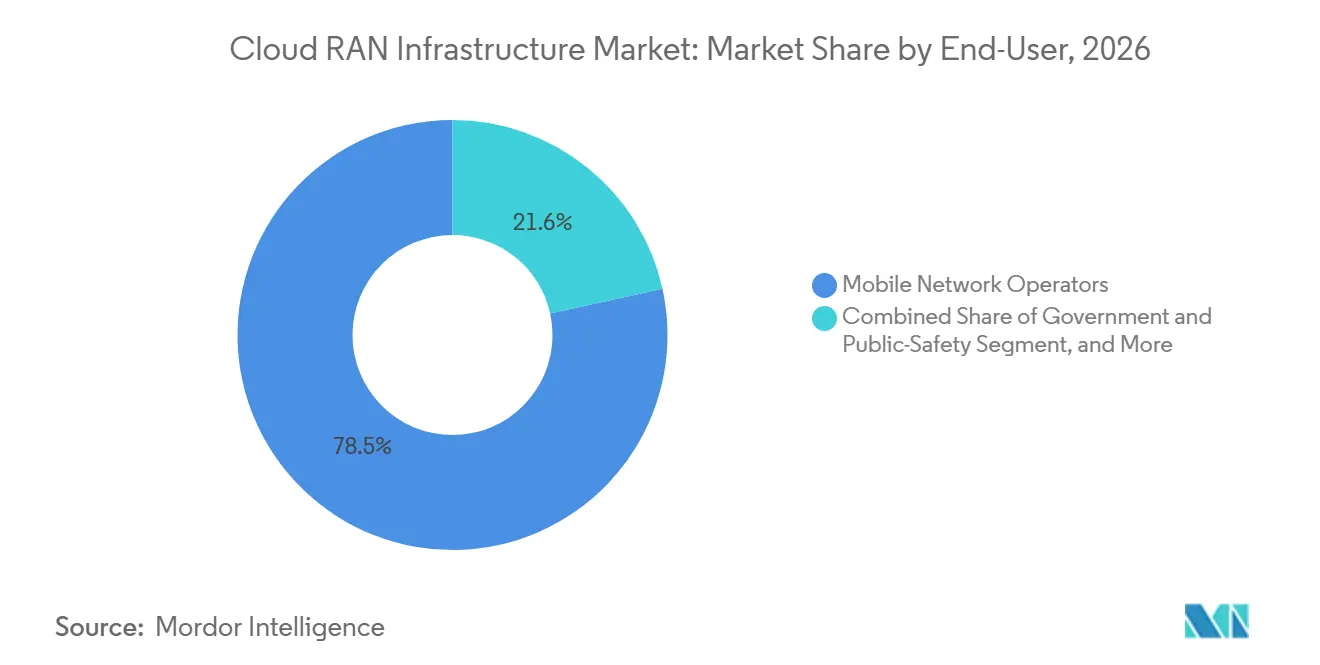
- By end-user, mobile network operators held 78.45% of the cloud RAN infrastructure market share in 2026, while enterprises are projected to expand at a 19.72% CAGR through 2032.
- By application, macrocell Networks accounted for 54.25% of the cloud RAN infrastructure market share in 2026, while private 5G networks are projected to expand at a 19.86% CAGR through 2032.
- By geography, North America held 36.85% of the cloud RAN infrastructure market share in 2026, while Asia-Pacific is projected to expand at a 19.65% CAGR through 2032.
Note: Market numbers in this report are based on Mordor Intelligence's proprietary estimation framework, which combines nine months of actuals with Q4 projections for base year 2026.
Market Trends and Insights
Drivers Impact Analysis of Cloud RAN Infrastructure Market*
| Driver | (~) % Impact on CAGR Forecast | Geographic Relevance | Impact Timeline |
|---|---|---|---|
| 5G Standalone Rollouts and RAN Densification | +5.5% | Global, concentrated in North America, Europe, and Asia-Pacific | Medium term (2-4 years) |
| Mobile Data Traffic Growth and Capacity Pressure | +4.2% | Global | Short term (≤ 2 years) |
| CAPEX and OPEX Optimization Through Baseband Pooling | +3.2% | North America and Europe, with rising adoption in Asia-Pacific | Medium term (2-4 years) |
| AI-Native RAN Automation and Energy Optimization | +2.3% | Global, led by North America, Japan, and Europe | Long term (≥ 4 years) |
| Cloud RAN Expansion Into Private 5G and Neutral-Host Networks | +1.3% | Global, concentrated in Asia-Pacific and Europe | Medium term (2-4 years) |
| Hyperscaler and Telco Cloud Ecosystem Convergence | +1.0% | North America and Europe, with spillover to the Middle East | Long term (≥ 4 years) |
| Source: Mordor Intelligence | |||
5G Standalone Rollouts and RAN Densification
Commercial 5G Standalone deployment is prompting an upgrade cycle in the related cloud RAN infrastructure market. Standalone networks need a cloud-native core and disaggregated RAN functions to support slicing, ultra-reliable low-latency communications, and differentiated enterprise services. GSA recorded 95 commercially launched 5G Standalone networks in Q1 2026, 42% more than in Q1 2025, and 35 operators investing in 5G-Advanced, 71% more year over year. Those rollout decisions also establish the baseband architecture that can shape operator cost structures for 5-7 years. Ericsson states that its commercial AI-native RAN software can deliver up to 20% higher throughput and 14% lower energy use in compatible 5G deployments.[1] EE introduced advanced RAN coordination in September 2025, allowing nearby sites to share capacity without new physical infrastructure, a capability suited to cloud-native baseband operations.
Mobile Data Traffic Growth and Capacity Pressure
Mobile traffic is rising faster than incremental RAN capacity in many networks, strengthening demand for elastic, software-defined baseband resources in the cloud RAN infrastructure market. Global mobile data traffic rose 22% year over year in Q1 2026 to 210 exabytes per month, while video represented 75% of mobile traffic at the end of 2025. Ericsson expects total traffic to be 2.5 times higher in 2030 than in 2025. Among 55 measured service providers, 43 had faster uplink than downlink traffic expansion during Q1 2026. Such uneven uplink demand can place variable processing loads on distributed units, where pooled cloud resources can be more efficient than fixed hardware. Average smartphone consumption reached 22 GB per month globally by the end of 2025 and 37 GB in India, making further capacity investment difficult to postpone.
CAPEX and OPEX Optimization Through Baseband Pooling
Centralized baseband pooling remains a key financial reason for operators to assess cloud RAN infrastructure. Research using traces from a commercial 5G network found that fine-grained DU pooling could deliver 84% CAPEX gains and 94% OPEX gains against static configurations. A shared compute pool lets operators serve traffic peaks across hundreds of macro sites without sizing every site for its own maximum load. This approach can reduce unused capacity and site-level server requirements in dense urban deployments. NEC commercialized fully containerized 5G vRAN software in March 2025 and reported 65% lower device power consumption than conventional 5G equipment.[2] European energy efficiency requirements can further support adoption, as efficient baseband designs help operators meet power consumption obligations. The cloud RAN infrastructure market, therefore, has a clear cost case when the conditions for transport, integration, and utilization support pooling.
AI-Native RAN Automation and Energy Optimization
AI-native functions are moving from demonstrations toward deployable cloud RAN features. A peer-reviewed live testbed study reported that an O-RAN-compliant ES-rApp achieved up to 19.5% energy savings without reducing the quality of service. Nokia tested its anyRAN software on NVIDIA GPU-accelerated AI-RAN infrastructure at MWC 2026 with T-Mobile US, Indosat, and SoftBank Corp. NVIDIA committed USD 1 billion to Nokia in October 2025 to support AI-RAN commercialization and the transition from 5G to 6G. Shared accelerated computing can run AI inference and RAN workloads concurrently, potentially improving resource utilization and reducing energy consumption. This capability gives vendors another way to position the cloud RAN infrastructure market beyond a narrow discussion of equipment costs.
Restraints Impact Analysis of Cloud RAN Infrastructure Market*
| Restraint | (~) % Impact on CAGR Forecast | Geographic Relevance | Impact Timeline |
|---|---|---|---|
| High Fronthaul Capacity, Fiber Availability and Synchronization Requirements | -2.5% | Global, with acute constraints in Africa, South Asia, and Southeast Asia | Short term (≤ 2 years) |
| Integration Complexity and Performance-Parity Risk Versus Purpose-Built RAN | -2.0% | Global | Medium term (2-4 years) |
| Security, Sovereignty and Lifecycle Governance Across Distributed Cloud Workloads | -1.2% | Europe, Middle East, and Asia-Pacific | Long term (≥ 4 years) |
| Misaligned Telco Investment Cycles and Uncertain Standalone Cloud RAN ROI | -1.0% | Global, concentrated in South America and Africa | Medium term (2-4 years) |
| Source: Mordor Intelligence | |||
High Fronthaul Capacity, Fiber Availability, and Synchronization Requirements
The transport layer between remote radio units and centralized baseband pools is a direct constraint on large-scale cloud RAN deployment. O-RAN specifications set fronthaul latency budgets from 25 microseconds to 500 microseconds, depending on the functional split, with 100 microseconds of one-way delay needed for full-performance deployments. Meeting those limits requires high-capacity fiber or dense wavelength-division multiplexing at cell sites. 5G time-division duplex coordination also requires ITU-T G.8275.1 timing alignment, while GPS synchronization can be affected by jamming and atmospheric conditions. Ericsson has identified intelligent packet fronthaul automation as a response to these operational demands. Fiber penetration below 30% in parts of South America, Africa, and Southeast Asia can lead to lower functional splits and reduced pooling benefits. The cloud RAN infrastructure market consequently has stronger economics in fiber-rich markets than in less-connected economies.
Integration Complexity and Performance-Parity Risk Versus Purpose-Built RAN
Multi-vendor integration can cost more and take longer than operators initially expect in the cloud RAN infrastructure market. Deployment evidence through 2026 indicates that non-recurring engineering costs for open RAN programs with more than 10,000 cells can carry a 50-200% one-time premium over traditional RAN. Those costs can delay OPEX benefits until the third year or later, complicating investment approvals in short planning cycles. A comparative study found that RAN slicing could reduce CAPEX by 33-68% and OPEX by 12-51% compared with dedicated private networks, although coordination overhead can narrow those benefits.[3] Cloud RAN software must also match the latency certainty and spectral efficiency of purpose-built silicon. SynaXG reported 36 Gbps throughput with sub-10 millisecond latency on an NVIDIA-accelerated platform in March 2026, but brownfield performance still depends on legacy fronthaul conditions.[4]
*Our forecasts treat driver/restraint impacts as directional, not additive. The impact forecasts reflect baseline growth, mix effects, and variable interactions.
Cloud RAN Infrastructure Market Segment Analysis
By Component:
Software-Driven Value Reshapes the Infrastructure LayerInfrastructure held 47.35% of cloud RAN infrastructure spending in 2026, making it the largest component of the cloud RAN infrastructure market. Operators must establish commercial server, remote radio unit, and fronthaul capacity before cloud-based control can deliver operating benefits. Dell Technologies, HPE, and Intel provide the server and processor foundation for major programs, including deployments using Intel Granite Rapids processors. This share reflects the immediate need for reliable compute and transport capacity.
Solutions is projected to expand at a 19.58% CAGR through 2032, the highest rate among components. The cloud RAN infrastructure market size for Solutions reflects demand for management platforms, AI-native orchestration, and multi-vendor integration software. Operators are placing more weight on these tools as compute hardware becomes easier to source, shifting value toward software licenses and automation support. Research on DU pooling supports the continuing infrastructure buildout, showing 84% CAPEX gains and 94% OPEX gains under fine-grained pooling conditions. Services also expand as operators seek specialist support for complex multi-vendor programs.

By Deployment Model:
Private Cloud Anchors Revenue While Public Cloud AcceleratesPrivate Cloud RAN held 45.65% of deployment model spending in 2026, giving it the largest cloud RAN infrastructure market share. Tier-1 operators use private environments to preserve isolation, predictable latency, regulatory control, and direct control of sensitive traffic. Private deployments can meet the fronthaul latency budgets needed for high-performance functional splits. These qualities make private cloud practical for early large-scale rollouts and gradual RAN modernization.
Public Cloud-Hosted RAN is projected to expand at a 19.94% CAGR through 2032. The cloud RAN infrastructure market size for this model benefits from hyperscaler support for containerized RAN workloads at edge locations. Telefónica completed Europe’s first 5G Standalone call using Nokia Cloud RAN workloads across on-premises AWS Outposts and the AWS Spain Region in March 2025. Hybrid Cloud RAN lets operators retain on-premises DU processing, move selected CU functions to public infrastructure, and develop cloud operating skills in stages. European data-residency considerations under the NIS 2 Directive can still favor private or hybrid environments for sensitive traffic.
By End-User:
MNOs Dominate Spending While Enterprises Set the Fastest PaceMobile Network Operators accounted for 78.45% of cloud RAN infrastructure spending in 2026, the largest end-user share. Their position reflects national macrocell programs and vendor agreements with large carriers, including VodafoneThree’s GBP 2 billion (USD 2.7 billion) contract for more than 10,000 United Kingdom sites in September 2025. Samsung was selected by Vodafone as a primary open RAN partner for Germany, while Nokia secured a 5-year Cloud RAN agreement with Telefónica Germany. These programs continue to anchor near-term vendor revenue.
Enterprises are projected to expand at a 19.72% CAGR through 2032, the fastest pace among end users. The cloud RAN infrastructure market for enterprises is supported by industrial automation, smart campuses, and mission-critical communications that require quality-of-service control. Peer-reviewed research found that AI-native Cloud-RAN orchestration using digital twin models reduced service-level agreement violations by up to 37% and raised throughput by up to 22%. Government and public-safety customers remain relevant but usually have longer procurement cycles. Neutral-host providers and tower companies can offer multi-operator capacity while converting upfront capital needs into recurring operating costs.
By Application:
Macrocell Scale Persists While Private 5G Networks AdvanceMacrocell Networks accounted for 54.25% of cloud RAN infrastructure spending in 2026, the largest share by application. The cloud RAN infrastructure market share in macrocells reflects 5G New Radio densification and the value of centralizing DU functions across several sectors. Shared processing can reduce site hardware requirements and support coordinated multi-cell beamforming. EE used advanced RAN coordination in Manchester and Edinburgh during September 2025 to let nearby sites share capacity without new infrastructure.
Private 5G Networks is projected to expand at a 19.86% CAGR through 2032, the fastest application rate among all applications. Industrial automation, seaport logistics, and connected campuses require dedicated connectivity, isolation, and sub-10 millisecond latency, while small-cell and indoor networks benefit from enterprise digitalization. Fixed wireless access is gaining traction because 71% of service providers offered 5G fixed wireless access in June 2026, up from 57% in June 2025. Operators can place fixed wireless and mobile broadband baseband functions on shared cloud infrastructure. Utilities, defense organizations, and first-responder networks are emerging users, though their procurement cycles can extend 18-36 months beyond enterprise cycles.
Geography Analysis
North America Cloud RAN Infrastructure Market
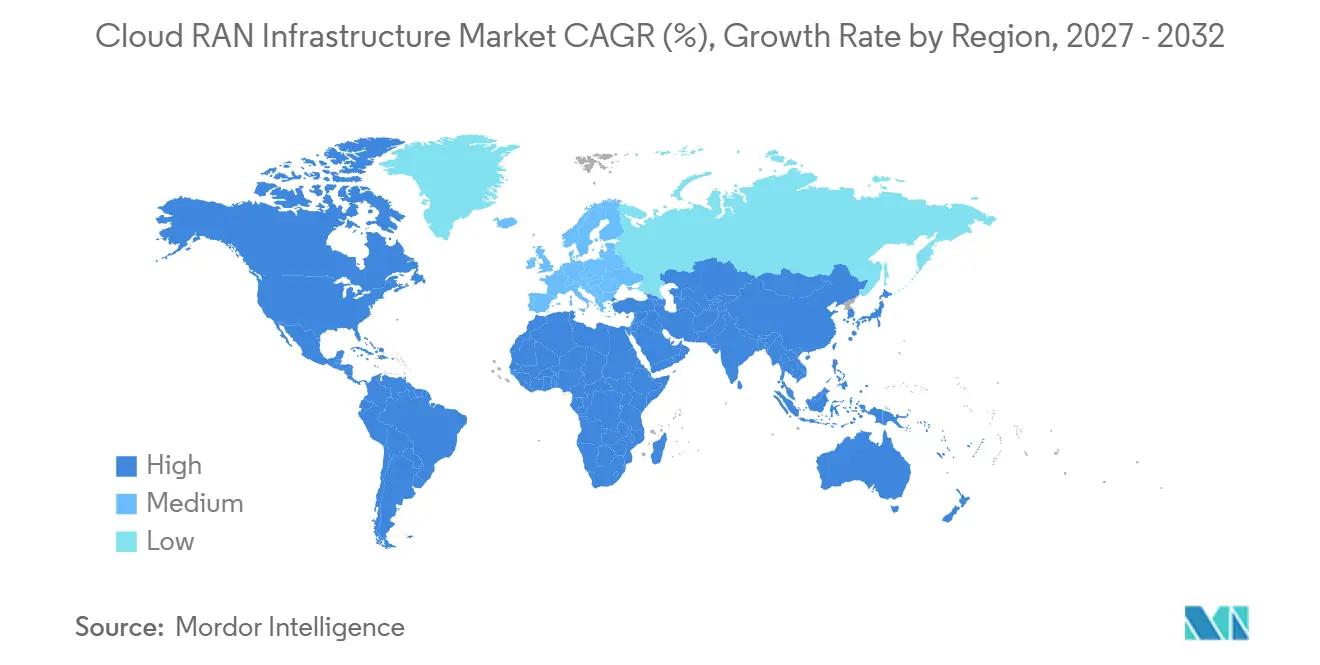
North America held 36.85% of cloud RAN infrastructure spending in 2026, the highest regional share. The cloud RAN infrastructure market share is supported by multi-year open RAN programs from large United States carriers that use commercial server platforms and substantial capital investments. Bell Canada expanded its Cloud RAN relationship with Nokia in February 2025, using Nokia AirScale Cloud RAN, Red Hat OpenShift, and Dell PowerEdge servers. The concentration around 3-4 large operators can create material vendor demand swings as budgets and order schedules change.
APAC Cloud RAN Infrastructure Market
Asia-Pacific is projected to expand at a 19.65% CAGR from 2027 to 2032, the highest regional rate in the cloud RAN infrastructure market. Japan is a major reference point for virtualized, cloud-native open RAN at commercial scale, including a nationwide deployment of the RAN Intelligent Controller by Rakuten Mobile and Rakuten Symphony in February 2026. Samsung was selected as Rakuten Mobile’s nationwide 5G Open RAN radio provider in March 2026. India is also scaling 5G through Bharti Airtel and Reliance Jio. Rakuten Symphony received a JPY 8 billion (USD 56.52 million) grant from Japan’s Ministry of Economy, Trade, and Industry in April 2026 for a 7-country open RAN trial.
EMEA and South America Cloud RAN Infrastructure Market
Europe saw high contract activity in 2025, with Germany emerging as a key deployment location. Vodafone selected Samsung for a large open RAN rollout, while Nokia agreed a 5-year Cloud RAN program with Telefónica Germany through 2030. Middle East operators are exploring hybrid models, including du’s Cloud RAN work with AWS and Nokia. South America and Africa remain smaller opportunities due to fiber gaps that limit the deployment of high-performance models, though Brazil and South Africa may host early pilots.
Competitive Landscape
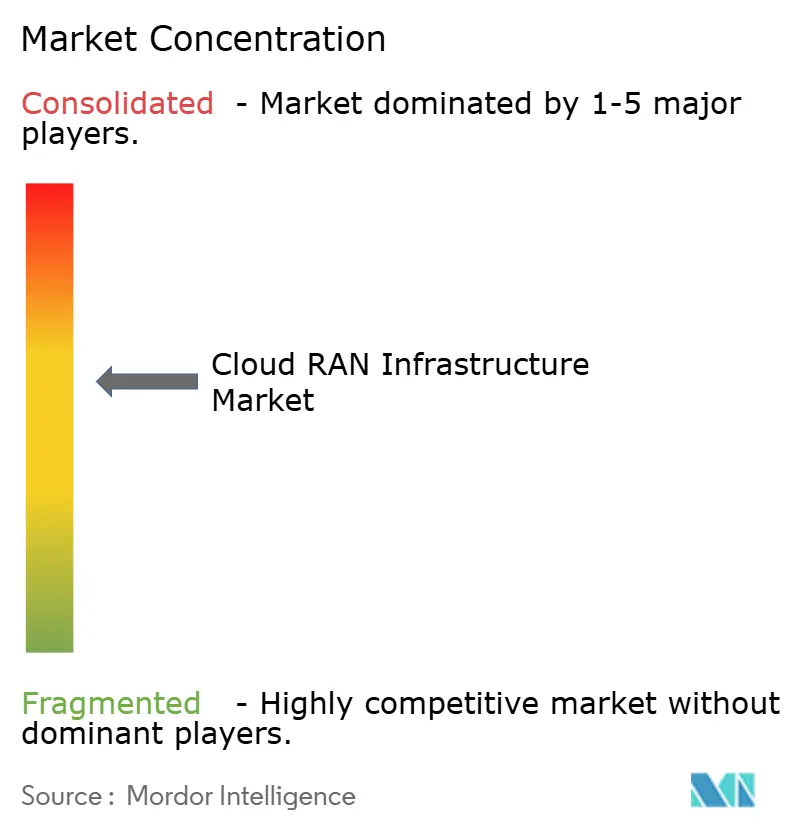
The cloud RAN infrastructure market is moderately concentrated at the integrated platform level. Ericsson, Nokia, Huawei, ZTE, and Samsung lead major operator programs by combining hardware, cloud software, and professional services. Ericsson launched rApp as a Service on AWS compute in February 2026, while Nokia expanded its AI-native RAN portfolio with NVIDIA to target level 4 automation. This approach seeks to protect equipment revenue while expanding recurring software and automation income.
Mavenir, Parallel Wireless, and Airspan Networks compete in software-led, disaggregated deployments that use cloud-native DU and CU functions for multi-vendor, open fronthaul systems. They can be relevant in neutral-host and enterprise private 5G projects, where flexibility can outweigh the performance guarantees of an integrated vendor. Rakuten Symphony and Samsung completed interoperability testing in March 2026 for Samsung vRAN and vCore on the Rakuten Cloud-Native Platform. The companies reported near-perfect results with no code changes, supporting multi-vendor deployment options. O-RAN Alliance specifications for RIC xApp and rApp interfaces shape competition in AI orchestration.
GPU-accelerated platforms may replace standard commercial servers in high-throughput deployments within the cloud RAN infrastructure market. The software coordinating shared AI and RAN workloads on accelerated infrastructure remains an important competitive area. NVIDIA’s USD 1 billion investment in Nokia shows the importance vendors place on this transition. Vendors that combine scalable compute, open interfaces, energy management, and automation can strengthen their competitive position.
Cloud RAN Infrastructure Industry Leaders
-
Telefonaktiebolaget LM Ericsson
-
Nokia Corporation
-
Huawei Technologies Co., Ltd.
-
Samsung Electronics Co., Ltd.
-
ZTE Corporation
- *Disclaimer: Major Players sorted in no particular order
Cloud RAN Infrastructure Market Companies Covered in this Report
- Telefonaktiebolaget LM Ericsson
- Nokia Corporation
- Huawei Technologies Co., Ltd.
- ZTE Corporation
- Samsung Electronics Co., Ltd.
- Cisco Systems, Inc.
- Intel Corporation
- Fujitsu Limited
- NEC Corporation
- Mavenir Systems, Inc.
- Rakuten Group, Inc. (Rakuten Symphony)
- Parallel Wireless, Inc.
- Airspan Networks Holdings LLC
- NVIDIA Corporation
- Hewlett Packard Enterprise Company
- Dell Technologies Inc.
- Red Hat, Inc.
- Wind River Systems, Inc.
- Advanced Micro Devices, Inc. (AMD)
- Amazon Web Services, Inc. (AWS)
Recent Industry Developments in Cloud RAN Infrastructure Market
- April 2026: Rakuten Symphony announced its selection for a METI-backed program to demonstrate virtualized Open RAN and RAN Intelligent Controller (RIC) technologies across Indonesia, Malaysia, Vietnam, India, Kuwait, Bolivia, and Paraguay. The project envisages approximately 100 base stations per country, with a maximum subsidy allocation of JPY 8 billion across the relevant demonstration programs. The initiative aims to validate AI-driven RAN optimization and accelerate the commercial adoption of Open RAN in Global South markets.
- April 2026: Mavenir’s Converged Packet Core went live on Rakuten Mobile’s Cloud Platform, enabling Japan’s nationwide Japan Roaming emergency service launched by major carriers on April 1, 2026. The deployment validated Mavenir’s cloud-native core on a fully virtualized open RAN environment and positioned the vendor as a supplier for Japan’s national emergency communications framework.
- February 2026: Nokia and AWS announced the industry’s first agentic AI-powered 5G-Advanced network slicing solution in a live 5G network, with du and Orange as the first operator explorers. The intent-based solution combines Nokia’s RAN management with AWS AI services to autonomously adjust RAN policies and service-level agreements in real time.
- February 2026: Rakuten Mobile and Rakuten Symphony completed a nationwide RAN Intelligent Controller deployment, the world’s first at national commercial scale. It integrated third-party rApps from AirHop Communications and Future Connections for predictive maintenance, mobility enhancement, and traffic optimization across Japan’s commercial mobile network.
Global Cloud RAN Infrastructure Market Report Scope
The Cloud RAN Infrastructure Market Report is Segmented by Component (Infrastructure, Solutions, and Services), Deployment Model (Hybrid Cloud RAN, Private Cloud RAN, and Public Cloud-Hosted RAN), End-User (Mobile Network Operators, Enterprises, Government and Public-Safety, Neutral Host and TowerCos, and Other End-Users), Application (Macrocell Networks, Small Cell and Indoor Networks, Private 5G Networks, Fixed Wireless Access, Industrial and Mission-Critical Communications, and Other Applications), and Geography (North America, South America, Europe, Asia-Pacific, Middle East and Africa). The Market Forecasts are Provided in Terms of Value (USD).
Segmentation Overview
| Infrastructure |
| Solutions |
| Services |
| Hybrid Cloud RAN |
| Private Cloud RAN |
| Public Cloud-Hosted RAN |
| Mobile Network Operators |
| Enterprises |
| Government and Public-Safety |
| Neutral Host and TowerCos |
| Other End-Users |
| Macrocell Networks |
| Small Cell and Indoor Networks |
| Private 5G Networks |
| Fixed Wireless Access |
| Industrial and Mission-Critical Communications |
| Other Applications |
| North America | United States |
| Canada | |
| Mexico | |
| South America | Brazil |
| Argentina | |
| Rest of South America | |
| Europe | United Kingdom |
| Germany | |
| France | |
| Italy | |
| Spain | |
| Russia | |
| Rest of Europe | |
| Asia-Pacific | China |
| Japan | |
| South Korea | |
| India | |
| Australia | |
| Rest of Asia-Pacific | |
| Middle East | Saudi Arabia |
| United Arab Emirates | |
| Rest of Middle East | |
| Africa | South Africa |
| Nigeria | |
| Rest of Africa |
| By Component | Infrastructure | |
| Solutions | ||
| Services | ||
| By Deployment Model | Hybrid Cloud RAN | |
| Private Cloud RAN | ||
| Public Cloud-Hosted RAN | ||
| By End-User | Mobile Network Operators | |
| Enterprises | ||
| Government and Public-Safety | ||
| Neutral Host and TowerCos | ||
| Other End-Users | ||
| By Application | Macrocell Networks | |
| Small Cell and Indoor Networks | ||
| Private 5G Networks | ||
| Fixed Wireless Access | ||
| Industrial and Mission-Critical Communications | ||
| Other Applications | ||
| By Geography | North America | United States |
| Canada | ||
| Mexico | ||
| South America | Brazil | |
| Argentina | ||
| Rest of South America | ||
| Europe | United Kingdom | |
| Germany | ||
| France | ||
| Italy | ||
| Spain | ||
| Russia | ||
| Rest of Europe | ||
| Asia-Pacific | China | |
| Japan | ||
| South Korea | ||
| India | ||
| Australia | ||
| Rest of Asia-Pacific | ||
| Middle East | Saudi Arabia | |
| United Arab Emirates | ||
| Rest of Middle East | ||
| Africa | South Africa | |
| Nigeria | ||
| Rest of Africa | ||
Key Questions Answered in the Report
What is the projected size of the Cloud RAN infrastructure market?
The Cloud RAN infrastructure market is projected to reach USD 8.75 billion by 2032, from USD 3.82 billion in 2027, at an 18.03% CAGR.
What is driving adoption of Cloud RAN infrastructure?
5G Standalone deployments, higher mobile traffic, baseband pooling, and AI-enabled network automation are supporting adoption.
Which component is projected to expand fastest?
Solutions is projected to expand at a 19.58% CAGR through 2032 as operators invest in orchestration, management, and automation software.
Which deployment model leads Cloud RAN spending?
Private Cloud RAN held 45.65% of deployment model spending in 2026 because it supports control, isolation, and predictable latency.
Which region is projected to expand fastest?
Asia-Pacific is projected to expand at a 19.65% CAGR through 2032, supported by Japan’s open RAN ecosystem and 5G deployment in India.
What limits wider Cloud RAN deployment?
Fronthaul fiber requirements, timing constraints, integration costs, and performance parity with purpose-built RAN can slow adoption.