
Citrus Concentrates Market Size and Share
Market Overview
| Study Period | 2021 - 2031 |
|---|---|
| Market Size (2026) | USD 18.77 Billion |
| Market Size (2031) | USD 23.72 Billion |
| Growth Rate (2026 - 2031) | 4.80 % |
| Fastest Growing Market | Asia-Pacific |
| Largest Market | North America |
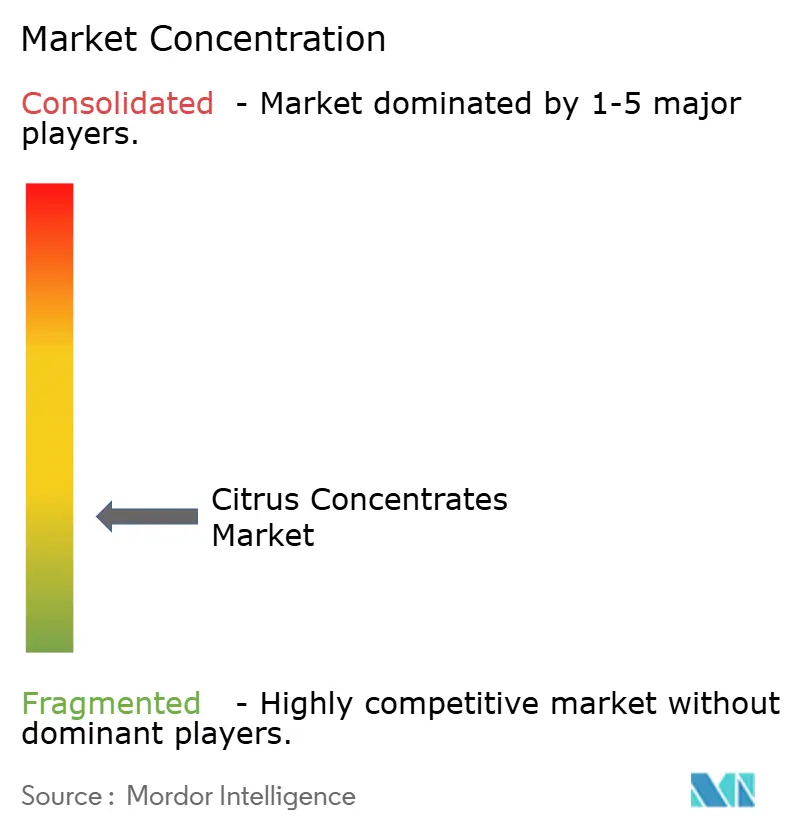
| Market Concentration | Low |
Major Players
*Disclaimer: Major Players sorted in no particular order Image © Mordor Intelligence. Reuse requires attribution under CC BY 4.0. |
|
Citrus Concentrates Market Analysis by Mordor Intelligence
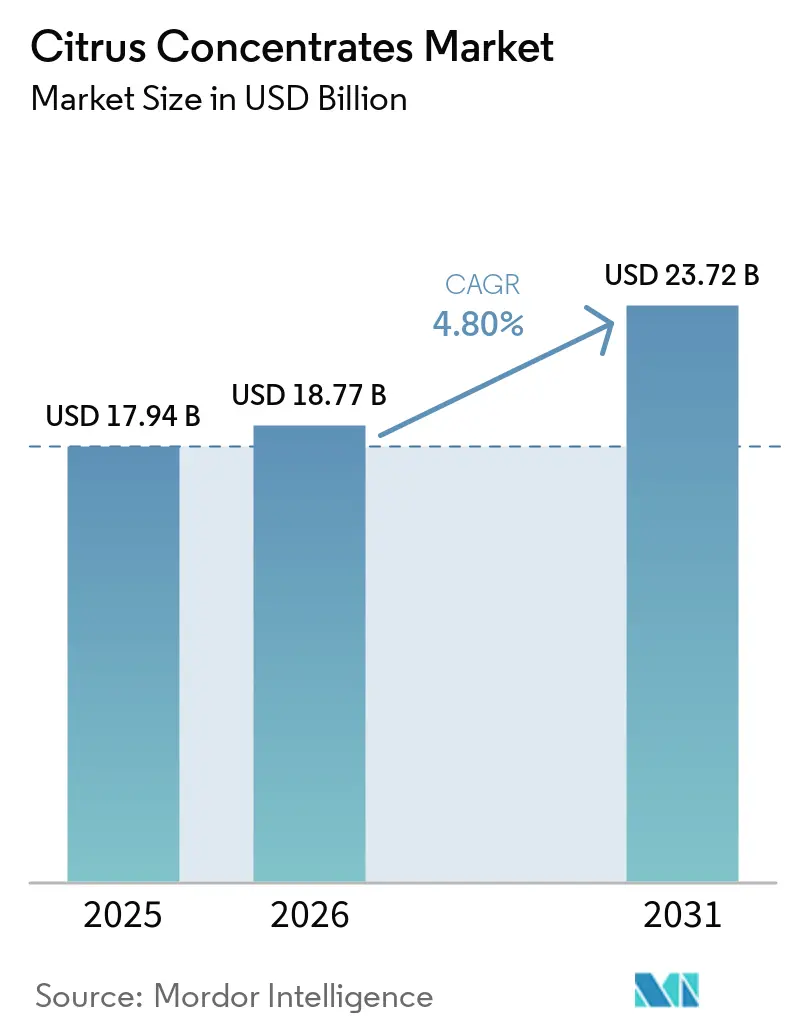
The citrus concentrates market size is expected to grow from USD 17.94 billion in 2025 to USD 18.77 billion in 2026 and is forecast to reach USD 23.72 billion by 2031 at a 4.80% CAGR over 2026-2031. The market is supported by the growing use of naturally derived citrus ingredients across food, beverage, and nutraceutical applications. Demand is also benefiting from the expansion of ready-to-drink and functional beverage products that require consistent, application-specific concentrate formulations. Processors are increasingly focusing on quality specifications, functional performance, and formulation consistency rather than competing primarily on commodity pricing. Sustainability initiatives and the recovery of valuable compounds from citrus processing by-products are further improving production efficiency and resource utilization. Continued product innovation, clean-label formulation, and broader applications across food and beverage products are expected to support steady market growth.
Key Report Takeaways
- By source, orange held 62.14% of the Citrus concentrates market share in 2025, while lemon and lime are forecast to grow at a 6.18% CAGR from 2026 to 2031.
- By nature, conventional concentrates held 85.83% of the Citrus concentrates market share in 2025, while organic concentrates are forecast to grow at a 6.57% CAGR from 2026 to 2031.
- By form, liquid concentrates held 90.76% of the Citrus concentrates market share in 2025, while dry and powdered formats are forecast to grow at a 5.34% CAGR from 2026 to 2031.
- By application, beverages held 67.28% of the Citrus concentrates market share in 2025, while nutraceuticals and dietary supplements are forecast to grow at a 6.73% CAGR from 2026 to 2031.
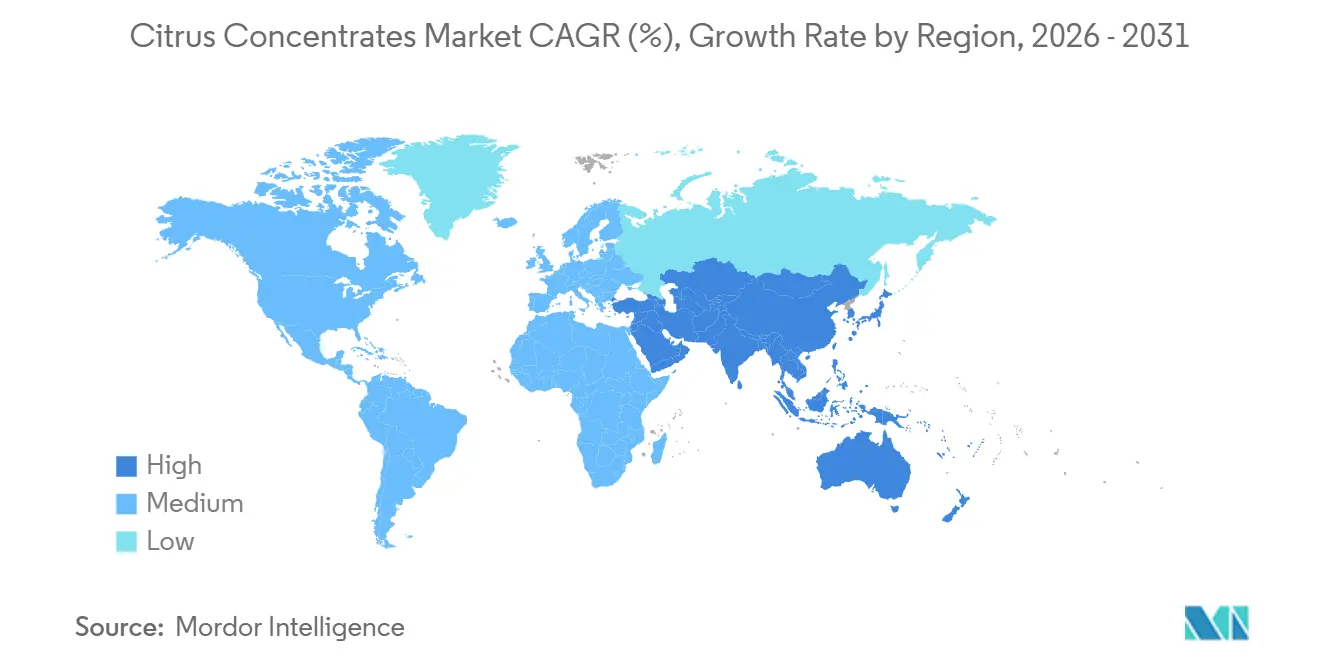
- By geography, North America held 30.87% of the Citrus concentrates market share in 2025, while Asia-Pacific is forecast to grow at a 6.21% CAGR from 2026 to 2031.
Note: Market size and forecast figures in this report are generated using Mordor Intelligence’s proprietary estimation framework, updated with the latest available data and insights as of January 2026.
Global Citrus Concentrates Market Trends and Insights
Drivers Impact Analysis*
| Driver | (~) % Impact on CAGR Forecast | Geographic Relevance | Impact Timeline |
|---|---|---|---|
| Natural and clean-label ingredient demand | +1.1% | Global | Short term (≤ 2 years) |
| Expansion of ready-to-drink and functional beverages | +1.2% | Global, with strongest momentum in Asia-Pacific and North America | Short term (≤ 2 years) |
| Growth in global citrus juice processing | +0.7% | South America, North America, Asia-Pacific | Medium term (2-4 years) |
| Broadening use of citrus concentrates in food applications | +0.6% | Global | Medium term (2-4 years) |
| Shelf-life and storage advantages of citrus concentrates | +0.5% | Global | Short term (≤ 2 years) |
| Citrus by-product valorization and circular ingredient demand | +0.4% | Europe core, spill-over to Brazil and South America | Long term (≥ 4 years) |
| Source: Mordor Intelligence | |||
Natural and Clean-Label Ingredient Demand
Growing consumer preference for natural and recognizable ingredients is encouraging food and beverage manufacturers to incorporate fruit-derived ingredients such as citrus concentrates in place of synthetic alternatives. The 2025 International Food Information Council (IFIC) Food & Health Survey found that 41% of Americans look for “natural” claims when purchasing food and beverages[1]Source: International Food Information Council, "2025 IFIC Food & Health Survey", ific.org. The same survey found that 48% check the ingredients list when deciding whether to purchase a food or beverage, highlighting the growing importance of ingredient transparency[2]Source: International Food Information Council, "2025 IFIC Food & Health Survey", ific.org. This shift is encouraging manufacturers to prioritize simpler ingredient profiles and recognizable fruit-based inputs, supporting the use of citrus concentrates across beverage and food formulations. As clean-label positioning becomes more prominent, citrus concentrates can provide recognizable fruit flavor while helping manufacturers meet consumer expectations for familiar and minimally processed ingredients.
Expansion of Ready-to-Drink and Functional Beverages
The expansion of ready-to-drink (RTD) and functional beverage formats is creating additional applications for citrus concentrates, as manufacturers respond to rising consumer interest in beverages that offer both refreshment and wellness benefits. The 2025 International Food Information Council (IFIC) Food & Health Survey found that 40% of Americans seek energy or reduced fatigue from foods, beverages, or nutrients, making it the most sought-after health benefit for the fourth consecutive year[3]Source: International Food Information Council, "2025 IFIC Food & Health Survey", ific.org. Digestive and gut health was sought by 37% of Americans, with demand for this benefit also increasing compared with 2022. This growing interest in energy, digestive health, immunity, and other functional benefits is encouraging manufacturers to develop more benefit-oriented beverage formulations. Citrus concentrates can support these products by providing recognizable fruit flavors and citrus-derived characteristics across a range of RTD and functional beverage applications.
Growth in Global Citrus Juice Processing
The continued expansion of citrus juice processing is supporting demand for citrus concentrates, as a larger share of citrus production is directed toward processed juice and ingredient applications. Citrus processing enables manufacturers to convert fruit into shelf-stable, standardized ingredients that can be used throughout the year, reducing dependence on fresh-fruit availability. Concentration also improves the efficiency of storage, transportation, and handling by substantially reducing the volume of water in processed juice. As juice processors increasingly serve beverage, food, and ingredient manufacturers, the need for consistent citrus-based inputs is creating additional applications for concentrates. This broader integration of citrus processing into the food and beverage supply chain is expected to support steady demand for citrus concentrates.
Broadening Use of Citrus Concentrates in Food Applications
The use of citrus concentrates is expanding beyond traditional juice and beverage applications into a wider range of food products, including bakery and confectionery, dairy products, sauces, dressings, and prepared foods. Citrus concentrates provide fruit flavor, acidity, aroma, and color, allowing manufacturers to incorporate citrus characteristics into different formulations. Their stability across processing conditions makes them suitable for products that undergo heating, freezing, mixing, or other industrial processes. This versatility is encouraging food manufacturers to incorporate citrus ingredients into new product formulations and flavor profiles. As product developers seek multifunctional fruit-based ingredients, the broader application base is expected to support demand for citrus concentrates across the food industry.
Restraints Impact Analysis*
| Restraint | (~) % Impact on CAGR Forecast | Geographic Relevance | Impact Timeline |
|---|---|---|---|
| Climate volatility and citrus greening | -1.4% | South America (Brazil), North America (Florida) | Short term (≤ 2 years) |
| Fructose and sugar-related health concerns | -0.7% | North America and Europe | Medium term (2-4 years) |
| Flavor degradation during storage and processing | -0.4% | Global | Medium term (2-4 years) |
| Geographic concentration of citrus processing and supply | -0.6% | Global, especially Europe and Asia importers | Long term (≥ 4 years) |
| Source: Mordor Intelligence | |||
Climate Volatility and Citrus Greening
Increasing climate volatility and the spread of citrus greening are creating supply-side challenges for citrus concentrate producers by affecting fruit yields, quality, and availability. Rising temperatures, irregular rainfall, drought, and extreme weather events place additional stress on citrus trees and disrupt cultivation and harvesting conditions. The United States Department of Agriculture (USDA) identifies citrus greening as one of the most serious citrus diseases globally, noting that infected trees progressively produce fewer, smaller, and lower-quality fruit before eventually dying. The disease has no known cure, requiring producers to rely on costly management and prevention measures. Together, these agricultural risks can reduce the availability of suitable fruit for processing, increase raw material procurement costs, and create greater volatility in concentrate production.
Fructose and Sugar-Related Health Concerns
Growing awareness of the health risks associated with high sugar intake is creating a restraint for citrus concentrates, particularly in beverages and other products where sugars become concentrated during formulation. The World Health Organization (WHO) recommends limiting free sugars to less than 10% of total daily energy intake, with a further reduction to below 5% providing additional health benefits. The WHO also classifies sugars naturally present in fruit juices and fruit juice concentrates, including fructose, as free sugars, distinguishing them from sugars naturally contained in whole fruits. These recommendations increase scrutiny of concentrated fruit ingredients and encourage manufacturers to manage sugar levels when developing citrus-based products. As consumers and regulators place greater emphasis on reducing excessive sugar consumption, the use of citrus concentrates in formulations where sugar reduction is a priority may be limited.
*Our forecasts treat driver/restraint impacts as directional, not additive. The impact forecasts reflect baseline growth, mix effects, and variable interactions.
Segment Analysis
By Source: Orange Anchors Value as Lemon/Lime Accelerates
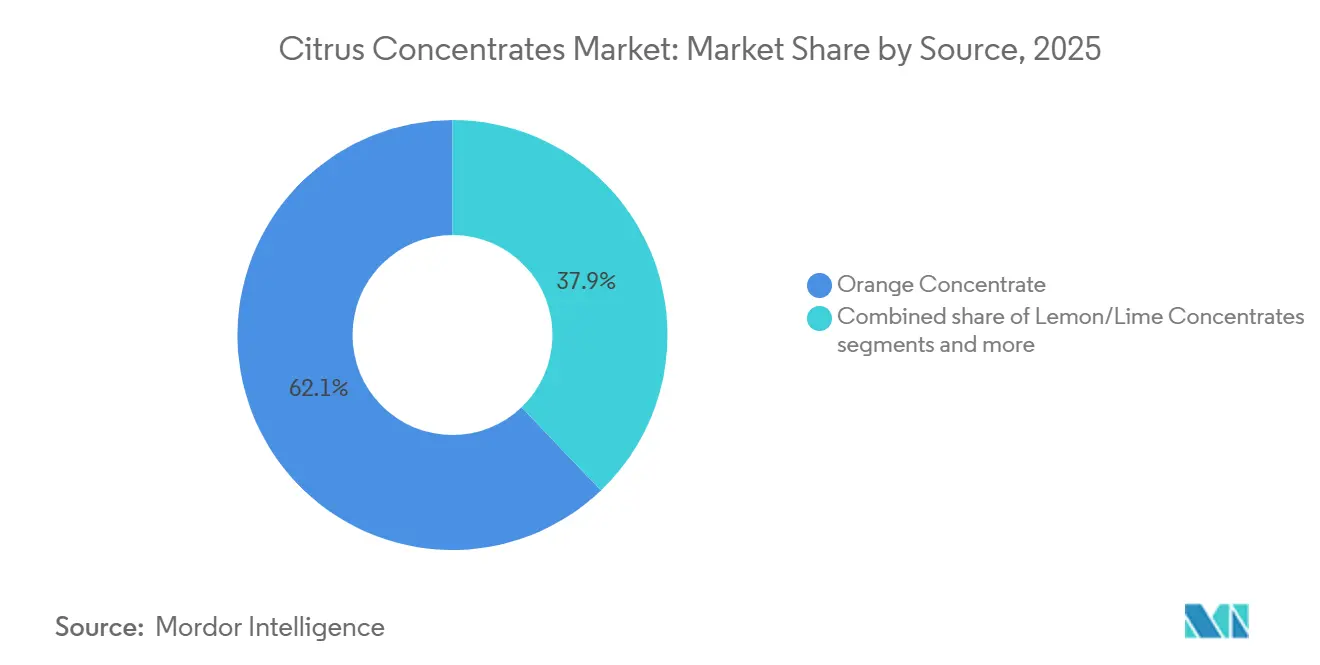
Orange concentrate accounted for 62.14% of the citrus concentrates market in 2025, driven by its extensive use across carbonated soft drinks, juice blends, dairy beverages, confectionery, and other food and beverage applications. Its established flavor profile, acidity, and broad formulation compatibility make it a widely used citrus ingredient, supported by established processing capabilities and supply chains that ensure consistent availability. The segment is expected to maintain its dominant position as demand remains broad-based across processed food and beverage applications.
Lemon/lime concentrates are expected to be the fastest-growing segment, registering a CAGR of 6.18% through 2031, driven by expanding applications in beverages, cocktail mixers, carbonated drinks, sauces, dressings, and culinary products. Their distinctive acidic and aromatic profiles make them suitable for both flavor enhancement and formulation purposes. Grapefruit, tangerine, and other specialty citrus concentrates serve more differentiated applications across food, beverages, and ingredient formulations, offering opportunities for product diversification within the market.



By Nature: Organic Premiumization Adds Margin to a Conventional-Led Base
Conventional concentrates accounted for 85.83% of the citrus concentrates market in 2025, making them the largest segment. Their dominance is supported by cost advantages, established processing infrastructure, and extensive use in large-scale juice and beverage production. Conventional concentrates are widely available and suitable for high-volume applications where consistent supply and production efficiency are key considerations. Their broad application base and established supply chains are expected to support continued demand during the forecast period.
Organic concentrates are projected to grow at a faster CAGR of 6.57% through 2031, driven by increasing demand for certified and clean-label ingredients across beverages, baby food, and dietary supplement applications. Growing consumer interest in organic and minimally processed products is encouraging manufacturers to expand their organic ingredient offerings. Organic citrus concentrates serve as a recognizable fruit-based ingredient for products positioned around natural and wellness-oriented attributes. However, certification and supply chain requirements can increase production complexity and costs compared with conventional concentrates.
By Form: Liquid Concentrates Lead on Scale, Dry Formats Target Specialty Channels
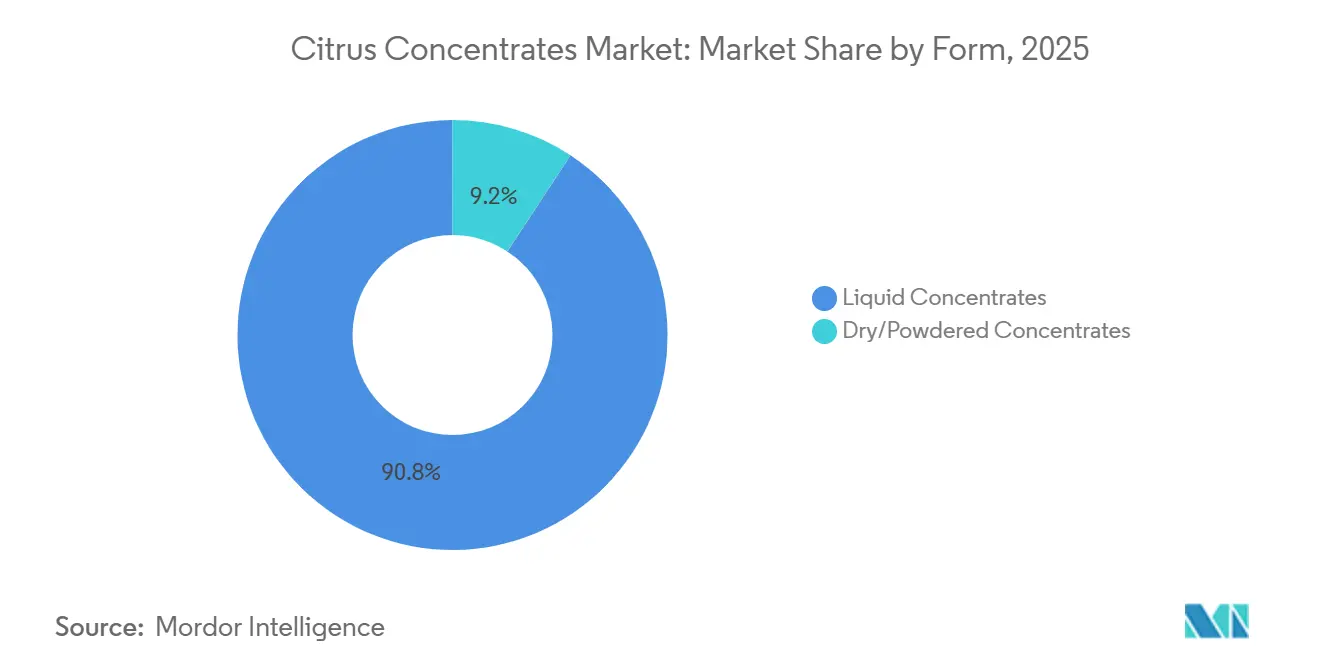
Liquid concentrates accounted for 90.76% of the citrus concentrates market in 2025, making them the largest segment. Their dominance is supported by their ease of integration into beverage formulations, where they provide consistent flavor, acidity, and soluble citrus components. Liquid formats are also compatible with established processing and handling systems used by large-scale food and beverage manufacturers. Their broad applicability across juice, beverage, dairy, and other liquid applications is expected to support continued segment demand.
Dry/powdered concentrates are expected to register the fastest CAGR of 5.34% through 2031, driven by growing demand for convenient, shelf-stable, and easily transportable citrus ingredients. These formats are particularly suited to applications where reduced storage requirements, precise dosing, and longer ambient shelf life are priorities. Increasing use in nutraceuticals, functional beverage mixes, foodservice products, and other powdered formulations is expanding their application base. Improvements in drying technologies are also helping preserve citrus flavor and functional characteristics, supporting wider adoption of powdered formats.
By Application: Beverages Lead by Share, Nutraceuticals Outpace on Growth
Beverages accounted for 67.28% of the citrus concentrates market in 2025, making them the largest application segment. This dominance is driven by the extensive use of citrus concentrates in juice, carbonated soft drinks, sports drinks, ready-to-drink beverages, and other liquid formulations. Citrus concentrates provide consistent flavor, acidity, and fruit characteristics, making them suitable for large-scale beverage production. The broad application base and continued product development across beverage categories are expected to support sustained demand.
Nutraceuticals and dietary supplements are expected to register the fastest CAGR of 6.73% through 2031, driven by growing interest in naturally derived citrus ingredients and bioactive compounds. Citrus-derived compounds such as hesperidin and naringin are increasingly incorporated into formulations targeting antioxidant and wellness benefits. The use of citrus ingredients in functional and health-oriented products is also expanding the application base beyond traditional food and beverage categories. This shift toward value-added formulations is expected to create additional opportunities for citrus concentrates in nutraceutical applications.
Geography Analysis
North America accounted for 30.87% of the citrus concentrates market in 2025, making it the largest regional market. Demand is supported by well-established juice and beverage processing industries, broad retail availability, and extensive use of citrus ingredients across beverages and processed foods. The United States represents the region's primary demand center, while Canada and Mexico contribute through their beverage, foodservice, and food-processing industries. Established distribution networks and cross-border trade further support the regional market.
Asia-Pacific is expected to be the fastest-growing regional market, registering a CAGR of 6.21% through 2031. Growth is driven by urbanization, rising disposable incomes, expanding modern retail, and increasing consumption of packaged and ready-to-drink beverages. China, India, Japan, South Korea, and Southeast Asian markets are contributing to regional demand as manufacturers broaden beverage portfolios and introduce more fruit-based and functional products. Increasing adoption of citrus flavors across beverages and processed foods is expected to create additional opportunities for concentrate suppliers.
South America remains an important region for the citrus concentrates market due to its significant citrus cultivation and processing base, particularly in Brazil and Argentina. Brazil is a major global source of orange juice and concentrate, while Argentina holds a strong position in lemon production and processing. The Middle East and Africa represent smaller but developing markets, supported by expanding beverage manufacturing, urbanization, and rising demand for packaged drinks. Improving food-processing infrastructure and retail development across several countries are expected to gradually increase regional consumption of citrus concentrates.

Competitive Landscape
The citrus concentrates market has a fragmented competitive landscape, with major players competing on product range, processing capabilities, supply chain integration, and relationships with food and beverage manufacturers. Louis Dreyfus Company B.V., Döhler GmbH, Citrosuco S.A., Prodalim Group, and LemonConcentrate S.L.U. are key participants with capabilities spanning citrus sourcing, processing, concentration, and ingredient supply. Their broad application coverage allows them to serve beverage, food, and industrial customers with varying concentrate specifications.
Leading players are increasingly focusing on vertical integration, product quality, and supply reliability to strengthen their market positions. Louis Dreyfus Company and Citrosuco benefit from extensive citrus sourcing and processing capabilities, while Döhler combines citrus ingredients with broader food and beverage solution capabilities. Prodalim focuses on citrus ingredients and concentrates across multiple applications, while LemonConcentrate specializes in lemon-based ingredients and concentrates, building a differentiated position within specific citrus categories.
Competition is also shaped by growing demand for application-specific formulations, consistent quality, and sustainable sourcing, rather than concentrate supply based solely on volume and price. Players are expanding their product portfolios and strengthening processing and sourcing capabilities to meet changing requirements from beverage, food, and ingredient manufacturers. This focus on specialization and supply chain reliability allows established suppliers to differentiate their offerings and support stronger relationships with downstream customers.
Citrus Concentrates Industry Leaders
-
Louis Dreyfus Company B.V.
-
Döhler GmbH
-
Citrosuco S.A.
-
Prodalim Group
-
LemonConcentrate S.L.U.
- *Disclaimer: Major Players sorted in no particular order

Recent Industry Developments
- July 2026: Acomo completed its acquisition of Citromil S.L., a Spanish organic citrus processor, on July 16, 2026. Citromil sources and processes lemon, mandarin, clementine, orange, pink grapefruit and lime and produces direct and concentrate juices, essential oils and other citrus-derived products. The business was integrated into Acomo's Tradin Organic subsidiary, expanding the group's citrus sourcing and processing capabilities and strengthening its position in organic citrus ingredients.
- December 2025: Citrosuco entered into a strategic partnership with PSP Investments, which joined Votorantim and Grupo Fischer as a shareholder with a significant minority stake. The partnership supports Citrosuco’s long-term growth in orange production and processing, diversification, innovation, and global competitiveness.
- January 2024: LDC and Invaio Sciences collaborated on a three-year initiative to mitigate Huanglongbing (HLB), or citrus greening, on LDC-managed farms in Brazil. The collaboration combines Invaio’s Trecise™ technology with LDC’s citrus-farming expertise to improve citrus crop health, yield, and longevity.


Global Citrus Concentrates Market Report Scope
The citrus concentrates market comprises concentrated citrus juice and citrus-derived ingredients produced by removing a portion of water from citrus juice to improve storage, transportation, and formulation efficiency. The citrus concentrates market is segmented by source (orange concentrate, lemon/lime concentrates, and more), nature (conventional and organic), form (liquid concentrates and powdered concentrates), application (beverages, bakery/confectionery, dairy/frozen desserts, and more), and geography (North America, Europe, Asia-Pacific, South America, Middle East and Africa). For each segment, the market sizing and forecasting have been done in value terms (USD billion).
| Orange Concentrate |
| Lemon/Lime Concentrates |
| Grapefruit Concentrate |
| Tangerine Concentrate |
| Other Citrus Concentrates |
| Conventional |
| Organic |
| Liquid Concentrates |
| Dry/Powdered Concentrates |
| Beverages |
| Bakery/Confectionery |
| Dairy/Frozen Desserts |
| Sauces, Dressings, and Condiments |
| Nutraceuticals/Dietary Supplements |
| Pharmaceutical Formulations |
| Personal Care/Cosmetics |
| Other Applications |
| North America | United States |
| Canada | |
| Mexico | |
| Rest of North America | |
| Europe | Germany |
| United Kingdom | |
| Italy | |
| France | |
| Spain | |
| Netherlands | |
| Poland | |
| Belgium | |
| Sweden | |
| Rest of Europe | |
| Asia-Pacific | China |
| India | |
| Japan | |
| Australia | |
| Indonesia | |
| South Korea | |
| Thailand | |
| Singapore | |
| Rest of Asia-Pacific | |
| South America | Brazil |
| Argentina | |
| Colombia | |
| Chile | |
| Peru | |
| Rest of South America | |
| Middle East and Africa | South Africa |
| Saudi Arabia | |
| United Arab Emirates | |
| Nigeria | |
| Egypt | |
| Morocco | |
| Turkey | |
| Rest of Middle East and Africa |
| By Source | Orange Concentrate | |
| Lemon/Lime Concentrates | ||
| Grapefruit Concentrate | ||
| Tangerine Concentrate | ||
| Other Citrus Concentrates | ||
| By Nature | Conventional | |
| Organic | ||
| By Form | Liquid Concentrates | |
| Dry/Powdered Concentrates | ||
| By Application | Beverages | |
| Bakery/Confectionery | ||
| Dairy/Frozen Desserts | ||
| Sauces, Dressings, and Condiments | ||
| Nutraceuticals/Dietary Supplements | ||
| Pharmaceutical Formulations | ||
| Personal Care/Cosmetics | ||
| Other Applications | ||
| By Geography | North America | United States |
| Canada | ||
| Mexico | ||
| Rest of North America | ||
| Europe | Germany | |
| United Kingdom | ||
| Italy | ||
| France | ||
| Spain | ||
| Netherlands | ||
| Poland | ||
| Belgium | ||
| Sweden | ||
| Rest of Europe | ||
| Asia-Pacific | China | |
| India | ||
| Japan | ||
| Australia | ||
| Indonesia | ||
| South Korea | ||
| Thailand | ||
| Singapore | ||
| Rest of Asia-Pacific | ||
| South America | Brazil | |
| Argentina | ||
| Colombia | ||
| Chile | ||
| Peru | ||
| Rest of South America | ||
| Middle East and Africa | South Africa | |
| Saudi Arabia | ||
| United Arab Emirates | ||
| Nigeria | ||
| Egypt | ||
| Morocco | ||
| Turkey | ||
| Rest of Middle East and Africa | ||


Key Questions Answered in the Report
What is the forecast for citrus concentrates through 2031?
The Citrus concentrates market is projected to rise from USD 18.77 billion in 2026 to USD 23.72 billion by 2031, at a 4.80% CAGR.
Which citrus source held the largest share in 2025?
Orange led with 62.14% in 2025 because it is widely used in juice, soft drinks, dairy beverages, and confectionery.
Which application is growing fastest through 2031?
Nutraceuticals/dietary supplements are forecast to grow at a 6.73% CAGR from 2026 to 2031.
Which region is expected to grow fastest?
Asia-Pacific is forecast to expand at a 6.21% CAGR from 2026 to 2031, supported by urbanization and ready-to-drink beverage demand
Page last updated on:


 Your data is secure and never sold or shared.


