
Lemon Compound Market Size and Share
Market Overview
| Study Period | 2021 - 2031 |
|---|---|
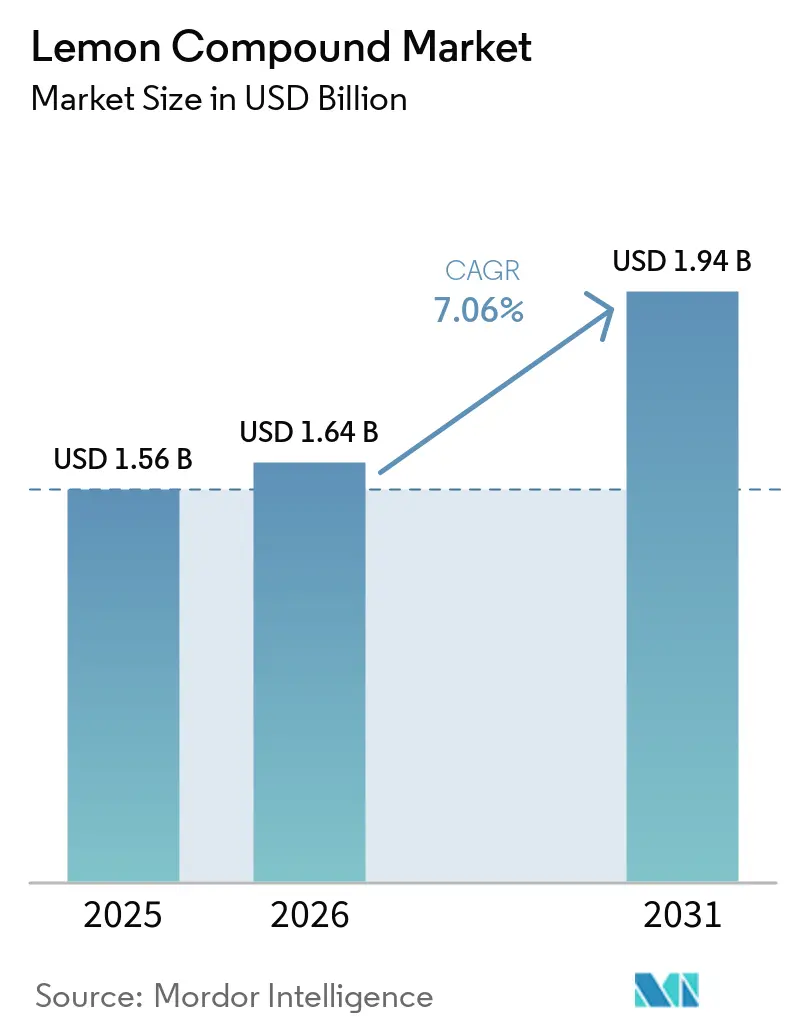
| Market Size (2026) | USD 1.64 Billion |
| Market Size (2031) | USD 1.94 Billion |
| Growth Rate (2026 - 2031) | 3.42 % |
| Fastest Growing Market | Asia-Pacific |
| Largest Market | Europe |
| Market Concentration | Medium |
Major Players *Disclaimer: Major Players sorted in no particular order Image © Mordor Intelligence. Reuse requires attribution under CC BY 4.0. | |
Lemon Compound Market Analysis by Mordor Intelligence
The lemon compounds market is expected to grow from USD 1.56 billion in 2025 to USD 1.64 billion in 2026, reaching USD 1.94 billion by 2031, at a CAGR of 3.42% during the 2026–2031 forecast period. Demand is shifting toward ingredients that provide a recognizable citrus profile and have a documented natural origin. Food and beverage producers remain the primary buyers, while functional nutrition, pharmaceutical, and personal care applications drive additional demand for citral, D-limonene, and related fractions. Increasing regulatory scrutiny of ingredient documentation is elevating the importance of traceability and supplier testing in purchasing decisions. The lemon compounds market also faces an uneven supply base, as weather conditions, disease outbreaks, and processing yields can rapidly affect the availability of lemon oil.
Key Report Takeaways
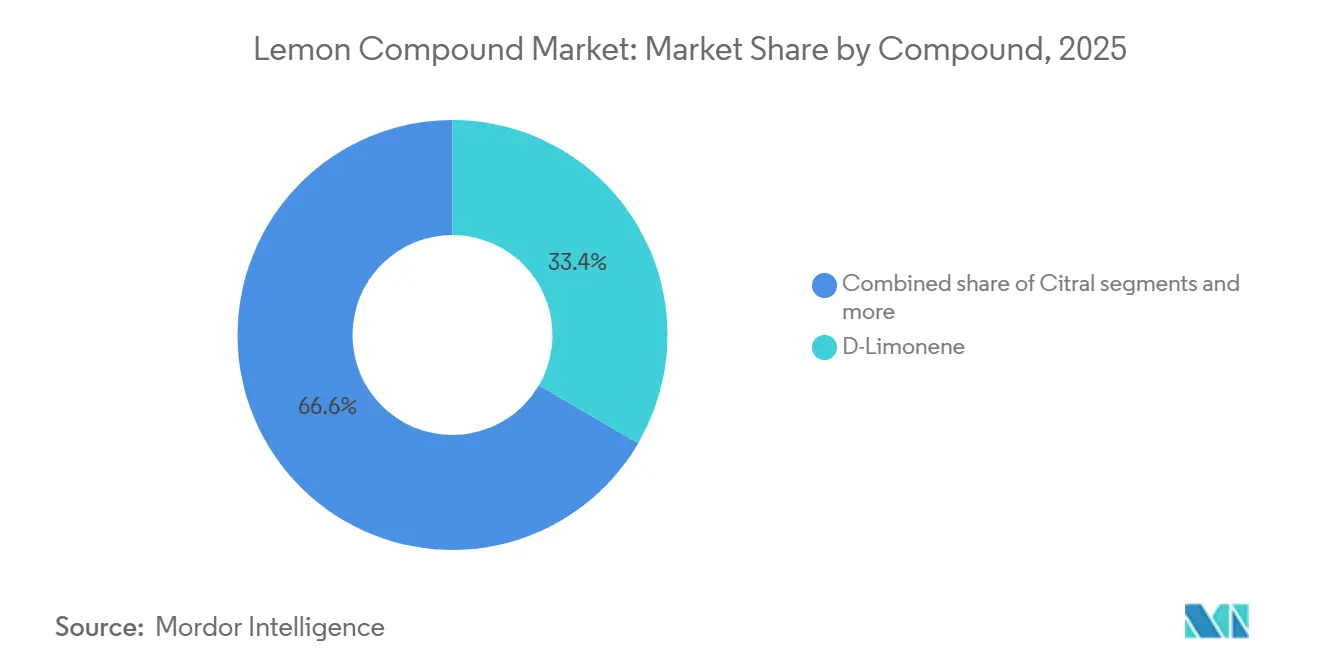
- By compound, D-limonene held 33.40% of the Lemon compounds market share in 2025, while citral is forecast to grow at a 4.12% CAGR through 2031.
- By source, natural compounds held 71.50% of the Lemon compounds market share in 2025, while synthetic compounds are forecast to expand at a 4.68% CAGR through 2031.
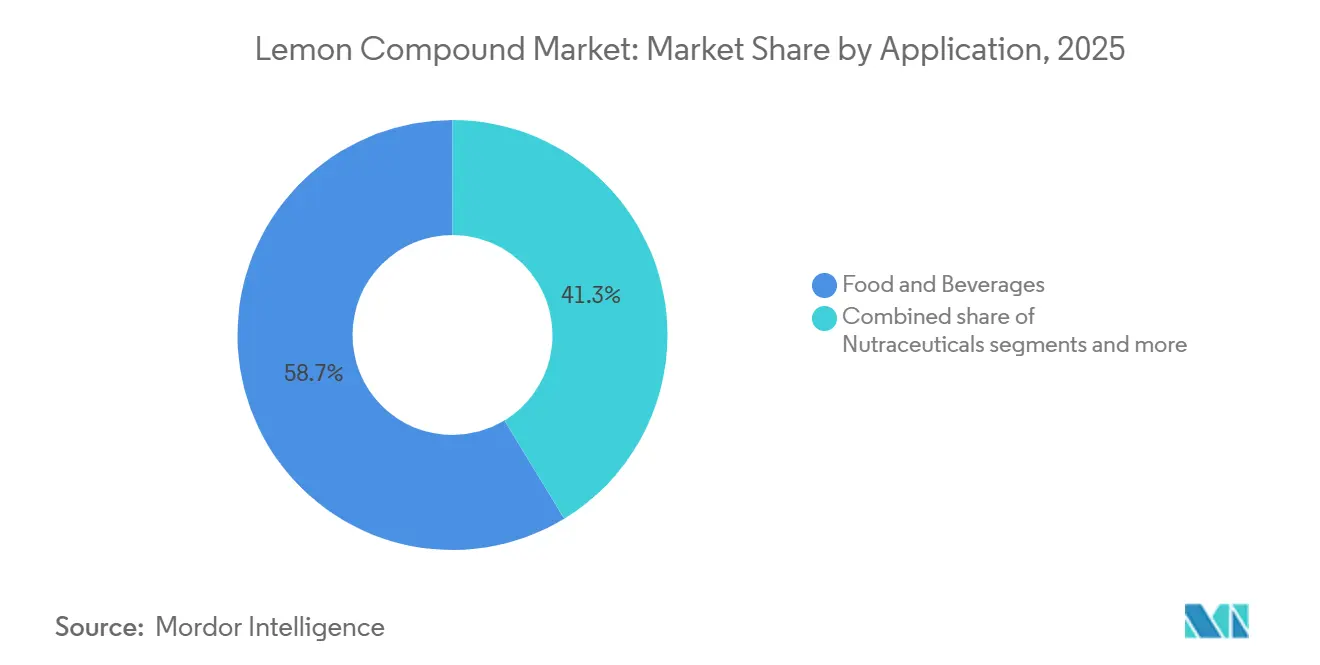
- By application, food and beverage accounted for 58.71% of the Lemon compounds market size in 2025, while nutraceuticals are forecast to grow at a 4.96% CAGR through 2031.
- By geography, Europe held 40.02% of revenue in 2025, while Asia-Pacific is forecast to grow at a 5.11% CAGR through 2031.
Note: Market size and forecast figures in this report are generated using Mordor Intelligence’s proprietary estimation framework, updated with the latest available data and insights as of January 2026.
Market Trends and Insights
Drivers Impact Analysis of Lemon Compound Market*
| Driver | (~) % Impact on CAGR Forecast | Geographic Relevance | Impact Timeline |
|---|---|---|---|
| Clean-Label Replacement of Synthetic Flavor Systems | +1.5% | North America and Europe, with Asia-Pacific spillover | Short term (≤ 2 years) |
| Expansion of Functional Beverages and Nutraceutical Delivery Formats | +1.2% | Global, strongest in North America and Asia-Pacific | Medium term (2-4 years) |
| Growing demand for processing-stable lemon compounds | +0.9% | Europe, North America, and Japan | Short term (≤ 2 years) |
| Citrus By-Product Valorization and Circular Ingredient Sourcing | +0.8% | Europe, Argentina, and Brazil | Long term (≥ 4 years) |
| Rising Demand for Customized Lemon Flavor Profiles | +0.6% | North America, Europe, and core Asia-Pacific markets | Medium term (2-4 years) |
| Advancements in Lemon Compound Extraction and Purification Technologies | +0.7% | Global, with the strongest advancements observed in North America, Europe, and Asia-Pacific. | Long term (≥ 4 years) |
| Source: Mordor Intelligence | |||
Clean-Label Replacement of Synthetic Flavor Systems
Clean-label replacement of synthetic flavor systems is gaining momentum as consumers increasingly prefer recognizable, minimally processed, and naturally derived ingredients. In response, food and beverage manufacturers are reducing their reliance on synthetic flavor systems and increasing the use of naturally derived lemon compounds and citrus fractions in product reformulation and new product development. Regulatory scrutiny of synthetic food ingredients further encourages manufacturers to reassess conventional flavor systems and evaluate natural alternatives. Lemon compounds support clean-label positioning by delivering recognizable, citrus-derived flavor profiles while maintaining the desired sensory characteristics of finished products.
Expansion of Functional Beverages and Nutraceutical Delivery Formats
The expansion of functional beverages and nutraceutical formulations is increasing demand for lemon-derived compounds, including D-limonene, citral, γ-terpinene, and β-pinene. Formulators seek customized lemon compound systems that provide specific aroma profiles, taste-masking properties, and formulation performance across beverages, nutrition products, and pharmaceutical applications. Citral delivers characteristic lemon notes, while D-limonene, γ-terpinene, and β-pinene provide complementary citrus and terpene characteristics. The development of liquid concentrates, powdered functional beverages, and nutraceutical premixes is driving demand for application-specific lemon compounds. This trend enables suppliers to differentiate through purity, compositional control, stability, and formulation compatibility.
Growing Demand for Processing-Stable Lemon Compounds
Food and beverage manufacturers increasingly seek lemon compounds that retain fresh, bright citrus characteristics throughout processing and storage. As beverages and other food products undergo heat treatment, formulation, and extended shelf-life processes, manufacturers require flavor systems that provide consistent lemon top notes in the finished product. This demand creates opportunities for suppliers to develop processing-stable lemon compounds with enhanced aroma retention and controlled profiles of terpenes and oxygenated compounds. Technologies such as supercritical carbon dioxide processing and specialized citrus fractionation help produce ingredients with targeted sensory characteristics and improved performance in demanding applications.
Citrus By-Product Valorization and Circular Ingredient Sourcing
Lemon processing residues, including peels, pomace, and seeds, are increasingly used to extract valuable compounds such as essential oils, pectin, polyphenols, and other citrus ingredients. Cascade processing and biorefinery approaches recover multiple products from these residues, improving resource utilization and generating higher-value outputs from the same raw material stream [1]. This trend is particularly relevant in major lemon-processing regions, such as Argentina, where substantial volumes of lemons are processed into juice, oil, and pulp. Recovering additional compounds helps manufacturers improve raw material utilization, reduce waste, diversify product portfolios, and support circular sourcing practices across the lemon compounds industry.
Restraints Impact Analysis of Lemon Compound Market*
| Restraint | (~) % Impact on CAGR Forecast | Geographical Relevace | Impact Timeline |
|---|---|---|---|
| Climate, Disease, and Seasonality-Driven Lemon Oil Supply Volatility | -1.4% | Global, especially the Mediterranean and the Americas | Short term (≤ 2 years) |
| Oxidation and Specification Variability in Natural Lemon Compounds | -0.8% | Global, with stronger relevance in the Mediterranean, the Americas, and Asia-Pacific. | Medium term (2-4 years) |
| Regionally Divergent Safety, Labeling, and Purity Requirements | -0.5% | North America and Europe, with expanding Asia-Pacific relevance | Medium term (2-4 years) |
| Synthetic and Biotechnology-Derived Substitution Pressure | -0.4% | Asia-Pacific, with Middle East and Africa spillover | Long term (≥ 4 years) |
| Source: Mordor Intelligence | |||
Climate, Disease, and Seasonality-Driven Lemon Oil Supply Volatility
Lemon oil supply remains vulnerable to climate variability, disease pressure, and seasonal fluctuations in lemon harvests across major producing regions. Changes in rainfall, temperature, flowering cycles, and fruit-set conditions can affect lemon yields and reduce the availability of peels for oil extraction. Extreme weather events, such as droughts, excessive rainfall, and frost, can further disrupt harvest volumes. Disease and pest pressures can also reduce orchard productivity, leading to uneven supply across sourcing origins. Because lemon oil production is closely linked to fruit-processing volumes, fluctuations in these volumes can affect the consistency and availability of raw materials used in lemon compound production.
Oxidation and Specification Variability in Natural Lemon Compounds
Natural lemon compounds vary in aroma, composition, and oxidative stability due to differences in cultivar, harvest timing, geographic origin, and processing conditions. Climate, soil conditions, extraction methods, and storage practices further influence the quality and sensory profile of these compounds. This variability makes it challenging for manufacturers to maintain consistent specifications, flavor profiles, and batch performance across product formulations. Consequently, suppliers must implement stricter quality control measures, analytical testing, traceability systems, and stabilization processes to ensure product consistency and shelf-life performance, which increases production costs.
*Our forecasts treat driver/restraint impacts as directional, not additive. The impact forecasts reflect baseline growth, mix effects, and variable interactions.
Lemon Compound Market Segment Analysis
By Compound:
D-Limonene Leads While Citral Gains ValueD-limonene accounted for 33.40% of revenue in 2025, driven by its widespread use in food and beverages, cosmetics, fragrances, and industrial applications. As a major component of citrus processing streams, D-limonene benefits from a broad supply base. Its use in citrus flavors, fragrances, and solvents also supports consistent demand. Citral is projected to grow at a 4.12% CAGR through 2031, outpacing the overall lemon compounds market. Its application in premium flavor profiles and pharmaceutical synthesis positions it as a higher-value ingredient, particularly for formulators requiring a strong lemon note with controlled terpene content. This demand drives fractionation, deterpenation, and tighter composition control, creating a clearer distinction between high-volume D-limonene and specialized citral-based ingredients.
Other lemon compounds, including γ-terpinene, β-pinene, β-myrcene, linalool, and geraniol, serve specialized applications in fragrances, cosmetics, aroma chemicals, and select pharmaceutical formulations. Their value depends on achieving specific aroma and functional profiles, while variations in raw materials and extraction methods can influence composition and consistency. These factors create opportunities for suppliers to provide targeted or full-spectrum fractions with controlled quality, traceable origins, and clearly defined functional properties. Growing interest in upcycled citrus materials and fermentation-based production may further expand the availability of specialty lemon compounds and support higher-value applications.

By Source:
Natural Ingredients Retain the Larger BaseNatural compounds are expected to account for 71.50% of revenue in 2025, driven by their authentic sensory profiles and alignment with clean-label product development. Growing consumer preference for recognizable ingredients and minimally processed formulations further supports demand for natural lemon compounds across end-use applications[2]. Cold-pressed and advanced extraction methods support natural positioning in premium food, beverage, and personal care products while helping manufacturers preserve the characteristic aroma and flavor profiles of lemons. These formulation requirements support the market size of natural lemon compounds; however, production remains dependent on crop conditions, seasonal availability, and processing capacity.
Synthetic lemon compounds are projected to grow at a CAGR of 4.68% through 2031, driven by their suitability for cost-sensitive, high-volume applications. These compounds offer a consistent supply and standardized composition when natural oil availability is limited or prices are volatile. Customers may select synthetic variants for industrial applications, pharmaceutical intermediates, and mass-market products where natural claims are not central to the brand proposition. Many manufacturers use both natural and synthetic compounds across product tiers. Natural ingredients support premium and clean-label positioning, while synthetic options help manage costs and supply requirements. Fermentation-derived compounds may further blur this distinction if regulations classify certain outputs as natural.
By Application:
Food and Beverage Holds Volume While Nutraceuticals Grow FasterFood and beverages accounted for 58.71% of lemon compounds revenue in 2025, driven by the widespread use of lemon compounds in beverages, juices, bakery products, confectionery, sauces, and prepared foods. Premium food and beverage formulations that require stable lemon flavor profiles further support demand for consistent supplies of D-limonene, citral, and concentrated citrus fractions. Nutraceuticals are projected to expand at a CAGR of 4.96% through 2031, making them the fastest-growing application segment. Manufacturers increasingly use lemon compounds in functional beverages, hydration products, vitamin supplements, protein products, and wellness products to enhance flavor and mask bitterness. Growth in this segment is increasing demand for traceable, stable, and specialized lemon ingredients.
Cosmetics represent a stable application segment for lemon compounds, particularly lemon oil and D-limonene[3]. Manufacturers use these compounds in fragrances, personal care products, and formulations that require citrus aroma profiles. Their fragrance and formulation properties support demand, although this segment remains smaller than the food and beverage segment. Pharmaceuticals and other applications generate more specialized demand, particularly for citral used in pharmaceutical synthesis and selected aroma-chemical applications. These applications typically require higher purity, consistent composition, and reliable specifications, creating opportunities for suppliers that offer controlled, traceable grades of lemon compounds.
Geography Analysis
Europe and APAC Lemon Compound Market
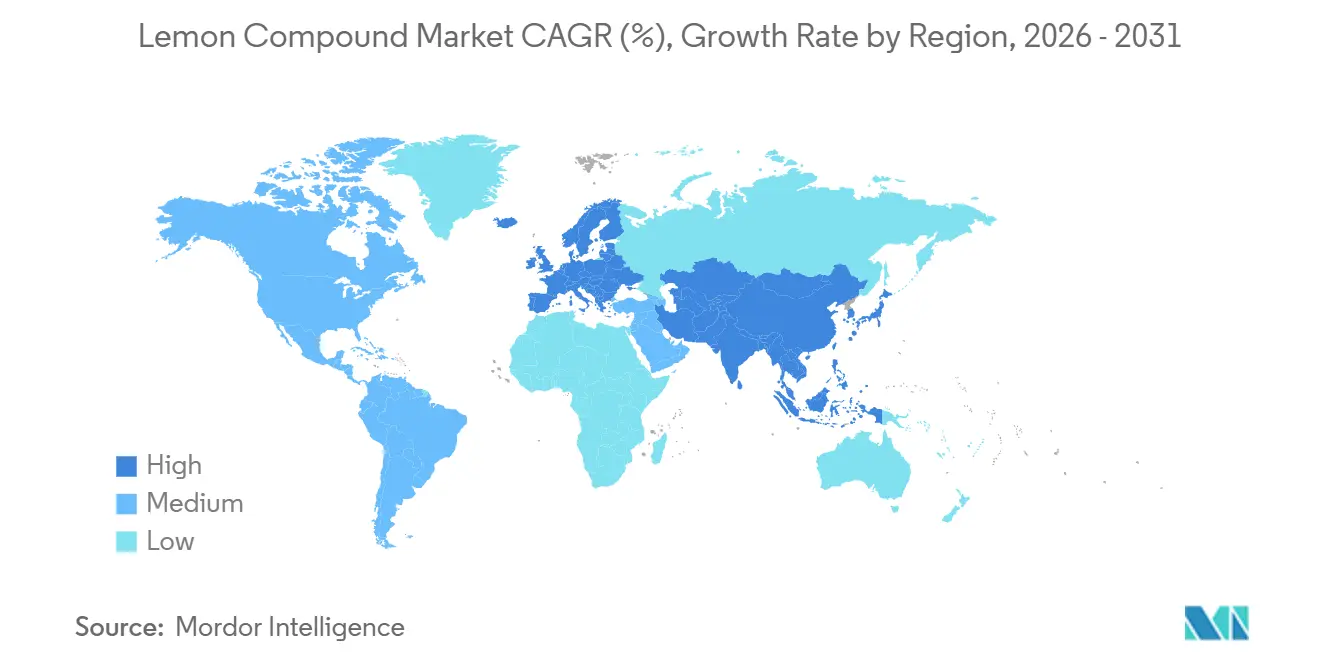
Europe accounted for 40.02% of revenue in 2025, making it the largest regional market for lemon compounds. Strong citrus processing activities in Spain and Italy, combined with established flavor and fragrance industries in France, Germany, and the United Kingdom, support regional demand. The region also shows a strong preference for traceability, natural sourcing, and consistent quality. However, fluctuations in European lemon production may affect the availability of raw materials. Asia-Pacific is projected to grow at a CAGR of 5.11% through 2031, making it the fastest-growing regional market. Growth is driven by the expansion of the packaged food, functional beverage, and personal care industries, as well as increasing local flavor production. Demand ranges from premium natural ingredients in Japan and Southeast Asia to cost-sensitive, standardized compounds in China, India, and Indonesia.
North America Lemon Compound Market
North America, comprising the United States, Canada, Mexico, and the Rest of North America, has an established demand base for lemon compounds across the food and beverage, cosmetics, fragrance, and personal care industries. The region’s demand is driven by the widespread use of lemon compounds in flavoring, household products, skincare formulations, and fragrance blends. The United States remains the primary market, supported by its large processed food and beverage industry and strong consumer demand for natural and citrus-based ingredients. Canada and Mexico contribute additional demand through growing consumer product manufacturing, flavor production, and expanding food processing activities. Suppliers benefit from diversified end-use demand across multiple industries but must compete on product consistency, quality, pricing, and the ability to meet evolving regulatory and sustainability requirements.
South America and MEA Lemon Compound Market
South America includes Brazil, Argentina, Colombia, Chile, Peru, and the Rest of South America. Argentina serves as a major lemon-processing and export hub for lemon oils, juice, and pulp, supported by its well-established citrus cultivation and processing infrastructure. Brazil provides additional citrus-processing capacity and supports the regional availability of ingredients, while Colombia, Chile, and Peru contribute to the supply of fruits and lemon-derived ingredients. The region’s position in the lemon compounds market is supported by its processing capabilities, export activity, and demand from the food, beverage, and personal care industries. The Middle East and Africa includes South Africa, Saudi Arabia, the United Arab Emirates, Nigeria, Egypt, Morocco, Turkey, and the Rest of the Middle East and Africa. The region represents a developing demand market, supported by the beverage, packaged food, hospitality, and personal care industries.
Competitive Landscape
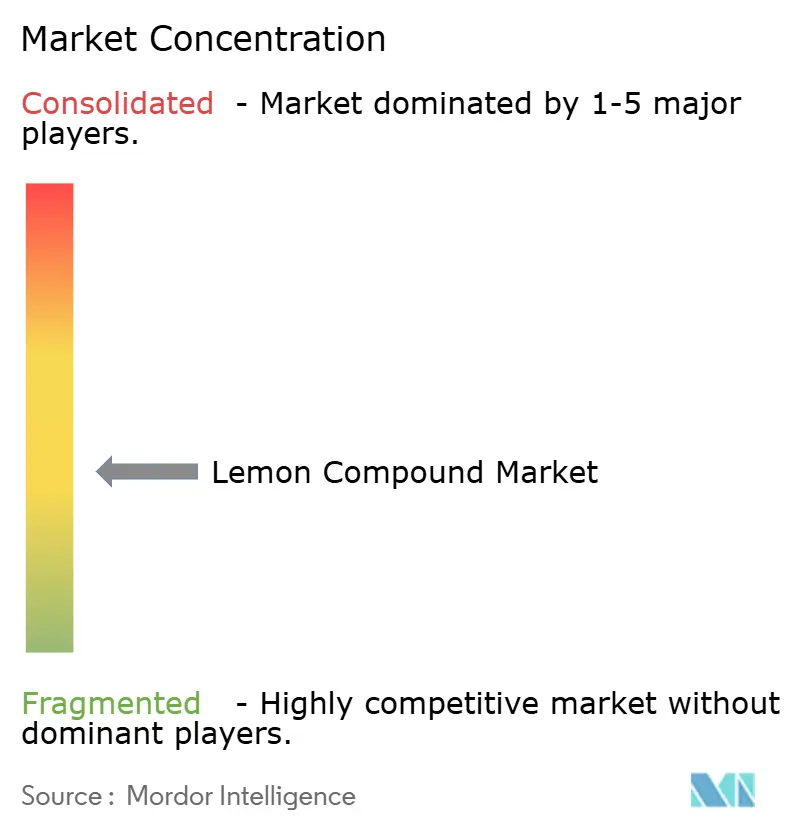
The lemon compounds market is fragmented, with competition spread across diversified multinational ingredient companies, vertically integrated citrus processors, and specialized flavor and fragrance suppliers. No single supplier holds a dominant position, while regional processors and mid-sized specialists support a broad competitive landscape. Citromax Group benefits from access to Argentina’s lemon-processing base, strengthening its control over raw material sourcing. Robertet, Bontoux, and other European specialists compete through botanical expertise, robust quality systems, and natural ingredient portfolios. Treatt has strengthened its position in specialty citrus ingredients through proprietary extraction platforms and application-focused products.
Technology, product formats, and application expertise are increasingly important factors for differentiation. Treatt’s launch of a powdered citrus extract demonstrates efforts to address demand for convenient handling and stable dry-blend applications. Robertet’s performance and growth in its flavors division also reflect continued investment in natural and specialty ingredients. Suppliers increasingly compete through extraction efficiency, encapsulation, analytical testing, sensory consistency, and the ability to provide application-specific formats. Smaller specialists and distributors remain competitive by serving niche requirements across food, beverage, fragrance, personal care, and industrial applications that may require greater customization than broad ingredient portfolios can provide.
Regional strategies contribute to the market’s fragmented competitive structure, as suppliers differentiate their offerings through sourcing practices, formulation expertise, and customer partnerships. European suppliers emphasize natural-origin products, documented sourcing, traceability, and technical compliance, particularly for applications subject to stringent regulatory and quality requirements. North American players focus on clean-label reformulation and collaborate with beverage and food manufacturers to develop application-specific ingredient solutions. ADM’s investment in its Erlanger facility supports demand for natural ingredient reformulation and expands its capacity to meet evolving customer requirements.
Lemon Compound Industry Leaders
-
Givaudan
-
IFF
-
dsm-firmenich
-
Symrise
-
Döhler
- *Disclaimer: Major Players sorted in no particular order
Lemon Compound Market Companies Covered in this Report
- Givaudan SA
- International Flavors and Fragrances Inc.
- dsm-firmenich
- Symrise AG
- Döhler Group
- Lionel Hitchen
- Citromax Group
- Treatt
- Robertet
- Takasago International
- Archer Daniels Midland Company
- Citrus Oleo
- Citrus & Allied Essences
- Berjé
- Ultra International
- Capol (Blue Pacific Flavors)
- Carbery Group (Synergy Flavors)
- Ernesto Ventós
- Bontoux
- Azelis Group (Vigon)
Recent Industry Developments in Lemon Compound Market
- April 2026: Treatt launched powdered citrus solutions that deliver stable, authentic citrus flavor in a convenient dry format. These solutions address stability, solubility, clean-label requirements, and the ease of handling citrus flavor ingredients.
- June 2025: Lemon Republic introduced a proprietary lemon peel oil aroma-refill technique that captures aromatic oils released during juicing and reintroduces them into the mix to enhance lemon flavor.
Global Lemon Compound Market Report Scope
The lemon compounds market encompasses the production and sale of D-Limonene, Citral, γ-Terpinene, β-Pinene, and other lemon-derived compounds from natural and synthetic sources. These compounds serve as flavoring agents, fragrances, active ingredients, solvents, and formulation components across food and beverage, cosmetics, pharmaceuticals, nutraceuticals, household care, and other industrial applications. The market includes both citrus-derived and synthetic lemon compounds, with demand influenced by consumer preferences for natural ingredients, product innovation, and regulatory requirements. It analyzes demand, supply, pricing, and formulation trends across key end-use industries.
Segmentation Overview
| D-Limonene |
| Citral |
| γ-Terpinene |
| β-Pinene |
| Others |
| Natural |
| Synthetic |
| Food and Beverage |
| Cosmetics |
| Pharmaceuticals |
| Nutraceuticals |
| Others |
| North America | United States |
| Canada | |
| Mexico | |
| Rest of North America | |
| Europe | United Kingdom |
| Germany | |
| France | |
| Italy | |
| Spain | |
| Netherlands | |
| Poland | |
| Belgium | |
| Sweden | |
| Rest of Europe | |
| Asia-Pacific | China |
| Japan | |
| India | |
| Australia | |
| Indonesia | |
| South Korea | |
| Thailand | |
| Singapore | |
| Rest of Asia-Pacific | |
| South America | Brazil |
| Argentina | |
| Colombia | |
| Chile | |
| Peru | |
| Rest of South America | |
| Middle East and Africa | South Africa |
| Saudi Arabia | |
| United Arab Emirates | |
| Nigeria | |
| Egypt | |
| Morocco | |
| Turkey | |
| Rest of Middle East and Africa |
| By Compound | D-Limonene | |
| Citral | ||
| γ-Terpinene | ||
| β-Pinene | ||
| Others | ||
| By Source | Natural | |
| Synthetic | ||
| By Application | Food and Beverage | |
| Cosmetics | ||
| Pharmaceuticals | ||
| Nutraceuticals | ||
| Others | ||
| By Geography | North America | United States |
| Canada | ||
| Mexico | ||
| Rest of North America | ||
| Europe | United Kingdom | |
| Germany | ||
| France | ||
| Italy | ||
| Spain | ||
| Netherlands | ||
| Poland | ||
| Belgium | ||
| Sweden | ||
| Rest of Europe | ||
| Asia-Pacific | China | |
| Japan | ||
| India | ||
| Australia | ||
| Indonesia | ||
| South Korea | ||
| Thailand | ||
| Singapore | ||
| Rest of Asia-Pacific | ||
| South America | Brazil | |
| Argentina | ||
| Colombia | ||
| Chile | ||
| Peru | ||
| Rest of South America | ||
| Middle East and Africa | South Africa | |
| Saudi Arabia | ||
| United Arab Emirates | ||
| Nigeria | ||
| Egypt | ||
| Morocco | ||
| Turkey | ||
| Rest of Middle East and Africa | ||
Key Questions Answered in the Report
What is the market size for lemon compounds market?
The lemon compounds market was valued at approximately USD 1.53 billion in 2025 and reached USD 1.64 billion in 2026. It is projected to reach USD 1.94 billion by 2031, registering a CAGR of 3.42% during the forecast period (2026–2031).
Which application is growing fastest?
Nutraceuticals are forecast to grow at an 4.96% CAGR through 2031, supported by immunity, hydration, and wellness formats.
Why is Europe important for lemon ingredients?
Europe held 40.02% of revenue in 2025 and combines citrus supply, flavor and fragrance manufacturing, and strict traceability requirements.
What is the main supply risk for lemon oil?
Weather events, disease, and lower crop output can restrict lemon availability and increase costs for processors and flavor suppliers.