
Chocolate Confectionery Market Size and Share
Market Overview
| Study Period | 2021 - 2031 |
|---|---|
| Market Size (2026) | USD 123.53 Billion |
| Market Size (2031) | USD 172.39 Billion |
| Growth Rate (2026 - 2031) | 6.89 % |
| Fastest Growing Market | Asia-Pacific |
| Largest Market | North America |
| Market Concentration | Medium |
Major Players *Disclaimer: Major Players sorted in no particular order Image © Mordor Intelligence. Reuse requires attribution under CC BY 4.0. | |
Chocolate Confectionery Market Analysis by Mordor Intelligence
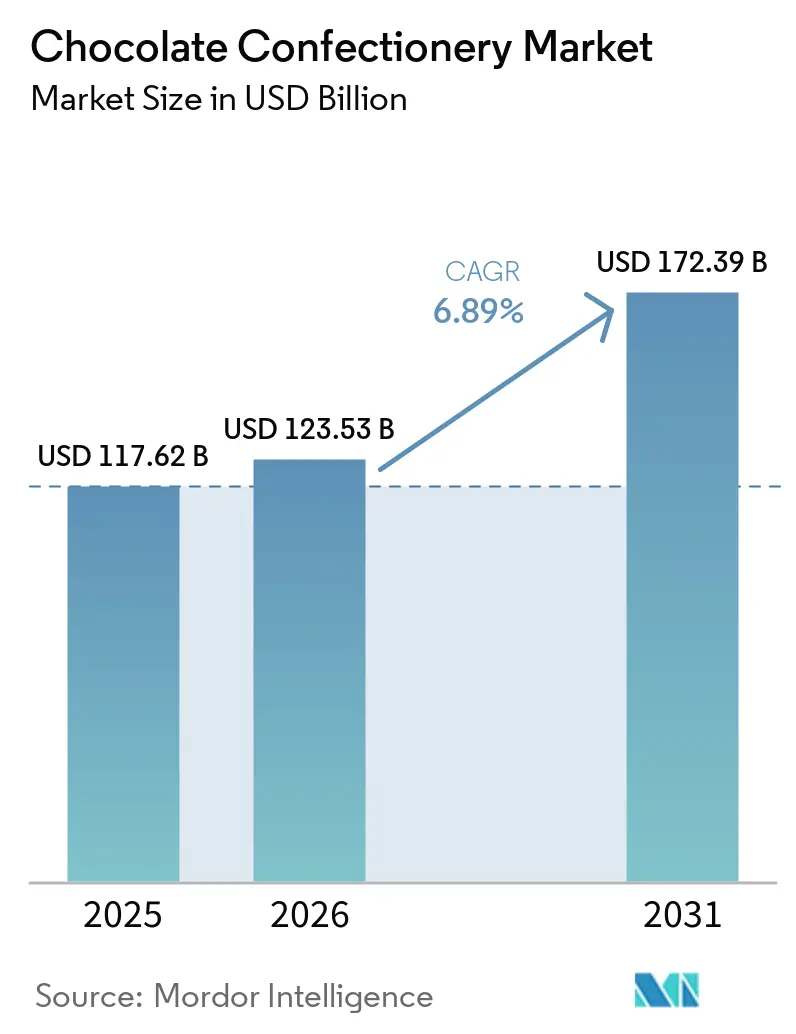
The Chocolate confectionery market size was valued at USD 117.62 billion in 2025 and estimated to grow from USD 123.53 billion in 2026 to reach USD 172.39 billion by 2031, at a CAGR of 6.89% during the forecast period (2026-2031). Premium products, reduced-sugar recipes, and high-cacao offerings are supporting value growth across the Chocolate confectionery market. Gifting remains a dependable source of demand, particularly during seasonal celebrations and premium occasions. In established markets, revenue can rise even when unit sales decline, which increases the value of strong brands, product quality, and targeted distribution. Cocoa supply pressures are encouraging manufacturers to diversify sourcing, improve traceability, and assess cocoa alternatives. The Chocolate confectionery market is separating between premium products that gain new buyers and mainstream products facing price sensitivity, reformulation concerns, and changing eating habits.
Key Report Takeaways
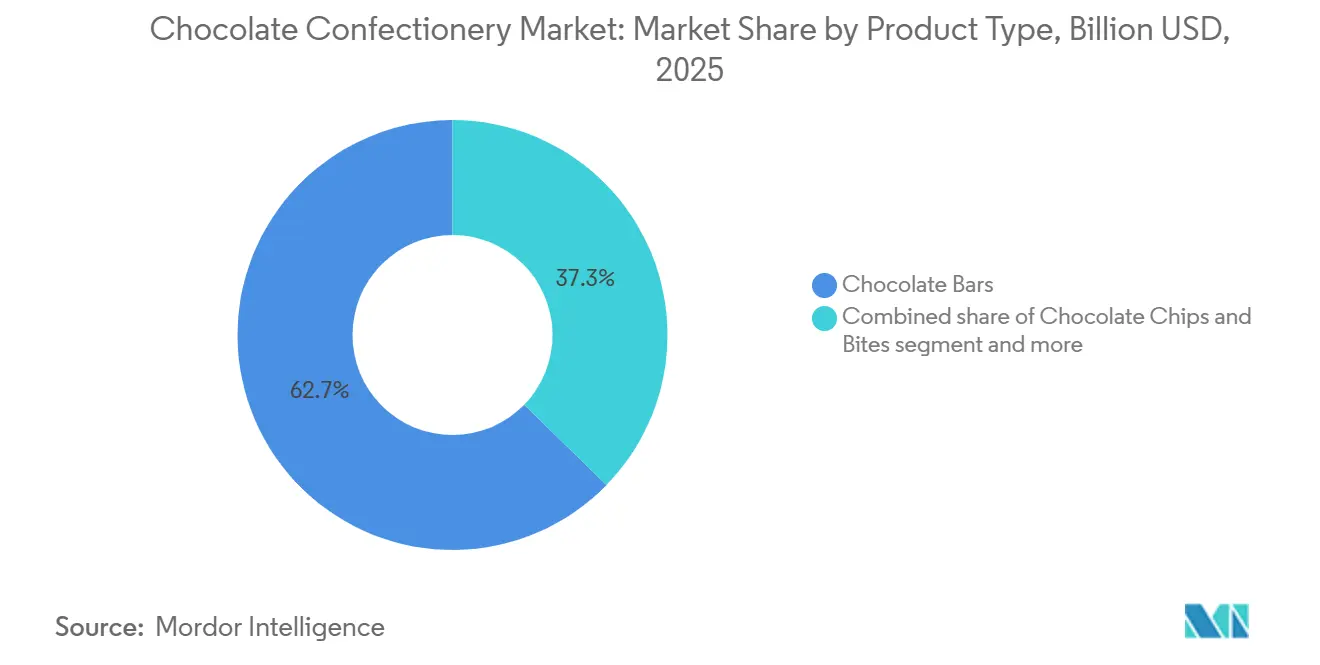
- By product type, chocolate bars held 62.71% of the Chocolate confectionery market share in 2025, while chocolate chips and bites are forecast to grow at a 7.46% CAGR through 2031.
- By chocolate type, milk chocolate accounted for 48.62% of the Chocolate confectionery market share in 2025, while dark chocolate is forecast to expand at an 8.11% CAGR through 2031.
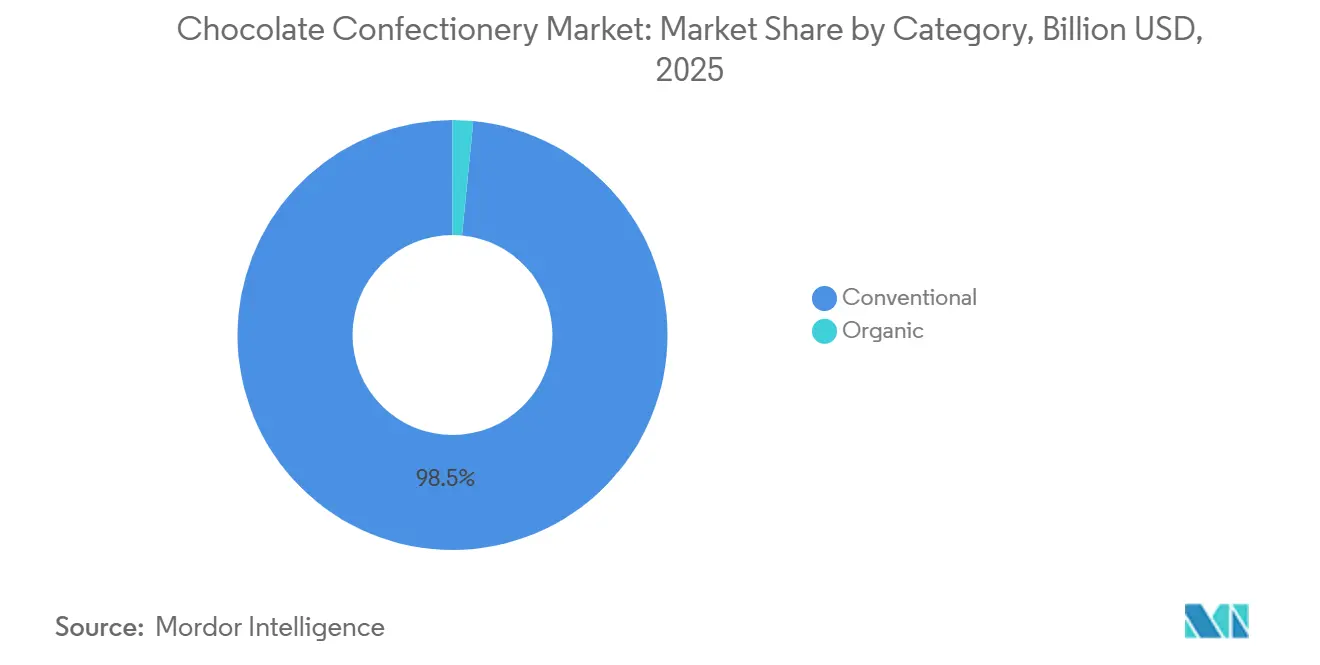
- By category, conventional products accounted for 98.47% of the market in 2025, while organic chocolate confectionery is forecast to grow at a 7.98% CAGR through 2031.
- By distribution channel, retail held 88.13% of the market in 2025, while foodservice is forecast to grow at a 7.51% CAGR through 2031.
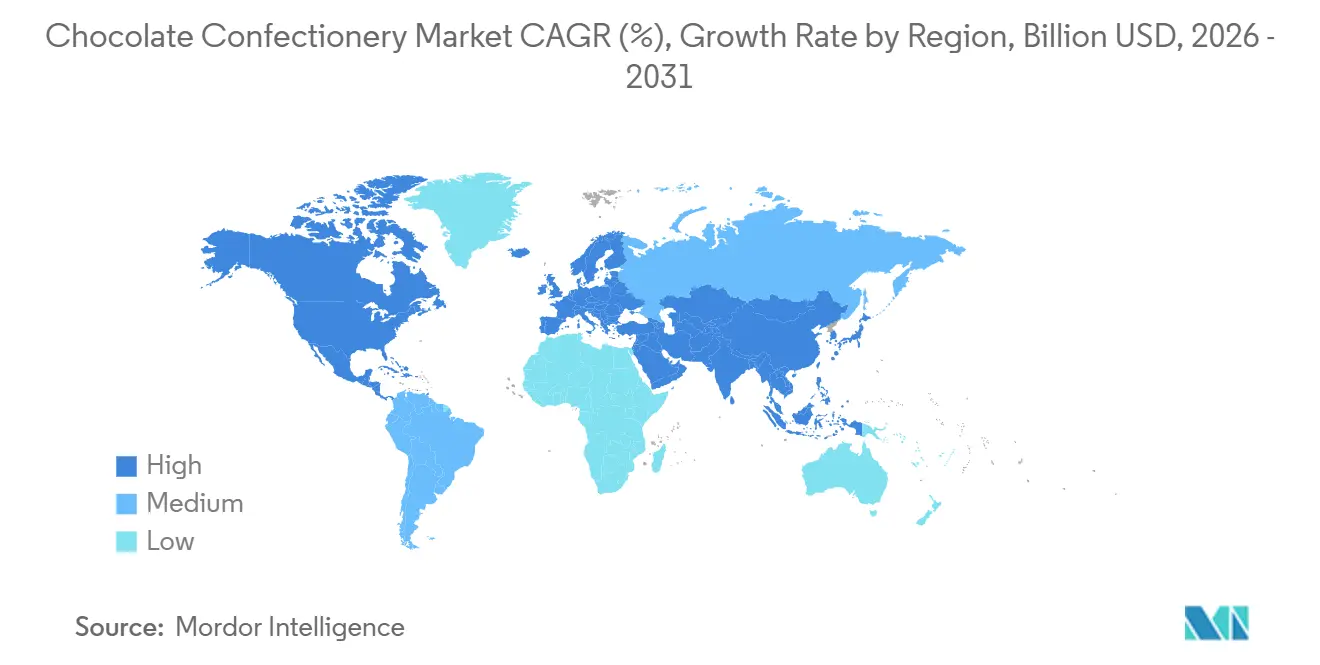
- By geography, North America held 33.90% of the market in 2025, while Asia-Pacific is forecast to expand at a 7.82% CAGR through 2031.
Note: Market size and forecast figures in this report are generated using Mordor Intelligence’s proprietary estimation framework, updated with the latest available data and insights as of January 2026.
Market Trends and Insights
Drivers Impact Analysis of Chocolate Confectionery Market*
| Driver | (~) % Impact on CAGR Forecast | Geographic Relevance | Impact Timeline |
|---|---|---|---|
| Growing demand for premium and artisanal chocolates | +1.8% | Global, concentrated in North America and Europe | Medium term (2-4 years) |
| Rising consumer preference for dark chocolate products | +1.2% | Global | Long term (≥ 4 years) |
| Increasing demand for plant-based and vegan chocolates | +0.5% | North America, Europe, and the Asia-Pacific | Medium term (2-4 years) |
| Expansion of healthier chocolate and reduced-sugar formulations | +0.6% | Global, the strongest uptake in North America and Europe | Long term (≥ 4 years) |
| Growing chocolate gifting and seasonal consumption occasions | +0.9% | Global, peak impact in North America and Europe | Short term (≤ 2 years) |
| Increasing product innovation through flavors and textures | +0.6% | Global | Short term (≤ 2 years) |
| Source: Mordor Intelligence | |||
Growing demand for premium and artisanal chocolates
Premiumization has moved from a niche positioning strategy to the dominant commercial driver across the chocolate confectionery market. Super-premium chocolate is the only price tier growing in both dollars and units, and it achieves this growth by attracting new buyers into the category rather than simply converting existing ones, a structural advantage that volume-oriented mainstream tiers cannot replicate through price adjustments alone. Super-premium buyers average just 4 retail trips per year, which elevates the strategic importance of in-store execution, packaging distinctiveness, and digital discovery at each of those moments. In Germany, a majority of consumers now prefer smaller quantities of higher-quality chocolate, confirming that a "less but better" philosophy is reshaping purchasing patterns in Europe's largest chocolate market. Brands that anchor on single-origin storytelling, craft production methods, and verifiable ingredient transparency are systematically gaining margin that commodity-positioned products cannot access.
Rising consumer preference for dark chocolate products
Dark chocolate's repositioning as a functional food product, not merely an indulgent one, is expanding its addressable market well beyond health-enthusiast cohorts. Research published in the European Journal of Microbiology and Immunology (2025) confirmed that cocoa-derived polyphenols and methylxanthines effectively modulate inflammatory responses and support vascular and metabolic outcomes, reinforcing a body of clinical evidence that manufacturers increasingly reference in product positioning[1]Source: Ágnes Fazekas et al., “Come to the Dark Side, A Review on the Health-Beneficial and Disease-Alleviating Effects of Cocoa-Rich Dark Chocolate,” European Journal of Microbiology and Immunology, akjournals.com.. Cleveland Clinic registered dietitians publicly recommended a minimum 70% cocoa content to access health benefits, while noting that theobromine, a naturally occurring cocoa compound now linked to anti-aging effects in preliminary research, is opening a new product narrative for older consumer cohorts previously underserved by chocolate marketing. Dark chocolate products recorded 9.1% year-over-year growth in 2025 globally, outpacing total category growth by a significant margin. Lindt's 2025 launch of EXCELLENCE Fusion, a dual-layer dark-and-milk chocolate tablet, is strategically designed to lower the taste barrier to dark chocolate adoption without diluting the brand's premium positioning, illustrating how market leaders are engineering accessible on-ramps to the high-cacao segment.
Increasing demand for plant-based and vegan chocolates
The structural demand base for plant-based and vegan chocolate is more durable than consumer-trend cycles suggest. The National Institutes of Health estimates that approximately 68% of the global population has some form of lactose intolerance, creating a physiological demand for dairy-free confectionery that persists irrespective of lifestyle trends or cultural attitudes toward veganism[2]Source: National Institute of Diabetes and Digestive and Kidney Diseases, “Lactose Intolerance,” National Institutes of Health, niddk.nih.gov.. Puratos' Taste Tomorrow research (2026) found that 61% of consumers choose plant-based chocolate primarily for its environmental credentials, with search interest in "vegan chocolate brands" rising 38% and "plant-based chocolate" rising 60% year-on-year. The EU Deforestation Regulation, effective December 2024, has inadvertently accelerated investment in cocoa-free formulations, as brands unable to trace cocoa to verified non-deforested origins are pivoting to plant-derived alternatives. Barry Callebaut's long-term commercial partnership with Planet A Foods, announced in 2025, to distribute the ChoViva cocoa-free alternative globally, signals that the ingredient-supply infrastructure for cocoa-free chocolate is moving from experimental to commercial scale, a critical threshold that precedes mainstream market adoption.
Growing chocolate gifting and seasonal consumption occasions
Chocolate's role in gifting generates a demand floor that is meaningfully insulated from economic cycles. The National Confectioners Association's (NCA) 2025 State of Treating report recorded combined US seasonal confectionery sales of approximately USD 25.7 billion across Valentine's Day (USD 5.5 billion), Easter (USD 5.3 billion), Halloween (USD 7.4 billion), and Winter Holidays (USD 7.5 billion) in 2024, with approximately 9 in 10 US consumers purchasing confectionery during holiday periods. What is less discussed is that the gifting occasion is now the primary commercial context in which texture-led innovation travels fastest. The Dubai chocolate trend, pistachio cream and toasted kataifi in a premium shell, migrated from artisan boutiques in the UAE to global retail shelves in under 18 months, driven by social media discovery at gift-purchase moments. Mexico's confectionery industry association ASCHOCO projects an 8.3% revenue increase for the domestic market in 2026, with Valentine's Day alone accounting for 10% of annual industry sales, a pattern that mirrors and amplifies the global gifting dynamic with Latin American seasonal intensity, pointing to South America as an underappreciated gifting-occasion growth market.
Restraints Impact Analysis of Chocolate Confectionery Market*
| Restraint | (~) % Impact on CAGR Forecast | Geographic Relevance | Impact Timeline |
|---|---|---|---|
| High cocoa prices increasing chocolate production costs | -0.4% | Global | Short term (≤ 2 years) |
| Climate change threatening global cocoa supply stability | -0.3% | West Africa primarily, with global import market spillover | Long term (≥ 4 years) |
| Rising consumer health concerns about sugar consumption | -0.2% | Developed markets: North America and Europe | Long term (≥ 4 years) |
| Increasing regulatory scrutiny of sugar and labeling | -0.1% | The United States and United Kingdom | Long term (≥ 4 years) |
| Source: Mordor Intelligence | |||
High cocoa prices increasing chocolate production costs
After reaching record highs in 2024, cocoa futures fell to approximately USD 3,000 per metric ton by early 2026, roughly 70% below the April 2024 peak, according to CNBC, but the consumer price pass-through has proven far stickier than the spot-price decline implies. Barry Callebaut's H1 FY2024/25 results reported that cocoa prices had risen 95% year-on-year and that market disruption contributed to a 4.7% decline in total sales volumes in its Global Cocoa business. US chocolate prices remained 14% higher year-on-year in early 2026 compared to the same period in 2025, while German chocolate prices rose 18.9% in 2025, dynamics driven by hedging cycles where manufacturers locked in contracts at peak rates and are continuing to pass costs downstream. The structural issue is that even with spot-price normalization, the industry has absorbed significant margin erosion, and the confirmed El Niño weather pattern for 2026 and 2027 introduces renewed downside supply risk. Manufacturers are responding through reformulation, reducing cocoa content, resizing portion formats, and investing in cocoa alternatives, strategies that, if overused, risk the consumer trust backlash already experienced by Hershey in 2026.
Climate change threatening global cocoa supply stability
The climate threat to cocoa supply is structural and long-cycle, which makes it fundamentally different in nature from cyclical price volatility. Climate Central's 2025 analysis found that human-caused climate change added approximately 40 days per year with daily maximum temperatures above 90°F (32°C) in cacao-growing regions of both the Ivory Coast and Ghana over the past decade, heat levels that directly reduce harvest quality and yield[3]Source: Climate Central, “Climate and Cocoa 2025,” Climate Central, climatecentral.org.. Ivory Coast and Ghana together account for over half of global cocoa production; 28 of the 44 analyzed cacao-producing areas saw at least 6 additional weeks of cacao-limiting heat annually due to climate change. Reuters reported in July 2025 that West Africa is on course for a 10% output decline in the 2025/26 season, reversing earlier forecasts of a 5% recovery, with the Ivory Coast's output tracking toward 1.6 million metric tons, down from over 2 million metric tons five years earlier, and Ghana's production hovering near 500,000 metric tons. Aging tree stocks (approximately 70% of the Ivory Coast's plantations exceed productive age) and illegal gold mining that destroys cocoa fields compound climate-driven yield loss in ways that price signals cannot resolve quickly. The EU Deforestation Regulation adds a compliance dimension: manufacturers unable to verify that cocoa originates from non-deforested land face import restrictions, incentivizing a shift to certified-traceable and organic supply chains as a dual business and regulatory response.
*Our forecasts treat driver/restraint impacts as directional, not additive. The impact forecasts reflect baseline growth, mix effects, and variable interactions.
Chocolate Confectionery Market Segment Analysis
By Product Type:
Bars Dominate Volume, Bite-Sized Formats Reshape OccasionsChocolate Bars account for 62.71% of the chocolate confectionery market in 2025, a dominance reflecting the format's universal versatility across impulse purchase, gifting, and household consumption contexts. However, that share is under structural pressure as consumption occasions fragment: younger demographics increasingly prefer smaller, portion-controlled formats that align with mindful eating habits and on-the-go snacking. Chocolate Chips and Bites are the fastest-growing product type at 7.46% CAGR (2026–2031), driven by their crossover appeal in baking, trail-mix, and portion-snacking applications, and by the broader movement toward per-serving calorie awareness. Boxed Chocolates maintain strong seasonal relevance, particularly in European and Asian gifting markets where occasion presentation matters as much as product quality.
Truffles and Cups serve premium gifting and fine-dining occasions, while Seasonal Chocolates benefit disproportionately from the gifting calendar. The viral adoption of the "Dubai chocolate" profile, pistachio cream, and toasted kataifi has created a globally recognized texture-innovation benchmark that is actively reshaping consumer expectations for what a premium chocolate bar experience should deliver, and mainstream producers from Lindt to Mars's Galaxy brand have already adapted their NPD pipelines in response.



By Chocolate Type:
Milk Leads Volume, Dark Chocolate Drives Premium ValueMilk Chocolate commanded 48.62% of the chocolate confectionery market in 2025 by chocolate type, anchored by its broadest demographic appeal, from children's confectionery to mainstream adult snacking, and the deepest portfolio penetration among the global branded leaders. Its enduring position reflects chocolate's core emotional attributes: creaminess, sweetness, and familiarity. Dark Chocolate is the fastest-growing type at 8.11% CAGR (2026–2031), as peer-reviewed research and mainstream health communication continuously reinforce the clinical credibility of high-cacao-content products.
A 2025 study published in the European Journal of Microbiology and Immunology found that cocoa-derived compounds can modulate inflammatory responses and alleviate conditions including cardiovascular disease and metabolic disorders, evidence that is being leveraged in product positioning across health-forward retail channels. White Chocolate retains niche relevance in bakery, confectionery applications, and premium gifting, but faces competitive pressure from flavored milk chocolate variants and ruby chocolate innovation. Compliance frameworks play an increasingly relevant role in this segment: FDA 21 CFR Part 163 standards define minimum cocoa content thresholds for "dark chocolate" labeling in the US, while India's FSSAI enforces parallel cocoa-content standards, definitions that shape how manufacturers position high-cacao-content products in key markets.
By Category:
Conventional Scale vs. Organic MomentumConventional chocolate confectionery accounted for 98.47% of the market in 2025, reflecting the enduring dominance of scale, shelf-price accessibility, and distribution breadth in core retail formats. That share is unlikely to erode dramatically in absolute volume terms, but the direction of incremental value creation is decisively shifting. Organic chocolate confectionery is the fastest-growing category at 7.98% CAGR (2026–2031), positioned uniquely at the intersection of health consciousness, environmental responsibility, and clean-label consumer expectations. Millennial and Gen Z parents represent the most reliable organic conversion cohort: their clean-label scrutiny for children's food actively extends to confectionery, making organic certification a purchase-decision factor beyond the traditional health-food retail niche.
Western Europe's organic chocolate confectionery category has grown to a large market, with growth projected to continue even in a broadly flat volume environment, evidence that organic is decoupling from broader category dynamics. The EU Deforestation Regulation is adding structural pull: brands seeking verified cocoa traceability increasingly gravitate toward certified-organic supply chains, since organic certification inherently demands more rigorous origin documentation and better aligns with EUDR's traceability requirements.
By Distribution Channel:
Retail Breadth vs. Foodservice DepthRetail held 88.13% of the chocolate confectionery market in 2025, with supermarkets and hypermarkets serving as the primary point of discovery, impulse purchase, and seasonal category activation. The physical retail environment remains irreplaceable for large-format seasonal displays, cross-category promotions, and premium brand adjacency strategies that drive trial of new variants. Within Retail, Online Retail Stores represent the fastest-growing sub-channel: India's GoKwik Great Indian Festive Food Map confirmed that chocolate was the most-ordered festive food category online during October 2024, surpassing all other tracked food categories combined, a result that illustrates digital channels' growing share of gifting-occasion purchases in emerging markets.
Foodservice is the fastest-growing distribution channel overall at 7.51% CAGR (2026–2031), capturing premium-occasion demand at cafés, hotels, fine-dining restaurants, and catering operations where controlled pricing power is structurally more defensible than on open retail shelves. Specialty Stores maintain strategic importance for artisanal and premium brands, providing controlled brand environments that support storytelling and higher-margin positioning independent of mass retail promotional pressures.
Geography Analysis
North America Chocolate Confectionery Market
North America held 33.9% of the global market in 2025. The United States generated USD 28.1 billion in chocolate sales in 2024, and the confectionery sector is projected to reach USD 38 billion by 2029, according to the National Confectioners Association. According to the same source, Valentine’s Day, Easter, Halloween, and winter holidays generated USD 25.7 billion in U.S. confectionery sales during 2024. Canada provides a stable demand for premium products, while Mexico adds a faster-growing consumption base that was projected to increase revenue by 8.3% in 2026, supported by the importance of Valentine’s Day, according to the Asociación Nacional de Fabricantes de Chocolates, Dulces y Similares, A.C. Proposed U.S. front-of-pack labels are encouraging manufacturers to review sugar levels and product messages across the Chocolate confectionery market.
Europe Chocolate Confectionery Market
Europe remains a quality reference point despite slower growth than the Asia-Pacific. Germany’s chocolate revenue increased 7.5% in 2025 while confectionery production fell to 3.9 million tons, demonstrating value growth despite lower volume, according to the Association of the German Confectionery Industry. UK HFSS advertising restrictions taking effect in January 2026 limit television and online promotion of affected products. European manufacturers are aligning procurement with the EU Deforestation Regulation, which supports a shift toward traceable and certified cocoa supply chains.
APAC, South America and MEA Chocolate Confectionery Market
Asia-Pacific is forecast to grow at a 7.82% CAGR through 2031. Japan’s confectionery retail value reached JPY 4 trillion in 2025, with chocolate at JPY 710.5 billion, up 12.6% year over year, according to the All Japan Confectionery Association. Urbanization, rising household income, and stronger gifting occasions are widening consumption across the region. Mondelēz launched CÔTE D’OR in India during July 2026, targeting urban premium buyers through quick-commerce channels. South America is supported by Brazil and growing premium gifting demand in Argentina, Colombia, Peru, and Chile, while the Middle East and Africa combine premium gifting in the UAE, Saudi Arabia, and South Africa with volume growth opportunities in Nigeria, Egypt, Morocco, and Turkey across the Chocolate confectionery market.

Competitive Landscape
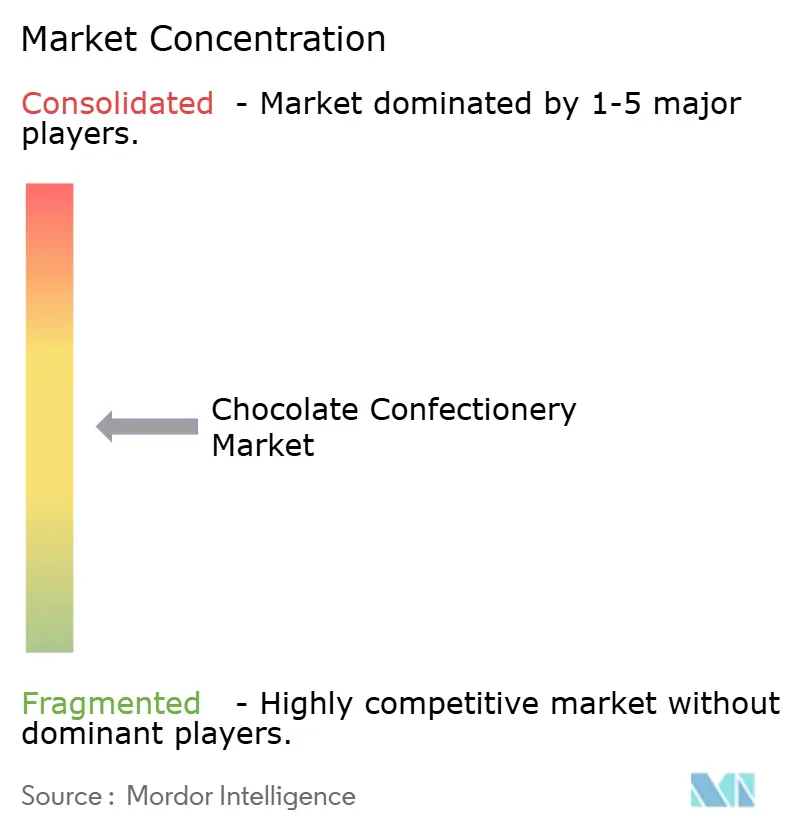
The Chocolate confectionery market includes a group of global branded leaders and a broad set of regional producers. Mars, Mondelēz, Ferrero, Nestlé, and Hershey lead mainstream branded segments. Lindt, Barry Callebaut, Meiji, Lotte, Yildiz, CEMOI, Arcor, Alfred Ritter, and Fazer compete through regional scale, ingredient expertise, or premium positioning. Artisan producers have limited aggregate volume but influence flavors, quality standards, premium pricing, and the innovation agenda of larger companies.
Acquisitions in 2025 expanded the competitive reach of major food companies. Mars completed its USD 35.9 billion acquisition of Kellanova in December 2025, creating a wider snacking platform beyond confectionery. Ferrero completed its USD 3.1 billion acquisition of WK Kellogg in September 2025 and gained manufacturing and distribution capacity across North America. Ferrero also commissioned its first North American chocolate-processing facility in Bloomington, Illinois, after investing more than USD 200 million in the site, showing that distribution and adjacent snacks now matter alongside chocolate brand ownership.
Supply resilience and alternatives are becoming direct competitive priorities. Mondelēz has diversified its supply and explored cell-based alternatives, while Lindt invested in Food Brewer, a company working with cocoa cells. Barry Callebaut entered a long-term partnership with Planet A Foods to distribute ChoViva globally. Mars, Mondelēz, Nestlé, Hershey, and Lindt formed TogetherCocoa in February 2026 to support cocoa-farming households in the Ivory Coast and Ghana. Functional products, cocoa-free alternatives, allergen-free products, and certified organic formats remain areas where specialist companies can compete. These positions show that supply resilience, formulation capability, and credible premium positioning are increasingly important alongside established brands.
Chocolate Confectionery Industry Leaders
Mars, Incorporated
Mondelēz International, Inc.
Ferrero International S.A.
Nestlé S.A.
The Hershey Company
- *Disclaimer: Major Players sorted in no particular order
Chocolate Confectionery Market Companies Covered in this Report
- Mars, Incorporated
- Mondelēz International, Inc.
- Ferrero International S.A.
- Nestlé S.A.
- The Hershey Company
- Chocoladefabriken Lindt & Sprüngli AG
- Barry Callebaut AG
- Meiji Holdings Co., Ltd.
- LOTTE Corporation
- Yildiz Holding A.Ş.
- CEMOI Group
- Ezaki Glico Co., Ltd.
- Arcor S.A.I.C.
- August Storck KG
- Orion Corporation
- Alfred Ritter GmbH & Co. KG
- Fazer Group
- Valrhona S.A.S.
- Morinaga & Co., Ltd.
- Perfetti Van Melle S.p.A.

Recent Industry Developments in Chocolate Confectionery Market
- August 2026: Mondelēz International launched its premium Belgian chocolate brand, CÔTE D'OR, in India, offering dark chocolate and whole-nut variants at INR 499 and INR 599 per pack. The launch targeted the country’s premium gifting segment through quick-commerce platforms and supported Mondelēz’s premiumization strategy in Asia-Pacific.
- July 2026: The Hershey Company launched REESE'S PIECES with Chocolate Cookie nationwide in the US, its first new REESE'S PIECES innovation in over a decade, to support its "One Hershey" strategy and expand snacking occasions.
- June 2026: Hershey partnered with Grupo Bimbo to launch Marinela and Bimbo co-branded snacks featuring Hershey's chocolate in US convenience stores, targeting Hispanic consumers and expanding into the baked goods snack aisle.


Global Chocolate Confectionery Market Report Scope
Chocolate confectionery is any ready-to-eat food item where chocolate, cocoa solids, or cocoa butter serve as a primary or characterizing ingredient. The chocolate confectionery market is segmented by product type, chocolate type, category, distribution channel, and geography. By product type, the market is segmented into chocolate bars, boxed chocolates, chips and bites, truffles and cups, seasonal chocolates, and others. By chocolate type, the market is segmented into milk, dark, and white chocolate. By category, the market is segmented into conventional and organic. By distribution channel, the market is segmented into foodservice and retail. The retail segment is further sub-segmented into supermarkets/hypermarkets, convenience and grocery stores, specialty stores, online retail stores, and other distribution channels. By geography, the market is segmented into North America, Europe, Asia-Pacific, South America, and the Middle East and Africa. The market forecasts are provided in terms of value (USD).
| Chocolate Bars |
| Boxed Chocolates |
| Chocolate Chips and Bites |
| Truffles and Cups |
| Seasonal Chocolates |
| Other Product Types |
| Milk Chocolate |
| Dark Chocolate |
| White Chocolate |
| Conventional |
| Organic |
| Foodservice | |
| Retail | Supermarkets/Hypermarkets |
| Convenience and Grocery Stores | |
| Specialty Stores | |
| Online Retail Stores | |
| Other Distribution Channels |
| North America | United States |
| Canada | |
| Mexico | |
| Rest of North America | |
| Europe | United Kingdom |
| Germany | |
| France | |
| Italy | |
| Spain | |
| Sweden | |
| Belgium | |
| Poland | |
| Netherlands | |
| Rest of Europe | |
| Asia-Pacific | China |
| Japan | |
| India | |
| Thailand | |
| Singapore | |
| Indonesia | |
| South Korea | |
| Australia | |
| Rest of Asia-Pacific | |
| South America | Brazil |
| Argentina | |
| Colombia | |
| Peru | |
| Chile | |
| Rest of South America | |
| Middle East and Africa | United Arab Emirates |
| South Africa | |
| Saudi Arabia | |
| Nigeria | |
| Egypt | |
| Morocco | |
| Turkey | |
| Rest of Middle East and Africa |
| Product Type | Chocolate Bars | |
| Boxed Chocolates | ||
| Chocolate Chips and Bites | ||
| Truffles and Cups | ||
| Seasonal Chocolates | ||
| Other Product Types | ||
| Chocolate Type | Milk Chocolate | |
| Dark Chocolate | ||
| White Chocolate | ||
| Category | Conventional | |
| Organic | ||
| Distribution Channel | Foodservice | |
| Retail | Supermarkets/Hypermarkets | |
| Convenience and Grocery Stores | ||
| Specialty Stores | ||
| Online Retail Stores | ||
| Other Distribution Channels | ||
| Geography | North America | United States |
| Canada | ||
| Mexico | ||
| Rest of North America | ||
| Europe | United Kingdom | |
| Germany | ||
| France | ||
| Italy | ||
| Spain | ||
| Sweden | ||
| Belgium | ||
| Poland | ||
| Netherlands | ||
| Rest of Europe | ||
| Asia-Pacific | China | |
| Japan | ||
| India | ||
| Thailand | ||
| Singapore | ||
| Indonesia | ||
| South Korea | ||
| Australia | ||
| Rest of Asia-Pacific | ||
| South America | Brazil | |
| Argentina | ||
| Colombia | ||
| Peru | ||
| Chile | ||
| Rest of South America | ||
| Middle East and Africa | United Arab Emirates | |
| South Africa | ||
| Saudi Arabia | ||
| Nigeria | ||
| Egypt | ||
| Morocco | ||
| Turkey | ||
| Rest of Middle East and Africa | ||


Key Questions Answered in the Report
What is the projected growth rate for chocolate confectionery through 2031?
The Chocolate confectionery market is forecast to grow at a 6.89% CAGR from 2026 to 2031, reaching USD 172.39 billion by 2031.
Which chocolate product format holds the largest share?
Chocolate bars held 62.71% of sales in 2025 because they serve impulse purchases, gifting, and household consumption.
Why is dark chocolate growing faster than other types?
Dark chocolate is forecast to grow at an 8.11% CAGR through 2031, supported by high-cacao positioning and consumer interest in cocoa-related health benefits.
What is driving demand for premium chocolate?
Premium products attract buyers seeking quality, distinctive ingredients, traceability, gifting relevance, and smaller portions.
Page last updated on:


 Your data is secure and never sold or shared.


