
Chlorinated Polyvinyl Chloride (CPVC) Pipe and Fitting Market Size and Share
Market Overview
| Study Period | 2021 - 2031 |
|---|---|
| Market Size (2026) | USD 1.95 Billion |
| Market Size (2031) | USD 3.39 Billion |
| Growth Rate (2026 - 2031) | 11.67 % |
| Fastest Growing Market | Asia-Pacific |
| Largest Market | Asia-Pacific |
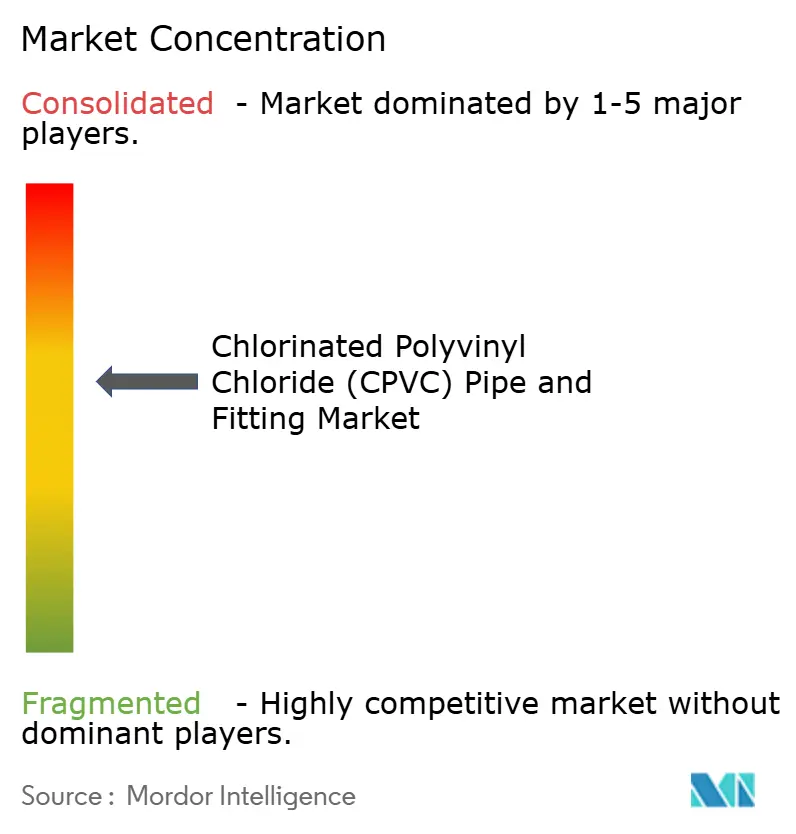
| Market Concentration | Medium |
Major Players *Disclaimer: Major Players sorted in no particular order Image © Mordor Intelligence. Reuse requires attribution under CC BY 4.0. | |
Chlorinated Polyvinyl Chloride (CPVC) Pipe and Fitting Market Analysis by Mordor Intelligence
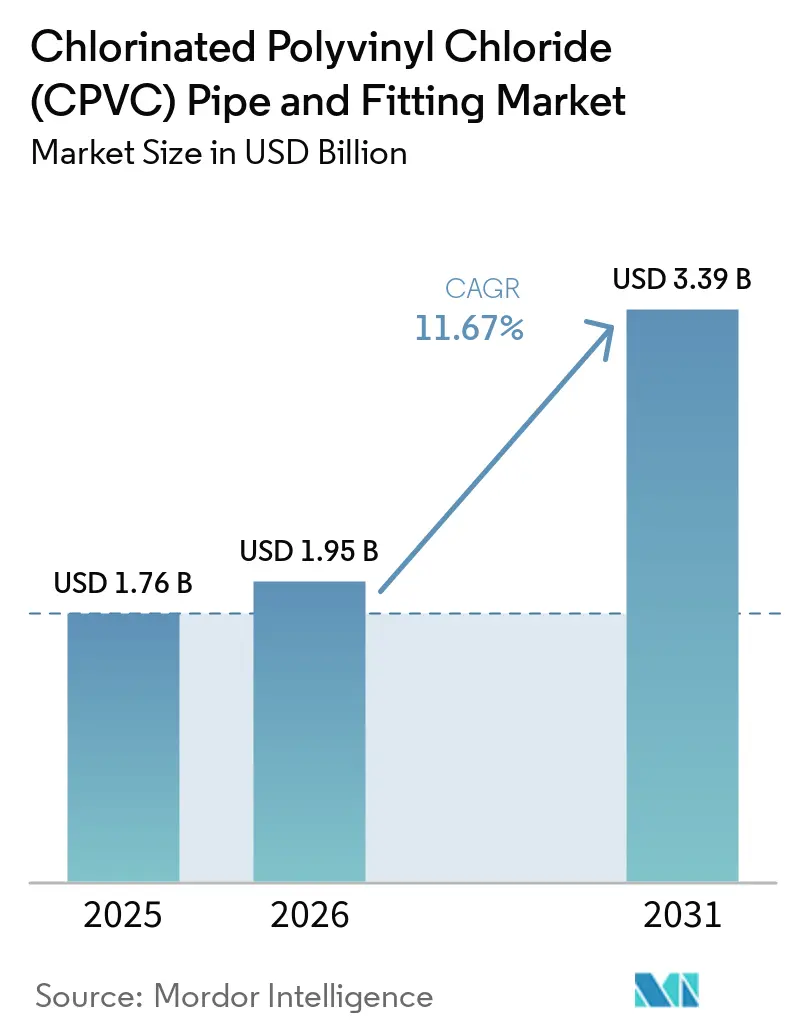
The chlorinated polyvinyl chloride (CPVC) pipe and fitting market size was valued at USD 1.76 billion in 2025 and is estimated to grow from USD 1.95 billion in 2026 to USD 3.39 billion by 2031, at a CAGR of 11.67% during the forecast period (2026-2031). The chlorinated polyvinyl chloride (CPVC) pipe and fitting market serves as a replacement for galvanized iron, copper, and standard polyvinyl chloride (PVC) in applications requiring temperature and chemical resistance and compliance with potable water standards. Demand varies across the value chain, as resin owners with proprietary chlorination technologies operate under different margin conditions than downstream fabricators. Residential construction and urban sanitation programs constitute the primary demand base, while fire safety regulations and chemical-handling requirements support additional applications. However, the CPVC pipe and fitting market faces volatility in raw material costs and competition from alternative piping materials. Consequently, supply security, certification compliance, and distribution execution remain key components of manufacturers’ strategies.
Key Report Takeaways
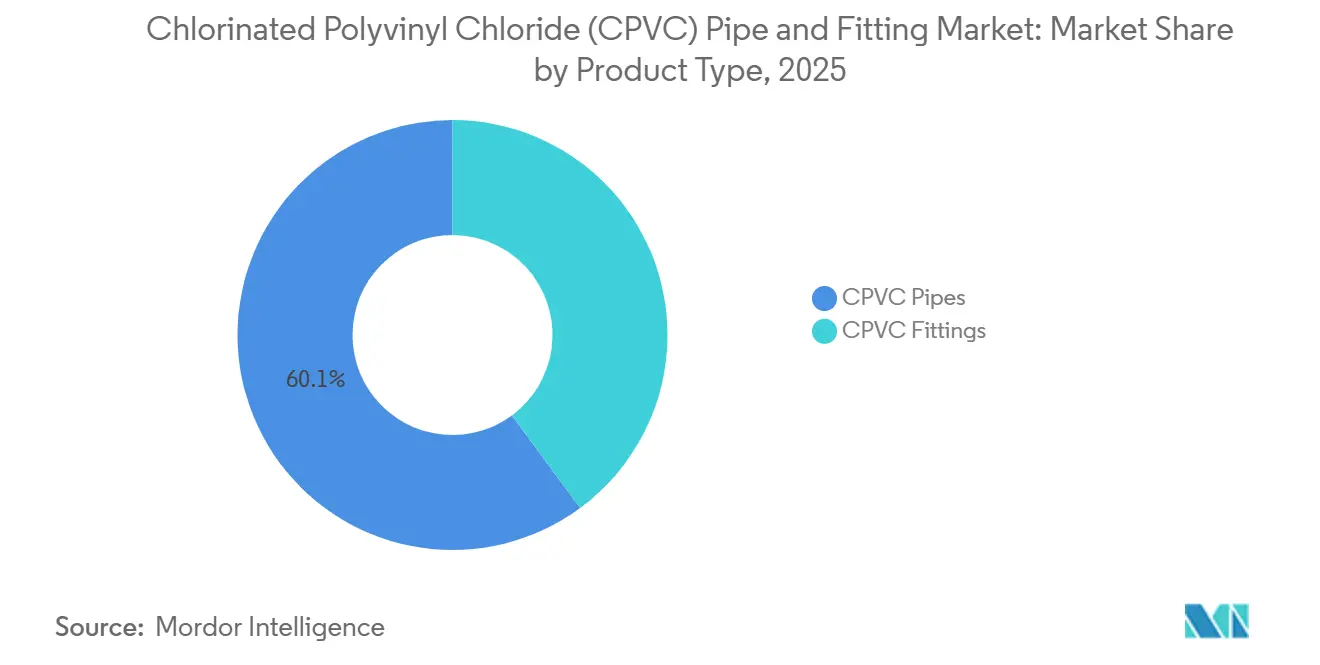
- By product type, CPVC pipes held 60.13% of the chlorinated polyvinyl chloride (CPVC) pipe and fitting market share in 2025, while CPVC fittings are projected to grow at a 12.13% CAGR through 2031.
- By application, hot- and cold-water distribution accounted for 45.58% of the chlorinated polyvinyl chloride (CPVC) pipe and fitting market size in 2025, while fire sprinkler systems are forecast to advance at a 12.76% CAGR through 2031.
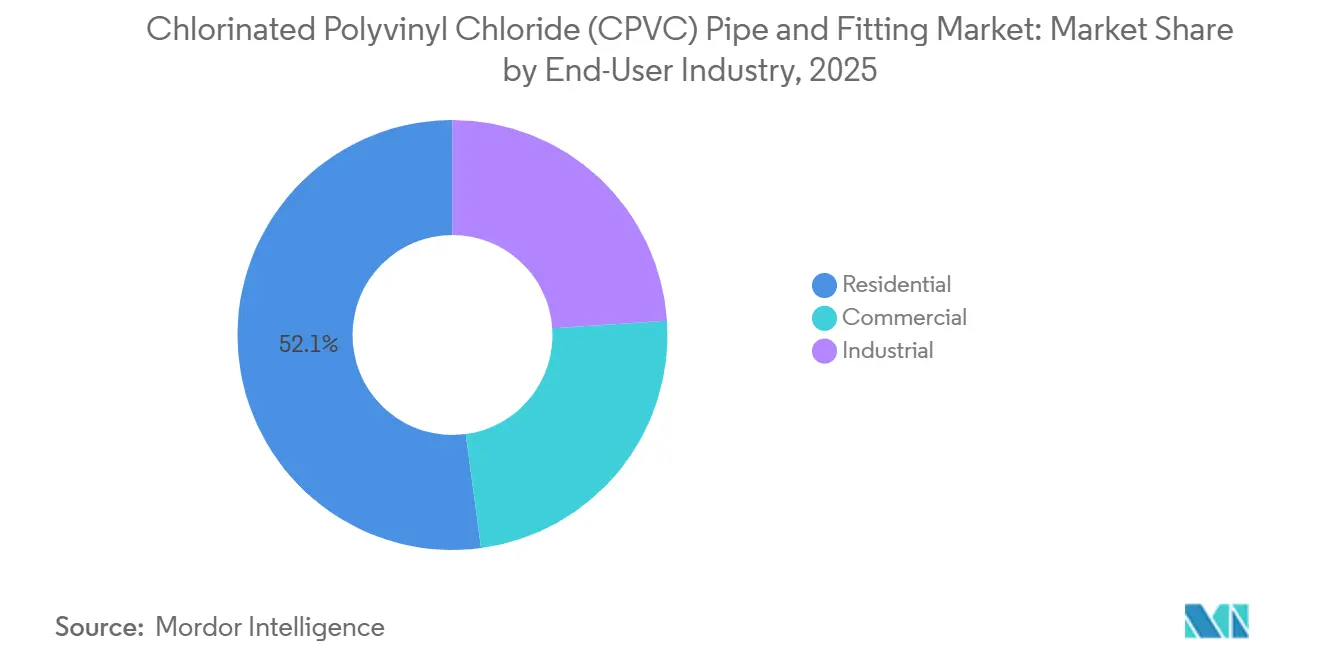
- By end-user industry, residential held 52.11% of the chlorinated polyvinyl chloride (CPVC) pipe and fitting market share in 2025, while industrial is projected to expand at a 13.17% CAGR through 2031.
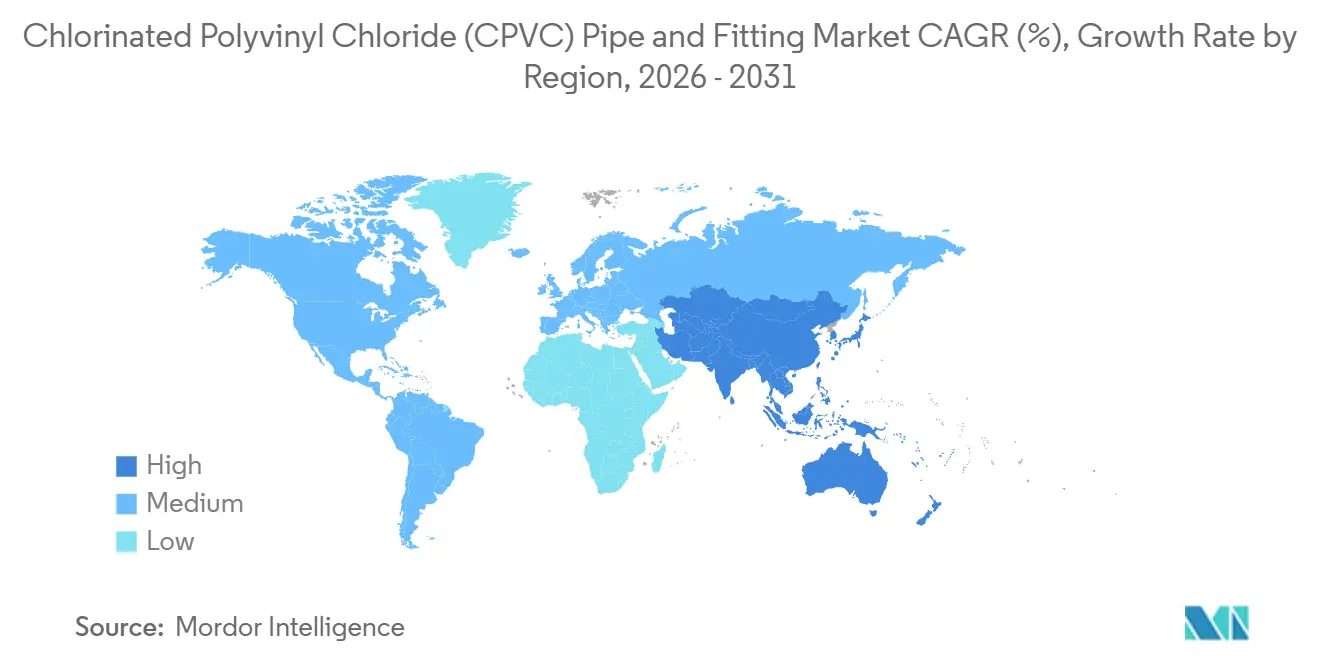
- By geography, Asia-Pacific accounted for 31.57% of total demand in 2025 and is projected to grow at a 12.95% CAGR through 2031.
Note: Market size and forecast figures in this report are generated using Mordor Intelligence’s proprietary estimation framework, updated with the latest available data and insights as of January 2026.
Global Chlorinated Polyvinyl Chloride (CPVC) Pipe and Fitting Market Trends and Insights
Drivers Impact Analysis*
| Drivers | (~) % Impact on CAGR Forecast | Geographic Relevance | Impact Timeline |
|---|---|---|---|
| Replacement of Corrosion-Prone Metal Piping | +3.2% | Global, concentrated in South Asia, Southeast Asia, and Latin America | Medium term (2-4 years) |
| Urban Water, Housing, and Sanitation Investment | +2.8% | Asia-Pacific, the Middle East and Africa, and South America | Long term (≥ 4 years) |
| Fire-Safety Code-Driven Polymer Sprinkler Adoption | +2.0% | North America and Europe, with early adoption in Asia-Pacific, the Middle East, and Africa | Medium term (2-4 years) |
| Industrial Chemical and High-Temperature Fluid Handling | +1.5% | North America, Europe, and the Asia-Pacific industrial belts | Long term (≥ 4 years) |
| Installer Productivity and Lifecycle-Cost Advantage | +0.9% | Global, strongest in mature markets with skilled labor cost pressure | Short term (≤ 2 years) |
| Source: Mordor Intelligence | |||
Replacement of Corrosion-Prone Metal Piping
Galvanized iron and copper piping can corrode, scale, and leach contaminants when exposed to chlorinated municipal water. These issues can increase costs as buildings age beyond 15 to 20 years, while maintenance requirements become less predictable for building owners. The chlorinated polyvinyl chloride (CPVC) pipe and fitting market is supported when municipal utilities replace aging distribution networks to meet public health mandates. CPVC is used in hot- and cold-water upgrades because it is compatible with Schedule 40 fittings, weighs less per linear meter, and is easier to transport through constrained renovation sites than steel or copper. Solvent-cement joining also enables installation in occupied buildings without hot-work permits, unlike copper-silver brazing. U.S. construction spending remained at a seasonally adjusted annual rate of USD 2.16 trillion in mid-2024, supporting replacement demand across the country’s building stock[1]U.S. Census Bureau, “Construction Spending, Value Put in Place,” U.S. Census Bureau, census.gov.
Urban Water, Housing, and Sanitation Investment
Government water-security programs can expand demand in the chlorinated polyvinyl chloride (CPVC) pipe and fitting market beyond private construction, particularly in regions where rural connections require local distribution networks. India’s Union Cabinet approved Jal Jeevan Mission 2.0 in March 2026, with a total outlay of INR 8.69 lakh crore (USD 103 billion) through December 2028. The program targets functional tap-water connections for 19.36 crore rural households and focuses on verified service delivery. The FY27 allocation of INR 67,670 crore (USD 806 million) is higher than the amount released in FY26, supporting procurement following earlier underspending. Housing activity in India, Vietnam, and Indonesia generates private-sector demand alongside public procurement, creating an installation base for distributors, contractors, and local fabricators. This demand mix reduces regional dependence on a single construction cycle.
Fire-Safety Code-Driven Polymer Sprinkler Adoption
The chlorinated polyvinyl chloride (CPVC) pipe and fitting market is supported by CPVC use in wet-pipe fire sprinkler systems. National Fire Protection Association (NFPA) 13 is the governing installation standard, and its 2025 edition includes updated provisions and technical guidance for sprinkler systems. CPVC is listed for wet-pipe systems, while its use in residential construction is supported by sprinkler requirements in applicable jurisdictions and contractor familiarity with approved material systems. The material does not require hot-work permits, which can simplify upgrades in occupied buildings where safety procedures, tenant disruption, and project timelines affect installation decisions. Viking Group Inc. increased prices for BlazeMaster CPVC pipe and fittings by 7% effective February 2026 and by an additional 6% effective June 2026. Contractors assess these price increases against installation time, permitting requirements, and labor costs.
Industrial Chemical and High-Temperature Fluid Handling
CPVC can handle fluid temperatures of up to 93°C and resists acids, alkalis, and brine under relevant service conditions. These properties support its use in chemical processing facilities, pharmaceutical cleanrooms, water treatment plants, and semiconductor fabrication lines that require consistent material performance under defined operating conditions. The chlorinated polyvinyl chloride (CPVC) pipe and fitting market is supported when end users replace metal lines used for chemical distribution, drain-waste-vent systems, and reagent transfer. A plant that qualifies CPVC for one corrosive-fluid application may extend its use to adjacent lines as its approved-materials list evolves and maintenance teams reduce the number of material families they manage. ISO 15877 provides a framework for plastic piping systems used in hot- and cold-water installations, helping buyers assess applications that require documented compliance. Precision fittings and reliable installation remain important because these applications allow limited tolerance for dimensional or joining errors.
Restraints Impact Analysis*
| Restraints | (~) % Impact on CAGR Forecast | Geographic Relevance | Impact Timeline |
|---|---|---|---|
| Raw-Material and Energy Price Volatility | -2.1% | Global, most acute in export-dependent fabricator markets in India, China, and Southeast Asia | Short term (≤ 2 years) |
| Competition from PEX, Copper, Steel, and Other Thermoplastics | -1.6% | North America and Europe for PEX, Asia-Pacific for Polypropylene Random Copolymer (PP-R), and the global premium segments for copper | Medium term (2-4 years) |
| Certification, Compatibility, and Counterfeit-Product Risk | -1.0% | South Asia, Southeast Asia, the Middle East, and Africa | Medium term (2-4 years) |
| Source: Mordor Intelligence | |||
Raw-Material and Energy Price Volatility
CPVC compound costs depend on chlorine, ethylene dichloride, and energy inputs, which are affected by crude oil price movements and geopolitical disruptions in the Middle East. Sekisui Chemical Co., Ltd. implemented a minimum price increase of USD 0.50/kg for CPVC resin and compound grades on April 1, 2026, citing raw material and freight cost pressures. The company stated that it may implement further price revisions if global conditions deteriorate[2]Sekisui Chemical Co., Ltd., “Price Revision for CPVC Resins and Compounds,” Sekisui Chemical, sekisuichemical.com. Indian fabricators also face planning challenges when PVC resin prices fluctuate and dealer inventory levels change, as they may make procurement decisions before adjusting finished-product prices. Larger producers are pursuing upstream integration, while smaller fabricators remain more exposed to feedstock price movements.
Competition from Cross-Linked Polyethylene (PEX), Copper, Steel, and Other Thermoplastics
PEX is used in residential hot-water and radiant-heating applications across North America and Europe because flexible coils reduce installation labor time. However, its competitive impact is application-specific because PEX does not offer the same chemical resistance or wet-pipe sprinkler-system positioning as CPVC. PP-R also competes with CPVC in price-sensitive Asia-Pacific and Middle Eastern markets, where developers prioritize lower initial costs while considering long-term performance and application limitations. Copper remains used in premium residential projects in North America, Australia, and Northern Europe. The chlorinated polyvinyl chloride (CPVC) pipe and fitting market serves fire protection and corrosive-fluid applications. In hybrid projects, installers may use Schedule 80 CPVC for main risers and cross-linked polyethylene (PEX) for branch lines, reducing CPVC usage without eliminating its role in the system.
*Our forecasts treat driver/restraint impacts as directional, not additive. The impact forecasts reflect baseline growth, mix effects, and variable interactions.
Segment Analysis
By Product Type: Pipe Systems Lead, but Fittings Set the Margin Agenda
CPVC pipes are projected to account for 60.13% of the chlorinated polyvinyl chloride (CPVC) pipe and fitting market in 2025, as they serve as the high-volume backbone of plumbing, fire-suppression mains, and industrial process systems. Solvent-cement joining supports their widespread use by reducing the need for specialized tools and enabling contractors to use familiar installation practices for routine building projects. This joining method also lowers installation labor requirements compared with copper or steel systems. Consequently, pipe demand remains closely linked to new construction, system replacement, and public water infrastructure projects. Building owners also favor the material for its lightweight properties, which simplify handling during installation.
CPVC fittings are projected to grow at a 12.13% CAGR through 2031, outpacing pipe growth as installers increasingly adopt complete system kits for complex projects. Specification-grade tees, elbows, and valves can reduce field labor requirements and minimize the risk of joint failures. Fitting quality directly influences system reliability, as dimensional tolerances are particularly critical in precision-formed components and in systems where repeated joints must perform reliably over extended operating periods. ASTM F439 and NSF/ANSI 61 remain important standards for potable-water fittings. Public-sector tenders favor assemblies supported by complete certification records, providing established manufacturers with an advantage when buyers assess product quality and compliance.



By Application: Hot Water Plumbing Anchors Demand, Fire Safety Accelerates
Hot- and cold-water distribution is projected to account for 45.58% of the chlorinated polyvinyl chloride (CPVC) pipe and fitting market in 2025. The segment benefits from CPVC’s temperature resistance and suitability for potable-water applications, enabling a single material family to support both cold-water supply and hot-water distribution across connected plumbing networks. It remains the primary application in residential plumbing and many commercial buildings. Standardized fitting systems allow contractors to deploy CPVC throughout entire water networks, while replacement projects in occupied properties create additional opportunities to replace older metal piping systems.
Fire sprinkler systems are projected to grow at a 12.76% CAGR through 2031, making them the fastest-growing application segment. NFPA 13, NFPA 13D, and NFPA 13R support the use of approved systems in applicable occupancies. Wastewater treatment and chemical processing also drive demand for acid drainage and reagent-handling applications, particularly where metal systems present corrosion and replacement concerns. HVAC and chilled-water systems can also use insulated CPVC in secondary loops.
By End-User Industry: Residential Scale Underpins the Market, Industrial Growth Leads the Upside
The residential segment is projected to account for 52.11% of the chlorinated polyvinyl chloride (CPVC) pipe and fitting market in 2025. The segment reflects CPVC’s use in premium housing in India and its established presence in residential buildings across North America and Australia. Residential demand is linked to new construction, renovation activity, hot-water plumbing installations, and local water infrastructure expansion. As a result, volumes depend on both housing activity and utility-led connection programs. The segment’s broad installed base provides manufacturers with steady demand for pipes, fittings, and replacement components. Public programs that expand access to piped water can further increase residential installation volumes.
Industrial applications are expected to expand at a 13.17% CAGR through 2031, the highest growth rate among end-user categories. Chemical plants, pharmaceutical manufacturers, and water-treatment operators use certified CPVC systems for chemically aggressive, non-critical fluid lines. Commercial construction, including hotels, hospitals, data centers, and mixed-use properties, represents an additional demand tier characterized by more stringent specifications and a greater need for coordinated system supply. Once a facility approves CPVC for one process line, engineers may extend that approval to adjacent lines to simplify maintenance and procurement. This internal specification process can support longer-term demand in the chlorinated polyvinyl chloride (CPVC) pipe and fitting industry. At the same time, compliance requirements remain essential in applications where system failure could disrupt operations.
Geography Analysis
Asia-Pacific accounted for 31.57% of the chlorinated polyvinyl chloride (CPVC) pipes and fittings market in 2025 and is projected to register a 12.95% CAGR through 2031. In India, premium housing, water infrastructure development, and the replacement of galvanized iron systems support demand across public and private installation channels. Jal Jeevan Mission 2.0 includes an infrastructure commitment of INR 8.69 lakh crore (USD 103 billion) through December 2028. In China, industrial applications include process lines handling acids and alkalis. In Japan, demand is supported by renovation activity, seismic-resilience upgrades, and the replacement of aging infrastructure.
North America is the second-largest regional market for chlorinated polyvinyl chloride (CPVC) pipes and fittings. In the United States, fire-sprinkler code adoption and NSF/ANSI 61 compliance requirements for potable water influence material selection in regulated residential and commercial projects. These requirements create a certification-based market for listed manufacturers. Hybrid specifications may use Schedule 80 CPVC for main risers and cross-linked polyethylene (PEX) for branch lines, maintaining CPVC use where PEX is also specified within the same project. Canada follows similar code practices, while Mexico contributes demand from industrial and affordable housing applications.
Europe, South America, the Middle East, and Africa constitute the remaining regional demand base. In Europe, renovation activity in France, Germany, and the Nordic countries supports the replacement of aging building plumbing systems, while lightweight piping reduces disruption during building upgrades. In South America, demand is concentrated in Brazil and Argentina as industrial and residential construction recovers. In the Middle East and Africa, demand is supported by urban development in Saudi Arabia, water infrastructure investments in South Africa, and fire-sprinkler requirements in Gulf countries. These regions extend the demand base for the chlorinated polyvinyl chloride (CPVC) pipes and fittings market beyond Asia-Pacific and North America, requiring suppliers to adapt to local certification requirements, installer practices, and distribution conditions.

Competitive Landscape
The chlorinated polyvinyl chloride (CPVC) pipe and fitting market is moderately consolidated at the resin level and fragmented among downstream pipe and fitting fabricators. At the upstream level, Lubrizol and Sekisui Chemical possess proprietary chlorination-process capabilities. Downstream manufacturers compete based on distribution coverage, brand trust, certifications, installer relationships, and their ability to supply complete system components through local dealer networks. This structure gives resin suppliers greater influence over material performance and pricing, while fabricators must manage raw material availability, quality control, and channel service through regional distribution networks.
Sekisui Chemical’s planned minimum resin and compound price revision of USD 0.50/kg in April 2026 illustrates how upstream cost changes can affect fabricator economics. Astral acquired an 80% stake in Nexelon Chem to establish a 40,000-ton captive resin plant, aiming to reduce its exposure to spot resin costs. This backward-integration strategy can strengthen supply control for a major Indian fabricator. Meanwhile, Formosa Plastics, NIBCO, IPEX, China Lesso, and GF Industry and Infrastructure Flow Solutions compete through product portfolios, geographic reach, certifications, and technical support for specification-driven projects. Their strategies emphasize technical product extensions and specification-led demand, while smaller manufacturers require comparable quality systems to compete for formal project work.
Small-diameter industrial fittings for pharmaceutical and semiconductor applications offer opportunities, as these applications require precision manufacturing and cleanroom-compatible packaging. Fire-suppression systems for high-rise residential projects in emerging markets present another opportunity, as local competition is developing and code awareness can affect the pace of specification adoption. Prince Pipes and Fittings, Supreme Industries, and Finolex Industries reported CPVC growth of 12% to 15% in recent financial years, indicating that distribution networks can support growth without resin ownership. India’s Bureau of Indian Standards (BIS) requirements under IS 15778 and IS 16392 can serve as prequalification criteria for Jal Jeevan Mission procurement, supporting branded suppliers with testing and quality-management capabilities.
Chlorinated Polyvinyl Chloride (CPVC) Pipe and Fitting Industry Leaders
Lubrizol
SEKISUI CHEMICAL CO., LTD.
KANEKA CORPORATION
ASTRAL PIPES
Aliaxis Holdings SA
- *Disclaimer: Major Players sorted in no particular order

Recent Industry Developments
- June 2026: Charlotte Pipe and Foundry completed a USD 25 million expansion of its manufacturing facility in Wildwood, Florida. The expansion added 54,700 square feet of production and warehousing space, supporting demand for CPVC pipes and fittings in residential and irrigation applications across the US Southeast market.
- March 2026: The Union Cabinet of India approved Jal Jeevan Mission 2.0, with a total outlay of INR 8.69 lakh crore (USD 103 billion). The program runs through December 2028 and targets functional tap-water connections for all 19.36 crore rural households in India, supporting demand for CPVC pipes and fittings in water distribution applications.


Global Chlorinated Polyvinyl Chloride (CPVC) Pipe and Fitting Market Report Scope
Chlorinated Polyvinyl Chloride (CPVC) is a thermoplastic material used in pipe and fitting manufacturing. It is produced by chlorinating standard Polyvinyl Chloride (PVC) resin, which increases its chlorine content. This process supports its use in piping systems designed for higher-temperature and corrosive fluid applications.
The chlorinated polyvinyl chloride (CPVC) pipe and fitting market is segmented by product type, application, end-user industry, and geography. By product type, the market is segmented into CPVC pipes and CPVC fittings. By application, the market is segmented into hot and cold-water distribution, wastewater treatment, chemical processing, fire sprinkler systems, HVAC and chilled-water systems, and others. By end-user industry, the market is segmented into residential, commercial, and industrial. The report also covers market size and forecasts for chlorinated polyvinyl chloride (CPVC) pipe and fittings across 15 countries in major regions. The market sizes and forecasts are provided in terms of value (USD).
| CPVC Pipes |
| CPVC Fittings |
| Hot and Cold-Water Distribution |
| Wastewater Treatment |
| Chemical Processing |
| Fire Sprinkler Systems |
| HVAC and Chilled-Water Systems |
| Others |
| Residential |
| Commercial |
| Industrial |
| Asia-Pacific | China |
| India | |
| Japan | |
| South Korea | |
| ASEAN Countries | |
| Rest of Asia-Pacific | |
| North America | United States |
| Canada | |
| Mexico | |
| Europe | Germany |
| United Kingdom | |
| France | |
| Italy | |
| NORDIC Countries | |
| Rest of Europe | |
| South America | Brazil |
| Argentina | |
| Rest of South America | |
| Middle East and Africa | Saudi Arabia |
| South Africa | |
| Rest of Middle East and Africa |
| By Product Type | CPVC Pipes | |
| CPVC Fittings | ||
| By Application | Hot and Cold-Water Distribution | |
| Wastewater Treatment | ||
| Chemical Processing | ||
| Fire Sprinkler Systems | ||
| HVAC and Chilled-Water Systems | ||
| Others | ||
| By End-User Industry | Residential | |
| Commercial | ||
| Industrial | ||
| By Geography | Asia-Pacific | China |
| India | ||
| Japan | ||
| South Korea | ||
| ASEAN Countries | ||
| Rest of Asia-Pacific | ||
| North America | United States | |
| Canada | ||
| Mexico | ||
| Europe | Germany | |
| United Kingdom | ||
| France | ||
| Italy | ||
| NORDIC Countries | ||
| Rest of Europe | ||
| South America | Brazil | |
| Argentina | ||
| Rest of South America | ||
| Middle East and Africa | Saudi Arabia | |
| South Africa | ||
| Rest of Middle East and Africa | ||


Key Questions Answered in the Report
What is current market size of Chlorinated Polyvinyl Chloride (CPVC) Pipe and Fitting Market?
The chlorinated polyvinyl chloride (CPVC) pipe and fitting market size was valued at USD 1.76 billion in 2025 and is estimated to grow from USD 1.95 billion in 2026 to USD 3.39 billion by 2031, at a CAGR of 11.67% during the forecast period (2026-2031).
Which product category leads CPVC pipe and fittings?
CPVC pipes led with a 60.13% share in 2025, while fittings are forecast to expand at a 12.13% CAGR through 2031. Pipes supply the high-volume network, while fittings are important for complete and compliant system installation.
Which application is growing fastest for CPVC systems?
Fire sprinkler systems are projected to grow at a 12.76% CAGR through 2031, supported by the approval of wet-pipe systems. The application benefits from installation approaches that avoid the need for hot-work permits in suitable buildings.
Which end-user category is expanding fastest?
Industrial end users are projected to expand at a 13.17% CAGR through 2031 as chemical, pharmaceutical, and water-treatment facilities adopt certified systems. Chemical resistance and temperature performance support the use in relevant non-critical fluid lines.
Page last updated on:


 Your data is secure and never sold or shared.


