
Chlorinated Polyvinyl Chloride (CPVC) Market Size and Share
Market Overview
| Study Period | 2022 - 2032 |
|---|---|
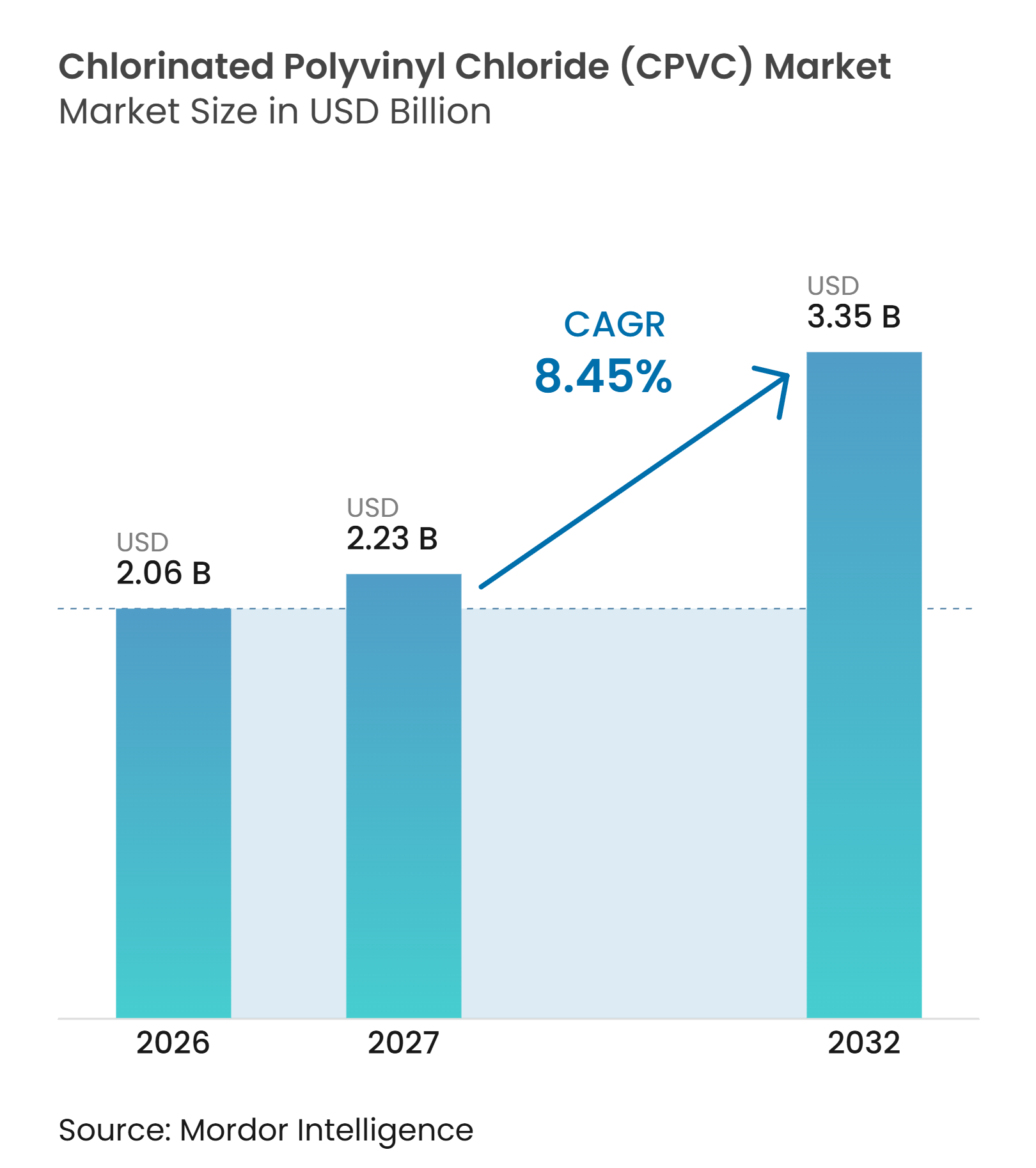
| Market Size (2027) | USD 2.23 Billion |
| Market Size (2032) | USD 3.35 Billion |
| Growth Rate (2027 - 2032) | 8.45 % |
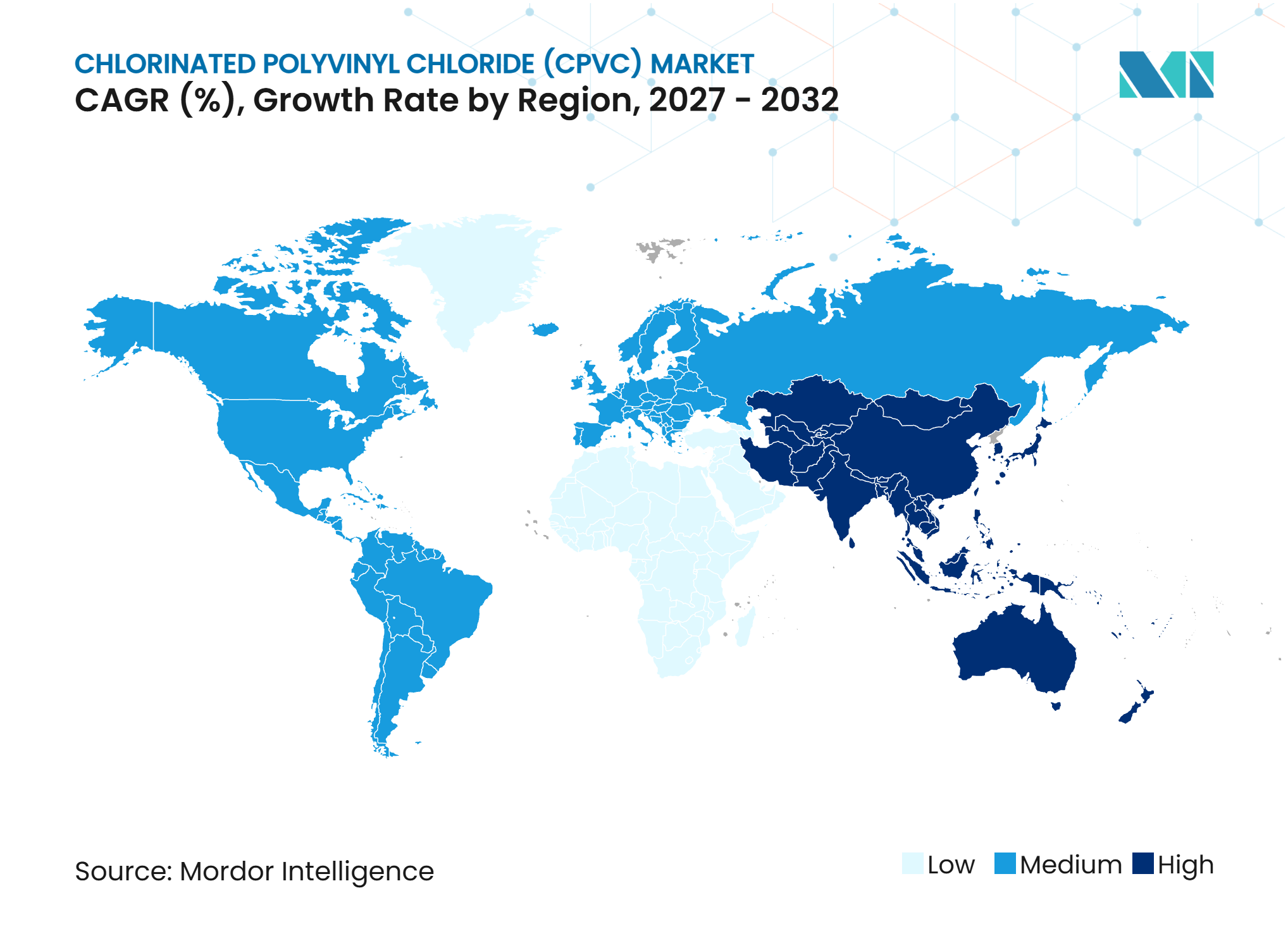
| Fastest Growing Market | Asia-Pacific |
| Largest Market | Asia-Pacific |
| Market Concentration | Medium |
Major Players *Disclaimer: Major Players sorted in no particular order Image © Mordor Intelligence. Reuse requires attribution under CC BY 4.0. | |
Chlorinated Polyvinyl Chloride (CPVC) Market Analysis by Mordor Intelligence
The Chlorinated Polyvinyl Chloride (CPVC) Market size was valued at USD 2.06 billion in 2026 and is estimated to grow from USD 2.23 billion in 2027 to USD 3.35 billion by 2032, at a CAGR of 8.45% during the forecast period (2027-2032). The chlorinated polyvinyl chloride (CPVC) market is supported by the replacement of galvanized iron and standard polyvinyl chloride (PVC) systems in plumbing, commercial buildings, and industrial facilities. CPVC can serve hot-water applications at temperatures up to 93°C, while standard PVC is generally limited to 60°C in continuous service. India remains the largest single-country demand center and is becoming an increasingly integrated production base as resin capacity expands. Local production can reduce import dependence, improve supply security for processors, and create scope for exports during the forecast period. The CPVC market also benefits where codes, certifications, and system approvals make material performance a procurement requirement rather than a discretionary choice.
Key Report Takeaways
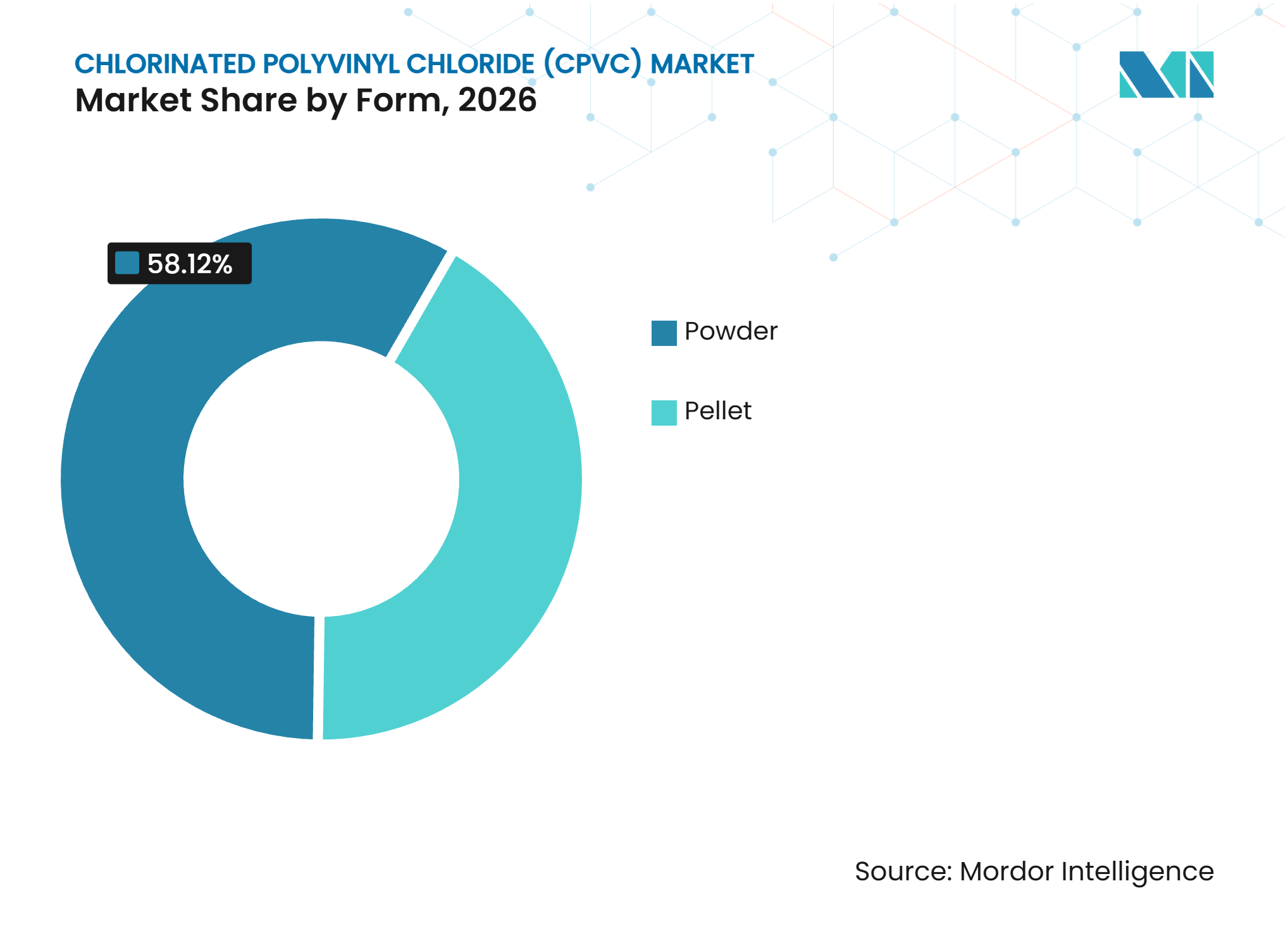
- By form, Powder held 58.12% of the chlorinated polyvinyl chloride (CPVC) market share in 2026, while Powder is projected to grow at a 9.27% CAGR through 2032.
- By grade, Extrusion Grade held 70.61% of the chlorinated polyvinyl chloride (CPVC) market share in 2026, while Injection Grade is projected to grow at a 9.56% CAGR through 2032.
- By application, Pipes and Fittings accounted for 56.27% of the chlorinated polyvinyl chloride (CPVC) market size in 2026, while Fire Sprinkler Systems are projected to grow at a 10.03% CAGR through 2032.
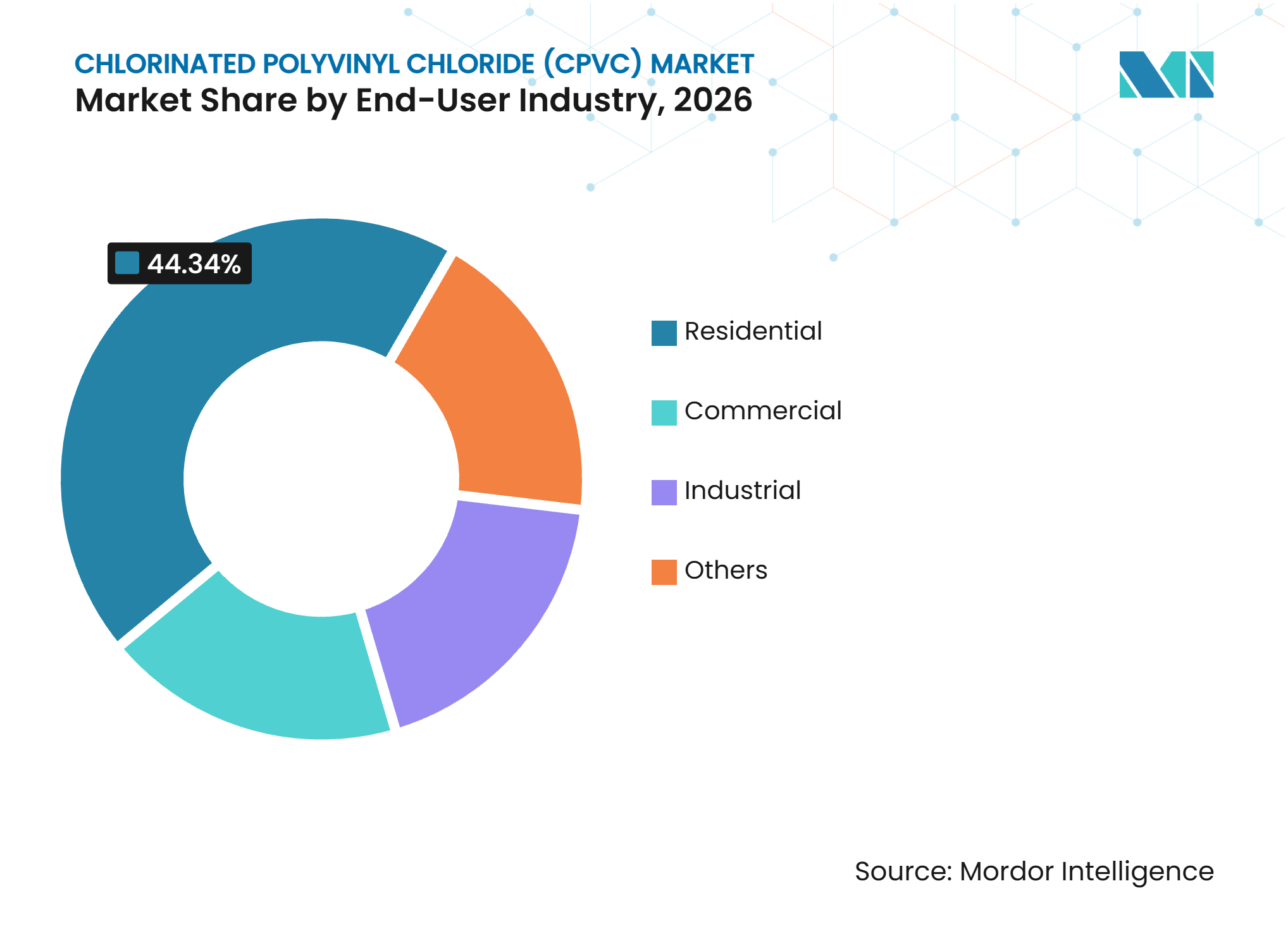
- By end-user industry, Residential held 44.34% of the chlorinated polyvinyl chloride (CPVC) market share in 2026, while Industrial is projected to grow at a 10.49% CAGR through 2032.
- By geography, Asia-Pacific held 36.73% of the chlorinated polyvinyl chloride (CPVC) market share in 2026 and is projected to grow at a 10.18% CAGR through 2032.
Note: Market numbers in this report are based on Mordor Intelligence's proprietary estimation framework, which combines nine months of actuals with Q4 projections for base year 2026.
Market Trends and Insights
Drivers Impact Analysis of Chlorinated Polyvinyl Chloride (CPVC) Market*
| Drivers | (~) % Impact on CAGR Forecast | Geographic Relevance | Impact Timeline |
|---|---|---|---|
| Replacement of Corrosion-Prone Metal Piping | +2.5% | Global, highest intensity in South Asia and Southeast Asia | Long term (≥ 4 years) |
| Residential and Commercial Hot-Water Plumbing Demand | +2.1% | APAC core, with spillover to MEA | Medium term (2-4 years) |
| Fire-Safety Code Expansion and Sprinkler Retrofits | +1.3% | North America and Europe | Medium term (2-4 years) |
| Industrial Chemical-Handling and Water-Treatment Applications | +0.9% | Global | Long term (≥ 4 years) |
| Resin Supply Localization in India and Other Emerging Markets | +0.7% | APAC core | Medium term (2-4 years) |
| Source: Mordor Intelligence | |||
Replacement of Corrosion-Prone Metal Piping
Galvanized iron pipe installed in South and Southeast Asia during the 1990s and 2000s is approaching the end of its 20- to 25-year service life. This replacement cycle supports the CPVC market even when new construction activity slows. CPVC is suitable for hot-water lines because it can handle service temperatures up to 93°C, allowing installers to use a single material across hot and cold distribution systems. This capability differentiates it from standard PVC, which is limited to 60°C for continuous service. Brackish groundwater and temperatures above 45°C can shorten the service life of metal piping in Middle Eastern infrastructure, strengthening the case for corrosion-resistant alternatives. India's Bureau of Indian Standards (BIS) IS 15778 Amendment 5 took effect in September 2025 and raised technical requirements for CPVC potable-water pipe, including chlorine content, hydraulic performance, and heavy-metal leaching controls.
Residential and Commercial Hot-Water Plumbing Demand
Residential and commercial hot-water systems create sustained demand for CPVC plumbing in India and other developing building markets. Multi-story projects can specify CPVC for cold potable lines and hot-water loops, avoiding the use of separate materials for each function. Hotels, hospitals, and corporate campuses use more hot-water recirculation piping per square foot than standard residential projects. These systems often operate above PVC's continuous-service temperature, making CPVC a technical requirement. Public housing activity in Tier 2 and Tier 3 cities also broadens the installed base for compliant plumbing systems. The CPVC market benefits when certified pipe systems are selected during design rather than substituted at the construction stage.
Fire-Safety Code Expansion and Sprinkler Retrofits
Fire safety regulations are expanding the addressable market for CPVC sprinkler systems in residential and light-hazard commercial buildings. The 2025 edition of NFPA 13 includes updated occupancy classifications, seismic bracing provisions, and sprinkler placement guidance. UL 1821, revised in November 2025, sets requirements for thermoplastic sprinkler pipe and fittings used in fire protection service[1]. BlazeMaster CPVC received an updated listing for exposed basement installation in NFPA 13D applications with 16-inch solid joists. This listing can reduce retrofit constraints where steel pipe was previously required. CPVC can also reduce labor requirements because its lower weight and solvent-cement joining avoid the threading or roll-groove work associated with steel systems.
Industrial Chemical-Handling and Water-Treatment Applications
Industrial sites use CPVC for concentrated acids, alkalis, and chlorinated process water at temperatures up to 93°C. Standard PVC can soften under these conditions, while stainless steel may require inhibitors or higher-cost alloy grades. Municipal and industrial water-treatment systems use CPVC in chlorine-dosing lines, sodium hypochlorite feed loops, and reverse-osmosis pretreatment headers. Its resistance to oxidizing disinfectants and elevated temperatures is important in these applications. This combination is difficult for polypropylene and polyethylene to match across the full temperature and chemical-resistance range. The industrial segment of the CPVC market is supported by project specification work, field technical support, and the need for reliable fluid-handling systems.
Restraints Impact Analysis of Chlorinated Polyvinyl Chloride (CPVC) Market*
| Restraints | (~) % Impact on CAGR Forecast | Geographic Relevance | Impact Timeline |
|---|---|---|---|
| CPVC Price Premium Versus PVC and Competing Materials | -1.0% | Global, most pronounced in price-sensitive emerging markets | Medium term (2-4 years) |
| Chlorine, PVC Resin, and Energy-Cost Volatility | -0.8% | Global | Short term (≤ 2 years) |
| Installer Qualification and Solvent-Cement Compatibility Requirements | -0.4% | Global, highest in markets with low plumber certification rates | Long term (≥ 4 years) |
| Source: Mordor Intelligence | |||
CPVC Price Premium Versus PVC and Competing Materials
CPVC requires post-chlorination of PVC resin with chlorine gas, which adds cost relative to commodity PVC. The premium varies by compound grade and regional supply conditions, and is estimated at between 30% and 60%. Large housing developers in India can compare CPVC with plain PVC and cross-linked polyethylene for non-critical plumbing runs. In North America, crosslinked polyethylene (PEX) press-fit systems compete in projects where installation speed takes priority over CPVC's upper temperature capability. CPVC can still offer a lower lifecycle cost when its 50-year service life is weighed against shorter-lived alternatives. The CPVC market therefore depends on demonstrating both operating value and material performance.
Chlorine, PVC Resin, and Energy-Cost Volatility
CPVC compound producers manage input cost exposure across PVC resin, chlorine gas, and energy used in production. A change in the cost of any one input can compress margins if pipe prices cannot adjust quickly. Producers without backward integration into chlorine are more exposed to simultaneous changes in resin and chlorine availability. This pressure is particularly relevant for smaller Indian pipe processors that source compound or feedstocks from outside suppliers. European compliance requirements under the Registration, Evaluation, Authorization and Restriction of Chemicals (REACH) regulation impose additional costs and handling obligations for chlorine and selected stabilizer chemistries. In the CPVC industry, larger suppliers that control more of the resin, compounding, and distribution chain are better positioned to manage these pressures.
*Our forecasts treat driver/restraint impacts as directional, not additive. The impact forecasts reflect baseline growth, mix effects, and variable interactions.
Chlorinated Polyvinyl Chloride (CPVC) Market Segment Analysis
By Form:
Powder Form Supports Processing FlexibilityPowder held 58.12% of the chlorinated polyvinyl chloride (CPVC) market share in 2026 and is forecast to expand at a 9.27% CAGR through 2032. The segment leads because compound manufacturers use powder to blend resin with heat stabilizers, impact modifiers, and lubricants. Fine particle size supports even additive dispersion and enables tailored chlorine-content ranges for specialized grades. Powder also allows processors to adjust compound recipes for different pipe, fitting, and industrial-use requirements. This flexibility across downstream manufacturing processes supports the size of the CPVC powder market.
Pellet-form CPVC serves manufacturers that need pre-compounded feedstock with defined melt-flow characteristics. It is particularly useful in injection-molded fittings where dimensional repeatability takes precedence over formulation flexibility. Indian processors are shifting toward locally produced powder where domestic capacity is available, reducing logistics exposure relative to imported material. Local compounding can improve supply continuity for pipe and fitting manufacturers. Certification remains important because pipe makers need consistent material quality for potable-water and building-system applications. Certified source materials can therefore retain an advantage where compliance requirements are incorporated into project specifications.



By Grade:
Extrusion Grade Retains Scale While Injection Grade Gains GroundExtrusion grade held 70.61% of the CPVC market share in 2026. The grade is widely used because pipe and tubing are produced by extrusion and account for most CPVC end-product output. Controlled chlorine content and melt strength help manufacturers maintain wall uniformity across pipe diameters from 15 mm to 200 mm. BIS IS 15778 specifies a minimum chlorine content of 66.5% for relevant CPVC pipe applications in India. The CPVC market size for extrusion grade remains tied to demand for plumbing and fluid-handling pipe.
Injection grade is projected to expand at a 9.56% CAGR through 2032, faster than extrusion grade. Fire sprinkler fittings, industrial valve housings, and manifold blocks require complex molded shapes that cannot be produced through extrusion. Georg Fischer launched 565 Butterfly Valves in sizes from 2 to 12 inches for its Uponor ChlorFIT Corzan CPVC system in September 2025. Products with more complex geometry increase demand for reliable injection-molding compounds. As fire-safety retrofits expand, a higher fittings-to-pipe ratio can support the faster growth of injection grade
By Application:
Pipes and Fittings Lead While Fire Sprinkler Systems AcceleratePipes and fittings accounted for 56.27% of the CPVC market size in 2026. The segment is anchored by residential and commercial hot- and cold-water distribution, where CPVC covers pipe runs and solvent-cement joints within a single system. This simplifies material selection for installers and building owners. Industrial fluid-handling systems also use pipes and fittings for chlorine dosing, reverse-osmosis pretreatment, and wastewater neutralization. These applications are commonly selected based on engineering performance rather than standard distributor inventory.
Fire sprinkler systems are projected to grow at a 10.03% CAGR through 2032. The segment benefits from fire codes, listed components, and system approvals that guide product choice. Viking's July 2025 BlazeMaster CPVC catalog confirmed listings for exposed basement applications, including 16-inch solid-joist configurations per National Fire Protection Association (NFPA) 13D. Power cable casing and other uses, including laboratory chemical waste drains and semiconductor fluid lines, add incremental demand. ASTM F2618 provides the specification pathway for CPVC fittings used in chemical waste drainage, supporting specialized applications.
By End-User Industry:
Residential Maintains Demand While Industrial Expands FasterResidential held 44.34% of the CPVC market share in 2026. Housing programs in India, multi-family construction in Southeast Asia, and activity in Gulf cities sustain demand for plumbing. CPVC's ability to meet hot-water requirements and comply with potable-water standards supports its use in these projects. Indian urban and peri-urban developments also use CPVC, where compliance with Bureau of Indian Standards (BIS) IS 15778 is a procurement criterion. The large installed base means that residential construction and replacement demand remain central to the CPVC market.
Industrial is projected to grow at a 10.49% CAGR through 2032. Chemical plants, water-treatment facilities, and power-plant cooling circuits require materials that can withstand aggressive fluids and high operating temperatures. Corzan-grade systems are used where hydrochloric acid, sodium hypochlorite, and process steam conditions would degrade polypropylene or polyethylene alternatives. Commercial buildings sit between residential and industrial in scale, with demand from hotels, hospitals, and data centers. Their hot-water recirculation and fire-suppression systems also benefit from CPVC's lower weight compared with steel pipe.

Geography Analysis
Asia-Pacific: Demand Scale and Local Supply Development
Asia-Pacific held 36.73% of the chlorinated polyvinyl chloride (CPVC) market share in 2026 and is forecast to grow at a 10.18% CAGR through 2032. India is the primary country-level driver, as multi-story projects increasingly specify CPVC for hot-water plumbing. BIS IS 15778 Amendment 5 raised requirements for chlorine content, hydraulic performance, and heavy-metal leaching from September 2025. These compliance factors favor producers with certified compounds and tested systems. Lubrizol and Grasim's Vilayat plant bring local resin production capacity into the region. Sekisui Chemical's FY2026 plan identifies new CPVC product sales and geographic expansion in Asia as priorities. Vietnam and Indonesia are expected to see increased demand as high-rise construction activity and water infrastructure standards develop.
North America: Fire Protection and Commercial System Upgrades
North America is supported by separate plumbing and fire-protection demand channels. In the United States, FlowGuard Gold specifications support residential and light-commercial plumbing, while BlazeMaster products serve fire protection. UL 1821 provides a key product standard for thermoplastic sprinkler pipe and fittings. NFPA 13 and NFPA 13D changes in 2025 expanded design flexibility for certain sprinkler installations, supporting retrofit and new-build applications. NIBCO launched the Chemtrol Model D True Union Ball Valve in March 2025 with a 250 psi CPVC rating. Canada follows CSA B137.6 for CPVC hot- and cold-water distribution, while Mexico also sees demand from industrial process lines in northern manufacturing corridors.
Europe, South America, and MEA: Specialized Uses Add Regional Breadth
Europe is focused on industrial fluid handling and fire protection in commercial and heritage buildings. DIN EN ISO 15493:2025-10 updates the European framework for PVC-C industrial piping systems and replaces the 2003 edition[2]. The standard supports clearer material classification and production requirements for industrial systems. South America is seeing increased demand for industrial chemicals and municipal water infrastructure upgrades, while replacement activity is beginning in secondary cities. The Middle East and Africa draw demand from desalination chemical dosing and high-rise construction in Gulf Cooperation Council cities. CPVC is suited for hypochlorite and acid-dosing lines operating at elevated temperatures. South Africa's water-treatment investment and use of NSF/ANSI 61-compliant pipe systems also provide demand outside the Gulf.
Competitive Landscape
Market Concentration
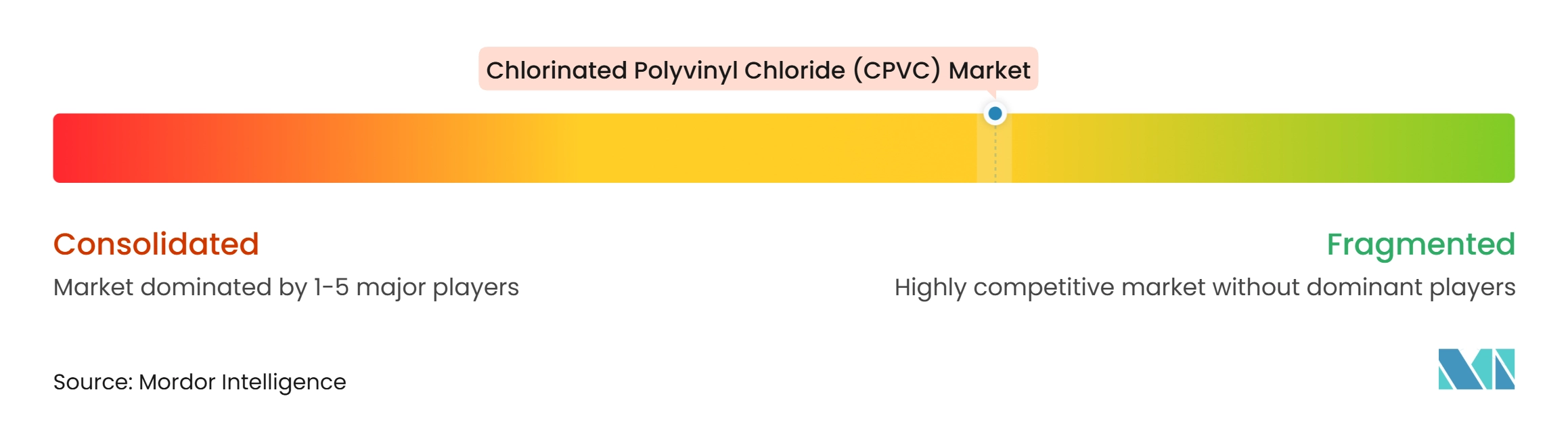
The chlorinated polyvinyl chloride (CPVC) market is moderately fragmented. Resin and compound production is concentrated among Lubrizol, Kaneka, Sekisui Chemical, and Epigral. At the same time, pipe, fitting, and system fabrication is handled by licensed processors and independent manufacturers across South Asia, North America, and Europe. Lubrizol operates through distinct brand lines: FlowGuard Gold for residential plumbing, BlazeMaster for fire protection, and Corzan for industrial applications. This brand structure integrates compound technology, licensing, and system approvals, making it difficult for smaller producers to replicate, as fire and plumbing specifications often depend on established certification histories.
Vertically integrated suppliers are better positioned to manage resin, compounding, pipe extrusion, and distribution during periods of input-cost volatility. Ashirvad by Aliaxis and Astral Limited hold this advantage in India through their manufacturing capabilities and dealer networks. Georg Fischer expanded its Uponor ChlorFIT offering with the launch of the 565 Butterfly Valve in September 2025, extending CPVC system capability in commercial applications that have traditionally used copper or carbon steel. Epigral's planned 150,000-tons-per-year facility is expected to increase local resin supply and improve competitive landed costs.
Fire sprinkler suppliers face high barriers to entry, as product approval requires material testing and system-level validation under UL and FM Approvals (FM) requirements. These barriers support the market position of established listed suppliers such as Viking, Spears, and IPEX in North America.
Chlorinated Polyvinyl Chloride (CPVC) Industry Leaders
-
Wavin B.V.
-
Spears Manufacturing Company
-
Viking Group Inc.
-
KANEKA CORPORATION
-
NIBCO INC.
- *Disclaimer: Major Players sorted in no particular order
Chlorinated Polyvinyl Chloride (CPVC) Market Companies Covered in this Report
- Aliaxis
- Ashirvad
- Astral Limited
- Epigral Limited
- Finolex Industries Limited
- Georg Fischer AG
- KANEKA CORPORATION
- Lubrizol
- NIBCO INC.
- Prince Pipes and Fittings Ltd.
- Sekisui Chemical Co., Ltd.
- Spears Manufacturing Company
- Supreme Industries Limited
- Viking Group Inc.
- Wavin B.V.
Recent Industry Developments in Chlorinated Polyvinyl Chloride (CPVC) Market
- June 2026: Lubrizol and Grasim inaugurated a chlorinated polyvinyl chloride (CPVC) resin plant in Vilayat, Gujarat. Phase 1 has a capacity of 50,000 tons per annum, with a total planned capacity of 100,000 tons. The combined USD 150 million investment, along with Lubrizol's expanded Dahej compounding site, establishes an integrated CPVC manufacturing footprint in India, reducing dependence on Japanese and American resin imports.
- March 2026: Sekisui Chemical announced a price revision for chlorinated polyvinyl chloride (CPVC) resins and compounds, citing increases in raw material and logistics costs. This affects customers in Asia and North America who use Sekisui-resin-based compounds.
Global Chlorinated Polyvinyl Chloride (CPVC) Market Report Scope
Chlorinated Polyvinyl Chloride (CPVC) is a rigid thermoplastic produced by adding chlorine to standard polyvinyl chloride (PVC) resin through a free-radical chlorination reaction. This process increases the chlorine content of the material from approximately 56-57% in standard PVC to 63-69% in CPVC, resulting in enhanced thermal, chemical, and mechanical properties compared to standard PVC.
The chlorinated polyvinyl chloride (CPVC) market is segmented by form, grade, application, end-user industry, and geography. By form, the market is segmented into pellets and powder. By grade, the market is segmented into extrusion grade and injection grade. By application, the market is segmented into pipes and fittings, fire sprinkler systems, industrial fluid handling, power cable casing, and others. By end-user industry, the market is segmented into residential, commercial, industrial, and others. The report also covers market sizes and forecasts for chlorinated polyvinyl chloride (CPVC) across 15 countries in major regions. The market sizes and forecasts are provided in terms of value (USD).
Segmentation Overview
| Pellet |
| Powder |
| Extrusion Grade |
| Injection Grade |
| Pipes and Fittings |
| Fire Sprinkler Systems |
| Industrial Fluid Handling |
| Power Cable Casing |
| Others |
| Residential |
| Commercial |
| Industrial |
| Others |
| Asia-Pacific | China |
| India | |
| Japan | |
| South Korea | |
| ASEAN Countries | |
| Rest of Asia-Pacific | |
| North America | United States |
| Canada | |
| Mexico | |
| Europe | Germany |
| United Kingdom | |
| France | |
| Italy | |
| NORDIC Countries | |
| Rest of Europe | |
| South America | Brazil |
| Argentina | |
| Rest of South America | |
| Middle East and Africa | Saudi Arabia |
| South Africa | |
| Rest of Middle East and Africa |
| By Form | Pellet | |
| Powder | ||
| By Grade | Extrusion Grade | |
| Injection Grade | ||
| By Application | Pipes and Fittings | |
| Fire Sprinkler Systems | ||
| Industrial Fluid Handling | ||
| Power Cable Casing | ||
| Others | ||
| By End-User Industry | Residential | |
| Commercial | ||
| Industrial | ||
| Others | ||
| By Geography | Asia-Pacific | China |
| India | ||
| Japan | ||
| South Korea | ||
| ASEAN Countries | ||
| Rest of Asia-Pacific | ||
| North America | United States | |
| Canada | ||
| Mexico | ||
| Europe | Germany | |
| United Kingdom | ||
| France | ||
| Italy | ||
| NORDIC Countries | ||
| Rest of Europe | ||
| South America | Brazil | |
| Argentina | ||
| Rest of South America | ||
| Middle East and Africa | Saudi Arabia | |
| South Africa | ||
| Rest of Middle East and Africa | ||
Key Questions Answered in the Report
What is current market size of Chlorinated Polyvinyl Chloride (CPVC) Market?
The Chlorinated Polyvinyl Chloride (CPVC) Market size was valued at USD 2.06 billion in 2026 and is estimated to grow from USD 2.23 billion in 2027 to USD 3.35 billion by 2032, at a CAGR of 8.45% during the forecast period (2027-2032).
Why is powder CPVC widely used?
Powder held a 58.12% share in 2026 because it gives compound makers flexibility to blend stabilizers, modifiers, lubricants, and tailored material grades.
Which region leads CPVC demand?
Asia-Pacific held a 36.73% share in 2026 and is projected to grow at a 10.18% CAGR through 2032. India supports both demand growth and the localization of resin supply.
What is the main challenge for CPVC suppliers?
CPVC has a price premium over PVC and faces exposure to PVC resin, chlorine, energy, installer qualification, and solvent-cement compatibility requirements.