
Chlorinated Paraffins Market Size and Share
Market Overview
| Study Period | 2021 - 2031 |
|---|---|
| Market Size (2026) | USD 2.16 Billion |
| Market Size (2031) | USD 2.58 Billion |
| Growth Rate (2026 - 2031) | 3.67 % |
| Fastest Growing Market | Asia-Pacific |
| Largest Market | Asia-Pacific |
| Market Concentration | Low |
Major Players *Disclaimer: Major Players sorted in no particular order Image © Mordor Intelligence. Reuse requires attribution under CC BY 4.0. | |
Chlorinated Paraffins Market Analysis by Mordor Intelligence
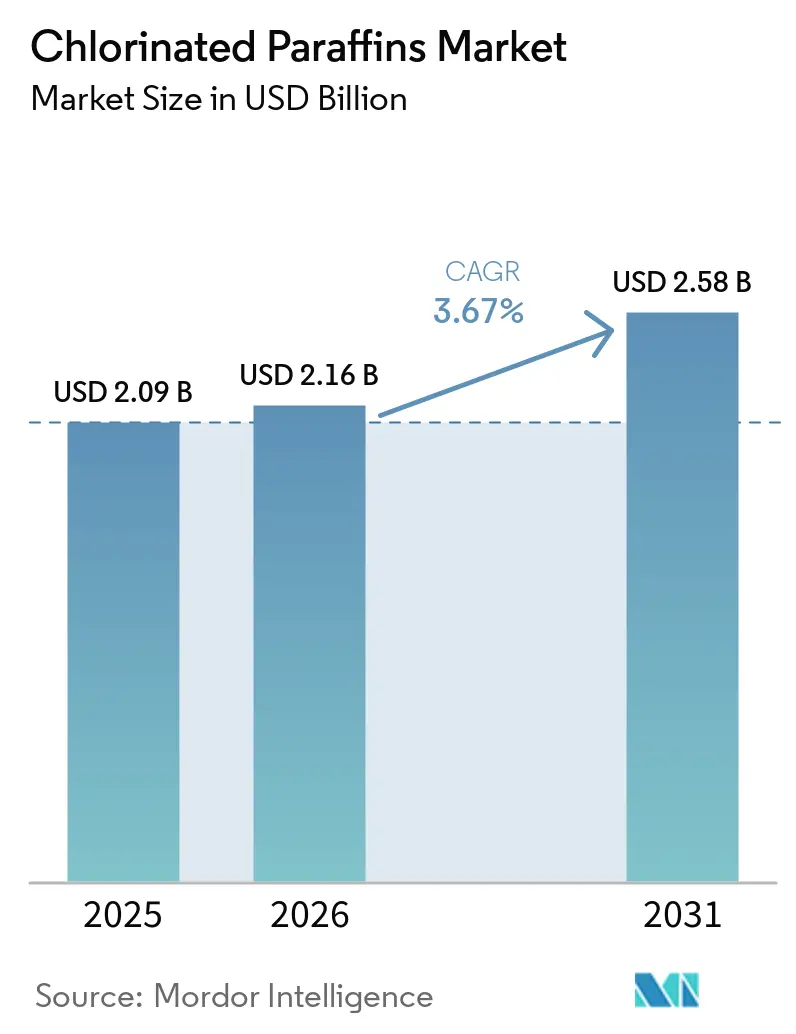
The Chlorinated Paraffins Market size stood at USD 2.09 billion in 2025, and is projected to grow from USD 2.16 billion in 2026 to USD 2.58 billion by 2031, at a CAGR of 3.67% during the forecast period (2026–2031). Flexible PVC production, metalworking fluid formulations, and flame-retardant applications in polymers support market growth. The May 2025 listing of medium-chain chlorinated paraffins under the Stockholm Convention is shifting demand toward long-chain and lower-chlorination grades rather than eliminating demand entirely. This development disrupts regulated regions while supporting investments in grades that comply with evolving registration and documentation requirements. Integrated producers can secure feedstock availability when chlorine and paraffin supplies are sourced within the same production system. In demanding metalworking operations, cost-performance considerations also sustain the relevance of chlorinated paraffins, where alternatives cannot provide comparable boundary lubrication.[1]United Nations Environment Programme, “The New POPs, Medium-Chain Chlorinated Paraffins Listed at COP12,” Stockholm Convention, pops.int.
Key Report Takeaways
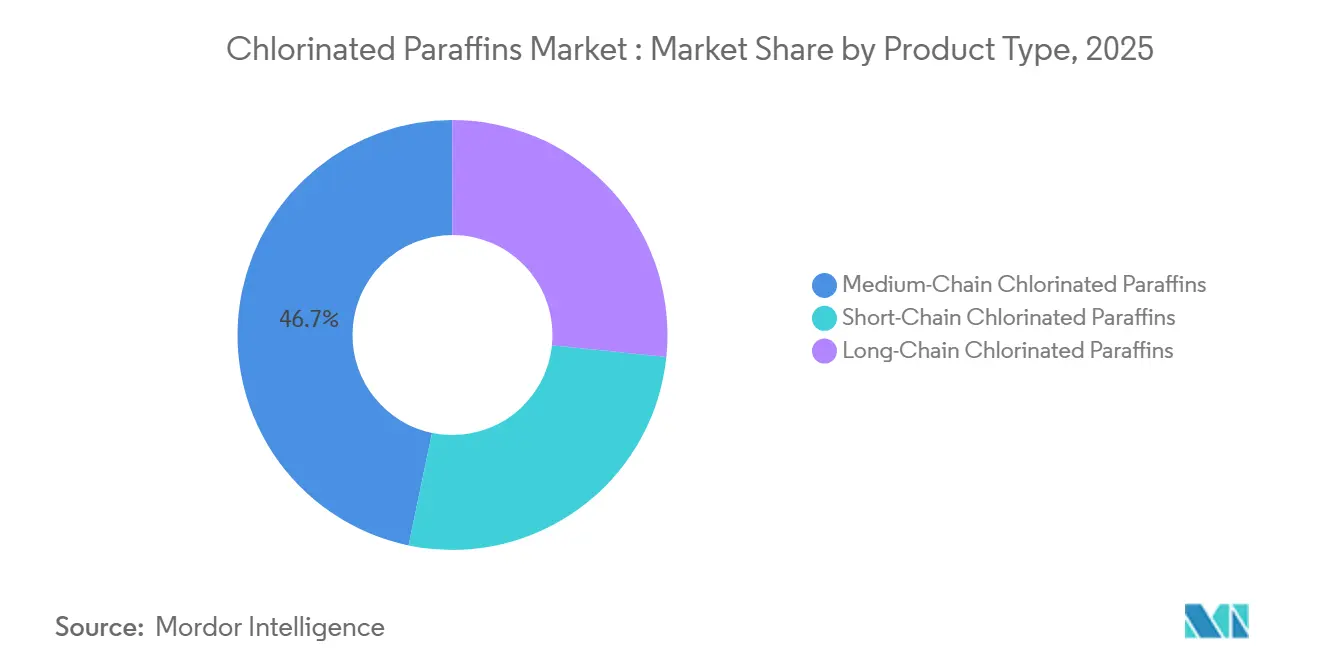
- By product type, medium-chain chlorinated paraffins held 46.72% of the chlorinated paraffins market share in 2025, while long-chain chlorinated paraffins are expected to be the fastest-growing product type with 4.23% CAGR through 2031.
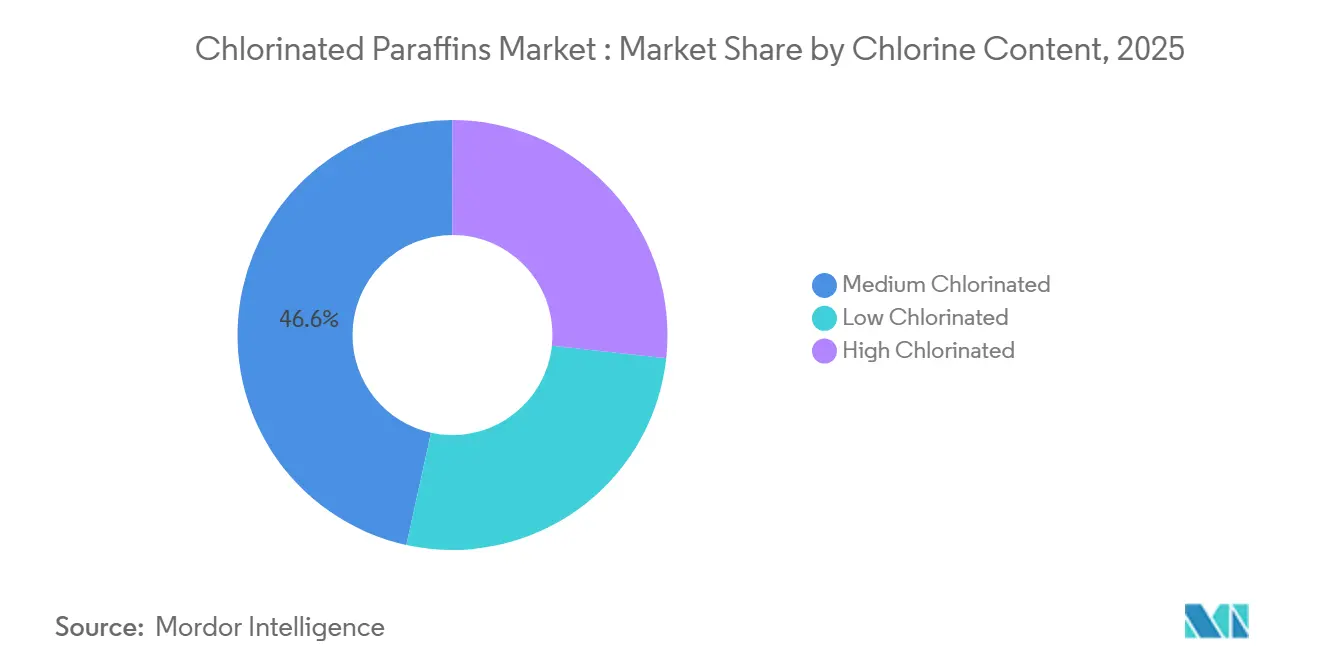
- By chlorine content, low-chlorinated grades are expected to record the highest projected CAGR at 4.31% through 2031, while medium-chlorinated grades held 46.56% of the chlorinated paraffins market share in 2025.
- By application, metalworking fluids were the largest application in 2025, while lubricating additives are expected to record the highest projected CAGR at 4.78% through 2031.
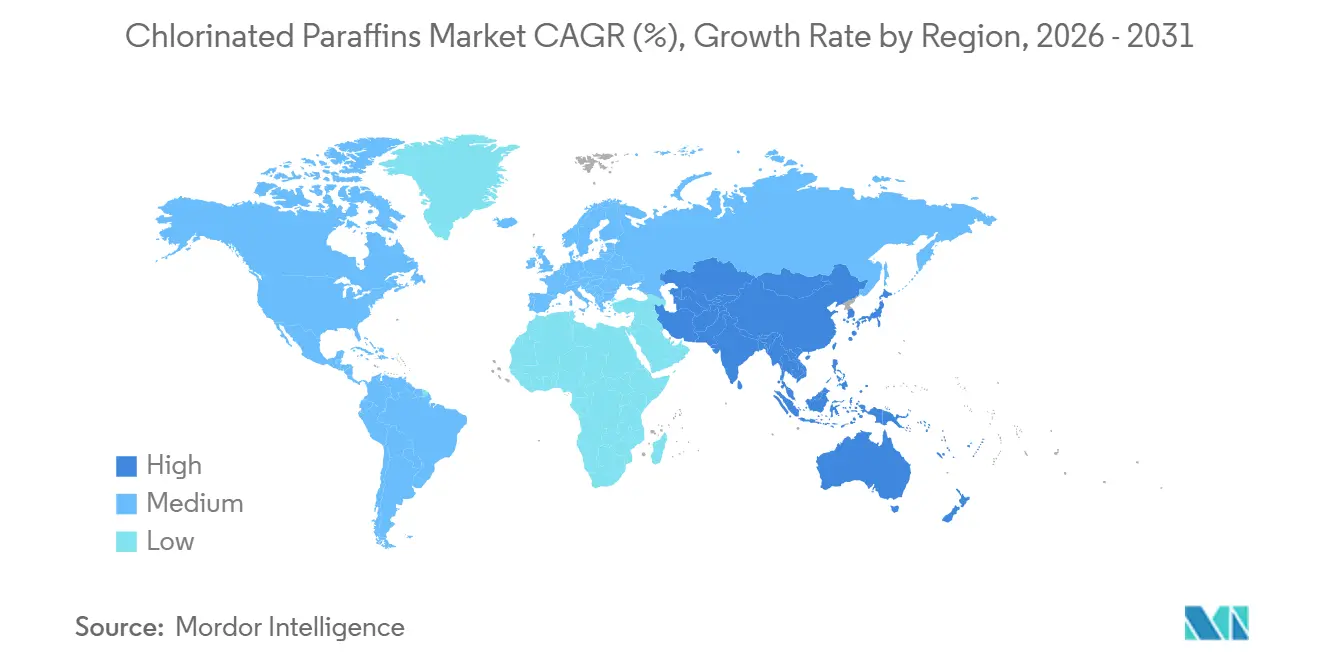
- By geography, Asia-Pacific held 31.27% of the chlorinated paraffins market share in 2025 and is expected to be the fastest-expanding region at 4.18% CAGR through 2031.
Note: Market size and forecast figures in this report are generated using Mordor Intelligence’s proprietary estimation framework, updated with the latest available data and insights as of January 2026.
Global Chlorinated Paraffins Market Trends and Insights
Drivers Impact Analysis*
| Driver | (~) % Impact on CAGR Forecast | Geographic Relevance | Impact Timeline |
|---|---|---|---|
| Flexible PVC Demand | +0.8% | Global, concentrated in Asia-Pacific and Latin America | Long term (≥ 4 years) |
| Metalworking Fluid Consumption | +0.7% | Asia-Pacific, North America, Europe | Medium term (2-4 years) |
| Fire-Safety Requirements for Polymers and Textiles | +0.4% | North America, Europe, South Korea, Japan | Medium term (2-4 years) |
| Construction and Manufacturing Expansion in Emerging Economies | +0.6% | Asia-Pacific, Middle East and Africa, South America | Long term (≥ 4 years) |
| Integrated Chlorine and Paraffin Supply Security | +0.3% | Asia-Pacific, North America | Medium term (2-4 years) |
| Grade Migration Toward Compliant MCCP and LCCP Formulations | +0.4% | Europe, North America, and supply-side shifts in Asia-Pacific | Short term (≤ 2 years) |
| Source: Mordor Intelligence | |||
Flexible PVC Demand
Flexible PVC remains the largest global consumption channel for chlorinated paraffins. Manufacturers use chlorinated paraffins as secondary plasticizers and flame-retardant co-agents alongside primary phthalates, such as DINP and DEHP. Demand from cable insulation, automotive interiors, flooring, and protective sheeting remains closely linked to construction and electrification activity. Higher prices for primary plasticizers can encourage compounders to use lower-cost secondary plasticizers, supporting demand during periods of feedstock price volatility. Southeast Asia’s projected urban population growth through 2035 is expected to support future demand for housing, pipes, profiles, and cable insulation. In August 2024, Reliance Industries announced plans to expand its integrated PVC capacity, reinforcing PVC’s role in the chlorinated paraffins market.
Metalworking Fluid Consumption
Chlorinated paraffins serve as extreme-pressure additives in cutting, grinding, forming, and deep-drawing fluids. They provide boundary lubrication in applications where contact pressures exceed the capabilities of many alternative chemistries. Consequently, automotive component manufacturing, aerospace fabrication, and precision engineering remain key demand sources for the chlorinated paraffins market. Manufacturing reshoring in North America, along with expanded CNC capacity in India and Southeast Asia, supports demand across these applications. The Stockholm Convention provides a time-limited exemption for the use of MCCPs in professional and industrial heavy-duty metalworking fluids through December 31, 2036. This exemption reflects the lack of technically equivalent alternatives for the most demanding cutting and forming applications.
Fire-Safety Requirements for Polymers and Textiles
Fire codes in construction, transportation, and electronics continue to support demand for chlorinated paraffins in polymers, rubber compounds, and technical textiles. High-chlorine grades provide flame-retardant performance in applications requiring enhanced fire resistance. South Korea’s electronics manufacturing base supports demand for flame retardants in wire and cable jacketing, conveyor belting, and textile backcoatings. Although restrictions apply to apparel textiles, they do not significantly affect the larger volumes used in construction polymers, electrical cables, and automotive components. Canada’s prohibition on SCCPs, effective June 30, 2026, is directing formulation development in the chlorinated paraffins market toward compliant MCCP and LCCP grades. Cable fire-performance requirements continue to support demand for halogen-based flame retardants in infrastructure projects.
Construction and Manufacturing Expansion in Emerging Economies
Infrastructure investment across South and Southeast Asia supports demand in the chlorinated paraffins market, particularly for PVC plasticizers and metalworking fluids. Indonesia’s national development plan, Vietnam’s housing activity, the Philippines’ infrastructure program, and India’s Smart Cities Mission are increasing requirements for pipes, profiles, and cable insulation.
Manufacturing expansion in Vietnam, Thailand, and Bangladesh is also generating additional demand for cutting and forming fluids. Electronics assembly, garment machinery manufacturing, and automotive parts production support the chlorinated paraffins market in applications that require extreme-pressure additives. Much of Southeast Asia remains dependent on imports from Chinese producers, reinforcing China’s export-oriented production system. Brazil’s petrochemical expansion and Saudi Arabia’s industrial diversification are further extending the demand base to South America and the Middle East.
Restraints Impact Analysis*
| Restraint | (~) % Impact on CAGR Forecast | Geographic Relevance | Impact Timeline |
|---|---|---|---|
| SCCP and MCCP Regulatory Restrictions | -0.9% | Global, most acute in Europe and North America | Short term (≤ 2 years) |
| Substitution by Non-Chlorinated Additives | -0.5% | Europe, North America, South Korea, with spillover to Asia-Pacific | Medium term (2-4 years) |
| Analytical Ambiguity and Testing Costs | -0.3% | Global, particularly EU and North American compliance regions | Medium term (2-4 years) |
| Source: Mordor Intelligence | |||
Short-Chain Chlorinated Paraffins and Medium-Chain Chlorinated Paraffins Regulatory Restrictions
The proposed May 2025 Annex A listing of Medium-Chain Chlorinated Paraffins (MCCPs) marks a significant regulatory escalation for the chlorinated paraffins market. The decision would extend control measures beyond Short-Chain Chlorinated Paraffins (SCCPs) to MCCPs, which accounted for 46.72% of global revenue in 2025. Time-limited exemptions would permit the use of MCCPs in metalworking fluids until December 31, 2036, and in defense and aerospace applications until December 31, 2041. However, these exemptions establish a planned phaseout of broader MCCP use across signatory jurisdictions. European formulators operating in the chlorinated paraffins market must prepare for a proposed concentration limit of 0.1% w/w for substances, mixtures, and articles. Demand is likely to become increasingly geographically fragmented as non-signatory markets retain a broader window for MCCP use.[2]Council of the European Union, “Council Decision EU 2025/868 of April 23, 2025, on the Position to Be Taken on Behalf of the European Union at the Twelfth Meeting of the Conference of the Parties to the Stockholm Convention,” EUR-Lex, eur-lex.europa.eu.
Substitution by Non-Chlorinated Additives
Substitution is more viable in moderate-duty applications than in heavy-duty metalworking operations. Alternative chemistries often cannot match the cost and performance of chlorinated paraffins in deep drawing, broaching, and demanding forming applications. Formulators are evaluating polymeric esters, sulfurized polyisobutylene, phosphate esters, and vLCCPs as potential substitutes. Certain polymeric ester formulations have demonstrated effective extreme-pressure properties and thermal stability in cutting and stamping applications. CONDAT has reformulated select drawing oils and greases without SCCPs or MCCPs for stainless steel wire and coil stamping applications. Therefore, the chlorinated paraffins market is expected to experience gradual erosion in regulated regions rather than immediate replacement across all applications.
*Our forecasts treat driver/restraint impacts as directional, not additive. The impact forecasts reflect baseline growth, mix effects, and variable interactions.
Segment Analysis
By Product Type: Regulatory Divergence Drives LCCP Portfolio Upgrades
Medium-chain chlorinated paraffins accounted for 46.72% of global revenue in 2025. Their significant position in the chlorinated paraffins market stems from their use as PVC secondary plasticizers, extreme-pressure additives in metalworking fluids, and flame-retardant additives in polymer formulations. Their balanced viscosity and compatibility characteristics support their use across these applications. Their cost-performance advantage remains particularly important in price-sensitive construction and cable markets across Asia-Pacific. Demand for short-chain chlorinated paraffins (SCCPs) is declining in regulated markets, as they have been listed as persistent organic pollutants since 2017. Residual SCCP demand remains concentrated in jurisdictions that have not implemented equivalent restrictions.
Long-chain chlorinated paraffins are expected to be the fastest-growing product type during 2026-2031 with a CAGR of 4.23%. They are gaining market share as formulators in Europe and North America update product registrations and reduce exposure to restrictions on medium-chain chlorinated paraffins (MCCPs). The chlorinated paraffins market size for long-chain grades is expected to benefit from the shift toward compliant specialty formulations. Vantage Leuna offers MCCP grades ranging from C14 to C17 and LCCP grades ranging from C17 to C30, with different stabilizer configurations. Caffaro Industrie manufactures MCCP and LCCP grades at its Torviscosa facility, where LCCPs represent a growing share of the product portfolio. In less-regulated Asia-Pacific markets, cost and application performance continue to influence grade selection more strongly than regulatory classification.



By Chlorine Content: Low-Chlorine Grades Outpace Market on Compliance Tailwinds
Low-chlorinated grades are projected to record the highest CAGR of 4.31% during 2026–2031. This growth reflects their position below chlorination thresholds targeted by restrictive regulatory frameworks. These products continue to serve as secondary plasticizers and additives for lower-duty lubricants in the chlorinated paraffins market. European regulatory proposals define restrictions based on specific molecular formulas rather than average chlorine content alone. As a result, congener composition and technical documentation are critical for suppliers. Low-chlorinated grades can provide downstream buyers with greater procurement flexibility in regulated markets.
Medium-chlorinated grades remained the commercial backbone of the chlorinated paraffins market in 2025, with the largest revenue share of 46.56% in 2025. CP-52 grades are particularly important in China’s PVC plasticizer and metalworking industries. High-chlorinated grades serve flame-retardant and specialty rubber applications, where fire-performance requirements remain critical. Demand for high-chlorine products continues in jurisdictions with less-developed restrictions and where non-halogenated alternatives remain costly. South Korean fire-safety requirements also support specialized demand for medium-chlorinated grades in electronics and transportation components. Producers exporting to the European Union must demonstrate that product congener profiles comply with relevant formula thresholds, increasing testing and documentation requirements.
By Application: Metalworking Fluids Anchor Volume, Lubricating Additives Lead Growth
Metalworking fluids accounted for the largest application share of 35.21% in 2025. The chlorinated paraffins market relies on these fluids for cutting, grinding, drilling, and forming operations. Applications such as deep drawing of stainless steel, machining of aerospace alloys, and precision thread forming require reliable boundary lubrication at the metal-tool interface. Synthetic ester alternatives do not consistently match the performance of CP-based formulations under comparable viscosity and cost conditions. The metalworking exemption, effective until December 31, 2036, supports European demand beyond the broader prohibition timeline. PVC plasticizers represented the second-largest application by value and remained closely tied to construction activity in Asia.
Lubricating additives are projected to register the highest CAGR of 4.78% through 2031. Expanding machining capacity in India, Vietnam, and Indonesia is supporting growth in the chlorinated paraffins market. Automotive and general industrial maintenance applications in these manufacturing hubs are increasingly adopting CP-enhanced lubricant formulations. Flame retardants, rubber, and elastomers remain significant applications but face greater substitution pressure in Europe. The “others” category includes leather processing, adhesives, and specialty coatings, supported by demand from the leather industries in South and Southeast Asia. OEKO-TEX Standard 100 requirements are also influencing procurement decisions for leather finishing and textile coatings among export-oriented manufacturers.
Geography Analysis
Asia-Pacific accounted for 31.27% of global revenue in 2025 and is expected to remain the fastest-growing region through 2031 with a CAGR of 4.18%. China anchors regional production and consumption through manufacturing clusters in Shandong, Jiangsu, and Zhejiang. However, environmental compliance costs and feedstock constraints reduce utilization rates at some facilities in central and western China. India is the second-largest regional consumer and the fastest-growing major producing country in the Asia-Pacific. PVC cable production, automotive components, leather processing, and metalworking applications support demand in India. Lords Chloro Alkali plans to expand its CPW capacity from 20 to 50 TPD in December 2024, followed by a further expansion to 100 TPD in June 2025, supported by capital expenditure of INR 300 million (USD 3.6 million).
Southeast Asian countries, including Vietnam, Thailand, and Indonesia, remain significant net importers of products from Chinese producers. This trade pattern reinforces China’s role in price formation within the chlorinated paraffins market. Metalworking fluid and PVC applications sustain demand in North America. The United States has approved vLCCPs with C21+ carbon chains for domestic manufacturing, providing a compliance pathway for certain industrial applications. Europe faces a more restrictive operating environment as controls on MCCPs advance. In August 2026, INEOS Inovyn is expected to acquire the remaining 50% shareholding in Runcorn MCP Limited and related EDC assets, strengthening its integrated supply chain in the United Kingdom.
South America, the Middle East, and Africa offer demand outlets where regulatory frameworks remain at earlier stages of development. Brazil’s PVC processing and construction activities support demand for secondary plasticizers in the chlorinated paraffins market. Saudi Arabia and South Africa represent significant demand centers in the Middle East and Africa. NCP Chlorchem manufactures Plasticlor chlorinated paraffin products in Gauteng for mining, plastics, and industrial chemical applications. Nuberg EPC is expected to receive a contract in November 2025 for a chlor-alkali expansion project in Oman that includes downstream chlorinated paraffin wax production capability. These regions can absorb applications that face increasing restrictions in Europe and North America.

Competitive Landscape
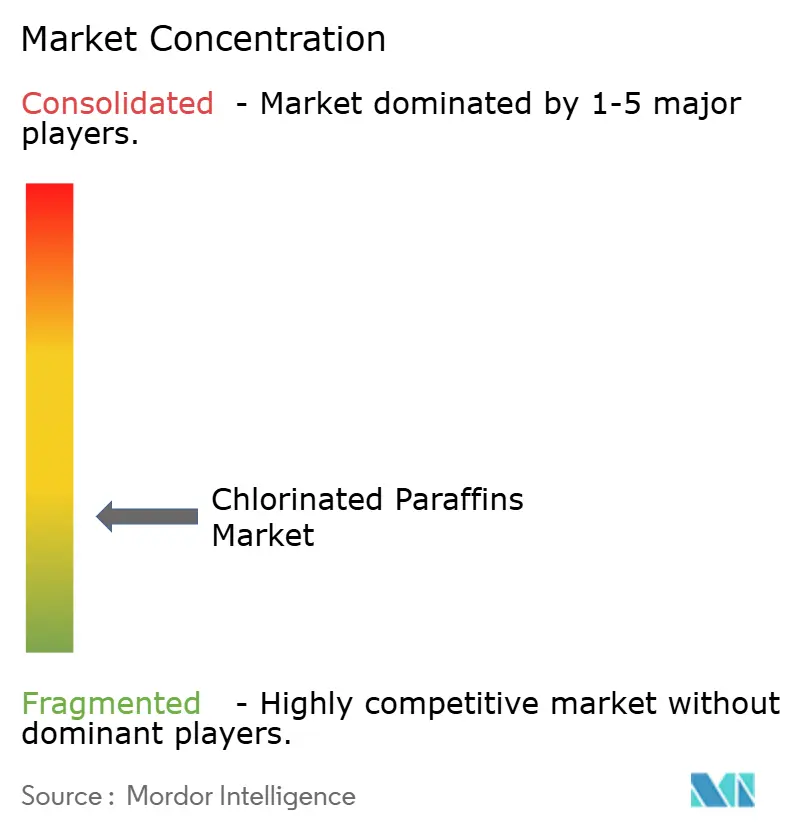
The global chlorinated paraffins market is moderately fragmented, although concentration varies across regions. China has hundreds of producers operating at different levels of integration and environmental compliance. Competition in commodity-grade products is particularly intense in Asian PVC and metalworking applications, driven by production capacity and export-oriented economics. INEOS Inovyn and KLJ Group are globally positioned producers with chlor-alkali integration and broad product portfolios. KLJ Group operates facilities in India, Thailand, and Qatar, providing a broader manufacturing footprint than many competitors. Producers with integrated access to chlorine and paraffin feedstocks can reduce feedstock exposure and improve supply reliability.
In Europe and North America, competition in specialty-grade products centers on registrations, formulation capabilities, and supply chain documentation. Vantage Leuna’s 2026 product catalog identifies ISO 9001:2015 and ISO 50001 certifications at its Leuna site. These certifications support its quality and energy-management positioning in European specialty tenders. The draft also references a EUR 5 million (USD 5.82 million) investment received by Caffaro Industrie in July 2025 for facility upgrades and pharmaceutical intermediate development. This investment reduces the company’s reliance on chlorinated paraffins while leveraging its chlorination capabilities. Suppliers with established compliance records are better positioned to serve defense and aerospace applications, which retain a longer exemption period for MCCPs.
Chinese producers that invest in cleaner production processes and REACH registrations could compete more directly in premium LCCP segments. Established European suppliers are responding through broader product portfolios, registration capabilities, and customer support. The draft references INEOS Inovyn’s August 2026 Runcorn transaction as an example of a supply-security strategy. KLJ Group’s USD 125 million chlor-alkali complex in Qatar provides another example of backward integration that supports cost resilience. Caffaro’s facility upgrades represent a third strategic initiative focused on strengthening portfolio diversity and production capabilities. The market concentration score is 3 out of 10, reflecting moderate fragmentation and the presence of hundreds of Chinese producers. The available evidence does not indicate that leading companies hold the combined market shares required to support a higher score.
Chlorinated Paraffins Industry Leaders
INEOS
Dover Chemical Corporation
Aditya Birla Chemicals Limited
KLJ Group
NCP Chlorchem (Pty) Ltd
- *Disclaimer: Major Players sorted in no particular order

Recent Industry Developments
- August 2026: INEOS Inovyn agreed to acquire the remaining 50% shareholding in Runcorn MCP Limited, along with ethylene dichloride (EDC) production assets, from Vynova Runcorn Limited, which entered administration in 2025. The transaction fully integrates the United Kingdom’s chlor-alkali and EDC value chain under INEOS Inovyn and secures the Runcorn site, which supplies 98% of the chlorine used in UK drinking water treatment. This acquisition is critical to maintaining the continuity of downstream chlorinated derivatives production.
- June 2025: Lords Chloro Alkali Limited announced plans to expand its chlorinated paraffin wax manufacturing capacity at its Rajasthan facility from 50 TPD to 100 TPD. The company allocated INR 300 million (USD 3.6 million) in capital expenditure, funded through internal accruals and existing credit lines. It aims to commission the expansion by the end of FY2026–27 to improve captive chlorine utilization and meet domestic industrial demand.


Global Chlorinated Paraffins Market Report Scope
Chlorinated paraffin is a complex mixture of chlorinated hydrocarbons used widely as a secondary plasticizer, flame retardant, and extreme-pressure lubricant additive.
The Chlorinated paraffin market is segmented by product type, chlorine content, application, and geography. By product type, the market is segmented into short-chain chlorinated paraffins, medium-chain chlorinated paraffins, and long-chain chlorinated paraffins. By chlorine content, the market is segmented into low chlorinated, medium chlorinated, and high chlorinated. By application, the market is segmented into metalworking fluids, lubricating additives, PVC plasticizers, flame retardants, rubber and elastomers, and others. By geography, the market is segmented into Asia Pacific, North America, Europe, South America, the Middle East and Africa. The report also covers the Chlorinated paraffin market size and forecasts for the Chlorinated paraffin market in 15 countries across major regions. For each segment, the market sizing and forecasts have been done on the basis of value (USD).
| Short-Chain Chlorinated Paraffins |
| Medium-Chain Chlorinated Paraffins |
| Long-Chain Chlorinated Paraffins |
| Low Chlorinated |
| Medium Chlorinated |
| High Chlorinated |
| Metalworking Fluids |
| Lubricating Additives |
| PVC Plasticizers |
| Flame Retardants |
| Rubber and Elastomers |
| Others |
| Asia-Pacific | China |
| India | |
| Japan | |
| South Korea | |
| Rest of Asia-Pacific | |
| North America | United States |
| Canada | |
| Mexico | |
| Europe | Germany |
| United Kingdom | |
| France | |
| Italy | |
| Rest of Europe | |
| South America | Brazil |
| Argentina | |
| Rest of South America | |
| Middle East and Africa | Saudi Arabia |
| South Africa | |
| Rest of Middle East and Africa |
| By Product Type | Short-Chain Chlorinated Paraffins | |
| Medium-Chain Chlorinated Paraffins | ||
| Long-Chain Chlorinated Paraffins | ||
| By Chlorine Content | Low Chlorinated | |
| Medium Chlorinated | ||
| High Chlorinated | ||
| By Application | Metalworking Fluids | |
| Lubricating Additives | ||
| PVC Plasticizers | ||
| Flame Retardants | ||
| Rubber and Elastomers | ||
| Others | ||
| By Geography | Asia-Pacific | China |
| India | ||
| Japan | ||
| South Korea | ||
| Rest of Asia-Pacific | ||
| North America | United States | |
| Canada | ||
| Mexico | ||
| Europe | Germany | |
| United Kingdom | ||
| France | ||
| Italy | ||
| Rest of Europe | ||
| South America | Brazil | |
| Argentina | ||
| Rest of South America | ||
| Middle East and Africa | Saudi Arabia | |
| South Africa | ||
| Rest of Middle East and Africa | ||


Key Questions Answered in the Report
What is the projected value of chlorinated paraffins by 2031?
The value is projected to reach USD 2.58 billion by 2031, rising from USD 2.16 billion in 2026 at a CAGR of 3.67%.
Which chlorinated paraffin product type held the largest share in 2025?
Medium-chain chlorinated paraffins held 46.72% of global revenue in 2025.
Which chlorine-content grade is growing fastest?
Low-chlorinated grade is forecast to grow at a CAGR of 4.31% from 2026 to 2031.
Which region leads demand and growth?
Asia-Pacific held 31.27% of global revenue in 2025 and is forecast to be the fastest-expanding region through 2031.
Page last updated on:





