
China Technical Textile Manufacturing Market Size and Share
Market Overview
| Study Period | 2021 - 2032 |
|---|---|
| Forecast Data Period | 2027 - 2032 |
| Base Year Market Size (2026) | USD 76.99 Billion |
| Market Size (2027) | USD 82.94 Billion |
| Market Size (2032) | USD 113.63 Billion |
| Growth Rate (2027 - 2032) | 6.50 % |
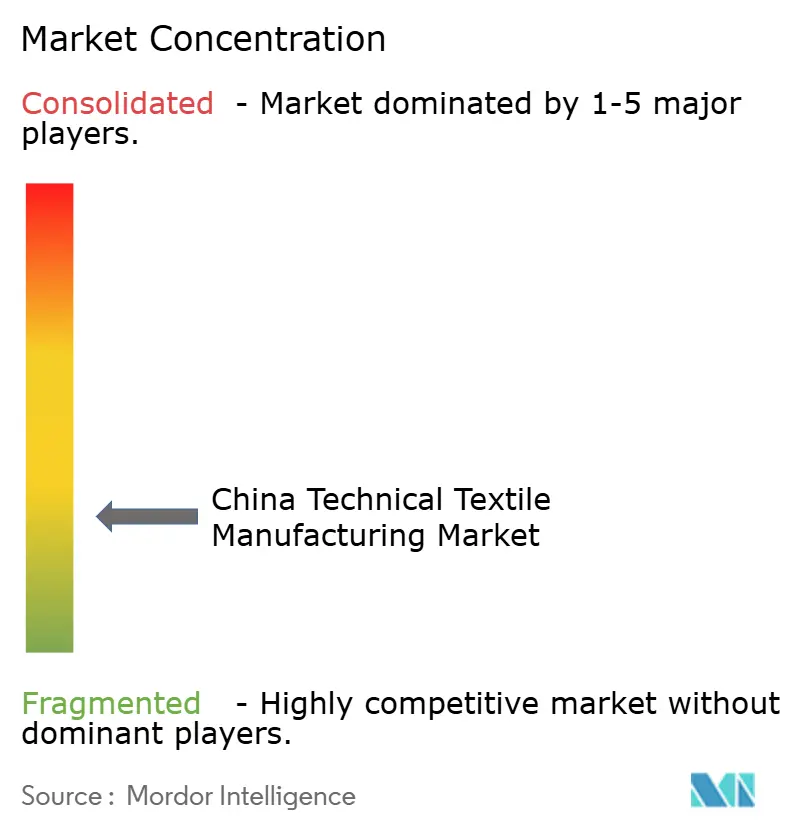
| Market Concentration | Low |
Major Players *Disclaimer: Major Players sorted in no particular order Image © Mordor Intelligence. Reuse requires attribution under CC BY 4.0. | |
China Technical Textile Manufacturing Market Analysis by Mordor Intelligence
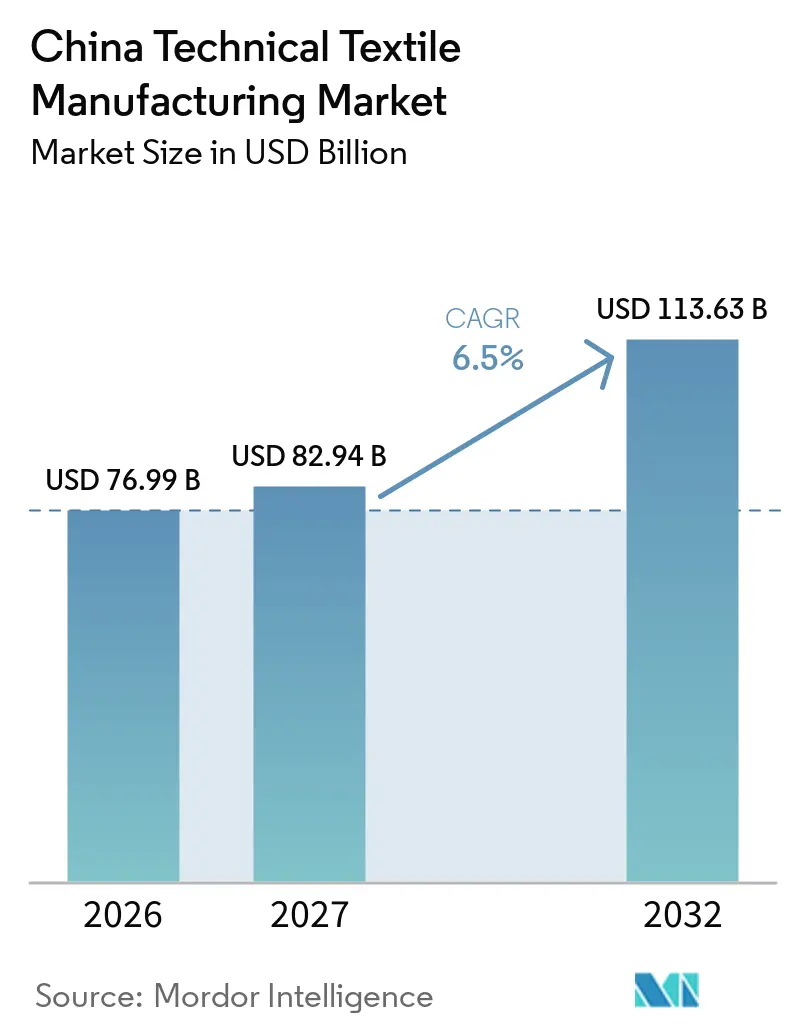
The China Technical Textile Manufacturing Market size is projected to expand from USD 76.99 billion in 2026 and USD 82.94 billion in 2027 to USD 113.63 billion by 2032, registering a CAGR of 6.5% between 2027 and 2032.
The China technical textile manufacturing market is being shaped by demand from new-energy vehicles, healthcare, hygiene, infrastructure, and environmental applications. Higher specifications for battery insulation, filtration, protective clothing, and geotechnical materials are moving demand toward products that need certification and consistent performance. This change gives integrated manufacturers a clearer route to defend margins than producers of conventional nonwoven and standard synthetic yarns. At the same time, excess capacity, volatile polymer prices, and trade barriers continue to pressure commodity-oriented suppliers. Export demand from Belt and Road Initiative economies offers an outlet for some producers, although high-specification medical, aerospace, and defense applications still require long qualification cycles.
Key Report Takeaways
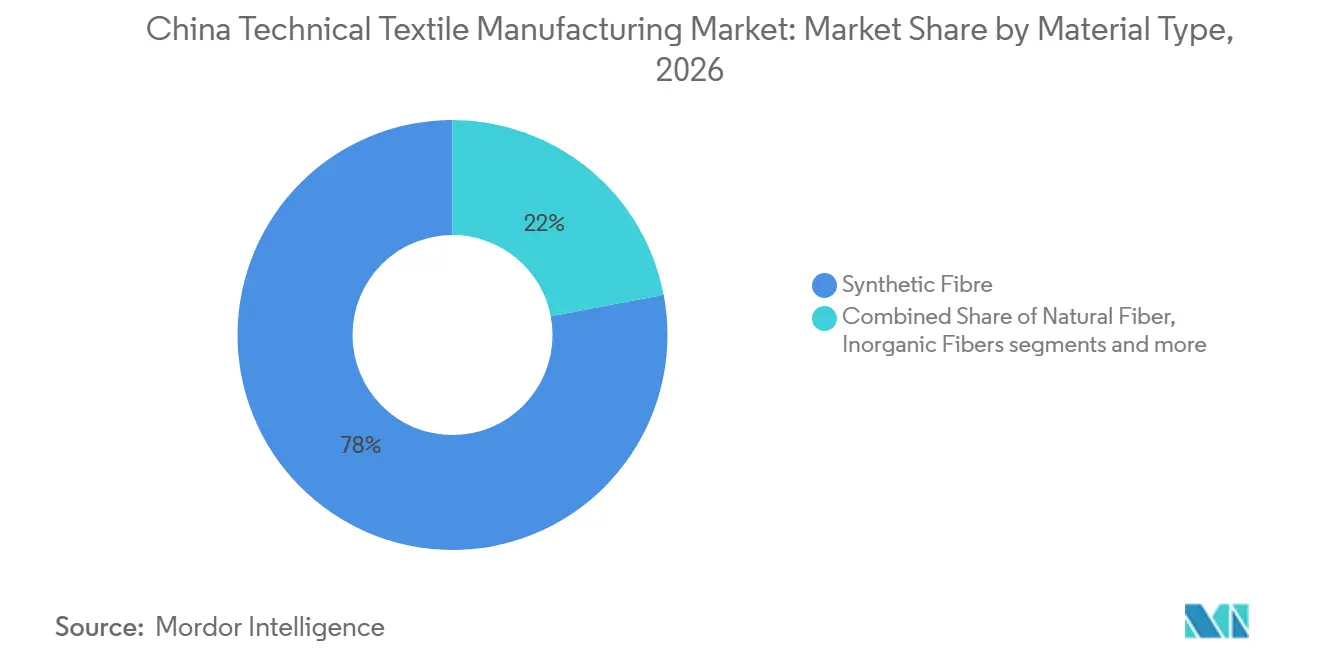
- By material type, synthetic fiber held 78% of the China technical textile manufacturing market share in 2026, while regenerated and other fibers are forecast to expand at a 7.4% CAGR through 2032.
- By form and structure, nonwoven technical textiles accounted for 44% of the China technical textile manufacturing market size in 2026 and are forecast to grow at a 6.9% CAGR through 2032.
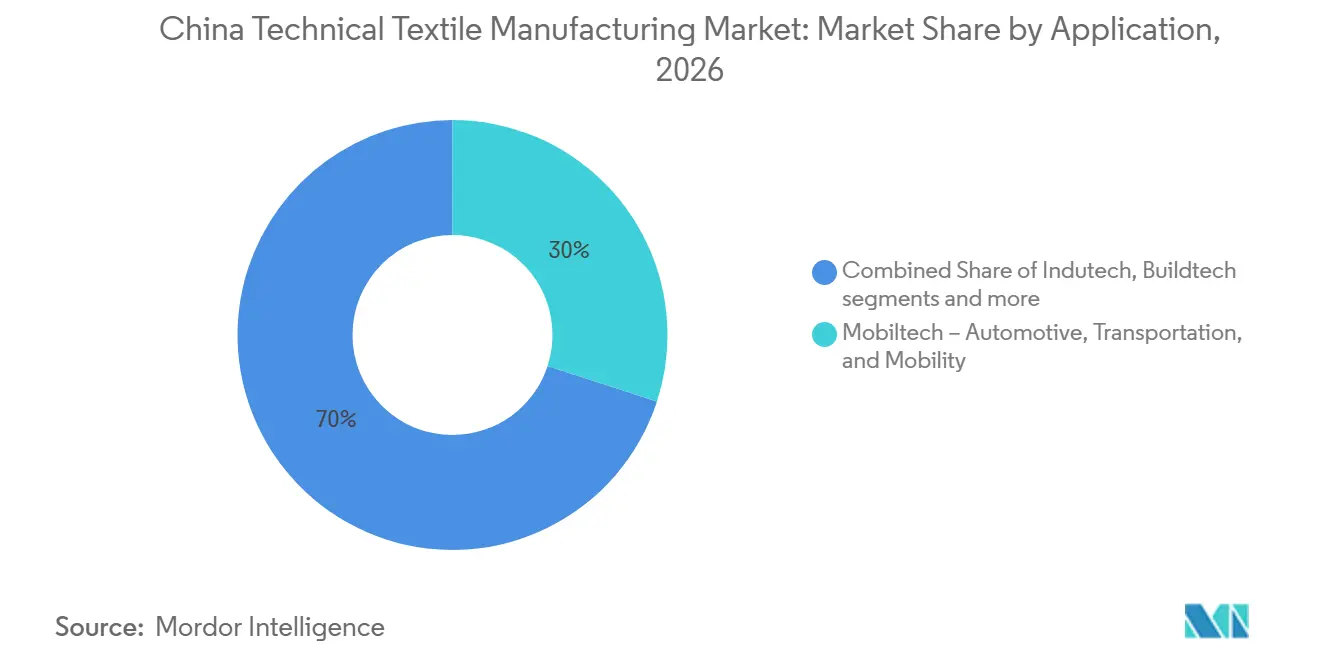
- By application, mobiltech held 30% of the China technical textile manufacturing market share in 2026 and is projected to grow at an 8.5% CAGR through 2032.
Note: Market numbers in this report are based on Mordor Intelligence's proprietary estimation framework, which combines nine months of actuals with Q4 projections for base year 2026.
China Technical Textile Manufacturing Market Trends and Insights
Drivers Impact Analysis*
| Driver | (~) % Impact on CAGR Forecast | Geographic Relevance | Impact Timeline |
|---|---|---|---|
| New-Energy Vehicle, Battery, and Mobility Material Demand | +1.5% | National, with core gains in Guangdong, Jiangsu, Anhui, and Sichuan NEV clusters | Short term (≤ 2 years) |
| Infrastructure Modernization and Geotechnical Demand | +1.2% | National, concentrated in central, western, and coastal infrastructure corridors. | Medium term (2-4 years) |
| Healthcare, Hygiene, and Medical Nonwoven Expansion | +1% | National, strongest in Jiangsu, Zhejiang, Fujian, and Shandong | Short term (≤ 2 years) |
| Export Competitiveness and Integrated Fiber-to-Article Supply Chains | +0.8% | Coastal provinces, especially Jiangsu, Zhejiang, Guangdong, and Fujian, with spillover to ASEAN relocation bases | Medium term (2-4 years) |
| Domestic Substitution of Imported High-Specification Technical Materials | +0.6% | National, led by Jiangsu, Zhejiang, and Shandong manufacturing hubs | Long term (≥ 4 years) |
| Digital Traceability and Small-Batch Customization for Industrial Buyers | +0.4% | National, with early gains in coastal export-oriented provinces | Long term (≥ 4 years) |
| Source: Mordor Intelligence | |||
New-Energy Vehicle, Battery, and Mobility Material Demand
China’s new-energy vehicle expansion is raising both the volume and performance requirements for technical textiles. Materials used in battery packs need thermal protection, insulation, separation, acoustic control, and lightweight structural performance. The China technical textile manufacturing market benefits as vehicle makers require more material content in electric vehicles than in conventional vehicles. Vehicle makers are also placing more attention on traceable materials and consistent life-cycle information. Domestic aramid insulation paper can provide a cost advantage over imported alternatives. The opportunity, therefore, remains strongest for suppliers that can qualify battery-grade products and document their material performance.
Infrastructure Modernization and Geotechnical Demand
Transportation, water management, and urban construction continue to support demand for geotextiles and related materials. The first year of the 15th Five-Year Plan is 2026, sustaining the policy setting for road, high-speed rail, flood control, and municipal drainage investment. China Industrial Textile Association reported that demand for wiping products, automotive supporting products, and wind power applications each grew by more than 10% in 2025. The China technical textile manufacturing market can gain from higher procurement requirements for durable and certified geocomposites. More than 1,200 producers operate in geotechnical construction materials, which keeps price competition intense in standard products. Suppliers that meet recyclable or bio-based product requirements can be better placed as infrastructure buyers raise material standards.
Healthcare, Hygiene, and Medical Nonwoven Expansion
Medical and hygiene nonwovens are less exposed to the price pressure affecting many industrial grades. National Bureau of Statistics data showed that nonwoven fabric output increased 8.9% year over year in the first quarter of 2025, supported by healthcare demand.[1] The approval of more than 2,400 hospital projects between 2023 and 2025 points to continuing demand for surgical drapes, gowns, sterilization wraps, and wound-care substrates, although that historical count is not used as a new forecast. The China technical textile manufacturing market also has a larger addressable base for premium consumables as healthcare reform advances. The T/CNHAW 0017-2025 functional evaluation standard was issued in October 2025 and raises performance expectations for healthcare textiles. This favors producers that can distinguish clinical-grade products from general-purpose materials.
Export Competitiveness and Integrated Fiber-to-Article Supply Chains
Integrated production from fiber through finished articles remains a major advantage for Chinese suppliers. This structure can shorten lead times and reduce the cost of coordinating yarn, fabric, coating, conversion, and final delivery. Technical textile exports to the European Union increased 3.8%, exports to Latin America rose 5.3%, and exports to Africa grew 11.6% in 2025, even as shipments to North America faced tariff pressure. Exports to Belt and Road Initiative economies reached USD 23.43 billion in 2025, equal to 60.7% of sector exports and up 4.2% year over year. The China technical textile manufacturing market can use demand from Southeast Asia, Central Asia, the Middle East, and Africa to support infrastructure, hygiene, and filtration sales. Zhejiang Hailide’s Vietnam tire-cord plant shows how overseas capacity can help suppliers serve regional automotive demand through a local production base.
Restraints Impact Analysis*
| Restraint | (~) % Impact on CAGR Forecast | Geographic Relevance | Impact Timeline |
|---|---|---|---|
| Overcapacity and Margin Compression in Commodity Nonwovens | -1.2% | National, most acute in Shandong, Jiangsu, and Zhejiang commodity nonwoven clusters | Short term (≤ 2 years) |
| Volatility in Polymer, Energy, and Chemical Input Costs | -0.9% | National, amplified in polypropylene- and polyester-intensive production regions. | Short term (≤ 2 years) |
| Export Tariffs, Trade Fragmentation, and Compliance Costs | -0.7% | Coastal export provinces, with spillover to North America-facing supply chains | Medium term (2-4 years) |
| Uneven Qualification Cycles for High-Specification Applications | -0.5% | National, most acute for medical, aerospace, and defense supply chains | Long term (≥ 4 years) |
| Source: Mordor Intelligence | |||
Overcapacity and Margin Compression in Commodity Nonwovens
Commodity nonwovens carry the strongest margin risk in the China technical textile manufacturing market. National Bureau of Statistics data showed that profits in China’s textile sector fell 12% in 2025. China Industrial Textile Association survey data put sector operating margins at 4.1% in 2025, down 0.2 percentage points from 2024, while revenue and total profit among enterprises above the designated size fell 2.4% and 7%. More than 700,000 tons of nonwoven capacity was contracted in 2025, including 140 needle-punched lines and 70 spunbond or meltblown lines. Only 36% of surveyed enterprises operated above 80% utilization, while average utilization was 73.5%. This environment favors consolidation and makes differentiated applications more important for sustaining profitability.
Volatility in Polymer, Energy, and Chemical Input Costs
Polymer and energy costs can reduce margins when prices rise and can deepen oversupply when prices stay weak. National Bureau of Statistics data showed polypropylene wire-drawing material falling from CNY 7,290 (USD 1,041.2) per metric ton in early April 2025 to CNY 6,115 (USD 873.4) per metric ton in late December 2025. The industrial producer price index averaged a 2.7% year-over-year decline from January through October 2025. China Chemical Fiber Association reporting showed that the chemical fiber sector revenue declined 7.31% in 2025, with polyester profit down 18.72% and nylon profit down 37.64%.[2] Integrated groups can manage feedstock exposure more effectively than standalone converters. Most producers nevertheless remain exposed to changes in polymer markets and conversion spreads.
*Our forecasts treat driver/restraint impacts as directional, not additive. The impact forecasts reflect baseline growth, mix effects, and variable interactions.
Segment Analysis
By Material Type: Synthetic Fibers Lead, While Specialty Fibers Grow Faster
Synthetic fiber accounted for 78% of the sector value in 2026. It provides the volume base for polyester, polyamide, UHMWPE, inorganic fibers, and other performance materials used in transport, protection, construction, aerospace, and filtration. The China technical textile manufacturing market continues to depend on synthetic materials for scale, while certification requirements increasingly separate specialized products from standard grades. Polyamide and UHMWPE are gaining importance where protective and defense applications require verified performance.
Regenerated and other fibers are the fastest-growing material category, with a forecast CAGR of 7.4% through 2032. This group includes Lyocell, bio-based fibers, recycled inputs, and other specialty alternatives that can address sustainability and traceability requirements. China Chemical Fiber Association data showed that bio-based chemical fiber profits rose 88.28% in 2025. Green factory evaluation and circularity programs encourage export-oriented producers to use traceable and bio-derived inputs, particularly for demanding overseas buyers. Synthetic fibers will remain essential for many end uses, but suppliers that combine performance, documented feedstocks, and consistent quality have a stronger proposition.

By Form and Structure: Nonwovens Lead While Reinforcement Products Retain Strategic Value
Nonwoven technical textiles held 44% of the China technical textile manufacturing market size in 2026 and are forecast to grow at a 6.9% CAGR through 2032. Their use spans hygiene, medical products, filtration, automotive components, and geotextiles, giving them an unusually broad demand base. Spunbond, meltblown, needle-punch, and spunlace lines serve different end uses and allow producers to adjust their product mix. This flexibility does not eliminate the overcapacity risk in commodity nonwoven grades. Producers with medical, filtration, battery, or other qualified products have a stronger basis for pricing than firms focused on standard materials.
National Bureau of Statistics reporting showed cord fabric production increased 3.8% in the first 5 months of 2026. Vertical integration from spinning through weaving and dipping matters in the Chinese technical textile manufacturing industry because product consistency affects customer qualification. Woven technical textiles serve demanding applications such as geogrid reinforcement and ballistic protection, where performance consistency is central to supplier selection. Product classification and procurement requirements make compliance capability a key point of difference among suppliers.
By Application: Mobiltech Leads Growth While Other Applications Stabilize Demand
Mobiltech held 30% of sector value in 2026 and is forecast to expand at an 8.5% CAGR through 2032. Electric vehicles require more nonwovens and specialized materials for battery insulation, thermal barriers, acoustic layers, and lightweight structures. The application combines rising vehicle production with greater technical textile content per vehicle. The China technical textile manufacturing market is also supported by Medtech and Geotech, which benefit from hospital capacity, hygiene demand, and infrastructure investment. Buildtech, Industech, Protech, and Oekotech form a broad middle layer of demand for filtration, protective workwear, and environmental cleanup.
Agrotech, Packtech, Hometech, Clothtech, and Sporttech are smaller but stable application areas. Functional finishes, durability, safety features, and customization can create selective pricing power in these categories. Suppliers need to match investment decisions to application-specific requirements rather than depend on broad capacity additions. Medical, aerospace, and defense applications can offer stronger margins but require longer validation cycles, which can delay growth for new entrants. This difference separates capacity-led expansion from qualification-led growth across the China technical textile manufacturing market.
Geography Analysis
The eastern coastal cluster, led by Jiangsu, Zhejiang, and Fujian, is the principal manufacturing base for the China technical textile manufacturing market. Within the China technical textile manufacturing market, enterprise concentration helps coastal suppliers coordinate fiber production, conversion, testing, export logistics, and access to high-specification supply chains. Hengli Group signed a CNY 12 billion (USD 1.7 billion) project agreement in Wujiang, Suzhou, in February 2026 for an advanced manufacturing cluster that includes 500,000 tons of high-performance polyester fiber capacity and an R&D headquarters.[3] Zhejiang’s producers are advancing LCP and PPS fiber industrialization for high-frequency electronics and specialty industrial uses, where domestic supply can reduce dependence on imported materials. Ports such as Ningbo-Zhoushan and Shanghai strengthen links to export markets, automotive customers, and electronics buyers, helping suppliers combine domestic demand with international sales.
Northern China, including Shandong, Hebei, and Tianjin, is a major base for filtration media, industrial geotextiles, nonwovens, and protective clothing. Technical textile exports to Africa increased 11.6% in 2025, creating demand conditions that fit the region’s geotextile and filtration capabilities. Tianjin TEDA’s clean-materials industrial zone supports advanced filtration capacity and access to northern infrastructure projects, where local delivery and technical support can matter in procurement. The region also has substantial commodity nonwoven capacity, which increases its exposure to margin pressure when utilization falls. Producers that meet higher filtration and protection specifications can reduce their reliance on price-led competition and improve their access to specialized customers.
Central and southwestern provinces, including Hubei, Sichuan, Chongqing, and Anhui, are emerging as secondary production centers. Their position near new-energy vehicle clusters links regional suppliers to battery and mobility-material demand, including insulation, reinforcement, and related nonwoven products. Lower labor and energy costs can support inland production, while local demand can reduce dependence on coastal transport routes and shorten delivery distances. This regional shift is consistent with the 15th Five-Year Plan’s focus on coordinated development and can reduce logistics concentration as vehicle supply networks expand.
Competitive Landscape
The China technical textile manufacturing market exhibits a low level of market concentration. Large domestic companies with integrated operations compete in polyester fiber, industrial yarn, tire cord, and specialty materials, while smaller manufacturers often compete through price in standard grades. Jiangsu Hengli Chemical Fiber has a 600,000-ton annual polyester fiber capacity. Zhejiang Hailide New Material is another important domestic participant in industrial yarn, tire cord, and specialty specifications. The contrast between these groups shows why technical qualification and vertical integration are becoming more important than capacity alone.
Hengli Group’s February 2026 CNY 12 billion (USD 1.7 billion) Wujiang investment is a notable move toward capital-intensive, higher-specification capacity. Zhejiang Hailide’s USD 52 million tire-cord fabric plant in Tay Ninh, Vietnam, entered equipment installation and commissioning in 2026, supporting its plan to serve Southeast Asian automotive customers and preserve a compliant origin option for United States-bound sales. International manufacturers such as Toray Industries, Freudenberg Group, Asahi Kasei, Ahlstrom, Berry Global, and DuPont maintain China operations in filtration, automotive, and medical nonwovens, where local production can shorten supply chains. DuPont broke ground on a MOLYKOTE specialty lubricants plant in Zhangjiagang in November 2025, which supports advanced manufacturing value chains in China. Ahlstrom’s 2025 portfolio actions emphasized filtration, life sciences, and protective materials, with relevance to industrial and medical nonwoven demand.
Qualification capability remains the key competitive dividing line in aerospace, medical-device, and defense supply chains. High-specification technical-material imports rose 3.8% to USD 5.51 billion in 2025, showing continued foreign dependence in clinically qualified and aerospace-grade products. Domestic suppliers are seeking to close these gaps through specialty fiber development, patents, pilot orders, and R&D investment, but customer validation can take time. This favors established producers that can fund development, testing, and repeated qualification work before volume sales begin.
China Technical Textile Manufacturing Industry Leaders
-
Jiangsu Hengli Chemical Fiber Co., Ltd.
-
Zhejiang Hailide New Material Co., Ltd.
-
Shanghai Shenda Co., Ltd.
-
Zhejiang Unifull Industrial Fibre Co., Ltd.
-
Shandong Helon Polytex Chemical Fibre Co., Ltd.
- *Disclaimer: Major Players sorted in no particular order
Recent Industry Developments
- February 2026: Hengli Group signed a CNY 12 billion (USD 1.7 billion) agreement for the Hengli Advanced Intelligent Manufacturing Industrial Cluster in Wujiang, Suzhou, encompassing a 500,000-ton high-performance polyester fiber base, a high-end marine generator R&D and manufacturing base, and an R&D headquarters. The investment consolidates Hengli's technical leadership in high-end polyester manufacturing while establishing indigenous capability in marine-grade components.
- November 2025: DuPont held a groundbreaking ceremony for a MOLYKOTE specialty lubricants manufacturing plant in Zhangjiagang, Jiangsu Province, targeting operational start by early 2027. The investment supports growing demand for advanced lubricants in transportation, industrial, energy, and electronics manufacturing sectors served by China’s technical textile production chains.
- October 2025: Ahlstrom completed the sale of its Abrasives business and acquired United States-based EBF to expand its laboratory and life sciences position, funded by portfolio rationalization. This shift reflects a deliberate pivot away from commoditized abrasive media toward filtration and specialty materials, reinforcing Ahlstrom’s Filtration & Life Sciences and Protective Materials segments with direct relevance to China’s industrial and medical nonwoven markets.
China Technical Textile Manufacturing Market Report Scope
The China Technical Textile Manufacturing Market Report is Segmented by Material Type (Natural Fiber, Synthetic Fiber, and More), by Form and Structure (Woven Technical Textiles, Nonwoven Technical Textiles, and More), and by Application (Mobiltech – Automotive, Transportation, and Mobility, Indutech – Industrial and Manufacturing Applications, and More). The Market Forecasts are Provided in Terms of Value (USD).
| Natural Fiber | Cotton |
| Jute | |
| Others - Flex, Wool, Hemp, Coir, etc. | |
| Synthetic Fiber | Polyester |
| Polyamide / Nylon | |
| Polypropylene | |
| Polyethylene / UHMWPE | |
| Aramid and Other Specialty Synthetic Fibers | |
| Regenerated Fiber - Viscose, Lyocell, and Modal | |
| Inorganic Fibers (Glass, Carbon, Basalt, etc.) | |
| Others (Metallic, Conductive, and Other Specialty Fibers) |
| Woven Technical Textiles |
| Nonwoven Technical Textiles |
| Knitted Technical Textiles |
| Braided Technical Textiles |
| Other Engineered Textile Structures (Technical Yarns, Cords, Rovings, etc.) |
| Mobiltech - Automotive, Transportation, and Mobility |
| Indutech - Industrial and Manufacturing Applications |
| Buildtech - Building and Construction |
| Medtech - Medical and Hygiene |
| Protech - Personal and Property Protection |
| Agrotech - Agriculture, Horticulture, Forestry, and Fishing |
| Geotech - Geotextiles and Civil Engineering |
| Packtech - Packaging and Containment |
| Oekotech - Environmental Protection |
| Hometech - Furniture, Floor Coverings, and Domestic Technical Applications |
| Clothtech - Functional Components for Clothing and Footwear |
| Sporttech - Sports and Leisure Applications |
| By Material Type | Natural Fiber | Cotton |
| Jute | ||
| Others - Flex, Wool, Hemp, Coir, etc. | ||
| Synthetic Fiber | Polyester | |
| Polyamide / Nylon | ||
| Polypropylene | ||
| Polyethylene / UHMWPE | ||
| Aramid and Other Specialty Synthetic Fibers | ||
| Regenerated Fiber - Viscose, Lyocell, and Modal | ||
| Inorganic Fibers (Glass, Carbon, Basalt, etc.) | ||
| Others (Metallic, Conductive, and Other Specialty Fibers) | ||
| By Form and Structure | Woven Technical Textiles | |
| Nonwoven Technical Textiles | ||
| Knitted Technical Textiles | ||
| Braided Technical Textiles | ||
| Other Engineered Textile Structures (Technical Yarns, Cords, Rovings, etc.) | ||
| By Application | Mobiltech - Automotive, Transportation, and Mobility | |
| Indutech - Industrial and Manufacturing Applications | ||
| Buildtech - Building and Construction | ||
| Medtech - Medical and Hygiene | ||
| Protech - Personal and Property Protection | ||
| Agrotech - Agriculture, Horticulture, Forestry, and Fishing | ||
| Geotech - Geotextiles and Civil Engineering | ||
| Packtech - Packaging and Containment | ||
| Oekotech - Environmental Protection | ||
| Hometech - Furniture, Floor Coverings, and Domestic Technical Applications | ||
| Clothtech - Functional Components for Clothing and Footwear | ||
| Sporttech - Sports and Leisure Applications | ||
Key Questions Answered in the Report
What is the forecast for China's technical textile manufacturing through 2032?
The China technical textile manufacturing market is forecast to reach USD 113.63 billion by 2032 from USD 76.99 billion in 2026, growing at a 6.5% CAGR from 2027 to 2032. Growth is linked to mobility, medical, infrastructure, and higher-value industrial uses.
Which application has the strongest growth outlook in China?
Mobiltech leads applications with a 30% share in 2026 and the highest forecast CAGR of 8.5% through 2032. Electric-vehicle battery systems, insulation, acoustic layers, and lightweight components support this position.
Why are nonwovens important in China’s technical textiles?
Nonwovens held 44% of the value in 2026 and are projected to grow at a 6.9% CAGR. They serve hygiene, medical, filtration, automotive, and geotechnical applications, although standard grades face capacity and pricing pressure.
What is driving demand for specialty fibers in China?
Battery applications, medical products, filtration, protective equipment, and sustainability requirements are increasing the demand for qualified specialty materials. Regenerated and other fibers are the fastest-growing material category, with a 7.4% CAGR projected through 2032.
What are the main risks facing technical-textile manufacturers in China?
Excess capacity in commodity nonwovens, volatile polymer costs, tariffs, compliance costs, and long qualification cycles continue to limit profitability. In 2025, the sector’s operating margin was 4.1%, and average utilization among surveyed enterprises was 73.5%.
Which Chinese regions are most important for production?
Jiangsu, Zhejiang, and Fujian form the leading coastal cluster, while Shandong, Hebei, Tianjin, Hubei, Sichuan, Chongqing, and Anhui are significant or emerging production centers. Coastal regions retain stronger export links, while inland locations benefit from proximity to mobility supply chains.