
China Pet Treats Market Size and Share
Market Overview
| Study Period | 2021 - 2031 |
|---|---|
| Forecast Data Period | 2026 - 2031 |
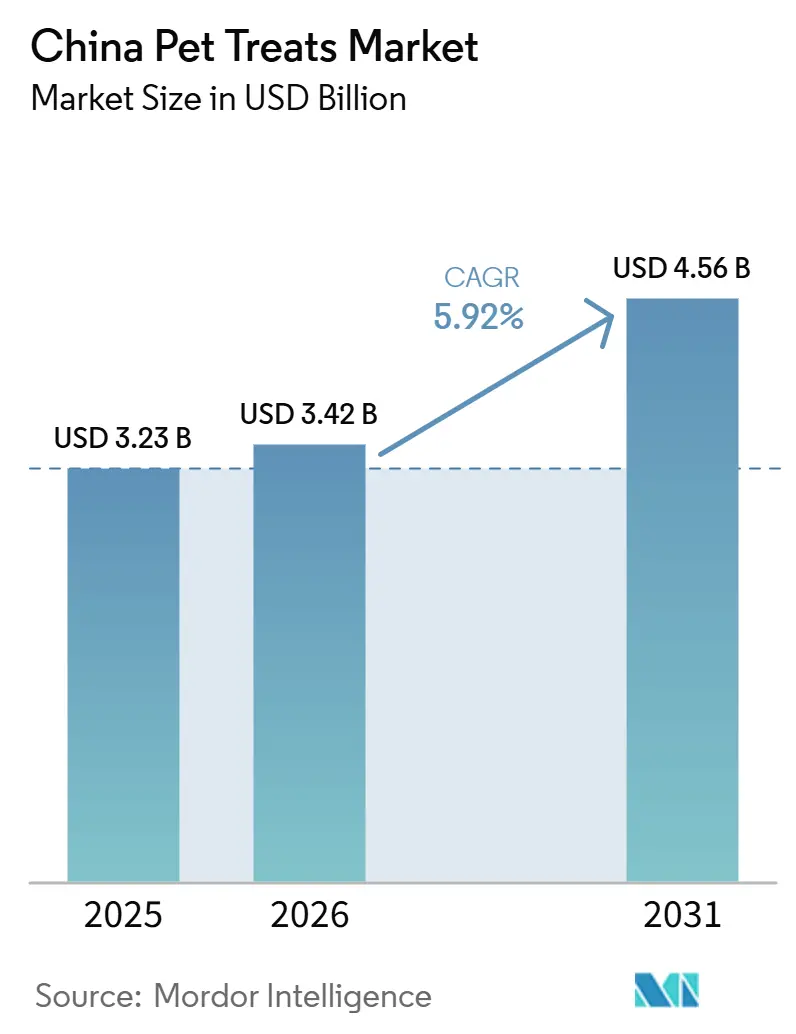
| Base Year Market Size (2025) | USD 3.23 Billion |
| Market Size (2026) | USD 3.42 Billion |
| Market Size (2031) | USD 4.56 Billion |
| Growth Rate (2026 - 2031) | 5.92 % |
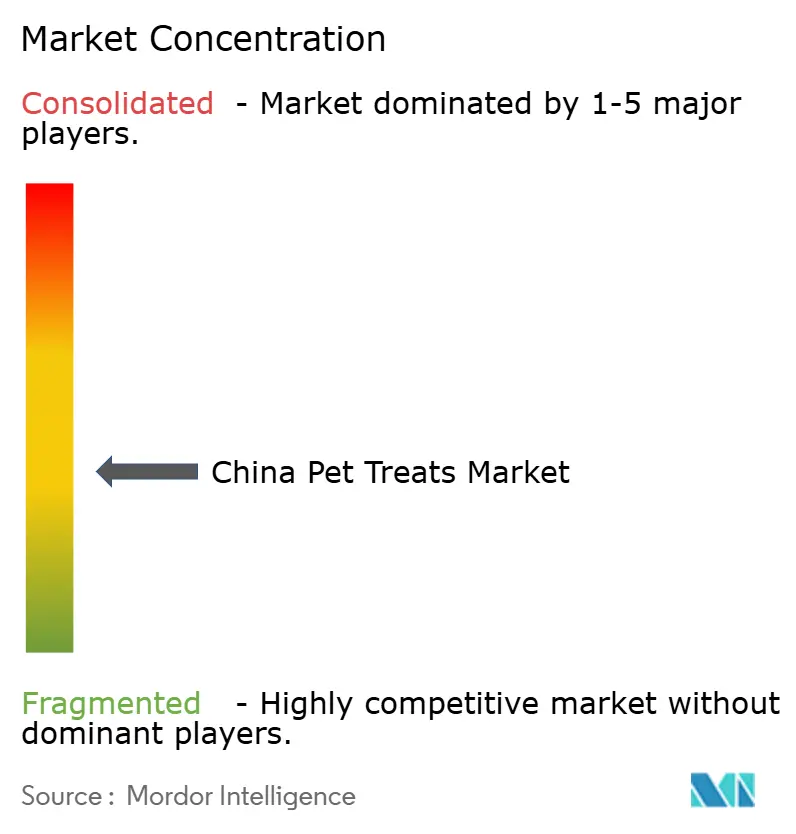
| Market Concentration | Medium |
Major Players *Disclaimer: Major Players sorted in no particular order Image © Mordor Intelligence. Reuse requires attribution under CC BY 4.0. | |
China Pet Treats Market Analysis by Mordor Intelligence
The China pet treats market size is projected to be USD 3.23 billion in 2025, USD 3.42 billion in 2026, and reach USD 4.56 billion by 2031, growing at a CAGR of 5.9% from 2026 to 2031. The China pet treats market is moving from volume-led demand to value-led demand as younger urban pet owners spend more on premium nutrition and daily feeding quality. Urban dog and cat pet food consumption in China reached RMB 312.6 billion (USD 43.4 billion) in 2025, according to the United States Department of Agriculture (USDA), and pet food accounted for 53.7% of total pet spending, making food products the largest spending category and a key driver of the China pet treats market. Functional positioning is becoming more important than simple taste, which is pushing brands to build claims around digestion, oral care, immunity, and ingredient quality in the China pet treats market. Imported products are facing added pressure after China raised the provisional most-favored-nation (MFN) tariff on retail-packaged pet food from 4% to 10% on January 1, 2025, which is improving the relative position of domestic suppliers in the China pet treats market. The result is a China pet treats market where premium demand, digital retail, and local manufacturing are expanding together, while cost control and compliance discipline are becoming more important for growth.
Key Report Takeaways
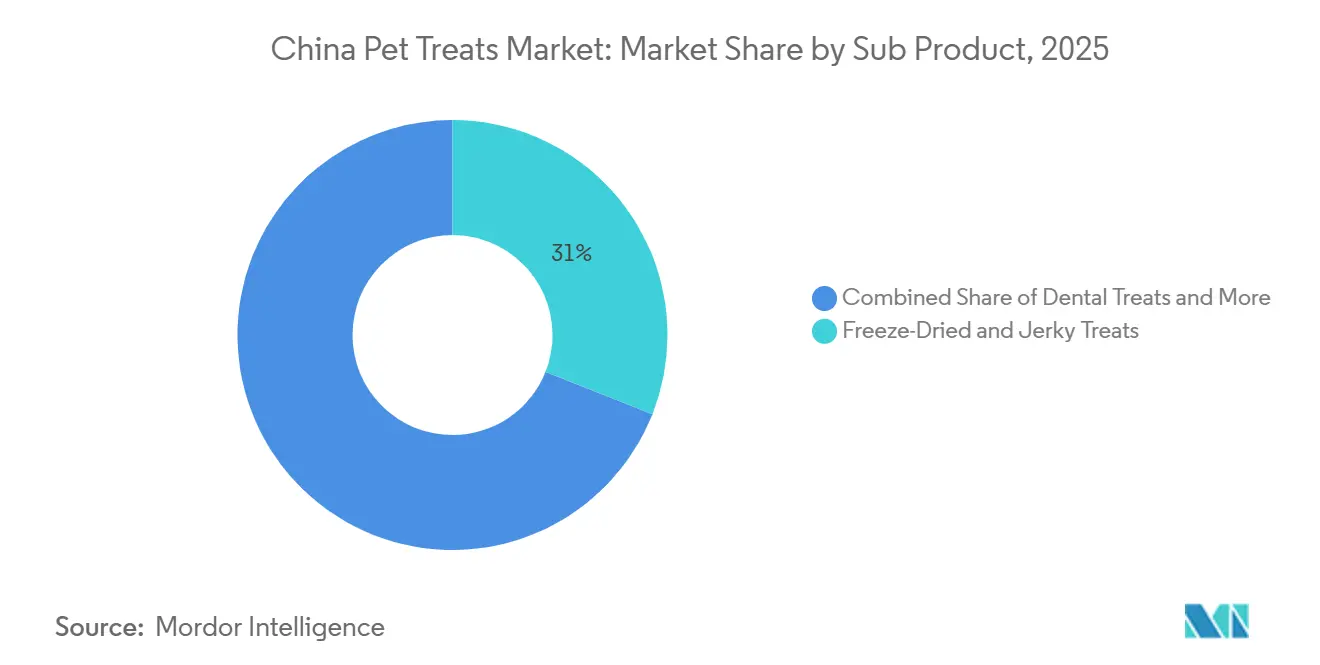
- By sub product, freeze-dried and jerky treats held 31% of China pet treats market share in 2025 and remained the fastest format in the China pet treats market.
- By pets, dogs accounted for 51.2% share of the China pet treats market size in 2025, while cats recorded the fastest projected CAGR of 7.4% through 2031.
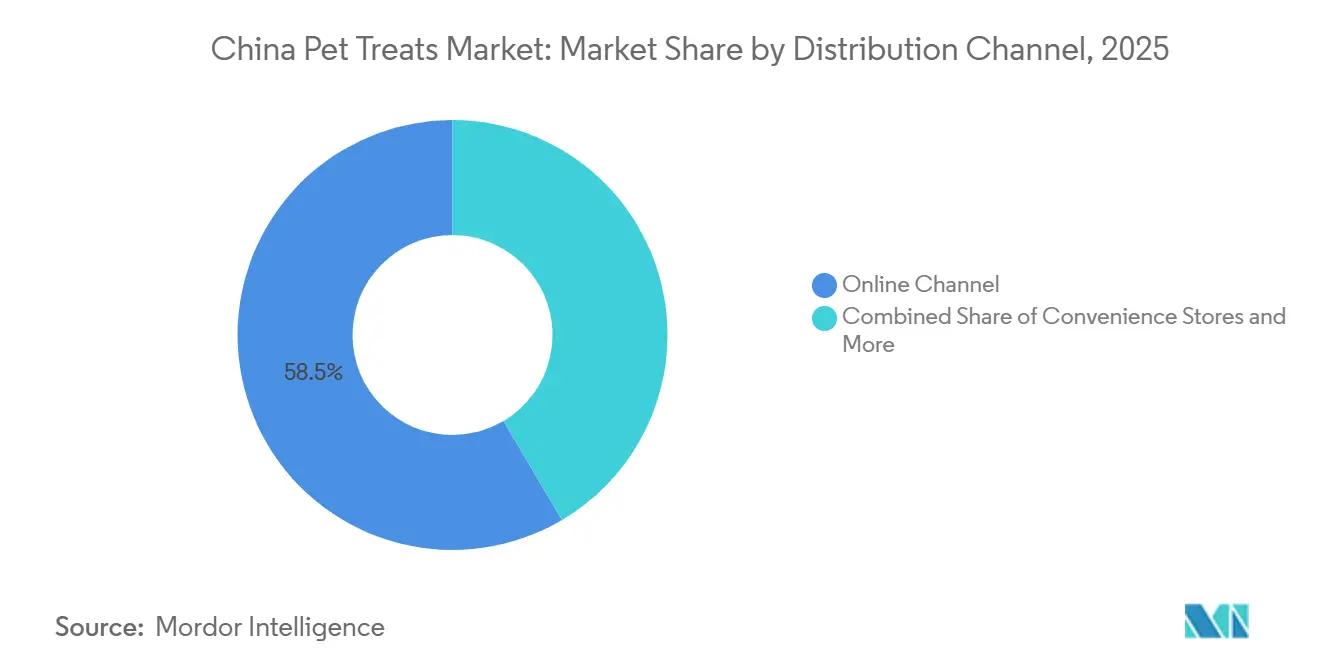
- By distribution channel, the online channel captured 58.5% of China pet treats market share in 2025 and remained the fastest route for brand discovery and purchase in the China pet treats market.
Note: Market size and forecast figures in this report are generated using Mordor Intelligence’s proprietary estimation framework, updated with the latest available data and insights as of January 2026.
China Pet Treats Market Trends and Insights
Drivers Impact Analysis*
| Driver | (~) % Impact on CAGR Forecast | Geographic Relevance | Impact Timeline |
|---|---|---|---|
| Premiumization of Pet Snacks and Functional Treats | +1.6% | National, with highest intensity in Tier 1 and Tier 2 cities | Short term (≤ 2 years) |
| Rising Cat Ownership and Cat Treat Penetration | +0.9% | National, with strongest growth in Tier 2 cities and urban suburbs | Medium term (2-4 years) |
| E-Commerce and Social Commerce Led Discovery | +1.1% | National, with spillover across Tier 3 and Tier 4 cities through mobile commerce | Short term (≤ 2 years) |
| Humanization of Pets and Treats as Rewarding Occasions | +0.7% | National, particularly among post-1990 and post-2000 urban households | Long term (≥ 4 years) |
| Expansion of Local Clean-Label and Fresh-Style Treat Innovation | +0.4% | National, with early adoption concentrated in Tier 1 cities | Medium term (2-4 years) |
| Demand for Dental, Training, and Digestive Health Treats | +0.5% | National, with urban households as the primary demand center | Medium term (2-4 years) |
| Source: Mordor Intelligence | |||
Premiumization of Pet Snacks and Functional Treats
The China pet treats market is shifting from simple reward feeding to targeted nutrition, and premiumization is now the main revenue driver. The USDA FAS Pet Food Market Update 2026 reported that functional foods, interactive treats, and fresh offerings have become the primary growth drivers for both domestic and imported brands, particularly among younger Chinese consumers, highlighting the growing demand for specialized products in the China pet treats market. The United States Department of Agriculture (USDA) Foreign Agricultural Service (FAS) stated that high-end and functional pet food products were projected to grow at 6% to 8% in 2025[1]Source: United States Department of Agriculture Foreign Agricultural Service, “Pet Food Market Update 2025,” United States Department of Agriculture, fas.usda.gov, with strong interest in freeze-dried training treats, cartilage treats, dental sticks, and air-dried meat formats. Oral care, immune support, joint and bone health, and skin and coat support are also gaining attention, so brands without a clear functional position are losing relevance in the China pet treats market
Rising Cat Ownership and Cat Treat Penetration
Rising cat ownership is changing the demand base of the China pet treats market and widening the opportunity for species-specific product launches. The United States Department of Agriculture – Foreign Agricultural Service (USDA-FAS) reported that 69.7% of cat owners purchased freeze-dried formats in 2025, and demand increased for products linked to hairball control, hydration, and liver and kidney support. The State Council Information Office also noted that regulations in many cities restricted large-breed dogs and daytime dog-walking hours, which is one reason new urban pet ownership has shifted toward cats in the China pet treats market
E-Commerce and Social Commerce Led Discovery
Digital retail is the primary sales and discovery channel in the China pet treats market. The USDA FAS reported in 2026 that Douyin generated rapid growth through impulse buying. This creates a market structure in which agile domestic brands can move from content exposure to purchase much faster than those that depend on slower campaign cycles. It also means the China pet treats market rewards companies that can balance steady repeat demand on major platforms with quick customer acquisition through live commerce and short-video traffic.
Humanization of Pets and Treats as Rewarding Occasions
The China pet treats market is also being supported by the rising role of pets in daily household routines and emotional spending. Urban Chinese pet owners spent RMB 300.2 billion (USD 41.1 billion) on cats and dogs in 2024, a 7.5% year-on-year increase, according to China International Pet Show (CIPS). The USDA FAS noted that occasion-based treat formats linked to training, meal sharing, and seasonal gifting gained traction in 2025. As a result, the China pet treats market is seeing stronger demand for products that combine emotional reward with visible health value.
Restraints Impact Analysis*
| Restraint | (~) % Impact on CAGR Forecast | Geographic Relevance | Impact Timeline |
|---|---|---|---|
| Price Sensitivity in Mass-Market Channels | -1.40% | National, with highest drag in Tier 3 and Tier 4 cities and value-oriented offline retail | Short term (≤ 2 years) |
| Tightening Import Registration and Compliance Burden | -0.80% | National, with greatest impact on imported brand entry and international stock keeping unit expansion | Medium term (2-4 years) |
| Ingredient Cost Volatility for Meat-Based Treats | -0.70% | National, with acute pressure on freeze-dried and single-protein formats | Medium term (2-4 years) |
| Risk of Quality Perception Gaps in Lower-Tier Brands | -0.50% | National, concentrated in Tier 3 and below markets and mass e-commerce channels | Long term (≥ 4 years) |
| Source: Mordor Intelligence | |||
Tightening Import Registration and Compliance Burden
Compliance requirements are making it harder for imported treat brands to enter China and narrowing the economics of a full-import strategy. The USDA FAS reported that in September 2025, China notified the World Trade Organization (WTO) of draft National Hygienic Standards for Pet Feed (Food) and a draft Mandatory National Standard for Pet Food Labeling, both of which would create additional quality and labeling obligations for producers. The same USDA FAS report stated that imported packaged pet food fell to USD 474.1 million in 2025, down 5.2% from 2024, indicating that cost and compliance pressures were already affecting trade flows. China also raised the provisional MFN tariff on retail-packaged pet food from 4% to 10% from January 1, 2025, which lifted landed costs for foreign brands. In the China pet treats market, this pushes many international suppliers toward local manufacturing, co-packing, or a narrower premium product mix.
Ingredient Cost Volatility for Meat-Based Treats
Ingredient cost volatility is a direct risk for the China pet treats market because many of the fastest-growing products depend on meat-heavy inputs. Freeze-dried, jerky, cartilage, and air-dried products all rely on protein ingredients whose cost changes can quickly affect margins and end prices. This matters more in premium segments because buyers expect quality consistency even as raw material costs rise. It also matters in mass segments because lower-tier consumers are more sensitive to price increases and can shift back to cheaper everyday treat formats. The China pet treats market therefore, favors suppliers with stronger sourcing control, flexible recipes, and local production depth.
*Our forecasts treat driver/restraint impacts as directional, not additive. The impact forecasts reflect baseline growth, mix effects, and variable interactions.
Segment Analysis
By Sub Product: Freeze-Dried And Jerky Treats Anchor The Premium Tier
Freeze-dried and jerky treats accounted for 31% of the China pet treats market size in 2025, making them the largest subsegment. The same category was also the fastest-growing, showing that premium demand and scale are building in the same part of the category. According to China International Pet Show (CIPS 2026), 81.2% of dog owners purchased jerky and meat strip treats in 2025, while 56.6% purchased freeze-dried formats.
The USDA FAS identified freeze-dried snacks, cartilage treats, meat floss, dental sticks, and air-dried meat as the highest-growth dog treat formats in 2025. It also pointed to freeze-dried donuts, grass sticks, and interactive pocket treats as fast-growing cat formats, which shows that premium innovation is spreading across use cases and species. The China pet treats industry is therefore rewarding products that combine visible protein content with convenience and function. Soft and chewy treats continue to meet training needs because they are easy to portion and feed. Crunchy treats still hold stable everyday volume in the China pet treats market because they remain accessible to more price-sensitive households.



By Pets: Cat Segment Momentum Reshapes The Market’s Growth Equation
Dogs held 51.2% of the China pet treats market share in 2025, making them the largest pet segment. Cats, however, are the fastest-growing segment, with a projected CAGR of 7.4% over 2026-2031, indicating that future growth is shifting toward cats. According to USDA FAS China’s urban cat population reached 72.89 million in 2025, while the urban dog population reached 53.43 million. Other pets remain small, but the same source noted that aquatic pet ownership reached 17.3% of pet owners in 2025, up by 3.9 percentage points from 2024, suggesting a modest widening of the addressable base[2]Source: Pet Data, “2026 China Pet Industry White Paper (Consumer Report),” CIPS International Pet Show News, cipscom.com.
The USDA FAS reported that domestic brands are increasingly investing in cat-specific functional ingredients and premium formulas to compete with long-established international brands in the premium cat segment[3]Source: United States Department of Agriculture Foreign Agricultural Service, “Pet Food Market Update 2025,” United States Department of Agriculture, fas.usda.gov. The China pet treats industry is therefore likely to see stronger competition in cat snacks linked to digestion, hydration, and hairball control. Brands with clear veterinary positioning, ingredient transparency, and species-specific claims are better placed to benefit from this shift in the China pet treats market.
By Distribution Channel: Online Commerce Leads On Scale And Speed
The online channel accounted for 58.5% of the China pet treats market in 2025, making it the largest distribution format. That level of share shows that digital retail is already the main route for both repeat buying and new brand discovery. Specialty stores remain important in Tier 1 and Tier 2 cities because they support premium and veterinary-focused purchases. Supermarkets and hypermarkets continue to matter for everyday treat formats and national household visibility. Convenience stores still capture lower-value impulse purchases among younger urban buyers.
The USDA FAS reported that traditional large platforms such as JD.com and Tmall show stronger loyalty and higher repeat purchases, while Douyin is generating faster growth through impulse buying and content-led discovery. This creates a distribution structure where platform strategy is now part of product strategy in the China pet treats market. Brands that balance reliable repeat demand on established platforms with customer acquisition through live content are better positioned than single-channel competitors. Offline specialty retail also still matters because many buyers want guidance when selecting functional treats. The China pet treats market is therefore becoming more integrated across online and offline touchpoints rather than moving toward a simple one-channel model.
Geography Analysis
China’s geography is a single national market for reporting purposes, but demand patterns within the country are uneven across city tiers and production regions. Premium treat demand is concentrated in Tier 1 and leading Tier 2 cities, where disposable income is higher, and pet humanization is more advanced. Beijing, Shanghai, Guangzhou, Shenzhen, and several major Tier 2 cities remain the core demand centers for premium and functional products. The China pet treats market also benefits in these cities from better specialty retail access and stronger acceptance of higher-value nutrition. This leaves top-tier urban clusters as the main source of premium revenue, even as national reach widens.
The USDA FAS reported that China had 94,891 pet stores as of September 2025, down by a net 1,270 from the start of the year, while cities such as Shanghai, Chengdu, Hangzhou, and Beijing remained more resilient due to their service-oriented retail bases. This suggests that offline retail in the China pet treats market is consolidating around stronger stores in stronger cities rather than expanding evenly. The USDA FAS also stated that Shandong and Hebei accounted for more than 70% of domestic pet food output in 2024, underscoring the continued concentration of the manufacturing base. Henan’s pet food output rose 119% in 2025, which points to an emerging secondary production cluster in central China. This production pattern gives northern and central suppliers a clear cost and logistics role in the China pet treats market.
Tier 3 and lower cities represent the next wave of expansion, but this part of the China pet treats market is still more price sensitive. The USDA FAS reported that premium products in these markets are largely imported or higher-priced domestic brands selling above RMB 120 per kilogram (USD 16.7 per kilogram), while domestic brands dominate the mid-priced and low-priced bands. This means growth outside the largest cities will depend on price architecture as much as brand awareness. E-commerce is likely to remain the main route for expansion because it reduces physical distribution limits in smaller cities. The China pet treats market will therefore reward brands that can match regional price expectations without losing product credibility.
Competitive Landscape
The China pet treats market remains fragmented, with revenue spread across domestic and international brands rather than controlled by one or two companies. International groups still hold strong positions in premium nutrition, but domestic challengers are narrowing the gap through local sourcing, digital execution, and faster product adaptation. This has made the China pet treats market more competitive at mid-premium price points, where quality perception and value now matter equally. Imported brands are also facing a more challenging operating environment, as tariffs and compliance burdens have risen since 2025. The result is a market where local manufacturing strength increasingly matters as much as brand heritage.
Fubei Pet Food Co., Ltd. filed its Hong Kong Stock Exchange (HKEX) application on June 1, 2026, and disclosed that it ranked second in China’s third-party pet food manufacturing segment with 5.3% revenue share in 2025. That filing shows how domestic suppliers are using capital markets to build scale and move up the value chain. Yantai China Pet Foods Co., Ltd. completed its Mexico factory in 2025, becoming the first Chinese pet food company to establish manufacturing operations in Mexico, which points to a wider supply strategy beyond the domestic base. In April 2026, Toptrees, a subsidiary of Yantai China Pet Foods Co., Ltd., also completed and started operations at a new baking plant focused on premium baked pet food and treat products. These moves show that competition in the China pet treats market is being shaped by capacity expansion, product specialization, and supply diversification.
Another notable move came in April 2025, when Fubei Pet Food Co., Ltd. and New Ruipeng Pet Healthcare Group entered a strategic cooperation agreement for joint research and development (R&D) of premium pet food and treat formulas at Fubei’s Xuancheng base in Anhui Province. This type of partnership matters because clinical credibility and formulation depth are becoming more important in premium treats. The China pet treats market is therefore shifting from brand-led competition alone to a model that also values manufacturing quality, compliance readiness, and formulation partnerships. Companies that can combine those capabilities with digital channel strength are likely to gain share more steadily. Smaller undifferentiated players may find it harder to keep pace as standards tighten and consumers become more selective.
China Pet Treats Industry Leaders
Mars, Incorporated
Nestlé S.A.
Colgate-Palmolive Company
General Mills, Inc.
Yantai China Pet Foods Co., Ltd.
- *Disclaimer: Major Players sorted in no particular order

Recent Industry Developments
- June 2026: Fubei Pet Food Co., Ltd. filed an initial public offering (IPO) application with the Hong Kong Stock Exchange (HKEX) on June 1, 2026, seeking a Main Board listing with Sinolink Securities as sole sponsor. The company disclosed in its HKEX prospectus that it ranked as China’s second-largest third-party pet food manufacturer by 2025 revenue with a 5.3% contract manufacturing market share, and that its proprietary brand Bi Le ranked as the tenth-largest local pet food brand in China by 2025 retail sales making it one of the major players in the pet treats market as well as it hase pet treats offering under product category.
- April 2026: Toptrees, a subsidiary of Yantai China Pet Foods Co., Ltd., completed the construction and commenced operations of a new state-of-the-art pet food baking plant in April 2026 in China, adding dedicated production capacity for premium baked treat formats targeting the fast-growing high-value pet snack segment.
- January 2025: China raised the provisional most-favored-nation (MFN) tariff on retail-packaged pet food (HS codes 23091010 and 23091090) from 4% to 10%, effective January 1, 2025, directly increasing import costs for all foreign pet treat manufacturers and accelerating the competitive advantage of locally produced alternatives.


China Pet Treats Market Report Scope
Pet treats are snack products given to pets for reward, nutrition, training, or enjoyment. The China pet treats market report is segmented by sub-product (crunchy treats, dental treats, and more), by Pets (cats, dogs, other pets), and by distribution channel (convenience stores, online channel, and more). The market forecasts are provided in terms of value (USD) and volume (metric tons).
| Crunchy Treats |
| Dental Treats |
| Freeze-Dried and Jerky Treats |
| Soft and Chewy Treats |
| Other Treats |
| Cats |
| Dogs |
| Other Pets |
| Convenience Stores |
| Online Channel |
| Specialty Stores |
| Supermarkets and Hypermarkets |
| Other Distribution Channels |
| By Sub Product | Crunchy Treats |
| Dental Treats | |
| Freeze-Dried and Jerky Treats | |
| Soft and Chewy Treats | |
| Other Treats | |
| By Pets | Cats |
| Dogs | |
| Other Pets | |
| By Distribution Channel | Convenience Stores |
| Online Channel | |
| Specialty Stores | |
| Supermarkets and Hypermarkets | |
| Other Distribution Channels |


Key Questions Answered in the Report
What is the current size of China’s pet treats category?
The China pet treats market stood at USD 3.2 billion in 2025.
How fast is spending anticipated to grow through 2031?
The China pet treats market is projected to grow at a 5.9% compound annual growth rate (CAGR) from 2026 to 2031.
Which product type leads sales in China?
Freeze-dried and jerky treats were the largest sub-product category with 31% share in 2025, and they also remained the fastest format.
Which sales channel matters most for brands?
Online sales are the main route to scale, with the online channel holding 58.5% share in 2025 and supporting both repeat buying and new customer discovery.
Page last updated on:





