
China Mechanical, Electrical, and Plumbing (MEP) Services Market Size and Share
Market Overview
| Study Period | 2021 - 2032 |
|---|---|
| Forecast Data Period | 2027 - 2032 |
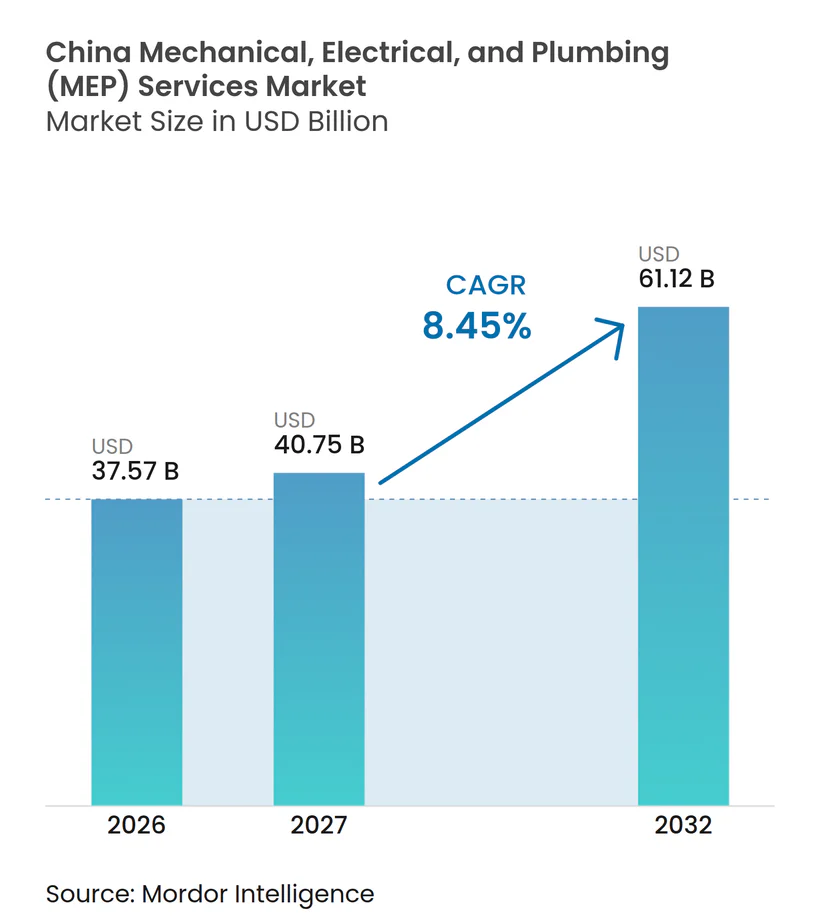
| Base Year Market Size (2026) | USD 37.57 Billion |
| Market Size (2027) | USD 40.75 Billion |
| Market Size (2032) | USD 61.12 Billion |
| Growth Rate (2027 - 2032) | 8.45 % |
| Market Concentration | Low |
Major Players *Disclaimer: Major Players sorted in no particular order Image © Mordor Intelligence. Reuse requires attribution under CC BY 4.0. | |
China Mechanical, Electrical, and Plumbing (MEP) Services Market Analysis by Mordor Intelligence
The China Mechanical, Electrical, And Plumbing Services Market size is expected to grow from USD 37.57 billion in 2026 to USD 40.75 billion in 2027 and is forecast to reach USD 61.12 billion by 2032 at 8.45% CAGR over 2027-2032.
The China MEP services market is gaining support from data centers, semiconductor facilities, urban renewal, and energy-related building upgrades. These activities shift demand toward cooling, electrical distribution, water systems, controls, and commissioning work with higher technical requirements, including greater coordination between cooling, power, water management, controls, safety systems, and digital monitoring, which makes early engineering decisions more important than on conventional building projects and strengthens demand for specialist commissioning skills across complex facilities. This changes the work mix from routine, separate trade packages toward coordinated systems that need reliable design, installation, testing, and operation. It also places greater weight on projects where service quality, energy performance, and commissioning discipline affect the customer’s ability to operate safely. A smaller residential construction pipeline continues to limit conventional installation volumes, especially for contractors that rely on new housing projects. Retrofit activity offers a more stable source of work because older buildings need pipe, HVAC, electrical, and building-control improvements. The China MEP services market also favors providers that can combine design, installation, testing, and ongoing performance management.
Key Report Takeaways
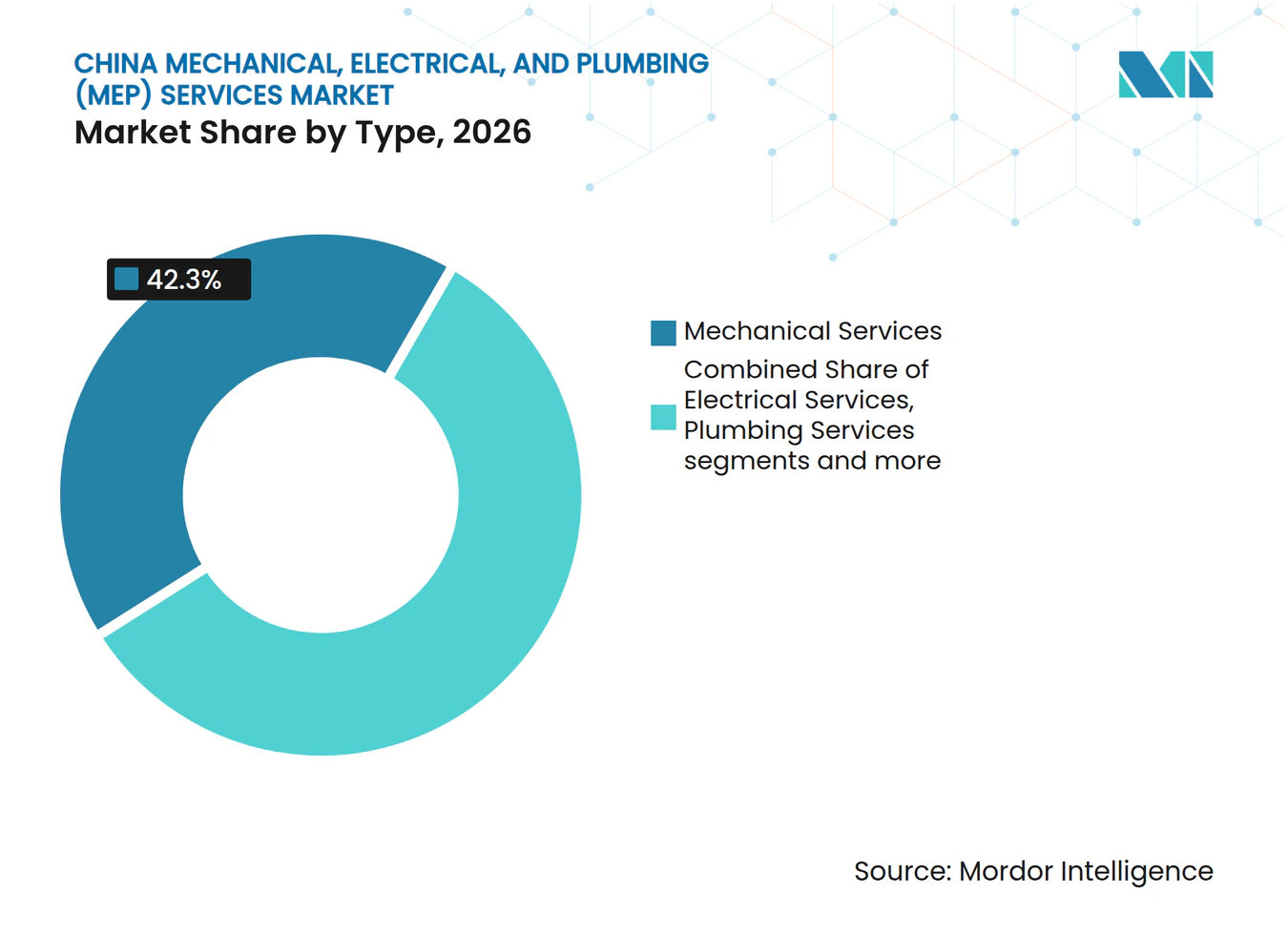
- By type, mechanical services accounted for 42.3% of the China mechanical, electrical, and plumbing (MEP) services market share in 2026, while integrated MEP services are projected to grow at a 9.19% CAGR through 2032.
- By service type, maintenance, repair, and retrofit accounted for 38.1% of the China mechanical, electrical, and plumbing (MEP) services market share in 2026, while managed / performance-based services are projected to grow at a 9.21% CAGR through 2032.
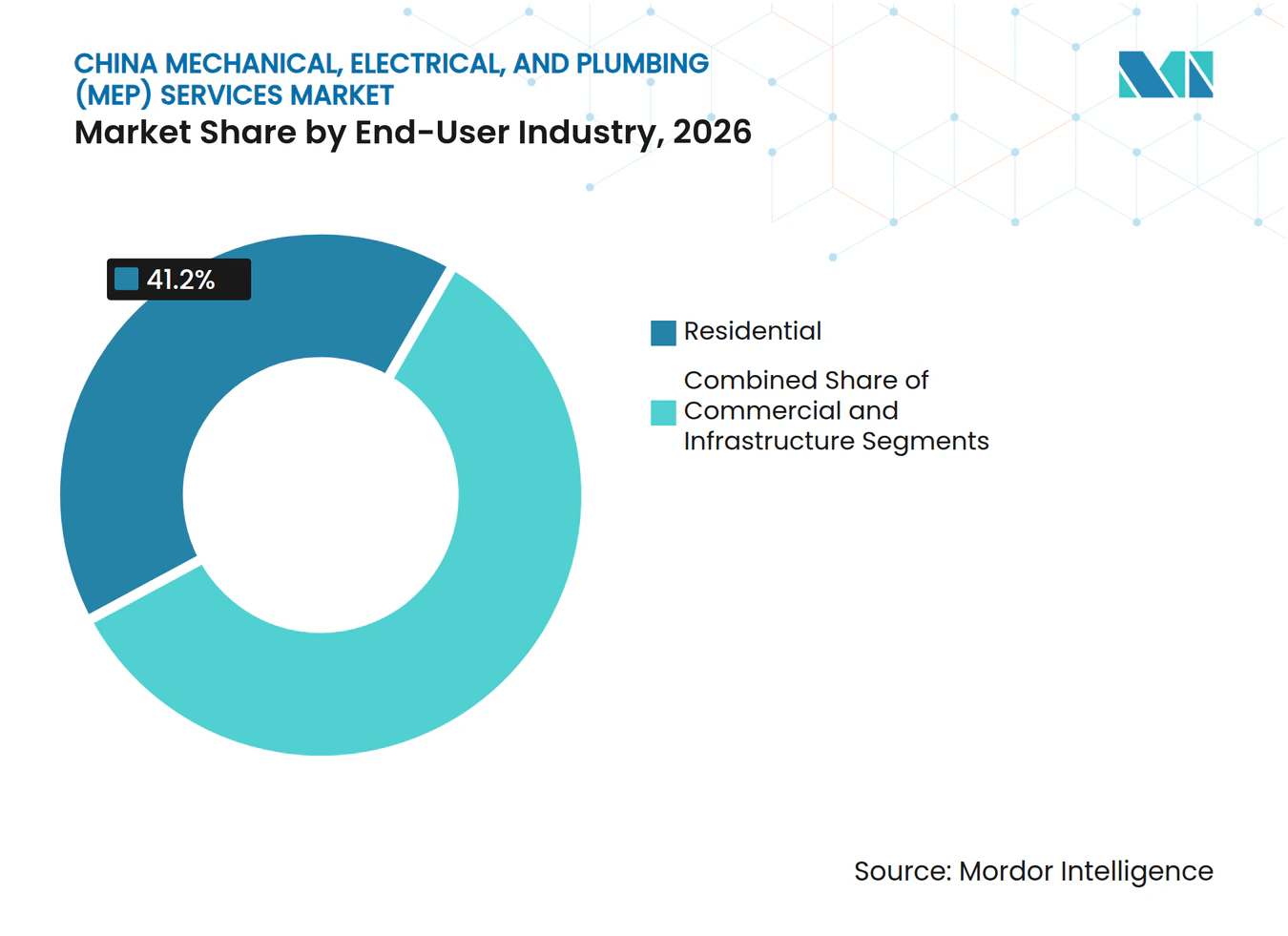
- By end-user industry, the residential segment represented 41.2% of the China mechanical, electrical, and plumbing (MEP) services market size in 2026, while commercial MEP services are projected to grow at a 9.44% CAGR through 2032.
- By major cities, Shanghai represented 18.5% of the China mechanical, electrical, and plumbing (MEP) services market size in 2026, while Shenzhen is projected to grow at a 9.71% CAGR through 2032.
Note: Market numbers in this report are based on Mordor Intelligence's proprietary estimation framework, which combines nine months of actuals with Q4 projections for base year 2026.
China Mechanical, Electrical, and Plumbing (MEP) Services Market Trends and Insights
Drivers Impact Analysis*
| Drivers | (~) % Impact on CAGR Forecast | Geographic Relevance | Impact Timeline |
|---|---|---|---|
| AI and data center expansion are driving demand for high-capacity electrical, cooling, and backup power systems | +2.1% | Shanghai, Beijing, Shenzhen, Chengdu; national hub nodes under East-Data-West-Computing | Short term (≤ 2 years) |
| Urban renewal programs are generating MEP retrofit opportunities across aging residential and commercial buildings | +1.6% | All major cities; the highest concentration in Beijing, Shanghai, and pre-2000 building-stock cities | Medium term (2–4 years) |
| Advanced manufacturing investment is driving specialized MEP requirements for semiconductor, electronics, and high-tech facilities | +1.4% | Shanghai, Shenzhen, Chengdu, Wuxi, and Wuhan semiconductor corridors | Medium term (2–4 years) |
| Building electrification initiatives are accelerating the replacement of conventional heating systems with electric alternatives | +1.2% | Northern and central China heating zones; national spill-over in commercial buildings | Medium term (2–4 years) |
| Smart-building adoption is expanding demand for automated controls, sensors, and integrated building management systems | +1.1% | Shenzhen, Shanghai, Beijing; spill-over to Guangzhou, Chengdu | Long term (≥ 4 years) |
| Municipal utility upgrades are creating plumbing opportunities across water, drainage, heating, and gas networks | +0.8% | National; concentrated spend in Beijing, Chengdu, and Tier 2 renewal corridors | Medium term (2–4 years) |
| Source: Mordor Intelligence | |||
AI and Data Center Expansion Driving Higher-Capacity Building Systems
AI data centers require far more electrical and cooling capacity than standard commercial properties. The China MEP services market, therefore, benefits from work on power distribution, backup power, chilled-water systems, drainage, and controls. The National Development and Reform Commission set power usage effectiveness targets of 1.3 for new large data centers and 1.25 for national hub nodes[1]. Those requirements make cooling design and system integration central to project delivery. China Mobile commissioned its Shanghai Lingang underwater data center in October 2025 with 24 megawatts of capacity and seawater-cooling systems[2]. The project demonstrated how specialized cooling designs can expand the scope of mechanical and electrical work.
Urban Renewal and Building Retrofit Programs Supporting Recurring Work
Urban renewal has created a broad retrofit pipeline for the China MEP services market. China renovated 27,100 older residential communities in 2025, covering 4.99 million households[3]. The work included the construction or overhaul of 156,000 kilometers of underground pipe networks. Updated buildings need coordinated work on electrical safety, HVAC, water, drainage, gas lines, elevators, and smart utility monitoring. A May 2025 central government directive called for continuing urban renewal actions, including improvements to gas networks and urban infrastructure. T/CIAS-9-2025 also requires covered renovation projects to treat electrical, HVAC, plumbing, and building intelligence as connected systems.
Advanced Manufacturing Investment Increasing Specialized MEP Requirements
Semiconductor and advanced electronics projects need specialized building systems that differ from standard commercial installations. Cleanrooms require stable temperature and humidity, high-purity water, process exhaust, and dependable electrical distribution. These requirements expand the design, installation, testing, and commissioning work available to qualified contractors. Hua Hong announced its Wuxi Phase III foundry expansion in September 2026 with USD 4.1 billion of planned investment. The facility is planned for 55,000 12-inch wafers of monthly capacity and will require cleanroom HVAC, ultra-pure water, and high-availability power systems. The China MEP services market has opportunities in cities where semiconductor investment is moving beyond the coastal centers.
Building Electrification Expanding Heating System Replacement Work
Building electrification is creating a replacement cycle for heating and hot-water equipment. Six central government bodies issued the Action Plan for Promoting High-Quality Development of the Heat Pump Industry in April 2025. The plan targeted at least a 20% improvement in heat-pump energy efficiency. It also encouraged the replacement of coal-fired heating systems in public buildings and hospitals. These projects require close coordination among mechanical, electrical, and plumbing contractors. Beijing’s 2025 sewage-source heat pump design standard also supports integrated heating configurations that bring these workstreams together.
Restraints Impact Analysis*
| Restraints | (~) % Impact on CAGR Forecast | Geographic Relevance | Impact Timeline |
|---|---|---|---|
| Prolonged property-sector weakness is limiting MEP demand from conventional residential construction | -1.3% | National; most pronounced in lower-tier cities with large developer exposure | Long term (≥ 4 years) |
| Intense contractor competition is placing pressure on pricing and service margins | -0.8% | National; concentrated effect in Tier 1 cities where bidder density is highest | Short term (≤ 2 years) |
| Rising equipment and skilled-labor costs are increasing overall MEP project expenditure | -0.7% | National; strongest impact in Shenzhen, Shanghai, and high-cost coastal cities | Medium term (2–4 years) |
| Complex building codes and energy-efficiency requirements are increasing engineering and compliance burdens | -0.5% | National: strongest regulatory influence in Beijing, Shanghai, and Guangdong | Medium term (2–4 years) |
| Source: Mordor Intelligence | |||
Prolonged Property-Sector Weakness Limiting Conventional Installation Volumes
Conventional residential construction has remained a structural constraint for the China MEP services market. Real estate development investment fell 17.2% in 2025. Residential new starts declined 19.8%, while new-home sales by value fell 12.6%. Lower starts reduce early-stage electrical, plumbing, and HVAC installation work for contractors that serve housing developers. Completion work and code-driven upgrades still provide some activity, but they do not replace lost volumes from new projects. This pressure is strongest where contractors have limited access to government-funded retrofit and infrastructure work.
Intense Contractor Competition Pressuring Prices and Capability Investment
Competition is strongest in standard project categories where contract awards are primarily price-led. New contracts signed by Chinese construction enterprises declined 4.6% year over year during the first three quarters of 2025. State-owned enterprises retain an advantage in many publicly funded renewal and infrastructure projects. Private contractors are more exposed to lower-margin work and crowded tender processes. That pressure can delay investment in workforce development, digital coordination, and specialist commissioning capabilities. Larger firms can defend margins where they demonstrate stronger building information modeling, testing, and integrated delivery performance.
*Our forecasts treat driver/restraint impacts as directional, not additive. The impact forecasts reflect baseline growth, mix effects, and variable interactions.
Segment Analysis
By Type: Mechanical Services Provide the Largest Base While Integrated MEP Services Gains Ground
Mechanical services held 42.3% of the China MEP services market share in 2026. HVAC work remained central to commercial buildings, industrial facilities, and high-density computing sites. Data centers require larger cooling systems as rack loads move beyond ordinary office specifications. Mechanical contractors also support heat-pump replacement, ventilation upgrades, and district-heating modernization. These requirements preserve a broad addressable base for the China MEP services market. Electrical services serve high-voltage distribution, uninterruptible power supplies, emergency systems, and controls. Plumbing services benefit from water, drainage, gas, and municipal network upgrades. Each discipline remains necessary even when a project uses a unified service contract.
Integrated MEP services are forecast to grow at a 9.19% CAGR through 2032. Customers in semiconductor, healthcare, and data center projects increasingly seek one accountable provider for coordination. Unified delivery reduces handoffs between separate mechanical, electrical, plumbing, and controls contractors. It can also improve schedule control before systems are commissioned. Siemens introduced its Desigo CC Connected Buildings platform in September 2025 to combine HVAC, lighting, fire protection, and energy management controls. The platform reflects a move toward building systems that operate through connected software and hardware. The China MEP services sector, therefore, rewards providers that can connect physical installation with controls and lifecycle support. This shift does not eliminate specialist trades, but it changes how customers package their work.



By Service Type: Maintenance, Repair, and Retrofit Leads Market Share, While Managed and Performance-Based Services Grow Faster
Maintenance, repair, and retrofit held 38.1% of the China MEP services market share in 2026. Aging properties need replacement pipes, electrical grounding, ventilation upgrades, and building-control improvements. Renovation standards increasingly require these systems to be considered together instead of being repaired in isolation. This raises the value and technical scope of some retrofit assignments. The 2025 national renovation program supported work across millions of households and large pipe-network projects. The China MEP services market, therefore, has a source of demand that is less dependent on new housing starts. Design and engineering remain important because high-specification facilities need coordinated layouts before construction begins. Installation, testing, and commissioning remain essential where system reliability is critical.
Managed / performance-based services are projected to grow at a 9.21% CAGR through 2032. Building owners increasingly want service contracts linked to uptime, energy results, and planned maintenance. This changes the relationship from reactive repair to continuous system oversight. Johnson Controls International plc launched Metasys 16.0 in June 2026 with predictive fault detection, cybersecurity updates, and recommissioning tools. Its focus on data centers, healthcare, pharmaceutical facilities, and advanced manufacturing aligns with the sectors that need reliable operating performance. Formal performance agreements can favor providers with monitoring platforms and trained service teams. The China MEP services sector may therefore see more recurring revenue tied to operations. Informal repair work will continue, but it offers fewer tools for demonstrating measured results.
By End-User Industry: Residential Retains the Largest Share While Commercial Demand Expands Faster
Residential held a 41.2% share of the China MEP services market in 2026. Its demand is increasingly linked to renovation rather than installation in new housing developments. Older communities need pipe replacements, elevator-related improvements, electrical safety upgrades, and better ventilation. National urban renewal policy supports this work across a wide range of cities. The China MEP services market also benefits from building intelligence and utility monitoring requirements in retrofit projects. These projects partly offset weaker first-installation demand from developers. Infrastructure users add volume through transit facilities, utilities, district heating, and public buildings. Government procurement can make this part of the customer base more resilient during property-sector weakness.
Commercial end users are projected to grow at a 9.44% CAGR through 2032. Data centers, technology campuses, life-science facilities, and premium offices need complex cooling, power, water, and controls systems. These customers are less likely to delay critical upgrades because operating reliability affects their own services. Building standards also encourage stronger HVAC efficiency, lighting performance, and water-use controls. China Mobile’s Lingang facility illustrated the specialized cooling systems that can be used for high-capacity computing projects. Commercial customers also create demand for testing, commissioning, automation, and ongoing managed services. This provides opportunities for firms with technical depth beyond standard construction installation. The China MEP services sector can increase value capture when it supports the full operating life of these systems.

Geography Analysis
Shanghai held 18.5% of the China MEP services share in 2026 and remains the largest city market. Its position rests on advanced manufacturing, AI computing facilities, and large commercial projects. The city’s liquid-cooling direction for new data centers increases the complexity of cooling and water-system installations. China Mobile’s Lingang underwater data center entered service in October 2025 with seawater cooling and 24 megawatts of capacity. It showed the level of specialized coordination required for some Shanghai projects. Beijing adds institutional construction and government-backed renewal work to the national-hub computing demand. Limits on central-area computing expansion can move some new data center activity to surrounding locations while preserving local retrofit demand. The China MEP services market remains supported in both cities by buildings that need system upgrades.
Shenzhen is projected to grow at a 9.71% CAGR through 2032, the fastest rate among the major cities assessed. Technology campus development and electronics manufacturing support demand for cleanroom-grade HVAC and dependable electrical systems. Cross-boundary infrastructure adds work that requires coordinated design and technical controls. Guangzhou complements this demand through urban-village regeneration projects entering their installation phases in 2026. Guangdong’s infrastructure equipment renewal plan includes elevator assessments and HVAC replacement in large public and commercial buildings. That policy supports compliance-driven work beyond conventional property development. The China MEP services market in the Pearl River Delta benefits from a mix of technology investment, redevelopment, and building equipment replacement.
Chengdu and the Rest of China category is becoming a more specialized source of demand. Chengdu has positioned AI and semiconductor sectors as strategic priorities under its 14th Five-Year Plan. These projects need contractors that can manage cleanroom systems, process utilities, and reliable power. Western cities can attract data centers because electricity costs are lower than in eastern regions. Their growth creates an opportunity for specialists to establish regional delivery capacity before the contractor base becomes crowded. National urban renewal also spreads retrofit demand across smaller cities through old-community and pipe-network programs. This broad geographic base reduces the China MEP services market’s dependence on a small number of coastal construction centers. The China MEP services market size for these dispersed locations is supported by multiple small renovation programs rather than a single project class.
Competitive Landscape
Market Concentration
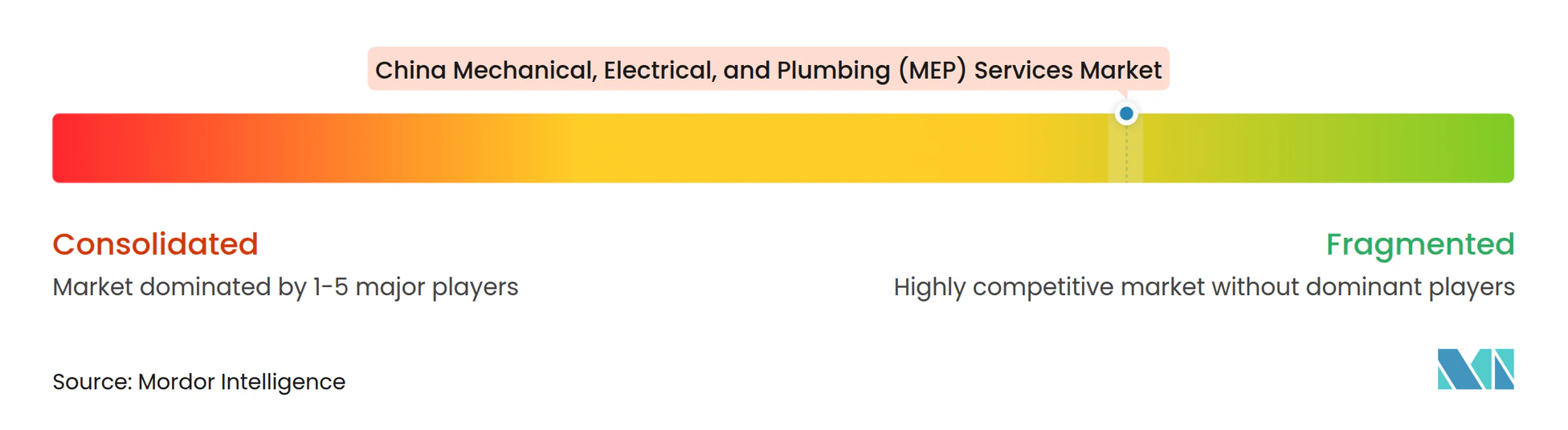
The China MEP services market is fragmented in nature, and it combines large state-owned engineering groups with many regional contractors. State-owned groups are well-positioned for large public, infrastructure, and urban renewal contracts. Regional specialists remain important for local installation, repair, and maintenance work. This structure makes project access, technical capability, and delivery experience important competitive factors. China State Construction Engineering Corporation reported stable newly signed contract activity during 2025, indicating continued ability to secure large construction work. However, standard MEP packages remain subject to price pressure when bidders offer similar labor-led services. Firms that can integrate design, installation, controls, and commissioning have clearer differentiation.
International building-technology providers compete more directly for managed-service and high-specification assignments. Johnson Controls International plc launched Metasys 16.0 in June 2026 with predictive fault detection, cybersecurity hardening, and rapid recommissioning functions. The product helps customers track operating data and measured system performance after construction is complete. Siemens launched the Desigo CC Connected Buildings platform in September 2025 for connected HVAC, lighting, fire protection, and energy management. These moves place software, controls, and lifecycle service alongside traditional mechanical and electrical installation. The China MEP services market offers a stronger scope for these approaches in data centers, hospitals, pharmaceutical facilities, and advanced manufacturing sites. Contractors without comparable control capabilities may partner with technology providers or focus on execution-led packages.
Specialist engineering firms can differentiate through complex coordination and commissioning work. AECOM supported MEP engineering on the new Huanggang Port, a cross-boundary project with Hong Kong and Shenzhen requirements. WSP Global Inc. used Multi-trade Integrated MEP methods on Lee Garden Eight in the Greater Bay Area. These examples show the value of coordination methods where safety, schedule, labor exposure, and building performance matter. Domestic contractors retain scale advantages in many publicly funded projects, while international firms offer experience from comparable complex facilities. The China MEP services market may favor cooperation between local execution providers and international technical specialists. Performance-based contracting remains a relevant opening where data centers and fabs need reliable commissioning and ongoing service.
China Mechanical, Electrical, and Plumbing (MEP) Services Industry Leaders
-
China State Construction Engineering Corporation Limited
-
China Railway Group Limited
-
China Railway Construction Corporation Limited
-
China Energy Engineering Corporation Limited
-
China National Chemical Engineering Group Corporation Ltd.
- *Disclaimer: Major Players sorted in no particular order
Recent Industry Developments
- September 2026: Hua Hong Grace Semiconductor announced the Wuxi Phase III foundry expansion with a total investment of USD 4.1 billion and a planned capacity of 55,000 12-inch wafers per month, requiring cleanroom HVAC, ultra-pure water circuits, and high-availability power distribution MEP systems.
- August 2026: Advanced Micro-Fabrication Equipment announced a CNY 3.5 billion (approximately USD 520 million) investment in the second phase of its Lingang facility. The project expands manufacturing, research and development, and sales capabilities for semiconductor-processing equipment, supporting demand for industrial utilities and factory MEP systems.
- June 2026: Johnson Controls International plc launched Metasys 16.0 with predictive fault detection, cybersecurity hardening, and accelerated commissioning tools, targeting data centers, healthcare, pharmaceutical, and advanced manufacturing facilities as the system’s primary deployment environments.
China Mechanical, Electrical, and Plumbing (MEP) Services Market Report Scope
| Mechanical Services |
| Electrical Services |
| Plumbing Services |
| Integrated MEP Services |
| Design and Engineering |
| Installation, Testing, and Commissioning |
| Maintenance, Repair, and Retrofit |
| Managed / Performance-Based Services |
| Residential |
| Commercial |
| Infrastructure |
| Beijing |
| Shanghai |
| Shenzhen |
| Guangzhou |
| Chengdu |
| Rest of China |
| By Type | Mechanical Services |
| Electrical Services | |
| Plumbing Services | |
| Integrated MEP Services | |
| By Service Type | Design and Engineering |
| Installation, Testing, and Commissioning | |
| Maintenance, Repair, and Retrofit | |
| Managed / Performance-Based Services | |
| By End-User Industry | Residential |
| Commercial | |
| Infrastructure | |
| By Major Cities | Beijing |
| Shanghai | |
| Shenzhen | |
| Guangzhou | |
| Chengdu | |
| Rest of China |
Key Questions Answered in the Report
What is the value of the China MEP services market?
The China MEP services market is projected at USD 40.75 billion in 2027 and is forecast to reach USD 61.12 billion by 2032, expanding at an 8.45% CAGR.
Which MEP service type holds the largest share in China?
Maintenance, repair, and retrofit held 38.1% in 2026, supported by older building stock and urban renewal activity.
Which MEP segment is expected to grow fastest through 2031?
Commercial end users are projected to grow at a 9.44% CAGR, driven by data centers, technology campuses, life-science facilities, and office upgrades.
Why are data centers important for MEP demand in China?
Data centers need high-capacity electrical distribution, backup power, cooling, chilled-water systems, drainage, and integrated controls.
Which Chinese city leads MEP demand?
Shanghai held 18.5% in 2026 because it concentrated data centers, semiconductor manufacturing, and large commercial projects.
Which city is forecast to grow fastest for MEP services?
Shenzhen is forecast to grow at a 9.71% CAGR through 2032, supported by technology campuses, electronics manufacturing, and infrastructure development.