
Market Overview
| Study Period | 2020 - 2031 |
|---|---|
| Forecast Data Period | 2026 - 2031 |
| Historical Data Period | 2020 - 2024 |
| Growth Rate | 2.05 % |
Major Players *Disclaimer: Major Players sorted in no particular order Image © Mordor Intelligence. Reuse requires attribution under CC BY 4.0. | |
China Marine Coatings Market Analysis by Mordor Intelligence
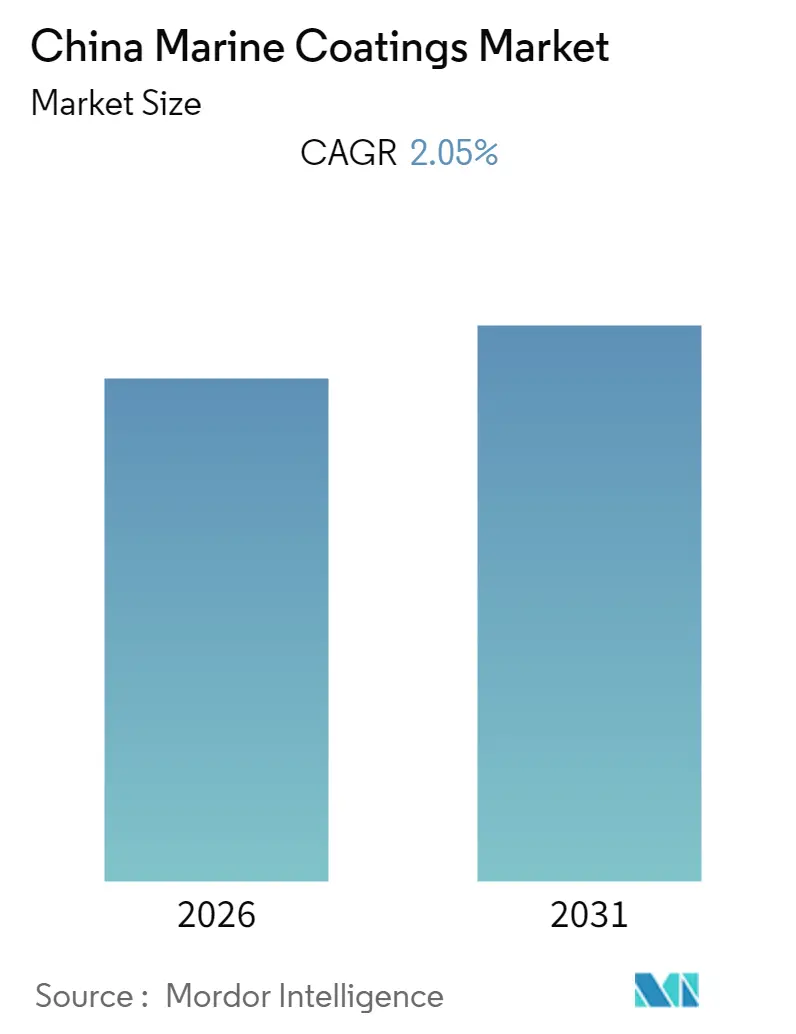
The China Marine Coatings Market size is expected to register a CAGR of 2.05% during the forecast period (2026-2031).
Note: Market size and forecast figures in this report are generated using Mordor Intelligence’s proprietary estimation framework, updated with the latest available data and insights as of 2026.
China Marine Coatings Market Trends and Insights
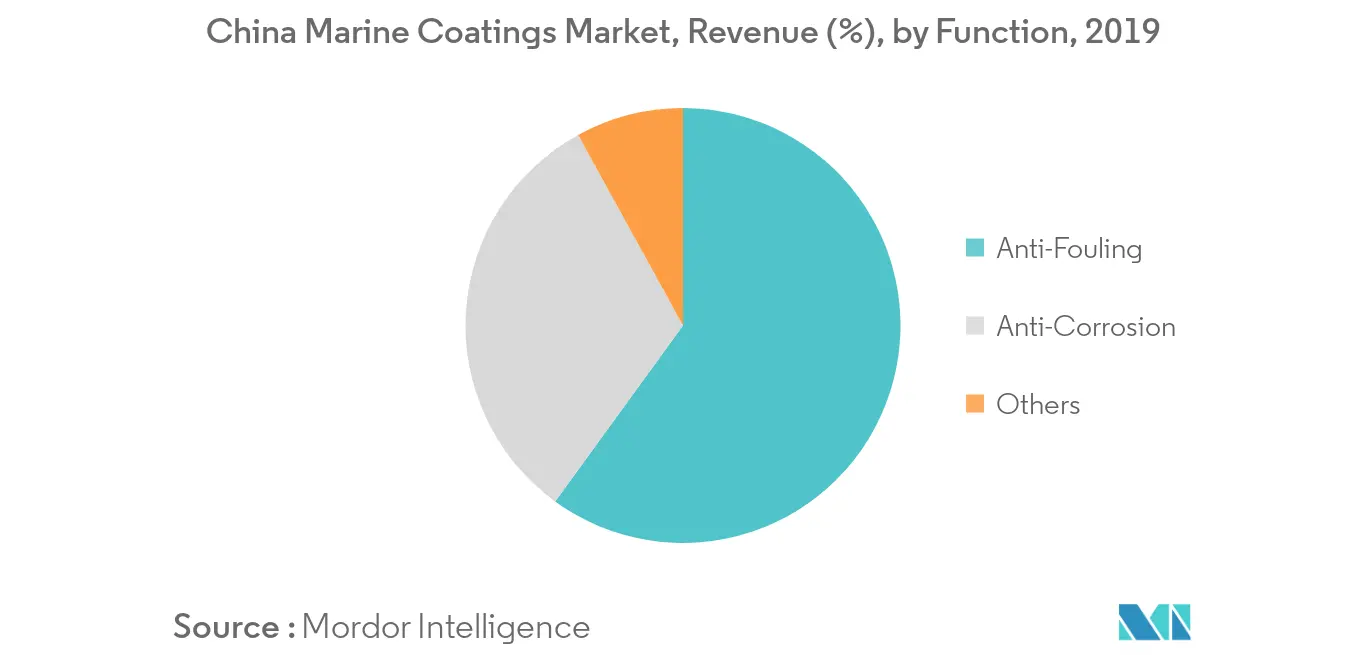
Anti-fouling coatings are expected to dominate the market
- Anti-fouling coatings are mainly used for hull and tank applications of which marine hull coatings hold a share of more than 75% in the marine antifouling coatings market.
- Anti-fouling hull coating applications dominate the market studied, due to the increasing production of offshore ships, including passenger and cargo, along with offshore drilling activities.
- These coatings are primarily applied to the under-water parts of a ship or yacht, to reduce the growth of the organisms and microbes in the parts attached to the hull. The coatings provide enhancement and durability, along with providing benefits, such as self-cleaning and graffiti resistance.
- Their self-polishing resins and biocides, such as cuprous oxide, along with booster biocides, help prevent bio-fouling organisms. Overall Anti-fouling coatings are expected to dominate the China Marine Coatings Market, owing to the high volume requirement of foul resistance coatings for seafaring vessels.
Slow Down in OEM Coatings Segment
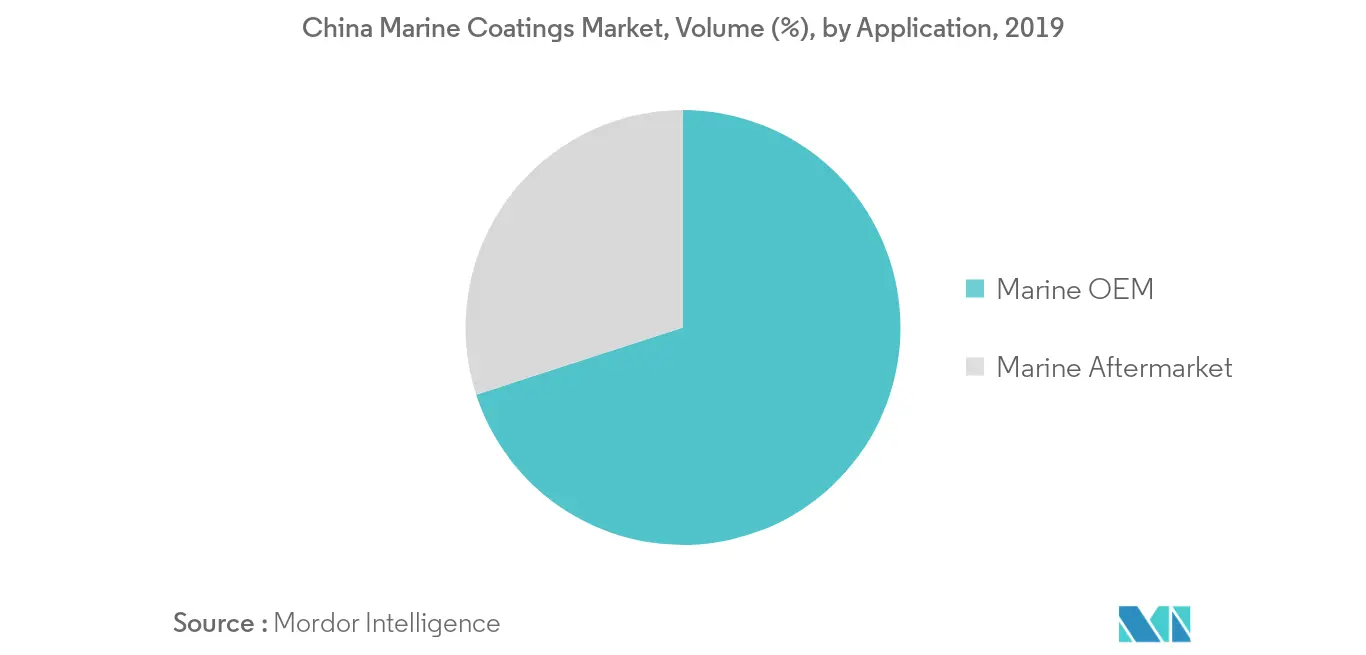
The marine vessel construction industry in China has experienced a slowdown in recent years as maritime trade lost momentum in 2018 owing to many reasons including a weakening multilateral trading system and growing protectionism. Chinese marine industry has started showing a recovery in late 2019, especially in the naval cruise market. However, COVID-19 has further affected the industry negatively in 2020. This resulted in the slowdown of new construction orders which has slowed down marine OEM coatings growth considerably in the short term. The aftermarket segment is expected to grow higher than the OEM segment owing to the increase in construction and repair activities. However, the OEM segment is expected to still retain the largest market share in the China Marine Coatings Market.
Competitive Landscape
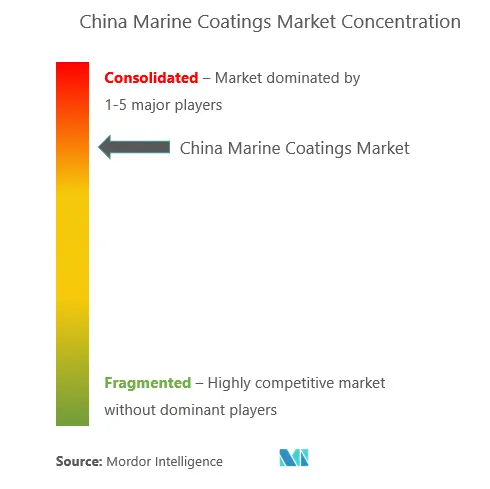
The China Marine Coatings Market is consolidated in nature. Some of the key players in the market include Akzo Nobel N.V., Jotun, PPG Industries, Hempel A/S, NIPSEA GROUP, among others.
China Marine Coatings Industry Leaders
-
Akzo Nobel N.V.
-
Jotun
-
PPG Industries
-
Hempel A/S
-
NIPSEA GROUP
- *Disclaimer: Major Players sorted in no particular order
Market Opportunities and Future Outlook
China marine coatings demand is being shaped by two visible whitespace areas: (i) the shift toward higher-performance antifouling systems that support operational efficiency and (ii) localization of advanced coating manufacturing and R&D alongside major shipowner and shipyard ecosystems. A concrete signal of scale is Jotun Group's December 2025 agreements in Zhangjiagang for a new high-performance coatings plant (200,000 tons annual capacity) and a liquid coatings R&D center, alongside Jotun COSCO Marine Coatings' expansion milestones in Qingdao, including a 100 million liters annual production milestone and Phase I capacity additions. Supply security and technical service depth are also becoming differentiators as major suppliers deepen structured relationships with shipping groups for newbuildings and dockings, as shown by Jotun COSCO Marine Coatings' cooperation covering 125 newbuilding bulk carriers with COSCO SHIPPING Bulk (June 2026) and AkzoNobel's partnership extension with Winning Shipping for 2026 drydocking projects in China.
On technology and application practices, opportunities are emerging around eco-friendlier formulations and more consistent application quality across shipyards. June 2026 activity in Nantong highlights this direction, with Dowill Paints inaugurating an R&D center in Qidong focused on eco-friendly coating materials and robotic application technologies for shipbuilding, pointing to investment in both material innovation and process modernization. Domestic capacity additions also suggest room for suppliers that can bridge performance and compliance, such as Zhejiang Yu Xi Corrosion Control commissioning a 41,000-ton marine anti-fouling and anti-corrosion materials project in Xiangshan (commissioning initiated in 2025), which supports broader availability of antifouling and anticorrosion systems across OEM and aftermarket channels.
Recent Industry Developments
- June 2026: Jotun COSCO Marine Coatings signed a memorandum of cooperation with COSCO SHIPPING Bulk covering coating supply for 125 newbuilding bulk carriers. The agreement centers on high-performance antifouling systems aimed at improving vessel efficiency, reinforcing long-cycle demand visibility tied to newbuild activity. It also strengthens supplier positioning with one of the largest shipping groups operating in China.
- December 2025: Jotun Group signed agreements in Zhangjiagang for a new high-performance coatings plant with 200,000 tons annual capacity and a new liquid coatings R&D center, with total investment reported at USD 330 million. The project increases local manufacturing scale and deepens China-based development capability for higher-performance marine and protective coating systems. It adds competitive pressure on both multinational and domestic suppliers to match local supply reliability and technical service levels.
- December 2025: AkzoNobel extended its strategic partnership with Winning Shipping in China to support 2026 drydocking projects, supplying International brand marine coatings for six vessels. The scope includes premium hull solutions (such as Intersleek 1100SR) alongside other systems used in dockings, anchoring aftermarket volume through a named fleet relationship. The partnership underscores how supplier-shipowner agreements are being used to secure planned maintenance demand and standardize coating specifications across fleets.
Research Methodology Framework and Report Scope
Market Definition and Coverage
For this report, the market covers marine coating products sold in China for ship and marine asset protection and performance, including newbuild application and maintenance recoating, and it is measured as the value of coatings supplied to marine OEM and aftermarket demand.
Scope exclusions: We exclude shipbuilding steel, blasting and surface-prep services, marine adhesives and sealants, and non-marine industrial protective coatings even if used near ports.
Segmentation Overview
- By Function
- Anti-corrosion
- Antifouling
- Others
- By Resin
- Epoxy
- Polyurethane
- Acrylic
- Alkyd
- Others
- By Technology
- Water-borne
- Solvent-borne
- Others
- By Application
- Marine OEM
- Marine Aftermarket
Data Sources, Market Sizing, and Validation
Desk Research
Desk work starts by mapping the demand pool that drives coating consumption in China, and then we line up public indicators that can be checked year after year. Key anchors include National Bureau of Statistics releases for industrial production context, Ministry of Transport publications on port throughput, China Customs trade statistics for resins and coating-related inputs, and maritime regulators such as the International Maritime Organization for rule changes that affect dry-dock cycles.
We also review public sources that help translate activity into coatings demand, such as classification society guidance and maintenance intervals, shipyard order and delivery commentary in reputable press, and company filings and investor presentations that discuss marine coatings exposure and pricing trends. Where available, a paid subscription for company financials and a shipment-level trade database are used to cross-check directional movements in sales and import flows. The sources listed here are illustrative only, and many other public documents were also consulted for data collection, validation, and clarification.
Primary Interviews and Surveys
Primary checks were used to convert visible shipbuilding and repair activity into realistic coating consumption and pricing, before the final numbers were locked. We spoke with a mix of coating formulators, distributors, applicators, shipyards, and ship owners to confirm typical paint system splits, repaint intervals, and how bidding and tendering affects realized pricing. Because this is a China-only market, we covered coastal shipbuilding clusters and major repair hubs so the assumptions reflected on-the-ground buying patterns rather than a single location.
Distribution of primary research fieldwork respondents
| Company type | Respondent position |
|---|---|
| Top tier: 32% | CXOs: 15% |
| Mid tier: 52% | Functional/Unit leaders: 31% |
| Smaller Players: 16% | Managers: 54% |
Market-Sizing & Forecasting
Our model starts with a top-down build that reconstructs China demand from shipbuilding and repair signals, then links that activity to coating usage by application stage. In practice, we translate newbuild deliveries, repair and dry-dock frequency, and the mix of vessel maintenance scopes into an annual coating demand pool, which is then converted to value using realistic average selling prices by coating system.
To keep the results grounded, we corroborate totals with selective bottom-up checks, such as rolling up a sample of supplier revenues, distributor channel checks, and sampled volume times price calculations for key coating systems. When gaps appear, such as limited visibility on smaller repair yards or informal purchasing, the model uses conservative fill rates that are then stress-tested in interviews. Key inputs used in the sizing and forecast include shipbuilding output trends, fleet maintenance and repaint intervals, antifouling versus anti-corrosion system mix, solvent-borne versus water-borne adoption, and raw material price pass-through that impacts realized ASPs.
For forecasting, scenario analysis is used so demand paths can be flexed based on shipyard order books, expected repair cycles, and regulatory-driven maintenance timing. The final growth path is selected only after it matches what industry respondents describe for tender pipelines and pricing behavior over the next few years.
Data Validation & Update Cycle
We run multiple checks before sign-off so the final market size is consistent with what the industry can realistically supply and consume. Outputs are compared against independent signals such as ship deliveries and port activity trends, and then large year-to-year swings are challenged until the underlying driver is clearly explained.
A second analyst reviews key assumptions, math logic, and sensitivity ranges, and we re-contact experts when a material variance cannot be resolved from public information. The report is refreshed annually, and interim updates are made when major events change shipbuilding schedules, repair cycles, or pricing. Before delivery, the full model is re-checked so clients receive the most current view available at that time.
Mordor Intelligence's China Marine Coatings Market Size Versus Other Published Estimates
Published market sizes for China marine coatings can differ even when the topic name looks the same, because the scope boundary and the conversion from marine activity to coating value are handled differently. The biggest differences usually come from what is counted as marine only, which sales channel is captured, and how pricing is translated from list prices to realized prices.
By tracking vessel newbuild and repair activity, then refreshing price and repaint-interval assumptions through field validation, Mordor Intelligence keeps the model tied to coating demand applied in China shipyards and dry docks, rather than expanding the scope into adjacent protective coatings used for broader industrial purposes.
Benchmark comparison
| Source | Market Size | Gaps in Research Methodology |
|---|---|---|
| Mordor Intelligence | USD 0.00 B (2024) | |
| Trade Journal A | USD 0.28 B (2024) | This type of estimate often treats marine coatings as a wider protective coatings bucket for coastal infrastructure and marine equipment, which lifts the value beyond ship newbuild and repair demand. It also tends to apply a single blended price, which can overstate antifouling-heavy mixes and premium systems. |
| Regional Consultancy B | USD 0.20 B (2024) | Some studies back into value from shipbuilding output using a fixed paint cost per vessel assumption, which misses variability by vessel class, maintenance scope, and coating system thickness. These models also commonly under-capture aftermarket recoating done through distributors and local applicators. |
The spread mainly reflects three choices that are easy to overlook, which are the boundary around what counts as marine, the activity-to-consumption conversion, and how realized pricing is built. When scope is kept to ship newbuild and repair demand and the assumptions are checked with market participants, the result becomes easier to trace and to repeat in future updates.
Key Questions Answered in the Report
What is the current China Marine Coatings Market size?
The China Marine Coatings Market is projected to register a CAGR of 2.05% during the forecast period (2026-2031)
Who are the key players in China Marine Coatings Market?
Akzo Nobel N.V., Jotun, PPG Industries, Hempel A/S and NIPSEA GROUP are the major companies operating in the China Marine Coatings Market.
What years does this China Marine Coatings Market cover?
The report covers the China Marine Coatings Market historical market size for years: 2019, 2020, 2021, 2022, 2023 and 2024. The report also forecasts the China Marine Coatings Market size for years: 2025, 2026, 2027, 2028, 2029 and 2030.