
China Electric Vehicle CNC Turning Centers Market Size and Share
Market Overview
| Study Period | 2020 - 2031 |
|---|---|
| Forecast Data Period | 2026 - 2031 |
| Base Year Market Size (2025) | USD 417 Million |
| Market Size (2026) | USD 478 Million |
| Market Size (2031) | USD 873 Million |
| Growth Rate (2026 - 2031) | 12.80 % |
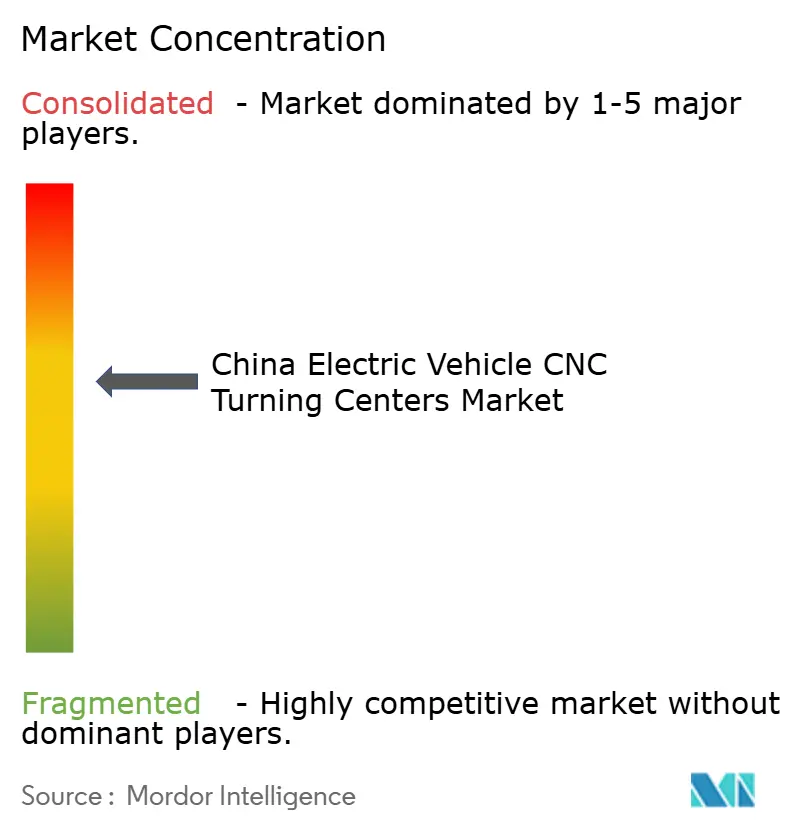
| Market Concentration | Medium |
Major Players *Disclaimer: Major Players sorted in no particular order Image © Mordor Intelligence. Reuse requires attribution under CC BY 4.0. | |
China Electric Vehicle CNC Turning Centers Market Analysis by Mordor Intelligence
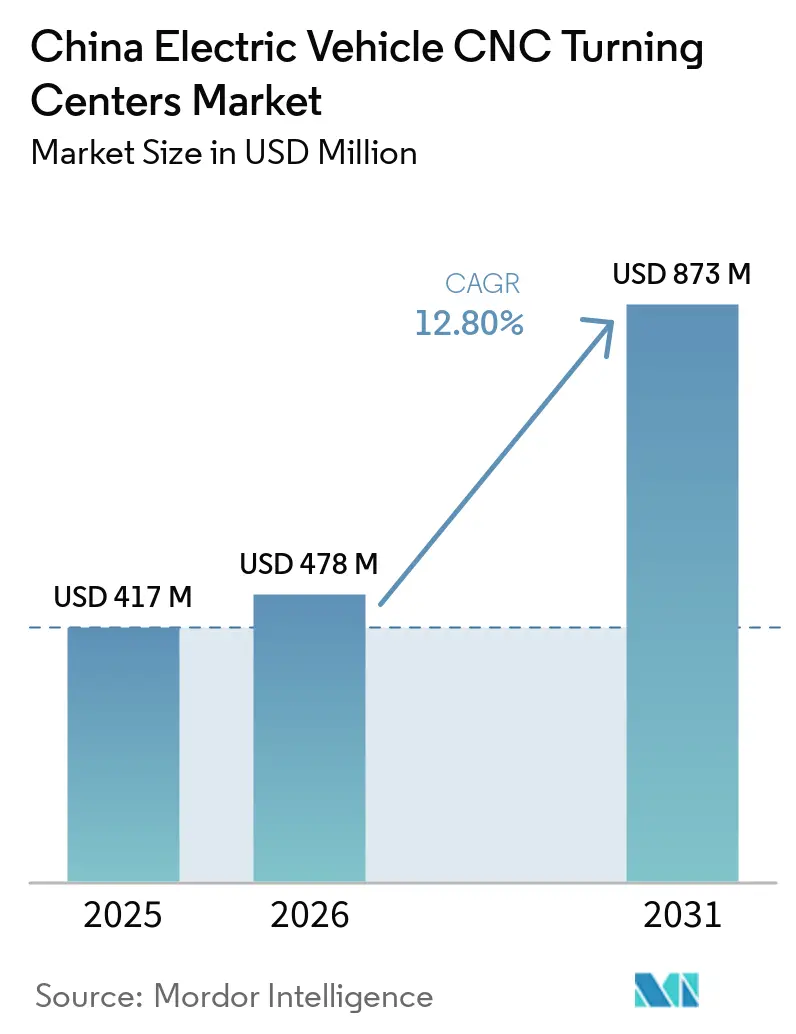
The China Electric Vehicle CNC Turning Centers Market size is expected to grow from USD 417 million in 2025 to USD 478 million in 2026 and is forecast to reach USD 873 million by 2031 at 12.80% CAGR over 2026-2031.
China’s expanding NEV production base supports capital spending on precision machining equipment across vehicle and component plants, particularly for the motor, e-axle, and battery-related parts that determine vehicle performance, and this effect extends from the largest assembly plants to specialist machining firms that supply shafts, housings, bearing-related parts, and smaller electronic enclosures. Vehicle exports also raise the need for consistent dimensional control in components supplied to overseas programs, where manufacturers must demonstrate repeatable quality. Domestic machine tool policy and local procurement preferences support equipment suppliers capable of meeting higher accuracy requirements and responding quickly to local customers. Automation is changing purchase decisions because OEMs increasingly evaluate machines as part of an integrated production cell that includes material handling, inspection, and software connections. High equipment costs, skills shortages, and reliance on imported high-end controls limit the pace at which smaller suppliers can upgrade.
Key Report Takeaways
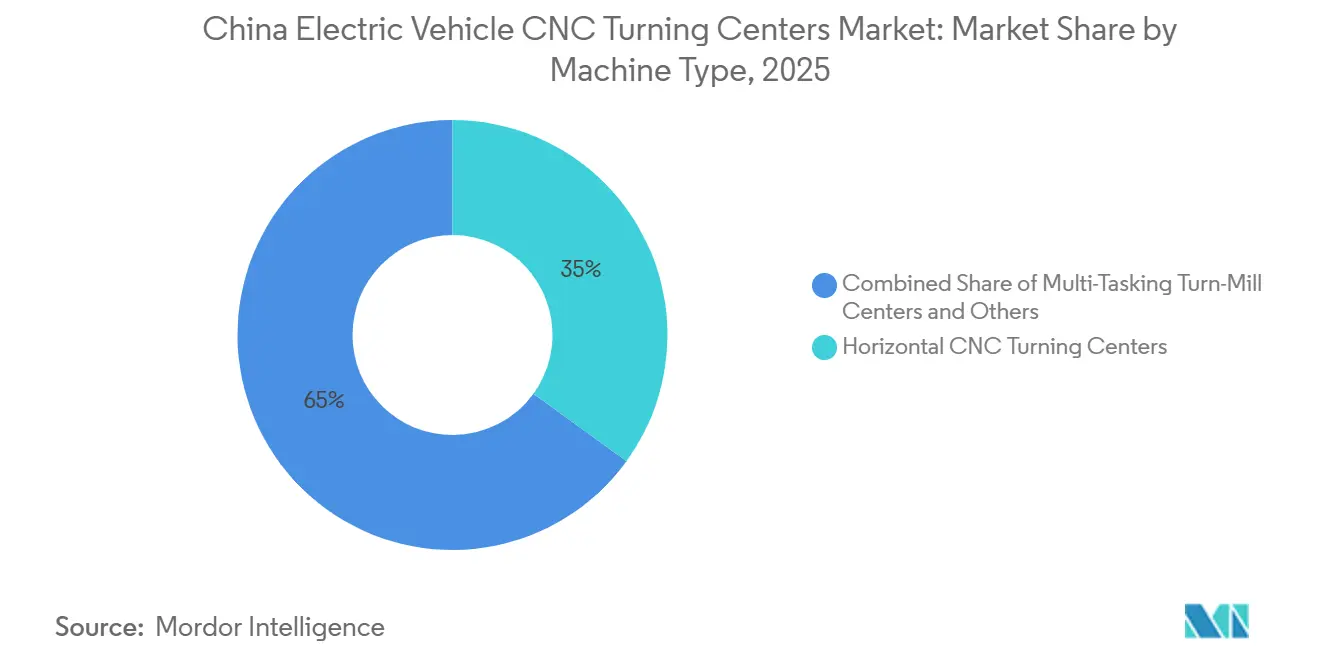
- By machine type, horizontal CNC turning centers accounted for 35% of the China electric vehicle CNC turning centers market share in 2025, while multi-tasking turn-mill centers recorded the highest projected CAGR at 16.1% through 2031.
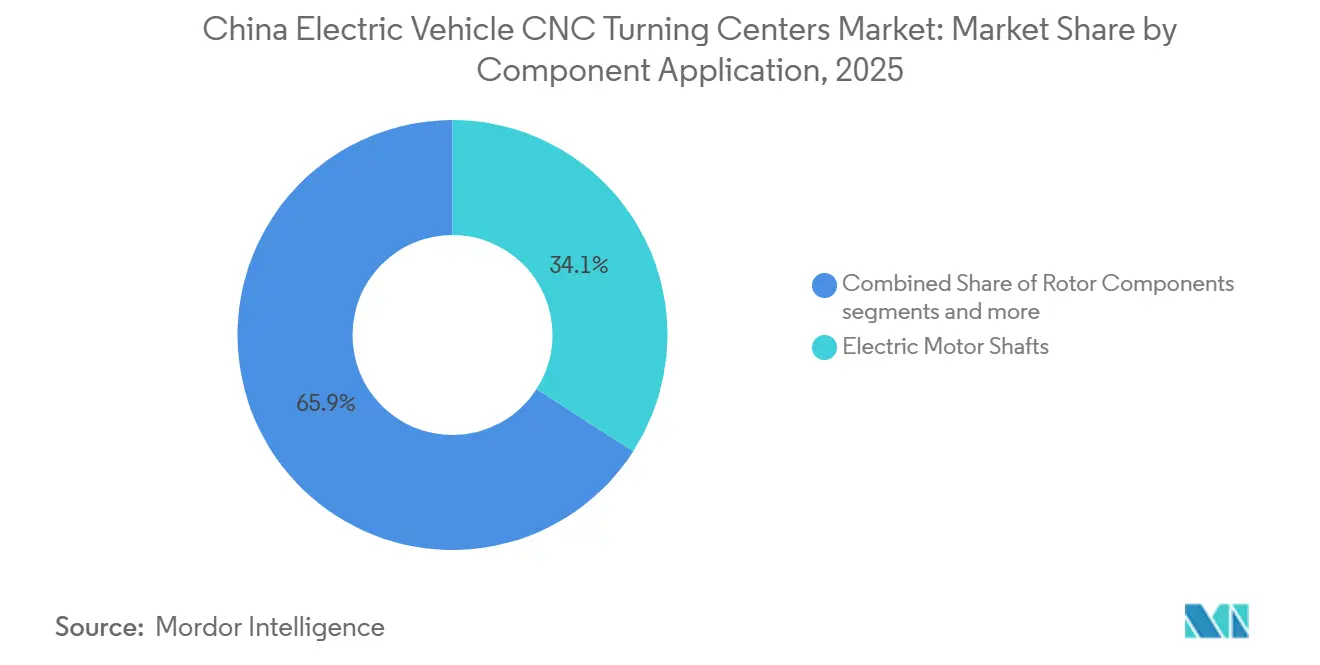
- By component application, electric motor components accounted for 34.1% of revenue in 2025, while battery system components are forecast to expand at a 14.6% CAGR through 2031.
- By end user, EV OEM manufacturing plants accounted for 47% of the China electric vehicle CNC turning centers market size in 2025, while Tier-2 Component manufacturers recorded the highest projected CAGR at 14.3% through 2031
Note: Market size and forecast figures in this report are generated using Mordor Intelligence’s proprietary estimation framework, updated with the latest available data and insights as of January 2026.
China Electric Vehicle CNC Turning Centers Market Trends and Insights
Drivers Impact Analysis*
| Driver | (~) % Impact on CAGR Forecast | Geographic Relevance | Impact Timeline |
|---|---|---|---|
| Accelerating EV Production and Precision Machining Demand | +4.2% | National, with the greatest concentration in the Yangtze River Delta and Pearl River Delta manufacturing clusters | Short term (≤ 2 years) |
| Localized EV Component Production and CNC Investment | +2.8% | National, with priority zones in Jiangsu, Zhejiang, Guangdong, and Chongqing | Medium term (2-4 years) |
| High-Precision E-Axle, Motor, and Battery Requirements | +1.8% | Global demand pull centered in eastern China’s export-oriented manufacturing corridors | Medium term (2-4 years) |
| Smart Factories, Automation, and Multi-Axis Adoption | +1.5% | National, with early gains in Shenzhen, Shanghai, Hefei, and Xi’an | Long term (≥ 4 years) |
| Domestic Machine Tool Capability and Industrial Policy Support | +1.2% | National, aligned with the MIIT 2026-2030 Action Plan and specialized SME frameworks | Long term (≥ 4 years) |
| Multi-Axis Turning for Higher Manufacturing Productivity | +0.8% | National, with greater uptake in Tier-1 supplier clusters near EV OEM hubs | Medium term (2-4 years) |
| Source: Mordor Intelligence | |||
Accelerating Electric Vehicle Production Expands Precision Machining Demand
China produced 16.63 million NEVs in 2025, a 29% increase from 2024, and NEV sales are projected to reach 19 million units in 2026. NEV output totaled 7.43 million units in the first half of 2026, while the June penetration rate reached 58.5% of new car sales[1]Source: China Association of Automobile Manufacturers, “China’s New Energy Vehicle Output and Sales Both Exceed 7 Million in H1,” Xinhua News Agency, english.news.cn.. This volume creates continuing demand for motor shafts, rotor housings, e-axle casings, and battery tray structures that require turning and related precision machining, with each additional production program drawing on several component suppliers. Demand is not confined to final assembly because component makers must add capacity before vehicle plants can complete their production ramps. The China electric-vehicle CNC turning centers market benefits when OEMs refresh vehicle architectures more frequently, as suppliers must adapt tooling, programming, and production capacity while maintaining stable output. Procurement is increasingly tied to broader plant engineering programs rather than being handled as an isolated machine purchase, bringing machine selection closer to line design and automation planning. That practice favors suppliers that can support specification, commissioning, process validation, operator training, and production ramp-up across several machining cells.
Localization of EV Component Manufacturing Strengthens CNC Machine Investments
Localized production of e-motor assemblies, integrated e-axles, and battery management housings is creating both new-site and upgrade demand for machining equipment. MIIT’s 2026-2030 machine tool development plan set a target of more than 75% self-sufficiency in key functional components by 2027 and established support for joint research and development. The policy direction strengthens the case for Chinese equipment suppliers capable of serving mid-range and higher-specification applications, especially when their service teams can work closely with component makers. It also puts greater value on suppliers that can tailor a machine configuration to a specific part family rather than only provide standard equipment. Local procurement requirements can also influence equipment selection, as suppliers seek preferred status within OEM supply chains and need to demonstrate alignment with localization objectives. The China electric vehicle CNC turning centers market, therefore, has room for domestic manufacturers that combine acceptable accuracy with responsive local service, application advice, and spare-parts availability. This environment does not eliminate demand for foreign equipment, especially where complex machining, control performance, or validation requirements remain high, and buyers have established global production standards.
High-Precision Requirements for E-Axles, Motor Shafts, and Battery Components
EV powertrain parts require tighter control of geometry and surface quality than many conventional drivetrain components. Rotor shaft runout can be held within 3 micrometers, while e-axle output shaft bearing journals can require cylindricity below 5 micrometers. These requirements support the use of automated turning systems with in-process measurement, reliable thermal behavior, and stable part handling during long production runs. Electric motors can operate at speeds above 20,000 rpm in high-performance configurations, underscoring the importance of shaft geometry, fatigue performance, and reliable surface finishing. Battery tray and cell housing work requires thin-wall machining, with wall thicknesses of 1.5 mm and flatness within 0.02 mm, making distortion control important. The China electric vehicle CNC turning centers market is therefore shifting toward equipment that can document capability, support automotive quality management requirements, and maintain precision across repeated cycles.
Smart Factories and Automation Reshape Equipment Selection
Automotive plants are adding robots, vision systems, and automated machine cells as part of their EV manufacturing programs. Changan’s smart EV factory for the Avatr 07 uses nearly 1,000 robots on its automated assembly floor, including a large-scale deployment of HCNC robots[2]Source: Huazhong Numerical Control, “HCNC Robots Power Changan’s Smart Factory,” Huazhong CNC, en.huazhongcnc.com.. Turning centers are consequently more often purchased with handling systems, cell controls, inspection links, and service arrangements that support sustained availability. Integrated cells can raise the value of each project while making system compatibility, programming discipline, and maintenance planning more important for buyers. Once a machine interface is embedded in a factory’s digital production architecture, a change of supplier can require broader cell redesign and renewed process testing. The China electric vehicle CNC turning centers market consequently rewards vendors that offer dependable automation interfaces, practical lifecycle support, and the ability to work with an OEM’s production engineering team.
Restraints Impact Analysis*
| Restraint | (~) % Impact on CAGR Forecast | Geographic Relevance | Impact Timeline |
|---|---|---|---|
| High Capital Investment for Advanced Turning Centers | -1.8% | National, most acute for Tier-2 Component Manufacturers with limited equipment financing | Medium term (2-4 years) |
| Dependence on Imported High-End Controllers and Core Components | -1.5% | National, with concentration risk in eastern export-oriented precision manufacturing | Long term (≥ 4 years) |
| Shortage of Skilled CNC Programmers and Precision Technicians | -0.9% | National, most severe in inland provinces, entering EV-linked precision manufacturing | Medium term (2-4 years) |
| Low-Cost Equipment Competition and Margin Pressure | -0.7% | National, with the strongest pressure in mid-range horizontal turning centers | Short term (≤ 2 years) |
| Source: Mordor Intelligence | |||
High Capital Costs and Skills Constraints Slow Upgrades
Advanced multi-axis turning centers capable of meeting EV tolerance requirements cost between CNY 800,000 and more than CNY 5 million (USD 112,000 and USD 700,000). Smaller component producers can face multi-year payback periods, particularly when their orders change with vehicle model transitions or when their production volumes are not yet sufficient to keep a new cell fully utilized. Financing often depends on real-asset collateral, which can disadvantage precision machining firms with limited fixed assets and reduce the options available to firms that want to fund technology-led productivity gains. The required conversion from ICE-focused lines also includes workholding, aluminum-capable cutting tools, revised programs, inspection methods, and employee training for different parts and materials. Those changes can add 15% to 20% to the effective acquisition cost beyond the machine price and can lengthen the time before a supplier obtains stable output. A shortage of experienced CNC programmers and precision technicians further limits the speed at which suppliers can bring new capacity into stable production, verify capability, and respond to customer schedule changes.
Imported Control Dependence and Price Competition Constrain Returns
Chinese manufacturers have expanded domestic CNC capabilities for mid-range applications, but high-end EV machining still relies heavily on overseas control systems and related components. The United States-China Economic and Security Review Commission reported that Chinese CNC firms remained dependent on foreign components, operating hardware, and software. This reliance exposes the China electric-vehicle CNC turning centers market to supply-chain and technology-access risks in advanced configurations, particularly where control performance directly affects repeatability. It also makes it harder for domestic producers to match foreign systems in demanding simultaneous multi-axis work, despite continuing progress in local systems. At the same time, low-cost equipment competition reduces margins in the mid-range horizontal segment and makes it harder to recoup development costs. Vendors must balance price discipline with investment in service, automation, accuracy improvements, and the technical support customers need after installation.
*Our forecasts treat driver/restraint impacts as directional, not additive. The impact forecasts reflect baseline growth, mix effects, and variable interactions.
Segment Analysis
By Machine Type: Horizontal Scale Meets Multi-Tasking Demand
Horizontal CNC turning centers accounted for 35% of 2025 revenue. They are widely used for bar-stock and shaft-family parts, including rotor shafts, motor spindles, and differential housings. Their suitability for continuous-cycle production and limited setup changes has supported adoption in OEM and Tier-1 machining lines. The installed base also creates replacement and upgrade demand as plants revise tooling, controls, and capacity. Vertical CNC turning centers are well-suited to larger-diameter, lower-height parts such as bearing rings, motor end plates, and brake rotors. They remain relevant where chip evacuation or workpiece handling makes a horizontal layout less suitable.
Multi-tasking turn-mill centers are forecast to grow at a 16.1% CAGR from 2026 to 2031. The equipment combines turning, milling, drilling, and thread cutting in one setup for complex e-axle components. This reduces transfer time between machines and can simplify the production of multi-face parts. EMAG introduced the MSC 5 DUO at EMO 2025, a compact, automated twin-spindle turning system for automotive components. Okuma introduced the MULTUS U1000 and MULTUS U2000 in 2026, with 5-axis simultaneous machining and an 8.2 m² footprint. The China electric vehicle CNC turning centers industry is moving toward these systems, in which factories prioritize space utilization, labor efficiency, and process consolidation.



By Component Application: Motor Shafts Anchor Volume as Battery Machining Accelerates
Electric motor components held 34.1% of 2025 revenue. Every battery electric vehicle requires at least 1 traction motor, while some higher-performance models use 2 or 4 motors. Motor shaft and housing machining are central to each powertrain configuration. Rotor shaft work is among the more demanding applications because it requires precise runout and dynamic balance control. Integrated e-axle housings add demand for complex machining because they combine motor, gearbox, and inverter functions. These parts support the use of machines that can perform several operations while retaining consistent part positioning.
Battery system components are projected to grow at a 14.6% CAGR through 2031. China’s installed battery manufacturing capacity exceeded 800 GWh in 2025, supporting downstream investment across cell, module, and pack production. Battery tray machining requires controlled thin-wall processing and stable geometry to prevent distortion. These needs create demand for thermally stable turning centers with active compensation. The China electric-vehicle CNC turning centers market can also benefit from the shift toward higher-precision cell-housing components. Equipment suppliers that can help customers manage aluminum machining, inspection, and repeatability are better placed to address this application.
By End User: OEM Programs Anchor Demand and Tier-2 Suppliers Grow Fastest
EV OEM manufacturing plants commanded 47% of the China electric vehicle CNC turning centers market size in 2025. Greenfield EV plants often procure automated turning cells through larger engineering contracts. Major capacity hubs in Shenzhen, Shanghai, Hefei, Wuhan, and Xi’an, therefore, create concentrated purchasing events. Tier-1 Automotive Suppliers form the next major buyer group because they machine e-axle assemblies and integrated motor housings. Their automotive quality requirements encourage investment in thermally stable and high-accuracy equipment. The volume of OEM programs can make annual equipment demand uneven, but it provides large opportunities for established vendors.
Tier-2 component manufacturers are projected to expand at a 14.3% CAGR through 2031. These suppliers produce specialized components such as connector housings, bearing sleeves, sensor brackets, and motor subcomponents. Their growth spreads EV-related machining demand beyond the largest integrated plants. Shenyang Machine Tool delivered its 1,000th combined production line to Suzhou Lvkong Transmission Technology in July 2026, demonstrating a flexible automation approach for electric-drive components[3]Source: General Technology Group Shenyang Machine Tool, “1000th Combined Production Line Delivered to Suzhou Lvkong Transmission Technology,” Sina Finance, finance.sina.com.cn.. Precision contract manufacturers also need multi-axis capacity to serve domestic programs and export-oriented supply chains. The China electric-vehicle CNC turning centers industry has an opportunity to offer scalable cell designs to buyers who cannot deploy large OEM-style production systems.
Geography Analysis
The Yangtze River Delta is the most concentrated demand area for China's electric-vehicle CNC turning centers market in 2026. Jiangsu, Zhejiang, and Shanghai combine major EV OEM and Tier-1 clusters with established precision machining networks. The region supports demand for equipment from both new component facilities and upgrades at existing suppliers. Manufacturers in this corridor increasingly compete on quality and international-standard capabilities rather than solely on price. The China electric vehicle CNC turning centers market benefits from the short distances between vehicle plants, component producers, equipment vendors, and engineering service providers in this cluster. Investment in lightweight structures, steering parts, and EV chassis components supports related machining needs.
The Pearl River Delta is the fastest-growing regional area for EV precision machining equipment in 2026. Shenzhen, Guangzhou, and Dongguan benefit from the presence of BYD and a large ecosystem of electronics and power-electronics suppliers. Domestic OEM programs and export-facing contract manufacturing support regional demand. Manufacturers are adding advanced machining capacity to meet demand for battery enclosures and other precision components the region’s logistics capability and dense supplier base support fast equipment commissioning and component delivery.
Northeast China, centered on Shenyang, remains important as a machine tool production base and a source of integrated machining solutions for the Chinese electric vehicle CNC turning centers market. Shenyang Machine Tool’s sub-0.01 mm precision capability and its 1,000-production-line milestone show the region’s focus on higher-value equipment, automation, and the ability to link several machines into a single controlled production flow. The region also benefits from long-standing manufacturing expertise, which can support the adaptation of machine tools for new electric-drive components as suppliers shift away from conventional powertrain work. Chongqing, Sichuan, and Hubei are emerging as the next phase of EV manufacturing expansion, where lower land and labor costs, provincial incentives, and new component investment can support local machining capacity. This geographic spread creates a broader service and application support requirement for equipment suppliers, because customers outside coastal clusters need commissioning, maintenance, process advice, and rapid access to replacement parts as they build new precision production lines.
Competitive Landscape
The China electric vehicle CNC turning centers market is moderately consolidated. DMG MORI, Mazak, Okuma, EMAG, and DN Solutions are established suppliers in high-value equipment used by OEM plants and Tier-1 suppliers. Shenyang Machine Tool, Haitian Precision, and Qinchuan Machine Tool are expanding their domestic market presence in the mid-range and higher-specification segments. Foreign vendors remain important when buyers require advanced controls, advanced machining capabilities, and established validation processes. Domestic vendors compete through total ownership cost, local support, and faster adaptation to customer requirements. The China electric vehicle CNC turning centers market has no disclosed combined share for leading suppliers, so a concentration conclusion cannot be based on a verified top-player share figure.
Digital production integration is becoming an important competitive factor in the Chinese electric-vehicle CNC turning centers market. DMG MORI established the Machining Transformation Research Center with the University of Tokyo in April 2026 to pursue manufacturing efficiency, energy savings, and labor substitution[4]Source: DMG MORI Co., Ltd., “DMG MORI and The University of Tokyo Establish the Machining Transformation Research Center to Promote Innovation and Sustainability Through MX,” DMG MORI, dmgmori.co.jp.. The initiative supports the company’s broader focus on automation and digital manufacturing capabilities. Okuma’s MULTUS U1000 and U2000 provide compact multi-tasking options with a design intended for close robot placement. EMAG’s MSC 5 DUO offers a compact twin-spindle configuration for automated production of automotive components. These product strategies address factory space, automation, and labor constraints without separating machine selection from broader cell design.
Domestic suppliers have a practical opening in Tier-2 purchasing, where payback periods and service access often influence equipment decisions. The China electric vehicle CNC turning centers market is also likely to favor vendors that offer pre-engineered cells for recurring EV component applications. Such offerings can reduce integration work for buyers and make performance expectations clearer before installation. Haitian Precision launched 3 five-axis machining centers at CCMT 2026 for complex parts, volume production, and precision curved-surface processing. DMG MORI’s 2025 NLX 2500|1250 2nd Generation turning center addresses EV motor and drivetrain applications with dual-spindle and driven-tool capability. Competition will remain centered on machine accuracy, automation readiness, lifecycle service, and the ability to meet increasingly demanding EV component requirements.
China Electric Vehicle CNC Turning Centers Industry Leaders
DMG MORI Co., Ltd.
Yamazaki Mazak Corporation
Okuma Corporation
DN Solutions
EMAG GmbH & Co. KG
- *Disclaimer: Major Players sorted in no particular order

Recent Industry Developments
- April 2026: DMG MORI and The University of Tokyo formally established the Machining Transformation Research Center (MX Center) on April 1, 2026, within the Graduate School of Engineering of The University of Tokyo, dedicated to advancing efficiency, energy savings, and labor substitution in manufacturing, with EV, aerospace, and semiconductor sectors identified as priority application domains within the 2050 research horizon.
- April 2026: Haitian Precision launched 3 new five-axis machining centers at CCMT 2026, each addressing distinct scenarios, medium-to-large complex parts, high-efficiency mass production, and high-precision large curved-surface processing, targeting EV powertrain and advanced automotive manufacturing customers.
- April 2026: Okuma launched the MULTUS U1000 and MULTUS U2000 compact multitasking machines, offering 5-axis simultaneous machining within an 8.2 square-meter footprint, a standard 80-tool magazine that can be upgraded to 180 tools, and a flat-front design optimized for close-range robot placement, targeting high-mix EV component production environments.
- September 2025: DMG MORI launched the NLX 2500|1250 2nd Generation turning center at EMO Hannover 2025, explicitly targeting EV, aerospace, and semiconductor applications, featuring left and right spindles, a driven-tool turret, an extended Y-axis of ±60 mm, and workpiece capacity up to 1,258 mm length, directly suited to EV motor and drivetrain long-shaft production.


China Electric Vehicle CNC Turning Centers Market Report Scope
The China Electric Vehicle CNC Turning Centers Report is Segmented by Machine Type (Horizontal CNC Turning Centers, and More), by Automation Level (Standalone CNC Turning Centers, and More), by Component Application (Electric Motor Shafts and More), by End User (EV OEM Manufacturing Plants and More ), by EV Type (Battery Electric Vehicles (BEV) and More). The Market Forecasts are Provided in Terms of Value (USD) and Volume (Units).
| Horizontal CNC Turning Centers |
| Vertical CNC Turning Centers |
| Multi-Tasking Turn-Mill Centers |
| Swiss-Type CNC Turning Centers |
| Others |
| Electric Motor Components |
| E-Axles & Transmission Components |
| Battery System Components |
| Others |
| EV OEM Manufacturing Plants |
| Tier-1 Automotive Suppliers |
| Tier-2 Component Manufacturers |
| Precision Contract Manufacturers |
| By Machine Type | Horizontal CNC Turning Centers |
| Vertical CNC Turning Centers | |
| Multi-Tasking Turn-Mill Centers | |
| Swiss-Type CNC Turning Centers | |
| Others | |
| By Component Application | Electric Motor Components |
| E-Axles & Transmission Components | |
| Battery System Components | |
| Others | |
| By End User | EV OEM Manufacturing Plants |
| Tier-1 Automotive Suppliers | |
| Tier-2 Component Manufacturers | |
| Precision Contract Manufacturers |


Key Questions Answered in the Report
What is the expected growth outlook for China's EV CNC turning centers through 2031?
The sector is projected to rise from USD 478 million in 2026 to USD 873 million by 2031 at a 12.8% CAGR, supported by the continued expansion of EV drivetrain and battery manufacturing.
Why do battery electric vehicle programs create more machining demand than older powertrain lines?
BEV platforms rely heavily on precision motor shafts, rotor components, and e-axle parts, which need tighter tolerances and more stable process control than many legacy ICE machining lines.
Which machine type is leading current demand in China’s EV turning center space?
Horizontal CNC turning centers led with a 35.0% share in 2025 because they meet the high-volume shaft-machining and automated-loading requirements across large supplier programs.
What limits the broader adoption of advanced CNC turning centers?
Capital costs, the availability of skilled programmers, dependence on imported controls, and pressure from lower-cost equipment slow upgrades. Smaller suppliers also incur additional costs for workholding, cutting tools, programming changes, testing, and the time required to establish a repeatable process. These constraints are most significant when financing is limited, and a buyer has little room for extended production trials, delayed customer approvals, or adjustments to production schedules.
Which end users are spending the most on CNC turning capacity for EV production?
EV OEM manufacturing plants held 47.0% of demand in 2025, while Tier-2 component manufacturers are expected to post the fastest growth as supplier qualification standards tighten.
What is the main competitive divide among suppliers of EV-focused CNC turning systems in China?
Global brands remain stronger in premium multi-axis and integrated cell applications, while domestic manufacturers are gaining ground in mid-tier horizontal turning and lower-cost automated solutions.
Page last updated on:





