
China Commercial Roofing Market Size and Share
Market Overview
| Study Period | 2021 - 2032 |
|---|---|
| Forecast Data Period | 2027 - 2032 |
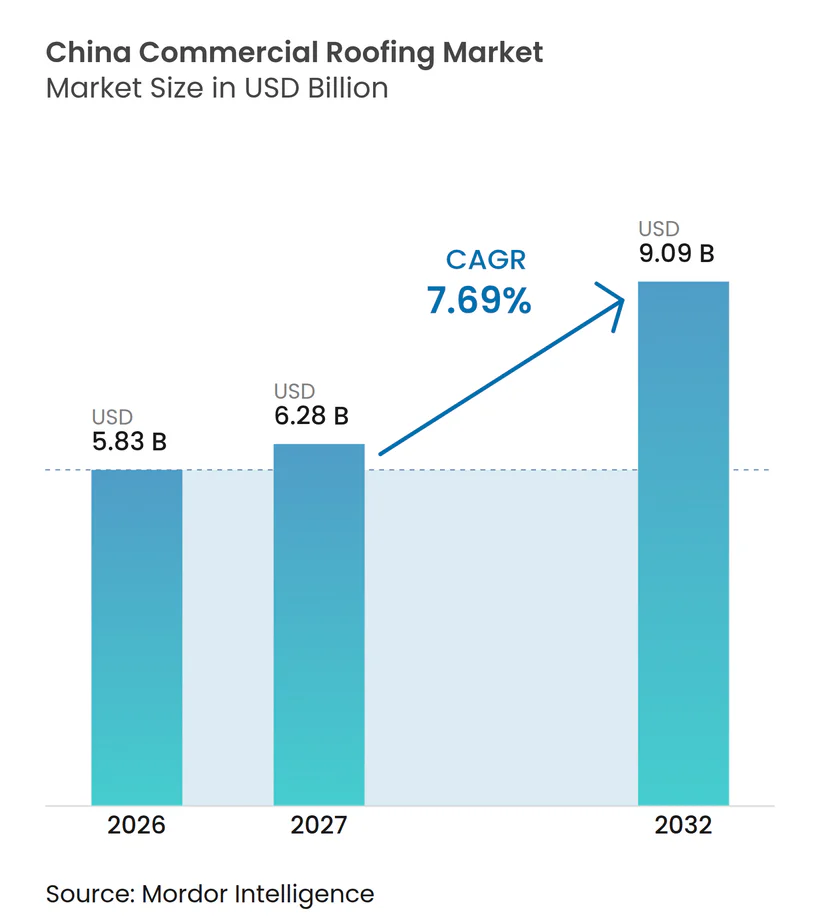
| Base Year Market Size (2026) | USD 5.83 Billion |
| Market Size (2027) | USD 6.28 Billion |
| Market Size (2032) | USD 9.09 Billion |
| Growth Rate (2027 - 2032) | 7.69 % |
| Market Concentration | Medium |
Major Players *Disclaimer: Major Players sorted in no particular order Image © Mordor Intelligence. Reuse requires attribution under CC BY 4.0. | |
China Commercial Roofing Market Analysis by Mordor Intelligence
The China Commercial Roofing Market size is projected to be USD 5.83 billion in 2026, USD 6.28 billion in 2027, and reach USD 9.09 billion by 2032, growing at a CAGR of 7.69% from 2027 to 2032.
Demand is moving toward nonresidential assets, particularly logistics facilities, industrial parks, public buildings, and technology infrastructure. These projects require roofs that can handle photovoltaic panels, heavier mechanical equipment, and more demanding waterproofing specifications. This supports higher-value roofing systems and reduces direct exposure to the residential construction slowdown. Suppliers are responding with systems that combine weather protection, insulation, fire resistance, and support for rooftop solar. The China commercial roofing market also benefits from public investment, urban renewal, and a broader need to replace aging roof systems.
Key Report Takeaways
- By material type, metal roofing held 44.00% of the China commercial roofing market share in 2026, while single-ply membranes are forecast to grow at a 9.40% CAGR through 2032.
- By construction type, new construction held 62.00% of the China commercial roofing market share in 2026 and is forecast to grow at a 9.10% CAGR through 2032.
- By application, industrial buildings held 39.00% of the China commercial roofing market share in 2026 and are forecast to grow at a 9.60% CAGR through 2032.
- By city, Shenzhen held 25.00% of the China commercial roofing market share in 2026 and is forecast to grow at a 10.20% CAGR through 2032.
Note: Market numbers in this report are based on Mordor Intelligence's proprietary estimation framework, which combines nine months of actuals with Q4 projections for base year 2026.
Market Trends and Insights
Drivers Impact Analysis of China Commercial Roofing Market*
| Drivers | (~) % Impact on CAGR Forecast | Geographic Relevance | Impact Timeline |
|---|---|---|---|
| Industrial and Logistics Park Construction | +2.1% | Greater Bay Area, Yangtze River Delta, Chengdu-Chongqing corridor | Medium term (2-4 years) |
| Data Center and Semiconductor Facility Expansion | +1.5% | National, concentrated in Beijing, Shanghai, Inner Mongolia, Gansu, Shenzhen. | Medium term (2-4 years) |
| Photovoltaic-Ready Factory and Warehouse Roofs | +1.2% | National, strongest in Jiangsu, Guangdong, Zhejiang, and Hubei | Long-term (≥ 4 years) |
| High-Speed Rail, Airport, and Public-Building Investment | +1.0% | National across rail corridors, airports concentrated in Tier 1 and Tier 2 cities. | Medium term (2-4 years) |
| Urban Renewal and Commercial Roof Replacement | +0.9% | Shanghai, Guangzhou, Shenzhen, and Beijing urban cores | Long term (≥ 4 years) |
| Domestic Membrane and Steel Manufacturing Scale | +0.8% | National, production hubs in Jiangsu, Shandong, and Guangdong | Long term (≥ 4 years) |
| Source: Mordor Intelligence | |||
Industrial and Logistics Park Construction
Industrial and logistics park construction is a direct source of demand for the China commercial roofing market. National investment in transport and logistics infrastructure continues to support industrial development across major corridors. Warehouses and industrial facilities commonly use wide-span steel structures that are suited to metal roofs and single-ply membrane systems. These roofs are also designed to carry solar equipment and support longer maintenance cycles. Shenzhen launched 279 major projects in May 2026, including industrial parks and vertical factory projects[1]. Multi-floor factory formats increase the number of waterproofing and drainage surfaces within a single development.
Data Center and Semiconductor Facility Expansion
Data centers and semiconductor facilities require roof systems that differ from standard offices and retail buildings. Low-slope membranes are used where roofs must support heating, ventilation, and air-conditioning equipment, cooling towers, and backup-power equipment. These facilities also need reliable waterproofing because interruption from water ingress can affect high-value operations. The China commercial roofing market therefore gains from technical requirements as well as from new building volume. Low-carbon upgrades at existing facilities can also require insulation improvements and roof refurbishment. Renovation work can include reinforcement when equipment loads increase.
Photovoltaic-Ready Factory and Warehouse Roofs
Rooftop solar requirements are changing the technical role of factory and warehouse roofs. New industrial roofs need adequate structural capacity, water control, and durable membranes before photovoltaic equipment can be installed. Ningbo’s 2025 to 2027 rooftop solar action plan calls for new industrial buildings to reach more than 98% photovoltaic coverage and targets 4 gigawatts of new rooftop installations. The China commercial roofing market benefits when existing roofs require replacement before solar systems are added. This can bring roof renewal forward because older waterproofing layers may not meet structural or operating requirements. The resulting work supports demand even when new construction activity is uneven.
High-Speed Rail, Airport, and Public-Building Investment
Public transport and civic projects generate roof contracts with strict procurement and performance requirements. China’s railway fixed-asset investment reached USD 132.6 billion in 2025, and investment totaled USD 75.7 billion during the first 8 months of 2026[2]. Shanghai East Railway Station is scheduled to open in July 2027, while Pudong International Airport Terminal 3 is targeted for 2028[3]. Shanghai plans USD 36.9 billion in investment in major projects during 2026, including more than USD 14.5 billion for infrastructure. These buildings often need engineered roof assemblies that are not fully reflected in private commercial construction indicators. This provides a relatively stable order source for the China commercial roofing market.
Restraints Impact Analysis of China Commercial Roofing Market*
| Restraints | (~) % Impact on CAGR Forecast | Geographic Relevance | Impact Timeline |
|---|---|---|---|
| Property-Sector Construction Volatility | -1.4% | National, most acute in lower-tier cities and inland regions | Short term (≤ 2 years) |
| Regional Overcapacity and Price Competition | -0.8% | National, most intense in coastal provinces with high membrane production density | Medium term (2-4 years) |
| Raw-Material and Energy-Price Volatility | -0.6% | National, disproportionately affecting bitumen-dependent product lines | Short term (≤ 2 years) |
| Typhoon, Flood, and Humidity-Driven Installation Risk | -0.5% | South China, Guangdong, Guangxi, Hainan, Fujian, with effects in Zhejiang and Jiangsu | Short term (≤ 2 years) |
| Inconsistent Applicator Quality Across Provinces | -0.3% | National, most acute in lower-tier cities and rural counties | Long term (≥ 4 years) |
| Source: Mordor Intelligence | |||
Property-Sector Construction Volatility
Property-sector weakness remains an important restraint on construction-related demand. The slowdown affects roofing producers because many contractors and installers still depend on residential project cash flow. Longer payment cycles can reduce working capital and limit the capacity available for commercial work. The China commercial roofing market has some protection through industrial and public projects, but it is not fully separate from the broader construction economy. Supplier financial discipline and better collection practices are important while the property correction continues. The ability to manage project selection is also important when developers face financing pressure.
Regional Overcapacity and Price Competition
Overcapacity in membrane and coated-steel supply has increased price competition among roofing suppliers. The China Building Materials Federation reported that waterproofing material ex-factory prices declined 5.3% year over year during the first 7 months of 2025. Lower prices can pressure margins for standard systems and smaller manufacturers. At the same time, better-capitalized producers can use certification, integrated products, and distribution strength to protect their position. The China commercial roofing market is therefore becoming more selective for suppliers that compete mainly on price. Consolidation can improve discipline if excess capacity exits the sector.
*Our forecasts treat driver/restraint impacts as directional, not additive. The impact forecasts reflect baseline growth, mix effects, and variable interactions.
China Commercial Roofing Market Segment Analysis
By Material Type:
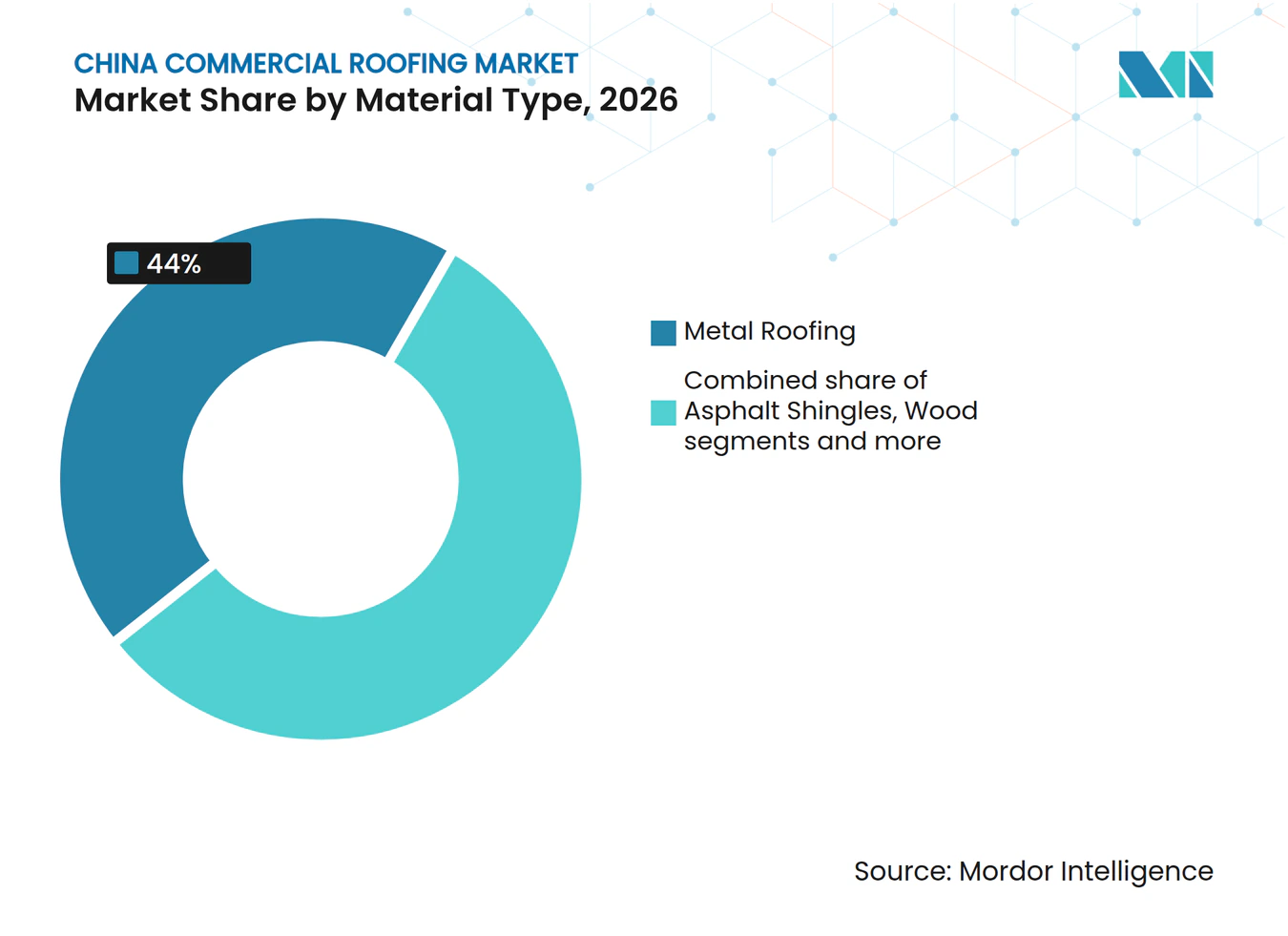
Metal Roofing Holds the Broadest PositionMetal roofing held 44.00% of the China commercial roofing market share in 2026, reflecting its wide use in large industrial facilities and logistics buildings. It is compatible with pre-engineered steel structures and can accommodate rooftop photovoltaic mounting systems. Metal systems also suit projects where contractors need fast installation across large roof areas. Their durability makes them relevant for warehouses, production facilities, and transport-related buildings. The material’s established contractor base supports its position in the China commercial roofing industry. It also provides a familiar option for building owners who need long spans and controlled maintenance costs.
Single-ply membranes are forecast to record a 9.40% CAGR through 2032, making them the fastest-growing material group. This part of the China commercial roofing market size benefits from demand for thermoplastic polyolefin, ethylene propylene diene monomer, and polyvinyl chloride systems. These materials are used in data centers, pharmaceutical sites, and food-grade warehouses where waterproofing and thermal performance are important. Beixin Waterproof reported that its thermoplastic polyolefin and polyvinyl chloride membranes passed Class B1 combustion-performance testing in early 2026. This type of certification can shape procurement specifications for public and higher-value private projects. Modified bitumen products face higher sensitivity to bitumen costs, while asphalt shingles, clay and concrete tiles, and wood remain more limited in newer commercial projects. Cool-roof coatings and green roof assemblies also have a role where energy performance and heat management receive more attention under the 15th Five-Year Plan.



By Construction Type:
New Construction Provides the Largest Demand BaseNew construction held 62.00% of the China commercial roofing market share in 2026 and is forecast to grow at a 9.10% CAGR through 2032. Government-supported industrial parks, transport facilities, data centers, and public institutions form the core of this demand. These projects are less dependent on the residential development cycle than many construction categories. Advanced manufacturing, digital infrastructure, and transport links remain important priorities for public investment. New developments can specify roofing requirements at the design stage, which favors systems with defined fire, insulation, and photovoltaic performance. This makes product selection more focused on lifecycle value than on initial material cost alone.
Reroofing and replacement form the smaller construction category, but they offer a reliable future source of demand. Buildings constructed between 2005 and 2015 are entering a major maintenance period as waterproofing systems reach a 10 to 15-year design life. Shanghai’s City Update Three-Year Action Plan for 2026 to 2028 calls for renovation of at least 90 commercial and office buildings and 1,800 million square meters of public buildings. Roof replacement is often required when owners improve insulation, drainage, or loading capacity for rooftop solar. This supports the China commercial roofing industry because renovation activity can continue when greenfield development slows. Contractors with inspection, repair, and warranty capabilities are likely to be well placed in this segment.
By Application:
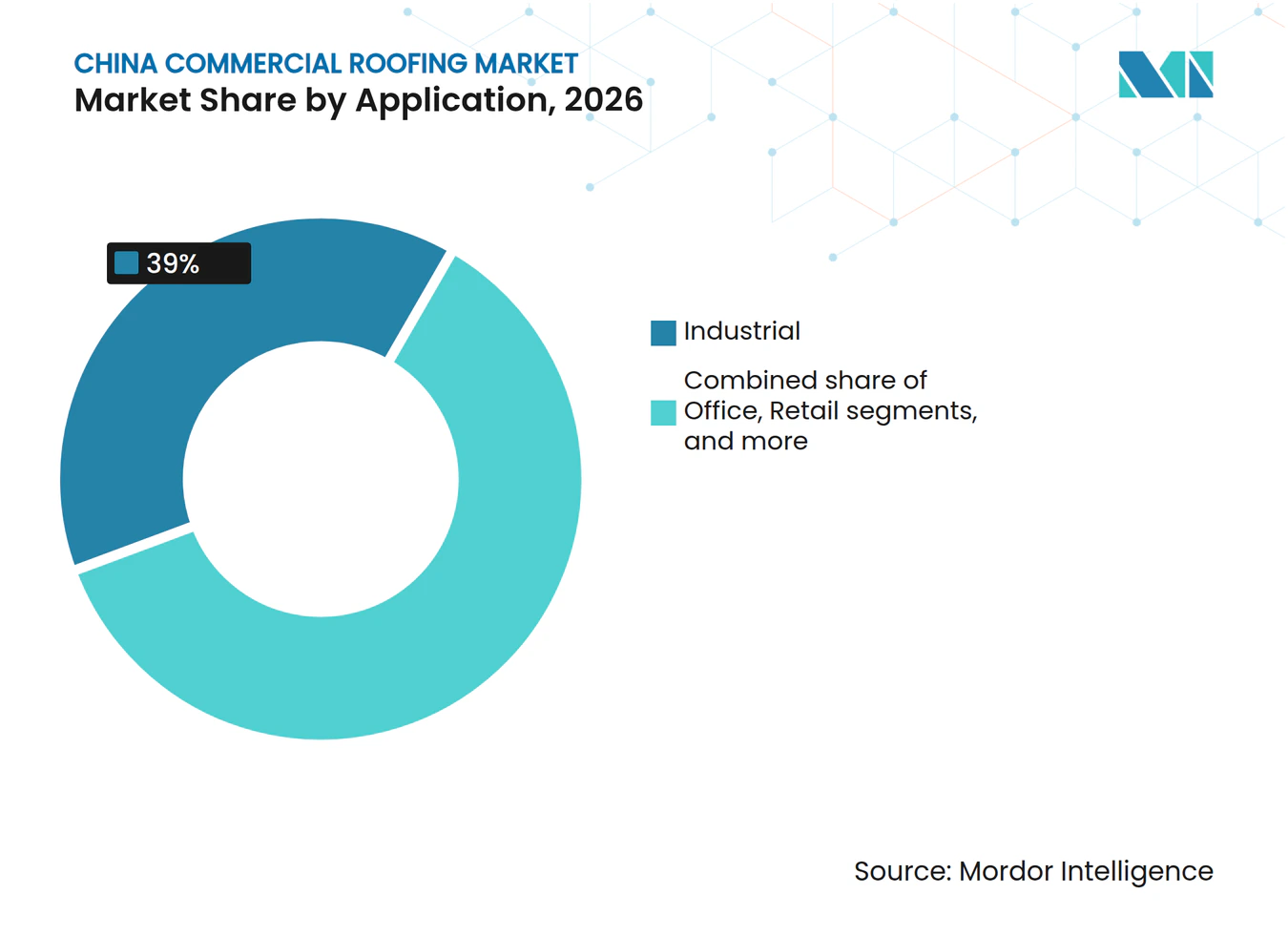
Industrial Buildings Set the Demand PatternIndustrial buildings held 39.00% of the China commercial roofing market share in 2026 and are forecast to expand at a 9.60% CAGR through 2032. Factories in semiconductors, pharmaceutical, new-energy vehicle, and logistics activities need roofs that meet functional operating requirements. Cleanroom pressure conditions, thermal insulation needs, and photovoltaic mounting loads affect product selection. Industrial owners are more likely to invest in durable systems because roof failure can affect production and stored goods. This supports higher specification levels in the China commercial roofing market. It also gives suppliers an opportunity to offer design support, installation control, and longer warranties.
Office and retail applications are more mature and are exposed to property and consumer spending conditions. Existing commercial assets still need roof upgrades to help maintain occupancy and protect building value. The other application category includes transport terminals, stadiums, and government buildings. These projects receive direct public budget support under the 15th Five-Year Plan. Their funding structure can provide better visibility than private office or retail development. The China commercial roofing market size for these uses is supported by performance requirements that vary from standard commercial roof work.

Geography Analysis
Shenzhen held 25.00% of the China commercial roofing market share in 2026 and is forecast to grow at a 10.20% CAGR through 2032. The Greater Bay Area’s advanced manufacturing and technology export base supports demand for high-specification roofs. Technology companies and industrial owners often place greater weight on certified performance than on the lowest upfront price. This supports single-ply membranes and engineered metal systems. Guangdong, Guangxi, and Hainan face high typhoon exposure among China’s coastal provinces. Stronger wind resistance and waterproofing requirements can increase the value of well-designed systems in South China.
Beijing and Shanghai are the second and third largest city markets in the supplied estimates. Institutional owners in these cities favor certified products and warranty-backed installation. Shanghai plans CNY 255 billion of major project investment in 2026, with airport and rail development creating large roof procurement needs. Its City Update Three-Year Action Plan also provides a large pipeline for public-building renovation. Beijing’s digital infrastructure and rail investment support related demand for facilities that need reliable envelope systems. The China commercial roofing market size in these cities is strengthened by projects that face defined procurement and safety requirements.
Guangzhou, Hangzhou, and other key cities reflect the investment patterns of their regional economies. Guangzhou’s building renewal policy supports renovation of older commercial and office buildings, including roof systems. Hangzhou’s logistics network favors standardized metal roofs that can support photovoltaic equipment across multiple sites. Chengdu, Chongqing, Wuhan, and Xi’an benefit from industrial parks and technology redistribution policies under the 15th Five-Year Plan. These locations can create opportunities for suppliers that offer local installation support and consistent warranty coverage. The China commercial roofing market across these cities is less dependent on a single construction cycle than on the mix of industrial, logistics, and public projects. Regional weather conditions also influence the need for drainage, wind resistance, and durable waterproofing details.
Competitive Landscape
Market Concentration
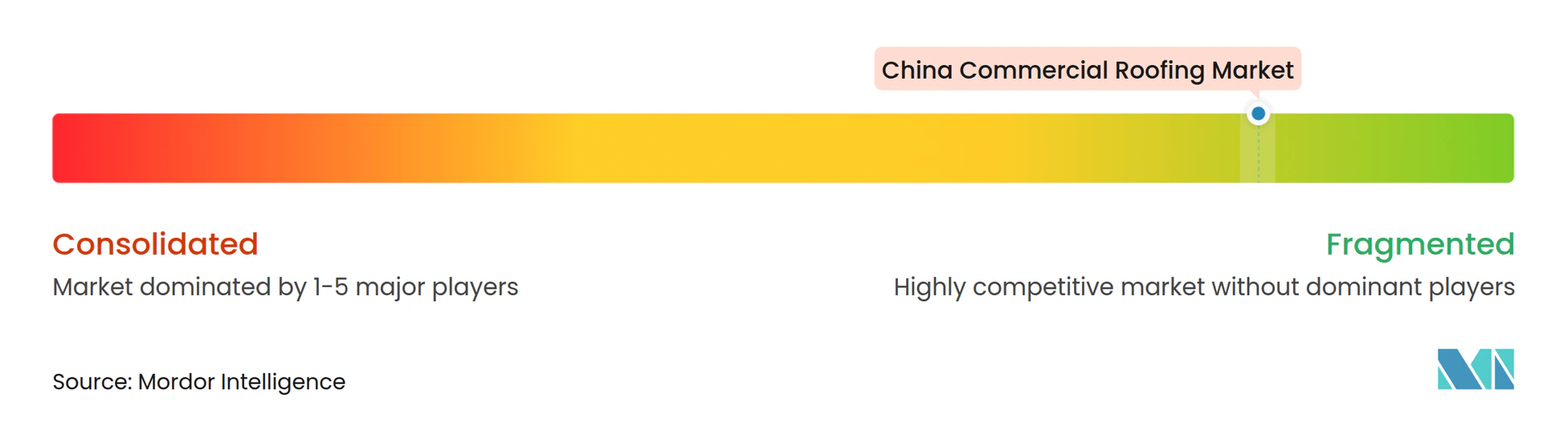
The China commercial roofing market is moderately fragmented, with Oriental Yuhong and Keshun among the leading domestic waterproofing specialists. Sika, Saint-Gobain, Kingspan, and BlueScope Steel compete more actively in higher-specification product areas. Domestic suppliers have broad local distribution and experience in membrane applications. Multinational suppliers can compete through product certification, engineered systems, and relationships with industrial customers. Price competition remains strong in standard roofing products because of excess manufacturing capacity. The competitive balance is shifting toward suppliers that can meet complex performance requirements and provide dependable installation support.
Leading suppliers are pursuing international expansion and integrated product development to reduce reliance on the domestic construction cycle. Beixin Waterproof introduced its OTAI Waterproof Composite Panel in 2026, combining waterproofing, thermal insulation, and sound control in a factory-produced unit. Integrated systems can simplify procurement and reduce the number of installation trades on a project. Suppliers are also seeking manufacturing and sales positions outside China to diversify demand. These moves show how roofing suppliers are seeking growth through geographic diversification and integrated envelope products. The China commercial roofing market rewards suppliers that can address both material performance and project execution.
Opportunity remains in fire-resistant assemblies for data centers and semiconductor sites, integrated roof and photovoltaic systems, and reroofing in smaller cities. Saint-Gobain opened Asia’s largest single-line plasterboard facility in Kaiping, Guangdong, in July 2026, with CNY 400 million in investment and annual output of 64 million square meters. The project supports the company’s nonresidential building materials strategy in China. Kingspan completed the acquisition of Hao Wei in April 2025, establishing its first local manufacturing facility in Asia. Local production can improve access to high-performance insulated envelope systems for data center and cold-chain applications. The China commercial roofing market is likely to remain competitive because suppliers must balance scale, technical capability, and local service coverage.
China Commercial Roofing Industry Leaders
-
China National Building Material Company Limited
-
China Baowu Steel Group Corporation Limited
-
Jiangsu Canlon Building Materials Co., Ltd.
-
Beijing Orient Sundar Technology Development Co., Ltd.
-
Beijing New Building Materials Public Limited Company
- *Disclaimer: Major Players sorted in no particular order
China Commercial Roofing Market Companies Covered in this Report
- China National Building Material Company Limited
- China Baowu Steel Group Corporation Limited
- Jiangsu Canlon Building Materials Co., Ltd.
- Beijing Orient Sundar Technology Development Co., Ltd.
- Beijing New Building Materials Public Limited Company
- Tangshan Junnan Trade Co., Ltd.
- Jiangsu Jiuding New Material Co., Ltd.
- Hubei Yulong Chemical Building Materials Co., Ltd.
- Jiangsu Yuhong Waterproof Technology Co., Ltd.
- Oriental Yuhong
- Keshun Waterproof Technology Co., Ltd.
- Wuhan Shuanghu Building Materials Co., Ltd.
- Sika China
- Saint-Gobain China
- Kingspan Group plc
- BlueScope Steel Limited
- Tianjin Xuyang Waterproof Materials Co., Ltd.
- Shanghai Keshun Waterproof Technology Co., Ltd.
- China State Construction Engineering Corporation Limited
- China Railway Construction Corporation Limited
Recent Industry Developments in China Commercial Roofing Market
- July 2026: Saint-Gobain opened Asia's largest single-line plasterboard facility in Kaiping, Guangdong, representing USD 58.8 million in investment and annual output of 64 million square meters. The plant strengthens Saint-Gobain's South China supply network and aligns with the company's "Lead & Grow" strategy targeting non-residential building materials growth through 2030.
- June 2026: China's State Council released the "Urban Renewal 15th Five-Year Plan," targeting 1,700 km of new railway lines by 2030 and systematic upgrades of public buildings, generating commercial roofing procurement across transport, civic, and institutional facility categories.
- June 2026: Guangzhou issued its "Low-Efficiency Building Update Implementation Plan," permitting and incentivizing roof renovation as part of the approved upgrade pathway for older commercial and office buildings across the city.
China Commercial Roofing Market Report Scope
Segmentation Overview
| Asphalt Shingles |
| Clay & Concrete Tiles |
| Metal Roofing |
| Bituminous / Modified Bitumen Membranes |
| Single-Ply Membranes (TPO, EPDM, and PVC) |
| Wood |
| Others |
| New Construction |
| Reroofing and Replacement |
| Retail |
| Office |
| Industrial |
| Others |
| Others |
| Shenzhen |
| Beijing |
| Shanghai |
| Hangzhou |
| Guangzhou |
| Other Key Cities |
| By Material Type | Asphalt Shingles |
| Clay & Concrete Tiles | |
| Metal Roofing | |
| Bituminous / Modified Bitumen Membranes | |
| Single-Ply Membranes (TPO, EPDM, and PVC) | |
| Wood | |
| Others | |
| By Construction Type | New Construction |
| Reroofing and Replacement | |
| By Application | Retail |
| Office | |
| Industrial | |
| Others | |
| Others | |
| By Cities | Shenzhen |
| Beijing | |
| Shanghai | |
| Hangzhou | |
| Guangzhou | |
| Other Key Cities |
Key Questions Answered in the Report
What is the forecast growth rate for commercial roofing in China?
The China commercial roofing market is forecast to grow at a 7.69% CAGR from 2027 to 2032, reaching USD 9.09 billion by 2032. Industrial facilities, logistics assets, public projects, and roof replacement work support the outlook.
Which material leads demand for commercial roofs in China?
Metal roofing leads with a 44.00% share in 2026 because it is widely used in large industrial and logistics structures. It also suits long-span steel frames and can support rooftop photovoltaic installations.
Which commercial roofing material is growing fastest in China?
Single-ply membranes are forecast to grow at a 9.40% CAGR through 2032, supported by data center and high-performance industrial requirements. These systems address waterproofing, thermal performance, and certification needs.
Why are industrial facilities important for roofing suppliers in China?
Industrial buildings hold a 39.00% share in 2026 and are forecast to grow at a 9.60% CAGR because factories and warehouses need durable roof systems. Functional demands include insulation, drainage, equipment loads, and roof-mounted solar.
Which city offers the strongest growth opportunity for commercial roof systems?
Shenzhen leads with a 25.00% share in 2026 and a forecast 10.20% CAGR through 2032, supported by advanced manufacturing and vertical factory projects. The city also has demand from logistics facilities and technology-related buildings.
How does rooftop solar affect demand for commercial roof systems in China?
Solar installations require roofs with suitable structural capacity and waterproofing, which can lead owners to replace older membrane systems before installation. This creates replacement work alongside demand for roofs in newly built industrial properties.