
China Beer Market Size and Share
Market Overview
| Study Period | 2022 - 2032 |
|---|---|
| Forecast Data Period | 2027 - 2032 |
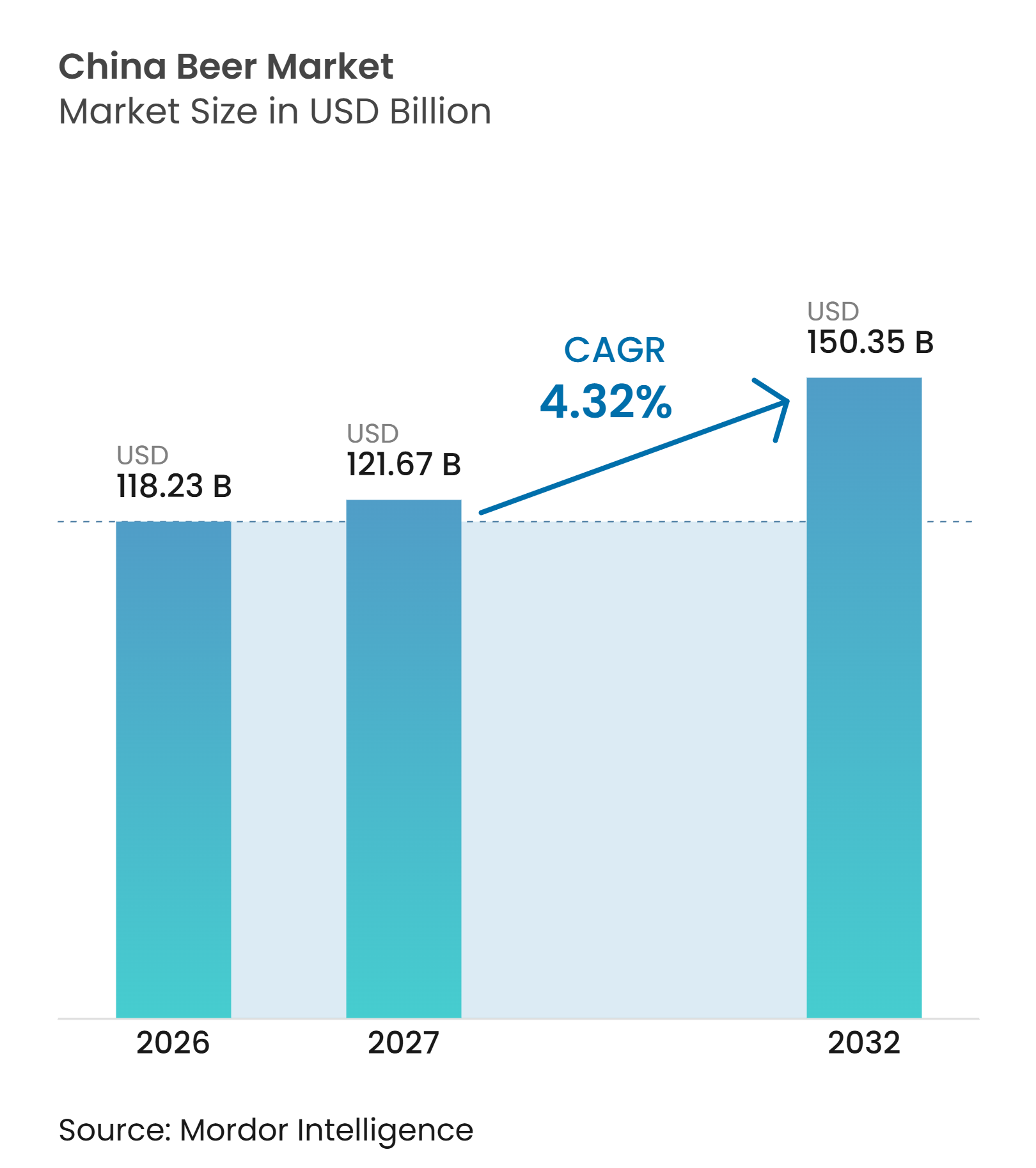
| Base Year Market Size (2026) | USD 118.23 Billion |
| Market Size (2027) | USD 121.67 Billion |
| Market Size (2032) | USD 150.35 Billion |
| Growth Rate (2027 - 2032) | 4.32 % |
| Market Concentration | High |
Major Players *Disclaimer: Major Players sorted in no particular order Image © Mordor Intelligence. Reuse requires attribution under CC BY 4.0. | |
China Beer Market Analysis by Mordor Intelligence
The China beer market size is expected to grow from USD 118.23 billion in 2026 to USD 121.67 billion in 2027 and is forecast to reach USD 150.35 billion by 2032 at a 4.32% CAGR over 2027-2032. The China beer market is expanding in value while production remains largely flat, placing pricing, product mix, and channel control at the center of competition. Large-scale beer output reached 19.36 million kiloliters during the first half of 2026, up 0.2% from the prior year, while 2025 full-year output fell to 35.3 million kiloliters. Domestic brewers are shifting consumers toward sub-premium and premium products, while non-alcoholic options, localized craft flavors, and smaller pack sizes are expanding the range of drinking occasions. Digital retail is reshaping the China beer market by giving brewers more direct control over inventory, pricing, and consumer engagement. In this mature category, market share gains increasingly depend on product quality, distribution execution, and the ability to serve evolving social occasions.
Key Report Takeaways
-
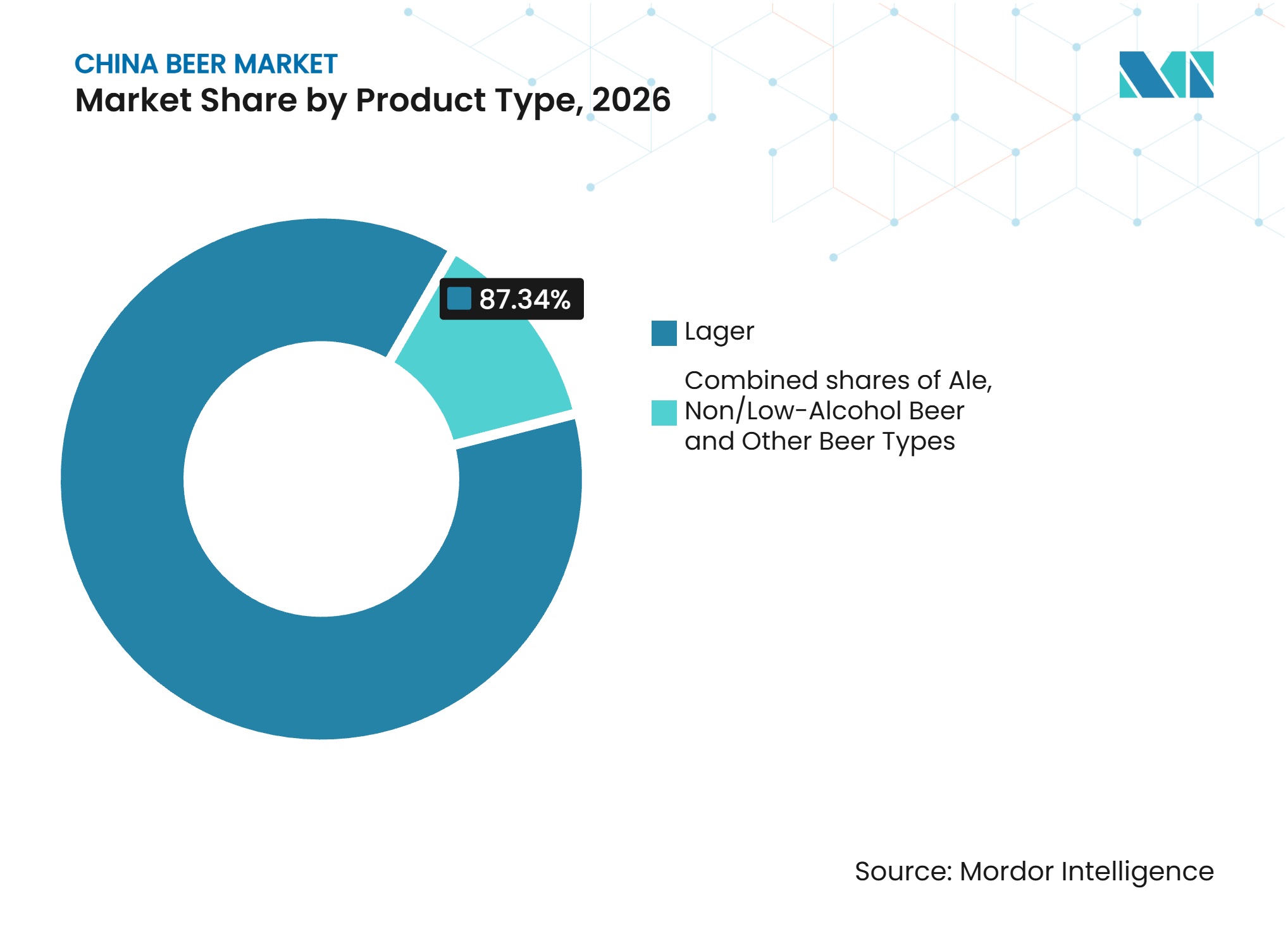
By product type, lager held 87.34% of the China beer market share in 2026, while non/low-alcohol beer is projected to grow at a 4.76% CAGR through 2032.
-
By production type, macro breweries held 83.23% of sales in 2026, while craft breweries are projected to grow at a 5.12% CAGR through 2032.
-
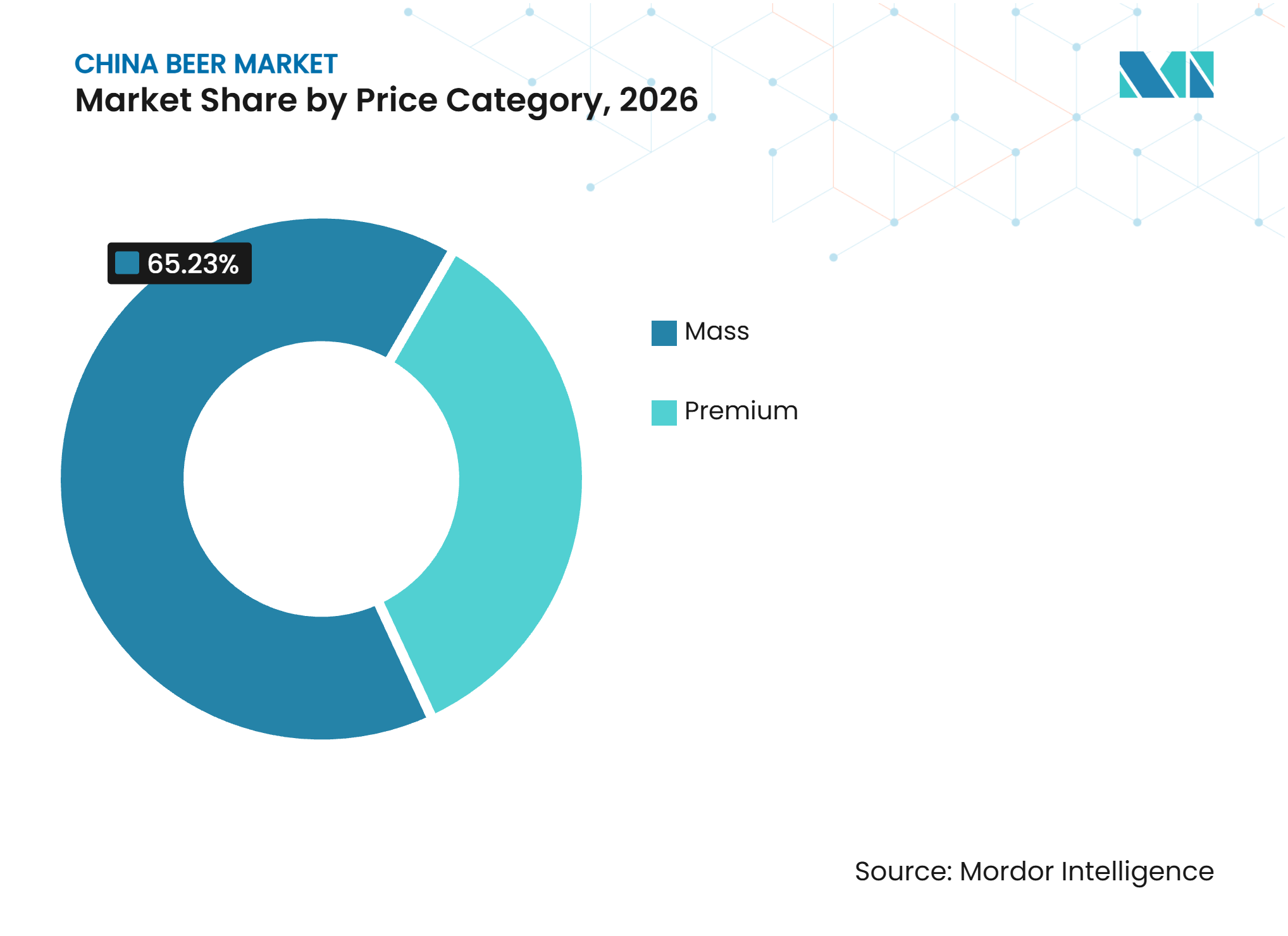
By price category, mass beer held 65.23% of the China beer market size in 2026, while premium beer is projected to grow at a 4.87% CAGR through 2032.
-
By packaging type, glass bottles represented 58.26% of beer sales in 2026, while cans are projected to grow at a 5.23% CAGR through 2032.
-
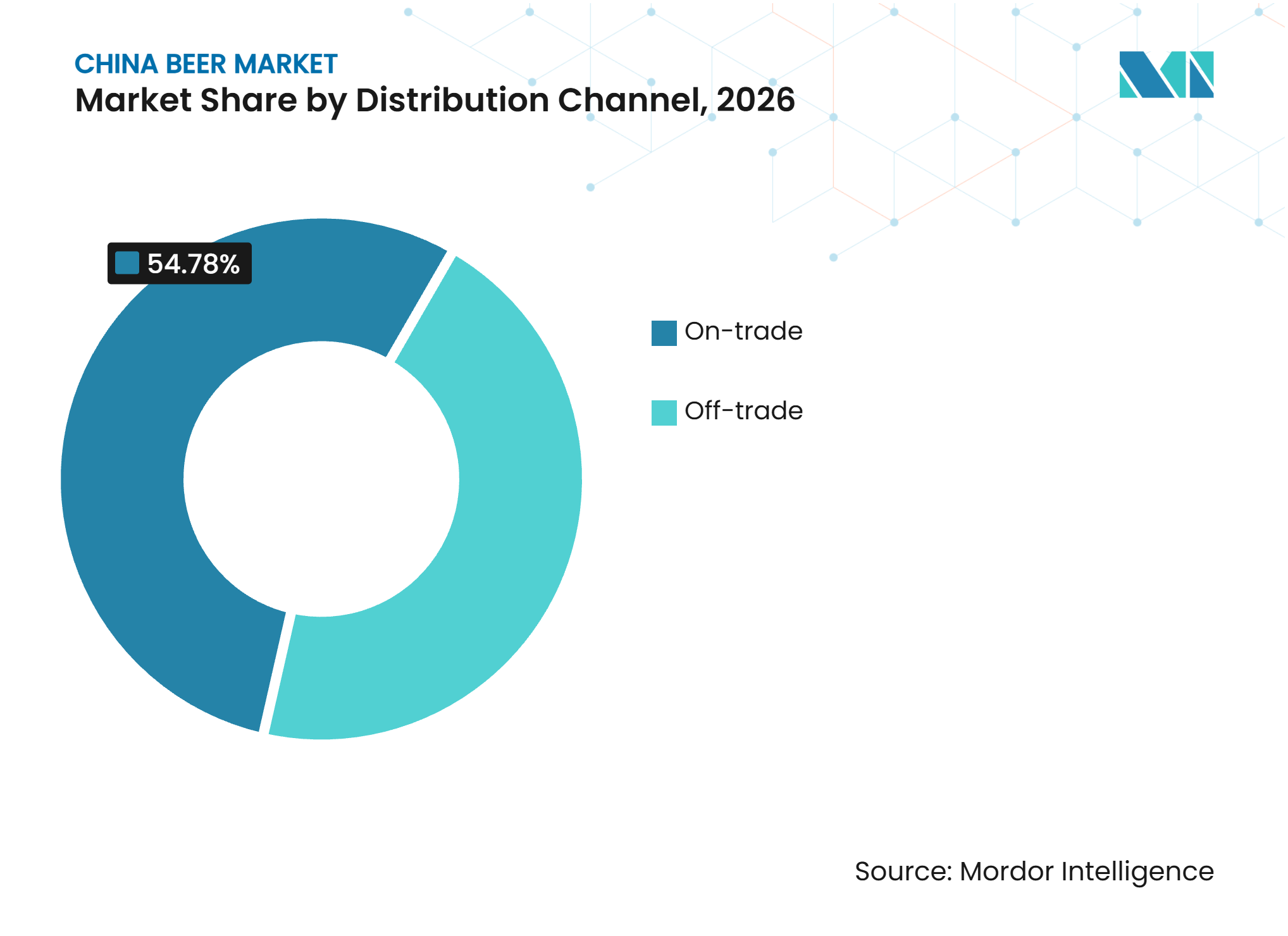
By distribution channel, on-trade distribution held 54.78% in 2026, while off-trade distribution is projected to grow at a 4.92% CAGR through 2032.
Note: Market numbers in this report are based on Mordor Intelligence's proprietary estimation framework, which combines nine months of actuals with Q4 projections for base year 2026.
Market Trends and Insights
Drivers Impact Analysis of China Beer Market*
| Driver | (~) % Impact on CAGR Forecast | Geographic Relevance | Impact Timeline |
| Premiumization and increasing demand for high-quality beer | +1.2% | National, strongest in Tier-1 cities and East China coastal markets | Long term (≥ 4 years) |
| Expansion of craft beer and specialty beer consumption | +0.8% | East and South China, extending into Tier-2 cities | Medium term (2–4 years) |
| Growth of specialty and flavored beer | +0.8% | National, strongest among urban and health-conscious consumers | Short term (≤ 2 years) |
| Increasing popularity of low-alcohol and non-alcoholic beer | +0.5% | National, particularly relevant in Tier-2 and Tier-3 cities | Medium term (2–4 years) |
| Expansion of casual socializing, foodservice, and at-home consumption | +0.6% | National, strongest in major urban markets and coastal consumption centres | Medium to long term (2–4 years) |
| Product innovation and flavor diversification | +0.5% | National, particularly strong in Tier-1 and Tier-2 cities | Short to medium term (≤ 4 years) |
| Source: Mordor Intelligence | |||
Premiumization as the Engine of Value Growth
Premiumization is emerging as a major growth driver in China's beer market, as consumers increasingly seek products with superior taste, differentiated brewing processes, established brand reputations, and higher-quality ingredients. This shift is particularly evident among urban consumers in cities such as Shanghai, Beijing, Shenzhen, and Guangzhou, where exposure to international beer brands and evolving dining preferences are driving demand for premium and super-premium products. Premium international brands are gaining traction in the market, and breweries are introducing higher-priced product variants, upgraded packaging, and specialty brewing formulations to raise average selling prices and improve product mix. This transition from volume-oriented competition toward value-driven consumption is encouraging manufacturers to expand their premium portfolios and invest in brand positioning. Quality signals such as all-malt recipes, improved cold-chain service, and differentiated packaging are increasingly used to support pricing in the China beer market. Competition is expected to remain most intense in the sub-premium segment, as these products reach a broad consumer base while offering better value than traditional mass beer.
Craft, Specialty, and Flavored Beer Reconfiguring Consumer Expectations
Growing consumer interest in differentiated beer experiences is supporting demand for craft and specialty beer in China. Consumers, particularly younger urban populations, are increasingly exploring products such as India Pale Ale (IPA), wheat beer, stout, porter, fruit-infused beer, and locally inspired specialty varieties rather than relying exclusively on conventional mass-market lagers. The emergence of independent breweries, microbreweries, brewpubs, and specialty beer bars is improving product accessibility and consumer awareness. Breweries are expanding their specialty portfolios through localized ingredients, experimental brewing techniques, and limited-edition offerings to differentiate their brands, creating opportunities to attract consumers seeking distinctive flavors and premium drinking experiences. These products provide established brewers with a route to address consumer demand for variety while also giving local challengers distinctive market propositions. Innovation tied to recognizable local flavors, rather than replication of imported craft formats, offers stronger growth potential for the China beer market.
New Social Occasions Diversifying Consumption Patterns
Changing social drinking occasions are supporting beer demand across restaurants, bars, casual dining establishments, entertainment venues, and household consumption channels in China. Consumers are increasingly shifting toward informal social gatherings, smaller-group dining, casual entertainment, and personal consumption, rather than relying exclusively on traditional business-oriented banquets and large gatherings. According to IWSR's analysis of China's changing alcohol consumption landscape, younger legal-age consumers are increasingly embracing casual drinking, while home consumption, smaller formats, and on-demand delivery are gaining relevance[1]. This shift is encouraging breweries to develop products and packaging suited to different consumption occasions, including convenient cans, larger-format bottles, and premium beer variants for household gatherings. Carlsberg China reported 27% e-commerce volume growth in the first half of 2025, compared with an industry benchmark of 13%. Online and instant retail channels enable brands to respond faster to local demand and reduce dependence on multi-tier distribution[2]. The growth of restaurants, pubs, live-music venues, and specialized beer outlets is also creating opportunities for on-trade sales. Meanwhile, instant retail and home-delivery platforms are making beer more accessible for consumers purchasing products for personal consumption and informal gatherings.
Product innovation and flavor diversification are becoming important strategies for breweries seeking to attract new consumers and differentiate their offerings in China's competitive beer market. While traditional lager remains the mainstream beer category, manufacturers are increasingly experimenting with wheat beer, fruit-infused beer, dark beer, specialty hops, and other differentiated formulations to address evolving consumer preferences. Localized product development incorporating ingredients such as tea, citrus, regional fruits, and other botanical flavors can help breweries establish stronger connections with domestic consumers. For instance, Chongqing Brewery expanded its Wusu portfolio in 2025 with products including Xinjiang Hop Craft, Da Hong Pao Craft, and Wusu Original Brew, strengthening its specialty and premium product positioning. Manufacturers are also using limited-edition packaging, seasonal launches, brand collaborations, and digital marketing campaigns to generate consumer interest. Such approaches enable breweries to encourage product trials, strengthen brand loyalty, and create additional value beyond conventional mass-market beer offerings.
Restraints Impact Analysis of China Beer Market*
| Restraint | (~) % Impact on CAGR Forecast | Geographic Relevance | Impact Timeline |
| Declining beer consumption and market maturity | -1.1% | National, most acute in Northeast China and mature urban markets | Long term (≥ 4 years) |
| Raw material and packaging cost volatility | -0.4% | Global supply chain effects across all Chinese beer producers | Short term (≤ 2 years) |
| Intense market competition and price-sensitive consumer behaviour | -0.7% | National, particularly intense in Tier-2 and Tier-3 cities and mainstream beer markets | Medium term (2–4 years) |
| Changing consumer preferences and increasing health consciousness | -0.6% | National, strongest among younger and health-conscious consumers in Tier-1 and Tier-2 cities | Medium to long term (2–4 years) |
| Source: Mordor Intelligence | |||
Volume Saturation Constraining Base Growth
The China beer market faces structural challenges, including declining consumption volumes, an ageing consumer base, and saturation in established urban markets. The industry has undergone a prolonged adjustment over years as consumers increasingly moderate alcohol consumption and diversify their beverage preferences. According to data from China's National Bureau of Statistics, cited in Yanjing Brewery's 2025 annual report, beer production by above-designated-size enterprises reached approximately 35.36 million kiloliters in 2025, a year-on-year decline of 1.1%. This limits opportunities for manufacturers to achieve growth through higher production volumes alone. Changing social habits, greater health awareness, and competition from non-alcoholic beverages are also affecting conventional beer consumption occasions. As a result, breweries are increasingly reliant on premiumization, product innovation, and market-share gains to sustain revenue growth, while smaller manufacturers face difficulties competing in an increasingly mature market.
Raw Material and Packaging Cost Volatility
Input costs remain a significant constraint for the China beer market, as barley and packaging materials represent major cost components. Packaging accounts for close to 50% of factory-gate production costs, while barley import dependence stands at close to 90%. Stable glass prices and normalized Australian barley trade supported margins during 2025. The growing adoption of cans increases exposure to aluminum price fluctuations, even as the format serves more portable consumption occasions. Premium packaging carries higher costs, as bottles, cans, labels, and finishes serve as visible elements of the brand proposition. Producers must maintain quality differentiation while preventing packaging costs from eroding the margin benefits of premium products. Supply chain disruptions and currency fluctuations further compound input cost pressures, as barley is predominantly priced in foreign currencies, making procurement costs sensitive to renminbi movements. Brewers with greater scale are better positioned to negotiate long-term supply contracts and hedge against price volatility, while smaller producers face comparatively higher exposure to spot market pricing. Managing input cost efficiency has therefore become an increasingly important operational priority alongside product premiumization strategies.
*Our forecasts treat driver/restraint impacts as directional, not additive. The impact forecasts reflect baseline growth, mix effects, and variable interactions.
China Beer Market Segment Analysis
By Product Type:
Lager Retains Scale While Innovation Moves Within Familiar StylesLager accounted for 87.34% of the China beer market in 2026, reflecting its broad consumer familiarity and established production and distribution base. Ale, other beer types, and specialty products represented a smaller share but were more visible in urban on-trade and craft settings. Non/low-alcohol beer is expected to record a 4.76% CAGR from 2027 to 2032, the fastest rate among product segments. The strong position of lager does not prevent category change, as brewers can improve recipes, fermentation, and packaging without requiring consumers to move away from a familiar style. Premium lager gives producers a practical way to upgrade the product mix while keeping the base proposition recognizable. Tsingtao's 0.0% non-alcoholic wheat beer demonstrates how a brewer can pair a familiar beer format with process innovation and external product recognition. The China beer market size for lager remains important because scale supports production efficiency and national availability. However, beer makers need to treat lager as a platform for differentiated products rather than a uniform mass offering.
The revised GB/T 4927-2025 standard will provide producers with clearer definitions for non-alcoholic and low-alcohol beer from January 2027. This policy change makes labeling and product claims more relevant to the segment's commercial position. The 0.5% alcohol-by-volume threshold will require careful formulation and communication across the portfolio. Brands that offer clear taste, quality, and moderation propositions can reach consumers who might otherwise move into other beverage categories. The category also creates opportunities to participate in daytime, driving, and wellness-related occasions that conventional beer cannot always serve. The China beer industry is therefore likely to use non-alcoholic products as a complement to, rather than a replacement for, mainstream lager. The main competitive task is to build trust in flavor quality and consistency, which favors companies with brewing expertise, product development resources, and the ability to communicate the proposition through retail and foodservice channels.



By Production Type:
Craft Breweries Add Differentiation to Industrial ScaleMacro breweries held 83.23% of the China beer market share in 2026, supported by their substantial brewing, logistics, and route-to-market assets. Microbreweries and brewpubs remain more closely tied to local experiential consumption. Craft breweries are forecast to grow at a 5.12% CAGR through 2032, the highest rate among production formats. Craft capacity reached 450,000 kiloliters in 2025, double the level reported for 2023. Craft gross margins above 50% explain why the format continues to attract investment despite its smaller current base. The China beer market is seeing greater flavor differentiation and stronger regional identity across product offerings. Improved equipment access and online retail are enabling more brands to reach consumers beyond a single taproom or city.
Large brewers are responding by developing craft lines, acquiring brands, and using digital channels to expand national availability. Their resources can make craft beer more accessible, but may also intensify competition for smaller independent operators. Local brands retain an advantage when their products are built around tea, fruit, spices, and other flavors that align with regional preferences. Tea-infused beer sales demonstrate that local relevance can support demand at scale. Craft production is becoming a meaningful source of margin and consumer engagement in the China beer market, rather than remaining a niche segment. New entrants from adjacent food and beverage categories further increase the need for clear quality standards and reliable distribution. Companies that combine differentiated brewing with disciplined channel management will be better positioned to maintain value as the segment expands.
By Price Category:
Sub-Premium Products Reshape the Value PoolMass beer accounted for 65.23% of the China beer market in 2026, retaining its position in conventional retail, mainstream dining, and rural consumption. Premium beer is projected to grow at a 4.87% CAGR through 2032, supported by product upgrades and wider availability in second-tier cities. Five of seven mainland-listed beer companies expanded gross margins in the first quarter of 2026, as mid- to high-end sales outpaced core brand growth. The large mass-beer share remains significant, as affordability and broad availability continue to matter to a large portion of consumers. However, the primary earnings opportunity is shifting toward products that combine higher quality with accessible price points. This has made the CNY 8 to CNY 10 price range a key area of competition, positioned above traditional mainstream beer but without relying on the imported-brand status associated with ultra-premium offerings.
A higher shelf price in the sub-premium segment does not automatically translate into stronger margins. Domestic brands, premium extensions, and imported products frequently compete within the same price band. Quality signals such as all-malt formulations, cold-chain service, and distinctive packaging help companies justify a premium price. These features must be delivered consistently, as price-sensitive consumers can compare similar products more easily across modern retail and online channels. The China beer market will favor companies that build recognizable propositions rather than relying on short promotional cycles. Mass products continue to provide volume stability, but price pressure in this segment makes cost discipline essential. Premium offerings should be treated as a portfolio strategy that improves product mix, not as a reason to deprioritize mainstream consumers. This balance allows brewers to maintain distribution reach while improving revenue quality.

By Packaging Type:
Cans Match More Portable Drinking OccasionsGlass bottles accounted for 58.26% of the China beer market in 2026, reflecting their continued role in restaurants, premium gifting, and mainstream consumption. Cans are forecast to grow at a 5.23% CAGR from 2027 to 2032 as portable and at-home occasions become more relevant. Cans are lighter and easier to transport, making them suitable for instant retail, outdoor use, and smaller gatherings. Two-piece can demand reached 627.9 billion cans in 2025, supported in part by improvements in cold-chain logistics. PET bottles retain a role in price-sensitive convenience and rural demand, while kegs remain associated with draft beer in foodservice venues. The China beer market is therefore not moving toward a single packaging format. Instead, producers need to align each format with the occasion, channel, and price position it serves.
Packaging increasingly influences how consumers perceive product quality and brand identity. Craft brewers can use modern can design to project a more premium image while keeping products compatible with online delivery. Glass continues to serve as a useful signal for premium dining and gifting, where the sensory and visual experience matters. China's container-glass market is projected to rise from 10.53 million tonnes in 2025 to 12.89 million tonnes by 2030, supporting the continued availability of glass for premium and on-trade beer even as cans grow faster. The key risk for companies is input cost exposure, as a higher canning rate increases sensitivity to aluminum prices. A sound packaging strategy must therefore balance consumer convenience, product protection, brand expression, and total delivered cost to prevent premium packaging from eroding the value it is intended to create.
By Distribution Channel:
Off-Trade Formats Increase Channel FlexibilityOn-trade distribution accounted for 54.78% of the China beer market in 2026, supported by its established presence in restaurants, casual dining, and entertainment venues. Off-trade distribution is projected to grow at a 4.92% CAGR from 2027 to 2032. Supermarkets and hypermarkets provide a high-volume base, while e-commerce and instant delivery platforms represent higher-growth purchase occasions. Convenience stores also support impulse purchases of single-serve and premium products. The China beer market is becoming less dependent on the traditional division between foodservice and retail.
Digital channels give producers greater ability to manage pricing, inventory, and promotions with more speed. They also provide closer access to consumer data compared to traditional distributor-led routes. Carlsberg's e-commerce performance indicates the value of treating online retail as a core channel rather than a supplementary one. The shift does not diminish the importance of on-trade venues, which remain valuable for trial, brand visibility, and premium consumption. It does, however, make channel coordination more complex, as the same brand can appear across restaurants, supermarkets, and rapid delivery platforms simultaneously. Producers should differentiate pack formats and assortment by channel to reduce internal price conflicts. This will become increasingly important as off-trade demand accounts for a larger share of the China beer market. Companies that maintain service quality across channels can protect both consumer trust and distribution economics.
Geography Analysis
East China
East China is a key premium consumption area for the China beer market. Shanghai, Jiangsu, and Zhejiang combine higher incomes with developed cold-chain infrastructure. Shanghai had 229 licensed craft brewing operations, and Jiangsu had 196. Together with Guangdong, these provinces held 62% of China's active craft brewery licenses. The region's dense urban markets support imported styles, local specialty beer, non-alcoholic products, and premium lager. Its established food culture gives producers more opportunities to pair beer with differentiated dining occasions. East China's ability to test new products before wider national expansion benefits the broader China beer market. Strong logistics also make smaller packs and premium products more practical for delivery-led retail. The region is likely to remain important for premium assortment, cold-chain execution, and product education.
South China
South China has a substantial craft base and a climate that supports high levels of beer consumption. Guangdong had 317 licensed craft breweries, the highest total for any province. Guangzhou Zhujiang Brewery reported a 58.1% gross margin in the first half of 2026, supported by its premium product mix. Guangzhou and Shenzhen also serve as important gateways for imported craft beer, supporting awareness of international styles. Proximity to Hong Kong strengthens consumer familiarity with premium offerings and imported formats. Domestic craft producers can use this environment to develop comparable products at more accessible price points. Regulatory compliance with GB/T 4927-2025 will be relevant as brands broaden low-alcohol and specialty offerings. South China's combination of demand, port access, and craft density makes it significant for both innovation and premium distribution.
North, Southwest, Northwest, and Northeast China
North China has a developed craft culture in Beijing and a strong home-market position for Yanjing Beer. Beijing's annual Brew conference supported product launches and trade collaboration in March 2026. Southwest China is important to Chongqing Brewery and to Wusu's domestic sub-premium positioning. Northwest China has regional beer brands and opportunities to expand into North and Central China. Northeast China faces more difficult demographic conditions and lower craft penetration. Xinjiang had 17 licensed craft breweries, compared with 89 in Shenzhen, despite Shenzhen's much smaller land area. Second-tier cities including Changsha, Wuhan, Xi'an, Chengdu, Hangzhou, and Nanjing are becoming key locations for sub-premium and craft competition. The China beer market therefore requires region-specific assortment, pricing, and distribution strategies rather than a uniform national approach.
Competitive Landscape
Market Concentration
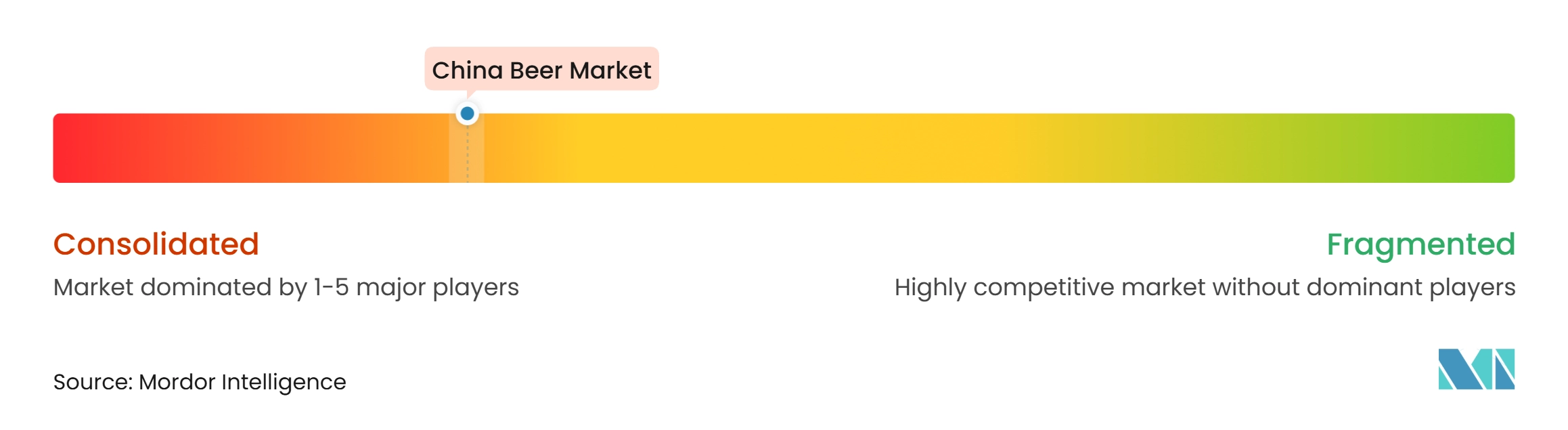
The China beer market is highly concentrated at the industrial level. Large brewery networks, distribution arrangements, and cross-regional logistics costs limit the potential for new industrial-scale entrants. As category volume growth remains slow, competition has shifted to market share, product mix, and margins. Domestic brewers are strengthening their positions through portfolio upgrades and broad distribution reach. International brands face additional pressure in premium on-trade consumption as domestic competitors develop stronger sub-premium and premium offerings.
Carlsberg illustrates the growing importance of digital channel investment, reporting 16% modern off-trade volume growth and 27% e-commerce growth in the first half of 2025. The company also launched Jing-A 1-liter craft cans and Sky Mountain fruity beverages in Northwest China in October 2025. Tsingtao strengthened its position in alcohol-free beer by winning a 2025 Beer World Cup award for its 0.0% wheat beer. These developments indicate that portfolio breadth and channel capability are becoming more important than broad volume expansion. China Resources Beer, Tsingtao, Yanjing, Chongqing Brewery, and Carlsberg-affiliated brands have the scale to support national execution. Local craft producers remain competitive where they offer strong regional identity and product quality. The market is likely to reward companies that combine product differentiation with reliable distribution economics.
The craft tier adds competitive pressure, as it includes thousands of producers and can operate with higher reported margins. However, GB/T 4927-2025 will raise compliance requirements around labeling and product quality from January 2027, which may prove difficult for smaller producers that lack the resources to invest in consistent production and compliance processes. Companies that successfully navigate this transition may emerge as stronger regional challengers. The main opportunity lies in bringing craft-quality products to broader audiences through dependable retail and delivery channels. Large brewers have the resources to pursue this model, while specialist brands retain flexibility in flavor development and local positioning. Competition will remain strongest in the CNY 8 to CNY 10 sub-premium zone and in channels where data, availability, and fast delivery influence purchase decisions.
China Beer Industry Leaders
-
China Resources Beer (Holdings) Company Limited
-
Anheuser-Busch InBev SA/NV
-
Tsingtao Brewery Company Limited
-
Beijing Yanjing Brewery Co., Ltd.
-
Chongqing Brewery Co., Ltd.
- *Disclaimer: Major Players sorted in no particular order
China Beer Market Companies Covered in this Report
- China Resources Beer (Holdings) Company Limited
- Tsingtao Brewery Company Limited
- Anheuser-Busch InBev SA/NV
- Beijing Yanjing Brewery Co., Ltd.
- Chongqing Brewery Co., Ltd.
- Guangzhou Zhujiang Brewery Co., Ltd.
- Heineken N.V.
- Carlsberg A/S
- Asahi Group Holdings, Ltd.
- Henan Jinxing Beer Group Co., Ltd.
- Lanzhou Huanghe Enterprise Co., Ltd.
- Kingstar Beer Group Co., Ltd.
- San Miguel Brewery Hong Kong Limited
- Taiwan Tobacco and Liquor Corporation
- BrewDog PLC
- Jing-A Brewing Co.
- Boxing Cat Brewery
- Great Leap Brewing
- Panda Brewpub
- The Craft Brewery
Recent Industry Developments in China Beer Market
- November 2026: Seven A-share listed beer companies reported combined Q1–Q3 2026 revenue of CNY 608.25 billion and net profits of CNY 94.15 billion. Yanjing Beer recorded the strongest growth, with net profit up 20.56% year-on-year. Its flagship U8 brand accumulated cumulative sales of 934,100 kiloliters by Q3, surpassing its full-year 2025 volume, as the brand overtook Chongqing Brewery to become China's fourth-largest brewer by revenue.
- August 2026: ST Xifa acquired Carlsberg International's 50% stake in Lhasa Beer for CNY 292 million (USD 40 million), with the aim of achieving 100% ownership of the premium Tibet-branded brewer. The transaction remained subject to shareholder and regulatory approval at the time of announcement.
- April 2026: Lhasa Intermediate Court accepted ST Xifa's formal restructuring petition. A consortium of investors committed a combined CNY 2.29 billion (USD 316 million) in restructuring capital, providing a potential pathway to revitalize the Tibet-based brewer and complete its pending acquisition of Carlsberg's Lhasa Beer stake.
China Beer Market Report Scope
The beer market encompasses the production, distribution, and sale of alcoholic and non-alcoholic fermented beverages manufactured through the brewing and fermentation of malted cereals, such as barley and wheat, with water, hops, and yeast. China Beer Market is segmented by product type, production type, price category, packaging type, and distribution channel. Based on product type, the market is segmented into Ale, Lager, non/low-alocohol beer, and other beer types. Based on production type, the market is segmented into macro brewery, micro brewery, craft brewery, and brewpub. Based on price categroy, the market is segmented into mass and premium. Based on packaging type, the market is segmented into glass bottles, cans, PET bottles, Kegs, and other packaging types. Based on distribution channel, the market is segmented into on-trade and off-trade. Off-trade is further segmented into supermarkets/hypermarkets, convenience stores, specialty stores, online retail stores, and other distribution channels.
Segmentation Overview
| Ale |
| Lager |
| Non/Low-Alcohol Beer |
| Other Beer Types |
| Macro Brewery |
| Micro Brewery |
| Craft Brewery |
| Brewpub |
| Mass |
| Premium |
| Glass Bottles |
| Cans |
| PET Bottles |
| Kegs |
| Other Packaging Types |
| On-Trade | |
| Off-Trade | Supermarkets and Hypermarkets |
| Convenience Stores | |
| Specialty Stores | |
| Online Retail Stores | |
| Other Distribution Channels |
| By Product Type | Ale | |
| Lager | ||
| Non/Low-Alcohol Beer | ||
| Other Beer Types | ||
| By Production Type | Macro Brewery | |
| Micro Brewery | ||
| Craft Brewery | ||
| Brewpub | ||
| By Price Category | Mass | |
| Premium | ||
| By Packaging Type | Glass Bottles | |
| Cans | ||
| PET Bottles | ||
| Kegs | ||
| Other Packaging Types | ||
| By Distribution Channel | On-Trade | |
| Off-Trade | Supermarkets and Hypermarkets | |
| Convenience Stores | ||
| Specialty Stores | ||
| Online Retail Stores | ||
| Other Distribution Channels | ||
Key Questions Answered in the Report
What is the projected value of the China beer sector by 2032?
He China beer market is projected to reach USD 150.35 billion by 2032, with a 4.32% CAGR from 2027 to 2032.
Which beer type holds the largest share in China?
Lager leads the product mix with 87.34% share in 2026, supported by its established consumer base and nationwide distribution.
Which China beer category is growing fastest?
Non/low-alcohol beer is the fastest-growing product type, with a projected 4.76% CAGR through 2032.
Why are premium beers becoming more important in China?
Premium beer is projected to grow at a 4.87% CAGR as brewers use better product mixes, quality cues, and wider access in second-tier cities.