
Market Overview
| Study Period | 2020 - 2032 |
|---|---|
| Forecast Data Period | 2027 - 2032 |
| Base Year Market Size (2026) | USD 5.01 Billion |
| Market Size (2027) | USD 5.30 Billion |
| Market Size (2032) | USD 7.09 Billion |
| Growth Rate (2027 - 2032) | 5.99 % |
| Market Concentration | Medium |
Major Players *Disclaimer: Major Players sorted in no particular order Image © Mordor Intelligence. Reuse requires attribution under CC BY 4.0. | |
China Automotive Parts Magnesium Die Casting Market Analysis by Mordor Intelligence
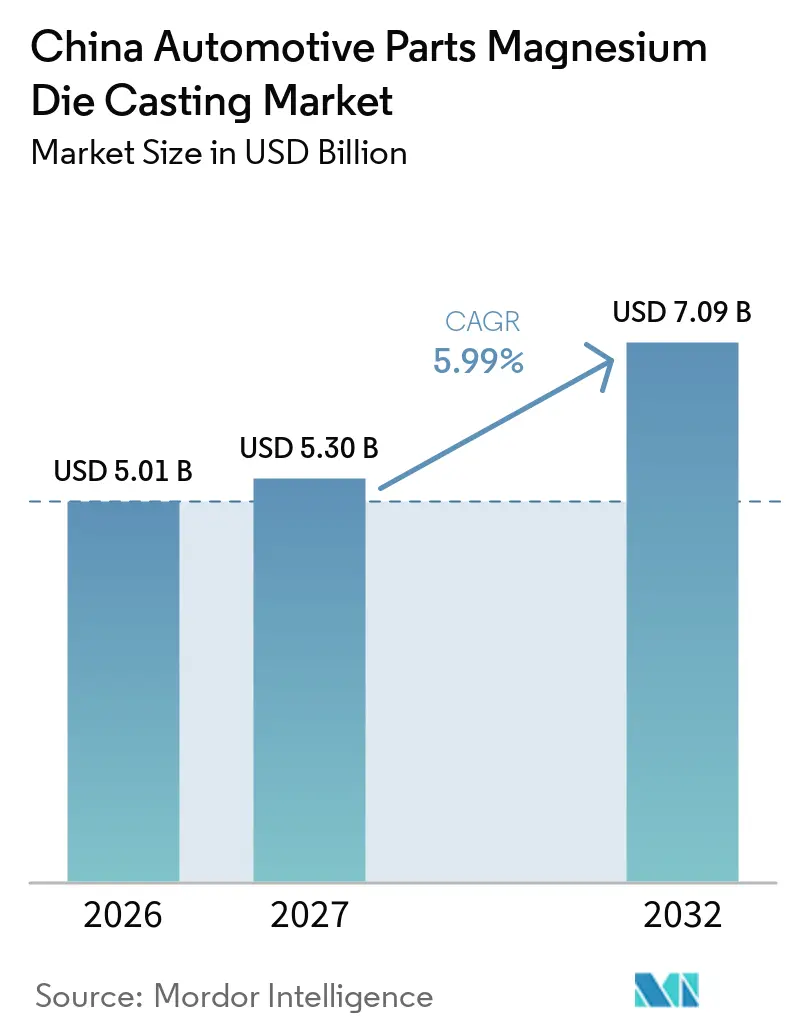
The China automotive parts magnesium die casting market size was valued at USD 5.01 billion in 2026 and is estimated to grow from USD 5.30 billion in 2027 to reach USD 7.09 billion by 2032, at a CAGR of 5.99% between 2027 and 2032. Higher NEV output increases demand for battery enclosures, e-drive housings, and structural parts that reduce vehicle mass without compromising functional integration, particularly when vehicle designers work within fixed battery, thermal, packaging, crash performance, and production cost limits. Supplier strategies are therefore shifting toward co-development with OEMs, stronger process control, capacity for larger structural parts, and earlier involvement in designs that require special tooling, material selection, coating decisions, defined validation plans, and sustained coordination between component, system, and vehicle engineering teams.
Key Report Takeaways
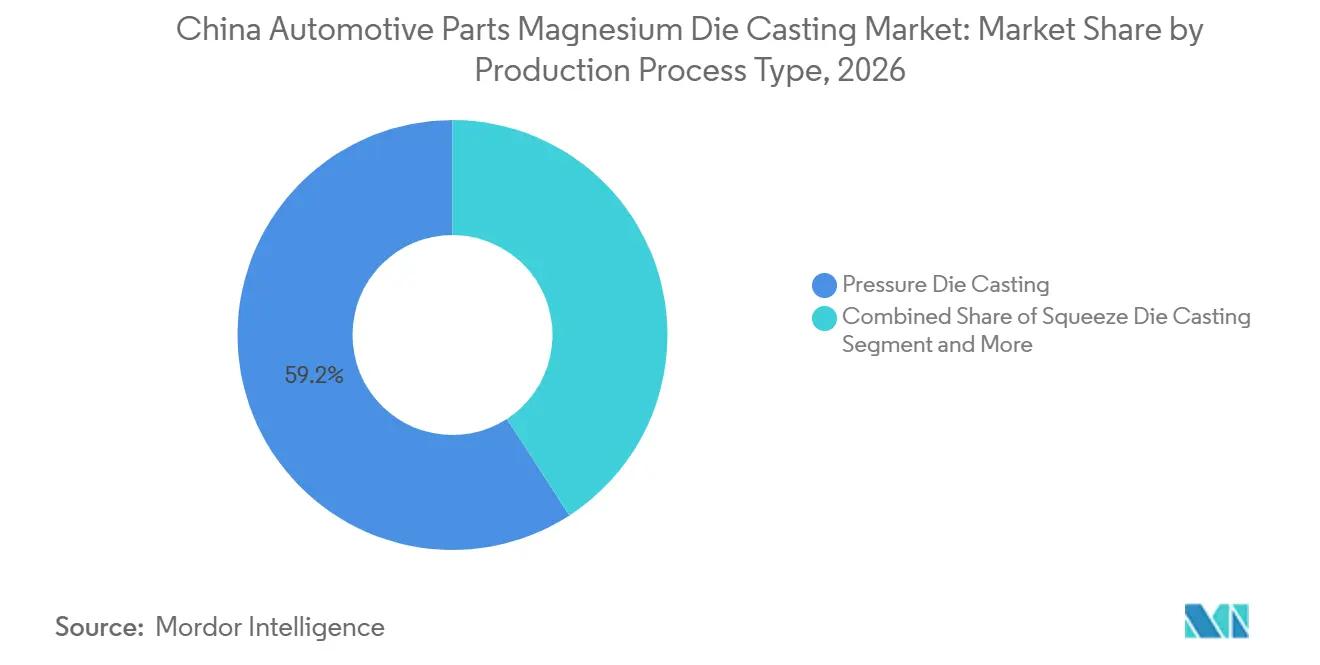
- By production process type, pressure die casting led with a 59.15% market share in the China automotive parts magnesium die casting market in 2026, while vacuum die casting is forecast to grow at a 7.55% CAGR through 2032.
- By application type, engine parts accounted for 35.11% of China automotive parts magnesium die casting market revenue in 2026, while EV batteries and e-drive housings are forecast to expand at a 13.21% CAGR through 2032.
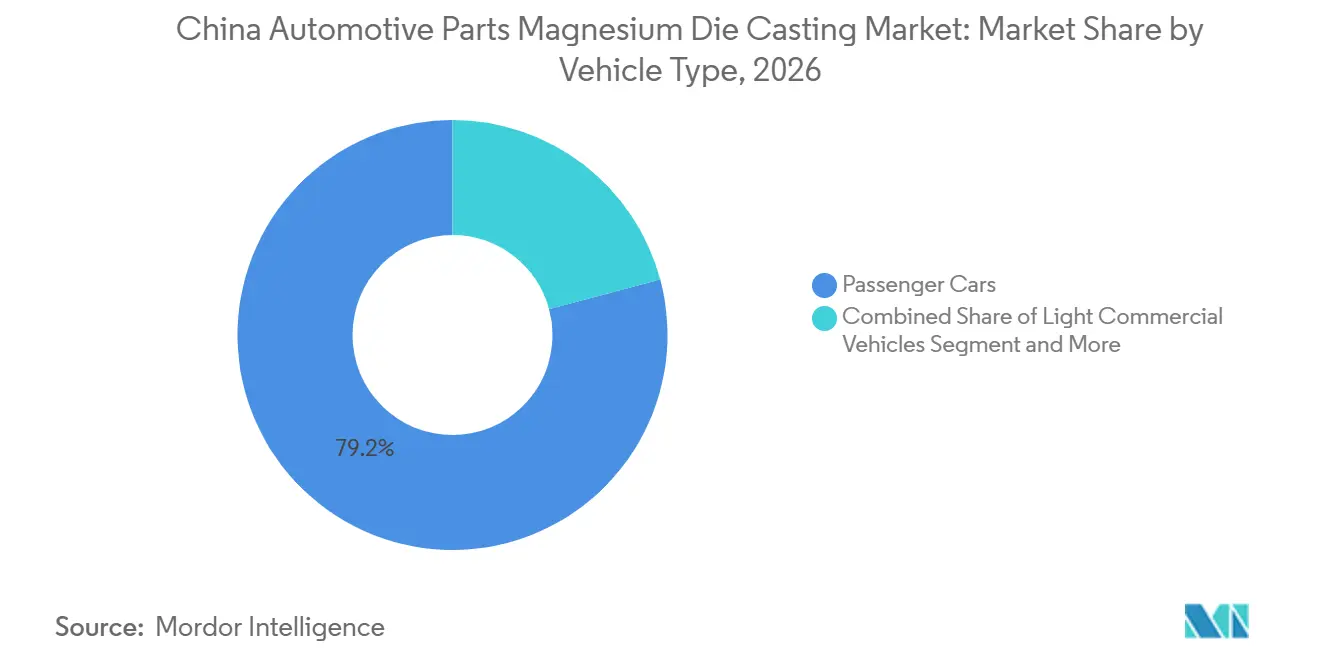
- By vehicle type, passenger cars accounted for 79.16% of China's automotive parts magnesium die casting market revenue in 2026, while medium and heavy commercial vehicles are forecast to grow at an 8.34% CAGR through 2032.
- By propulsion type, battery electric vehicles accounted for 36.18% of China's automotive parts magnesium die casting market revenue in 2026 and are forecast to expand at an 11.28% CAGR through 2032.
- By sales channel, OEM channels accounted for 90.44% of the China automotive parts magnesium die casting market revenue in 2026 and are forecast to grow at a 6.33% CAGR through 2032.
- By alloy grade, AZ-series magnesium alloys accounted for 55.13% of China's automotive parts magnesium die casting market revenue in 2026, while rare-earth-containing magnesium alloys are forecast to grow at a 9.64% CAGR through 2032.
Note: Market numbers in this report are based on Mordor Intelligence's proprietary estimation framework, which combines nine months of actuals with Q4 projections for base year 2026.
China Automotive Parts Magnesium Die Casting Market Trends and Insights
Drivers Impact Analysis*
| Driver | (~) % Impact on CAGR Forecast | Geographic Relevance | Impact Timeline |
|---|---|---|---|
| New-Energy Vehicle and Vehicle Production Growth | +2.1% | China, with spill-over to NEV export markets | Short term (≤ 2 years) |
| Lightweighting for Range and Efficiency | +1.8% | Global, concentrated in China NEV production corridors | Long term (≥ 4 years) |
| Structural Casting and Part Consolidation | +1.2% | Yangtze River Delta, Pearl River Delta, Chongqing | Medium term (2-4 years) |
| Magnesium Giga-Casting Qualification | +0.9% | Shenzhen, Chongqing, Shanghai NEV OEM hubs | Short term (≤ 2 years) to Medium term (2-4 years) |
| Magnesium Alloy Supply and Processing | +0.8% | Shaanxi, Shanxi, Inner Mongolia, Anhui, Xinjiang | Medium term (2-4 years) |
| Scrap Recovery and Localized Material Traceability | +0.4% | National, with early adoption in Yangtze River Delta clusters | Long term (≥ 4 years) |
| Source: Mordor Intelligence | |||
China New-Energy Vehicle and Vehicle Production Growth
China recorded vehicle production of 34.531 million units in 2025, and its NEV output of 16.626 million units was 29% higher than in the prior year [1]. The China automotive parts magnesium die casting market gains from this shift because electric platforms use housings and enclosures that must manage battery mass, thermal loads, structural needs, and packaging constraints. Material demand can rise faster than vehicle volumes when OEMs increase magnesium content per vehicle in e-drive, battery-related, and larger structural parts. The production outlook supports suppliers that can serve recurring OEM programs with consistent quality, engineering support, sufficient capacity for program ramps, and reliable delivery through the early years of a new vehicle platform.
Vehicle Lightweighting for Range and Efficiency
Vehicle manufacturers use magnesium to lower component mass in powertrain, interior, and structural applications, particularly where a lighter casting can improve the packaging balance around batteries, motors, and reinforced body sections. The China automotive parts magnesium die casting market benefits because battery packs raise vehicle weight and make mass reduction in surrounding systems more important for vehicle efficiency and design flexibility. SERES and AITO have applied more than 20 kg of magnesium per vehicle across the AITO M9 lineup, demonstrating how leading NEV platforms are extending the use of the material beyond conventional interior parts. The China automotive parts magnesium die casting market is moving toward components with tighter dimensional requirements because larger, integrated parts require stable filling, cooling, machining, coating, and post-processing. This underscores the importance of process expertise and clarifies the distinction between specialist suppliers capable of supporting structural applications and commodity die casters focused on simpler parts, especially when component performance must remain consistent throughout serial production.
Integrated Structural Casting and Part Consolidation
Integrated structural casting replaces multi-part assemblies with fewer large cast components, reducing joining work and altering how component value is distributed across the supply chain. This approach concentrates technical value in casting design, mold construction, melt handling, process control, quality inspection, and the ability to maintain stable output through model-program volumes. The China automotive parts magnesium die casting market is affected as OEMs evaluate magnesium for rear floors, structural sections, high-voltage e-drive units, and parts where reduced mass can support wider platform objectives. Qualification depends on more than just press size, as suppliers must achieve repeatable yields, control thin-wall filling, minimize defects, and demonstrate performance throughout the expected service life. Large integrated parts also require closer coordination among OEM engineering teams, toolmakers, alloy suppliers, coating specialists, and casting firms.
Magnesium Giga-Casting Qualification by Chinese OEMs
Chinese OEMs are moving from early trials toward formal qualification of magnesium giga-castings for larger structural and powertrain applications. This step requires stable filling of thin-walled sections, repeatable mold temperature control, defect management, and evidence that the part can meet performance requirements in series production. The qualification challenge is not limited to press tonnage because yield consistency and process control determine whether a design can be produced at the required scale. It also requires close work among OEM engineering teams, alloy providers, mold suppliers, and die casters before a part can be approved for a vehicle program. Suppliers that qualify early can develop stronger positions in later sourcing rounds because they already understand the component's design, quality records, and operating limits.
Restraints Impact Analysis*
| Restraint | (~) % Impact on CAGR Forecast | Geographic Relevance | Impact Timeline |
|---|---|---|---|
| Input-Price Volatility and Capital Intensity | -0.6% | Shaanxi and Shanxi energy-cost exposure, national capital markets | Short term (≤ 2 years) to Medium term (2-4 years) |
| Corrosion Protection and Surface-Finish | -0.5% | Acute in humid coastal production regions of eastern China | Medium term (2-4 years) |
| Creep and Crash-Performance Validation | -0.4% | National, particularly affecting new giga-casting qualification sites | Medium term (2-4 years) |
| Fire-Safety, Recycling, and End-of-Life Design | -0.3% | National, with spill-over to key export destinations in the European Union and Southeast Asia | Long term (≥ 4 years) |
| Source: Mordor Intelligence | |||
Magnesium Input-Price Volatility and Capital Intensity
Primary magnesium economics are sensitive to energy costs in key producing provinces, which can create input-price uncertainty for downstream die casters and complicate long-term component pricing. Large semi-solid and thixomolding equipment, specialized molds, controlled handling systems, and long OEM qualification cycles require significant investment before full commercial output begins. The China automotive parts magnesium die casting market can therefore be difficult for smaller contract producers that lack long-term supply arrangements, engineering resources, or sufficient capital to fund development work. Tier-1 suppliers and OEM-linked casting companies can reduce their exposure by entering into longer supply agreements, integrating engineering work, and coordinating more closely with material providers. Independent producers may face more margin pressure when metal costs move before component prices can be reset, especially where customer contracts offer limited recovery mechanisms or development spending is not supported by committed volume.
Corrosion Protection and Surface-Finish Requirements
Magnesium can be vulnerable to galvanic and pitting corrosion when it is exposed to dissimilar metals, coolant systems, or chloride-rich environments common in vehicle service conditions. Surface treatments are established for many interior uses, but complex housings and structural parts create more demanding interface conditions around joints, fasteners, coatings, and fluid-facing areas. Research on magnesium coatings has shown that cold-sprayed zinc treatments can substantially reduce corrosion rates in high-pressure die-cast AZ91 alloy. However, their use in production depends on part design, process economics, and validation requirements [2]. The China automotive parts magnesium die casting market must also address creep, crash performance, thermal cycling, and defect control for large thin-walled parts that serve more demanding functional roles. Standardized inspection and validation can raise upfront costs, but they give technically capable suppliers a clearer route to demonstrate performance and protect program quality.
*Our forecasts treat driver/restraint impacts as directional, not additive. The impact forecasts reflect baseline growth, mix effects, and variable interactions.
Segment Analysis
By Production Process Type: Pressure Die Casting Retains Scale While Vacuum Casting Gains Structural Relevance
Pressure die casting accounted for 59.15% of China's automotive parts magnesium die casting market revenue in 2026, supported by established tooling, short cycle times, and cost efficiency in high-volume automotive production. The process serves a wide range of interior, powertrain, and smaller structural components that require repeatable output at established cost levels. Existing equipment, tooling databases, and operating practices reinforce its relevance in conventional applications. Its limitations become clearer when parts need very low porosity, complex thin walls, or more demanding mechanical performance.
Vacuum die casting is forecast to grow at a 7.55% CAGR through 2032 as OEMs seek processes that support larger structural components and more demanding validation requirements. Lower gas content can improve casting integrity and can support finishing or joining operations that are difficult with more porous parts. Semi-solid thixomolding uses magnesium chip feedstock and can support controlled, repeatable production settings for selected parts. Pressure die casting should retain the broadest production base. At the same time, vacuum and semi-solid methods account for a larger share of technically demanding work, particularly where part design requires reliable mechanical properties, lower porosity, and tighter control over conditions that can affect finishing and assembly.

By Application Type: E-Drive Housings Extend Magnesium Use Beyond Established Engine Components
Engine parts accounted for 35.11% of China's automotive parts magnesium die casting market revenue in 2026, reflecting magnesium’s long-established role in transmission housings, gearbox cases, and intake-related components. These uses rely on low density and vibration-damping properties and provide a stable source of demand as propulsion systems diversify. Transmission and driveline housings, body and closure components, chassis parts, instrument-panel beams, seat frames, and steering-wheel armatures add to this application base. Mature engineering standards and supplier relationships help these parts retain their importance in the China automotive parts magnesium die-casting market.
EV battery and e-drive housings are forecast to grow at a 13.21% CAGR through 2032, making them the fastest-growing application category. Electric platforms need integrated enclosures that balance vehicle mass, thermal requirements, structural performance, and available packaging space. The China automotive parts magnesium die casting market size for these applications is rising as OEMs assess magnesium for selected e-drive and battery-related components. A Changan-led trial reported a 23% reduction in the weight of a comparable aluminum e-drive housing, which supports continued qualification work. The move into e-drive housings places greater importance on corrosion protection, creep resistance, long-term validation, and stable quality under demanding operating conditions. At the same time, interior parts remain important high-volume entry points for firms seeking to build technical capabilities and enhance customer experience.
By Vehicle Type: Passenger Cars Provide the Current Base While Commercial Vehicles Add New Demand
Passenger cars accounted for 79.16% of China's automotive parts magnesium die-casting market revenue in 2026 because they dominate China’s vehicle production and have a longer history of magnesium adoption. Passenger platforms use magnesium in interior, powertrain, and selected structural components, giving suppliers a broad base of potential programs. The rapid product cadence of domestic NEV brands creates regular opportunities for updated vehicle architectures and lightweighting targets. Passenger-car volumes support investment in specialized machines and automated quality control for e-drive housings, seat structures, and interior reinforcements. These platforms therefore provide the main current production base for the Chinese automotive magnesium die casting market, and their scale enables suppliers to spread investment in equipment, tooling, inspection, and engineering across a wider range of component volumes.
Medium and heavy commercial vehicles are forecast to expand at an 8.34% CAGR through 2032. Their electrification path varies by duty cycle, payload requirements, and fleet economics, but lightweighting matters where mass affects available payload or energy use. FAW Casting has described magnesium die-casting applications in e-drive, flywheel, and transmission housings for commercial use, indicating a broader evaluation of the material [3]. Commercial platforms can generate recurring component programs when trials are translated into durable vehicle designs and sourcing plans. Light commercial vehicles occupy the middle ground, with demand linked to urban delivery applications and the pace of fleet electrification. At the same time, suppliers must match component designs to commercial requirements for durability, utilization, payload, and cost control.
By Propulsion Type: Battery Electric Vehicles Combine Current Scale and Fastest Growth
Battery electric vehicles held 36.18% of China's automotive parts magnesium die casting market revenue in 2026 and are forecast to grow at an 11.28% CAGR through 2032. This gives BEVs both a large current role and the fastest growth within propulsion types. Heavy battery packs make lightweight components more valuable in surrounding vehicle systems, including e-drive housings and high-voltage enclosures. The China automotive magnesium die-casting market share for BEVs reflects the need to manage vehicle mass, range targets, thermal design, and packaging constraints. These requirements support greater magnesium use where the required mechanical performance and protection standards can be achieved, because vehicle makers must balance weight savings against durability, corrosion management, thermal exposure, production yield, and the practical needs of each platform.
Hybrid vehicles hold the next-largest propulsion position and sustain demand as electrification broadens across vehicle types. Plug-in hybrids use established magnesium applications in engines and transmissions while adding electric-drive components. Internal-combustion vehicles continue to generate volume for mature powertrain and interior castings during their remaining product cycles. The China automotive magnesium die casting industry therefore serves a mix of propulsion systems rather than relying on a single vehicle technology. BEV-oriented parts can offer higher value per component. Still, they also need greater tooling precision, testing, and program-specific development, which means suppliers must carry more technical responsibility before a part reaches full-scale vehicle production.
By Sales Channel: OEM Programs Define Access to High-Value Applications
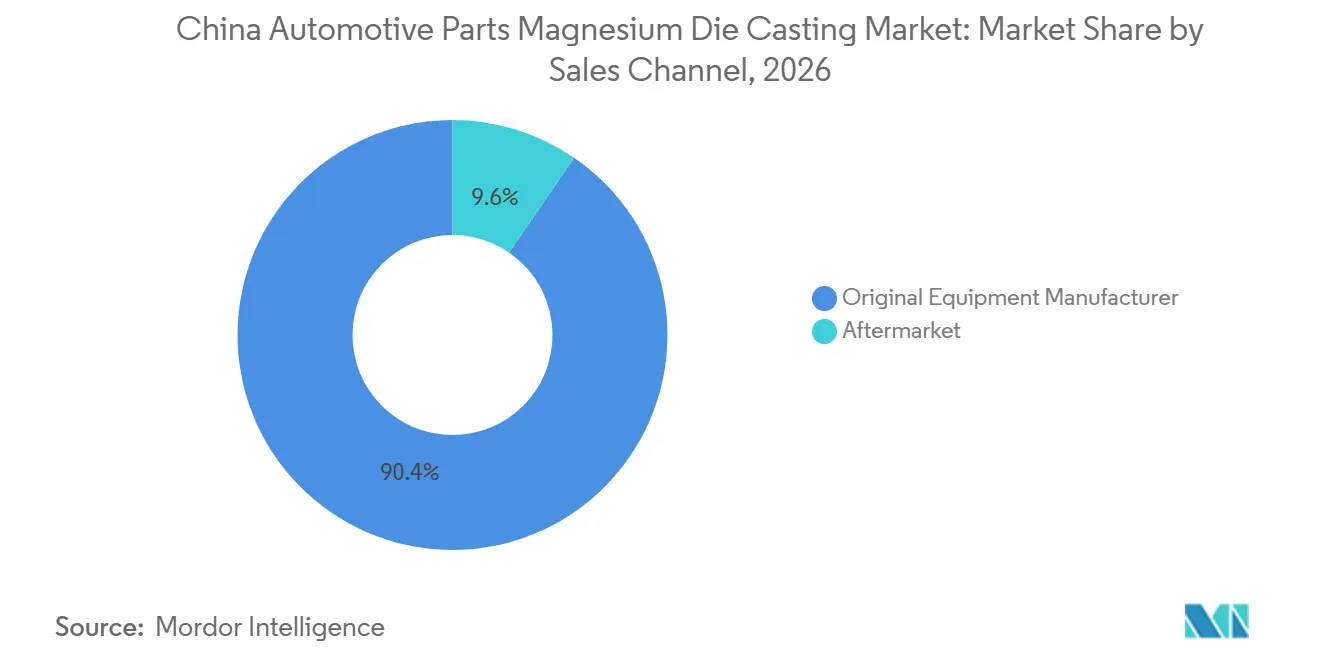
Original Equipment Manufacturer (OEM) channels accounted for 90.44% of China's automotive parts magnesium die casting market revenue in 2026 and are forecast to grow at a 6.33% CAGR through 2032. This position reflects the need for direct qualification in structural and powertrain applications. Such parts must meet vehicle-specific design, quality, and traceability requirements over the full program life. Long nomination cycles and close technical exchanges between vehicle makers and die casters shape the China automotive parts magnesium die casting market. Once approved for a platform, a supplier can support recurring component volumes, making engineering support and delivery reliability as important as quoted prices, since a production issue can affect the vehicle maker’s program timing, quality record, and future sourcing decisions.
The aftermarket primarily consists of replaceable interior components and smaller accessories, which typically face less extensive technical approval requirements. Integrated structural components have limited aftermarket relevance because they are not routinely replaced and require controlled fit and performance. Consequently, the Chinese automotive magnesium die-casting market has limited exposure to short-cycle replacement demand. OEM channel leadership also creates switching costs, as replacement suppliers must complete a new technical approval process before securing platform contracts. This process may involve new design reviews, tooling inspections, validation evidence, production trials, and quality system assessments.
By Alloy Grade: AZ-Series Leads Volume While Rare-Earth Grades Support Higher Performance
AZ-series alloys accounted for 55.13% of China's automotive parts magnesium die-casting market revenue in 2026 because they are commercially mature, widely available, and supported by established die-casting expertise. Their cost and process familiarity make them useful across a broad set of automotive applications. AM-series alloys continue to play a role in elevated-temperature and creep-sensitive applications, particularly in powertrain systems. Other grades serve specialized applications where heat resistance, corrosion behavior, or alloy chemistry requires a different balance. AZ-series materials will remain the main volume base because they are familiar to toolmakers, casters, and OEM engineers. At the same time, specialized grades are selected when the application demands a performance level that standard grades cannot consistently provide under operating conditions.
Rare-earth-containing magnesium alloys are forecast to grow at a 9.64% CAGR through 2032. These materials are being evaluated for use in structural EV components that require higher performance at elevated temperatures or under creep-sensitive conditions. Rare-earth additions can improve thermomechanical performance and creep resistance in magnesium alloys. The China automotive magnesium die-casting industry may use them where standard AZ formulations cannot meet the requirements for e-drive housings and rear-floor structures. Wider adoption depends on clear alloy specifications, qualification data, and reliable material availability, as vehicle makers need confidence that the selected grade can be sourced consistently and processed reliably by more than one qualified production location.
Geography Analysis
Eastern coastal clusters, including Guangdong in the Pearl River Delta and Jiangsu and Zhejiang in the Yangtze River Delta, are major centers of downstream die-casting demand. Their concentration of automotive electronics, e-drive suppliers, toolmakers, and vehicle programs supports faster product development and production coordination. Guangdong expanded downstream magnesium alloy casting capacity in 2025, supported by automotive and electronics supply chains. The Yangtze River Delta also benefits from precision mold-making capabilities that can shorten prototyping and qualification cycles, allowing casting firms, toolmakers, and vehicle teams to work through part revisions more quickly when designs require changes to filling behavior, surface finish, dimensional control, or joining interfaces.
Primary magnesium production is more concentrated in inland provinces than in the main consumption centers. Shaanxi accounted for a significant share of China’s primary magnesium output, while Shanxi and Inner Mongolia also made notable contributions. This separation can add logistics and working-capital demands for coastal die casters purchasing metal at spot prices. Anhui is developing as a bridge between inland supply and the Yangtze River Delta, while Chongqing combines access to supply with a major automotive manufacturing base. These locations support local development in alloy processing, vehicle design, and casting qualification. At the same time, their different positions in the supply chain require firms to coordinate metal sourcing, freight planning, inventory decisions, and production scheduling more carefully than suppliers located near both raw material and end demand.
Xinjiang is emerging as an additional location for raw materials and alloy production because of its mineral resources and energy profile. New plants in Hami indicate interest in expanding primary magnesium and alloy capacity near western resource bases. Northeast China forms a distinct automotive cluster centered on FAW and its supplier network. FAW Casting has reported magnesium applications ranging from interior and powertrain parts to larger integrated structures, showing how a regional automotive cluster can gradually move from mature applications toward more complex designs.
Competitive Landscape
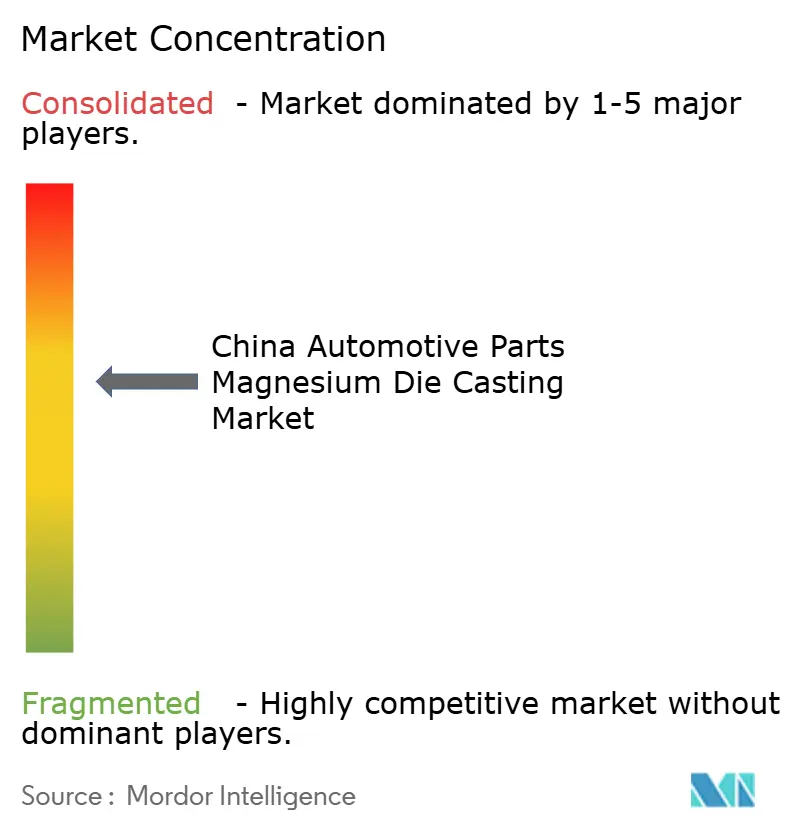
The China automotive parts magnesium die casting market is moderately concentrated among firms with large-format, semi-solid, or advanced structural casting capabilities. At the same time, conventional work remains distributed among many smaller suppliers. Competition depends on engineering support, yield control, access to large presses, and proximity to OEM programs. Suppliers that can co-develop parts with domestic NEV makers have an advantage in the speed of qualification and production coordination. Larger suppliers can invest in corrosion testing, inspection, and alloy development that are difficult for smaller firms to fund. This leaves conventional components more open to competition than high-value structural applications, where a supplier must demonstrate not only production capacity but also validated process control, inspection records, design support, material knowledge, and the ability to manage issues that arise during program launch.
Equipment availability is changing the field because more manufacturers can obtain semi-solid and thixomolding platforms. However, machine access alone does not assure reliable series-production performance. The China automotive parts magnesium die casting market favors firms that combine equipment with process data, tooling capability, and OEM validation history. Strategic opportunities are visible in large commercial-vehicle castings and scrap-recovery systems that can reduce material-cost exposure. OEM involvement in materials intellectual property can also influence supplier specifications and sourcing decisions, particularly when a new alloy or structural design is being developed for a vehicle platform, and the vehicle maker seeks to protect its technical choices, cost position, and access to qualified manufacturing capacity.
Equipment and capacity investments are being aligned with materials development and the qualification needs of increasingly complex vehicle structures. These actions show that casting firms and vehicle manufacturers are building positions through capacity, materials development, and structural-part qualification, and indicate that commercial advantage will depend on whether companies can convert pilot work into stable serial production with acceptable yields, controlled quality, and repeatable performance for customers operating at higher vehicle volumes.
China Automotive Parts Magnesium Die Casting Industry Leaders
-
Zhejiang Wanfeng Auto Wheel Co., Ltd.
-
Chongqing Fenghua Group Co., Ltd.
-
Ningbo Sinyuan ZM Technology Co., Ltd.
-
Dongguan Eontec Co., Ltd.
-
Ka Shui International Holdings Limited
- *Disclaimer: Major Players sorted in no particular order
Recent Industry Developments
- September 2026: Xinyuan Intelligent Manufacturing significantly expanded its capacity for large magnesium die castings. The Chinese company has largely completed its new large-tonnage die-casting plant and commissioned 2,500-ton and 3,500-ton die-casting machines. The expansion focuses on lightweight components for electric vehicles and other mobility applications.
- April 2026: SERES unveiled the world’s largest integrated die-cast magnesium alloy rear car body. SERES developed this achievement in collaboration with Chongqing University, Baowu Magnesium, and the University of Science and Technology Beijing. The successful trial production of the ultra-large integrated die-cast magnesium alloy rear car body represented a significant milestone, advancing magnesium alloy rear body production from individual components to a full vehicle body and from laboratory research to mass production.
China Automotive Parts Magnesium Die Casting Market Report Scope
The scope includes segmentation by production process type (pressure die casting, vacuum die casting, squeeze die casting, and semi-solid die casting), application type (engine parts, transmission and driveline housings, body and closure parts, structural and chassis parts, interior parts (instrument-panel and cross-car beams, seat frames, steering-wheel armatures), EV battery and e-drive housings, and other application types), vehicle type (passenger cars, light commercial vehicles, and medium and heavy commercial vehicles, propulsion type (internal combustion engine vehicles, hybrid vehicles, and battery electric vehicles), sales channel (original equipment manufacturer and aftermarket), alloy grade (AZ-series magnesium alloys, AM-series magnesium alloys, rare-earth-containing magnesium alloys, and other magnesium alloy grades), and end user (vehicle OEMs, tier-1 automotive suppliers, contract die casters, and aftermarket component suppliers). Market size and growth forecasts are presented by value in USD and volume in Units.
By Production Process Type
| Pressure Die Casting |
| Vacuum Die Casting |
| Squeeze Die Casting |
| Semi-Solid Die Casting |
By Application Type
| Engine Parts | |
| Transmission and Driveline Housings | |
| Body and Closure Parts | |
| Structural and Chassis Parts | |
| Interior Parts | Instrument-Panel and Cross-Car Beams |
| Seat Frames | |
| Steering-Wheel Armatures | |
| EV Battery and E-Drive Housings | |
| Other Application Types |
By Vehicle Type
| Passenger Cars |
| Light Commercial Vehicles |
| Medium and Heavy Commercial Vehicles |
By Propulsion Type
| Internal Combustion Engine Vehicles |
| Hybrid Vehicles |
| Battery Electric Vehicles |
By Sales Channel
| Original Equipment Manufacturer |
| Aftermarket |
By Alloy Grade
| AZ-Series Magnesium Alloys |
| AM-Series Magnesium Alloys |
| Rare-Earth-Containing Magnesium Alloys |
| Other Magnesium Alloy Grades |
Cross-Segmentation Analysis
| Application Type by Vehicle Type |
| Application Type by Sales Channel |
| By Production Process Type | Pressure Die Casting | |
| Vacuum Die Casting | ||
| Squeeze Die Casting | ||
| Semi-Solid Die Casting | ||
| By Application Type | Engine Parts | |
| Transmission and Driveline Housings | ||
| Body and Closure Parts | ||
| Structural and Chassis Parts | ||
| Interior Parts | Instrument-Panel and Cross-Car Beams | |
| Seat Frames | ||
| Steering-Wheel Armatures | ||
| EV Battery and E-Drive Housings | ||
| Other Application Types | ||
| By Vehicle Type | Passenger Cars | |
| Light Commercial Vehicles | ||
| Medium and Heavy Commercial Vehicles | ||
| By Propulsion Type | Internal Combustion Engine Vehicles | |
| Hybrid Vehicles | ||
| Battery Electric Vehicles | ||
| By Sales Channel | Original Equipment Manufacturer | |
| Aftermarket | ||
| By Alloy Grade | AZ-Series Magnesium Alloys | |
| AM-Series Magnesium Alloys | ||
| Rare-Earth-Containing Magnesium Alloys | ||
| Other Magnesium Alloy Grades | ||
| Cross-Segmentation Analysis | Application Type by Vehicle Type | |
| Application Type by Sales Channel | ||
Key Questions Answered in the Report
What is the expected growth rate of the automotive parts magnesium die-casting market in China?
The China automotive parts magnesium die casting market is projected to grow at a CAGR of 5.99% during 2027–2032, reaching USD 7.09 billion by 2032.
Which application is expected to grow fastest in China?
EV battery and e-drive housings are forecast to expand at a 13.21% CAGR through 2032. These applications need lower mass, careful thermal and corrosion management, and component designs that fit electric-vehicle packaging requirements.
Which production process holds the largest share in 2026?
Pressure die casting accounted for 59.15% of 2026 revenue because it has established tooling, short cycle times, and broad use in high-volume automotive production.
Which vehicle type holds the largest share in 2026?
Passenger cars hold a 79.16% revenue share in 2026. Growing demand for lightweight and fuel-efficient vehicles is likely to drive significant market growth.