
Chile Retail Market Size and Share
Market Overview
| Study Period | 2022 - 2032 |
|---|---|
| Forecast Data Period | 2027 - 2032 |
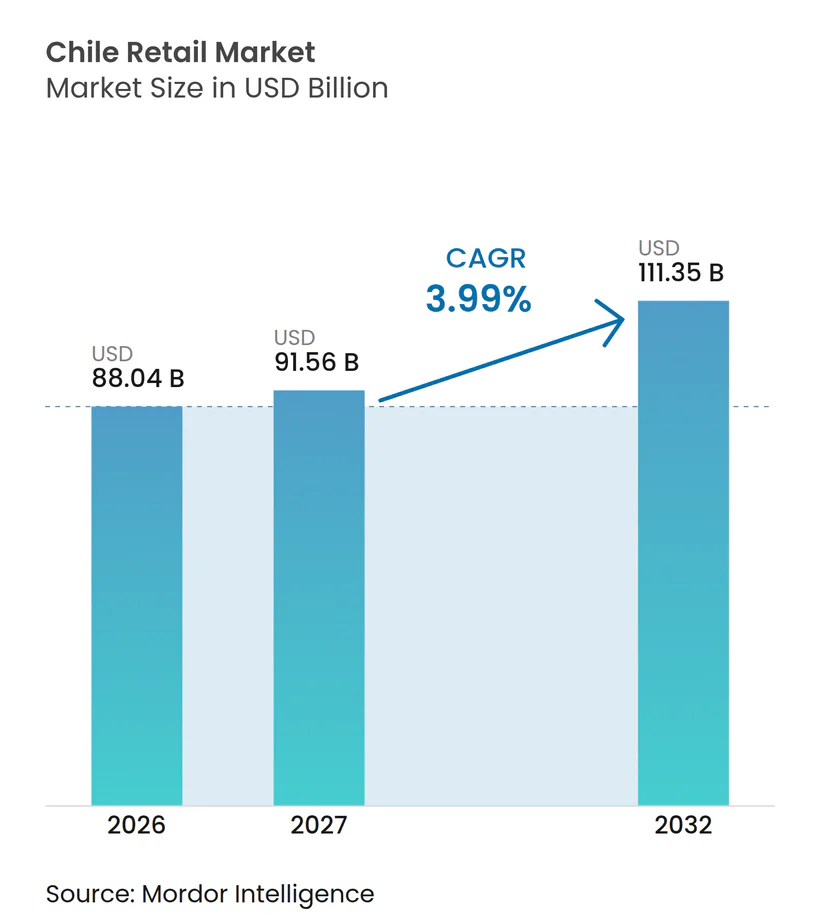
| Base Year Market Size (2026) | USD 88.04 Billion |
| Market Size (2027) | USD 91.56 Billion |
| Market Size (2032) | USD 111.35 Billion |
| Growth Rate (2027 - 2032) | 3.99 % |
| Market Concentration | High |
Major Players *Disclaimer: Major Players sorted in no particular order Image © Mordor Intelligence. Reuse requires attribution under CC BY 4.0. | |
Chile Retail Market Analysis by Mordor Intelligence
The Chile retail market size was valued at USD 88.04 billion in 2026 and is estimated to grow from USD 91.56 billion in 2027 to reach USD 111.35 billion by 2032, at a CAGR of 3.99% during the forecast period (2027-2032). Chile’s retail market returned to growth in 2025, with retail sales increasing by more than 5% in real terms, according to the Santiago Chamber of Commerce. E-commerce was the fastest-growing channel, with real sales growth and accounting for 12.6% of total retail sales. Online food and beverage sales grew by 25% in real terms, reaching USD 1.76 billion. A 19% Value-Added Tax (VAT) requirement for qualifying imported goods purchased remotely, valued at up to USD 500, took effect on October 25, 2025, changing the tax collection process for cross-border online purchases[1].
Key Report Takeaways
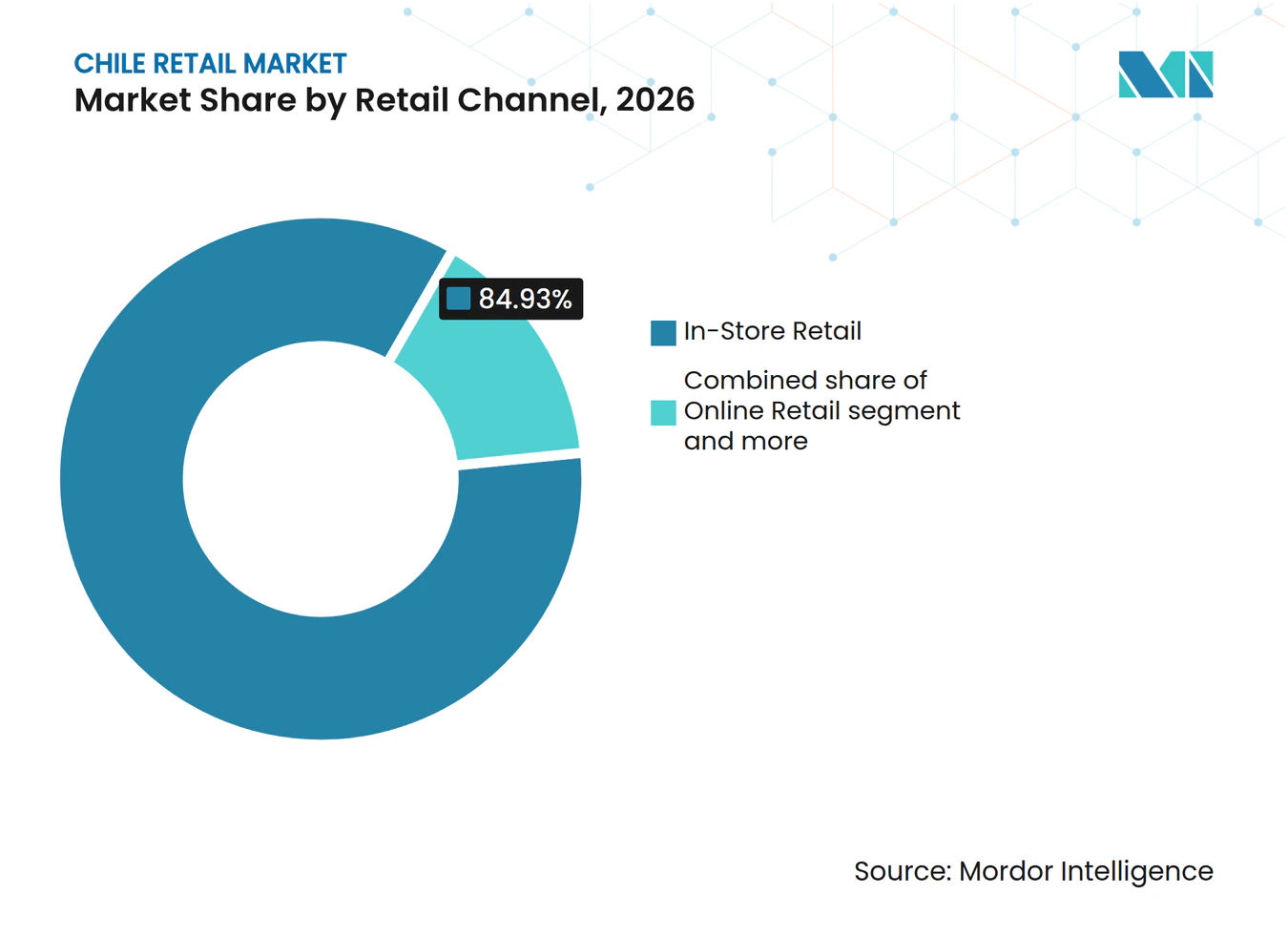
- By retail channel, in-store retail accounted for 84.93% of the Chile retail market share in 2026, while online retail is projected to grow at a 5.45% CAGR through 2032.
- By retail format, hypermarkets and supermarkets accounted for 34.12% of the Chile retail market share in 2026, while convenience stores are projected to grow at a 4.95% CAGR through 2032.
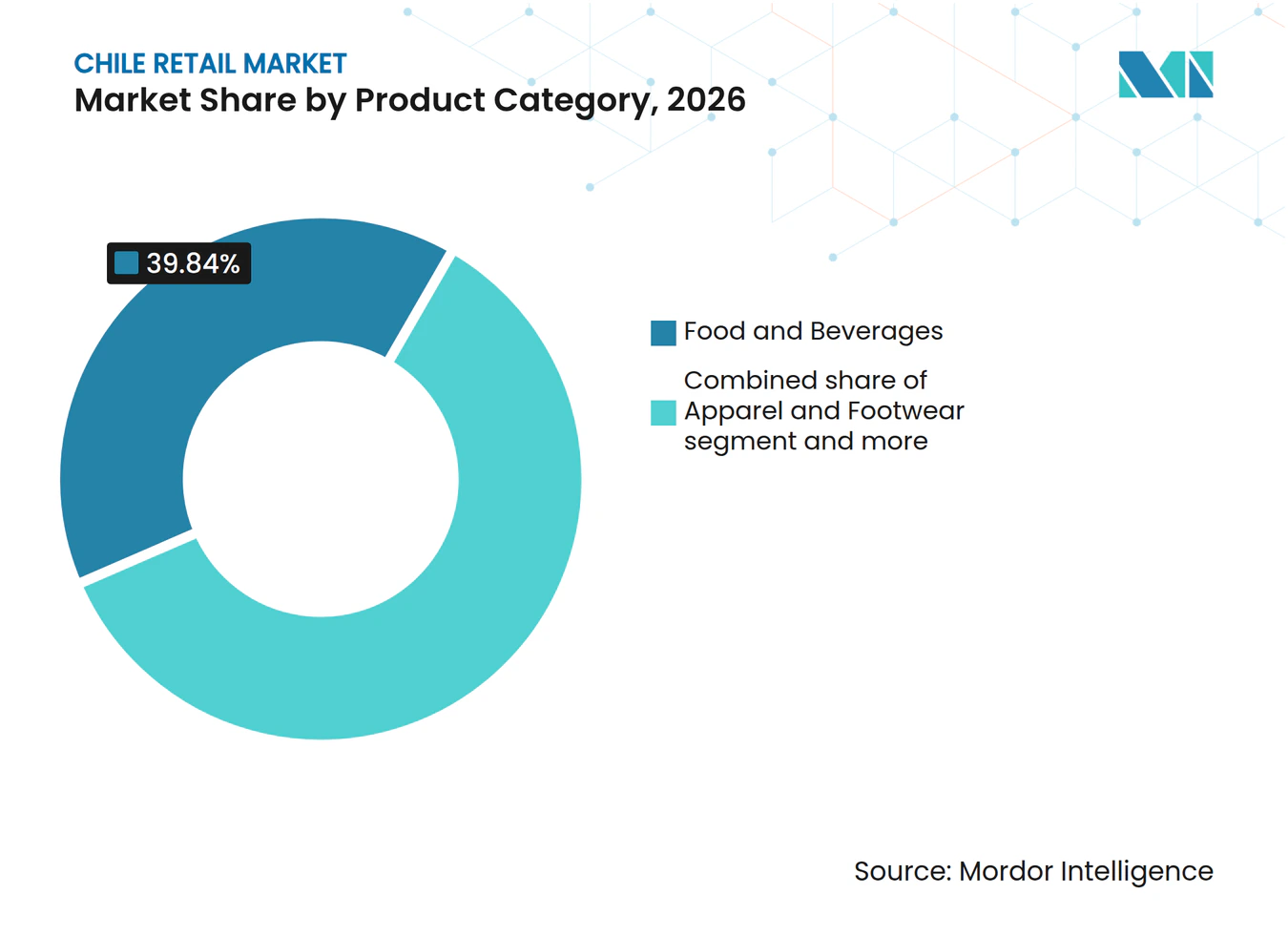
- By product category, food and beverages accounted for 39.84% of the Chile retail market share in 2026, while beauty, personal care, and health are projected to grow at a 4.76% CAGR through 2032.
- By geography, the Metropolitan Region (Santiago) accounted for 45.93% of the Chile retail market share in 2026, while the rest of Chile is projected to grow at a 4.84% CAGR through 2032.
Note: Market numbers in this report are based on Mordor Intelligence's proprietary estimation framework, which combines nine months of actuals with Q4 projections for base year 2026.
Market Trends and Insights
Drivers Impact Analysis of Chile Retail Market*
| Driver | (~) % Impact on CAGR Forecast | Geographic Relevance | Impact Timeline |
|---|---|---|---|
| Recovery in Real Household Consumption and Retail Sales | +1.1% | National, with the strongest gains in Metropolitan Region (Santiago), Valparaíso, and Biobío | Short term (≤ 2 years) |
| E-Commerce, Digital Payments, and Mobile-First Shopping | +0.8% | National, with early adoption concentrated in the Metropolitan Region (Santiago) | Medium term (2-4 years) |
| Omnichannel Fulfillment and Store-as-Distribution Infrastructure | +0.5% | National, concentrated in the Metropolitan Region (Santiago) and Valparaíso | Medium term (2-4 years) |
| Supermarket Modernization and Private-Label Penetration | +0.7% | National, across all 16 regions | Medium term (2-4 years) |
| Convenience, Ready-to-Eat, and Health-Oriented Consumption | +0.4% | National, with early gains in Metropolitan Region (Santiago), Valparaíso, and Concepción | Long term (≥ 4 years) |
| Cross-Border Marketplace Expansion and Logistics Investment | +0.3% | National, led by the Metropolitan Region | Medium term (2-4 years) |
| Source: Mordor Intelligence | |||
Recovery in Real Household Consumption and Retail Sales
Chile’s retail market recovered in 2025, with retail sales excluding automobiles reaching up just over 5% in real terms. The broader economy grew by 2.5%, while real household consumption increased by 2.7%, supported by food and clothing purchases within non-durable goods consumption. Supermarket sales recovered more moderately, with real sales increasing by an average of 1.2% and nominal sales rising by 4.6% to USD 18.582 billion. The gap between nominal and real growth reflected price changes, indicating that value growth did not correspond to equivalent volume growth. E-commerce sales expanded in real terms and accounted for 12.6% of total retail sales. Online food and beverage sales increased by 25% in real terms to USD 1.76 billion, reflecting the growing role of digital grocery purchases.
E-Commerce, Digital Payments, and Mobile-First Shopping
Chile's online retail sales approached USD 10 billion in 2025, growing 11.6% in nominal terms and over 9% in real terms to account for 12.6% of total retail sales. Digital payment adoption supported this growth, with 374 digital payments per capita and transaction values equivalent to 112% of GDP, according to the Central Bank of Chile[2]. Card payments represented 74% of household spending in the latest comparison, up from 32% in 2016. Mobile devices accounted for 59% of e-commerce sales. Online food and beverage sales reached USD 1.76 billion, growing 25% in real terms. Supermarket e-commerce penetration rose from 0.8% in 2019 to 8.6% in 2025. The 2023 Fintech Law and the planned Open Finance System aim to foster competition and develop digital financial services.
Omnichannel Fulfillment and Store-as-Distribution Infrastructure
Chile’s retail market continues to rely on physical stores, which increasingly support digital order fulfillment. Walmart Phronesis reported that 12.2% of Walmart Chile customers used an omnichannel purchasing model, combining physical-store and online shopping. This approach enables retailers to use stores as pickup points, return locations, and local distribution hubs. MercadoLibre began constructing a USD 135 million fulfillment center in Colina in 2025, with operations scheduled to begin in the fourth quarter of 2026[3]. The investment comes amid strong e-commerce growth, with the company’s Chilean gross merchandise volume increasing 41% year over year on a foreign exchange (FX)-neutral basis in the fourth quarter of 2025. Fulfillment infrastructure investments can help reduce delivery delays in densely populated urban areas, although benefits may take longer to materialize in lower-density regions.
Supermarket Modernization and Private-Label Penetration
Private-label products remain important to supermarket assortment and value strategies in Chile. In the second quarter of 2025, Cencosud’s private-label products accounted for 17.9% of consolidated sales, while penetration in Chile reached 17.6%. Under its three-year strategic plan, SMU (Supermercados del Sur) launched more than 500 private-label products, which accounted for approximately 13% of total sales. In December 2024, Walmart Chile announced a USD 1.3 billion investment plan to open 70 stores and expand distribution and logistics infrastructure. These initiatives show how major supermarket operators invest in product differentiation, value positioning, and distribution capacity to strengthen their competitive positions.
Restraints Impact Analysis of Chile Retail Market*
| Restraint | (~) % Impact on CAGR Forecast | Geographic Relevance | Impact Timeline |
|---|---|---|---|
| High Household Price Sensitivity and Smaller Basket Sizes | -0.6% | National | Medium term (2-4 years) |
| Concentrated Supermarket Structure and Limited Supplier Bargaining Space | -0.4% | National | Long term (≥ 4 years) |
| Last-Mile Cost and Delivery-Time Penalties Outside Santiago | -0.3% | Extra-metropolitan regions | Long term (≥ 4 years) |
| Informal and Cross-Border Digital Commerce Pressure | -0.5% | National, especially apparel and footwear | Medium term (2-4 years) |
| Source: Mordor Intelligence | |||
High Household Price Sensitivity and Smaller Basket Sizes
Chile’s retail market showed increasingly selective purchasing behavior. Small and bulk formats accounted for 50% of purchases in 2025, compared with 46% in 2022, reflecting changing shopping habits and household composition. Walmart Chile reported that 83.3% of its customers shopped exclusively in physical stores, while 12.2% used both online and physical channels and 4.5% purchased exclusively online. Small and medium formats accounted for 88% of spending on premium products[4]. In contrast, large and extra-large formats represented 51% of spending on private-label and economy brands. Retailers need to align pack sizes, promotions, and pricing with consumer budgets, product preferences, and channel-specific shopping patterns.
Concentrated Supermarket Structure and Limited Supplier Bargaining Space
Supermarket concentration improves operational efficiency for major chains but can reduce suppliers’ bargaining power. Walmart Chile, Cencosud, SMU, and Tottus accounted for most supermarket sales, reflecting the scale of their store networks and purchasing operations. Private-label products represented 18.1% of Cencosud’s sales and 13.6% of SMU’s sales, giving these retailers greater control over assortment and pricing. Smaller suppliers may face pressure to meet volume, promotion funding, and delivery requirements. This can limit assortment experimentation, particularly when national brands compete with private labels in staple categories. While this does not prevent retail growth, it may increase dependence on the strategies of large chain operators.
*Our forecasts treat driver/restraint impacts as directional, not additive. The impact forecasts reflect baseline growth, mix effects, and variable interactions.
Consumer Behavior Analysis
Chilean shoppers increasingly use multiple retail channels, intensifying competition. Worldpanel by Numerator reported households used an average of 8.7 channels in 2025, versus 6.4 in 2019; nearly 60% bought FMCG online. Online purchase frequency rose 12% and average ticket value 7%. The CNC's 2025 Christmas survey found 49% planned to use physical and online channels, while 12% planned to shop only online. Integrated inventory, collection options, and targeted promotions can support omnichannel shoppers.
Households balance budget-conscious buying with higher spending on health and personal care. Small and bulk formats represented 50% of 2025 purchases, while household care spending rose 7.3% and its basket share increased from 10.7% to 11.6%. CCS reported online pharmacy, cosmetics, and hygiene sales rose 14% to USD 640 million. Card payments represented 74% of household spending, versus 32% in 2016. Retailers can combine competitive staple pricing, digital convenience, relevant assortments, and payment options.
Retail Performance Intelligence
Chile’s supermarket sector recorded a moderate recovery in 2025, with real sales rising by an average of 1.2% year over year. Growth slowed to 0.8% in the fourth quarter, indicating a subdued recovery. The real supermarket sales index reached 122.6 in December, reflecting seasonal demand rather than sustained monthly growth, according to the Central Bank of Chile. Tottus, part of Grupo Falabella, reported 9% revenue growth across Chile and Peru in 2025, while its EBITDA margin increased to 7.8%, supported by operational improvements.
Santiago’s commercial-unit vacancy rate fell to 6.55% in the first half of 2025, and average first-floor rents reached 0.78 UF/m², indicating stronger demand for well-located retail space, according to EMB Construcción. Cenco Malls reported 97.3% consolidated occupancy at year-end 2025. These indicators supported retailers and shopping center operators with efficient inventory management, productive locations, and strong tenant mixes.
Chile Retail Market Segment Analysis
By Retail Channel:
Physical Retail Retains Scale While Digital Purchasing ExpandsIn-store retail is projected to account for 84.93% of Chile's retail market in 2026, supported by supermarkets and pharmacies serving routine household purchases. Walmart Chile operated 403 stores at the end of 2025, while SMU maintained more than 400 locations nationwide. Walmart reported that 12.2% of its Chilean customers shopped through both physical and digital channels.
Online retail is forecast to grow at a CAGR of 5.45% during 2027-2032. Chile’s e-commerce market approached USD 10 billion in 2025, with 6% growth forecast for 2026. Online food and beverage sales grew 25% in real terms to USD 1.76 billion. MercadoLibre’s USD 135 million Colina fulfillment center is scheduled to open in Q4 2026, expanding logistics capacity.



By Retail Format:
Supermarkets Lead While Convenience Formats Focus on ProfitabilityHypermarkets and supermarkets account for an estimated 34.12% of Chile’s retail market in 2026, supported by extensive networks, purchasing scale, loyalty programs, and private labels. Cencosud’s Jumbo Prime subscribers grew 7.9% year on year in Q2 2025, while private-label penetration reached 17.9% in Q3 2025. Its department stores face online price comparison pressure, increasing the need for digital reach and differentiated assortments. Falabella’s Home Improvement business recorded 19% online Gross Merchandise Value (GMV) penetration in Q4 2025, with private labels exceeding 30% of annual sales.
Convenience stores are forecast to grow at a 4.95% CAGR through 2032, the fastest among formats. Pronto Copec had approximately 500 stores at the end of 2025, benefiting from fuel-service and high-traffic locations. Copec OXXO operated 236 stores, while FEMSA paused expansion in Chile and Peru to improve operating results. Competition includes traditional grocers, discount formats, and Central Mayorista.
By Product Category:
Food Anchors Spending While Health and Beauty Gain MomentumFood and beverages account for 39.84% of Chile’s retail market value in 2026 and remain the main driver of supermarket traffic. Private labels accounted for 86.7% of supermarket spending on sugar and over 40% of cooking oil and flour purchases. Online food and beverage sales reached USD 1.76 billion in 2025, following 25% real growth. Consumer electronics and appliances remained the largest e-commerce category, valued at USD 4.6 billion. Apparel and footwear accounted for 47% of informal international purchases by value.
Beauty, personal care, and health are forecast to grow at a 4.76% CAGR through 2032. Online pharmacy, cosmetics, and personal hygiene sales reached USD 640 million in 2025 after 14% real growth. Dr. Simi reached 600 locations in October 2025, while Cruz Verde operated over 800 outlets. In home improvement retail, Sodimac Chile reported 7.7% revenue growth in the first half of 2025, supported by home, garden, and outdoor categories.

Geography Analysis
The Metropolitan Region (Santiago) accounted for an estimated 45.93% of Chile’s retail market in 2026, with approximately 40% of the country’s population. Supermarket sales reached USD 7.2 billion in 2025, growing 2.2% in real terms. During the 2025 Christmas season, 15% of Santiago shoppers purchased exclusively online, compared with 9% in other regions. Cenco Malls opened Qinto at Cenco Costanera in 2026, offering more than 80 culinary options across approximately 30,000 m².
Valparaíso and Biobío recorded supermarket sales of USD 2.2 billion and USD 1.68 billion, respectively, in 2025. Walmart opened its 400th Chilean store in Reñaca Alto in May 2025, increasing its regional presence to 52 stores. Falabella expanded in Viña del Mar, while Unimarc opened its first Concón store.
The rest of Chile is projected to grow at a CAGR of 4.84% through 2032. Supermarket sales grew 2.3% in Antofagasta, 4.3% in Aysén, and 3.5% in Magallanes in 2025. SMU plans 80 new stores, while Walmart plans more than 80, with 70% investment outside Santiago. Delivery economics remain challenging in less densely populated areas.
Retail Supply and Development Intelligence
Chile’s supermarket network comprised 1,364 outlets and approximately 2.7 million m² of sales area in 2025. Sales area grew by 0.3% year over year, indicating limited expansion in physical retail capacity. Walmart Chile operated 403 stores at the end of 2025, while Cencosud operated 251 supermarkets in Chile in Q1 2025.
Expansion plans indicate continued investment beyond existing store networks. Walmart announced a USD 1.3 billion, five-year program to open 70 stores, while SMU committed USD 600 million over five years to open 115 stores across Chile and Peru. MercadoLibre’s USD 135 million fulfillment center in Colina is scheduled to begin operations in Q4 2026, adding logistics capacity. These investments reflect a dual strategy of expanding regional store access and strengthening distribution infrastructure for e-commerce and delivery operations.
Competitive Landscape
Market Concentration
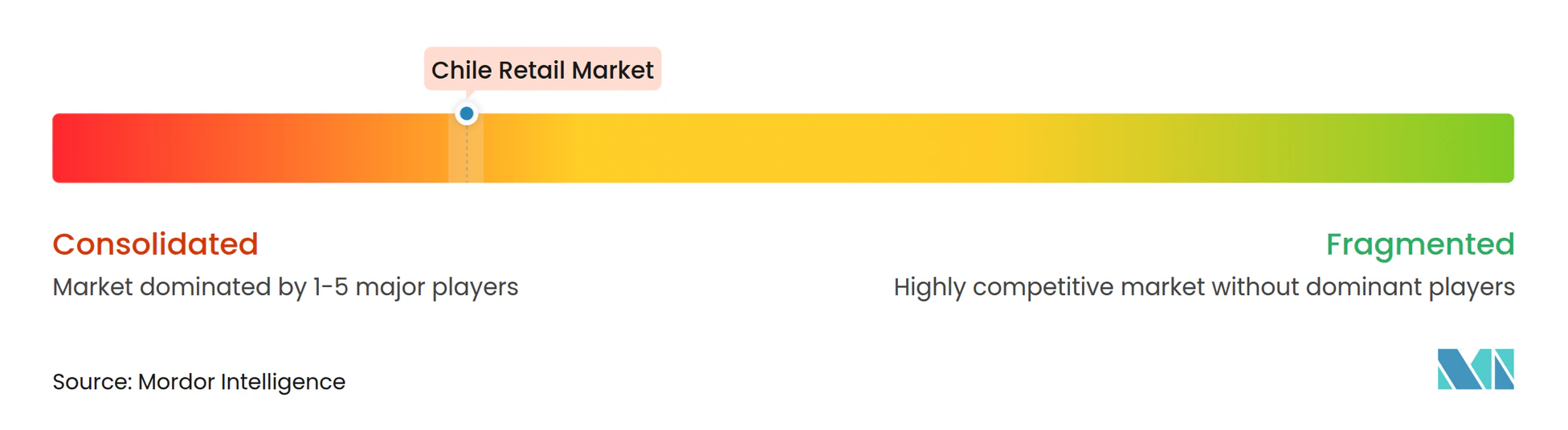
Chile’s retail market has a dual concentration structure, with a highly concentrated supermarket segment and a more fragmented broader retail landscape. The supermarket segment is led by Cencosud, followed by SMU and Tottus, with competition shaped by extensive store networks, purchasing scale, loyalty programs, and private-label offerings. In pharmacies, Salcobrand, Cruz Verde, and Farmacias Ahumada are the leading players, while Dr. Simi follows a price-led business model. Walmart Chile and Farmacias Ahumada formalized an alliance in September 2025, linking pharmacy outlets and loyalty programs.
Competition extended beyond store coverage to digital capabilities, fulfillment, customer data, and pricing. MercadoLibre’s Chilean gross merchandise value grew 41% year on year in Q4 2025. The company supported operations with a USD 135 million fulfillment center in Colina and committed USD 550 million to Chile. Walmart announced USD 1.3 billion in investment and more than 80 new stores by 2029. SMU announced USD 600 million for 115 new stores across Chile and Peru and more than 200 remodels. Cencosud and SMU reported private-label shares of 18.1% and 13.6%, respectively.
Chile Retail Industry Leaders
-
Walmart Chile
-
Cencosud
-
SMU
-
Falabella
-
MercadoLibre
- *Disclaimer: Major Players sorted in no particular order
Chile Retail Market Companies Covered in this Report
- Walmart Chile
- Cencosud
- SMU
- Falabella
- MercadoLibre
- Ripley
- FEMSA Comercio, OXXO
- Empresas Copec, Pronto and Punto
- Sodimac
- Salcobrand
- Farmacias Cruz Verde
- Farmacias Ahumada
- La Polar
- Hites
- Forus S.A.
- AD Retail
- Comercial K SpA
- Decathlon Chile
- IKEA Chile
- Casaideas
Recent Industry Developments in Chile Retail Market
- October 2026: Walmart Chile opened its 20th store in the O’Higgins Region, an Express de Líder location at Rancagua Outlet Mall, reinforcing coverage in a region where it has operated for 24 years and employs 1,700 people.
- November 2025: Grupo Falabella opened a new Falabella Retail store in Viña del Mar and launched its Beauty.F concept in Chile; the specific claim about layout renovations at 18 Tottus stores requires further confirmation.
- September 2025: FEMSA integrated OXXO into Intercarry’s logistics network at its 40,000 m² San Bernardo distribution center, which supplies more than 1,500 pharmacy, perfumery, and convenience outlets, including Cruz Verde, Maicao, OXXO, and OK Market.
- April 2025: SMU announced a five-year USD 600 million investment plan for 2025–2029, covering 115 new stores across Chile and Peru, more than 200 remodels and conversions, and logistics and operational-efficiency improvements.
Chile Retail Market Report Scope
The Chile retail market report analyzes retail sales across physical stores, online platforms, and omnichannel channels. The market is segmented by retail channel, retail format, product category, and geography, with separate market size and growth forecasts for the Metropolitan Region (Santiago), Valparaíso, Biobío, and the rest of Chile. The study assesses drivers such as recovery in household consumption, e-commerce growth, digital payments, omnichannel fulfillment, supermarket modernization, private-label penetration, convenience-led shopping, and cross-border marketplace expansion. It also examines restraints including household price sensitivity, smaller basket sizes, supermarket concentration, supplier bargaining constraints, last-mile delivery costs outside Santiago, and informal cross-border commerce. The report evaluates retail store networks, floor space, new store openings, expansion pipelines, sales performance, occupancy costs, consumer shopping behavior, channel preferences, spending patterns, and purchase frequency. It provides market size and growth forecasts by retail channel, format, product category, and geography for 2022-2032, including regional breakdowns by channel, format, and product category. The study also covers regulatory and technological developments, Porter’s Five Forces Analysis, market concentration, market shares, strategic moves, and profiles of major supermarket groups, department stores, pharmacies, specialty retailers, convenience operators, and e-commerce platforms. Opportunities in regional micro-fulfillment, lower-cost delivery beyond Santiago, private-label products, value retail, and affordable premiumization are also assessed. Market estimates and forecasts are presented in value terms across the covered segments.
Segmentation Overview
Key Questions Answered in the Report
What is the forecast growth rate for Chile retail through 2032?
The Chile retail market is forecast to grow at a 3.99% CAGR between 2027 and 2032, rising from USD 91.55 billion in 2027 to USD 111.35 billion in 2032.
Which retail channel has the highest projected growth in Chile?
Online retail is forecast to grow at a 5.45% CAGR through 2032, supported by digital payments, grocery adoption, and fulfillment investment.
Which format leads retail sales in Chile?
Hypermarkets and supermarkets accounted for 34.12% of value in 2026, supported by broad store coverage, private-label development, and loyalty programs.
What product category is expanding fastest in Chile?
Beauty, personal care, and health are forecast to expand at a 4.76% CAGR through 2032, with online pharmacy, cosmetics, and personal hygiene sales reaching USD 640 million in 2025.
Which region has the strongest expected retail growth in Chile?
The rest of Chile is forecast to grow at a 4.84% CAGR through 2032 as retailers expand store networks outside Santiago.
What is the main risk facing formal Chilean retailers?
Price sensitivity and informal cross-border e-commerce remain major pressures, particularly for apparel and footwear, despite VAT rules on remote sales below USD 500.