
Chile Refrigerated Trucking Market Size and Share
Market Overview
| Study Period | 2021 - 2032 |
|---|---|
| Forecast Data Period | 2027 - 2032 |
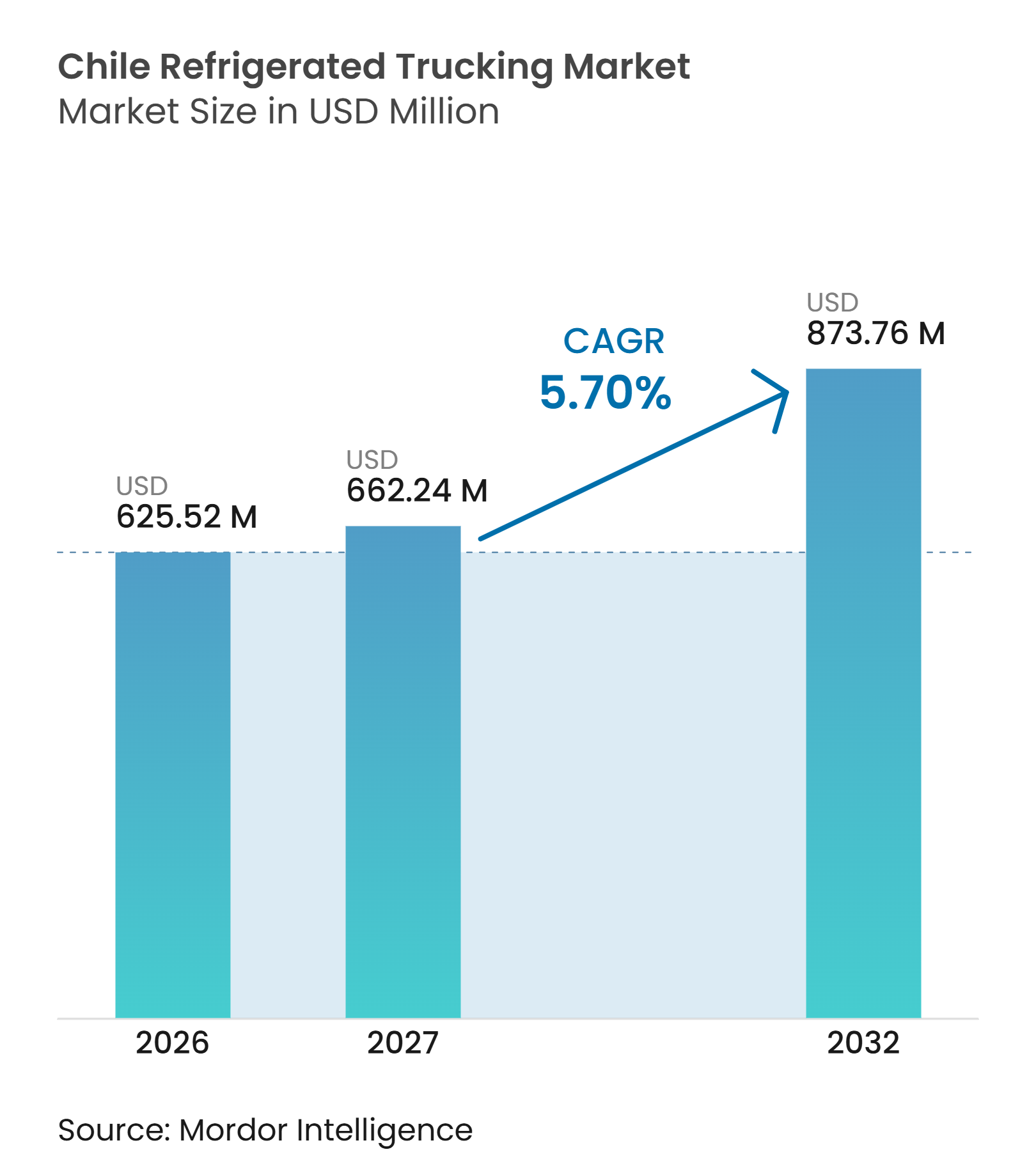
| Base Year Market Size (2026) | USD 625.52 Million |
| Market Size (2027) | USD 662.24 Million |
| Market Size (2032) | USD 873.76 Million |
| Growth Rate (2027 - 2032) | 5.70 % |
| Market Concentration | Low |
Major Players *Disclaimer: Major Players sorted in no particular order Image © Mordor Intelligence. Reuse requires attribution under CC BY 4.0. | |
Chile Refrigerated Trucking Market Analysis by Mordor Intelligence
The Chile refrigerated trucking market size is valued at USD 625.52 million in 2026. It is estimated to grow from USD 662.24 million in 2027 to reach USD 873.76 million by 2032, at a CAGR of 5.70% during the forecast period from 2027 to 2032.
Chile’s export-oriented food supply chain supports demand for temperature-controlled road transport, as food exports reached USD 12,460 million in the first half of 2025, led by cherries, grapes, kiwis, and frozen berries. Frozen fruit and vegetable exports also reached USD 715 million in 2025, which increased the need for refrigerated movement between processors, distribution centers, and ports. The Chile refrigerated trucking industry is also changing as multi-temperature vehicles and real-time monitoring allow operators to combine pharmaceutical, fresh-food, and frozen consignments on one route. Online grocery orders are adding shorter and more frequent delivery runs. At the same time, the Advanced Framework Agreement with the European Union increases the importance of traceability and food-safety control across domestic supply chains. These conditions create opportunities for operators that can combine reliable fleet availability, specialized compliance capabilities, and effective route planning.
Key Report Takeaways
- By application, horticultural products account for 29.76% of Chile refrigerated trucking market size, while healthcare and pharmaceutical shipments are projected to register a 7.76% CAGR through 2032.
- By truckload specification, full-truckload operations account for 70.82% of Chile refrigerated trucking market share, while less-than-truckload operations are projected to register a 7.94% CAGR through 2032.
- By containerization, non-containerized refrigerated transport accounts for 80.27% of Chile refrigerated trucking market size, while containerized refrigerated transport is projected to register a 6.83% CAGR through 2032.
- By distance, long-haul refrigerated trucking accounts for 68.52% of Chile refrigerated trucking industry share, while short-haul refrigerated transport is projected to register an 8.65% CAGR through 2032.
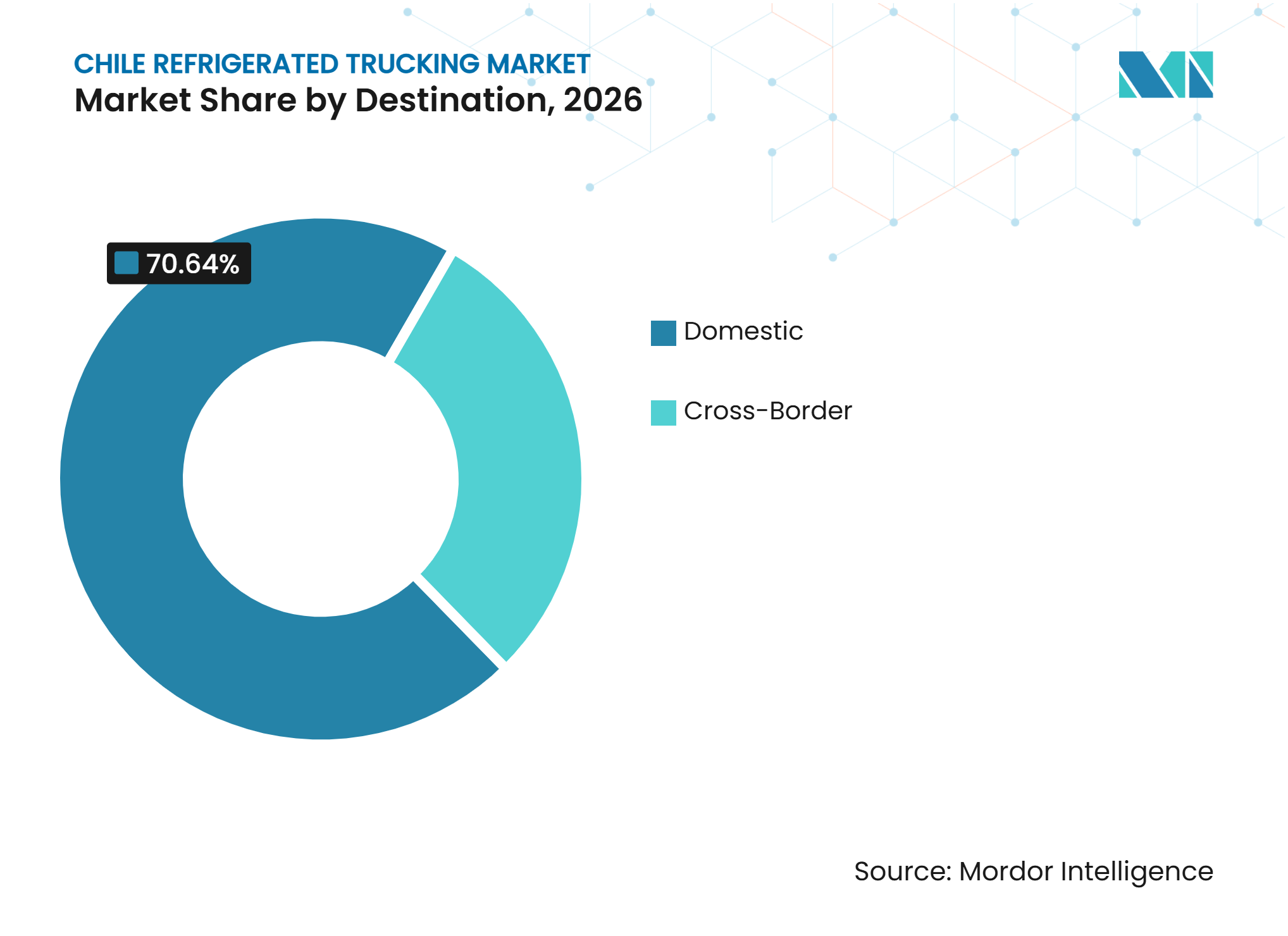
- By destination, domestic movements account for 70.64% of Chile refrigerated trucking market size, while cross-border shipments are projected to register an 8.89% CAGR through 2032.
- By temperature type, the frozen temperature band accounts for 45.69% of Chile refrigerated trucking market share, while deep-frozen and ultra-low-temperature transport is projected to register a 7.87% CAGR through 2032.
- By region, Central Chile accounts for 45.76% of the Chile refrigerated trucking market share in 2026, while Southern Chile is projected to register an 8.64% CAGR through 2032.
Note: Market numbers in this report are based on Mordor Intelligence's proprietary estimation framework, which combines nine months of actuals with Q4 projections for base year 2026.
Market Trends and Insights
Drivers Impact Analysis of Chile Refrigerated Trucking Market*
| Driver | (~) % Impact on CAGR Forecast | Geographic Relevance | Impact Timeline |
|---|---|---|---|
| Fresh Produce Exports Increasing Refrigerated Transport Demand | +1.5% | Central Chile, Northern Chile export corridors | Short term (≤ 2 years) |
| Seafood Exports Expanding Temperature-Controlled Freight Volumes | +1.0% | Southern Chile, Patagonia and Extreme South | Medium term (2-4 years) |
| Frozen Food Consumption Increasing Cold-Chain Distribution Demand | +0.8% | Central Chile, Santiago Metropolitan Region, secondary cities nationwide | Medium term (2-4 years) |
| Pharmaceutical Growth Increasing Specialized Refrigerated Transport Requirements | +0.6% | Santiago Metropolitan Region, Valparaíso, Concepción, national last-mile distribution | Long term (≥ 4 years) |
| Grocery E-Commerce Expanding Multi-Stop Cold-Chain Deliveries | +0.5% | Santiago Metropolitan Region, secondary urban centers | Short term (≤ 2 years) |
| Traceability Regulations Strengthening Temperature-Controlled Transport Compliance | +0.4% | National | Medium term (2-4 years) |
| Source: Mordor Intelligence | |||
Fresh Produce Exports Increasing Refrigerated Transport Demand
Chile’s fresh produce exports make refrigerated road freight essential to moving fruit from packhouses to container yards. Cherry shipments reached USD 2,243 million in the first half of 2025, and the 2025-2026 fresh fruit season generated USD 8,198.8 million FOB[1]. DP World processed 12.8 million boxes of cherries in the preceding season and projected 14,800 TEUs for the 2025-2026 season, with refrigerated container volumes rising to 5,350 units. The resulting peak is concentrated within a 5-6 week period, which raises the need for trucks between agricultural valleys and port facilities. Fleet operators may face premium freight requirements when contracted capacity cannot meet harvest-period demand. Chile’s Servicio Agrícola y Ganadero requirements for documented temperature control from the farm gate also favor providers with certified cold-chain procedures.
Seafood Exports Expanding Temperature-Controlled Freight Volumes
Salmon and other seafood provide year-round traffic that differs from the concentrated fruit export cycle. Chile exported 88,482 tons of coho salmon in the first quarter of 2025. Biobío handles 52.5% of national salmon shipment volumes and more than USD 2,556 million in salmonid FOB value each year. This volume supports regular refrigerated road movements from production areas to processing sites and terminals. Road links from Los Lagos and Aysén to Biobío remain important to this flow. Chile’s state railway company, EFE, is assessing 2 weekly refrigerated trains from Frutillar to Biobío, which could replace 34 trucks per train and affect some long-haul road demand over time.
Frozen Food Consumption Increasing Cold-Chain Distribution Demand
Domestic frozen-food consumption adds demand that is less dependent on export shipping cycles. Frozen pallet positions were projected to reach 630,000 by the end of 2025, with activity concentrated in Santiago, Concepción, and Puerto Montt. Additional storage capacity increases the number of refrigerated trips from hubs to secondary cities. It also changes the temperature requirements of fleets as more food is held and distributed in frozen form. Deeper temperature bands increase refrigeration-unit operating needs on each route. Operators therefore need to consider vehicle capability and energy use alongside added route volume. The Chile refrigerated trucking market can benefit when operators link cold storage capacity with dependable regional distribution.
Pharmaceutical Growth Increasing Specialized Refrigerated Transport Requirements
Pharmaceutical distribution requires more controlled handling than most food movements. Chile’s Instituto de Salud Pública requires compliance with Norma Técnica N°208 for refrigerated and frozen medicine transport. The standard covers qualification and validation for refrigerated conditions from 2-8 °C and frozen conditions from -25 to -15 °C. In Chile, DHL Supply Chain and Novo Nordisk established a controlled-temperature logistics operation for goods maintained between 15 °C and 25 °C. Pharmaceutical traffic can help fleets reduce seasonal underuse because demand continues outside agricultural peaks. This gives certified operators a more stable source of revenue than operators focused only on food cargo.
Restraints Impact Analysis of Chile Refrigerated Trucking Market*
| Restraint | (~) % Impact on CAGR Forecast | Geographic Relevance | Impact Timeline |
|---|---|---|---|
| Seasonal Reefer Imbalances Constraining Available Fleet Capacity | -0.7% | National, especially Central Chile and Southern Chile | Short term (≤ 2 years) |
| Fuel and Refrigeration Costs Increasing Operating Expenses | -0.5% | National, particularly long-haul southern corridors | Medium term (2-4 years) |
| Long Routes Weakening Refrigerated Backhaul Network Economics | -0.4% | Southern Chile, Patagonia and Extreme South, Antofagasta to Santiago corridors | Long term (≥ 4 years) |
| Skilled Driver Shortages Limiting Cold-Chain Service Capacity | -0.3% | National, especially Los Lagos and Aysén | Medium term (2-4 years) |
| Source: Mordor Intelligence | |||
Seasonal Reefer Imbalances Constraining Available Fleet Capacity
Cherries from November through January and coho salmon peaks in spring concentrate refrigerated freight demand into limited seasonal windows. Projected cherry volumes of 132 million boxes in the 2025-2026 season required close coordination at San Antonio after an early harvest compressed container, vessel, and driver availability. Vehicles added for these peaks may sit idle between April and October. This weakens returns on fleet investments and can discourage fleet renewal. Skilled driver availability is another constraint, particularly in Los Lagos and Aysén where aquaculture logistics compete for qualified operators. Pharmaceutical and retail contracts can help fill the gap between agricultural seasons, but many regional carriers have not fully developed these services.
Fuel and Refrigeration Costs Increasing Operating Expenses
Chile’s diesel reference price was USD 618.1 per m³ in June 2025, while the transport cost index increased 1.2% in the first half of 2025[2]. Costs rise further when refrigeration units run during terminal delays or multi-stop city routes. Long southern corridors also have limited backhaul opportunities, which reduces equipment use on return trips. This is particularly difficult on routes above 500 kilometers where fuel, driver time, and refrigeration requirements accumulate. Operators serving urban e-commerce must balance higher delivery frequency with the greater energy intensity of multiple stops.
*Our forecasts treat driver/restraint impacts as directional, not additive. The impact forecasts reflect baseline growth, mix effects, and variable interactions.
Chile Refrigerated Trucking Market Segment Analysis
By Application:
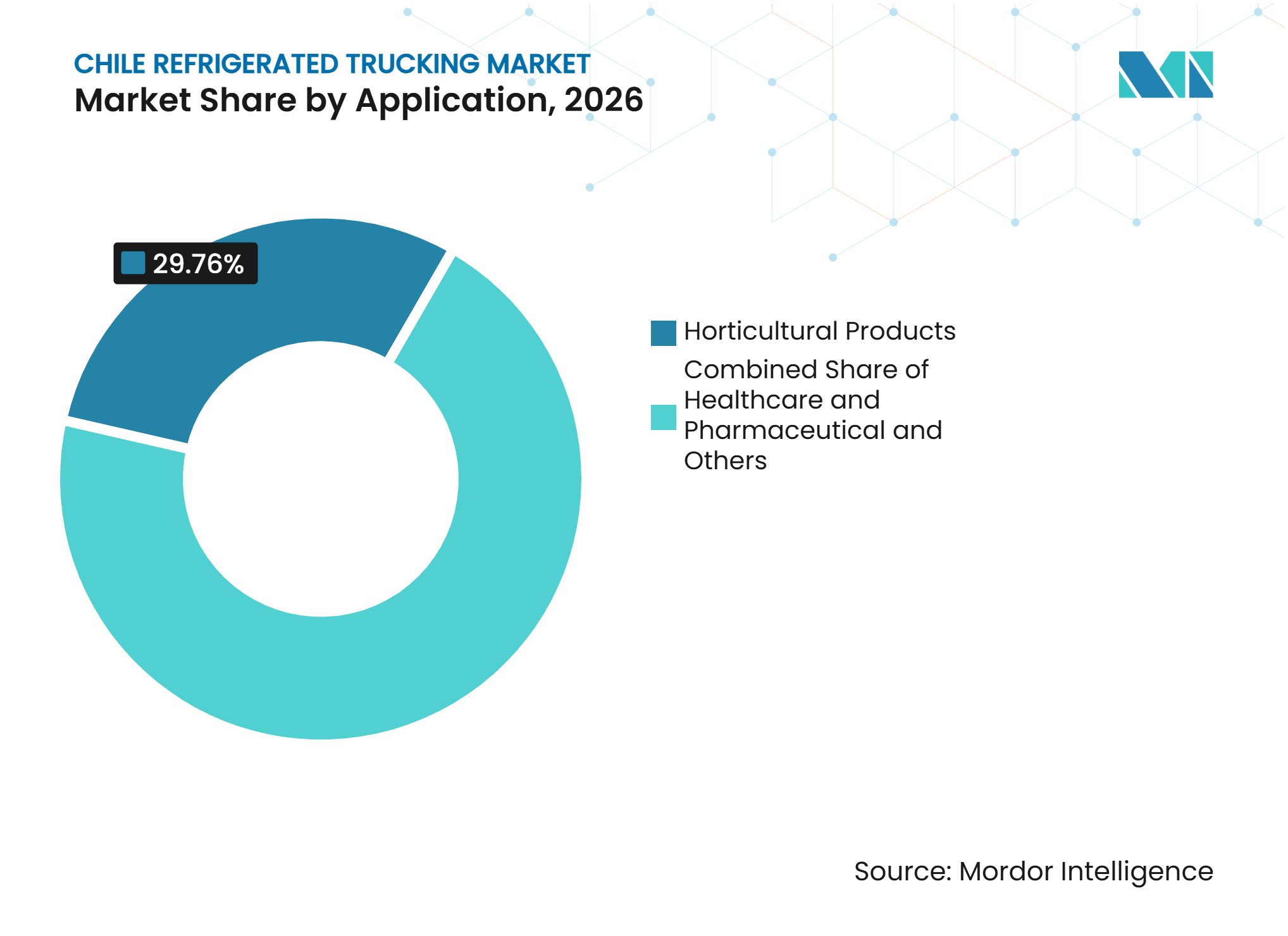
Horticultural Demand Holds the Largest Position While Pharmaceutical Logistics ExpandsHorticultural products account for 29.76% of the Chile refrigerated trucking market share in 2026. Cherries, grapes, kiwis, and blueberries generate the largest concentration of seasonal truckload demand. These products move from farms and packhouses toward San Antonio and Valparaíso, where export schedules require tight delivery timing. Dairy, frozen desserts, meat, poultry, fish, and seafood provide more regular demand across the year. Salmon processing in Biobío and Los Lagos is especially important because it sustains refrigerated movement outside the fruit season.
Healthcare and pharmaceutical shipments are projected to register a 7.76% CAGR from 2027 to 2032. Healthcare and pharmaceutical logistics have smaller volumes but grow faster because regulation requires purpose-fitted equipment. Norma Técnica N°208 requires qualified vehicles, continuous monitoring, and procedures for handling temperature deviations. This creates demand for specialized refrigerated vehicles, validated storage facilities, and trained logistics personnel. Pharmaceutical companies also require reliable traceability and controlled handling throughout transportation to maintain product quality and comply with regulatory standards.



By Truckload Specification:
Full-Truckload Remains the Core While Less-Than-Truckload BroadensFull-truckload operations account for 70.82% of the Chile refrigerated trucking market size in 2026, reflecting Chile’s large export consignments of fruit, salmon, and frozen products. Point-to-point routes from producing regions to ports often fill complete refrigerated trailers. This model is efficient for standard export volumes and supports scheduled runs during harvest and processing peaks. Full-truckload carriers still face exposure to crop variability. Chile exported 569,000 tons of cherries in the 2025-2026 season, which was 8.9% below the previous season[3].
Less-than-truckload operations are projected to register a 7.94% CAGR through 2032. E-commerce, pharmaceutical distribution, and retail replenishment create smaller and more frequent consignments. These shipments require stronger route planning and more stops than conventional export trips. Multi-temperature trailer technology improves less-than-truckload operations by carrying pharmaceutical, chilled, and ambient-controlled freight in separate zones. Thermo King equipment supports zone-specific cooling for these mixed urban routes. A specialized less-than-truckload network can provide an additional revenue stream when export volumes weaken. The mix may therefore shift toward specialized loads even while full-truckload remains the larger format.
By Containerization:
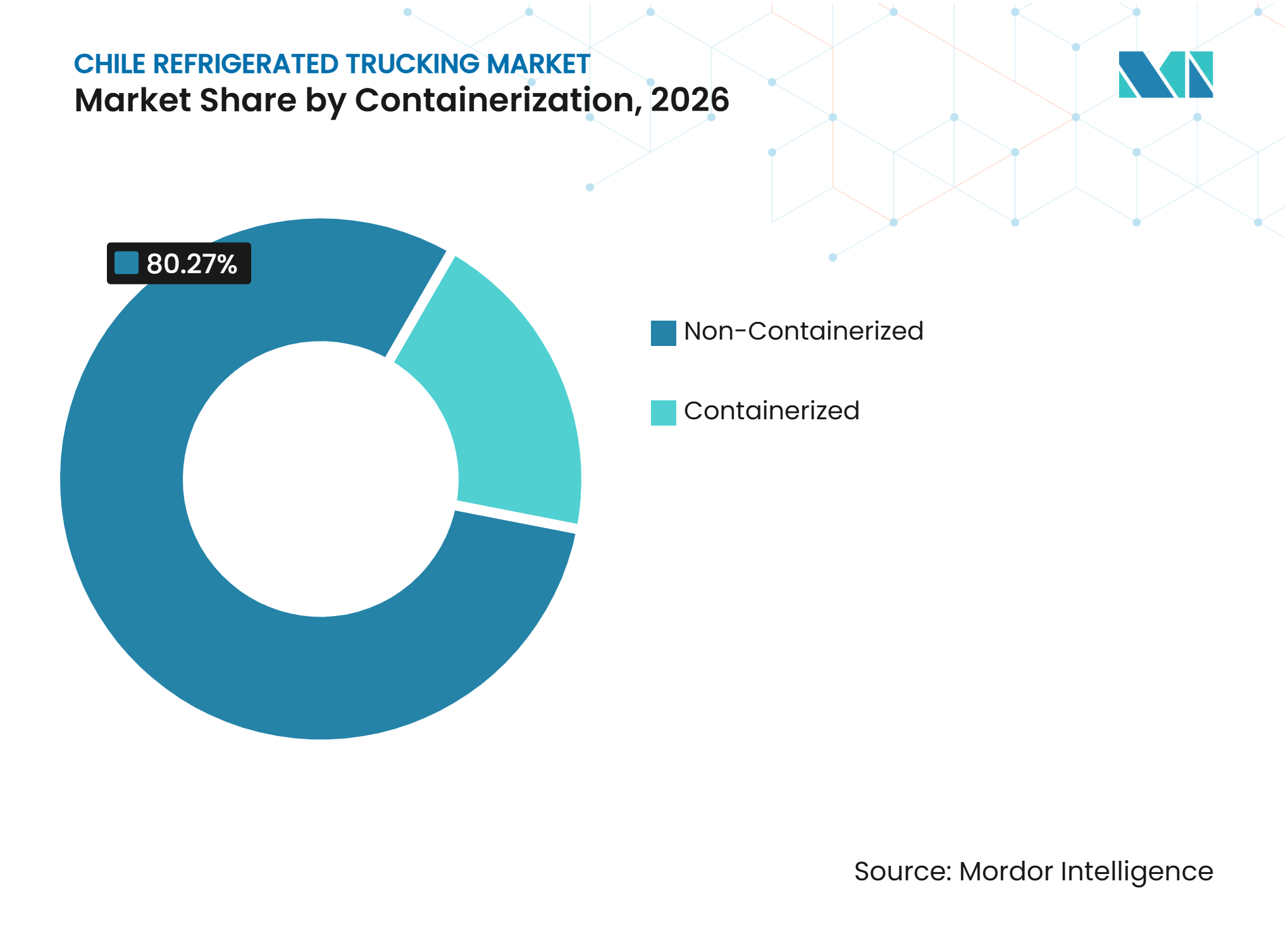
Conventional Trailers Lead While Port-Linked Containers Gain UseNon-containerized refrigerated transport accounts for 80.27% of the Chile refrigerated trucking market size in 2026 and remains the principal format for domestic food distribution. Insulated trailers serve meat processors, dairy distributors, and retail chains that do not require ISO container compatibility. This format fits direct deliveries between plants, warehouses, stores, and food-service sites. It also gives carriers flexibility to serve regional routes that are not connected to ports.
Containerized refrigerated transport is projected to register a 6.83% CAGR through 2032. It is supported by export container flows and by the use of combined maritime and road movements under one cold-chain process. Global Reefers adopted the DCSA Reefer Events standard in 2025 to improve visibility across Chilean cherry export journeys. The standard supports structured information on temperature, humidity, and cold-treatment events. As data standards and plug infrastructure expand, containerized road movements can become more practical for exporters. Conventional trailers will continue to dominate domestic traffic because of their established role in local distribution.

By Distance:
Long-Haul Routes Dominate While Urban Refrigerated Trips IncreaseLong-haul refrigerated trucking accounts for 68.52% of the Chile refrigerated trucking market size in 2026 because Chile’s production areas and consumption centers are far apart. Routes from Patagonian salmon farms and northern grape regions to Santiago or Pacific ports can exceed 500 kilometers in one direction. These routes support export movements and long-distance transfers to cold storage and processing centers.
Short-haul refrigerated transport is projected to register an 8.65% CAGR through 2032. Food delivery platforms, retail replenishment, and pharmaceutical distribution are increasing demand for sub-100-kilometer trips within metropolitan areas. This is changing the fleet requirements of urban operators. Walmart Chile and Sunswap deployed diesel-free refrigerated units on routes connecting Santiago, La Serena, and Concepción in 2025-2026. Sunswap reported refrigeration operating costs up to 81% lower than diesel on these operations. Chile’s solar resource can extend the operating range of solar-assisted refrigeration and lower charging costs for vehicles returning to depots at night. This configuration is more suitable for short urban routes than for long-distance export corridors. It can lower the operating threshold for refrigerated delivery in dense markets. Long-haul vehicles will remain essential because geography continues to require long-distance movement between production zones, ports, and major cities.
By Destination:
Domestic Supply Chains Lead While Cross-Border Corridors ExpandDomestic movements account for 70.64% of the Chile refrigerated trucking market size in 2026 because local trips form the first part of almost every export chain. Packhouse-to-storage, storage-to-port, and retail distribution movements produce a large share of freight activity. Domestic operations also serve food processors and urban retailers that do not ship internationally.
Cross-border shipments are projected to register an 8.89% CAGR through 2032. Their growth reflects trade with Argentina, Bolivia, and Peru, as well as inland transport supporting consolidated maritime exports. The Chile refrigerated trucking industry benefits when domestic transport links effectively with international cold-chain services. Citikold and Seaboard Marine launched a direct cold-freight service from Chile to the United States in March 2025, connecting San Antonio with major North American ports. This service creates additional requirements for inland refrigerated collection and delivery. InvestChile identified the Bi-oceanic Road Corridor as a possible route for connecting central-western Brazil and landlocked South American countries with northern Chilean ports.
By Temperature Type:
Frozen Loads Anchor Revenue While Deep-Frozen Freight RisesThe frozen temperature band from -20 to 0 °C accounts for 45.69% of the Chile refrigerated trucking market share in 2026. Frozen salmon, berries, poultry, and protein products support this position. These products require reliable temperature control through transfers between processors, stores, ports, and distribution centers.
Deep-frozen and ultra-low-temperature freight is projected to register a 7.87% CAGR through 2032. The faster growth reflects cold-treatment requirements for cherries exported to China and demand for premium seafood and specialty biologics. Chilled transport continues to support fresh fruit, dairy, and pharmaceutical distribution. Chile’s cherry cold-treatment requirements include holding containers below -1 °C for at least 15 days for the cited China-bound movement. These requirements increase the importance of monitored container and truck handoffs. Ambient-controlled freight is smaller but can earn higher revenue per kilometer for goods such as premium chocolate and wine. DHL Supply Chain Chile began a logistics partnership with Lindt in July 2026 that maintains chocolate at 14 °C with a permitted variation of 2 °C.
Geography Analysis
Central Chile accounts for 45.76% of the Chile refrigerated trucking market share in 2026. Its position comes from Santiago’s large consumption base, food processing in O’Higgins and Maule, and access to San Antonio. DP World projected 14,800 TEUs of cherry exports for the 2025-2026 season and increased refrigerated-container capacity to 5,350 units[4]. Emergent Cold LatAm’s Maipú facility adds automated storage capacity close to the metropolitan distribution network. Grocery e-commerce is also concentrated in Santiago, which handles more than 40% of national deliveries and exceeds 1 million shipments each day during peak periods. This favors multi-stop refrigerated routes and less-than-truckload delivery models.
Southern Chile is projected to expand at an 8.64% CAGR from 2027 to 2032. Salmonid production across Biobío, Los Lagos, Los Ríos, and Araucanía provides the main demand base. Biobío channels 52.5% of national salmon volumes, with salmonid FOB values above USD 2,556 million each year. The area continues to attract logistics investment because it connects salmon production with container terminal capacity. Emergent Cold LatAm’s Talcahuano terminal handled more than 60,000 tons of cargo in 2025. EFE’s review of refrigerated rail services from Frutillar to Biobío could shift a portion of long-distance cargo from roads. Trucking operators will retain an important role in connecting farms, plants, rail points, and ports.
Northern Chile and Patagonia or Extreme South have smaller established bases but distinct sources of refrigerated freight demand. Northern Chile supplies citrus, table grapes, and avocados through Iquique and Coquimbo. Terminal Puerto Coquimbo recorded its third consecutive year of regular citrus export operations in May 2026. The Bi-oceanic Road Corridor could increase northbound refrigerated traffic if investment and regulatory progress enable new transshipment capacity. Road conditions, weather, and limited refrigerated fuel infrastructure constrain Patagonia and Extreme South. HMM’s first ultra-reefer export of fresh sea urchins from Punta Arenas to Yokohama shows an early connection between southern marine products and premium Asian demand. Future growth in both areas depends on reliable nodes for temperature control and cross-border coordination.
Competitive Landscape
Market Concentration
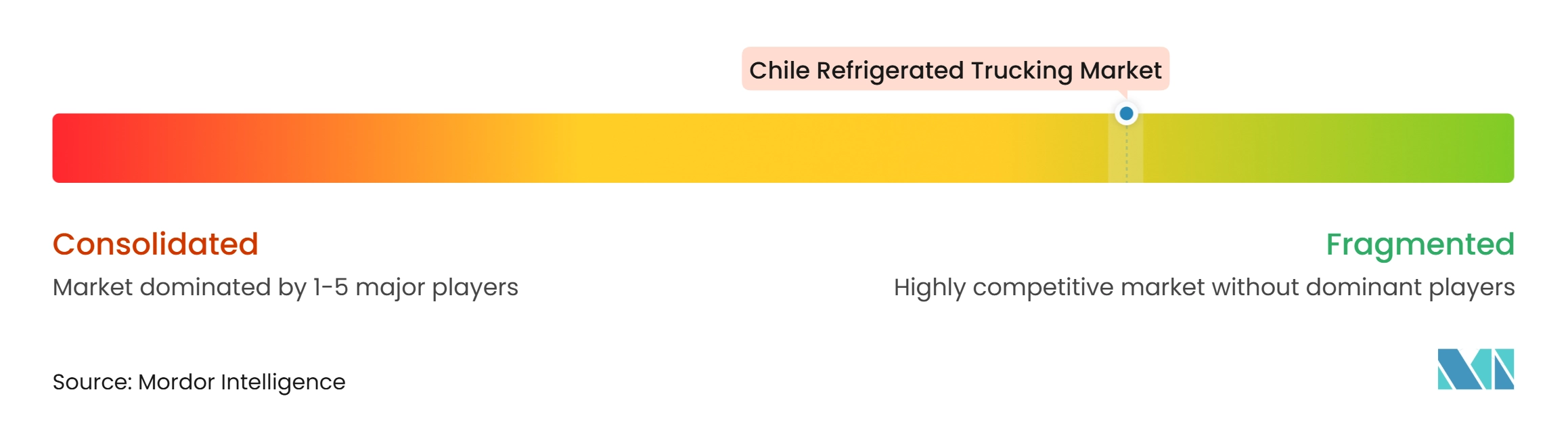
The Chile refrigerated trucking market is fragmented. International logistics operators compete through network coverage, technology, and compliance systems. Regional specialists compete through local route density and pricing. Emergent Cold LatAm ranked first among Latin American cold-chain operators in 2025, with 179 million ft³ of capacity. Its storage sites create demand for contracted refrigerated transport and make warehouse-to-road connections important. DHL, DSV, Kuehne+Nagel, and CEVA Logistics pursue integrated contracts that combine storage, transport management, and visibility tools. This can be particularly relevant to pharmaceutical and retail customers that require standardized procedures across several nodes.
CEVA expanded the operating scope of its Chilean entity in July 2025 to include domestic and international transport management and freight forwarding. Cold Chile SA, operating as IceStar, acquired Mega Frío Chile in April 2025. The transaction expanded storage capacity to 1.1 million m³ and added a national cold-chain transport network. This gives IceStar stronger coverage from Iquique to Puerto Montt. These moves show that larger operators are building broader storage and transport positions rather than competing only as truck providers.
Technology is becoming a practical competitive factor alongside fleet size. CEVA Logistics Chile launched an AI and drone inventory pilot in May 2025 and reported a 10x productivity improvement over traditional manual methods. Better inventory accuracy can support perishable order handling in cold storage. DHL Supply Chain Chile also formed a temperature-controlled logistics partnership with Lindt in July 2026, covering receipt, storage, and distribution. White-space opportunities remain in pharmaceutical-grade regional networks, food-delivery consolidation, and deep-frozen transport to northern mining camps. Capital needs for refrigerated fleet maintenance and Chile’s geography create entry barriers.
Chile Refrigerated Trucking Industry Leaders
-
Transportes Nazar
-
Transportes Casablanca
-
LDT Chile SA (Frío Chile)
-
DHL Group
-
DSV AS (Including DB Schenker)
- *Disclaimer: Major Players sorted in no particular order
Chile Refrigerated Trucking Market Companies Covered in this Report
- Transportes Nazar
- Transportes Casablanca
- Emergent Cold LatAm
- LDT Chile SA (Frío Chile)
- Loginsa
- Cold Chile SA (IceStar)
- Transportes Interandinos SA
- Transportes Generales Transgesa SA
- DHL Group
- DSV AS (Including DB Schenker)
- Kuehne+Nagel International AG
- CEVA Logistics
- Tudefrigo Chile SA
- Frigoríficos Puerto Montt SA (FPM Logistic)
- Transportes Ossa
- American Container Line Chile
- Bravo Transportes
- Travel Trans
- Transportes Sepúlveda
- Friotrans
- Ruta Águila
- Transportes Zúñiga
Recent Industry Developments in Chile Refrigerated Trucking Market
- July 2026: DHL Supply Chain Chile signed a cold-chain logistics partnership with Lindt, covering receipt of imported chocolate, storage at 14 °C, with a permitted variation of 2 °C, real-time temperature monitoring, order preparation, and distribution to Lindt’s retail stores, e-commerce channels, and retail partners across Chile.
- June 2026: Emergent Cold LatAm commissioned 2 new blast-freezing tunnels in San Antonio, capable of processing more than 10,500 tons of frozen food annually using CO₂ refrigeration technology. The project forms part of the company’s USD 500 million Chile investment program.
- April 2026: Trailer Logistics deployed Sunswap's battery-powered electric refrigeration systems within Walmart Chile's distribution network, supporting temperature-controlled freight movements between Santiago, La Serena, and Concepción. The deployment introduced diesel-free transport refrigeration into commercial operations, supporting fleet decarbonization and reduced refrigeration operating costs.
- March 2025: Emergent Cold LatAm inaugurated Latin America’s largest automated cold-storage facility in Maipú, Santiago. The USD 35 million investment uses high-capacity automated pallet systems to provide 33,000 pallet positions and received EDGE Zero Carbon certification in 2026.
Chile Refrigerated Trucking Market Report Scope
Segmentation Overview
| Horticultural Products |
| Dairy and Frozen Dessert Products |
| Meats, Poultry, Fish, and Seafood |
| Processed Food Products |
| Healthcare and Pharmaceutical |
| Other Applications |
| Full-Truckload (FTL) |
| Less-than-Truckload (LTL) |
| Containerized |
| Non-Containerized |
| Long Haul |
| Short Haul |
| Domestic |
| Cross-border |
| Chilled (0–5 °C) |
| Frozen (-20–0 °C) |
| Ambient |
| Deep-Frozen / Ultra-Low (Less than -20 °C) |
| Northern Chile (Antofagasta, Tarapacá, Atacama, Arica and Parinacota) |
| Central Chile (Santiago Metropolitan Region, Valparaíso, Coquimbo, O’Higgins, Maule) |
| Southern Chile (Biobío, Araucanía, Los Lagos, Los Ríos) |
| Patagonia / Extreme South (Aysén, Magallanes) |
| By Application | Horticultural Products |
| Dairy and Frozen Dessert Products | |
| Meats, Poultry, Fish, and Seafood | |
| Processed Food Products | |
| Healthcare and Pharmaceutical | |
| Other Applications | |
| By Truckload Specification | Full-Truckload (FTL) |
| Less-than-Truckload (LTL) | |
| By Containerization | Containerized |
| Non-Containerized | |
| By Distance | Long Haul |
| Short Haul | |
| By Destination | Domestic |
| Cross-border | |
| By Temperature Type | Chilled (0–5 °C) |
| Frozen (-20–0 °C) | |
| Ambient | |
| Deep-Frozen / Ultra-Low (Less than -20 °C) | |
| By Region | Northern Chile (Antofagasta, Tarapacá, Atacama, Arica and Parinacota) |
| Central Chile (Santiago Metropolitan Region, Valparaíso, Coquimbo, O’Higgins, Maule) | |
| Southern Chile (Biobío, Araucanía, Los Lagos, Los Ríos) | |
| Patagonia / Extreme South (Aysén, Magallanes) |
Key Questions Answered in the Report
What is the forecast growth rate for refrigerated trucking in Chile?
The sector is projected to register a 5.70% CAGR from 2027 to 2032, reaching USD 873.76 million by 2032.
Which application generates the largest share of refrigerated trucking demand in Chile?
Horticultural products lead with a 29.76% revenue share in 2026, supported by export movements of cherries, grapes, kiwis, and berries.
Which refrigerated trucking service is growing fastest in Chile?
Cross-border movements have the highest projected growth rate at an 8.89% CAGR through 2032.
Why is pharmaceutical refrigerated transport expanding in Chile?
Pharmaceutical logistics is projected to register a 7.76 % CAGR because regulated medicines require qualified vehicles, monitoring, and documented temperature control.
Which region leads Chile’s refrigerated trucking activity?
Central Chile leads with a 45.76% share in 2026 because it combines Santiago demand, agricultural processing, and access to San Antonio.
How are carriers reducing refrigeration operating costs in Chile?
Operators are testing diesel-free refrigerated units, and Sunswap reported operating cost reductions of up to 81% compared with diesel on selected Chilean routes.