
Chile Ocean Freight Transport Market Size and Share
Market Overview
| Study Period | 2021 - 2032 |
|---|---|
| Forecast Data Period | 2027 - 2032 |
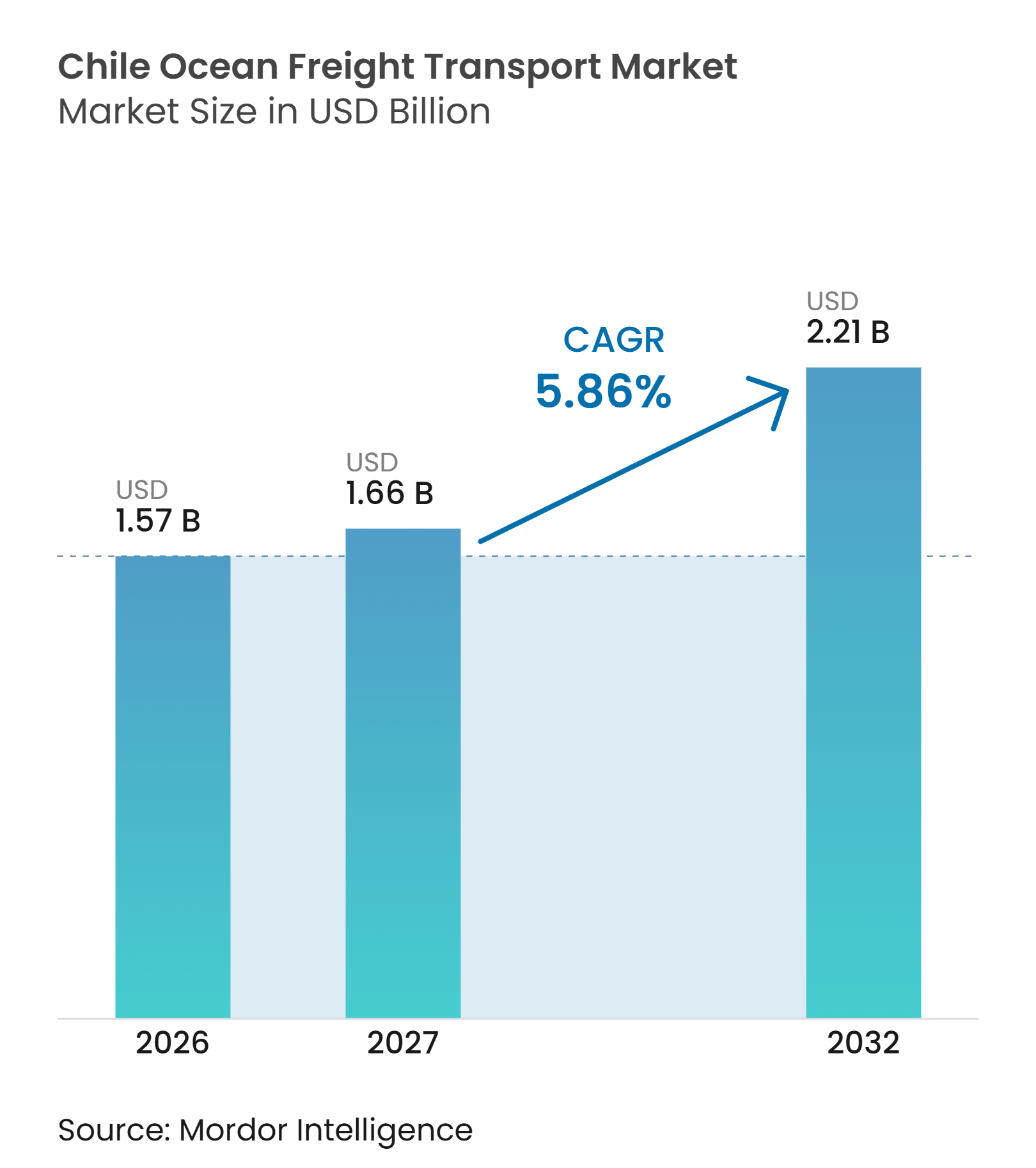
| Base Year Market Size (2026) | USD 1.57 Billion |
| Market Size (2027) | USD 1.66 Billion |
| Market Size (2032) | USD 2.21 Billion |
| Growth Rate (2027 - 2032) | 5.86 % |
| Market Concentration | High |
Major Players *Disclaimer: Major Players sorted in no particular order Image © Mordor Intelligence. Reuse requires attribution under CC BY 4.0. | |
Chile Ocean Freight Transport Market Analysis by Mordor Intelligence
The Chile ocean freight transport market size is valued at USD 1.57 billion in 2026, is projected to reach USD 1.66 billion in 2027, and reach USD 2.21 billion by 2032, registering a CAGR of 5.86% from 2027 to 2032.
Chile depends heavily on sea routes for foreign trade, which gives the Chile ocean freight transport industry a stable demand base. Maritime foreign trade reached 115 million tons in 2025, while its value increased 7.6% to USD 155.86 billion. Mining exports, refrigerated fruit shipments, and containerized imports are supporting cargo volumes across the country. New direct services to Asia and capacity investment in central ports are improving Chile’s access to major trade routes. Compliance costs, fuel price changes, and port disruptions may affect freight rates and reliability, although they do not change the underlying need for ocean transport.
Key Report Takeaways
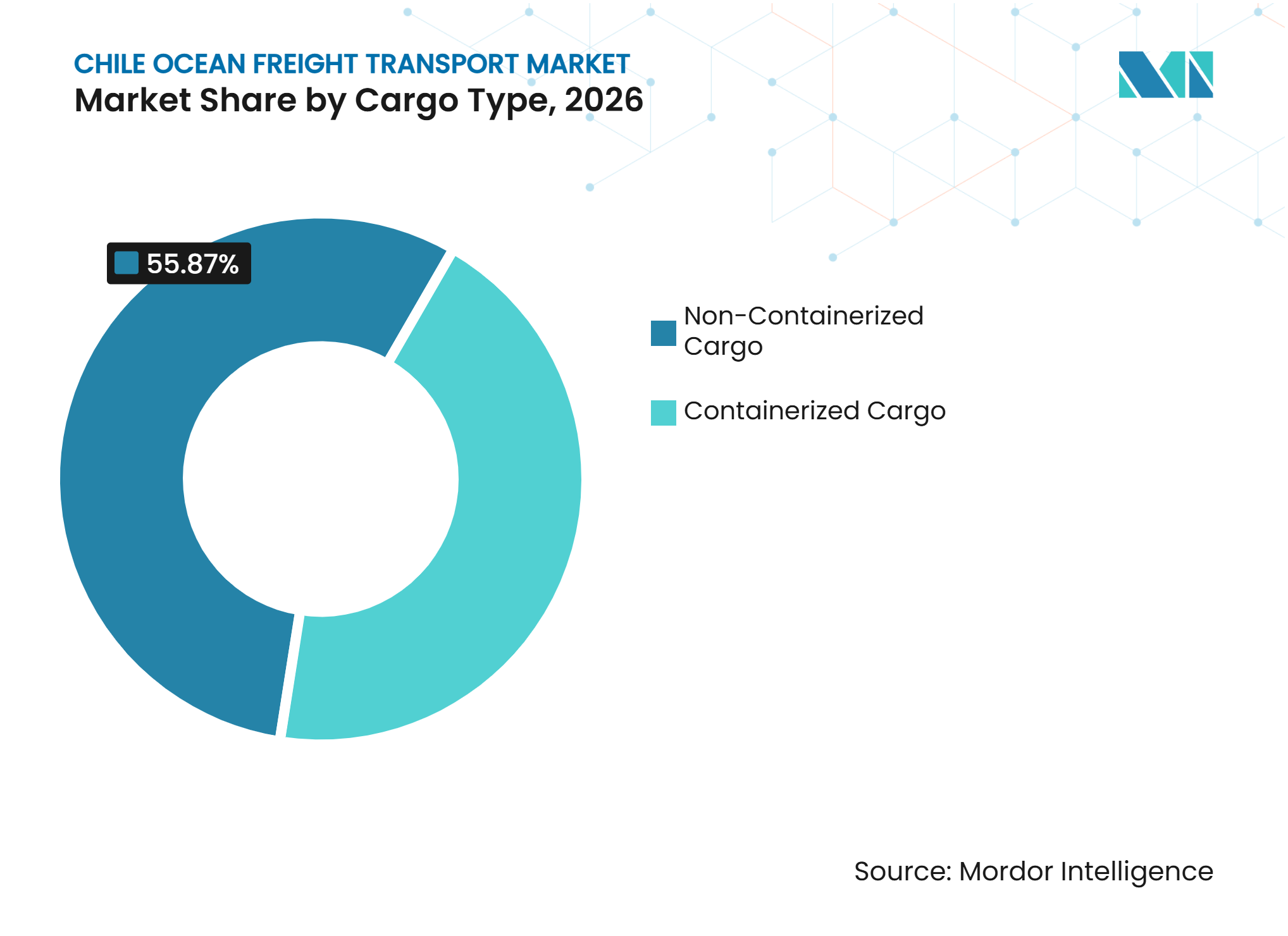
- By cargo type, non-containerized cargo accounts for 55.87% of Chile ocean freight transport market share in 2026, while containerized cargo shipments are projected to register a 7.12% CAGR through 2032.
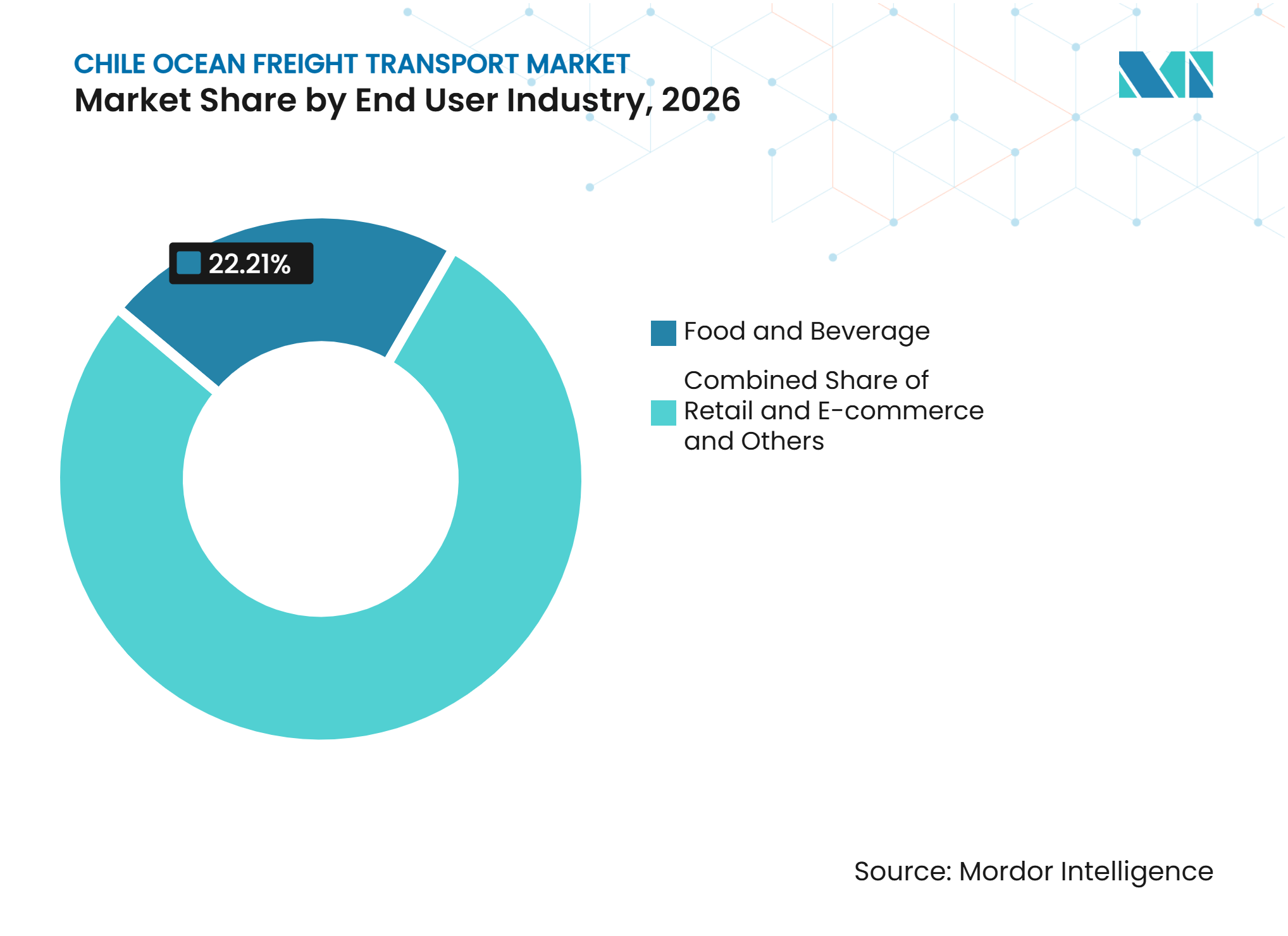
- By end-user industry, food and beverage accounts for 22.21% of the Chile ocean freight transport market size in 2026, while retail and e-commerce shipments are projected to register a 7.87% CAGR through 2032.
- By region Northern Chile accounts for 41.64% of the Chile ocean freight transport market share in 2026, while Central Chile shipments are projected to register an 8.54% CAGR through 2032.
Note: Market numbers in this report are based on Mordor Intelligence's proprietary estimation framework, which combines nine months of actuals with Q4 projections for base year 2026.
Market Trends and Insights
Drivers Impact Analysis of Chile Ocean Freight Transport Market*
| Driver | (~) % Impact on CAGR Forecast | Geographic Relevance | Impact Timeline |
|---|---|---|---|
| Maritime Trade Growth and Container Freight Volumes | +1.3% | National, with San Antonio and Valparaíso as primary hubs | Medium term (2-4 years) |
| Mining Exports and Bulk and Container Capacity Demand | +1.4% | Northern Chile, including Antofagasta, Mejillones, Patillos, and Caldera | Long term (≥ 4 years) |
| Reefer Exports and Temperature Controlled Shipping | +0.8% | Central Chile, with seasonal activity in Iquique | Short term (≤ 2 years) |
| Port Modernization and Cargo Handling Capacity | +0.7% | National, with early gains in San Antonio, Valparaíso, Antofagasta, and Mejillones | Long term (≥ 4 years) |
| Asia Pacific Connectivity and Direct Shipping Networks | +0.6% | National, concentrated in San Antonio, Arica, and Iquique | Medium term (2-4 years) |
| Port Digitalization and Cargo Coordination | +0.5% | National, with early implementation in Valparaíso, San Antonio, Antofagasta, and Mejillones | Medium term (2-4 years) |
| Source: Mordor Intelligence | |||
Maritime Trade Growth: Increasing Containerized Freight Volumes
National container movement increased 11.4% in 2025. Import TEUs reached 1,552,080, while transit TEUs rose 26.8%. The increase on both sides of trade gives the Chile ocean freight transport market broader support than a recovery led only by exports. Electric vehicles, accumulators, and electric motors have become important import cargo groups by value. This shift is changing demand for containers because these products require organized import supply chains rather than traditional bulk handling. The growth in transit cargo also supports Chile’s position in regional logistics connections with Bolivia and neighboring South American markets. Port modernization and better cargo coordination are needed to handle this larger and more varied flow without increasing dwell times.
Mining Exports Expanding Bulk and Container Capacity Demand
Mining exports remain a core source of cargo demand in the Chilean ocean freight transport market. Copper ores and concentrates were the largest export product by tonnage through Chilean ports in 2025. The northern ports handle mining flows that require dry bulk, liquid bulk, project cargo, and selected container capacity. Copper cathode export values grew faster than concentrate values during January through October 2026, which supports a gradual move toward more semi-processed material moving in containers. This creates demand across both major cargo types rather than allowing carriers to plan for mining traffic as only bulk cargo. Lithium supply chains add another layer because exports require dedicated imports of soda ash and industrial chemicals. Capacity planning in Antofagasta and Mejillones therefore needs to consider both mineral exports and inbound materials for mine operations.
Reefer Exports: Increasing Temperature-Controlled Shipping Requirements
Chile’s fresh fruit exports create strong seasonal demand for refrigerated containers and reliable vessel schedules. Food exports reached USD 12.46 billion in the first half of 2025, and cherry exports contributed USD 2.243 billion[1]. Refrigerated cargo volume rose 11.2% in 2025, exceeding the growth rate of other cargo categories. The short export season concentrates demand for reefer equipment, technicians, power connections, and vessel space. Global Reefers adopted the DCSA Reefer Events 1.0 Beta standard, which uses shared data standards for shipment condition updates. Carriers are also using controlled atmosphere and real-time monitoring systems to offer more dependable cold-chain services. These operating requirements give established providers an advantage when exporters need reliable temperature monitoring and fast transit to Asia.
Asia Pacific Connectivity Strengthening Direct Shipping Networks
The ACSA 1 service began in June 2025 as Chile’s first direct weekly connection to Asia from San Antonio. The service connects San Antonio with Busan, Shanghai, and Ningbo and handles 4,000 containers each week. It reduces dependence on relay ports and shortens transit time for time-sensitive cargo. MSC also introduced the Alpaca service in 2025, serving Arica, Iquique, and San Antonio as part of its Far East to South America West Coast route. A reconfigured service from PIL, Wan Hai, and Yang Ming added San Antonio as a direct call in 2025. The added services give shippers more route choices, but they also increase competition for cargo and slots on the Far East to West Coast South America corridor. The Chile ocean freight transport market benefits when direct networks support both container imports and fruit exports.
Restraints Impact Analysis of Chile Ocean Freight Transport Market*
| Restraint | (~) % Impact on CAGR Forecast | Geographic Relevance | Impact Timeline |
|---|---|---|---|
| Bunker Cost Volatility and Shipping Operating Expenses | -0.7% | Global, with direct pass-through to Chile-bound freight rates | Short term (≤ 2 years) |
| Decarbonization Requirements and Environmental Compliance Costs | -0.5% | Global, with greater exposure for European-flagged carriers serving Chile | Long term (≥ 4 years) |
| Modal Competition for Selected Cargo | -0.3% | National, including northern inland rail and air freight for perishables | Medium term (2-4 years) |
| Port Congestion and Labor Disruptions | -0.4% | Central Chile, including San Antonio and Valparaíso, and northern Chile, including Iquique and Angamos | Short term (≤ 2 years) |
| Source: Mordor Intelligence | |||
Bunker Cost Volatility Increasing Shipping Operating Expenses
Fuel costs remain a source of uncertainty for carriers serving Chile. The global nature of carrier fleets means operating costs from other trade routes can affect the prices paid by Chilean shippers. European rules reached full cost coverage under the EU Emissions Trading System in January 2026, raising the compliance burden on voyages touching Europe. Major carriers serving Chile use globally connected fleets so that bunker adjustment factors can pass higher costs through multiple shipping lanes. This limits the ability of the Chile ocean freight transport industry to offer lower rates for price-sensitive cargo such as dry bulk and breakbulk. Air freight and rail can also compete for selected cargo, particularly high-value perishables and inland mining supply flows. Port congestion and labor disruptions add further costs when vessels must wait, divert, or revise schedules.
Decarbonization Requirements Increasing Environmental Compliance Costs
The International Maritime Organization approved its Net Zero Framework at MEPC 83 in April 2025, and it is scheduled to enter into force in 2027[2]. The framework introduces fuel-intensity requirements for ocean-going vessels above 5,000 gross tonnage. It sets reduction targets of 4% by 2028, 8% by 2030, and 16.8% by 2032. The rules will increase the importance of fuel choices, vessel efficiency, and compliant fleet renewal. Chilean ports do not yet have large-scale bunkering infrastructure for LNG or methanol, which adds practical challenges for vessels using alternative fuels. The Maersk Tokyo made its first call at San Antonio Terminal Internacional in August 2026 as the first methanol-fueled vessel at the terminal. The transition may favor operators with modern fleets and sufficient capital to manage new compliance requirements.
*Our forecasts treat driver/restraint impacts as directional, not additive. The impact forecasts reflect baseline growth, mix effects, and variable interactions.
Chile Ocean Freight Transport Market Segment Analysis
By Cargo Type:
Non-Containerized Cargo Leads, While Containerized Cargo Gains PaceNon-containerized cargo accounts for 55.87% of the Chile ocean freight transport market share in 2026. Dry bulk minerals, liquid bulk hydrocarbons, and breakbulk project cargo support its leading position. Copper ore, concentrates, iron ore, and salt continue to supply large volumes to northern terminals. The Mejillones Port Complex handled 6.7 million tons in 2025, a 16% increase from the previous year. Metallic copper shipments increased 4%, and the port also opened a new mineral concentrate loading site. Liquid bulk demand is supported by petroleum imports and sulfuric acid supply chains used by copper mines. Project cargo for lithium and renewable energy infrastructure also supports breakbulk activity in the Atacama and Antofagasta regions. ATI Antofagasta recorded 13% growth in this cargo category during 2025.
Containerized cargo is projected to register a 7.12% CAGR through 2032, making it the fastest-growing cargo type. Reefer volumes rose 11.2% in 2025 as demand grew for manufactured goods, electric vehicles, and consumer electronics. This growth is changing the cargo mix within the Chile ocean freight transport market. Copper cathodes are increasingly relevant to container demand because they are more likely than concentrates to move in containers. Chilean forwarders are also applying data standards for refrigerated cargo, which supports quality control for fruit shipments. Temperature-controlled operations need consistent power supply, equipment availability, and traceable condition data. These conditions favor carriers that can combine equipment access with established digital monitoring services.



By End-User Industry:
Food and Beverage Provides the Largest Base, While Retail and E-Commerce Expand FastestFood and beverage accounts for 22.21% of the Chile ocean freight transport market size in 2026. Fresh fruit, salmon, seafood, wine, dairy, and other agri-food exports require regular access to container and reefer capacity. Food exports reached USD 12.46 billion in the first half of 2025. The Cherry Express season shows how food exports can concentrate cargo demand in a short period. DP World increased refrigeration technicians by 20% and added remote monitoring support for more than 450 connected reefer containers for the 2025 to 2026 season. The category also creates import demand for wheat, vegetable oils, and processing inputs. This mix helps food shipments support vessel utilization in both directions.
Retail and e-commerce is projected to register a 7.87% CAGR through 2032. Cross-border parcel imports exceeded 50 million packages in 2025, driven by platforms including AliExpress, Shein, and Temu. Many of these goods arrive in consolidated ocean containers before local delivery. Chile extended 19% value-added tax coverage to foreign digital-platform purchases in October 2025, bringing more low-value purchases into formal customs processes[3]. Formal customs treatment can improve shipment visibility for carriers and logistics providers. Electronics, pharmaceuticals, chemicals, machinery, and automotive cargo add further support to import demand. The segment’s growth depends on port processing capacity, customs coordination, and predictable delivery schedules after containers reach Chile.

Geography Analysis
Northern Chile holds 41.64% of the Chile ocean freight transport market share in 2026. Antofagasta, Mejillones, Iquique, Arica, Caldera, and Patillos serve mining supply chains that handle copper concentrates, metallic copper, iron ore, and lithium-related cargo. Copper ores and concentrates were the largest export product at Chilean ports by tonnage during January through October 2025. The region also needs inbound soda ash, fuel, machinery, and industrial chemicals for mining operations. Puerto Antofagasta’s capacity plan and the La Negra logistics project show that operators are preparing for larger inland and maritime cargo movements. Puerto Angamos introduced the Heyport vessel-planning platform in September 2025, replacing manual scheduling with a shared online system for berth windows and vessel coordination. This change can improve vessel planning at a terminal that supports major mining logistics. Capacity availability will remain important as copper cathodes and lithium-related cargo create more demand for containers alongside bulk flows.
Central Chile is projected to register an 8.54% CAGR through 2032. San Antonio and Valparaíso receive a high share of Asian imports and move refrigerated exports, which gives the area a broad mix of consumer, industrial, and agricultural cargo. STI San Antonio transferred 1,224,243 TEUs during 2025, and 73% of its imports originated in Asia[4]. ACSA 1 established a direct weekly route from San Antonio to Asia, which strengthens the port’s role in the Chile ocean freight transport market. The VUMAR platform is a key compliance and coordination measure because it standardizes arrival and departure procedures across Chilean ports. Research comparing Valparaíso and San Antonio with Rotterdam described the Chilean ports as being in transition to advanced port technologies. Digital twins, Port Community Systems, and single-window processes may improve use of existing facilities while larger expansion projects progress.
Southern Chile serves forestry, aquaculture, steel, and liquid bulk cargo through San Vicente, Puerto Montt, Lirquén, and Coronel. The region depends on refrigerated containers for salmon and trout exports, but it has fewer direct mainline calls than the central port cluster. This results in continued reliance on feeder services to San Antonio and San Vicente for some export flows. San Vicente reported a 57.3% increase in cargo tonnage in the first half of 2025, showing the effect of forestry and steel movements. Patagonia and the Extreme South have lower cargo density and depend more on ferry connections than international liner services. Naviera Austral assumed the Puerto Ibáñez to Chile Chico route in July 2025 after the previous operator’s contract ended. These areas can support specialized project cargo if infrastructure develops, but their freight patterns remain different from both northern mining exports and central container flows.
Competitive Landscape
Market Concentration
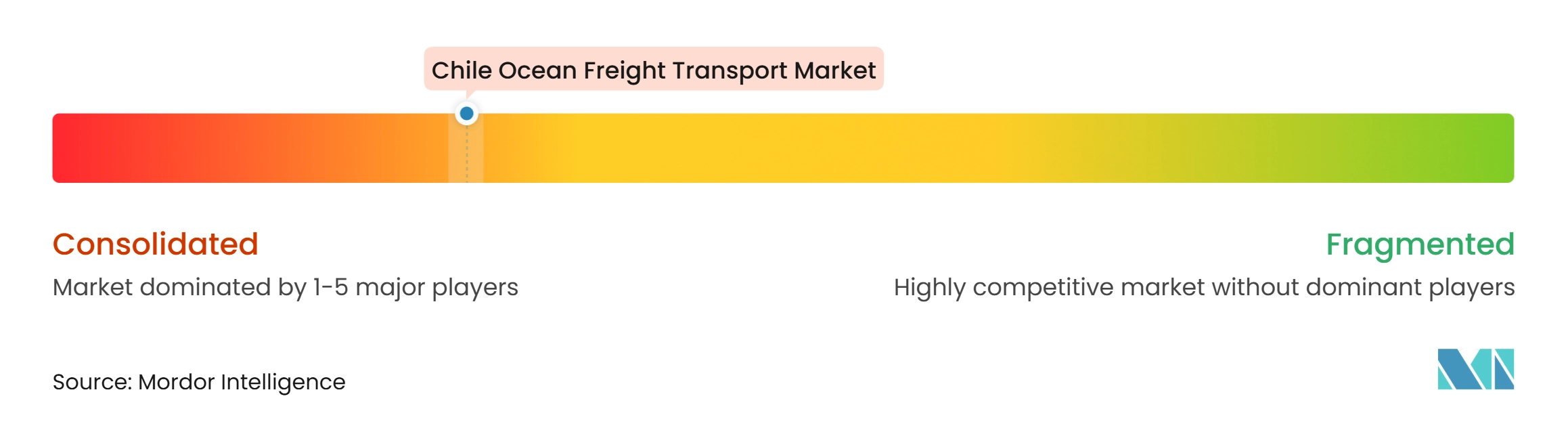
The Chile ocean freight transport market is consolidated. The largest carriers compete through network reach, reefer equipment, direct services, inland logistics, and fleet technology. Their scale helps them manage seasonal cherry-export demand and invest in modern vessels. Smaller operators can remain relevant in heavy-lift, dry bulk, and project cargo where global container carriers do not offer the same specialist service. Competition therefore differs by cargo type rather than following one common pattern across all freight activity.
MSC launched the Alpaca service in September 2025, offering a weekly Far East to South America West Coast route with calls at Arica, Iquique, and San Antonio. CMA CGM and DP World introduced ACSA 1 in June 2025, creating a direct weekly service from San Antonio to Asian ports. Maersk also expanded its Chilean logistics activity through a partnership with Sotraser Chile that uses electric trucks in Santiago and Antofagasta. These moves show that leading companies are competing through route design, inland cargo handling, and lower-emission operations. The new direct services provide exporters with alternatives, while adding pressure on carriers to retain cargo through reliability and transit time. Carrier decisions on reefer capacity remain particularly important because fruit exports require dependable service during a limited seasonal period.
Modern fleet requirements will influence the competitive structure of the Chile ocean freight transport market. MARPOL Annex VI requirements and the IMO Net Zero Framework increase the value of fuel-efficient vessels and compliance capability. Maersk Tokyo’s first call at San Antonio in August 2026 brought a methanol-fueled vessel to the terminal for the first time. This points to the operational changes ports and carriers must manage as alternative-fuel vessels appear on Chilean routes. Southern Chile and Patagonia remain less attractive to direct mainline calls because of limited infrastructure and dispersed cargo. Specialized carriers and regional logistics firms can retain a role in those areas and in breakbulk work. The Chile ocean freight transport industry remains competitive, but leading global carriers hold clear advantages in routes, fleet investment, and integrated service capability.
Chile Ocean Freight Transport Industry Leaders
-
Ultranav
-
Navimag Ferries
-
Naviera Austral SA
-
MSC Mediterranean Shipping Company SA
-
A.P. Moller - Maersk
- *Disclaimer: Major Players sorted in no particular order
Chile Ocean Freight Transport Market Companies Covered in this Report
- MSC Mediterranean Shipping Company SA
- A.P. Moller - Maersk
- Hapag-Lloyd AG
- CMA CGM SA
- COSCO SHIPPING Lines Co. Ltd
- Ocean Network Express
- Ultranav
- Evergreen Marine Corp.
- HMM Co. Ltd
- ZIM Integrated Shipping Services
- Yang Ming Marine Transport Corp.
- Wan Hai Lines
- Pacific International Lines
- Seaboard Marine
- Mitsui O.S.K. Lines
- Nippon Yusen Kabushiki Kaisha
- Wallenius Wilhelmsen
- Höegh Autoliners
- Oldendorff Carriers
- BBC Chartering
- Navimag Ferries
- Naviera Austral SA
Recent Industry Developments in Chile Ocean Freight Transport Market
- November 2026: PIL announced its Cherry Express 2026 service with six consecutive weekly sailings from November 20 through December 25. The service uses reefer containers no more than 5 years old and the PIL Cool telematics system for real-time temperature, humidity, and cargo-condition monitoring.
- August 2026: San Antonio Terminal Internacional received the inaugural call of the Maersk Tokyo, an 8,906-TEU methanol-propelled containership. This was the first methanol-fueled vessel to call at the terminal, and it was deployed on the AC3 Asia–West Coast South America service.
- July 2026: Maersk launched an integrated cold chain solution connecting Chilean produce exporters with the United States East Coast through ocean transportation, port handling, destination fumigation, inland transportation, and cold storage.
- May 2026: Evergreen Marine launched its new Peru–North Chile (PNC) container shipping service, connecting Chancay and Callao in Peru with Iquique and Arica in northern Chile. The service operates with a 2,500 TEU vessel on a fixed 14-day rotation, strengthening maritime connectivity with northern Chile and providing additional access to the Bolivian cargo market.
Chile Ocean Freight Transport Market Report Scope
Segmentation Overview
| Containerized Cargo | Dry |
| Reefer | |
| Non-Containerized Cargo | Dry Bulk Cargo |
| Liquid Bulk Cargo | |
| Breakbulk and General Cargo |
| Electronics and Semiconductors |
| Chemicals and Petrochemicals |
| Food and Beverage |
| Pharmaceuticals and Healthcare |
| Retail and E-commerce |
| Others |
| Northern Chile (Antofagasta, Tarapacá, Atacama, Arica and Parinacota) |
| Central Chile (Santiago Metropolitan Region, Valparaíso, Coquimbo, O’Higgins, Maule) |
| Southern Chile (Biobío, Araucanía, Los Lagos, Los Ríos) |
| Patagonia / Extreme South (Aysén, Magallanes) |
| By Cargo Type | Containerized Cargo | Dry |
| Reefer | ||
| Non-Containerized Cargo | Dry Bulk Cargo | |
| Liquid Bulk Cargo | ||
| Breakbulk and General Cargo | ||
| By End-User Industry | Electronics and Semiconductors | |
| Chemicals and Petrochemicals | ||
| Food and Beverage | ||
| Pharmaceuticals and Healthcare | ||
| Retail and E-commerce | ||
| Others | ||
| By Region | Northern Chile (Antofagasta, Tarapacá, Atacama, Arica and Parinacota) | |
| Central Chile (Santiago Metropolitan Region, Valparaíso, Coquimbo, O’Higgins, Maule) | ||
| Southern Chile (Biobío, Araucanía, Los Lagos, Los Ríos) | ||
| Patagonia / Extreme South (Aysén, Magallanes) | ||
Key Questions Answered in the Report
What is the expected value of the Chile ocean freight transport market by 2032?
The sector is projected to reach USD 2.21 billion by 2032, with a 5.86% CAGR from 2027 to 2032.
Which cargo type has the largest role in Chile’s ocean freight activity?
Non-containerized cargo leads with a 55.87% share in 2026, supported by mineral, liquid bulk, and breakbulk flows.
Which cargo type is expanding fastest in Chile?
Containerized cargo is projected to register a 7.12% CAGR through 2032, supported by reefer exports and manufactured imports.
What is driving container demand at Chilean ports?
Fresh fruit exports, cross-border e-commerce, electric vehicle imports, and direct Asia connections are increasing container demand.
Which Chilean region has the largest ocean freight share?
Northern Chile holds 41.64% in 2026 because of its mining export corridors and industrial supply chains.
Why is Central Chile important for ocean freight growth?
Central Chile is projected to register an 8.54% CAGR through 2032 as San Antonio and Valparaíso add direct Asia services and port capacity.