
Chile Less-than Truckload (LTL) Market Size and Share
Market Overview
| Study Period | 2021 - 2032 |
|---|---|
| Forecast Data Period | 2027 - 2032 |
| Base Year Market Size (2026) | USD 2.46 Billion |
| Market Size (2027) | USD 2.64 Billion |
| Market Size (2032) | USD 3.64 Billion |
| Growth Rate (2027 - 2032) | 6.69 % |
| Market Concentration | Low |
Major Players *Disclaimer: Major Players sorted in no particular order Image © Mordor Intelligence. Reuse requires attribution under CC BY 4.0. | |
Chile Less-than Truckload (LTL) Market Analysis by Mordor Intelligence
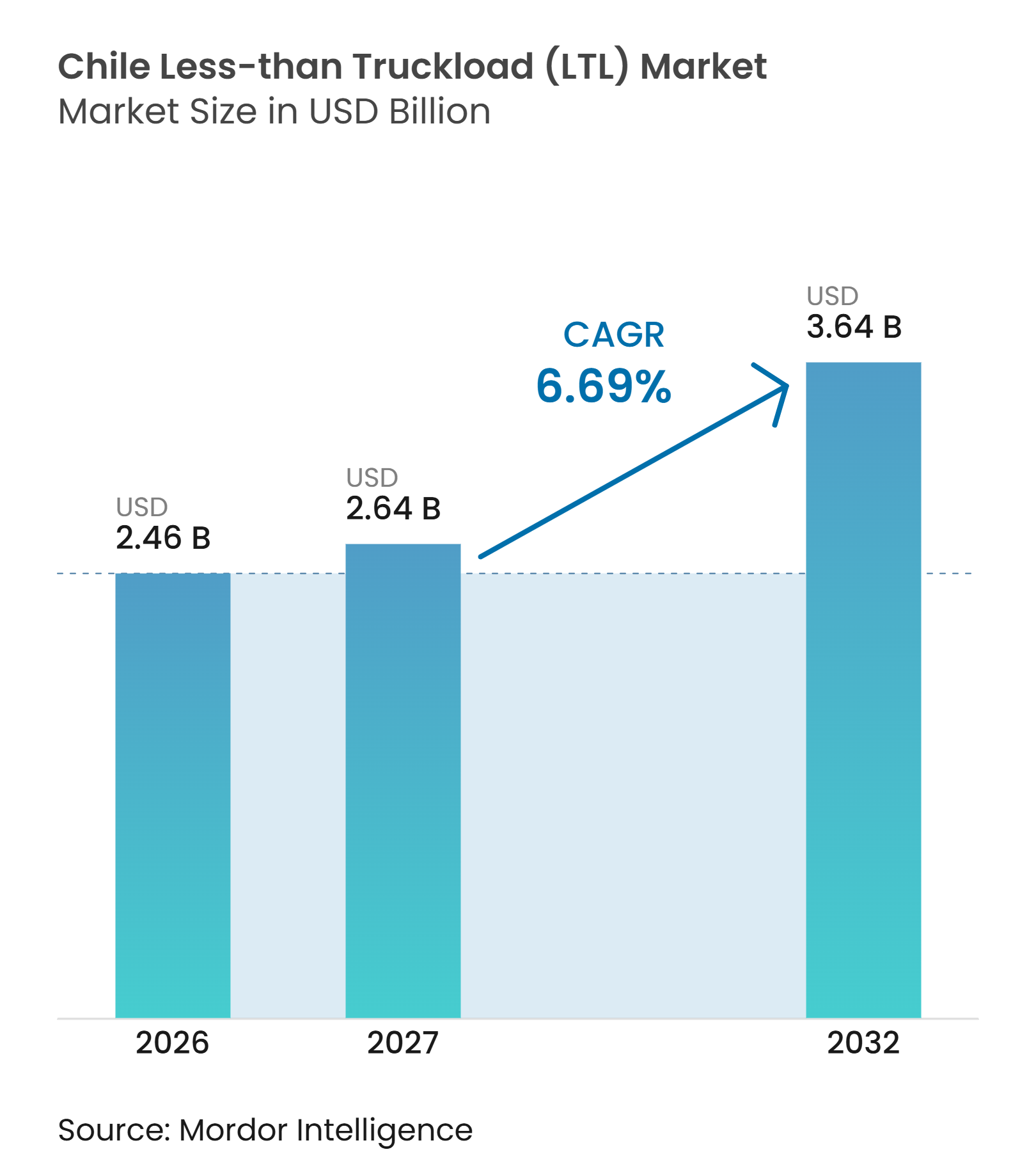
The Chile less-than-truckload (LTL) market size is valued at USD 2.46 billion in 2026 and is estimated to grow from USD 2.64 billion in 2027 to reach USD 3.64 billion by 2032, at a CAGR of 6.69% during the forecast period from 2027 to 2032.
Road freight carries more than 17 million tons of terrestrial cargo annually, and the Chile LTL market is gaining volume as shippers use consolidated, multi-stop services instead of dedicated full-truckload commitments. Chile’s geography supports this shift because its freight corridors span more than 4,000 kilometers from the Atacama Desert to Patagonia. At the same time, many shippers lack sufficient demand to fill a dedicated trailer across every route. E-commerce sales reached nearly USD 10 billion in 2025 and are expected to exceed USD 10.6 billion in 2026, increasing the volume of smaller replenishment and delivery movements that fit consolidated road networks. Public road investment and a mining project pipeline are also improving the conditions for the Chile LTL market, as more reliable corridors and industrial resupply requirements raise the value of route density and dependable multi-stop service.
Key Report Takeaways
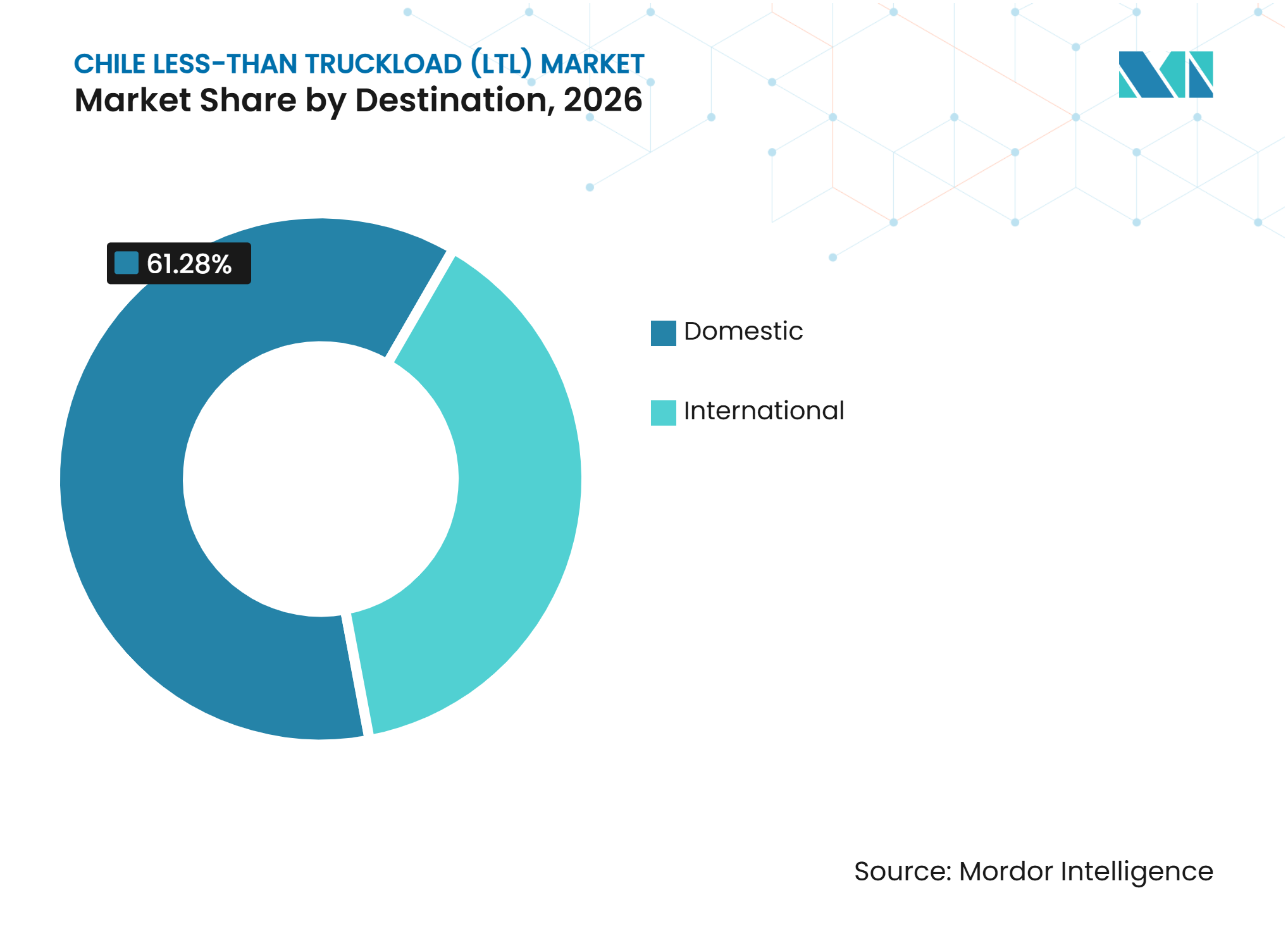
- By destination, domestic accounts for 61.28% of the Chile less-than-truckload (LTL) market size in 2026, while international shipments are projected to register an 8.87% CAGR through 2032.
- By temperature control, dry freight accounts for 93.74% of the Chile less-than-truckload (LTL) market share in 2026, while reefer freight is projected to register a 7.38% CAGR through 2032.
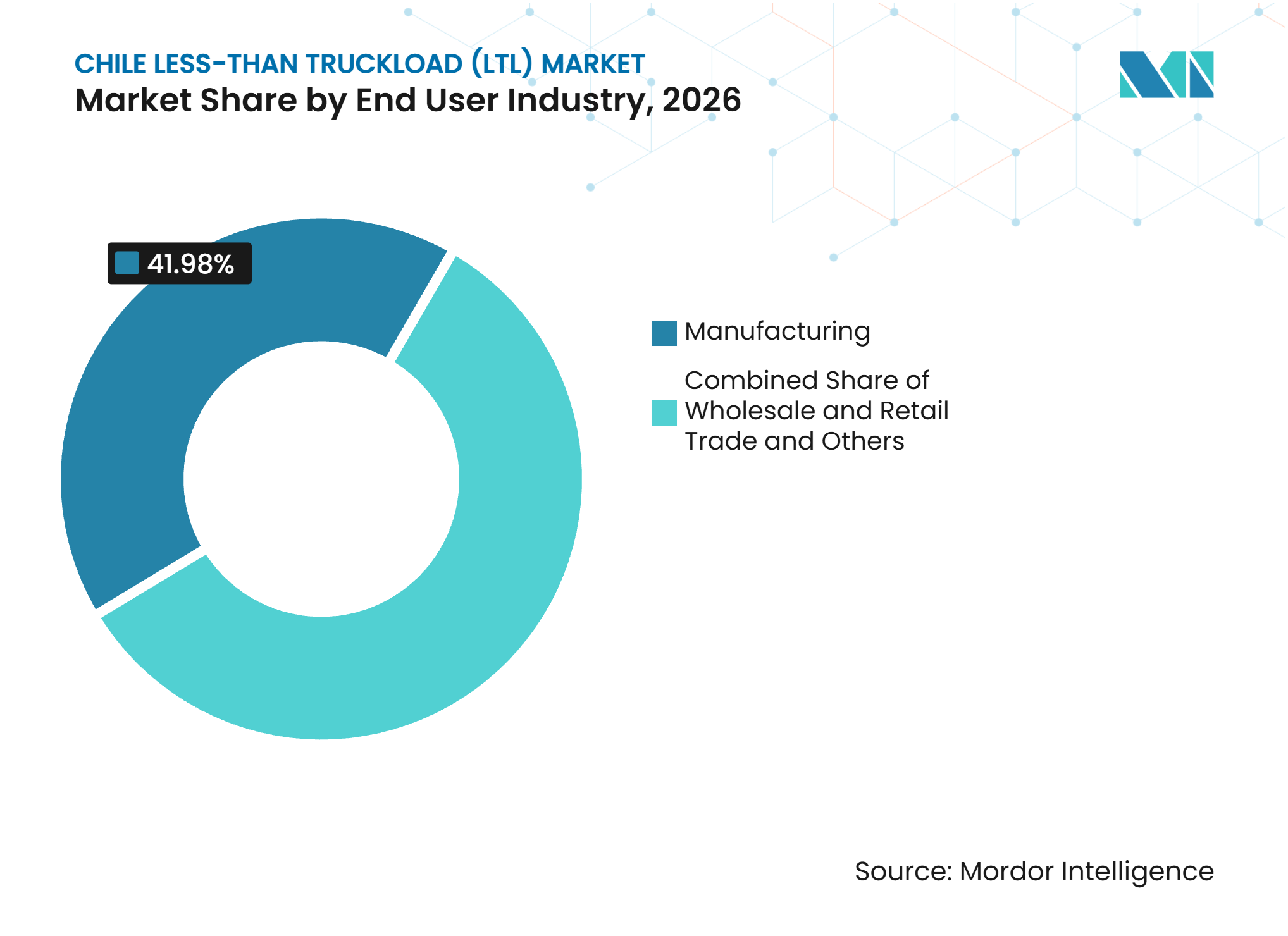
- By end-user industry, manufacturing accounts for 41.98% of the Chile less-than-truckload (LTL) industry size in 2026, while wholesale and retail trade are projected to register an 8.24% CAGR through 2032.
- By geography, Central Chile accounts for 54.39% of the Chile less-than-truckload (LTL) industry share in 2026, while Northern Chile is projected to register an 8.63% CAGR through 2032.
Note: Market numbers in this report are based on Mordor Intelligence's proprietary estimation framework, which combines nine months of actuals with Q4 projections for base year 2026.
Market Trends and Insights
Drivers Impact Analysis of Chile Less-than Truckload (LTL) Market*
| Driver | (~) % Impact on CAGR Forecast | Geographic Relevance | Impact Timeline |
|---|---|---|---|
| E-Commerce Growth Increasing Fragmented Shipment Volumes | +1.5% | National, strongest in Santiago Metropolitan, Valparaíso, and Concepción | Short term (≤ 2 years) |
| Highway Modernization Improving Regional LTL Network Reliability | +0.8% | National, most immediate in Central and Southern corridors | Medium term (2-4 years) |
| Mining Expansion Increasing Multi-Stop Distribution Requirements | +1.0% | Northern Chile, with spillover to Central Santiago hubs | Medium term (2-4 years) |
| Digital Freight Platforms Improving Consolidation Efficiency | +0.7% | National, with early adoption concentrated in Región Metropolitana | Short term (≤ 2 years) |
| Micro-Depot Expansion Strengthening Urban Distribution Density | +0.6% | Urban corridors in Santiago, Valparaíso, Antofagasta, and Concepción | Short term (≤ 2 years) |
| Regional Manufacturing Increasing Tier-Two Supplier Deliveries | +0.9% | Central Chile and selected industrial zones in Maule and Biobío | Medium term (2-4 years) |
| Source: Mordor Intelligence | |||
E-Commerce Growth and Urban Relay Networks Strengthen Shipment Density
Chile’s e-commerce sector recorded a 9% real increase in 2025, taking online retail sales to nearly USD 10 billion, and the Cámara de Comercio de Santiago expects a further 6% increase in 2026 toward USD 10.6 billion. Online transactions represented 12.6% of retail activity, which continues to raise demand for movements that are too small to justify dedicated trucks. Food and beverages were the fastest-growing online category in 2025, increasing 25% in real terms and accounting for 18% of online sales, which creates frequent replenishment movements between distribution centers, stores, and local delivery points. These movements increase the importance of route planning because more stops can improve vehicle utilization but also add handling time. The Chile LTL market benefits when operators can consolidate these shipments before city delivery, especially in Santiago, Valparaíso, and Concepción. Micro-depots and pickup and drop-off locations add local handoff points, allowing carriers to improve urban coverage without duplicating a full branch network.
Highway Upgrades and Regional Production Support More Reliable Networks
The Ministry of Public Works allocated CLP 1.95 trillion (USD 2.03 billion) for 2026 road investment across 88,248 kilometers of roads, 6,738 bridges, and 17 tunnels. The ministry also planned 14 concession tenders valued at USD 7.13 billion during 2026, including Route 5 between Iquique and Antofagasta, Route 57 between Santiago, Colina, and Los Andes, and the Route 68 renewal. Route 68, transferred to Sacyr Concesiones in July 2025, represents more than USD 1.6 billion of investment in the Santiago to Valparaíso corridor[1]. Better roads can lower transit variability, which is important for consolidated loads that must meet multiple delivery windows in one run. The effect extends to regional manufacturing in Central Chile, Maule, and Biobío, where tier-two suppliers require regular deliveries of parts and materials. The Chile LTL market can use these corridor improvements to schedule more dependable departures and connect secondary industrial zones to Santiago distribution hubs.
Mining Investment Raises Demand for Multi-Stop Industrial Distribution
Chile’s mining investment portfolio for 2025 to 2034 totals USD 104.549 billion, with 41% of projects already under execution in 2025. Mining supply chains require operational procurement, concentrate export support, reverse logistics, and capital-project supply, creating distinct freight needs that do not always require full-truckload service. More than 10 mining-related companies entered the Antofagasta logistics hub since 2025 and added more than 5,300 m² of contracted logistics space. Mintral opened its Copiapó terminal in March 2025 and recorded more than 800 monthly transport services and 5,200 monthly trips across its six-hub network during its first year. These activity levels demonstrate the need for regular delivery of consumables, equipment, and specialized materials to remote operating sites. The Chile LTL market therefore has an opportunity to link northern mining corridors with central consolidation hubs while providing more frequent deliveries than dedicated haulage arrangements typically support.
Digital Freight Tools Improve Consolidation Economics
Transport management systems with real-time routing functions are changing how carriers schedule multi-stop trips across Chile. SimpliRoute’s ADA autonomous agent was operating across Chile and several Latin American countries in 2026, enabling real-time route adjustments without direct dispatcher intervention. GPS Chile relaunched its TRACK platform in June 2025 with telematics, fatigue monitoring, ADAS functions, and more than 20 integrations. The company estimates that the platform can reduce idle-engine fuel burn by 5% to 15% per vehicle, which matters when fuel represents 30% to 40% of trucking operating costs. Digital dispatch can help smaller fleets manage consolidated routes that previously required larger vehicle networks and dedicated dispatch teams. This lowers the operating threshold for participation in the Chile LTL market but may also increase competition for established carriers. It also supports micro-depot networks by improving the handoff between linehaul, local delivery, and pickup points.
Restraints Impact Analysis of Chile Less-than Truckload (LTL) Market*
| Restraint | (~) % Impact on CAGR Forecast | Geographic Relevance | Impact Timeline |
|---|---|---|---|
| Driver Shortages Constraining LTL Network Capacity | -0.8% | National, most acute in Northern Chile mining corridors and Región Metropolitana | Long term (≥ 4 years) |
| Fuel and Labor Costs Increasing Operating Pressure | -0.9% | National, with disproportionate impact on small and mid-size LTL operators | Short term (≤ 2 years) |
| Cabotage Restrictions Limiting Cross-Border Backhaul Efficiency | -0.5% | Border crossings at Los Libertadores, Chacalluta, and Hito Cajón | Medium term (2-4 years) |
| Extreme Weather Disrupting Mountain-Corridor Service Reliability | -0.4% | Andean passes at Los Libertadores, Jama, Cardenal Samoré, and Pino Hachado | Short term (≤ 2 years) |
| Source: Mordor Intelligence | |||
Driver Shortages Restrict Network Capacity and Service Quality
Chile’s logistics sector entered 2026 with an estimated shortage of 20,000 drivers. The International Road Transport Union reported 3.6 million unfilled driver positions across 36 countries, showing that Chilean carriers are operating within a wider labor constraint[2]. Consolidated services require drivers who can manage urban navigation, loading procedures, and freight documentation within narrow delivery windows. The shortage is most difficult in northern mining corridors and the Santiago metropolitan area, where demand for skilled drivers is especially high.
Fuel, Labor, and Cross-Border Constraints Increase Operating Pressure
Chile’s diesel price increased 50% between March and September 2026, while the fuel component of the transport cost index rose 36.8% between January and September. Smaller fleets with 5 to 20 vehicles are less able to hedge fuel prices or apply fuel surcharges than larger operators, increasing the risk of consolidation or market exit. Cabotage rules and cross-border documentation also limit backhaul efficiency on routes to Argentina, Peru, and Bolivia, despite the adoption of Law No. 21,774 in November 2025. Weather-related closures at Andean passes can further disrupt scheduled transit and restrict capacity during critical delivery periods. These conditions make pricing discipline, route flexibility, and local network density important for Chile LTL operators.
*Our forecasts treat driver/restraint impacts as directional, not additive. The impact forecasts reflect baseline growth, mix effects, and variable interactions.
Chile Less-than Truckload (LTL) Market Segment Analysis
By Destination:
Domestic Demand Anchors the Chile LTL MarketThe domestic segment accounts for 61.28% of the Chile less-than-truckload (LTL) market size in 2026, supported by intra-country manufacturing and retail replenishment flows. Most domestic consolidated freight moves through Santiago Metropolitan’s distribution belt before reaching secondary cities and rural commerce points through spoke-and-hub networks. This structure allows carriers to combine shipments from different shippers while maintaining regular service on established national routes. Manufacturing, consumer goods, and retail inventories create repeated demand for smaller deliveries between suppliers, warehouses, stores, and regional customers. The Chile LTL market size for domestic services benefits from the country’s concentrated economic activity and its need to connect long-distance corridors. Domestic freight operators must also meet electronic dispatch documentation rules administered by the Ministry of Transport and Telecommunications and the Subsecretaría de Transportes.
International services account for the remaining share of the market and are projected to grow at 8.87% through 2032. These movements primarily connect Chile with Argentina, Peru, and Bolivia, where cross-border trade and online commerce require onward distribution from ports, border crossings, and central warehouses. The Cámara de Comercio de Santiago estimated that Chinese platforms accounted for 50% of Chilean consumers’ international transactions, increasing demand for inbound parcel and freight handling[3]. International operators need to manage MIC/DTA and CRT documentation, which adds compliance requirements beyond domestic movements. Changes to maritime cabotage rules can affect the balance between sea and road transport on northbound port-to-interior lanes. Carriers with established border processes and dependable backhaul planning are better placed to address this faster-growing segment.



By Temperature Control:
Dry Freight Dominates, While Reefer Services ExpandDry freight accounts for 93.74% of the Chile less-than-truckload (LTL) market size in 2026, reflecting the predominance of ambient industrial parts, consumer products, and construction materials in consolidated freight. Dry services cover the broadest set of shipments, making them central to route density and terminal utilization. The segment increasingly includes higher-value packaged goods with tighter transit requirements, even when the freight does not require refrigeration. This mix can raise the frequency of departures on major corridors because retailers and manufacturers seek more regular inventory replenishment. The scale of dry freight also allows network operators to combine cargo from multiple clients and improve truck utilization. As a result, dry freight remains the operational base of the Chile LTL market.
Reefer freight is projected to expand at a 7.38% CAGR through 2032, supported by pharmaceutical distribution, food service, fresh produce exports, and salmon aquaculture supply chains in the south. This segment requires specialized equipment and consistent handling procedures throughout transport and storage. CEVA Logistics Chile expanded healthcare logistics activity in the first quarter of 2026, including a 2,200-m² BYD spare-parts facility with temperature and humidity protocols. Agricultural export activity is also subject to phytosanitary oversight from the Servicio Agrícola y Ganadero, reinforcing the need for temperature continuity in relevant supply chains. Specialized reefer operators can therefore compete on certified processes and disciplined handling rather than price alone. These conditions support a measured expansion of temperature-controlled consolidated services beyond traditional food shipments.
By End-User Industry:
Manufacturing Leads, and Retail Trade Expands FasterManufacturing accounts for 41.98% of the Chile less-than-truckload (LTL) industry share in 2026, supported by food processing, metalworking, chemicals, and automotive assembly supply chains in central regions. These activities depend on regular deliveries from tier-two suppliers, often in shipment sizes that do not fill an entire truck. Consolidated freight supports the movement of components, packaging, consumables, and finished goods between plants, warehouses, and customers. The concentration of industrial activity near Santiago supports recurring hub-and-spoke routes and helps carriers maintain fuller vehicles. Regional manufacturing in Maule and Biobío also contributes demand for routes that connect secondary production sites to central distribution networks. This end-user base gives the Chile LTL market a stable source of freight volume across the forecast period.
Wholesale and retail trade is forecast to register an 8.24% CAGR through 2032 as omnichannel retail expands the need for store replenishment and fulfillment-center distribution. Kuehne+Nagel and Casaideas formally inaugurated a 30,000-m² semi-automated distribution center in Pudahuel in April 2026 after beginning operations together in 2025. The facility processed 34.8 million inbound units and distributed 24.7 million products during 2025, including close to 190,000 e-commerce orders. Oil and gas, mining, and quarrying also generate regular equipment and reagent deliveries in northern Chile. Agriculture, fishing, and forestry support frequent shipments in Biobío, Araucanía, and Los Lagos, while construction demand remains linked to the ongoing concession program. These end-user patterns spread freight demand across the country while keeping retail as the fastest-growing application.

Geography Analysis
Central Chile accounts for 54.39% of the Chile less-than-truckload (LTL) market size in 2026, with Santiago Metropolitan serving as the country’s primary logistics node. The region combines population density, industrial output, retail infrastructure, and distribution capacity, making it the leading origin and destination for consolidated freight. Logistics parks in Pudahuel, Lampa, and San Bernardo provide a base for inbound urban delivery and outbound regional distribution. Starken, DSV, Kuehne+Nagel, and CEVA Logistics operate within this broader cluster, which supports competition among national and global providers.
Northern Chile is projected to register an 8.63% CAGR through 2032, driven by mining investment in Antofagasta, Atacama, and Tarapacá. Mintral’s Copiapó hub tripled cargo volume during its first year, and Antofagasta Terminal Internacional handled 2.8 million tons in 2025[4]. Puerto Antofagasta is developing the 50-hectare Zona de Desarrollo Logístico La Negra, with potential annual capacity of 7 million tons. AGUNSA expanded its Gold Fields Salares Norte alliance in September 2026 by adding Santiago and Copiapó as dual supply nodes. These investments favor multi-stop delivery models that can serve remote sites with varying levels of urgency.
Southern Chile includes Biobío, Araucanía, Los Lagos, and Los Ríos, where forestry, aquaculture, and agro-industrial activity sustain demand for smaller and more frequent freight movements. Patagonia and the Extreme South, including Aysén and Magallanes, remain smaller markets because of low population density and geographic distance. Operators serving these areas need route discipline and local knowledge because sparse volumes can make frequent direct service uneconomic. Electric mining logistics, including the corridor proposed by Novandino Litio between Salar de Atacama and Antofagasta, indicates a developing freight requirement linked to mineral supply chains. Southern and extreme-south corridors will therefore require tailored network design rather than a replication of central Chile’s high-density model.
Competitive Landscape
Market Concentration
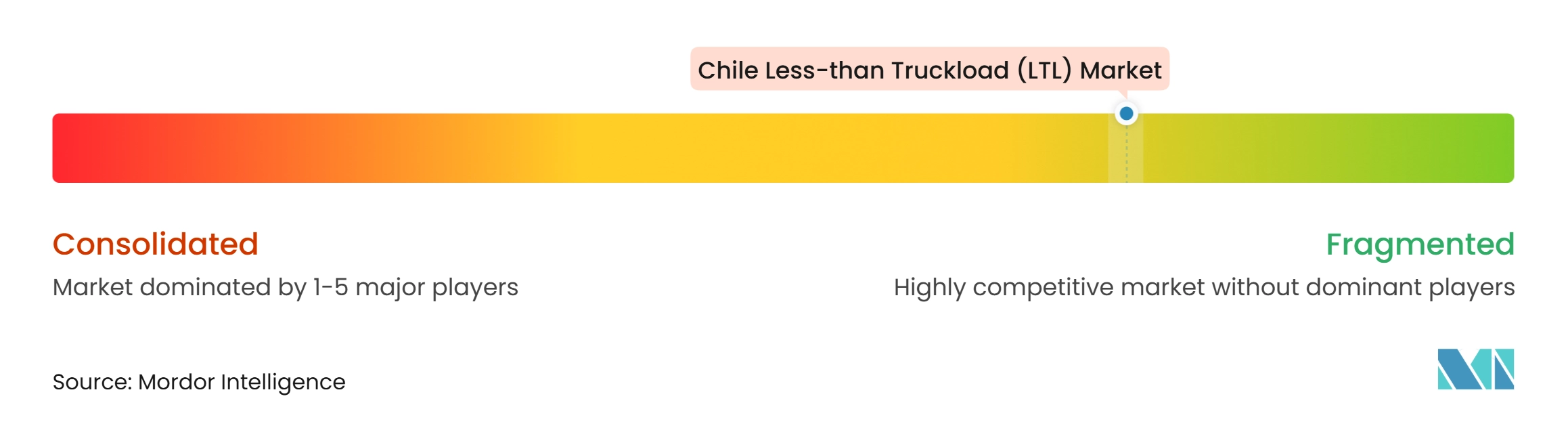
The Chile LTL market has a fragmented structure, with national carriers competing alongside global third-party logistics providers. Starken benefits from local delivery density and familiarity with national distribution patterns, while DSV, DHL Group, Kuehne+Nagel, and CEVA Logistics offer integrated warehousing, transport, and international supply chain services. Starken is scaling toward 1,000 delivery and pickup points and has expanded automated sorting capacity toward 19,500 packages per hour. The company’s network gives it a practical advantage in last-mile handoffs and delivery coverage. Global providers compete by linking Chilean customers with international transport, contract logistics, and specialized supply chain services. This creates a competitive environment in which local density and integrated capabilities both matter.
Kuehne+Nagel’s Casaideas distribution-center partnership is an example of a provider building dedicated retail distribution capacity in Chile. DHL Supply Chain also entered an alliance with Lindt Chile in July 2026, providing temperature-monitored distribution as Lindt plans to expand its retail operations. These moves show that specialized customer contracts are shaping competitive positions alongside general freight coverage.
Technology is becoming a key competitive factor in a market where price remains important. AI-supported routing and fleet management can reduce manual dispatch work and help operators respond to changes during multi-stop runs. CEVA Logistics launched an AI-driven drone inventory pilot in Chile in May 2025 and reported a 10x improvement in inventory-counting productivity. Starken also partnered with Autoplanet and Agroplanet in March 2026 to use all 86 stores as pickup and drop-off points, increasing its network reach by 15%. Digital documentation requirements administered by the Ministry of Transport and Telecommunications favor carriers that can maintain compliant, traceable operations. Northern mining corridors remain a potential opening for carriers able to build resilient, multi-depot networks for specialized industrial deliveries.
Chile Less-than Truckload (LTL) Industry Leaders
-
Starken
-
Pullman Cargo SA
-
Agencias Universales SA (AGUNSA)
-
DSV AS (Including DB Schenker)
-
DHL Group
- *Disclaimer: Major Players sorted in no particular order
Chile Less-than Truckload (LTL) Market Companies Covered in this Report
- Starken
- Pullman Cargo SA
- Transportes TVP
- Agencias Universales SA (AGUNSA)
- DHL Group
- DSV AS (Including DB Schenker)
- Kuehne+Nagel International AG
- CEVA Logistics
- Empresa de Correos de Chile (CorreosChile)
- Rhenus Group
- JAS Worldwide Inc.
- Fracht Chile
- Ecotrans
- Datadie Chile
- South Pacific Logistics
- LOGPAR Logistics Partners Chile
- M3GA Logistica
- DUCIS Logistics
- GeoLogistic
- Transportes Multitrans
- Transportes SCAR
- Transportes Palmor
Recent Industry Developments in Chile Less-than Truckload (LTL) Market
- September 2026: AGUNSA and Gold Fields formalized a strategic logistics alliance for the Salares Norte gold-and-silver mine supply chain, inaugurating a new logistics operator service at AGUNSA's Lampa Logistics Center. The arrangement enables Gold Fields suppliers to deliver cargo at both Santiago and Copiapó nodes, covering a mine described by Gold Fields as one of its most strategic global assets.
- May 2026: DSV Chile launched its first electric truck operation in Chile, deploying a Yutong T5 electric vehicle from Santiago Airport for urban last-mile distribution. The vehicle offers 220 to 300 kilometers of range per charge and fast-charges from 20% to 80% in under 1 hour.
- April 2026: Kuehne+Nagel and Casaideas formally inaugurated a dedicated 30,000 m² semi-automated distribution center in Pudahuel, built through a partnership that became operational in 2025. The center processed 34.8 million inbound units and distributed 24.7 million products to over 40 stores in 2025, with e-commerce fulfilling close to 190,000 customer orders. The facility generates 250 direct and 300 associated jobs.
- March 2026: Starken formed a strategic partnership with Autoplanet and Agroplanet, progressively enabling all 86 stores of both retail chains to serve as PUDO shipping and collection points during the first quarter of 2026. The agreement expanded Starken's national network coverage by 15%, extending reach into zones without dedicated branches.
Chile Less-than Truckload (LTL) Market Report Scope
Segmentation Overview
| Domestic |
| International |
| Dry |
| Reefer |
| Agriculture, Fishing, and Forestry |
| Construction |
| Manufacturing |
| Oil and Gas, Mining and Quarrying |
| Wholesale and Retail Trade |
| Others |
| Northern Chile (Antofagasta, Tarapacá, Atacama, Arica and Parinacota) |
| Central Chile (Santiago Metropolitan Region, Valparaíso, Coquimbo, O’Higgins, Maule) |
| Southern Chile (Biobío, Araucanía, Los Lagos, Los Ríos) |
| Patagonia / Extreme South (Aysén, Magallanes) |
| By Destination | Domestic |
| International | |
| By Temperature Control | Dry |
| Reefer | |
| By End-User Industry | Agriculture, Fishing, and Forestry |
| Construction | |
| Manufacturing | |
| Oil and Gas, Mining and Quarrying | |
| Wholesale and Retail Trade | |
| Others | |
| By Region | Northern Chile (Antofagasta, Tarapacá, Atacama, Arica and Parinacota) |
| Central Chile (Santiago Metropolitan Region, Valparaíso, Coquimbo, O’Higgins, Maule) | |
| Southern Chile (Biobío, Araucanía, Los Lagos, Los Ríos) | |
| Patagonia / Extreme South (Aysén, Magallanes) |
Key Questions Answered in the Report
What is the forecast growth rate for less-than-truckload services in Chile?
The Chile LTL market is projected to register a 6.69% CAGR from 2027 to 2032, reaching USD 3.64 billion by 2032.
Which destination segment leads Chile’s less-than-truckload services?
Domestic services lead with a 61.28% share in 2026, supported by manufacturing, retail replenishment, and Santiago-centered distribution networks.
Which freight type is growing fastest in Chile?
Reefer freight is projected to register a 7.38% CAGR through 2032 as healthcare, food, fresh produce, and aquaculture supply chains require temperature-controlled transport.
Why is Northern Chile growing faster for consolidated freight?
Northern Chile is projected to register an 8.63% CAGR through 2032 because mining investment increases demand for multi-stop delivery of equipment, materials, and operating supplies.
Which end-user segment is expanding fastest?
Wholesale and retail trade is expected to record an 8.24% CAGR through 2032 as omnichannel retail increases store replenishment and fulfillment requirements.
What are the main operating challenges for LTL carriers in Chile?
Driver shortages, fuel and labor costs, border backhaul constraints, and weather-related disruptions at Andean passes can limit capacity and raise operating costs.