
Chile Less-than Container Load (LCL) Market Size and Share
Market Overview
| Study Period | 2021 - 2032 |
|---|---|
| Forecast Data Period | 2027 - 2032 |
| Base Year Market Size (2026) | USD 207.62 Million |
| Market Size (2027) | USD 220.67 Million |
| Market Size (2032) | USD 296.70 Million |
| Growth Rate (2027 - 2032) | 6.10 % |
| Market Concentration | Medium |
Major Players *Disclaimer: Major Players sorted in no particular order Image © Mordor Intelligence. Reuse requires attribution under CC BY 4.0. | |
Chile Less-than Container Load (LCL) Market Analysis by Mordor Intelligence
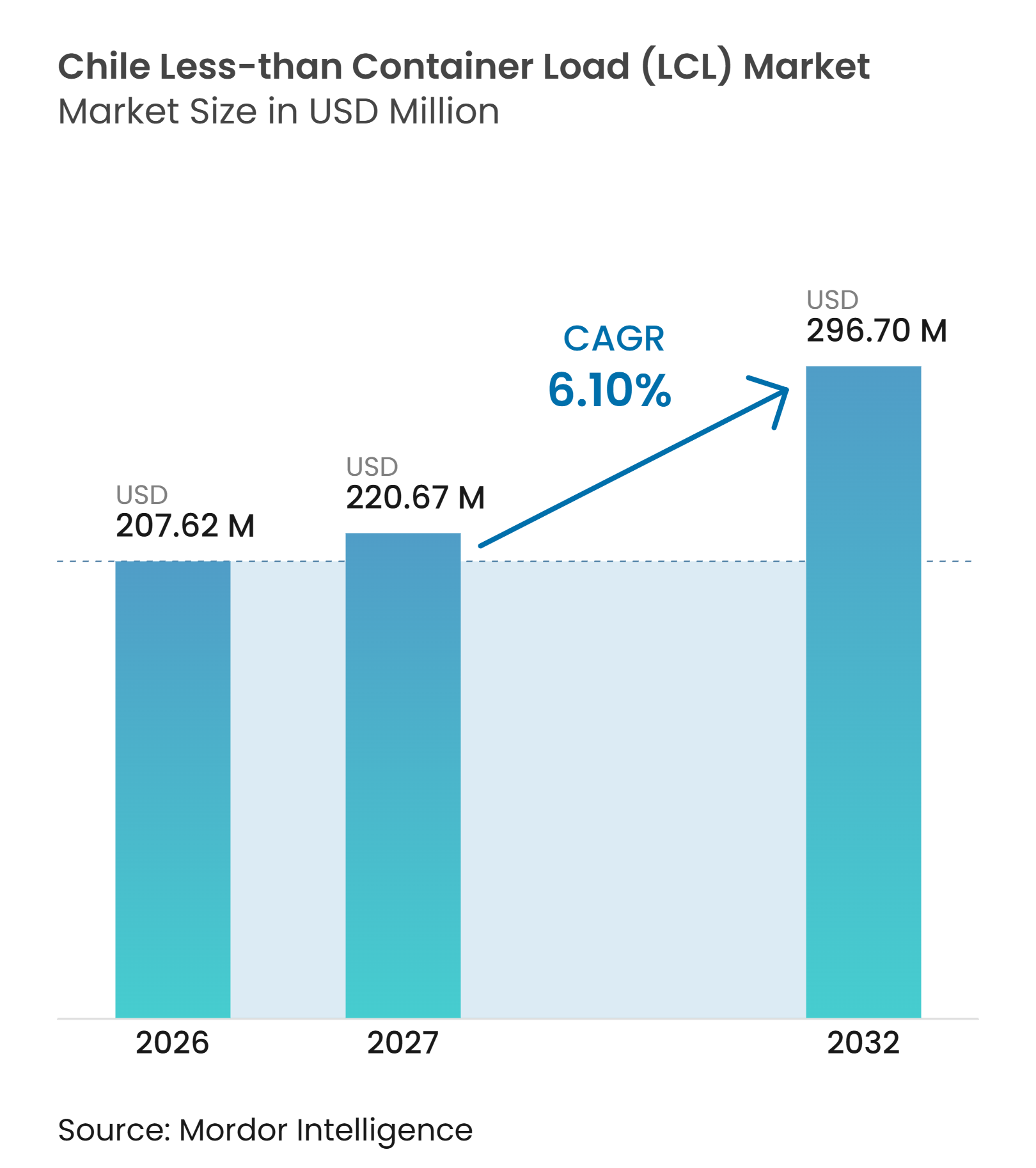
The Chile less-than container load market size is valued at USD 207.62 million in 2026 and is projected to reach USD 220.67 million in 2027 and USD 296.70 million by 2032, growing at a CAGR of 6.10% from 2027 to 2032.
The Chile less-than container load industry is supported by a broad maritime trade base and by importers that need shared container capacity rather than full-container shipments. Chile’s maritime foreign trade reached USD 155.9 billion in 2025, while import volumes reached 1.6 million TEUs, creating a larger flow of shipments that can be consolidated for smaller importers. Export activity also widened the pool of specialized outbound cargo, with Chilean goods exports exceeding USD 100 billion between January and October 2026. Port digitalization, cross-border online retail, and direct Asia services are making schedules and documentation processes more relevant to service choice. Providers that combine consolidation with customs support, warehousing, and inland delivery are better placed to serve importers that need regular, smaller shipments.
Key Report Takeaways
- By service type, consolidation services account for 58.43% of Chile less-than container load market share in 2026, while de-consolidation and distribution shipments are projected to register a 7.25% CAGR through 2032.
- By destination, international LCL accounts for 82.17% of Chile less-than container load market size in 2026 and is projected to register a 7.98% CAGR through 2032.
- By nature of business, freight forwarding accounts for 72.83% of Chile less-than container load industry share in 2026, while NVOCC shipments are projected to register an 8.65% CAGR through 2032.
- By end user, retail and e-commerce accounts for 31.27% of Chile less-than container load market size in 2026, while retail and e-commerce shipments are projected to register an 8.97% CAGR through 2032.
- By cargo type, general cargo accounts for 76.82% of Chile less-than container load market share in 2026, while temperature-controlled cargo shipments are projected to register a 7.54% CAGR through 2032.
- By region, Central Chile accounts for 52.73% of Chile less-than container load industry size in 2026, while Northern Chile shipments are projected to register an 8.32% CAGR through 2032.
Note: Market numbers in this report are based on Mordor Intelligence's proprietary estimation framework, which combines nine months of actuals with Q4 projections for base year 2026.
Market Trends and Insights
Drivers Impact Analysis of Chile Less-than Container Load (LCL) Market*
| Driver | (~) % Impact on CAGR Forecast | Geographic Relevance | Impact Timeline |
|---|---|---|---|
| Merchandise Trade Growth Increasing LCL Shipment Demand | +1.8% | National, concentrated in Central Chile | Medium term (2-4 years) |
| E-Commerce Expansion Increasing Small-Parcel Import Volumes | +1.5% | National, strongest in Santiago Metropolitan Region | Short term (≤ 2 years) |
| Maritime Trade Concentration Supporting LCL Service Demand | +0.8% | Central Chile core, spill-over to Northern Chile | Long term (≥ 4 years) |
| Multi-Supplier Sourcing Increasing Consolidation Requirements | +0.7% | National, with intensity in import-heavy SME clusters | Medium term (2-4 years) |
| Export Supply Chains Increasing Specialized Consolidation Demand | +0.6% | Northern Chile mining and lithium, Southern Chile salmon and cherries | Long term (≥ 4 years) |
| Port Digitalization Improving LCL Processing Efficiency | +0.5% | National, leading gains at San Antonio and Valparaíso | Medium term (2-4 years) |
| Source: Mordor Intelligence | |||
Merchandise Trade Growth Increasing LCL Shipment Demand
Chile’s maritime import value increased 10.5% in 2025, and TEU imports increased 15.9%, providing a larger shipment base for the Chile less-than container load market[1]. Small-volume shippers often do not have the inventory scale needed to fill a full container. They therefore rely on consolidators to combine shipments from several suppliers and maintain predictable arrival cycles. General cargo produced the largest absolute increase in maritime trade value during 2025, including categories such as electric motors, batteries, and petroleum equipment. These components are commonly ordered from more than one source, which supports consolidation demand. China remained Chile’s largest import partner in 2025, reinforcing the importance of Asia to West Coast South America connections for freight consolidation.
E-Commerce Expansion Increasing Small-Parcel Import Volumes
The expansion of online retail is increasing the number of small and frequent import orders entering Chile. The Cámara de Comercio de Santiago projected online retail sales of USD 10.6 billion in 2026, with 12.2% real growth. Cross-border platforms accounted for 55% of international transactions, which increases the relevance of inbound flows from Asian suppliers. The October 2025 tax change for low-value overseas purchases altered the economics of informal courier imports. Formal ocean freight and consolidated shipments are more relevant for importers that need a compliant route for recurring orders.
Maritime Trade Concentration Supporting LCL Service Demand
Chile’s container traffic is concentrated in the central corridor, where San Antonio and Valparaíso together handle more than 70% of maritime imports. This concentration supports regular consolidation activity because importers, warehouses, customs agents, and inland carriers are located within a connected logistics area. San Antonio Terminal Internacional handled 1.2 million TEUs in 2025, its fourteenth consecutive year above 1 million TEUs. Terminal Pacífico Sur in Valparaíso handled 916,355 TEUs in 2025. Such volumes support regular port calls and make it easier for forwarders to build fixed LCL schedules.
Port Digitalization Improving LCL Processing Efficiency
Digital port and customs programs are reducing administrative friction for consolidated cargo. Chile’s Ministry of Transport and Telecommunications launched Ventanilla Única Marítima in 2025 and rolled it out across major port regions. The program digitizes vessel arrival and departure formalities and is expected to save 62,500 agent-hours each year. Consolidated shipments benefit because several importers can be associated with one container and each party requires correct documentation. More consistent data exchange reduces the risk that an administrative error affects cargo release.
Restraints Impact Analysis of Chile Less-than Container Load (LCL) Market*
| Restraint | (~) % Impact on CAGR Forecast | Geographic Relevance | Impact Timeline |
|---|---|---|---|
| Port Congestion Increasing Inland LCL Transit Delays | -1.2% | Central Chile, San Antonio port cluster | Short term (≤ 2 years) |
| Destination Charges Increasing Deconsolidation Cost Complexity | -0.8% | National, most acute for multi-importer consolidated containers | Medium term (2-4 years) |
| Schedule Variability Reducing LCL Transit Reliability | -0.6% | National, worst on Asia to Chile lanes | Medium term (2-4 years) |
| SME Documentation Gaps Increasing Customs Clearance Delays | -0.5% | National, concentrated among first-time LCL importers | Short term (≤ 2 years) |
| Source: Mordor Intelligence | |||
Port Congestion Increasing Inland LCL Transit Delays
Port congestion remains a material operating risk for the Chile less-than container load market. The November 2026 resolution of a nine-day truckers’ blockade at San Antonio followed disruption affecting more than 3,000 containers in each direction[2]. LCL cargo is particularly exposed because a single consolidated container can include shipments for many importers. One interruption can generate separate delays, customer notifications, and delivery changes across multiple bills of lading. The incident also showed that disruption outside a terminal gate can affect the whole inland movement chain. Transport cost increases can raise destination costs for consolidated shipments and make smaller import orders less economical.
SME Documentation Gaps Increasing Customs Clearance Delays
Documentation gaps among smaller importers can delay customs clearance for consolidated cargo. Many first-time or infrequent importers have limited internal capacity to prepare commercial documents and product information correctly. A consolidated container has several consignees, so an error in one file can complicate the examination and release process for other shipments. This issue is important in the Chile less-than container load industry because small businesses are a core customer base. Chilean customs uses a risk-classification approach, and multi-origin shipments can require closer review because their manifests are more complex. The use of multiple suppliers increases the need for complete and consistent records before cargo is loaded.
*Our forecasts treat driver/restraint impacts as directional, not additive. The impact forecasts reflect baseline growth, mix effects, and variable interactions.
Chile Less-than Container Load (LCL) Market Segment Analysis
By Service Type:
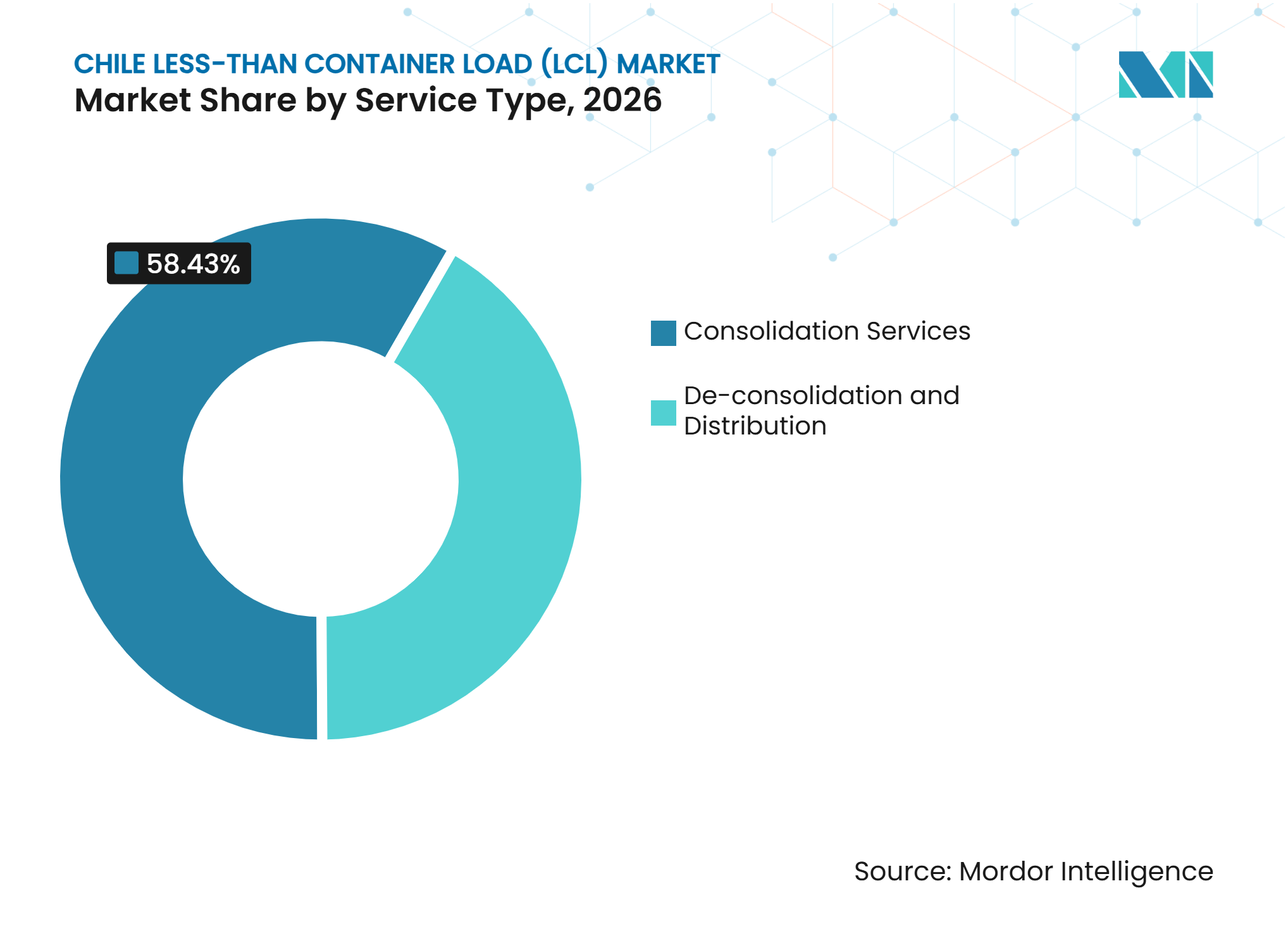
Consolidation Anchors the Market, De-consolidation AcceleratesConsolidation services account for 58.43% of the Chile less-than container load market share in 2026. The segment reflects an import structure in which small and mid-sized businesses buy goods from Asian and European suppliers without enough volume for a dedicated container. A consolidator combines those orders at origin and arranges transport to Chile. This model gives customers access to international sourcing while limiting inventory commitments. It is useful for buyers of components, consumer goods, and replenishment stock from several vendors. The Chile less-than container load market size for consolidation is supported by the concentration of import demand in the central logistics corridor. The service also suits cargo owners that prefer regular smaller shipments to larger and less frequent inventory purchases.
De-consolidation and distribution shipments are projected to register a 7.25% CAGR through 2032. This service extends the provider’s role after a container reaches a Chilean port. Customers increasingly require customs coordination, freight station handling, pick-and-pack work, inland transport, and direct delivery in one service scope. E-commerce importers particularly need this combined model because they must bring goods from several overseas suppliers into local fulfillment channels. Digital operators such as KLog.co have positioned their services around booking, customs work, and domestic delivery through one interface. The segment’s expansion shows that cargo owners value fewer handovers after arrival. It also increases the importance of local warehouse capacity and delivery partnerships.



By Destination:
International Lanes Define and Drive the MarketInternational LCL accounts for 82.17% of the Chile less-than container load market size in 2026. The segment reflects Chile’s dependence on imported consumer products, equipment, industrial components, and inputs from overseas suppliers. Its scale supports regular consolidation services on Asian and European routes. Direct services, fixed schedules, and origin warehouse coverage are therefore important competitive factors. International shipments require providers to align overseas consolidation with port handling and inland delivery in Chile. The large share also reflects the country’s role as a destination for multi-supplier procurement. It remains the principal destination category in the Chile less-than container load market.
International LCL shipments are projected to register a 7.98% CAGR through 2032. DP World inaugurated the ACSA 1 direct Asia-to-Chile service in 2025, linking Busan, Shanghai, and Ningbo with San Antonio. Direct connections can improve planning for forwarders that need predictable cutoffs and onward deliveries. This is important for importers that use shared containers and cannot absorb large inventory buffers. Domestic LCL still serves movements between Chilean regions, including links from Santiago to northern mining areas and southern agricultural locations. Providers that offer both options can connect port arrivals with regional consignee networks. The fastest growth in international activity reinforces the value of dependable Asia to Chile service schedules.
By Nature of Business:
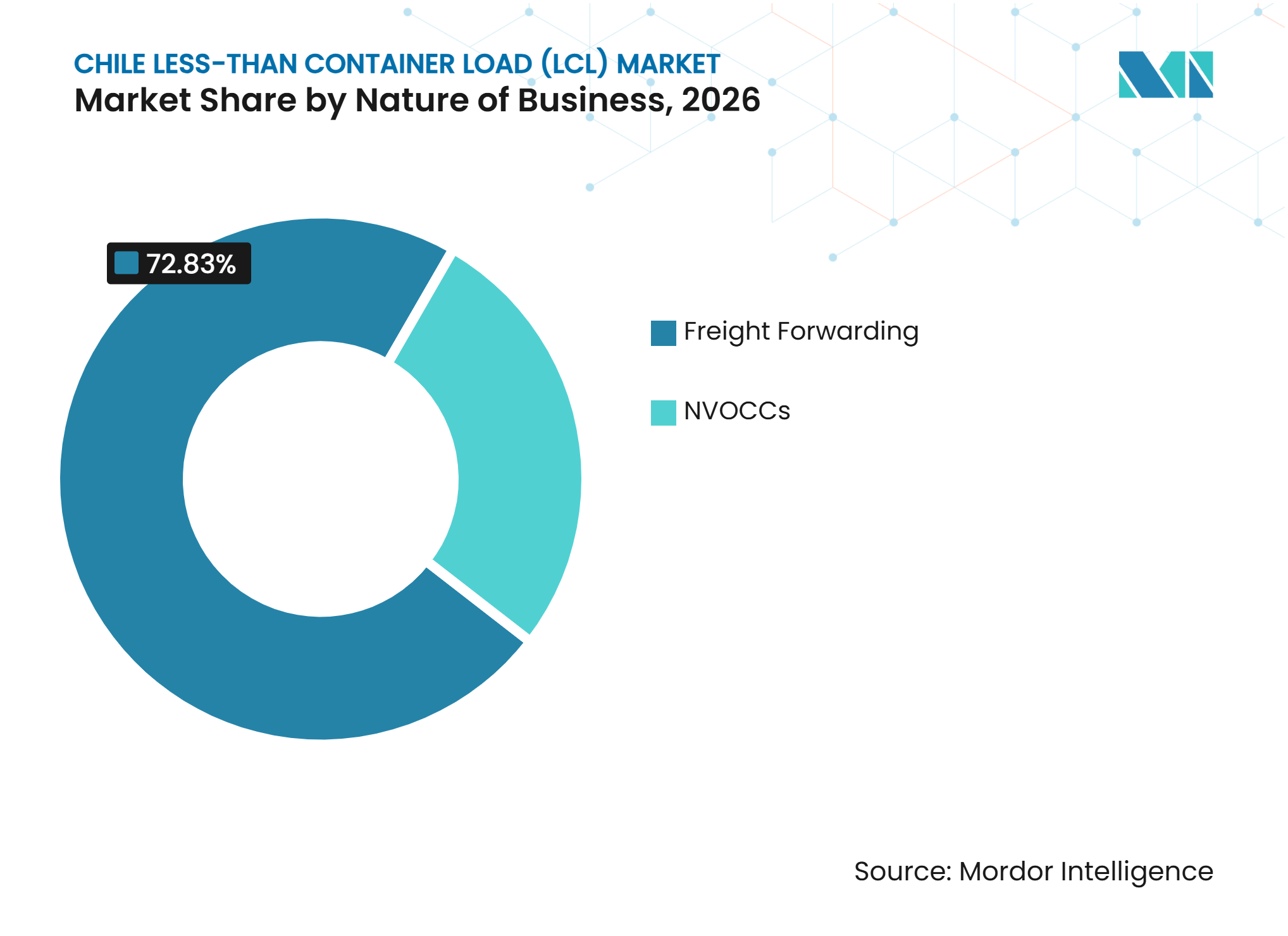
Freight Forwarding Leads but NVOCCs DisruptFreight forwarding accounts for 72.83% of the Chile less-than container load market size in 2026. The segment leads because Chilean importers often rely on an agent to manage transport documents, customs processes, carrier coordination, and inland arrangements. This role is useful for buyers that lack an internal logistics team. It is also important when one shipment requires several providers to work in sequence. Established forwarders use carrier contracts and local agent relationships to coordinate these steps. The Chile less-than container load market share held by freight forwarding reflects the value customers place on accountability and local knowledge. Customers often select forwarders when they need a named party to resolve clearance or delivery issues.
NVOCC shipments are projected to register an 8.65% CAGR through 2032. Their expansion is linked to their ability to aggregate cargo, negotiate capacity, and provide groupage services across defined trade lanes. NVOCCs can offer schedule flexibility when they control consolidation operations and maintain origin coverage. Their services appeal to customers that need alternatives to conventional forwarding arrangements. Increased NVOCC activity strengthens price and service competition for traditional forwarders. It also rewards providers that can maintain transparent rate structures and frequent departures. The category will remain dependent on reliable port, warehouse, and customs coordination.

By End User:
Retail and E-commerce Sets the Pace Across All SegmentsRetail and e-commerce accounts for 31.27% of the Chile less-than container load market size in 2026. Online retail activity increases inventory replenishment frequency and the number of small international orders. Retailers often source a broad assortment from several suppliers, which makes consolidation more suitable than a dedicated container. The Chile less-than container load market serves this need by matching freight capacity with smaller consignments. The segment also relies on efficient customs clearance and onward delivery to local fulfillment locations. Retail and e-commerce therefore create demand for services that integrate freight, warehousing, and delivery. This customer group remains the largest end-user category in the Chile less-than container load market.
Retail and e-commerce shipments are projected to register an 8.97% CAGR through 2032. Smaller but more frequent orders make schedule consistency and cargo visibility more important to these customers. Manufacturing and Automotive users also rely on LCL for spare parts and components from several supplier bases. Healthcare and Pharmaceuticals require temperature control, recordkeeping, and Good Distribution Practice procedures. Agriculture and Forestry use LCL for imported inputs and export-related coordination. Hellmann Worldwide Logistics highlighted its 25-year relationship with Salmones Antártica in August 2025, demonstrating the importance of established logistics support in the perishable export chain[3]. These varied requirements favor providers with broad handling, clearance, and delivery capabilities.
By Cargo Type:
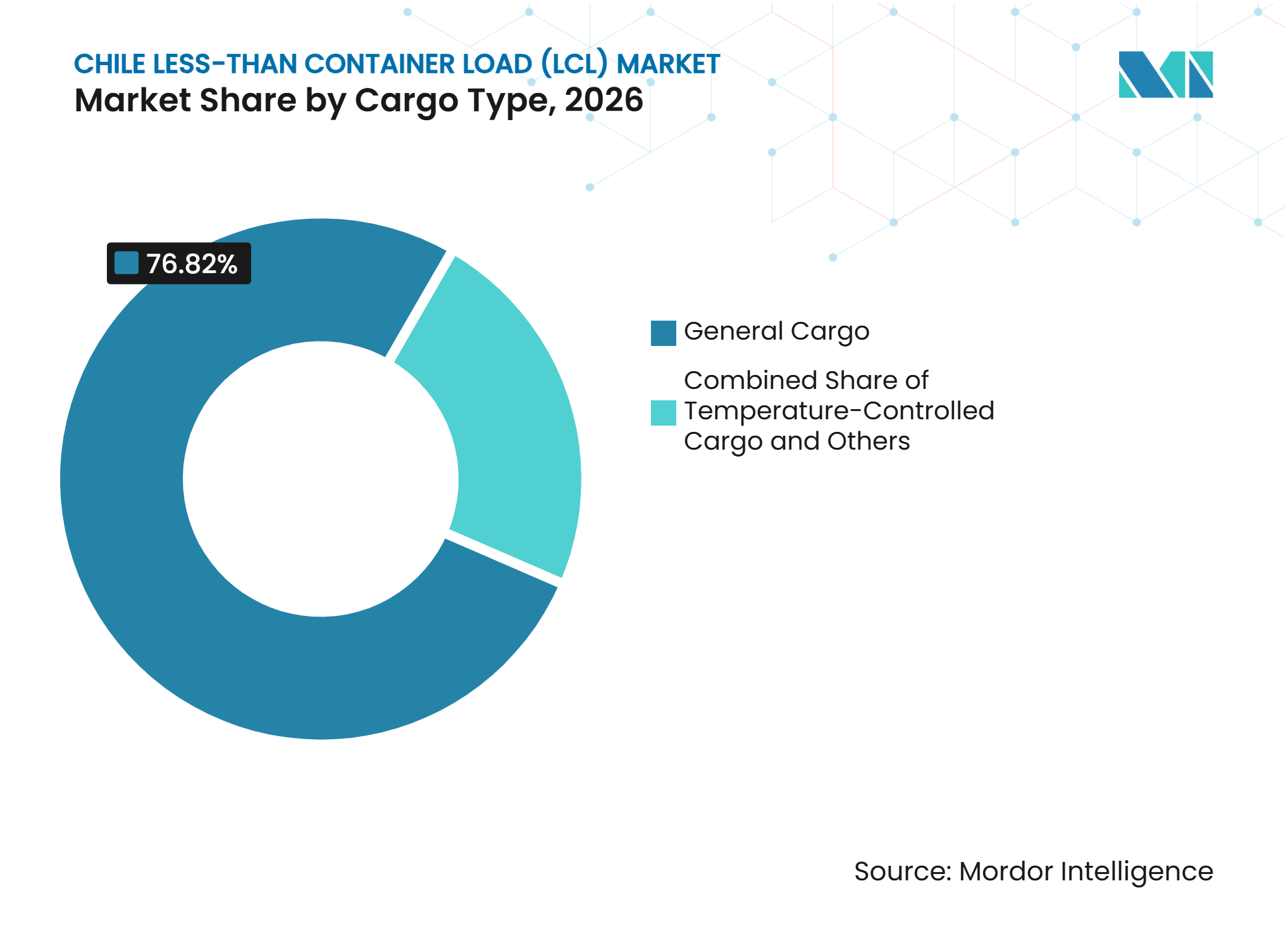
General Cargo Dominates, Temperature-Controlled Cargo GainsGeneral Cargo accounts for 76.82% of the Chile less-than container load market share in 2026. The segment aligns with the large role of manufactured goods, consumer products, and industrial inputs in Chile’s import mix. Camport reported that general cargo represented 56.3% of the value of Chile’s maritime foreign trade in 2025. General cargo suits standard consolidation because products can be packed and combined without specialized temperature equipment. It includes machinery components, batteries, household products, and other commercial merchandise. The Chile less-than container load market size for this cargo category benefits from a wide base of importers that buy smaller quantities from several suppliers. Its breadth keeps it as the leading cargo category.
Temperature-controlled cargo shipments are projected to register a 7.54% CAGR through 2032. Chile’s perishable export sectors and pharmaceutical imports create demand for controlled cargo handling. DP World San Antonio handled 14,800 TEUs of refrigerated cherry containers during the 2025 to 2026 season and increased refrigeration technicians by 20%. The activity shows the seasonal handling intensity associated with refrigerated cargo. This segment requires dedicated equipment, trained staff, and consistent monitoring. Hazardous and high-value cargo remain smaller categories that require specialized documentation and handling under customs requirements. The rising temperature-controlled category broadens the service requirements of LCL operators.
Geography Analysis
Central Chile accounts for 52.73% of the Chile less-than container load market share in 2026. San Antonio and Valparaíso handle more than 70% of the country’s maritime container activity, placing the main LCL arrival, deconsolidation, and distribution functions in one corridor. San Antonio Terminal Internacional processed 1.2 million TEUs in 2025, while Terminal Pacífico Sur processed 916,355 TEUs. The 21% increase at Terminal Pacífico Sur showed continued capacity use in the region. Providers can serve importers more efficiently when warehouses, customs agents, and trucking capacity are near the ports. Kuehne+Nagel expanded its partnership with Casaideas in April 2026 through a dedicated distribution center that handled 34.8 million inbound units. The example shows how freight services are being linked with warehousing and e-commerce fulfillment.
Northern Chile is forecast to register an 8.32% CAGR through 2032. The region’s mining and lithium activities require equipment, consumables, and spare parts from international suppliers. Chile produced 5.3 million tons of mined copper in 2025 and represented 23% of global production. This production base supports demand for time-sensitive and specialized imports. Antofagasta Terminal Internacional processed 2.8 million tons during 2025[4]. Its general cargo volumes increased 13%, which points to more activity in categories that can include mining consumables and components. The terminal’s planned capacity expansion through the La Negra logistics development may improve the handling base for regional cargo. Logistics providers are responding through specialized mining offerings and project cargo capabilities.
Southern Chile benefits from export-oriented cargo flows in salmon, timber, and agricultural products. AGUNSA opened the 21,300 m² Centro Logístico Rocuant in Biobío in January 2026, including covered warehouses, paved yard space, refrigerated container connections, and SAG-authorized storage. The facility supports import and export movements in the southern corridor. It also improves the ability to handle cold-chain cargo that needs regional storage and inland transport. Hellmann’s relationship with Salmones Antártica reflects the importance of experienced logistics partners in the perishable value chain. The mixed regional structure leaves central Chile as the primary operational hub while the north and south serve more specialized demand patterns.
Competitive Landscape
Market Concentration
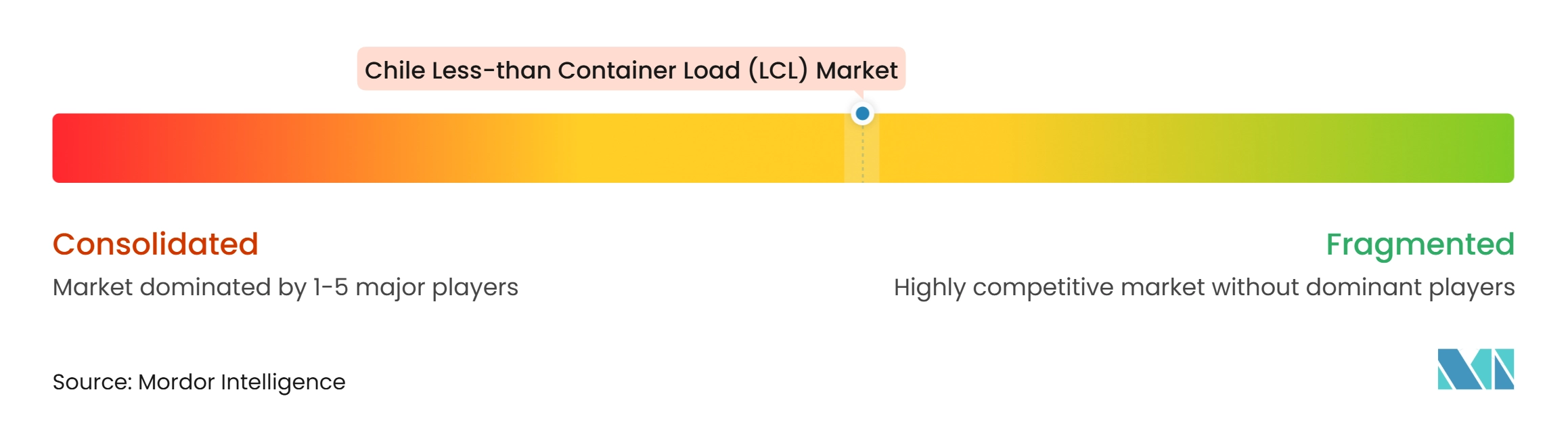
The Chile less-than container load market is consolidated and includes global forwarders, LCL specialists, regional operators, and digital platforms. ECU Worldwide, DSV, Kuehne+Nagel, DHL, and Maersk have brand recognition and international network reach. Regional providers and smaller NVOCCs compete for price-sensitive small and mid-sized customers. The competitive structure is stronger at the premium end and more dispersed across local operators. DSV completed the acquisition of DB Schenker in April 2025. The transaction expanded DSV’s global forwarding scale and increased the importance of network integration in Latin America. Operators increasingly compete on booking access, shipment visibility, customs coordination, and inland delivery. Digital services can simplify quotations for customers that place recurring smaller orders.
KLog.co and similar providers address customers seeking online rate quotations and more integrated customs and delivery tools. Larger firms can combine these digital functions with global carrier procurement and established local operations. Maersk’s electric truck program with Sotraser shows a separate effort to improve the sustainability profile of inland logistics. Competition will therefore extend beyond ocean freight pricing to include delivery reliability, data quality, and local asset access.
The main areas for differentiation include pharmaceutical cold-chain LCL and mining-related cargo for Northern Chile. These activities need controlled facilities, specialized documents, and credible handling procedures. ISO 9001 certification and cold-chain operating standards can support customer confidence, while Project Hermes creates a more connected customs compliance environment. Service providers with local container freight station access can better control deconsolidation and delivery quality. Providers without technology, machinery, and industrial cargo may rely more heavily on partners and face less control over exceptions.
Chile Less-than Container Load (LCL) Industry Leaders
-
Agencias Universales SA (AGUNSA)
-
Delpa Group
-
KLog.co
-
ECU Worldwide
-
DSV AS (Including DB Schenker)
- *Disclaimer: Major Players sorted in no particular order
Chile Less-than Container Load (LCL) Market Companies Covered in this Report
- ECU Worldwide
- DSV AS (Including DB Schenker)
- DHL Group
- Kuehne+Nagel International AG
- CEVA Logistics
- A.P. Møller - Mærsk AS
- Expeditors International of Washington Inc.
- Agencias Universales SA (AGUNSA)
- Rhenus Group
- GEODIS SA
- Scan Global Logistics
- JAS Worldwide Inc.
- Hellmann Worldwide Logistics
- Nippon Express Holdings Inc.
- Yusen Logistics Chile
- Noatum Logistics
- Röhlig Logistics
- TIBA
- Delpa Group
- KLog.co
- MSL Corporate
- Sitrans
Recent Industry Developments in Chile Less-than Container Load (LCL) Market
- October 2026: Pacific Anchor Line (PAL) established its own office in Miami, United States, to develop a North American LCL consolidation hub serving Latin American markets, including Chile. The service initially provides fortnightly departures to San Antonio and Valparaíso, with plans to increase frequency to weekly departures during the first year. The hub enables PAL to receive, consolidate, and dispatch shipments from the United States to Chile, targeting importers that do not have sufficient cargo to fill an entire container.
- August 2026: AMASS Global Network Chile promoted a direct, weekly LCL consolidation service from Miami, United States, to Valparaíso, Chile. The service, operated by Maersk, offers an estimated transit time of 19 days and is designed to provide freight forwarders with more frequent consolidated shipping options for shipments from the United States to Chile.
- July 2026: LTS Group announced a direct LCL consolidation service from San Antonio, Chile, to Panama, offering fortnightly departures and an indicative 13-day transit time. The service also accommodates cargo originating in Mendoza, Argentina, for consolidation in Chile and onward connections to Central America and the Caribbean.
- March 2026: ECU Worldwide announced the XLERATE 2.0 expansion, a time-definite LCL ocean service designed to support time-sensitive shipments.
Chile Less-than Container Load (LCL) Market Report Scope
Segmentation Overview
| Consolidation Services |
| De-consolidation and Distribution |
| Domestic |
| International |
| Freight Forwarding |
| NVOCCs |
| Manufacturing and Automotive |
| Retail and E-commerce |
| Healthcare and Pharmaceuticals |
| Agriculture and Forestry |
| Other End Users |
| General Cargo |
| Temperature-Controlled Cargo |
| Hazardous Cargo |
| High-Value and Sensitive Cargo |
| Others |
| Northern Chile (Antofagasta, Tarapacá, Atacama, Arica and Parinacota) |
| Central Chile (Santiago Metropolitan Region, Valparaíso, Coquimbo, O’Higgins, Maule) |
| Southern Chile (Biobío, Araucanía, Los Lagos, Los Ríos) |
| Patagonia / Extreme South (Aysén, Magallanes) |
| By Service Type | Consolidation Services |
| De-consolidation and Distribution | |
| By Destination | Domestic |
| International | |
| By Nature of Business | Freight Forwarding |
| NVOCCs | |
| By End User | Manufacturing and Automotive |
| Retail and E-commerce | |
| Healthcare and Pharmaceuticals | |
| Agriculture and Forestry | |
| Other End Users | |
| By Cargo Type | General Cargo |
| Temperature-Controlled Cargo | |
| Hazardous Cargo | |
| High-Value and Sensitive Cargo | |
| Others | |
| By Region | Northern Chile (Antofagasta, Tarapacá, Atacama, Arica and Parinacota) |
| Central Chile (Santiago Metropolitan Region, Valparaíso, Coquimbo, O’Higgins, Maule) | |
| Southern Chile (Biobío, Araucanía, Los Lagos, Los Ríos) | |
| Patagonia / Extreme South (Aysén, Magallanes) |
Key Questions Answered in the Report
What is the projected value of the Chile less-than container load market by 2032?
The Chile less-than container load market is projected to reach USD 296.70 million by 2032, registering a 6.10% CAGR from 2027.
Which service type leads less-than container load activity in Chile?
Consolidation services lead with a 58.43% share in 2026 because many smaller importers need shared container capacity.
Why is e-commerce important for Chilean LCL demand?
Online retail is projected to reach USD 10.6 billion in 2026, supporting frequent small orders that suit consolidated ocean shipments.
Which Chilean region is growing fastest for LCL services?
Northern Chile shipments are projected to register an 8.32% CAGR through 2032, supported by mining and lithium supply chains.
What are the main operational risks for LCL importers in Chile?
Port disruption, variable schedules, destination charges, and incomplete import documentation can delay consolidated cargo.
How are logistics providers improving LCL services in Chile?
Providers are adding digital booking, customs coordination, warehousing, delivery integration, and lower-emission inland transport options.