
Chile Full Truckload (FTL) Market Size and Share
Market Overview
| Study Period | 2021 - 2032 |
|---|---|
| Forecast Data Period | 2027 - 2032 |
| Base Year Market Size (2026) | USD 8.93 Billion |
| Market Size (2027) | USD 9.42 Billion |
| Market Size (2032) | USD 12.19 Billion |
| Growth Rate (2027 - 2032) | 5.30 % |
| Market Concentration | Medium |
Major Players *Disclaimer: Major Players sorted in no particular order Image © Mordor Intelligence. Reuse requires attribution under CC BY 4.0. | |
Chile Full Truckload (FTL) Market Analysis by Mordor Intelligence
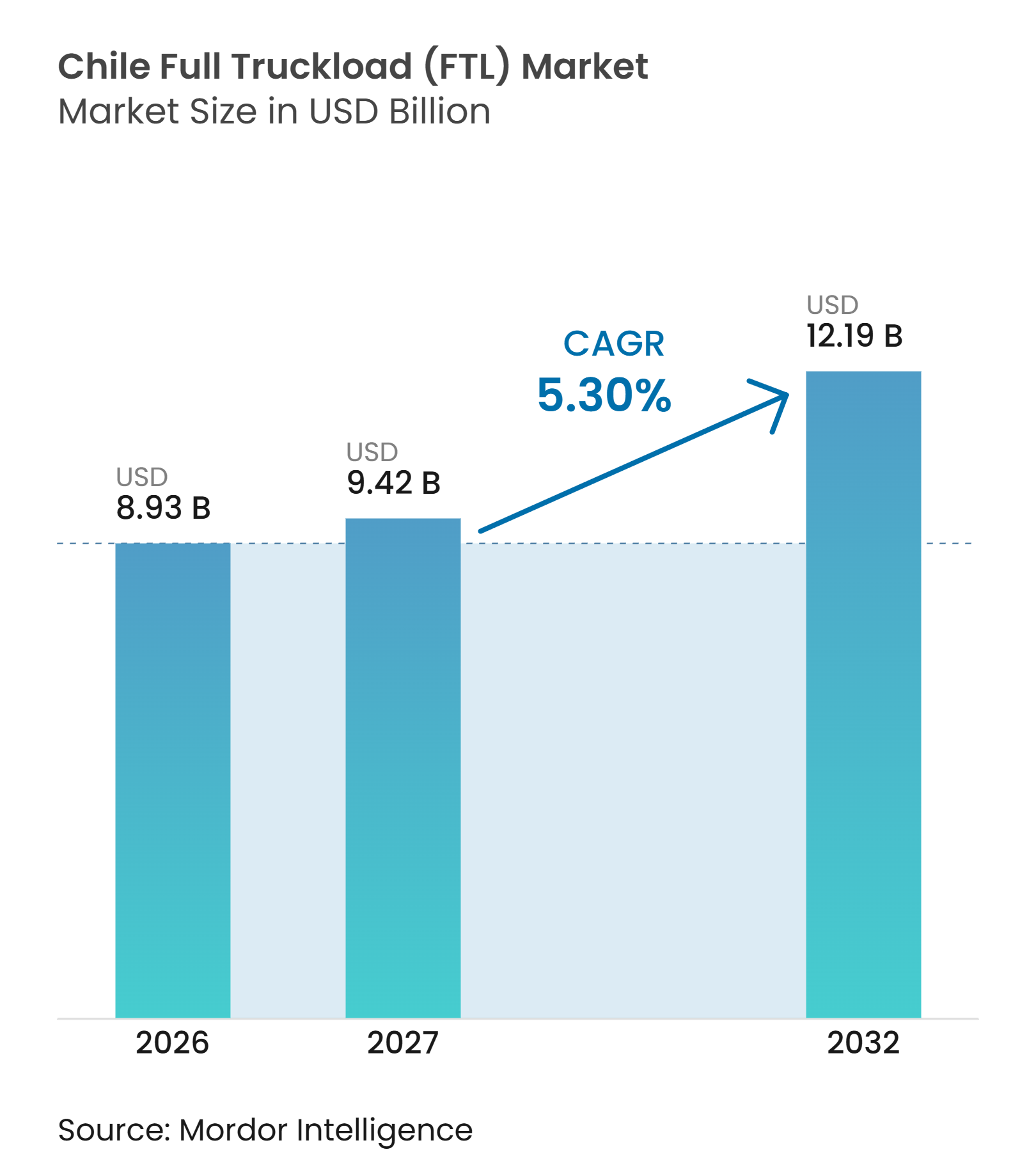
The Chile full truckload (FTL) market size is valued at USD 8.93 billion in 2026 and is estimated to grow from USD 9.42 billion in 2027 to reach USD 12.19 billion by 2032, at a CAGR of 5.30% during the forecast period from 2027 to 2032.
Chile’s road freight network supports domestic distribution, export activity, and cross-border trade across a long north-to-south supply chain. Mining, fresh produce exports, retail fulfillment, and manufacturing shipments create demand on different corridors and require carriers to balance capacity across long distances. Northern mining projects are increasing demand for dedicated truckloads that connect extraction sites, processing facilities, chemical suppliers, and Pacific ports. Retail distribution is also increasing the value of scheduled truckload contracts, particularly where operators need reliable capacity during peak online-sales periods. The Chile full truckload (FTL) industry remains shaped by operating costs, driver availability, corridor infrastructure, and the ability of carriers to reduce empty return trips.
Key Report Takeaways
- By destination, domestic FTL accounts for 62.12% of the Chile full truckload (FTL) market share in 2026, while international FTL is projected to register a 7.36% CAGR through 2032.
- By temperature control, dry FTL accounts for 91.36% of the Chile full truckload (FTL) market size in 2026, while reefer FTL is projected to register an 8.65% CAGR through 2032.
- By haul length, long-haul FTL accounts for 72.48% of the Chile full truckload (FTL) market share in 2026, while regional FTL is projected to register a 7.54% CAGR through 2032.
- By end-user industry, manufacturing accounts for 40.98% of the Chile full truckload (FTL) market size in 2026, while wholesale and retail trade is projected to register a 7.73% CAGR through 2032.
- By geography, Central Chile accounts for 52.16% of the Chile full truckload (FTL) market share in 2026, while Northern Chile is projected to register a 7.46% CAGR through 2032.
Note: Market numbers in this report are based on Mordor Intelligence's proprietary estimation framework, which combines nine months of actuals with Q4 projections for base year 2026.
Market Trends and Insights
Drivers Impact Analysis of Chile Full Truckload (FTL) Market*
| Driver | (~) % Impact on CAGR Forecast | Geographic Relevance | Impact Timeline |
|---|---|---|---|
| Mining and Lithium Projects Expanding FTL Demand | +1.2% | Northern Chile, with spillover to international corridors | Medium term (2-4 years) |
| E-Commerce Growth Increasing Dedicated Truckload Requirements | +1.0% | Central Chile, with spillover to Southern Chile | Short term (≤ 2 years) |
| Ruta 5 Investment Improving Long-Haul Freight Connectivity | +0.8% | National, with concentrated gains on the Santiago, Temuco, and Puerto Montt corridor | Long term (≥ 4 years) |
| Agricultural Exports Increasing Seasonal Reefer FTL Demand | +0.6% | Central Chile and Southern Chile | Short term (≤ 2 years) |
| Digital Freight Platforms Improving Fleet Utilization Efficiency | +0.5% | National, with early gains in the Santiago Metropolitan Region | Medium term (2-4 years) |
| Manufacturing Networks Expanding Dedicated FTL Transport Demand | +0.4% | Central Chile, with spillover to Northern and Southern Chile | Medium term (2-4 years) |
| Source: Mordor Intelligence | |||
Mining and Lithium Projects Expanding FTL Demand
Chile’s lithium logistics require truck movements between remote extraction areas, chemical facilities, ports, and suppliers of industrial inputs. Eramine completed its first lithium carbonate export through Chile in 2025, moving cargo through Paso de Jama to the Port of Angamos. The company cited a USD 100 per ton saving compared with an Atlantic route and expected monthly production of 1,200 tons by 2026[1]. These flows give FTL operators regular outbound mineral loads and create opportunities for northbound return loads of soda ash, sulfuric acid, and other reagents. SQM’s new soda-ash handling facility at Mejillones Bay further supports a denser mining-input supply chain in Northern Chile. The Chile full truckload (FTL) Market therefore benefits when carriers can coordinate cargo in both directions and build customs capability for Argentina-linked mining flows.
E-Commerce Growth Increasing Dedicated Truckload Requirements
Online retail is increasing the need for scheduled freight movements between distribution centers, urban fulfillment sites, and regional store networks. Peak sales events can generate sharp volume concentrations that are difficult to manage through spot freight capacity alone. This operating pattern favors dedicated truckload contracts that reserve capacity before demand peaks. Walmart Chile is developing an automated distribution center exceeding 60,000 m² in Chillán Viejo, which is expected to create recurring freight flows between Santiago and southern retail locations when operations begin in 2028. The project represents an investment of more than USD 40 million and is positioned on Ruta 5, a location that supports line-haul and regional distribution activity. The Chile full truckload (FTL) Market can gain from retail networks that need predictable capacity instead of irregular shipments.
Ruta 5 Investment Improving Long-Haul Freight Connectivity
Ruta 5 connects industrial, agricultural, forestry, mining, and consumer markets across Chile and remains central to long-haul freight planning. Mundys received the Temuco to Rio Bueno concession in March 2025 for a 182 km corridor, with investment exceeding EUR 700 million (USD 760 million). The project transferred to the new operator in April 2026 and is intended to improve the southern network used by freight carriers. Chile’s Ministry of Public Works also advanced the Chacao to Chonchi concession in July 2026, linking Chiloé’s forestry and aquaculture activity more closely with the wider road system. The construction schedule means that travel-time and reliability improvements will influence later forecast years more than the initial period. Carriers serving long routes can use better road capacity to improve truck utilization, delivery scheduling, and fleet maintenance planning.
Agricultural Exports Increasing Seasonal Reefer FTL Demand
Fresh-produce exports create a concentrated need for refrigerated trucking between farms, packing facilities, consolidation centers, and ports. DP World reported that its Chile operations handled 4,850 refrigerated cherry containers in the prior season and expected 5,350 units in the 2025 to 2026 season[2]. The increase requires coordinated truck arrivals because temperature-controlled cargo cannot wait for long periods at the terminal. Agricultural seasonality can improve reefer truck utilization during export peaks, but it also creates capacity pressure when weather or border disruptions affect schedules. Salmon, fruit, and other cold-chain products provide a wider source of reefer volumes beyond the cherry season. The Chile full truckload (FTL) industry gains from these flows, where operators can provide temperature monitoring, port appointment discipline, and reliable return cargo.
Restraints Impact Analysis of Chile Full Truckload (FTL) Market*
| Restraint | (~) % Impact on CAGR Forecast | Geographic Relevance | Impact Timeline |
|---|---|---|---|
| Fuel and Toll Costs Increasing Operating Pressure | -0.8% | National, with acute effects on long-haul mining corridors and multiple-toll Ruta 5 sections | Short term (≤ 2 years) |
| Driver Shortages Constraining Long-Haul Capacity Availability | -0.6% | National, with acute effects in Northern Chile mining corridors and remote Southern routes | Medium term (2-4 years) |
| Andean Weather Disruptions Reducing Corridor Reliability | -0.4% | Northern Chile crossings and Central Chile’s Los Libertadores corridor | Short term (≤ 2 years) |
| Empty Backhauls Weakening Remote-Corridor Fleet Economics | -0.3% | Northern mining corridors, Patagonia, and remote Southern routes | Long term (≥ 4 years) |
| Source: Mordor Intelligence | |||
Fuel and Toll Costs Increasing Operating Pressure
Operating costs place pressure on carrier margins because long-distance routes require substantial fuel, maintenance, and toll spending. Cost pressure is more difficult to absorb on long mining and southern routes because operators cannot easily reduce distance without giving up access to customers or export gateways. Tolls on heavily used road sections also remain a fixed cost for carriers that need the fastest connection to major cities and ports. Chile’s fuel-tax rebate for qualifying small operators extends through 2026 and provides a partial offset, but it does not remove the operating challenge across the fleet. Rising expenses can lead carriers to seek rate adjustments, invest in more efficient vehicles, and use digital tools to reduce non-revenue mileage.
Driver Shortages Constraining Long-Haul Capacity Availability
A shortage of qualified drivers limits the ability of truck operators to add capacity on demanding long-haul routes. Northern mining routes and remote southern lanes face the greatest constraint because they require experience, extended time away from home, and tolerance for difficult operating conditions. Training access remains limited for many small and medium-sized operators, which slows the supply of new drivers. Carriers may have to raise wages, improve scheduling, or invest in fatigue-monitoring tools to retain drivers and maintain service quality. The Chile full truckload (FTL) Market faces a capacity constraint when available trucks cannot be staffed for the routes where demand is growing.
*Our forecasts treat driver/restraint impacts as directional, not additive. The impact forecasts reflect baseline growth, mix effects, and variable interactions.
Chile Full Truckload (FTL) Market Segment Analysis
By Destination:
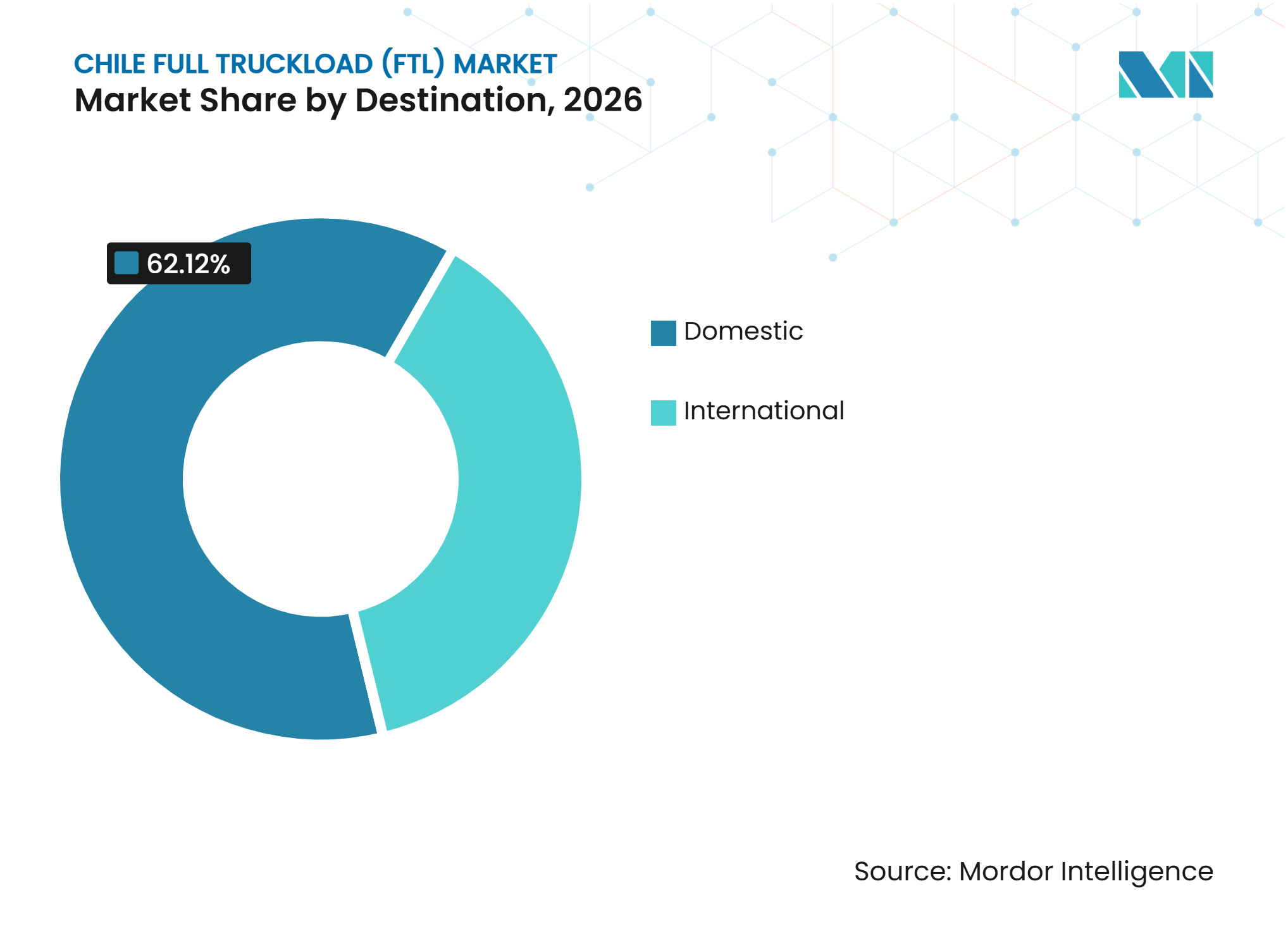
Domestic FTL Anchors the Market, International FTL AcceleratesDomestic FTL accounts for 62.12% of the Chile full truckload (FTL) market share in 2026, which gives the domestic network a stable role in total freight demand. Domestic distribution links Santiago with regional consumption centers, industrial facilities, ports, agricultural zones, and mining operations. The concentration of economic activity in Central Chile supports regular truckload demand for consumer goods, production inputs, and finished products. Domestic lanes also allow carriers to build recurring schedules and customer contracts around established delivery patterns.
International FTL is projected to expand at a 7.36% CAGR through 2032, making it the fastest-growing destination segment. Paso de Jama and Paso Colchane are gaining importance as routes that can connect Argentina-linked mining volumes with Chilean ports. Eramine’s first export through Chile in 2025 demonstrates the practical use of the corridor for lithium carbonate movements toward the Port of Angamos. Cross-border business requires transport companies to handle customs processes, border timing, equipment availability, and coordination with warehouse and port partners.



By Temperature Control:
Dry Freight Dominates, Reefer Sets the Growth PaceDry FTL accounts for 91.36% of the Chile full truckload (FTL) market share in 2026 because non-perishable goods account for a broad range of domestic and industrial freight movements. Manufactured products, construction materials, retail inventory, mining equipment, chemicals, and general consumer goods can move in dry trailers or standard truck bodies. The size of this segment gives carriers a large base of regular shipments across national corridors. It also means that fleet availability in dry freight has a direct effect on general distribution reliability. Operators often compete through route density, driver coverage, service consistency, and visibility tools. The segment remains closely tied to manufacturing production, retail replenishment, and infrastructure-related demand.
Reefer FTL is projected to register an 8.65% CAGR through 2032, the fastest pace among temperature-controlled categories. Fresh fruit, salmon, pharmaceuticals, and online food orders require monitored transport conditions from origin through delivery. DP World’s planned increase in refrigerated cherry container handling shows how seasonal exports can generate substantial truck-to-port demand. Reefer carriers must manage vehicle availability, temperature documentation, port appointments, and the risk of disruptions during peak periods. Refrigerated fleets can command a more specialized role, but they also face higher operational demands than standard equipment. The Chile full truckload (FTL) market size for reefer operations is supported by customers that value reliability and product protection more than basic transport capacity.
By Haul Length:
Long-Haul Structures the Market, Regional Miles AccelerateLong-haul FTL accounts for 72.48% of the Chile full truckload (FTL) market share in 2026, reflecting the country’s extended geography and the separation between major production and consumption areas. Mining regions in the north, industrial hubs in the center, and forestry and aquaculture zones in the south require sustained movement over large distances. These lanes place a premium on driver availability, vehicle reliability, fuel management, and safe rest planning. Long-haul freight also uses major highways and port connections that remain important to national trade. The segment offers stable demand for established carriers with fleet depth and knowledge of regional operating conditions.
Regional FTL is projected to register a 7.54% CAGR through 2032 as freight activity expands between mid-sized cities, distribution facilities, and production sites. New logistics developments along Ruta 5 can increase the need for repeated movements that are shorter than national line-haul routes but larger than local deliveries. Walmart Chile’s Chillán Viejo distribution center and the adjacent Megacentro project demonstrate how this corridor can create southbound and northbound regional flows. GPS Chile’s TRACK platform is relevant to these operations because regional carriers need visibility across multi-stop routes and mixed fleets. Regional growth can give operators opportunities to improve truck turns and offer frequent scheduled services without the extended dwell times of national routes.
By End-User Industry:
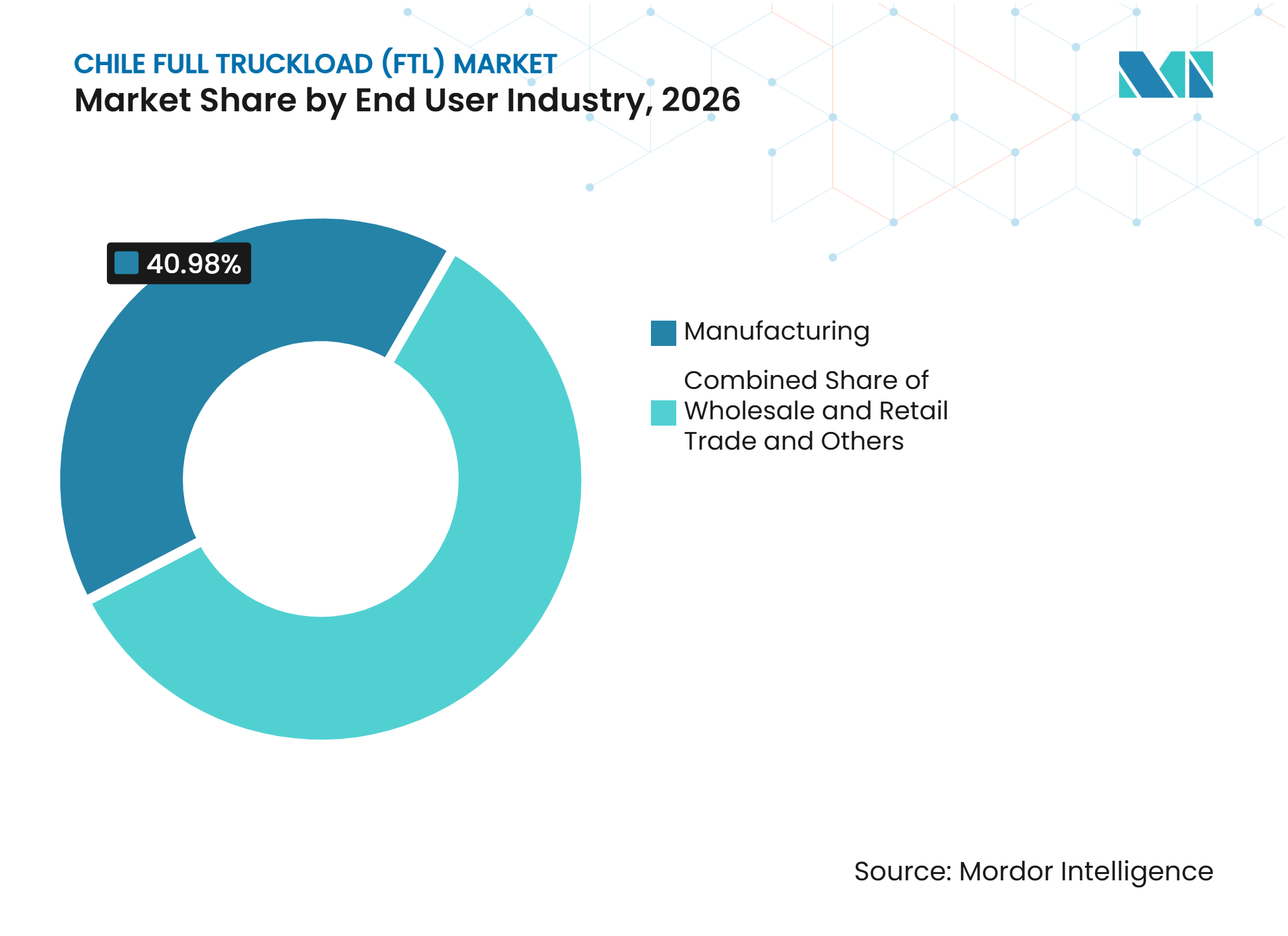
Manufacturing Leads, Retail Trade AcceleratesManufacturing accounts for 40.98% of the Chile full truckload (FTL) market share in 2026, supported by recurring deliveries of inputs and finished goods. Central Chile’s industrial base creates regular connections among factories, warehouses, retailers, and ports. Manufacturers often rely on FTL services when product volumes, timing requirements, or handling needs do not fit shared-load services. A dependable truckload network helps firms avoid production interruptions and move finished goods to customers on schedule. The manufacturing segment also benefits from road links that connect central facilities with northern resource operations and southern processing zones.
Wholesale and retail trade is projected to register a 7.73% CAGR through 2032, supported by online fulfillment and the expansion of modern retail distribution. Kuehne+Nagel and Casaideas expanded their Chile partnership in April 2026 around a dedicated semi-automated 30,000 m² distribution center. The center handled 34.8 million inbound units and fulfilled close to 190,000 e-commerce orders during 2025, showing the scale of inventory and delivery coordination required in omnichannel retail[3]. Dedicated truckloads are useful where retail customers need transfers between import facilities, central warehouses, regional distribution sites, and stores. The Chile full truckload (FTL) industry is therefore increasingly connected to inventory availability, order peaks, and the layout of retail logistics networks.

Geography Analysis
Central Chile accounts for 52.16% of the Chile full truckload (FTL) market share in 2026 because the Santiago Metropolitan Region is the country’s leading consumption, logistics, and industrial center. The region connects manufacturers, retail warehouses, ports, and regional buyers through established road infrastructure. Central Chile also serves as the origin or consolidation point for freight moving to northern mining areas and southern agricultural markets. The Paso Los Libertadores crossing adds an international function by linking this economic center with Argentina. Retail investment along Ruta 5 is creating new distribution points outside Santiago, which can broaden regional freight demand. Walmart Chile’s planned facility in Chillán Viejo illustrates how logistics sites can shift some activity toward mid-corridor cities. Chilean transport and customs requirements make reliable documentation and route coordination important for carriers serving port- and border-linked freight.
Northern Chile is projected to register a 7.46% CAGR through 2032, giving the region the highest geographic growth rate in the Chile Full Truckload (FTL) Market. Lithium and copper activity require regular truck movements between extraction sites, chemical suppliers, processing facilities, and Pacific ports. Eramine’s use of the Paso de Jama corridor for a 2025 lithium carbonate export provides evidence that Chilean ports can support Argentina-linked mineral logistics. Return loads of soda ash, sulfuric acid, and other mining inputs can reduce the cost of otherwise empty backhauls. Yet remote access roads, high-altitude operating conditions, and a shortage of qualified drivers limit the number of carriers able to serve the full corridor. Mining customers also need controlled delivery windows because site operations depend on the availability of fuels, reagents, parts, and equipment. Operators that develop border expertise, specialized fleet capability, and return-load networks can secure a stronger position in this region.
Southern Chile and Patagonia combine forestry, aquaculture, food processing, and remote-community supply routes, producing a mixed freight base rather than a single demand pattern. Salmon exports in Los Lagos require reefer movements, while Biobío’s forestry sector supports heavy freight on routes that connect processing facilities, ports, and national buyers. The Temuco to Rio Bueno concession is expected to improve a key part of the southern network after the change in operator in 2026. The Chacao to Chonchi project also points to a closer road connection for Chiloé’s aquaculture and forestry activity. The June 2026 intermodal pilot between Santiago and Biobío combined electric trucks, rail, and regional distribution activity, indicating a potential alternative for selected long-distance freight movements. Patagonia remains more difficult because long distances and limited return cargo reduce truck utilization. Carriers in these areas need resilient route planning, customer coordination, and cargo matching to control the cost of serving remote communities.
Competitive Landscape
Market Concentration
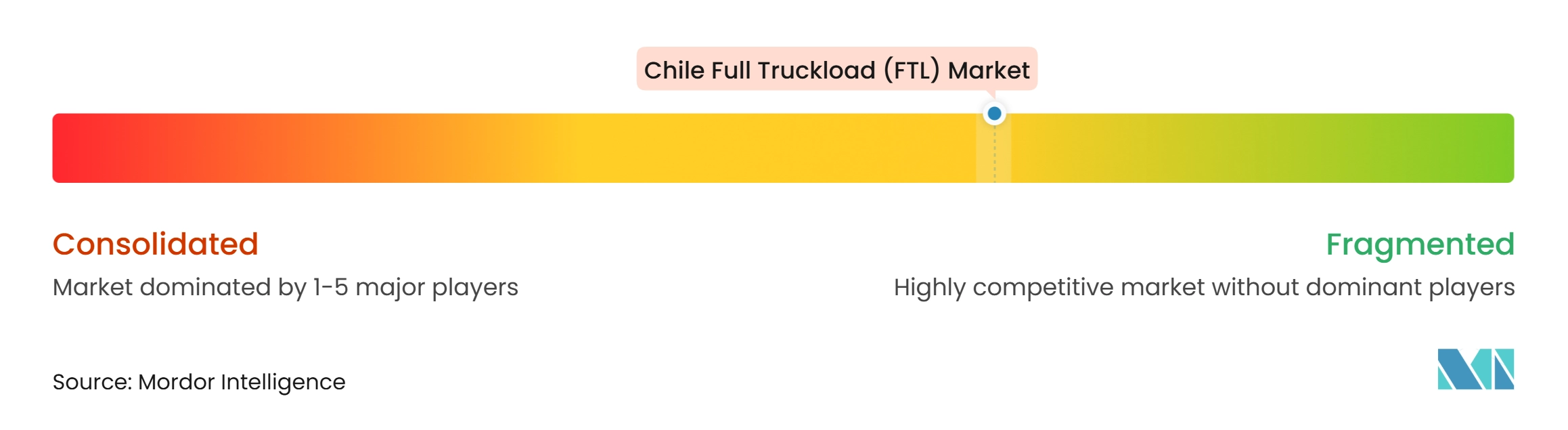
The Chile full truckload (FTL) Market has a fragmented structure. Domestic carriers have a strong position on major freight corridors because they have local fleets, route knowledge, and relationships with mining, agricultural, and retail customers. International logistics groups compete more often through contract logistics that combine trucking with warehousing, customs coordination, tracking, and supply chain management. This structure gives domestic operators an advantage in primary transport capacity while giving multinational firms an advantage in integrated customer contracts. The competitive position of each carrier depends on fleet availability, customer specialization, access to drivers, and the ability to provide dependable service across long distances. Mining corridors and the Santiago to Puerto Montt route can have more concentrated capacity because they require scale and experience.
Fleet electrification is becoming a practical competitive tool for companies seeking lower operating emissions and differentiated customer offerings. Maersk and Sotraser announced an electric-truck partnership in May 2025 for routes connecting Santiago, Viña del Mar, San Antonio, Antofagasta, and the Port of Mejillones. The project included Volvo FH Electric and FM Electric vehicles, Foton EAuman units, charging infrastructure in Santiago, and renewable-energy certification through I-RECs. GPS Chile’s TRACK system represents another strategic response because it allows operators to manage vehicle location, safety conditions, and fleet data in real time. These investments may favor carriers that can fund vehicle upgrades, data systems, and supporting infrastructure.
International firms are deepening their Chilean positions through acquisitions, warehouse capacity, and specialized customer contracts. DSV completed its acquisition of Schenker in April 2025, creating a larger global transport and logistics group with operations across more than 90 countries. Kuehne+Nagel’s expansion with Casaideas shows how an international provider can integrate distribution-center operations with transport and e-commerce fulfillment. DHL Supply Chain also assumed end-to-end management of BAIC spare-parts logistics in Chile from January 2026, including storage, order preparation, and nationwide distribution[4]. Opportunities remain in reefer capacity for smaller exporters, cross-border bonded logistics, and scheduled mid-corridor freight services. Chile’s transport policy and decarbonization direction may further favor carriers that can meet emerging fleet and compliance expectations.
Chile Full Truckload (FTL) Industry Leaders
-
Sotraser SA
-
Transportes Casablanca SA
-
Transportes Nazar
-
DHL Group
-
DSV AS (Including DB Schenker)
- *Disclaimer: Major Players sorted in no particular order
Chile Full Truckload (FTL) Market Companies Covered in this Report
- Sotraser SA
- Transportes Casablanca SA
- Transportes Nazar
- Transportes Bello
- Jorquera Transporte SA
- SAE Transportes
- Agencias Universales SA (AGUNSA)
- Sitrans
- Transportes Santa María
- Transportes Ilzauspe
- Transportes Interandinos SA
- Transportes Artisa
- Transportes Rado Internacional
- Rodotrans
- Transportes Transver
- Transportes Ocaña
- Transportes Cargotrans Tarapacá SA
- South Pacific Logistics
- DHL Group
- DSV AS (Including DB Schenker)
- CEVA Logistics
- Kuehne+Nagel International AG
Recent Industry Developments in Chile Full Truckload (FTL) Market
- July 2026: Sotraser participated in Chile's Santiago–Biobío intermodal freight pilot, deploying electric trucks to transport containerised cargo from manufacturing and distribution facilities to AGUNSA's Lampa terminal. The cargo was then transported by rail to Talcahuano, demonstrating the integration of heavy-duty road transport with rail freight over a corridor exceeding 500 km.
- May 2026: AGUNSA secured a nationwide contract with Capstone Copper to provide integrated warehousing and general cargo transportation services for its Mantos Blancos and Mantoverde mining operations. The contract covers logistics operations across Santiago, Copiapó and Antofagasta, including material reception, inventory management, transportation to mining sites and reverse logistics.
- May 2026: Sotraser partnered with Enel, ISA Vías, and Copelec to introduce Chile's first high-power electric charging corridor for heavy-duty trucks along Ruta 5 Sur between Santiago and Chillán. The initiative included four planned charging stations, two already operational, supporting electric long-haul freight transportation.
- April 2026: Kuehne+Nagel strengthened its Chile partnership with Casaideas through a dedicated, semi-automated 30,000 m² distribution center under a 7-year agreement. The facility supports store replenishment and e-commerce fulfillment.
Chile Full Truckload (FTL) Market Report Scope
Segmentation Overview
| Domestic |
| International |
| Dry |
| Reefer |
| Long-Haul (More than 500 miles) |
| Regional (100–500 miles) |
| Local (Less than 100 miles) |
| Agriculture |
| Fishing and Forestry |
| Construction |
| Manufacturing |
| Oil and Gas |
| Mining and Quarrying |
| Wholesale and Retail Trade |
| Others |
| Northern Chile (Antofagasta, Tarapacá, Atacama, Arica and Parinacota) |
| Central Chile (Santiago Metropolitan Region, Valparaíso, Coquimbo, O’Higgins, Maule) |
| Southern Chile (Biobío, Araucanía, Los Lagos, Los Ríos) |
| Patagonia / Extreme South (Aysén, Magallanes) |
| By Destination | Domestic |
| International | |
| By Temperature Control | Dry |
| Reefer | |
| By Haul Length | Long-Haul (More than 500 miles) |
| Regional (100–500 miles) | |
| Local (Less than 100 miles) | |
| By End-User Industry | Agriculture |
| Fishing and Forestry | |
| Construction | |
| Manufacturing | |
| Oil and Gas | |
| Mining and Quarrying | |
| Wholesale and Retail Trade | |
| Others | |
| By Region | Northern Chile (Antofagasta, Tarapacá, Atacama, Arica and Parinacota) |
| Central Chile (Santiago Metropolitan Region, Valparaíso, Coquimbo, O’Higgins, Maule) | |
| Southern Chile (Biobío, Araucanía, Los Lagos, Los Ríos) | |
| Patagonia / Extreme South (Aysén, Magallanes) |
Key Questions Answered in the Report
What is the projected value of Chile full truckload services by 2032?
The Chile full truckload (FTL) Market is projected to reach USD 12.19 billion by 2032, growing from USD 9.42 billion in 2027 at a 5.30% CAGR.
Which destination segment has the largest share of Chile full truckload services?
Domestic FTL leads with a 62.12% share in 2026, supported by recurring freight flows among Santiago, industrial centers, ports, and regional markets.
Which Chile full truckload service is expanding fastest by temperature control?
Reefer FTL is forecast to register an 8.65% CAGR through 2032, supported by produce, salmon, pharmaceutical, and temperature-controlled retail demand.
Why is Northern Chile important for truckload operators?
Northern Chile is forecast to register a 7.46% CAGR through 2032 because mining and lithium activity requires recurring transport between mine sites, chemical suppliers, and export ports.
What is the leading end-user for Chile full truckload transport?
Manufacturing holds a 40.98% share in 2026, as factories require regular movements of raw materials, components, and finished products.
What operational issues affect truckload carriers in Chile?
Fuel and toll costs, driver shortages, Andean weather disruptions, and empty return journeys can reduce fleet productivity and place pressure on operating margins.