
Chile-Fourth Party Logistics (4PL) Market Size and Share
Market Overview
| Study Period | 2021 - 2032 |
|---|---|
| Forecast Data Period | 2027 - 2032 |
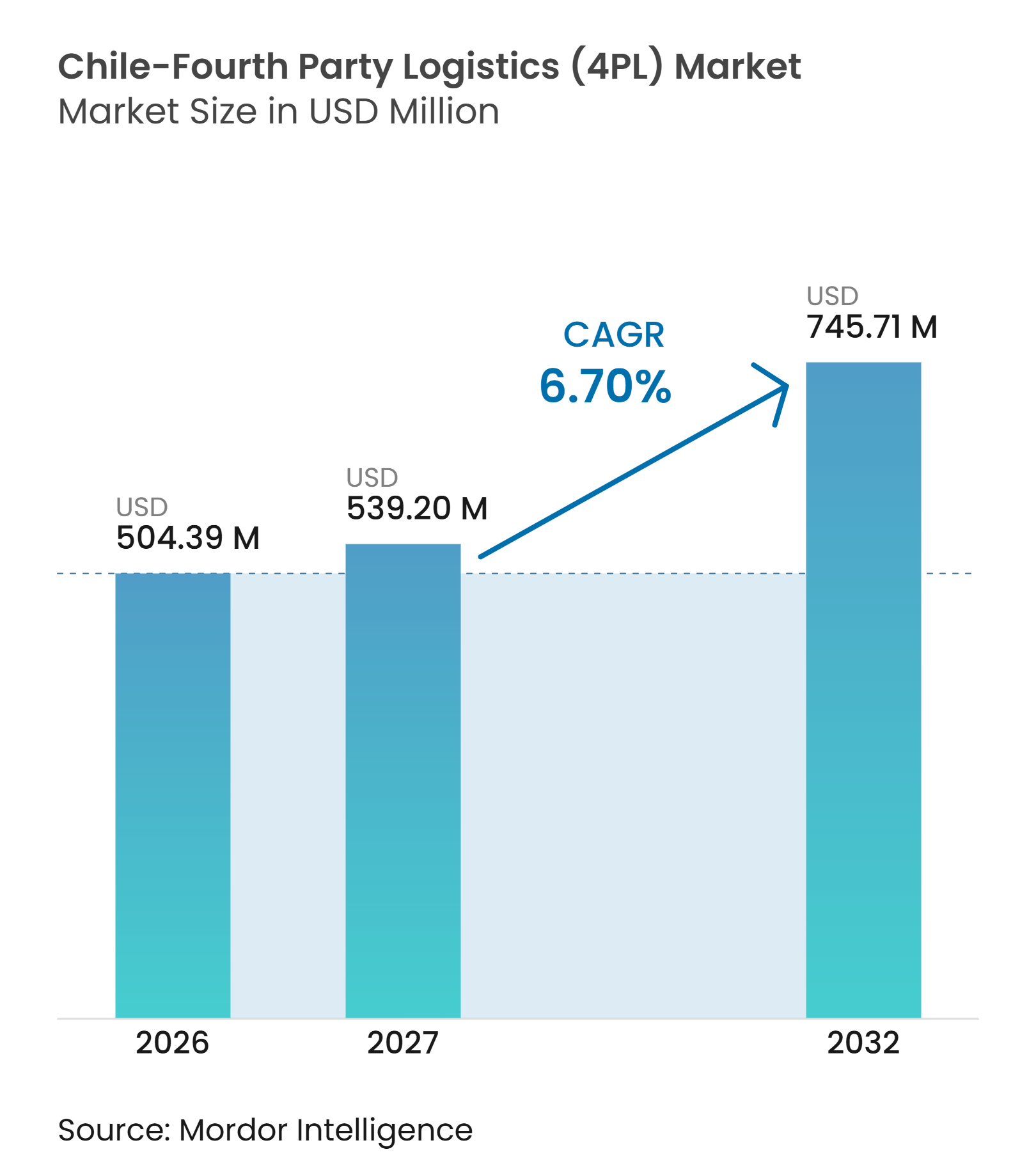
| Base Year Market Size (2026) | USD 504.39 Million |
| Market Size (2027) | USD 539.20 Million |
| Market Size (2032) | USD 745.71 Million |
| Growth Rate (2027 - 2032) | 6.70 % |
| Market Concentration | Medium |
Major Players *Disclaimer: Major Players sorted in no particular order Image © Mordor Intelligence. Reuse requires attribution under CC BY 4.0. | |
Chile-Fourth Party Logistics (4PL) Market Analysis by Mordor Intelligence
The Chile fourth-party logistics (4PL) market size is valued at USD 504.39 million in 2026 and is estimated to grow from USD 539.20 million in 2027 to reach USD 745.71 million by 2032, at a CAGR of 6.70% during 2027 to 2032.
Rising online order volumes are increasing the need for coordinated decisions on inventory, fulfillment, and transport across retailers and their logistics partners. Chilean exporters also require closer coordination across road, port, cold-storage, customs, and ocean freight networks, especially for fresh produce, salmon, and pharmaceuticals. Large providers are expanding control-tower services, digital tracking, and multi-provider management to retain enterprise accounts, while digital platforms are lowering barriers to entry for smaller shippers. Mining supply chains are moving inventory closer to northern operating sites, which is widening the addressable opportunity beyond Santiago-centered logistics networks. System incompatibility, uneven infrastructure, limited analytics talent, and cybersecurity obligations continue to slow deployment in some customer groups and regions.
Key Report Takeaways
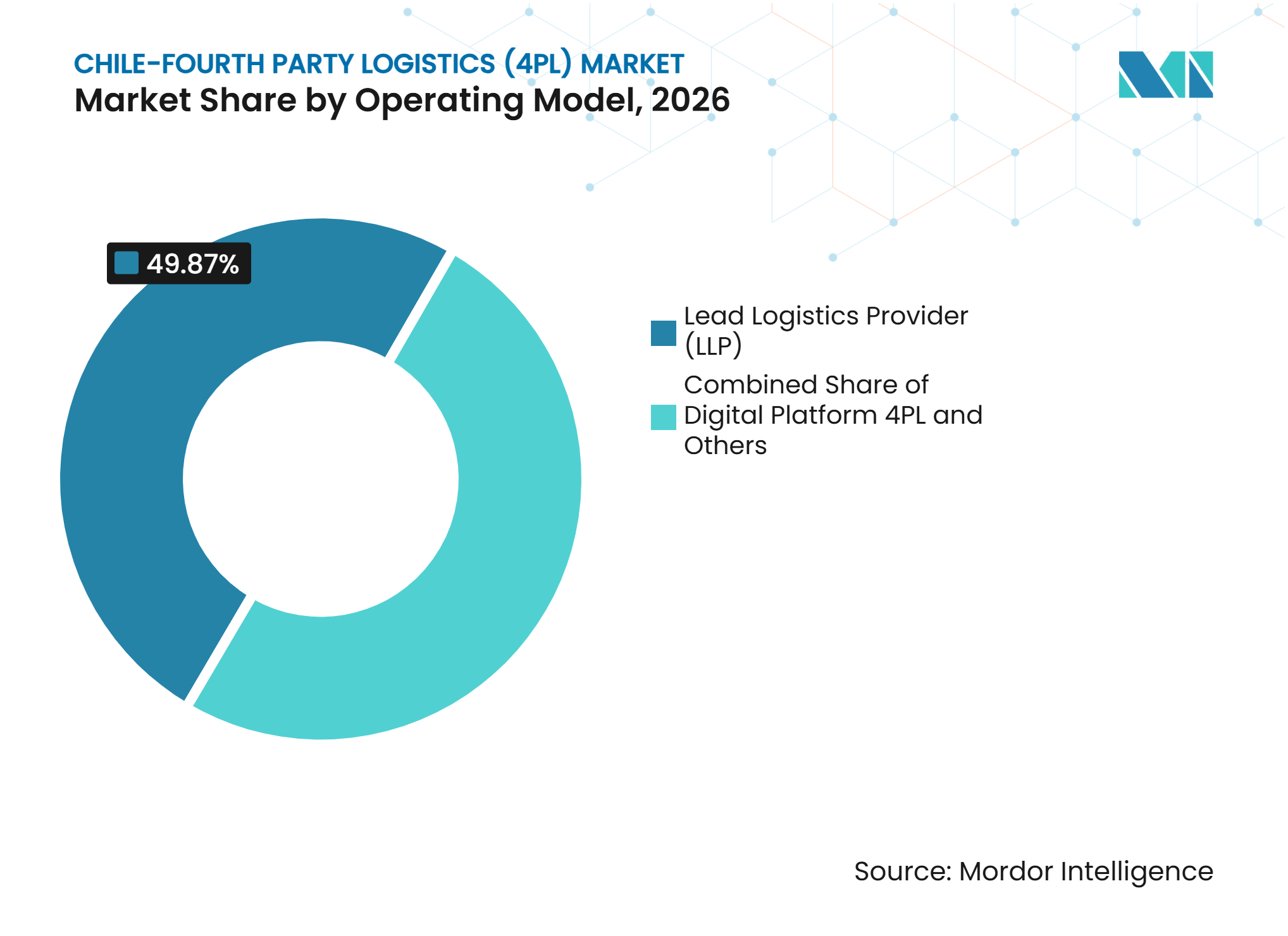
- By operating model, lead logistics provider accounts for 49.87% of the Chile fourth-party logistics (4PL) market share in 2026, while digital platform 4PL is forecast to register an 8.98% CAGR through 2032.
- By end-user industry, retail and e-commerce accounts for 31.68% of the Chile fourth-party logistics (4PL) market size in 2026, while refrigerated and pharma is forecast to register a 7.65% CAGR through 2032.
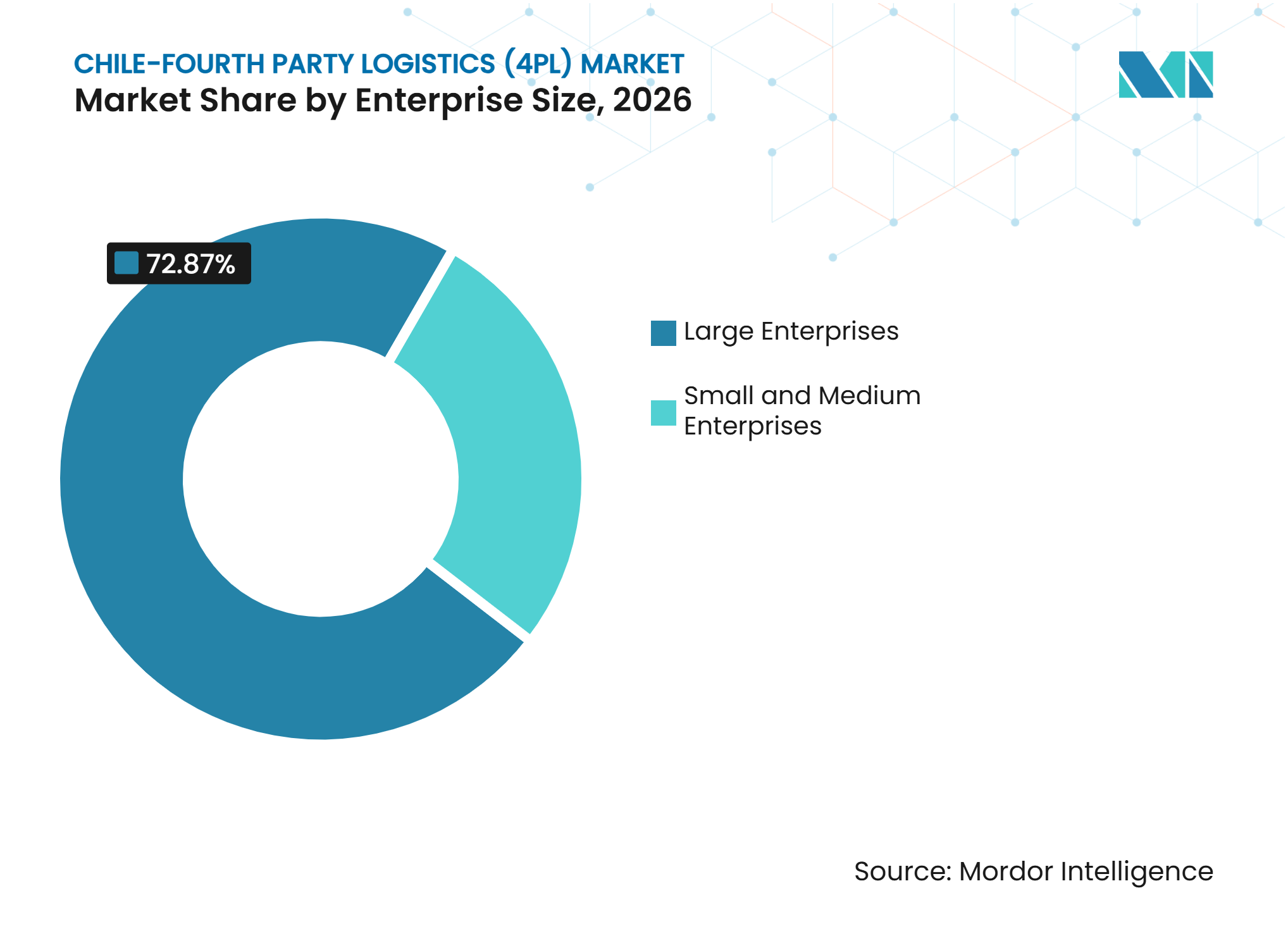
- By enterprise size, large enterprises account for 72.87% of the Chile fourth-party logistics (4PL) market share in 2026, while small and medium enterprises are forecast to register an 8.76% CAGR through 2032.
- By region, Central Chile accounts for 52.49% of the Chile fourth-party logistics (4PL) market share in 2026, while Northern Chile is forecast to register an 8.94% CAGR through 2032.
Note: Market numbers in this report are based on Mordor Intelligence's proprietary estimation framework, which combines nine months of actuals with Q4 projections for base year 2026.
Market Trends and Insights
Drivers Impact Analysis of Chile-Fourth Party Logistics (4PL) Market*
| Driver | (~) % Impact on CAGR Forecast | Geographic Relevance | Impact Timeline |
|---|---|---|---|
| Control-Tower Adoption and Integrated Orchestration | +1.5% | National, strongest in Santiago Metro, Valparaíso, and Antofagasta | Short term (≤ 2 years) |
| E-Commerce Growth and Omnichannel Coordination | +1.8% | National, highest density in Central Chile and the Metropolitan Region | Short term (≤ 2 years) |
| Mining Projects and Complex Logistics Management | +1.3% | Northern Chile, with spillover to Central Chile | Medium term (2-4 years) |
| Cold-Chain Exports and Multi-Provider Coordination | +1.1% | Central Chile and Southern Chile | Medium term (2-4 years) |
| Long Geography and Cross-Regional Orchestration | +0.8% | National, especially Patagonia and the Extreme South | Long term (≥ 4 years) |
| Neutral Orchestration and Multi-Provider Integration | +0.7% | National, with rising relevance in Northern and Southern Chile | Medium term (2-4 years) |
| Source: Mordor Intelligence | |||
Control-Tower Adoption Increasing Integrated Orchestration Demand
Control-tower adoption is increasing because Chilean shippers need a single operating view across carriers, warehouses, and customer delivery channels. DHL Supply Chain operates a central control tower in Chile that coordinates routing, carrier selection, and exception management across business units. Pharmaceutical companies are adopting these structures to more closely monitor inventory projections, fill rates, and production schedules. The Instituto de Salud Pública oversees requirements that make supply-chain traceability more relevant for regulated healthcare products. A control tower can therefore serve operational and compliance needs at the same time. This strengthens the case for long-term 4PL relationships where a provider manages the network rather than only a transport lane.
E-Commerce Growth Expanding Omnichannel Coordination Requirements
Chile’s online retail sales reached nearly USD 9.48 billion in 2025 and increased 9% in real terms, which raised the volume of fulfillment decisions facing retailers[1]. The Cámara de Comercio de Santiago expects double-digit e-commerce growth through 2026, supported by artificial intelligence applications and logistics improvements. Falabella delivered 60% of orders in less than 48 hours during the first quarter of 2025, raising service expectations for other sellers. Smaller sellers cannot always build comparable warehousing and carrier capabilities internally. The Chile fourth-party logistics (4PL) market benefits when providers pool transport capacity and warehouse resources across clients. This approach makes omnichannel coordination more available to marketplace merchants and growing retailers.
Mining Projects Increasing Complex Logistics Management Needs
Mining firms are placing strategic inventory nearer to operating areas, which increases the need to coordinate suppliers, regional warehouses, and mine-site delivery. Chile’s Ministry of Public Works agreed in November 2025 to invest CLP 600 billion (USD 622 million) over 10 years in the Bioceanic Corridor Capricornio connecting Antofagasta with Brazil and Paraguay. AGUNSA received a nationwide Capstone Copper contract in February 2026 covering warehousing and cargo transport across Santiago, Copiapó, and Antofagasta. These networks require a provider to manage multiple transport modes and inventory locations rather than isolated service contracts. Mining operators are also seeking better inventory visibility and demand planning tools. This supports 4PL models that can coordinate a full procurement chain across regional locations.
Cold-Chain Exports Increasing Multi-Provider Coordination Requirements
Chile’s cherry export flows require coordinated handling between orchards, inland transport, reefer connections, vessels, and customs processes. DP World processed more than 12.8 million cherry boxes at San Antonio during the 2024/25 season and introduced remote monitoring and automated vacuum-mooring capabilities for the following season[2]. Kuehne+Nagel received an exclusive healthcare logistics contract for Roche Chile in June 2026 that covers temperature-controlled products, raw materials, and psychotropic medicines. These assignments require controlled conditions from storage through delivery to hospitals, clinics, and pharmacy distribution centers. Good Distribution Practice requirements raise the cost of fragmented logistics execution for pharmaceutical customers. Cold-chain requirements therefore support integrated management across several specialized providers.
Restraints Impact Analysis of Chile-Fourth Party Logistics (4PL) Market*
| Restraint | (~) % Impact on CAGR Forecast | Geographic Relevance | Impact Timeline |
|---|---|---|---|
| Fragmented Data Standards and Provider Interoperability | -1.0% | National, especially corridors linking Northern Chile to Central hubs | Short term (≤ 2 years) |
| Infrastructure Imbalances and Network Optimization Limits | -0.8% | Patagonia, Extreme South, rural Northern Chile, and trans-Andean corridors | Long term (≥ 4 years) |
| Analytics Talent Shortages and Control-Tower Scalability | -0.5% | National, particularly Santiago Metropolitan Region and Antofagasta | Medium term (2-4 years) |
| Cybersecurity Risks in Digital Orchestration | -0.4% | National, with high exposure in automated distribution centers and port-linked systems | Short term (≤ 2 years) |
| Source: Mordor Intelligence | |||
Fragmented Data Standards Limiting Provider Interoperability
Incompatible data formats remain an immediate barrier when 4PL providers combine carrier, warehouse, customs, and sensor data. A mining network may use 8 to 15 sub-carriers, each with separate fleet, pallet, and shipment systems. Manual reconciliation can remove the efficiency benefits that a 4PL operator is expected to create. The Port Community System being implemented at Puerto San Antonio is intended to integrate cargo movement actors, documentation, truck scheduling, and container tracking in one platform. Port-level integration does not fully solve data gaps among inland carriers and last-mile operators. Cybersecurity concerns add another challenge because connected logistics systems need clear incident management and access controls under Chile’s cybersecurity framework.
Infrastructure Imbalances Reducing Network Optimization Efficiency
Chile’s 4,300-kilometer length and varied terrain make uniform logistics service levels difficult to deliver. Road, rail, port, and weather-related constraints can create material differences in cost and transit time across Southern Chile, Patagonia, rural northern areas, and trans-Andean corridors. The Puerto Exterior San Antonio project remains in development, leaving capacity pressure at a major container gateway in the medium term. In the south, rail and cold-chain projects may improve options but will also increase the number of assets that must be coordinated. Providers need specialized analytics staff to design resilient networks around these limits. The shortage of such capabilities can slow the expansion of sophisticated control-tower services beyond large customers.
*Our forecasts treat driver/restraint impacts as directional, not additive. The impact forecasts reflect baseline growth, mix effects, and variable interactions.
Chile-Fourth Party Logistics (4PL) Market Segment Analysis
By Operating Model:
LLP Retains the Largest Position While Digital Platforms Grow FasterLead logistics provider accounts for 49.87% of the Chile fourth-party logistics (4PL) market share in 2026. Large mining, retail, and manufacturing companies commonly prefer one contractually accountable operator that can design the network and manage subcontracts. These engagements often include multi-year contracts, service-level indicators, and dedicated control-tower teams. The model creates switching costs because the provider becomes embedded in governance and operating routines.
Digital platform 4PL is projected to register an 8.98% CAGR through 2032. These platforms aggregate carrier capacity, automate routing, and provide shipment visibility for mid-sized shippers and e-commerce sellers. The model reduces the need for a customer to build a dedicated internal logistics team. Kuehne+Nagel’s Blue Yonder deployment for Casaideas demonstrates how warehouse and transport systems can support omnichannel distribution. The distinction between LLP and digital platform models may narrow as control-tower tools become more widely deployed.



By End-User Industry:
Retail Provides Scale While Refrigerated and Pharma Grow FasterRetail and e-commerce represent 31.68% of the Chile fourth-party logistics (4PL) market size in 2026. Online sales account for more than 14% of national commerce, increasing the need for distributed inventory and coordinated fulfillment. FMCG also requires frequent replenishment across modern retail, independent stores, and online channels. Fashion, consumer technology, automotive, and industrial customers add requirements such as seasonal planning, spare-parts availability, and just-in-time delivery.
Refrigerated and pharma is expected to expand at a 7.65% CAGR through 2032. Cherry exports, salmon logistics, and healthcare distribution depend on controlled temperatures and coordinated handoffs. Chile’s fresh produce exporters face infrastructure needs in pre-cooling and reefer plug capacity, which makes external logistics coordination more attractive. Roche Chile’s managed logistics contract also shows the movement toward specialized healthcare distribution. These conditions increase the value of a vendor-neutral operator that can manage different cold-chain providers.
By Enterprise Size:
Large Enterprises Account for Most Value While SMEs Expand Through PlatformsLarge Enterprises account for 72.87% of Chile fourth-party logistics (4PL) market share in 2026. Multinationals and large Chilean groups have complex, multi-site supply chains and can support dedicated control-tower arrangements. They also have procurement teams that can evaluate provider-neutral models and performance commitments. DHL’s Chile operations include sector-specific work for pharmaceutical and automotive customers, illustrating the breadth of enterprise outsourcing requirements.
Small and medium enterprises are forecast to register an 8.76% CAGR through 2032. Digital platforms provide application programming interface integrations, carrier access, and real-time tracking without the expense of dedicated account teams. Continued online retail growth can push more sellers beyond the point where manual fulfillment remains workable. The Chile fourth-party logistics (4PL) market size for this customer group benefits when platforms simplify the use of several logistics partners. Platform-led adoption can broaden demand without requiring every smaller company to build its own supply-chain control function.

Geography Analysis
Central Chile accounts for 52.49% Chile fourth-party logistics (4PL) market share in 2026, reflecting its concentration of headquarters, warehouses, ports, and domestic transport links. San Antonio and Valparaíso connect import and export cargo to the Santiago metropolitan area. Indra began implementing a Port Community System at Puerto San Antonio in 2025 to integrate documentation, truck scheduling, container tracking, and workflow management. This digitalization gives 4PL providers more usable data for coordinating shipments through the central corridor. E-commerce growth is also adding warehouse and last-mile demands for retailers headquartered in Santiago. GEODIS opened a LEED-certified distribution center in Renca in March 2026, with 9,500 m² of expansion-ready space and highway connections to the major ports[3]. Central Chile should remain the country’s main contract-originating location even as incremental opportunities spread to other regions.
Northern Chile is expected to record an 8.94% CAGR through 2032, the fastest regional rate in the Chile fourth-party logistics (4PL) market. Copper, lithium, and specialty mineral projects need inventory nearer to extraction sites, which supports logistics hubs outside Santiago. AGUNSA’s nationwide Capstone Copper assignment covers logistics activity in Santiago, Copiapó, and Antofagasta. The Bioceanic Corridor Capricornio investment agreement supports longer-term connections from Antofagasta to Brazil and Paraguay. These projects make inventory visibility, multimodal planning, and consistent supplier coordination more important. Providers that understand mining compliance, remote delivery, and regional warehousing can build a defensible position in the north.
Southern Chile combines aquaculture, forestry, food production, and energy-related supply chains that require specialized coordination. Los Lagos is a core salmon production region, which increases demand for temperature-controlled movement between processing facilities, ports, and export services. Emergent Cold LatAm commissioned 2 blast-freezing tunnels in San Antonio in June 2026, adding capacity to process more than 10,500 tons of frozen food each year. This investment supports export flows that connect southern production zones with central port infrastructure. Scheduled reefer rail services under development can add another mode to manage for cold-chain shippers. Patagonia and the Extreme South have lower logistics density, high per-unit service costs, and more difficult infrastructure conditions.
Competitive Landscape
Market Concentration
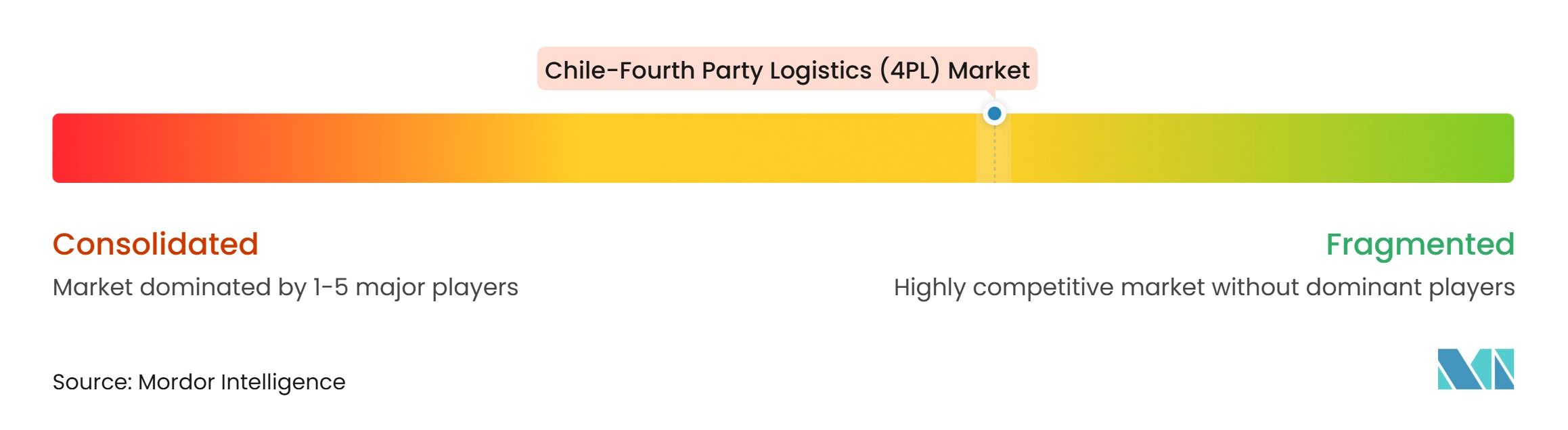
The Chile fourth-party logistics (4PL) market is fragmented, with global integrated providers serving many large enterprise accounts and regional specialists holding strong positions in particular sectors. DHL Group, Kuehne+Nagel, DSV, GEODIS, A.P. Moller-Maersk, and CEVA Logistics compete through international networks, account relationships, control-tower capabilities, and technology offerings. Their Chile strategies often extend existing global mandates into local operations. Ransa and AGUNSA compete through local infrastructure, operating relationships, and experience in mining, ports, and cold-chain logistics. This makes provider selection depend on the customer’s sector, network complexity, and need for international coordination.
Kuehne+Nagel’s Apex Logistics agreed to acquire a majority stake in Andes Integración Logística in November 2025, widening its reach in perishables and air freight across Latin America. Kuehne+Nagel also expanded its Casaideas partnership through a dedicated semi-automated 30,000 m² distribution center handling omnichannel activity[4]. Maersk expanded its cold-chain work with Geofrut in November 2025 across inland transport, cold storage, ocean freight, air freight, and customs clearance. These moves show that providers are competing for integrated assignments rather than single transport legs.
Digital capability is becoming a more important differentiator in the Chile fourth-party logistics (4PL) market. Providers that can use carrier selection tools, predictive arrival estimates, demand planning, and exception management can offer more consistent performance across complex networks. Smaller providers may compete in specialized lanes or regional niches but can face higher costs when customers require advanced systems and certified processes. Chile’s cybersecurity law increases the importance of digital security management and incident-reporting readiness for logistics organizations supporting essential services.
Chile-Fourth Party Logistics (4PL) Industry Leaders
-
Agencias Universales SA
-
TW Logística SpA
-
Inversiones Ultramar Ltda.
-
DHL Group
-
Kuehne + Nagel International AG
- *Disclaimer: Major Players sorted in no particular order
Chile-Fourth Party Logistics (4PL) Market Companies Covered in this Report
- DHL Group
- Kuehne + Nagel International AG
- DSV AS
- GEODIS
- A.P. Moller - Maersk AS
- CMA CGM SA
- Rhenus Group
- PSA International Pte Ltd
- DP World Ltd
- Expeditors International of Washington Inc
- JAS Worldwide Inc
- Hellmann Worldwide Logistics SE & Co. KG
- Nippon Yusen Kabushiki Kaisha
- AD Ports Group PJSC
- ID Logistics Group
- Ransa
- Agencias Universales SA
- Inversiones Ultramar Ltda.
- TW Logística SpA
- Avancargo SA
- Logistics Control Tower
- United Parcel Service Inc
Recent Industry Developments in Chile-Fourth Party Logistics (4PL) Market
- November 2026: AGUNSA commenced operations as the national logistics operator and transportation provider for CMPC. The agreement involves managing cargo distribution from its logistics centers in Santiago and Talcahuano to 25 destinations across Chile. This strengthens AGUNSA's integrated logistics and nationwide supply-chain management capabilities.
- September 2026: AGUNSA inaugurated a new logistics operator service for Gold Fields to support its Salares Norte mining operations. The service operates through AGUNSA's logistics center in Lampa and coordinates supplier cargo deliveries in Santiago and Copiapó. The development strengthens its integrated mining logistics and supplier-management capabilities.
- July 2026: Maersk introduced an integrated cold-chain logistics solution connecting Chilean agricultural exporters with the United States East Coast, in collaboration with Oppy and the Port of Wilmington. The solution integrates origin handling, ocean transportation, port operations, fumigation, inland transportation, and cold storage. The initiative strengthens Maersk's end-to-end logistics capabilities for Chilean fresh-produce exports.
- April 2026: Kuehne+Nagel expanded its seven-year logistics partnership with Chilean retailer Casaideas through a dedicated 30,000 m² semi-automated distribution center. The facility integrates e-commerce fulfilment and retail-store replenishment into a consolidated distribution operation. The expansion strengthens its contract logistics, inventory management, and omnichannel fulfilment capabilities in Chile.
Chile-Fourth Party Logistics (4PL) Market Report Scope
Segmentation Overview
| Lead Logistics Provider (LLP) |
| Solution Integrator |
| Digital Platform 4PL |
| FMCG |
| Retail and E-commerce |
| Fashion and Lifestyle |
| Technology and Electronics |
| Refrigerated and Pharma |
| Automotive and Mobility |
| Industrial Manufacturing |
| Others |
| Small and Medium Enterprises |
| Large Enterprises |
| Northern Chile (Antofagasta, Tarapacá, Atacama, Arica and Parinacota) |
| Central Chile (Santiago Metropolitan Region, Valparaíso, Coquimbo, O’Higgins, Maule) |
| Southern Chile (Biobío, Araucanía, Los Lagos, Los Ríos) |
| Patagonia / Extreme South (Aysén, Magallanes) |
| By Operating Model | Lead Logistics Provider (LLP) |
| Solution Integrator | |
| Digital Platform 4PL | |
| By End-User Industry | FMCG |
| Retail and E-commerce | |
| Fashion and Lifestyle | |
| Technology and Electronics | |
| Refrigerated and Pharma | |
| Automotive and Mobility | |
| Industrial Manufacturing | |
| Others | |
| By Enterprise Size | Small and Medium Enterprises |
| Large Enterprises | |
| By Region | Northern Chile (Antofagasta, Tarapacá, Atacama, Arica and Parinacota) |
| Central Chile (Santiago Metropolitan Region, Valparaíso, Coquimbo, O’Higgins, Maule) | |
| Southern Chile (Biobío, Araucanía, Los Lagos, Los Ríos) | |
| Patagonia / Extreme South (Aysén, Magallanes) |
Key Questions Answered in the Report
What is the projected growth rate for Chile fourth-party logistics (4PL) market services?
The Chile fourth-party logistics (4PL) market is projected to register a 6.70% CAGR from 2027 to 2032, reaching USD 745.71 million by 2032.
Which operating model has the largest position in Chile?
Lead logistics provider is the largest operating model, with a 49.87% share in 2026.
Which customer group is growing fastest for 4PL providers?
Small and medium enterprises are forecast to record an 8.76% CAGR through 2032 as digital platforms lower adoption barriers.
Why are cold-chain logistics important in Chile?
Cherry, salmon, and healthcare flows require temperature control and coordination across several transport and storage providers.
Which Chilean region is growing fastest for 4PL services?
Northern Chile is forecast to expand at an 8.94% CAGR through 2032, supported by decentralized mining supply chains.
Which factors limit 4PL adoption in Chile?
Fragmented data systems, uneven infrastructure, analytics talent shortages, and cybersecurity requirements can limit scalability.