
Chile Cross-Border Road Freight Transport Market Size and Share
Market Overview
| Study Period | 2021 - 2032 |
|---|---|
| Forecast Data Period | 2027 - 2032 |
| Base Year Market Size (2026) | USD 4.31 Billion |
| Market Size (2027) | USD 4.57 Billion |
| Market Size (2032) | USD 6.12 Billion |
| Growth Rate (2027 - 2032) | 5.98 % |
| Market Concentration | Low |
Major Players *Disclaimer: Major Players sorted in no particular order Image © Mordor Intelligence. Reuse requires attribution under CC BY 4.0. | |
Chile Cross-Border Road Freight Transport Market Analysis by Mordor Intelligence
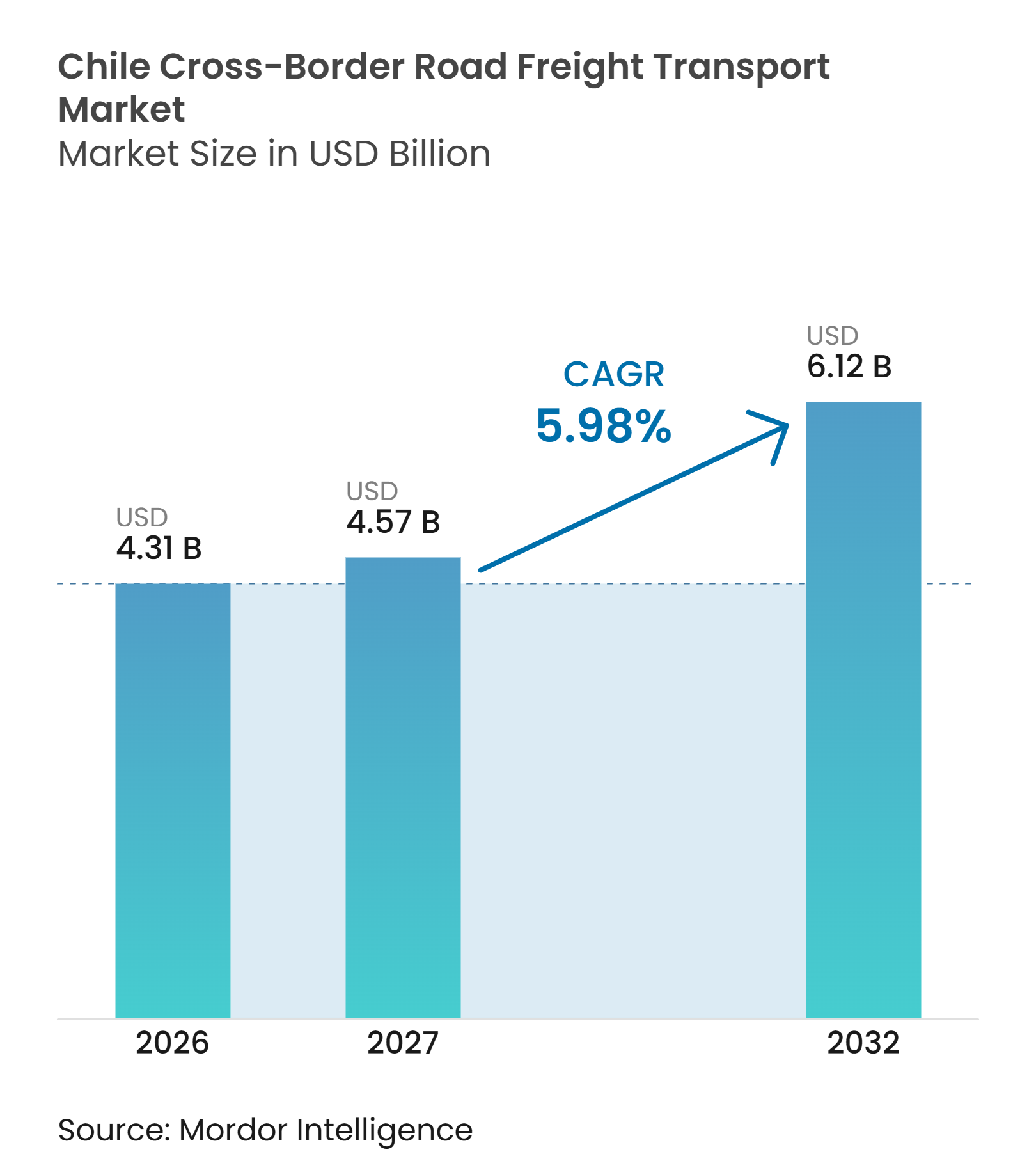
The Chile cross-border road freight transport market size is valued at USD 4.31 billion in 2026 and is estimated to grow from USD 4.57 billion in 2027 to USD 6.12 billion by 2032, at a CAGR of 5.98% during the forecast period from 2027 to 2032.
Chile has 36 active land border complexes, including 30 with Argentina, 5 with Bolivia, and 1 with Peru, which makes its road network an important Pacific connection for Southern Cone trade. Copper, lithium, consumer goods, and agricultural shipments continue to support demand for truck capacity on major corridors. Chile’s road investment program and customs modernization efforts are strengthening the operating conditions for carriers that can manage complex cross-border movements. The Chile cross-border road freight transport industry remains exposed to mountain closures, documentation delays, driver shortages, and uneven return loads.
Key Report Takeaways
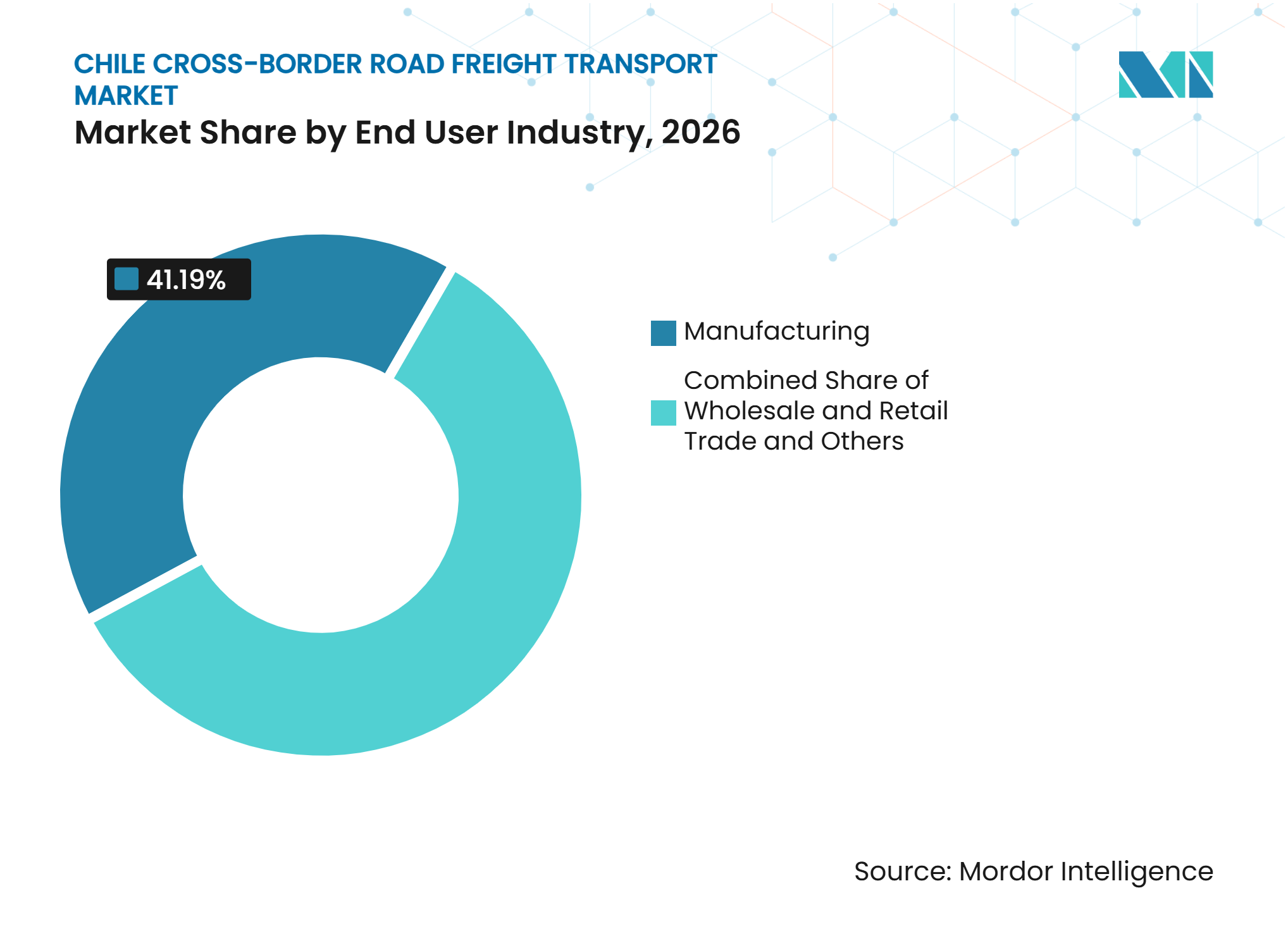
- By end user industry, manufacturing accounts for 41.19% of the Chile cross-border road freight transport market share in 2026, while wholesale and retail trade is projected to register a 6.46% CAGR through 2032.
- By truckload specification, full truckload accounts for 76.98% of the Chile cross-border road freight transport market size in 2026, while less-than-truckload is projected to register a 7.34% CAGR through 2032.
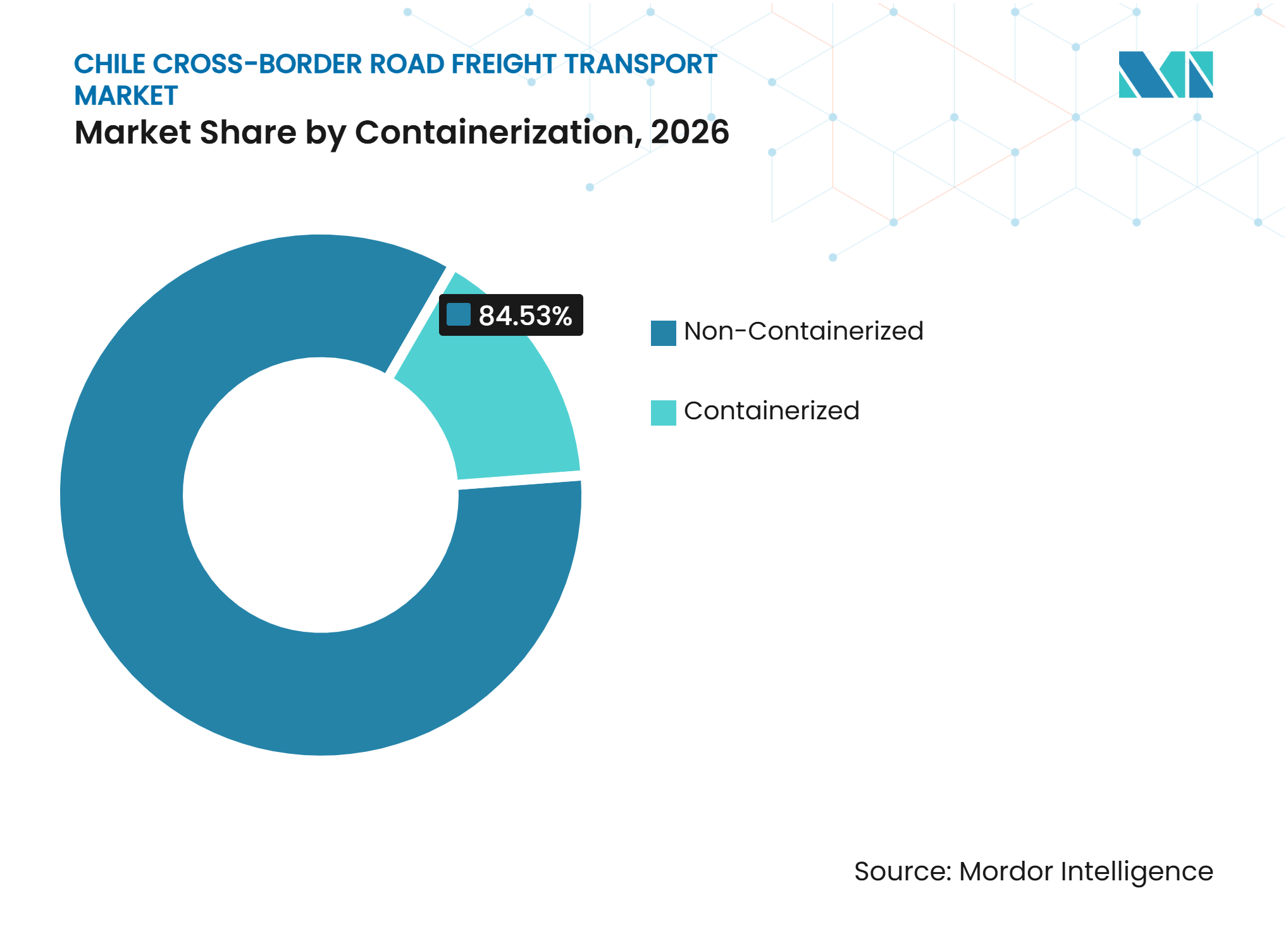
- By containerization, non-containerized freight accounts for 84.53% of the Chile cross-border road freight transport market share in 2026, while containerized loads are projected to register a 7.24% CAGR through 2032.
- By distance, long haul accounts for 74.24% of the Chile cross-border road freight transport industry size in 2026, while short haul is projected to register an 8.21% CAGR through 2032.
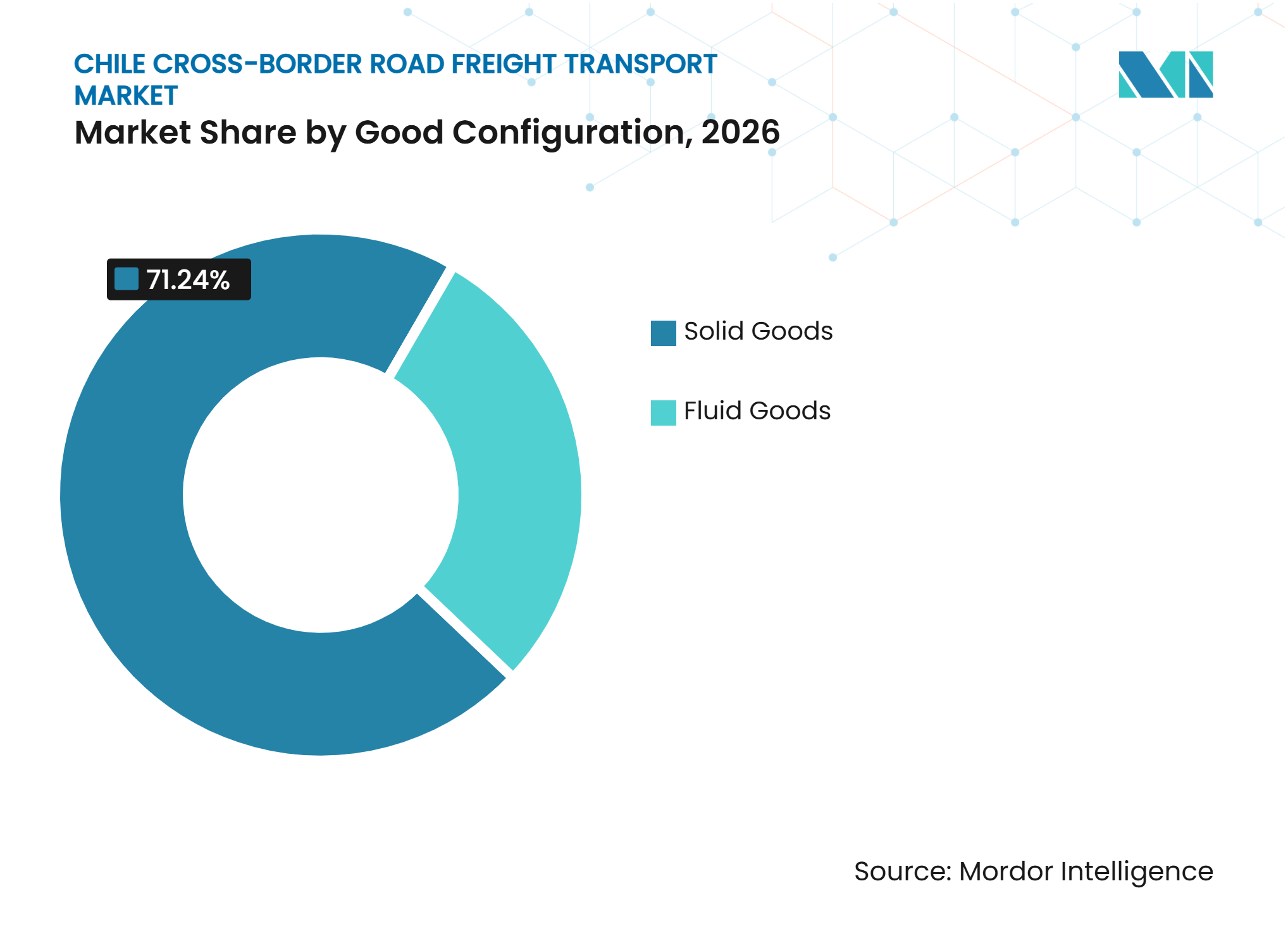
- By goods configuration, solid goods accounts for 71.24% of the Chile cross-border road freight transport market share in 2026, while fluid goods are projected to register an 8.37% CAGR through 2032.
- By temperature control, non-temperature-controlled freight accounts for 92.15% of the Chile cross-border road freight transport market size in 2026, while temperature-controlled freight is projected to register a 7.11% CAGR through 2032.
- By cross-border lane, Chile–Argentina accounts for 57.36% of the Chile cross-border road freight transport industry share in 2026, while the Chile–Paraguay lane is projected to register an 8.39% CAGR through 2032.
Note: Market numbers in this report are based on Mordor Intelligence's proprietary estimation framework, which combines nine months of actuals with Q4 projections for base year 2026.
Market Trends and Insights
Drivers Impact Analysis of Chile Cross-Border Road Freight Transport Market*
| Driver | (~) % Impact on CAGR Forecast | Geographic Relevance | Impact Timeline |
|---|---|---|---|
| Regional Trade Growth Increasing International Freight Volumes | +1.2% | Global, with early gains in Chile–Argentina and Chile–Brazil corridors | Medium term (2-4 years) |
| Bioceanic Corridor Investment Improving Cross-Border Road Connectivity | +1.8% | Northern Chile, with spillover to Brazil and Paraguay | Long term (≥ 4 years) |
| Mining and Agriculture Expanding Road Freight Demand | +1.5% | Chile–Argentina and Chile–Peru, with gains in Antofagasta and Tarapacá | Medium term (2-4 years) |
| Temperature-Sensitive Cargo Increasing Specialized Transport Requirements | +0.9% | Chile–Peru and Chile–Argentina, with early gains in Santiago | Long term (≥ 4 years) |
| Digital Freight Platforms Improving Capacity Matching Efficiency | +0.7% | National, with spillover to the Andean region | Short term (≤ 2 years) |
| Route Diversification Strengthening Network Resilience After Disruptions | +0.5% | Chile–Argentina corridor, Jama and Cardenal Samoré passes | Short term (≤ 2 years) |
| Source: Mordor Intelligence | |||
Regional Trade Growth Increasing International Freight Volumes
Chile’s cross-border road freight system processed 17.05 million tons of cargo in 2025. The increase reflects stronger trade movements with Argentina, Brazil, Bolivia, and Peru. Colchane recorded a 25.3% traffic increase in 2025, which points to a broader role for northern routes serving Bolivia-related commerce. Chile’s trade agreement network lowers barriers for goods moving through its border infrastructure. The Ministry of Transport and Telecommunications issued a cross-border cargo documentation guide in 2025, reflecting a need for clearer compliance processes as activity grows. Higher trade volumes create opportunities for carriers with customs capabilities, reliable cross-border capacity, and access to secondary routes.
Bioceanic Corridor Investment Improving Cross-Border Road Connectivity
Chile’s Ministry of Public Works committed CLP 595 billion (USD 612.85 million) for road upgrades across 352 km in Antofagasta under the Bioceanic Capricornio Corridor program[1]. The program includes improvements on Routes 23-CH, 27-CH, 24, and 29. The route connects Brazil and Paraguay with Chilean Pacific ports through northwestern Argentina. Chile’s 2026 High-Level Commission discussions prioritized inspection capacity at Paso Jama and logistics nodes in Antofagasta and Tarapacá. The Inter-American Development Bank identifies the corridor as an important platform for regional integration, particularly for areas that have had limited transport connections. The program can increase demand for long-distance road services, storage, border support, and port-linked distribution across northern Chile.
Mining and Agriculture Expanding Road Freight Demand
Copper and lithium remain central to Chile’s outbound cargo profile and associated road freight requirements. Chile exported USD 53.69 billion in copper and USD 2.4 billion in lithium in 2025. Chile’s copper project portfolio is expected to add capacity, supporting continued demand for equipment, inputs, and mineral-related transport. Agricultural exports add seasonal demand for refrigerated and general cargo movements. Fresh cherries, table grapes, and salmon require coordinated transport from production sites to export gateways. Chile exported 5.3 million tons of copper in 2025, which reinforces the relevance of mining-linked transport on the Chile cross-border road freight transport market. These supply chains favor operators with specialized equipment, safety systems, and established border operations.
Specialized Cargo and Digital Coordination Improving Service Requirements
Temperature-controlled transport is gaining relevance as pharmaceutical, salmon, and fresh-fruit shipments require consistent cold-chain conditions. Chile’s sanitary food rules require perishable foods to travel in closed refrigerated vehicles authorized by the relevant health authority. This rule limits participation to carriers that can meet equipment, sanitation, and monitoring standards. Regional freight providers are also using tracking applications that provide clients with real-time shipment visibility. DeltaX reported activity across six South American countries in 2025, indicating growing adoption of digital capacity coordination. Digital freight systems can help reduce unfilled return trips and improve asset use on long routes. These service capabilities are becoming more relevant where shippers need visibility, temperature assurance, and faster responses to border disruption.
Restraints Impact Analysis of Chile Cross-Border Road Freight Transport Market*
| Restraint | (~) % Impact on CAGR Forecast | Geographic Relevance | Impact Timeline |
|---|---|---|---|
| Mountain Weather Disruptions Reducing Corridor Reliability | -1.2% | Chile–Argentina, including Paso Los Libertadores, Pino Hachado, and Pehuenche | Short term (≤ 2 years) |
| Border Documentation Complexity Increasing Transit Delays | -0.8% | Chile–Argentina, Chile–Bolivia, and Chile–Peru corridors | Medium term (2-4 years) |
| Driver Shortages Constraining Long-Haul Freight Capacity | -0.6% | National, with early impact on long-haul and cross-border routes | Long term (≥ 4 years) |
| Empty-Return Imbalances Weakening Backhaul Operating Economics | -0.4% | Chile–Argentina and Chile–Brazil corridors | Medium term (2-4 years) |
| Source: Mordor Intelligence | |||
Mountain Weather Disruptions Reducing Corridor Reliability
The extended closure of Cristo Redentor–Los Libertadores in July and August 2026 disrupted a corridor that handles a large share of Chile’s inbound land freight. High-altitude routes such as Jama and Sico face additional winter and terrain risks. First-half 2026 cross-border cargo declined 1.26%, while truck traffic fell 3.43% from the same period in 2025[2]. Bilateral reopening arrangements can organize traffic when conditions permit, but they cannot remove physical weather risk. Service reliability therefore depends on alternative corridors, driver safety, and coordination among border agencies. Repeated disruptions can raise carrier costs and affect delivery commitments for manufacturers, retailers, and exporters.
Border Documentation Complexity Increasing Transit Delays
Cargo documentation remains an operating challenge at Chilean border crossings, especially during peak traffic periods. Chile introduced new customs procedures at Los Libertadores in August 2026, including risk-based pre-arrival cargo screening. The procedures can benefit compliant carriers, but they also raise requirements for operators that are unfamiliar with cross-border documentation. Argentina incorporated the ATIT Eighth Protocol in 2026, creating a legal basis for digital exchange of cargo declarations. During the transition, carriers must manage paper and digital processes at the same time. This environment favors logistics providers with dedicated compliance teams and established relationships with customs agencies.
*Our forecasts treat driver/restraint impacts as directional, not additive. The impact forecasts reflect baseline growth, mix effects, and variable interactions.
Chile Cross-Border Road Freight Transport Market Segment Analysis
By End User Industry:
Manufacturing Anchors Major Share, Retail Trade Leads Forward GrowthManufacturing holds 41.19% of the Chile cross-border road freight transport market share in 2026. The segment moves industrial raw materials, capital goods, machinery, and automotive components between Chile and neighboring countries. Argentine and Brazilian suppliers support a large portion of inbound industrial movements. Chilean processing facilities depend on reliable arrival times for inputs and spare parts. Manufacturing freight often requires predictable customs clearance and scheduled long-haul capacity. It also benefits from established logistics relationships that can manage recurring lanes. Mining and quarrying are another major source of freight demand. Copper concentrate, lithium compounds, equipment, and project supplies create both inbound and outbound road movements.
Wholesale and retail trade is projected to register a 6.46% CAGR through 2032. Retailers increasingly need smaller and more frequent cross-border replenishment shipments. Chile’s e-commerce activity grew 10% in 2025, supporting demand for parcel, LTL, and distribution services. Agriculture, fishing, and forestry add seasonal flows from fresh produce and salmon supply chains. Construction demand depends on investment conditions and the availability of imported materials. The Chile cross-border road freight transport industry therefore serves both high-volume industrial customers and more fragmented retail users. Carriers that combine full-truckload operations with consolidated cargo services can serve both demand patterns. Customs knowledge and delivery visibility remain important for each customer group. The mix of manufacturing, agriculture, and retail cargo supports the need for different vehicle types and operating schedules.



By Truckload Specification:
FTL Dominates, LTL Tracks E-Commerce UpswingFull truckload holds 76.98% of the Chile cross-border road freight transport market size in 2026. Copper concentrate, agricultural produce, construction materials, and industrial inputs can fill a trailer on a single shipment. This freight profile makes direct full-load transport economically suitable on trans-Andean routes. FTL services also reduce handling steps for time-sensitive or sensitive cargo. Large manufacturers and mining companies commonly require dedicated vehicle capacity. Long routes favor carriers that can maintain truck availability and driver coverage. Border dwell time can still affect full-load schedules. Operators must plan documentation before a truck reaches the crossing. These requirements strengthen the position of established providers with repeat cross-border flows.
Less-than-truckload is forecast to advance at a 7.34% CAGR through 2032. Shared-load services help smaller shippers access cross-border transport without paying for an entire vehicle. Retail, pharmaceutical, and consumer-goods customers support this need. Digital platforms can combine return loads and fragmented shipments more efficiently. Capacity matching is particularly valuable where return trips would otherwise be underfilled. The Chile cross-border road freight transport market size for LTL services benefits from regular retail replenishment and e-commerce-linked movement. LTL operators need stronger warehouse coordination, route planning, and cargo visibility than many full-load operations. Consolidation centers near border routes can reduce handling delays. Growth will depend on carriers building reliable networks that support frequent, smaller consignments.
By Containerization:
Non-Containerized Leads, ISO Containers Gain ShareNon-containerized freight holds 84.53% of the Chile cross-border road freight transport market share in 2026. Mining products, agricultural commodities, and construction materials commonly travel on flatbeds, tankers, and open-top equipment. These configurations suit cargo that does not require standardized container handling. They also match Chile’s bulk-oriented export and import profile. Specialized vehicles remain important for mineral and agricultural movements. Non-containerized transport can minimize loading and unloading steps for certain commodities. The model is well suited to direct movements between production sites, border points, and ports. It will continue to be the largest containerization segment during the forecast period. Its position reflects the structure of Chile’s commodity supply chains.
Containerized freight is projected to register a 7.24% CAGR through 2032. Retail distribution, pharmaceutical logistics, and cold-chain operations are supporting the adoption of ISO container equipment. Containers can improve cargo protection and simplify transfers at logistics facilities. They can also help align inland road transport with ocean shipping requirements. Antofagasta’s La Negra logistics development supports dry-port and cross-docking functions tied to the Bioceanic Corridor. The Chile cross-border road freight transport market size for containerized cargo may expand where shippers place greater value on security and intermodal compatibility. Cost remains an important consideration for overland moves. Container use will be strongest where cargo value, handling needs, and port connections justify the equipment premium. The shift does not replace bulk transport, but it broadens service options for higher-value cargo.

By Distance:
Long Haul Underpins Market, Short Haul Accelerates Near BorderLong haul accounts for 74.24% of the Chile cross-border road freight transport market size in 2026. Major cross-border routes link Chile with Argentina, Bolivia, Peru, Brazil, and Paraguay through long mountain and desert corridors. The Bioceanic route can extend beyond 2,400 km for some movements. Long-distance transport carries much of the market’s mining, manufacturing, and agricultural cargo. These services require experienced drivers and dependable fuel, maintenance, and rest arrangements. Border closures and winter conditions can sharply affect journey planning. Carriers must also manage customs procedures across several jurisdictions. These operational demands create high entry barriers on the most complex routes. Long-haul capacity remains the foundation of the Chile cross-border road freight transport market.
Short haul is projected to record an 8.21% CAGR through 2032. New logistics zones near border points and ports are creating local transfer and distribution work. Alto Hospicio, La Negra, and Mejillones are strengthening the link between crossings, warehouses, and port facilities. Shorter movements can support the transfer of semi-processed goods between border areas and nearby industrial sites. They can also reduce pressure on long-haul fleets during periods of driver scarcity. Local trucking services may require less demanding route planning than multi-day Andean trips. The growth of logistics nodes should increase demand for shuttle operations and distribution services. This creates opportunities for regional carriers that understand local regulations and facility operations. The segment’s progress is linked to the rollout of corridor infrastructure and the development of nearby logistics real estate.
By Goods Configuration:
Solid Goods Lead, Fluid Goods Set Fastest PaceSolid goods accounts for 71.24% of the Chile cross-border road freight transport market share in 2026. This category includes packaged manufactured goods, construction materials, agricultural products, and granular mineral concentrates. Solid cargo can move through various truck configurations, including dry vans, flatbeds, and bulk trailers. The category reflects the broad mix of Chilean inbound and outbound trade. Many shipments are tied to manufacturing inputs and consumer-goods distribution. Agricultural loads also add seasonal volume to cross-border routes. Mining-related solid cargo supports regular movement toward Pacific export facilities. Carriers can serve this segment with established general-freight equipment. Its large base gives solid goods a central role in the market’s overall capacity requirements.
Fluid goods are projected to expand at an 8.37% CAGR through 2032. Copper slurry, edible oils, chemical solvents, and liquid lithium compounds support tanker transport demand. Fluid movements require dedicated tanks, trained crews, and strict safety processes. Hazardous-goods rules in Chile and Argentina create additional compliance requirements for eligible operators. These requirements can limit entry by general-freight carriers. Chile’s continued mining development supports demand for specialized mineral transport. The Chile cross-border road freight transport market size for fluid goods benefits from projects that connect mineral production with Chilean ports. Food and chemical movements add further demand for tanker fleets. Operators with certified equipment can build a more defensible position in this segment.
By Temperature Control:
Non-Temperature Controlled Dominates, Cold Chain Builds MomentumNon-temperature controlled freight holds 92.15% of the Chile cross-border road freight transport market share in 2026. The segment includes most bulk commodities, manufactured goods, construction materials, and general cargo. These products do not need refrigerated equipment or continuous temperature monitoring. The segment’s scale reflects the importance of mining and industrial freight. General-purpose trucks can serve a wide set of shippers in this category. Operators can use dry vans, flatbeds, bulk trailers, and specialized units depending on cargo. Non-temperature-controlled freight will remain the main demand base for carriers. Its large share supports fleet utilization across core long-haul routes. Cost-efficient operations will remain a key competitive factor for this segment.
Temperature-controlled freight is projected to register a 7.11% CAGR through 2032. Fresh fruit, salmon, and pharmaceutical products require cold-chain conditions across road movements. Chile’s cherry season creates recurring demand for refrigerated capacity between October and January. Hellmann’s work with Salmones Antártica demonstrates the role of specialized logistics support for perishable exports. IoT monitoring can help operators track temperatures across changes in altitude and weather. Decree 977 maintains a regulatory barrier by requiring authorized refrigerated transport for perishable foods. The Chile cross-border road freight industry needs more certified reefer capacity as exporters require lower product-loss risk. Specialized providers can compete on temperature integrity, documentation, and response capability. The segment remains smaller than general freight, but its service requirements support higher-value operations.
Geography Analysis
Chile–Argentina holds 57.36% of the Chile cross-border road freight transport market share in 2026. Los Libertadores handled 427,214 heavy trucks and 6.52 million tons of cargo in 2025. The corridor carries Argentine food, dairy, grain, industrial inputs, and Chilean mineral, chemical, and agricultural shipments. Its diversified cargo base supports steady road demand across several customer groups. A 34-day closure in 2026 showed the effect of severe winter conditions on network reliability. Chile allocated CLP 39 billion (USD 40.17 million) to border infrastructure in 2026, following CLP 32.3 billion (USD 33.27 million) in 2025. This investment supports stronger facilities, although it cannot remove high-altitude weather risk. Customs compliance and multi-route planning remain decisive for carriers operating this lane.
The Chile–Paraguay lane is forecast to register an 8.39% CAGR through 2032. The Bioceanic Capricornio Corridor connects Chile and Paraguay with Pacific-facing Chilean ports through Argentina. Paraguay’s Route PY15 is an important part of the wider network. Chile is developing border inspection facilities, road connections, rest locations, and logistics zones to support expected cargo movement. The corridor gives exporters in Chile and Paraguay an additional route to Asian markets. It also creates a role for Antofagasta and Tarapacá as logistics centers. Operational success will depend on coordinated inspection procedures among the corridor countries. Reliable road infrastructure and commercial demand will determine whether the lane meets its projected potential.
Chile–Bolivia routes through Chungará and Colchane handled 288,757 trucks and 4.49 million tons in 2025[3]. Colchane traffic rose 25.3%, indicating growing use of northern corridors. Chile–Peru traffic through Concordia increased 14.5% in 2025. The southern Integración Austral crossing handled 103,096 trucks and 1.38 million tons during the year. These routes serve different cargo mixes, including consumer goods, minerals, energy products, and agricultural shipments. The International Road Transport Union has identified Chile as a priority location for TIR implementation. TIR could support pre-arrival information and more consistent transit procedures across multi-country movements. Better documentation systems can help secondary routes become practical alternatives when the main Andean corridor faces disruption.
Competitive Landscape
Market Concentration
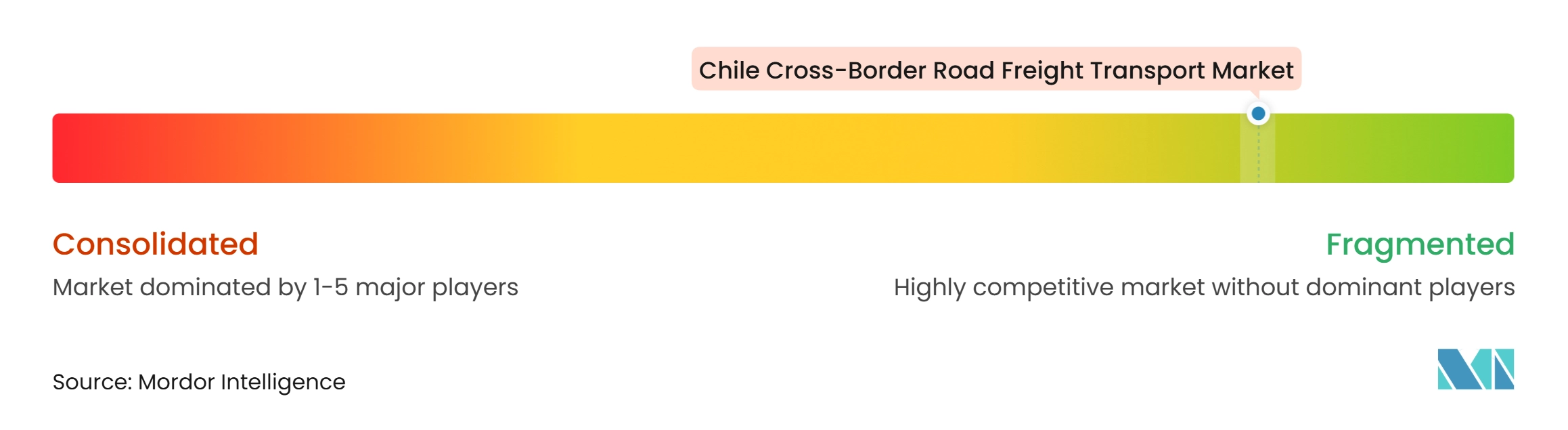
The Chile cross-border road freight transport market is fragmented. Global logistics providers compete with regional carriers that have strong corridor knowledge and local customer relationships. DSV completed its acquisition of DB Schenker in April 2025, increasing its ability to combine road freight with air and ocean services[4]. The combined group is integrating its operations across more than 60 countries through 2026. This move raises the competitive scale available to large multinational customers. CEVA Logistics has also expanded technology-based capabilities in Chile. Its 2025 AI and drone inventory pilot improved warehouse inventory counting productivity. Global providers can use these investments to connect warehouse services with inland and cross-border transport.
Kuehne+Nagel expanded its logistics relationship with Casaideas through a 30,000 m² semiautomated distribution center in Pudahuel. The facility handled 34.8 million inbound units in 2025, supporting a long-term contract logistics model. CEVA began new Chilean operations for BYD and an aeronautics customer in 2026. Regional operators compete through specialized knowledge of lanes, cargo types, and customs requirements. Delpa Group uses a mobile application that gives customers shipment tracking and cargo-management visibility. These capabilities help regional carriers defend service quality against larger integrators. High-value freight, cold chain, hazardous goods, and logistics-zone operations remain important areas for differentiation.
Quality and regulatory compliance are increasingly important in competition. ISO 9001-aligned quality systems can support service consistency for industrial and pharmaceutical shippers. Chile’s Decree 977 also differentiates carriers serving fresh-food supply chains because it requires authorized refrigerated transport. Röhlig acquired a 10% stake in OnBoard Logistics during 2025 to expand its Latin American coverage. Röhlig also appointed a new managing director for Chile in 2026 to pursue growth in the country and wider region. Large operators bring network scale, while smaller specialists can win mandates through local execution and niche equipment. Competition therefore rests on reliability, compliance, service visibility, and the ability to manage disrupted routes. The Chile cross-border road freight transport market is unlikely to be dominated by one provider, while corridor-specific expertise remains important.
Chile Cross-Border Road Freight Transport Industry Leaders
-
Quick Chile
-
Transportes Bello e Hijos
-
Agencias Universales SA (AGUNSA)
-
DSV AS (Including DB Schenker)
-
DHL Group
- *Disclaimer: Major Players sorted in no particular order
Chile Cross-Border Road Freight Transport Market Companies Covered in this Report
- Quick Chile
- Transportes Bello e Hijos
- Agencias Universales SA (AGUNSA)
- DSV AS (Including DB Schenker)
- DHL Group
- CEVA Logistics
- Kuehne+Nagel International AG
- Delpa Group
- Overseas Logistics Chile SA
- Cargo Trans
- Andesglobal
- Transportes Santa María
- Garrido Transportes
- Transportes Rado Internacional
- Andesmar Cargas
- GEODIS SA
- Rhenus Group
- Röhlig Logistics
- JAS Worldwide Inc.
- Fracht Chile
- Noatum Logistics
- Hellmann Worldwide Logistics
Recent Industry Developments in Chile Cross-Border Road Freight Transport Market
- October 2026: Empresa Portuaria Arica and Puerto Seco de Oruro signed a logistics cooperation agreement to strengthen freight connectivity between Bolivia's Oruro dry port and Chile's Port of Arica, supporting cargo consolidation, storage, and future cross-border corridor development.
- August 2026: Impala inaugurated a dry-bulk facility in Arica to receive Bolivian mineral concentrates transported by truck. The development strengthened inland cargo handling and export connectivity through northern Chile.
- July 2026: ITI implemented temporary customs-zone arrangements and stronger logistics coordination to maintain Bolivian transit cargo flows. The measures supported the dispatch of 580 containers bound for Bolivia during one week.
- May 2026: TPA opened a commercial office in Bolivia, strengthening customer coordination for Bolivian cargo moving through northern Chile. Its 2026 modernization program also included cargo-handling equipment and additional container capacity.
Chile Cross-Border Road Freight Transport Market Report Scope
Segmentation Overview
| Agriculture, Fishing, and Forestry |
| Construction |
| Manufacturing |
| Oil and Gas, Mining and Quarrying |
| Wholesale and Retail Trade |
| Others |
| Full-Truck-Load (FTL) |
| Less than-Truck-Load (LTL) |
| Containerized |
| Non-Containerized |
| Long Haul |
| Short Haul |
| Fluid Goods |
| Solid Goods |
| Non-Temperature Controlled |
| Temperature Controlled |
| Chile-Argentina |
| Chile-Brazil |
| Chile-Peru |
| Chile-Paraguay |
| Chile-Bolivia |
| Other Cross-Border Road Freight Lanes |
| By End User Industry | Agriculture, Fishing, and Forestry |
| Construction | |
| Manufacturing | |
| Oil and Gas, Mining and Quarrying | |
| Wholesale and Retail Trade | |
| Others | |
| By Truckload Specification | Full-Truck-Load (FTL) |
| Less than-Truck-Load (LTL) | |
| By Containerization | Containerized |
| Non-Containerized | |
| By Distance | Long Haul |
| Short Haul | |
| By Goods Configuration | Fluid Goods |
| Solid Goods | |
| By Temperature Control | Non-Temperature Controlled |
| Temperature Controlled | |
| By Cross-Border Lane | Chile-Argentina |
| Chile-Brazil | |
| Chile-Peru | |
| Chile-Paraguay | |
| Chile-Bolivia | |
| Other Cross-Border Road Freight Lanes |
Key Questions Answered in the Report
What is the forecast growth rate for Chile cross-border road freight transport?
The sector is forecast to register a 5.98% CAGR from 2027 to 2032, rising from USD 4.57 billion in 2027 to USD 6.12 billion by 2032.
Which end-user segment has the largest share of demand?
Manufacturing leads with a 41.19% share in 2026 because industrial inputs, capital goods, and automotive components generate recurring cross-border movements.
Which freight type is growing fastest by goods configuration?
Fluid goods are projected to record an 8.37% CAGR through 2032, supported by mineral slurry, edible oils, chemicals, and liquid lithium compounds.
Why is the Chile–Argentina route important for road freight?
The Chile–Argentina lane holds 57.36% of 2026 demand, and Los Libertadores processed 6.52 million tons of cargo in 2025.
What supports expansion on the Chile–Paraguay route?
The Bioceanic Capricornio Corridor is intended to connect Paraguayan exporters with Chilean Pacific ports through northern Chile and Argentina.
What are the main operating challenges for carriers?
Mountain weather closures, customs documentation, driver shortages, and underused return capacity limit reliability and margins.