
Chile Agrochemicals Market Size and Share
Market Overview
| Study Period | 2021 - 2031 |
|---|---|
| Forecast Data Period | 2026 - 2031 |
| Base Year Market Size (2025) | USD 1.54 Billion |
| Market Size (2026) | USD 1.62 Billion |
| Market Size (2031) | USD 2.06 Billion |
| Growth Rate (2026 - 2031) | 4.90 % |
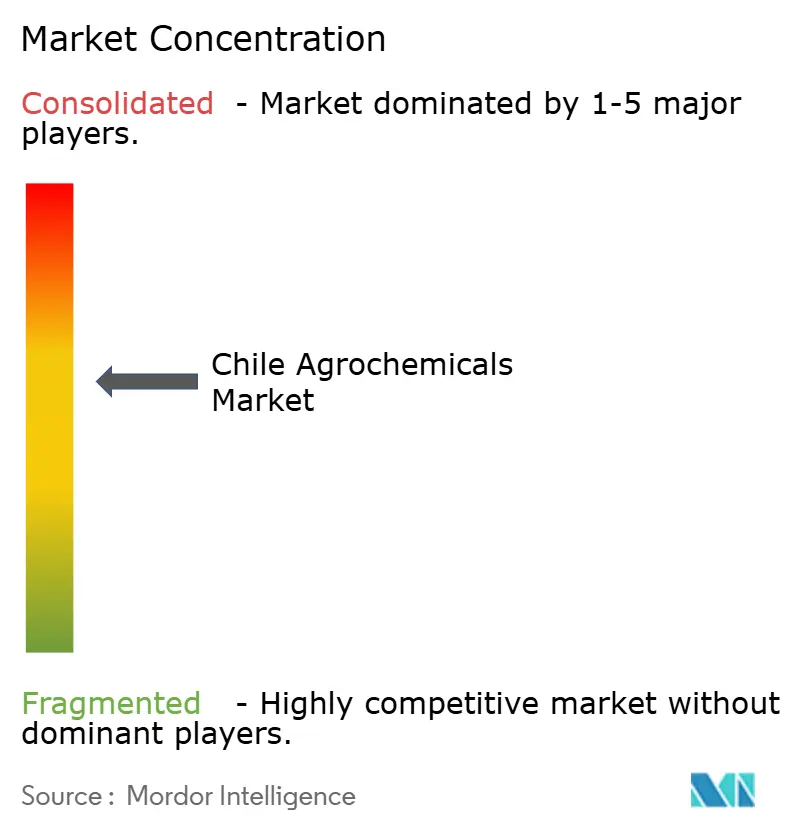
| Market Concentration | Medium |
Major Players
*Disclaimer: Major Players sorted in no particular order Image © Mordor Intelligence. Reuse requires attribution under CC BY 4.0. |
|
Chile Agrochemicals Market Analysis by Mordor Intelligence
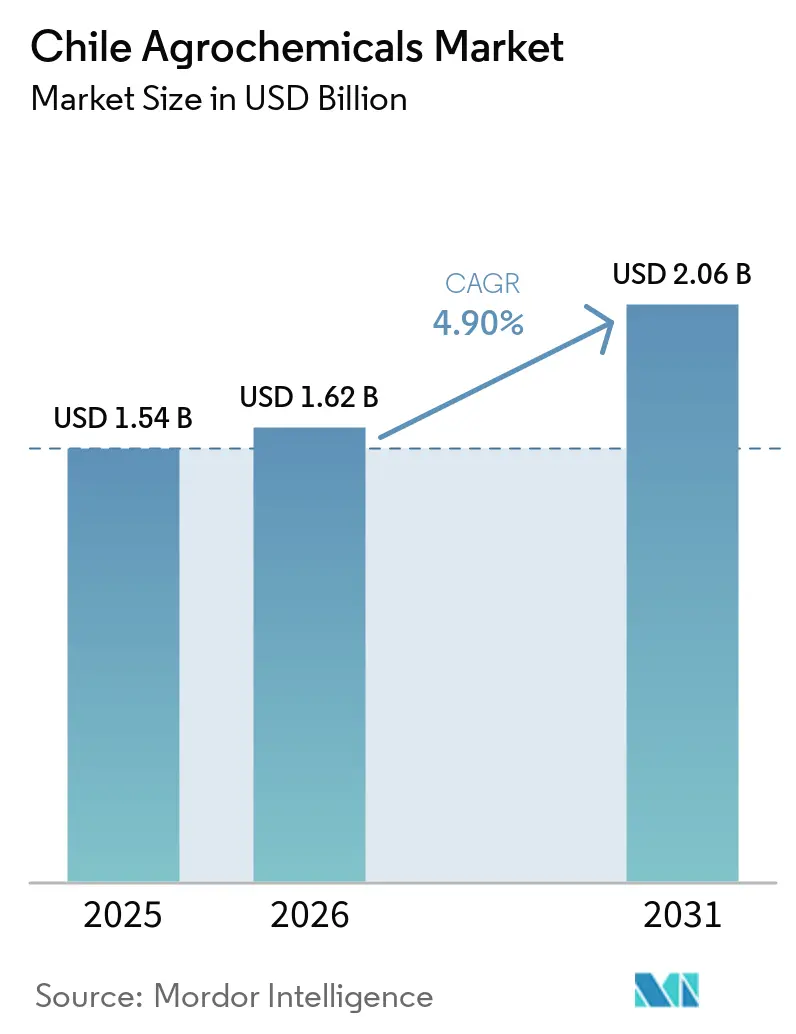
The Chile agrochemicals market size was valued at USD 1.54 billion in 2025 and is forecast to grow from USD 1.62 billion in 2026 to reach USD 2.06 billion by 2031, at a CAGR of 4.90% over the forecast period (2026-2031). Chilean growers purchase fertilizers, pesticides, adjuvants, and plant growth regulators for production systems serving export-oriented fruit, vegetable, grain, and other crop segments. Changing export requirements are influencing input decisions, as growers must manage residues and maintain application records to meet the standards of demanding destination markets. These requirements favor registered products, biological alternatives, and digital tools that support planned application programs. Import dependence also leaves fertilizer and active ingredient costs exposed to overseas supply conditions. The Chile agrochemicals market, therefore, gives suppliers opportunities in compliance support, resistance management, and efficient nutrient use.
Key Report Takeaways
- By product type, fertilizers accounted for 64.0% of the Chile agrochemicals market share in 2025, while plant growth regulators are forecast to grow at a CAGR of 13.0% from 2026 to 2031.
- By crop type, fruits and vegetables accounted for 34.0% of the Chile agrochemicals market size in 2025 and are also forecast to be the fastest-growing segment, with a CAGR of 7.4% from 2026 to 2031.
Note: Market size and forecast figures in this report are generated using Mordor Intelligence’s proprietary estimation framework, updated with the latest available data and insights as of January 2026.
Chile Agrochemicals Market Trends and Insights
Drivers Impact Analysis*
| Driver | (~) % Impact on CAGR Forecast | Geographic Relevance | Impact Timeline |
|---|---|---|---|
| Export Residue Compliance and Specialty-Fruit Protection | +1.3% | O'Higgins, Maule, Atacama, Coquimbo, and other export-oriented zones | Short term (≤ 2 years) |
| Adoption of Biological Crop-Protection Inputs | +0.8% | O'Higgins, Maule, Coquimbo, and certified export programs nationwide | Medium term (2-4 years) |
| Resistance Management and Multi-Mode-of-Action Products | +0.6% | Maule, O'Higgins, and Biobío | Medium term (2-4 years) |
| Precision Spraying and Digital Pest Monitoring | +0.5% | O'Higgins, Maule, Atacama, and Coquimbo pilot zones | Medium term (2-4 years) |
| Enhanced-Efficiency Fertilizers and Nitrogen Optimization | +0.4% | Maule, O'Higgins, Biobío, and policy-driven programs nationwide | Medium term (2-4 years) |
| Secure Product Traceability and Distribution Formalization | +0.3% | Nationwide, with priority at northern border crossings | Short term (≤ 2 years) |
| Source: Mordor Intelligence | |||
Export Residue Compliance and Specialty-Fruit Protection
The Chile agrochemicals market is supported by the need to meet residue rules in export destinations. European Commission Regulation (EU) 2026/215, which applies from 19 August 2026, revises the maximum residue limits (MRLs) for dimoxystrobin, ethephon, and propamocarb. The revised limits will have implications for Chilean fruit and food exports, particularly blueberries and apples, where crop-protection applications are frequently required. When residue standards change, growers must review product rotations, labels, application schedules, and preharvest intervals, as a single program must meet both crop-protection and destination-market compliance requirements. The Chile agrochemicals market consequently favors suppliers that can provide documented recommendations for different fruit crops and seasonal spray programs. Chile hosted the 56th Codex Committee on Pesticide Residues session in Santiago in September 2025, bringing together more than 250 delegates from 189 Codex member states and strengthening the country’s role in international discussions on pesticide residues.[1]ACHIPIA, “. Chile hosted the 56th Codex Committee on Pesticide Residues session in Santiago,” ACHIPIA, achipia.gob.cl
Adoption of Biological Crop-Protection Inputs
Biological products are becoming increasingly relevant as export buyers require lower residue risks and growers seek alternatives for rotation programs. Demand is linked to market access rather than solely to seasonal pest conditions, which may support more sustained adoption of biological products in export-oriented production areas. Instituto de Investigaciones Agropecuarias (INIA) and ANASAC S.A. signed a collaboration agreement in June 2025 to develop and scale domestic bioinputs. The agreement focused on products suited to southern hemisphere pest biology and on building local production capabilities.[2]Instituto de Investigaciones Agropecuarias, “INIA Chile and ANASAC S.A. signed a collaboration agreement to develop and scale domestic bioinputs,” Instituto de Investigaciones Agropecuarias, inia.cl A three-year project involving INIA, Center for Agriculture and Bioscience International (CABI), and the Croda Foundation reached 160 smallholder potato growers in its first year. The project supports the use of biopesticides as alternatives to chemical pesticides, demonstrating that biological programs can extend beyond high-value fruit production systems.[3]CABI, "3-year project involving INIA, CABI, and the Croda Foundation reached 160 smallholder potato growers ", blog.cabi.org
Precision Spraying and Digital Pest Monitoring
The Chile agrochemicals market is evolving as growers increasingly use data to plan applications, monitor pests, and assess weather conditions. INIA showed in April 2025 that optimized sprayer calibration could reduce pesticide use by up to 40% in citrus orchards while maintaining effective crop-protection applications. The institute also introduced a digital platform to standardize application parameters across Coquimbo and O'Higgins, providing growers with a consistent basis for equipment adjustments. Servicio Agrícola y Ganadero (SAG) and the Foundation for Fruit Development introduced a geographic information system (GIS) platform for fruit-fly monitoring in Coquimbo in January 2026. The system replaced paper-based monitoring with georeferenced alerts, enabling more targeted monitoring and supporting field-level pest-management decisions. INIA also launched an artificial intelligence (AI) and climate data project in July 2026 to reduce the impact of Drosophila suzukii on berry crops in Maule and Ñuble by up to 60%.
Secure Product Traceability and Distribution Formalization
Counterfeit and unauthorized products create pricing, efficacy, and compliance risks for registered suppliers and growers. Authorities seized 28,700 kg of illegal phytosanitary products in 2024, with a stated value of USD 74.4 million. Asociación Nacional de Fabricantes e Importadores de Productos Fitosanitarios Agrícolas (AFIPA) also reported a sharp year-on-year increase in seizures, highlighting the growing challenge posed by unauthorized products in formal agrochemical distribution channels.SAG identified 305 suspicious digital listings between January and August 2025. It has also removed 518 listings from 1 e-commerce platform since January 2024, underscoring the need for continuous monitoring of online channels. The Chile agrochemicals market can benefit from digital labeling and traceability systems that help suppliers demonstrate registration, product identity, and formal distribution practices.
Restraints Impact Analysis*
| Restraint | (~) % Impact on CAGR Forecast | Geographic Relevance | Impact Timeline |
|---|---|---|---|
| Imported Active-Ingredient and Freight Exposure | -0.8% | Nationwide, with pressure on Valparaíso, O'Higgins, and Maule supply chains | Short term (≤ 2 years) |
| Regulatory Compliance and Authorization Delays | -0.5% | Nationwide | Short term (≤ 2 years) |
| Water Scarcity and Restricted Spray Windows | -0.5% | Atacama and Coquimbo, extending to Maule and O'Higgins | Long term (≥ 4 years) |
| Illegal, Counterfeit, and Unauthorized Product Trade | -0.5% | Nationwide, with major entry points at northern border crossings | Short term (≤ 2 years) |
| Source: Mordor Intelligence | |||
Imported Active-Ingredient and Freight Exposure
Chile imports most of the fertilizers used in its agricultural sector, making farm input costs sensitive to freight, global supply availability, and foreign currency movements. The Minister of Agriculture stated in April 2026 that 85% of fertilizer use depended on imports. Chile imported 1.15 million metric tons of agricultural and industrial fertilizers in 2025, underscoring the scale of this reliance. Urea prices increased 70% in early 2026 after Middle East supply disruptions. Fertilizer imports then increased 123% in the first quarter of 2026 as growers purchased ahead of anticipated cost increases. These conditions raise inventory financing needs, disrupt seasonal purchasing patterns, and make efficient nutrient products more relevant when growers review fertilizer programs.
Regulatory Compliance and Authorization Delays
Stringent regulatory requirements for pesticide authorization and application in Chile can increase compliance burdens for agrochemical manufacturers and suppliers. The Servicio Agrícola y Ganadero (SAG) regulates the authorization and use of agricultural pesticides, with requirements covering product authorization, applicator competency, traceability, and application records. Resolution 6,152/2023 establishes a specific evaluation process for pesticides based on low-concern natural extracts, under which SAG has up to nine months to issue a decision once all information required for the technical evaluation has been submitted. These regulatory requirements and evaluation timelines can increase the time and resources required to bring new agrochemical products to the Chilean market, particularly for companies seeking authorization for new or specialized products.
*Our forecasts treat driver/restraint impacts as directional, not additive. The impact forecasts reflect baseline growth, mix effects, and variable interactions.
Segment Analysis
By Product Type: Fertilizers Lead the Market, While Plant Growth Regulators Register the Fastest Growth
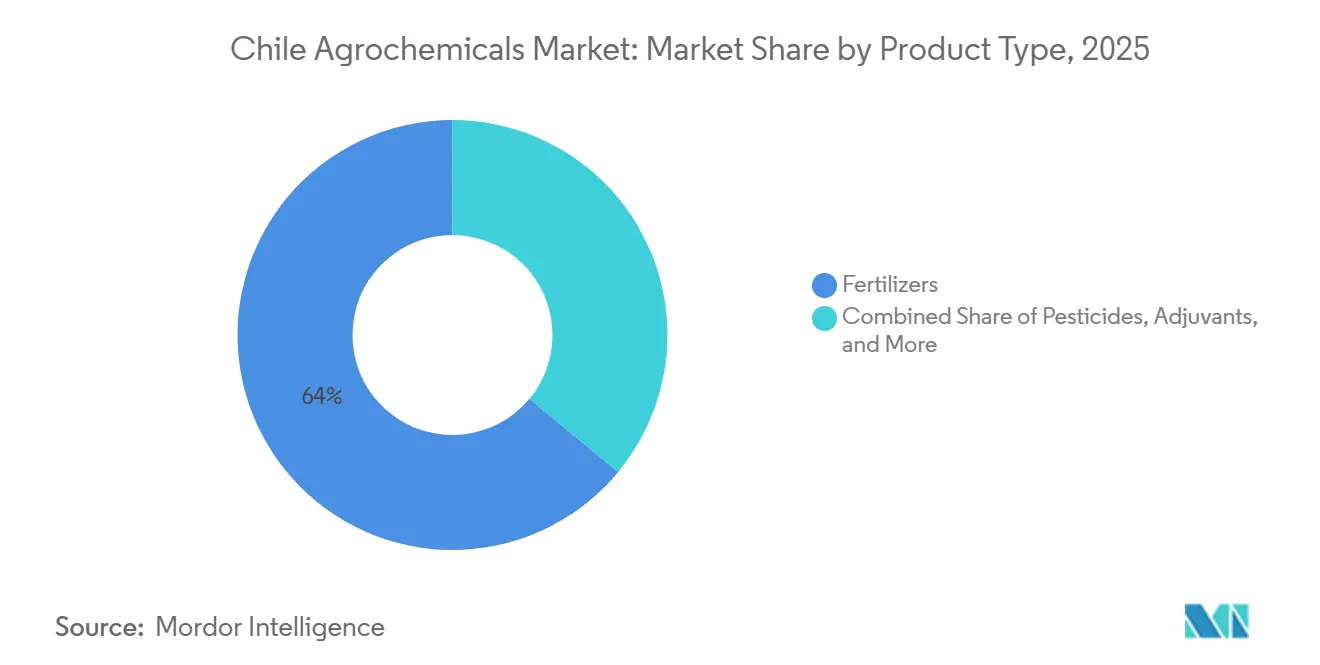
Fertilizers accounted for 64.0% of the Chile agrochemicals market share in 2025. Permanent crops in the Central Valley and Norte Chico require regular nutrient management. Nitrogenous fertilizers, including urea and ammonium nitrate, serve cereal fields and orchard programs. Phosphatic and potassic products support crop-specific nutrient plans. Chile’s dependence on imported supplies makes the economics of conventional fertilizer sensitive to global price movements. Fertilizer use spans a broad range of farm types, supporting fertilizers’ position as the largest product segment by value.
Pesticides form the next major product group, especially in disease-sensitive cherry, wine-grape, and blueberry programs. BASF SE’s Orkestra Ultra combines pyraclostrobin, epoxiconazole, and fluxapyroxad to provide fungicide activity across multiple modes of action. Adjuvants improve deposition and uptake in fertilizer and crop-protection applications. Plant growth regulators are forecast to grow at a CAGR of 13.0% between 2026 and 2031. Thinning, dormancy-breaking, and sizing programs support cherry and table-grape quality requirements. UPL Ltd launched Altum in July 2026, beginning in Buin, central Chile, and subsequently conducted technical workshops in various cherry-producing areas across the region. The launch highlighted UPL’s focus on plant growth regulators for fruit-set and fruit-retention management in cherry production.



By Crop Type: Fruits and Vegetables Lead Demand and Growth
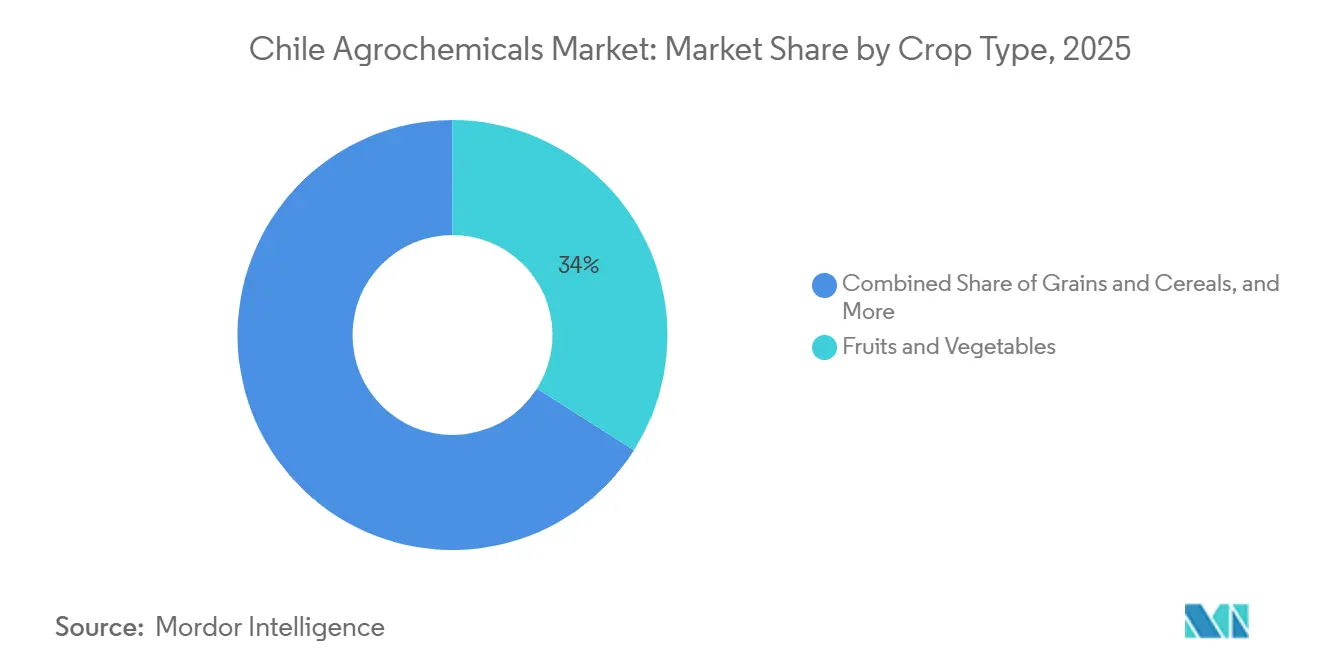
Fruits and vegetables held 34.0% of crop-type demand in 2025 and are forecast to grow at a CAGR of 7.4% from 2026 to 2031. Export-oriented cherries, blueberries, grapes, avocados, and citrus require repeated nutrition and protection programs. Cherries generated USD 2.6 billion in export value between September 2025 and February 2026, representing 60% of fresh fruit export value during that period. These crop systems place a high value on consistent quality, residue management, and traceable product use. Fruit growers' investment in products that protect export grades directly benefits the Chile agrochemicals market.
The United States Department of Agriculture (USDA) forecast that lemon, mandarin, and orange production would increase by 2.5% to 4.4% in the 2025/26 marketing year. Grains and cereals support high-volume herbicide and nitrogen sales, while pulses and oilseeds contribute to demand for crop protection products. Turf and ornamental crops support premium applications for specialty fungicides and plant growth regulators.
Geography Analysis
The Central Valley is the largest consumption area in the Chile agrochemicals market, as it concentrates cherries, blueberries, wine grapes, apples, and other export crops. This zone includes Valparaíso, Metropolitan, O'Higgins, and Maule. Export programs in this corridor require fungicides, insecticides, nutrient products, and specialized application support. Multinational suppliers compete most actively in the Central Valley because the crop mix supports higher-value product categories. INIA’s April 2025 sprayer-calibration initiative covered citrus producers from Coquimbo to O'Higgins. SAG Resolution 243 formalized application records and advance-notification requirements for 2026.
Norte Chico represents an important agrochemical demand area, with Atacama and Coquimbo supporting high-value table grapes, mandarins, avocados, and other horticultural crops. The region faces tight water conditions, which makes timing and application efficiency more important. According to Advances in Water Resources Science (2025), agriculture accounts for 83% of water allocation in the Elqui River Basin. The 2026 fruit-fly monitoring system in Coquimbo helps growers target insecticide applications more closely.
Biobío, Araucanía, and Los Ríos have a different input profile based on cereals, potatoes, and livestock forage. Biobío has strong wheat and oat production, supporting herbicide and nitrogen fertilizer demand. The Chile agrochemicals market in the south also depends on fungicides because wet winters raise disease pressure. Araucanía hosts the INIA, CABI, and Croda Foundation biopesticide project for potato growers. The project reached 160 smallholder farmers in its first year. SAG record-keeping requirements apply across all 3 macro-zones and expand the reach of registered suppliers.
Competitive Landscape
The Chile agrochemicals market is moderately concentrated, with major multinational suppliers such as Syngenta Group, Bayer AG, BASF SE, Corteva Agriscience, and UPL Ltd. maintaining strong market positions in 2025. Their position reflects broad crop-protection portfolios, registered products, established technical support networks, and access to specialized formulations. The remaining market is served by local formulators, specialized distributors, and fertilizer suppliers. Competition is strongest in herbicides and nitrogen products, while biological and precision products support premium positioning.
BASF SE introduced Serifel WP for cherry orchards in 2025. The Bacillus amyloliquefaciens MBI 600 biological fungicide was positioned as a rotation partner for chemical fungicides. The Group 7 succinate dehydrogenase inhibitor (SDHI) chemistry would expand grower options for resistance management. Syngenta Group and Botanical Solution Inc. expanded their Quillibrium agreement during February 2026. The product is marketed as BotriStop in Chile and was validated with Chilean grape, tomato, berry, and cherry growers.
ANASAC S.A. is a major domestically owned agrochemical supplier in Chile, offering pesticides, fertilizers, biostimulants, and plant growth regulators. Its June 2025 agreement with INIA gave it a direct role in domestic bioinput development. ANASAC S.A. also formed a distribution partnership with Fyteko for NURSPRAY HC during May 2026. The product initially targeted cherries, table grapes, and apples. Quimetal Industrial S.A. serves a defined niche in copper-based fungicide and bactericide products. Local suppliers retain relevance where they offer Chile-specific formulations, distribution coverage, or technical support for particular crops.
Chile Agrochemicals Industry Leaders
-
Bayer AG
-
BASF SE
-
Corteva Agriscience
-
UPL Ltd.
-
Syngenta Group
- *Disclaimer: Major Players sorted in no particular order

Recent Industry Developments
- April 2026: Fyteko and ANASAC S.A. announced a strategic distribution agreement for NURSPRAY HC, a biological plant protection product initially targeting cherries, table grapes, and apples in Chile.
- March 2026: Bayer Chile launched the Siberio biostimulant in partnership with Greenhas Chile in Curicó, marking Bayer’s entry into Chile’s plant health biostimulant segment.
- June 2025: INIA Chile and ANASAC S.A. signed a formal collaboration agreement to accelerate the development, production, and scaling of bioinputs in Chile.


Chile Agrochemicals Market Report Scope
The agrochemicals market comprises all factory-made fertilizers, synthetic and biological crop-protection chemicals, adjuvants, and plant-growth regulators that are traded through commercial channels for field and protected agriculture. Usage in forestry and home gardening is included only when the products and pack sizes mirror farm-grade specifications.
The Chile Agrochemicals Market Report is Segmented by Product Type (Fertilizers, Pesticides, Adjuvants, and Plant Growth Regulators) and by Crop Type (Grains and Cereals, Pulses and Oilseeds, Fruits and Vegetables, Commercial Crops, and Turf and Ornamental). The Market Forecasts are Provided in Terms of Value (USD).
| Fertilizers | Nitrogenous |
| Phosphatic | |
| Potassic | |
| Other Fertilizers | |
| Pesticides | Herbicides |
| Insecticides | |
| Fungicides | |
| Other Pesticides | |
| Adjuvants | |
| Plant Growth Regulators |
| Grains and Cereals |
| Pulses and Oilseeds |
| Fruits and Vegetables |
| Commercial Crops |
| Turf and Ornamental |
| By Product Type | Fertilizers | Nitrogenous |
| Phosphatic | ||
| Potassic | ||
| Other Fertilizers | ||
| Pesticides | Herbicides | |
| Insecticides | ||
| Fungicides | ||
| Other Pesticides | ||
| Adjuvants | ||
| Plant Growth Regulators | ||
| By Crop Type | Grains and Cereals | |
| Pulses and Oilseeds | ||
| Fruits and Vegetables | ||
| Commercial Crops | ||
| Turf and Ornamental | ||


Key Questions Answered in the Report
What is the value of Chile agrochemicals in 2026?
The Chile agrochemicals market size was valued at USD 1.62 billion in 2026.
Which product category leads Chile agrochemicals?
Fertilizers led with 64.0% share in 2025, reflecting nutrient demand across permanent crops, cereals, and horticulture. The Chile agrochemicals market continues to rely on this category because most farm systems require regular nutrient programs.
Which Chile agrochemicals category is growing fastest?
Plant growth regulators are forecast to grow at a CAGR of 13.0% between 2026 and 2031. Their use is linked to thinning, dormancy-breaking, and sizing programs in export cherry and table-grape orchards.
Which crop group has the strongest demand for agrochemicals in Chile?
Fruits and vegetables held 34.0% of crop-type demand in 2025 and are anticipated to grow at a 7.4% CAGR between 2026 and 2031. The segment includes export-oriented cherries, blueberries, grapes, avocados, and citrus.
Page last updated on:


 Your data is secure and never sold or shared.


