
Certificate Lifecycle Management Market Size and Share
Market Overview
| Study Period | 2020 - 2031 |
|---|---|
| Market Size (2026) | USD 1.77 Billion |
| Market Size (2031) | USD 4.36 Billion |
| Growth Rate (2026 - 2031) | 19.76 % |
| Fastest Growing Market | Asia-Pacific |
| Largest Market | North America |
| Market Concentration | Medium |
Major Players *Disclaimer: Major Players sorted in no particular order Image © Mordor Intelligence. Reuse requires attribution under CC BY 4.0. | |
Certificate Lifecycle Management Market Analysis by Mordor Intelligence
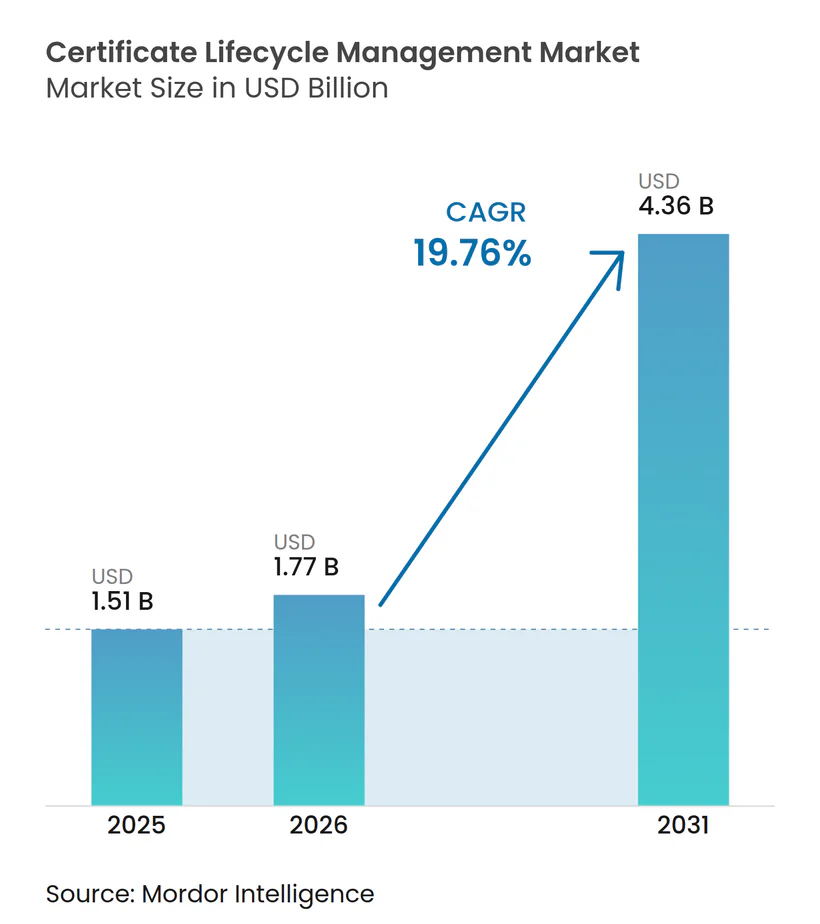
The certificate lifecycle management market size is projected to be USD 1.51 billion in 2025, USD 1.77 billion in 2026, and reach USD 4.36 billion by 2031, growing at a CAGR of 19.76% from 2026 to 2031. Shorter validity periods for publicly trusted TLS certificates are changing certificate renewal from a periodic administrative task into a continuous operational requirement. The certificate lifecycle management market, therefore, benefits from stronger demand for discovery, automated issuance, renewal, deployment, and policy controls. Cloud-native application environments are also increasing the number of machine identities that organizations must govern. Vendors are responding with CA-agnostic platforms, managed services, and tools that support cryptographic agility. The opportunity in the certificate lifecycle management market increasingly depends on helping organizations manage both public-facing certificates and internal certificates through consistent workflows.
Key Report Takeaways
- By component, software accounted for 69.32% of revenue in the certificate lifecycle management market in 2025, while services are projected to expand at a 22.76% CAGR through 2031.
- By certificate type, publicly trusted SSL/TLS certificates held 61.54% of revenue in 2025, while private TLS and network infrastructure certificates are projected to expand at a 24.62% CAGR through 2031.
- By deployment model, cloud-based deployment accounted for 68.87% of revenue in the certificate lifecycle management market in 2025 and is projected to grow at a 23.69% CAGR through 2031.
- By organization size, large enterprises held 68.73% of revenue in 2025, while small and medium-sized enterprises are projected to expand at a 25.81% CAGR through 2031.
- By industry vertical, BFSI held 31.76% of revenue in 2025, while information technology and telecommunications are projected to expand at a 24.76% CAGR through 2031.
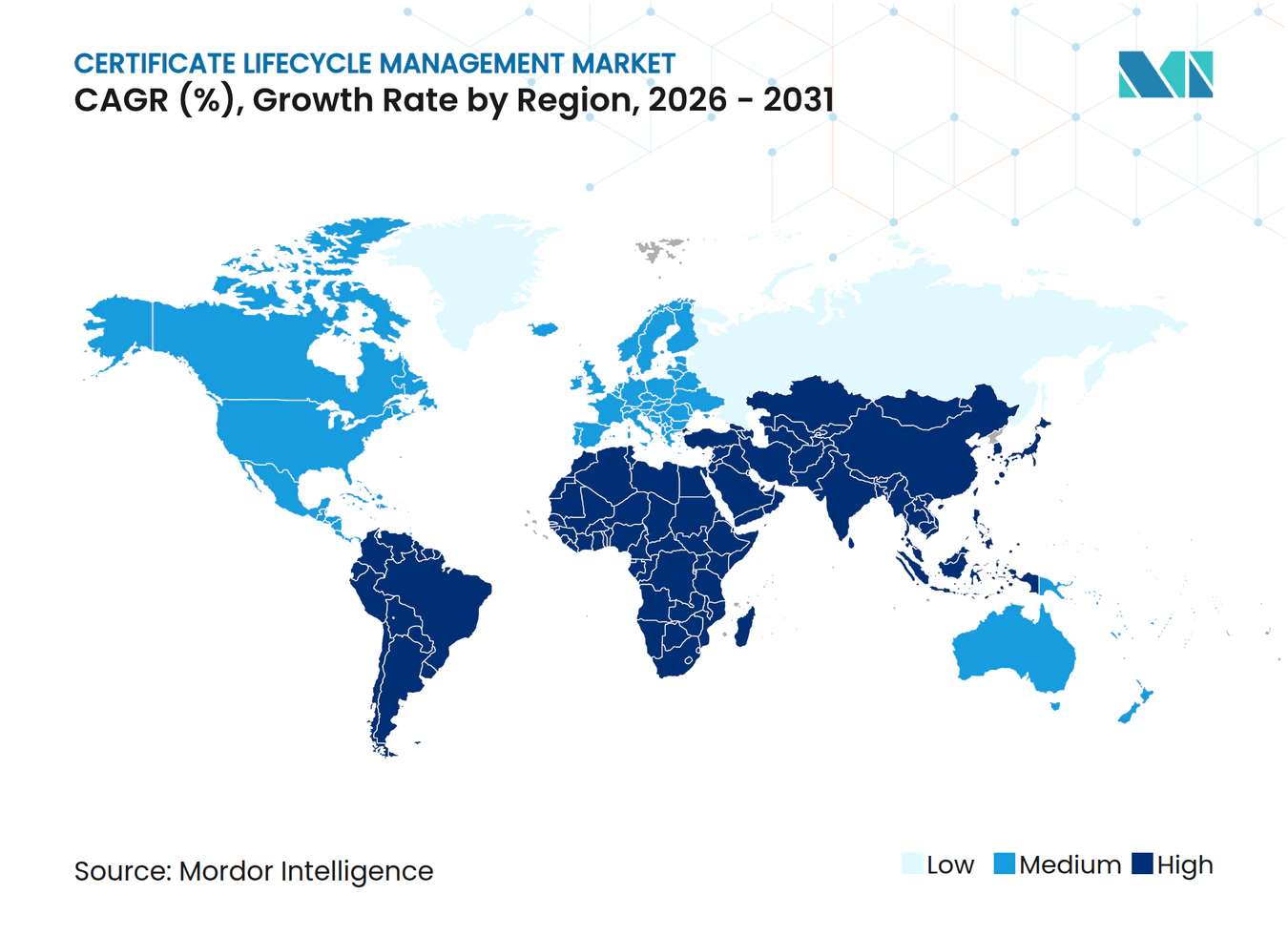
- By geography, North America held 36.72% of the certificate lifecycle management market in 2025, while Asia-Pacific is projected to expand at a 26.12% CAGR through 2031.
Note: Market size and forecast figures in this report are generated using Mordor Intelligence’s proprietary estimation framework, updated with the latest available data and insights as of January 2026.
Market Trends and Insights
Drivers Impact Analysis of Certificate Lifecycle Management Market*
| Driver | (~) % Impact on CAGR Forecast | Geographic Relevance | Impact Timeline |
|---|---|---|---|
| Shorter Public TLS Certificate Validity Periods | +4.5% | Global | Short term (≤ 2 years) |
| Growth of Machine Identities in Cloud-Native Workloads | +4.0% | APAC core, spill-over to North America and EU | Medium term (2-4 years) |
| Certificate Outages and Compliance Exposure | +3.3% | North America and EU | Short term (≤ 2 years) |
| Multi-Cloud and Kubernetes Certificate Sprawl | +2.8% | Global, highest in North America and APAC | Medium term (2-4 years) |
| CA/B Forum Validation Automation and Domain-Control Validation Changes | +2.2% | Global | Short term (≤ 2 years) |
| AI Workloads and Post-Quantum Cryptography Preparation | +1.8% | North America, EU, early gains in APAC | Long term (≥ 4 years) |
| Source: Mordor Intelligence | |||
Shorter Public TLS Certificate Validity Periods Create an Automation Mandate
The CA/Browser Forum approved Ballot SC081v3 in April 2025, with 25 certificate issuers and Apple, Google, Microsoft, and Mozilla participating in the vote. The measure limits the validity of publicly trusted TLS certificates to 200 days from March 15, 2026, 100 days from March 2027, and 47 days from March 2029, affecting certificates used for public websites, application interfaces, and other external services.[1] An enterprise with 10,000 certificates that renewed under the former 398-day ceiling experienced 9,200 renewals each year, whereas the same inventory would require 77,500 annual renewals at the 47-day endpoint. This change shifts attention from isolated expiration alerts toward repeatable processes that discover certificates, confirm ownership, renew them, and deploy them before a service is affected. This renewal load makes manual certificate handling impractical at enterprise scale and increases demand in the certificate lifecycle management market for automated workflows and controls that identify which certificates fall outside established processes. GlobalSign enforced 200-day validity requirements on March 14, 2026, and shortened renewal notification windows to 30 days before expiration.
Machine Identity Growth Across Cloud-Native Workloads Expands Certificate Volumes
Kubernetes clusters, serverless functions, service meshes, and CI/CD pipelines create machine identities that traditional PKI teams cannot track manually. These environments create certificates for workloads that can be started, scaled, and retired more frequently than conventional server infrastructure can. The certificate lifecycle management market is benefiting from this operational shift because each workload requires issuance, rotation, and policy controls tailored to its operating environment. Kubernetes v1.37 moved Pod Certificates and ClusterTrustBundles to stable status in August 2026, embedding X.509 certificate issuance and rotation capabilities in the Kubernetes control plane.[2] Native rotation capabilities reduce manual work within clusters, but they do not eliminate the need to apply organization-wide policies or to understand the identities operating in each environment. The resulting certificate population stretches across internal services, public endpoints, and cloud accounts, increasing demand for a common inventory and policy layer.
Certificate Outages and Compliance Exposure Raise Management Priorities
Keyfactor reported that 86% of surveyed organizations experienced at least 1 certificate-related outage in the prior 12 months, and 10% experienced them weekly. An expired certificate can interrupt access to customer services, internal applications, or automated connections between systems. The resulting impact can extend beyond a technical incident when customers cannot complete transactions or employees cannot access essential systems. DigiCert reported in July 2025 that 31% of organizations experienced certificate-related losses of USD 50,000 to USD 250,000, while 18.5% experienced losses above USD 250,000. PCI DSS Requirement 4, HIPAA Technical Safeguards, and Article 9 of the EU Digital Operational Resilience Act create governance expectations relevant to certificate hygiene. The certificate lifecycle management market gains relevance when security leaders link expired certificates to business interruption and audit exposure, and when automated discovery and renewal help teams reduce both risks.
Multi-Cloud and Kubernetes Certificate Sprawl Weakens Visibility
A single application can use certificates from AWS Certificate Manager, Azure Key Vault, and a private certificate authority simultaneously. Different application teams may select different cloud services based on delivery needs or prior platform choices, leaving inventories fragmented across environments. The certificate lifecycle management market addresses this problem by providing centralized discovery, workflow orchestration, and policy enforcement that span systems, rather than relying on a single native discovery tool. A complete view is important when a certificate is renewed in 1 system but still needs to be deployed to another system. New cloud accounts, Kubernetes clusters, SaaS integrations, and edge deployments introduce requirements, while cloud-managed services can provision certificates without direct involvement from the security team. Organizations therefore need an inventory that connects public, private, cloud, and application certificates so they can reliably automate their management.
Restraints Impact Analysis of Certificate Lifecycle Management Market*
| Restraint | (~) % Impact on CAGR Forecast | Geographic Relevance | Impact Timeline |
|---|---|---|---|
| Legacy PKI and Enterprise-System Integration Complexity | -0.7% | Global, highest impact in EU and South Asia | Medium term (2-4 years) |
| Shortage of PKI and Cryptographic Operations Expertise | -0.5% | Global | Long term (≥ 4 years) |
| Fragmented Ownership of Machine Identities | -0.4% | North America and EU | Medium term (2-4 years) |
| Resistance to Platform Lock-In and Per-Certificate Costs | -0.3% | Global, highest in SME segment | Short term (≤ 2 years) |
| Source: Mordor Intelligence | |||
Legacy PKI and Enterprise-System Integration Complexity Limits Deployment
Organizations that use Microsoft Active Directory Certificate Services, HSM-backed private certificate authorities, and diverse middleware face difficult integration work. These environments often have separate issuance policies, revocation processes, and application dependencies. The certificate lifecycle management market can face slower adoption when those systems require reconciliation before a platform goes live. AppViewX released an AD CS Migration Utility Wizard in its Summer 2026 PKI update to support the movement of Microsoft Certificate Authority configurations without disrupting dependent applications or users. The release reflects the practical importance of legacy PKI migration for buyers. Vendors that provide tested connectors, migration support, and audit records can reduce implementation barriers.
Limited PKI and Cryptographic Operations Expertise Constrains Scale
Certificate lifecycle management requires skills in cryptographic protocols, network engineering, and security operations. Those skills are not consistently available within enterprise IT teams. NIST approved FIPS 203, 204, and 205 for post-quantum cryptography in August 2024.[3] NIST selected HQC for standardization in March 2025, adding another future cryptographic requirement for security teams. Organizations with limited specialist capacity may implement automation only for part of their estate. This can leave incomplete inventory records and complicate broader deployment in the certificate lifecycle management market.
*Our forecasts treat driver/restraint impacts as directional, not additive. The impact forecasts reflect baseline growth, mix effects, and variable interactions.
Certificate Lifecycle Management Market Segment Analysis
By Component:
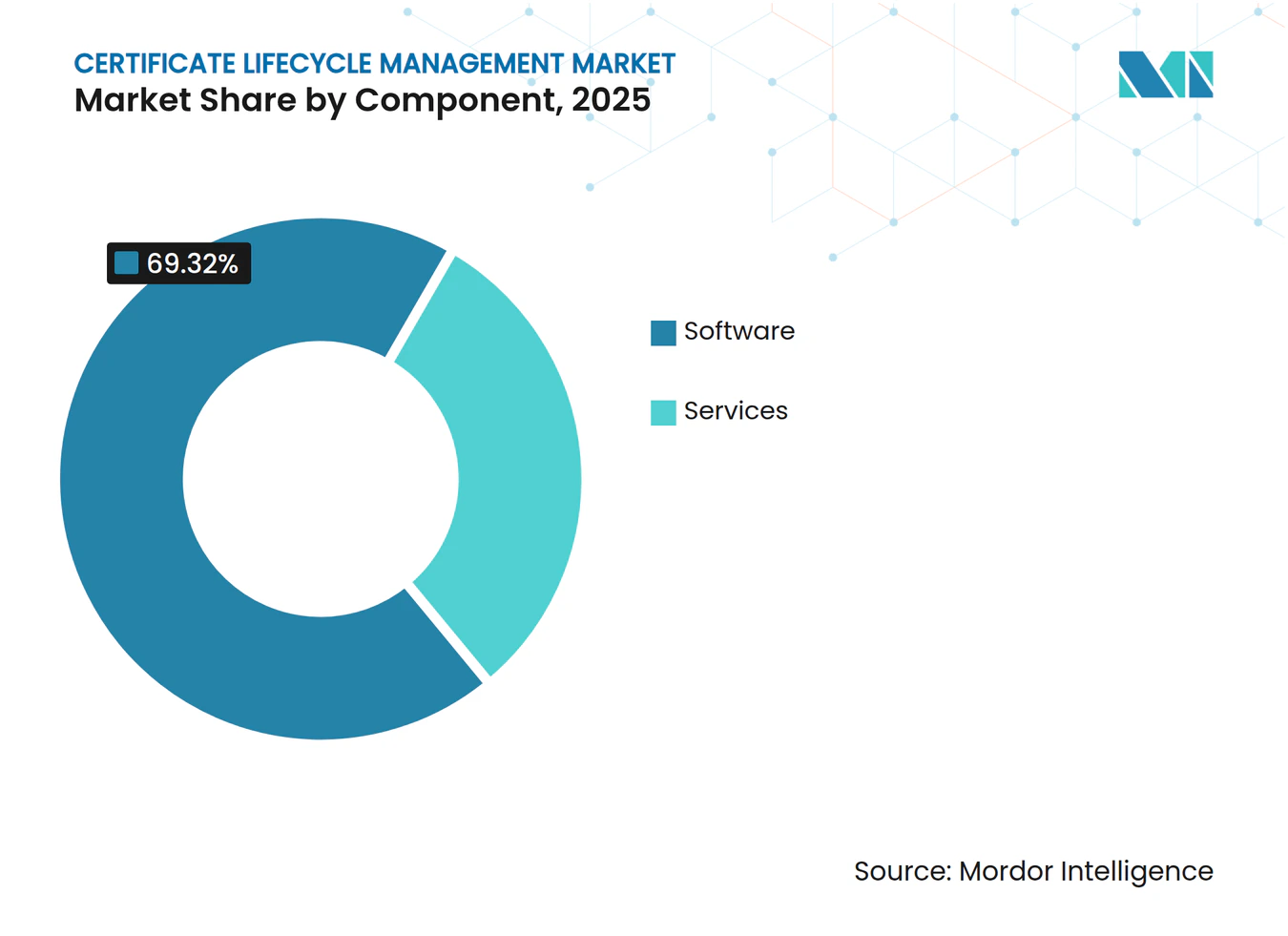
Services Growth Builds on Software’s Platform LeadSoftware held 69.32% of the certificate lifecycle management market share in 2025. Enterprises used dedicated applications to centralize certificate discovery, issuance, policy governance, and reporting. The certificate lifecycle management industry continues to favor CA-agnostic software layers that manage public CAs, private PKI hierarchies, and cloud issuance services from a single console. In 2026, large enterprises are standardizing these platforms across complex certificate estates.
Services are projected to expand at a 22.76% CAGR through 2031. Managed security service providers are delivering certificate lifecycle management as a recurring service, while implementation support is needed for legacy PKI migrations. Sectigo launched its Partner Platform in March 2026 as a multi-tenant platform for managed service providers and managed security service providers. The launch supports channel delivery models that can reduce staffing requirements for customers. Buyers also assess partner coverage and API integration maturity when selecting providers.


Component of Certificate Lifecycle Management Market
| X | Y |
|---|---|
| Software | 69.32% |
| Services | 30.68% |
| Source: Mordor Intelligence | |
By Certificate Type:
Private TLS Demand Changes Trust ArchitecturePublicly trusted SSL/TLS certificates held 61.54% of revenue in 2025. This position reflected the established importance of external HTTPS infrastructure in enterprise certificate inventories. The certificate lifecycle management market size for public-facing use cases remains substantial because public websites and applications require continuous trusted certificate coverage. Private TLS and network infrastructure certificates are projected to expand at a 24.62% CAGR through 2031.
The faster growth of private certificates reflects a shift toward internal workload identity in cloud-native environments. Mutual TLS between microservices, code-signing for CI/CD integrity, and Kubernetes pod credentials depend on private PKI rather than public certificate authorities. Automated discovery can reveal private certificate inventories that are 3 to 5 times larger than an organization’s public-facing portfolio. Providers that support public and private issuance in a common governance console are positioned to serve this broader need. This certificate lifecycle management market requirement favors tools that can apply consistent policies across certificate authority types.
By Deployment Model:
Cloud Leads Share and GrowthCloud-based deployment held 68.87% of the certificate lifecycle management market share in 2025. It is projected to expand at a 23.69% CAGR through 2031, making it both the largest and fastest-growing delivery model. Cloud platforms connect directly to ACME endpoints, hyperscaler issuance APIs, and Kubernetes admission controllers. These integrations support distributed environments in which certificate operations span more than 1 cloud account.
Microsoft Cloud PKI in the Intune Suite demonstrates how certificate automation can be integrated into existing enterprise software subscriptions. This can reduce the initial purchase hurdle for organizations already using Microsoft 365. On-premises deployments remain relevant for financial services, defense, and critical infrastructure organizations that operate air-gapped PKI or require local key custody. Hybrid models retain custody of root certificate authorities on-premises while automating subordinate certificate authority operations in the cloud. Ascertia’s PKI-as-a-Service reflects an approach that combines cloud operations with eIDAS and NIST alignment for regulated buyers.[4]
By Organization Size:
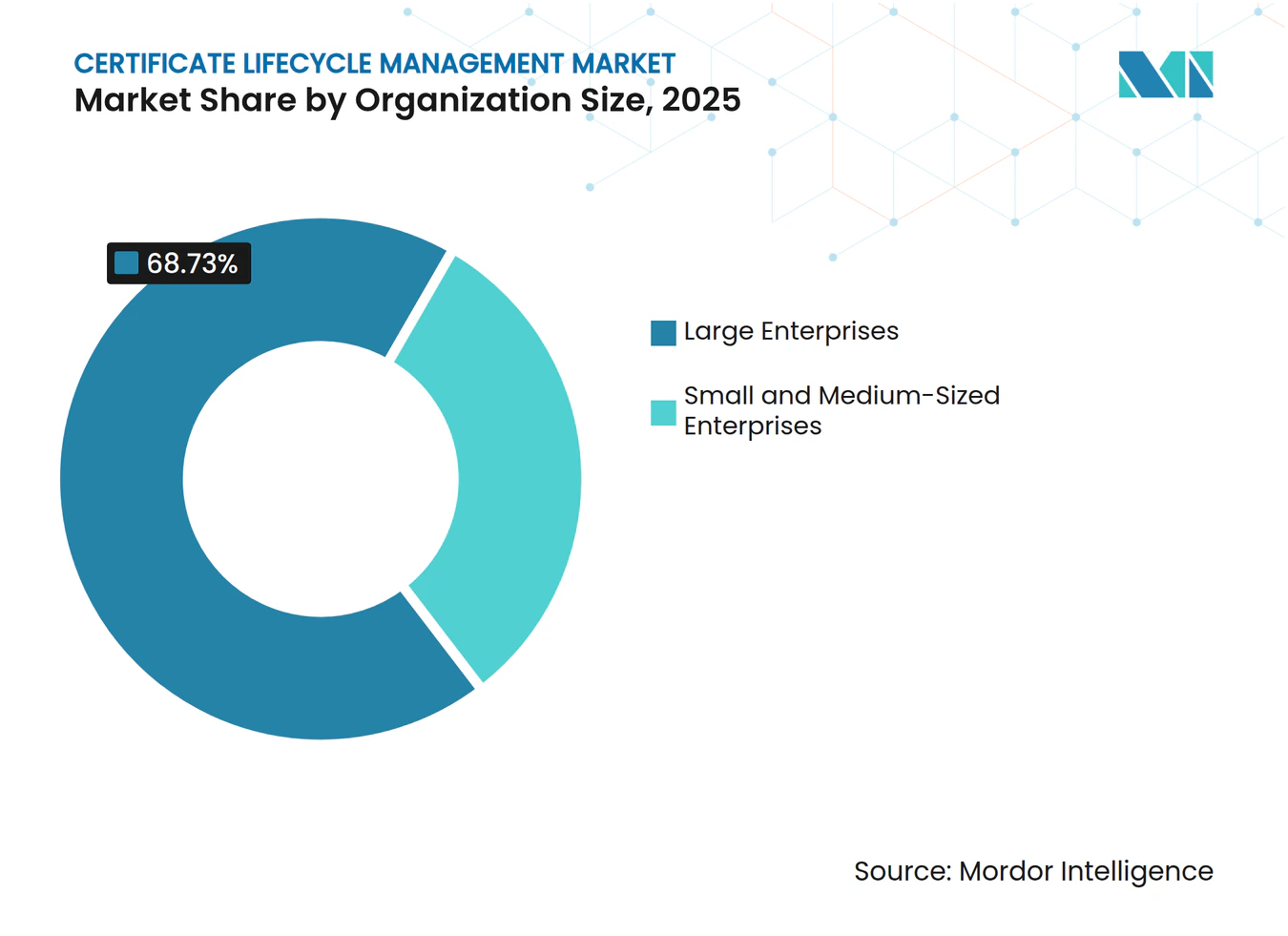
SMEs Become the Fastest-Growing Buyer GroupLarge enterprises held 68.73% of revenue in 2025. Their spending reflected years of investment in managing and expanding certificate populations across cloud and DevOps environments. The certificate lifecycle management industry has traditionally concentrated on this buyer group because large organizations operate complex, multi-cloud estates. Many large enterprises now need deeper coverage of machine identities and cryptographic assets rather than a first certificate automation deployment.
Small and medium-sized enterprises are projected to expand at a 25.81% CAGR through 2031. Lower cloud-hosted platform costs, financial and healthcare compliance requirements, digital commerce, and supply chain digitization are broadening the needs of organizations. These businesses often need client certificates and code-signing capabilities to meet partner trust requirements. Tiered pricing, ready-made integrations for Microsoft 365, AWS, and Cloudflare, and partner-led onboarding can improve adoption. Shorter public certificate validity periods create the same renewal burden for smaller organizations without dedicated security operations teams.

By Industry Vertical:
IT and Telecommunications Drives Faster GrowthBFSI held 31.76% of revenue in 2025. PCI DSS, DORA, and sector cybersecurity frameworks place certificate governance within formal compliance processes. Healthcare and life sciences also require attention to HIPAA Technical Safeguards, as connected medical devices and digital health systems increasingly rely on certificates. Government and public administration represent another important customer group because federal agencies must begin post-quantum migration planning following the approval of FIPS 203, 204, and 205.[5]
Information technology and telecommunications are projected to expand at a 24.76% CAGR through 2031. This sector manages dense machine identity populations across 5G network slicing, API authentication, and containerized network functions. Industrial manufacturing, retail and e-commerce, and energy and utilities also need certificate-based device authentication as operational technology becomes more connected. Unified certificate governance can bring IT and operational technology identities under consistent management. The certificate lifecycle management market is therefore extending beyond traditional web certificate use cases.
Geography Analysis
North America Certificate Lifecycle Management Market
North America held 36.72% of global revenue in 2025. The region’s position reflected deep platform adoption among Fortune 500 companies and large enterprises with multi-cloud certificate estates. Keyfactor stated in July 2026 that it supports 50% of the largest banks in the United States and Europe, as well as more than 40% of Fortune 100 companies.[6] This customer concentration suggests that later regional demand may depend more on broader platform adoption, including post-quantum readiness and AI workload governance. North American organizations remain important buyers of machine identity and cryptographic asset management tools in the certificate lifecycle management market.
Europe and APAC Certificate Lifecycle Management Market
Europe is a secondary regional market, with Germany, the United Kingdom, and France leading investment. eIDAS 2.0 requirements for qualified electronic signatures, the EU Cyber Resilience Act, and the CA/Browser Forum schedule are supporting a parallel cycle of certificate governance upgrades. Asia-Pacific is projected to expand at a 26.12% CAGR through 2031. India’s Digital India program and UPI-linked digital commerce infrastructure are creating requirements for certificate deployment that cloud-native platforms can address. Sectigo partnered with eCAPS Computers India in July 2026 to reach Tier-2 resellers and managed security service providers.
The Americas and MEA Certificate Lifecycle Management Market
China’s Cybersecurity Law and Data Security Law require domestic enterprises to use formal certificate management frameworks that accommodate SM2 and SM4 standards, favoring providers with localized certificate authority integrations. South America, the Middle East, and Africa are smaller but active adoption areas, with Brazil’s LGPD and Mexico’s evolving digital security frameworks supporting compliance-focused interest among financial institutions and government agencies. Saudi Arabia, the UAE, and South Africa are also developing demand through digital economy, sovereign cloud, financial services digitization, and e-government programs. Limited managed-service partner ecosystems can slow adoption outside the most mature regions.
Competitive Landscape
Market Concentration
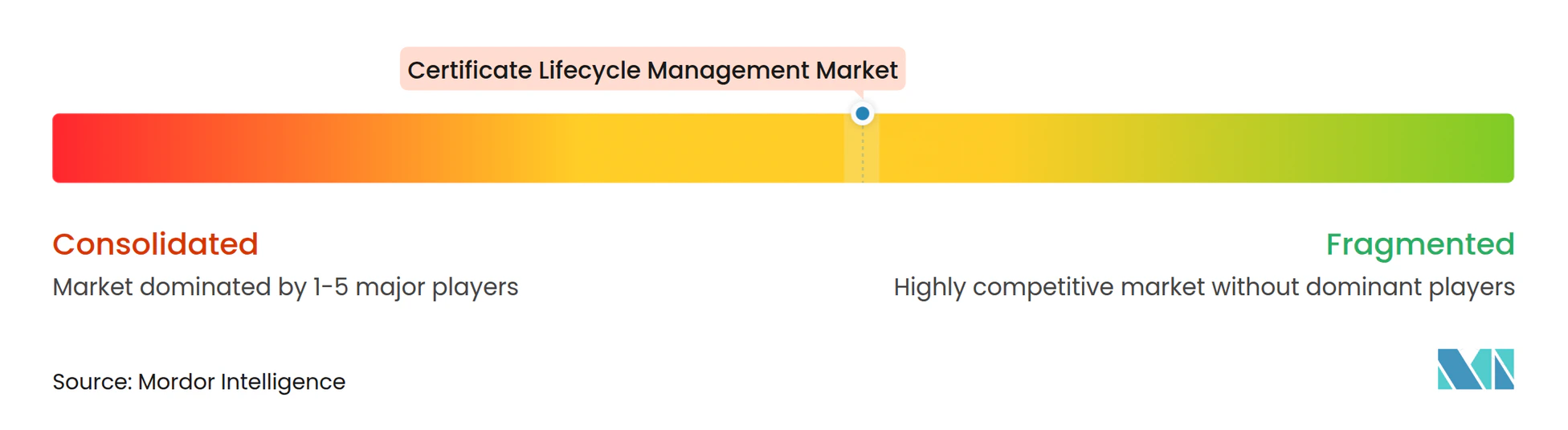
The certificate lifecycle management market is moderately concentrated among leading platform providers and more fragmented among specialists and regional vendors. Keyfactor, DigiCert, Entrust, Sectigo, AppViewX, Garantir, Ascertia, CyberArk, eMudhra, HID Global, MachineCert, and Smallstep Labs address varying parts of the market. Competition centers on certificate authority independence, automated discovery, certificate issuance, renewal, deployment, policy management, and cryptographic agility. Enterprise customers need a platform that can manage public and private PKI environments without separate operational tools. The certificate lifecycle management market also places greater weight on developer integration and support for distributed cloud environments.
Sectigo acquired Entrust’s public certificate business in January 2025 and completed the migration of more than 500,000 certificates by September 25, 2025.[7] This transaction increased Sectigo’s enterprise footprint while allowing Entrust to focus on quantum-ready and identity-centered cryptographic security. Keyfactor announced a USD 1 billion+ strategic growth investment in July 2026 to fund product development, geographic expansion, hiring, and acquisitions. Keyfactor also introduced Trust Control Plane in June 2026 to combine machine identity management and cryptographic asset governance.
IoT and operational technology certificate management remain areas where product requirements differ from standard enterprise TLS workflows. Devices with limited computing capacity and long replacement cycles may require support for EST, SCEP, or lightweight ACME. Post-quantum cryptographic agility is another competitive area, as customers must first identify cryptographic dependencies before changing algorithms. Smallstep Labs and MachineCert compete for mid-market users with developer-oriented automation that can fit into CI/CD workflows, while the certificate lifecycle management market remains open to providers that reduce deployment complexity for teams without dedicated PKI specialists.
Certificate Lifecycle Management Industry Leaders
-
Keyfactor, Inc.
-
CyberArk Software Ltd.
-
DigiCert, Inc.
-
Entrust Corporation
-
Sectigo Limited
- *Disclaimer: Major Players sorted in no particular order
Certificate Lifecycle Management Market Companies Covered in this Report
- Keyfactor, Inc.
- CyberArk Software Ltd.
- DigiCert, Inc.
- Entrust Corporation
- Sectigo Limited
- AppViewX, Inc.
- GMO GlobalSign Holdings K.K.
- Ascertia Limited
- HID Global Corporation
- Garantir, Inc.
- eMudhra Limited
- Versatile Security GmbH
- PrimeKey Solutions AB
- Nexus Technology GmbH
- D-Trust GmbH
- Xolphin B.V.
- KeyTalk B.V.
- Evertrust SAS
- Cogito Group Pty Ltd
- Savyint Limited
- Akeyless Security Ltd.
- Securemetric Technology Sdn. Bhd.
- Encryption Consulting LLC
- MachineCert, Inc.
- Smallstep Labs, Inc.
Recent Industry Developments in Certificate Lifecycle Management Market
- August 2026: Sectigo launched the Sectigo Orchestration Gateway (SOG), an automation layer within Sectigo Certificate Manager enabling IT teams to automate certificate discovery, issuance, renewal, and deployment across on-premises, cloud, and edge environments from a single platform designed to handle the near-monthly renewal cadence the 47-day validity mandate will impose by 2029.
- July 2026: Keyfactor announced a USD 1 billion+ strategic growth investment led by Summit Partners, with Insight Partners and Sixth Street Growth retaining significant ownership. Proceeds are designated for product innovation, geographic expansion, team building, and strategic acquisitions in the machine identity security sector.
- July 2026: DigiCert launched the preview of DigiCert Quantum Central, a self-service solution within the DigiCert ONE portfolio enabling organizations to inventory cryptographic dependencies and identify post-quantum cryptography migration priorities without requiring specialist PQC expertise.
- July 2026: Sectigo announced a strategic partnership with eCAPS Computers India to deliver automated CLM to India’s Tier-2 reseller and MSSP network, targeting enterprises navigating the shift to shorter certificate lifecycles across the South Asian mid-market.
- June 2026: Keyfactor launched the Trust Control Plane, a unified operating model consolidating machine identity management and cryptographic asset governance into a single control plane with continuous visibility, automated operations, and enforced policy across on-premises, cloud, and AI workload environments.
Global Certificate Lifecycle Management Market Report Scope
The certificate lifecycle management Market includes software platforms and managed services that automate the end‑to‑end management of digital certificates across public and private PKI. Certificate Lifecycle Management (CLM) solutions handle discovery and inventory, issuance, deployment, monitoring, renewal, and revocation of certificates, reducing the risk of outages and security gaps caused by expired or misconfigured certificates in large, dynamic environments.
The Certificate Lifecycle Management Market Report is Segmented by Component (Software, and Services), Certificate Type (Publicly Trusted SSL/TLS Certificates, and Private TLS and Network Infrastructure Certificates), Deployment Model (Cloud-Based, On-Premises, and Hybrid), Organization Size (Large Enterprises, and Small and Medium-Sized Enterprises), Industry Vertical (Banking, Financial Services, and Insurance (BFSI), Healthcare and Life Sciences, Government and Public Administration, Information Technology and Telecommunications, Industrial Manufacturing, Retail and E-Commerce, Energy and Utilities, and Other Industry Verticals), and Geography (North America, South America, Europe, Asia-Pacific, and Middle East and Africa). The Market Forecasts are Provided in Terms of Value (USD).
Segmentation Overview
| Software |
| Services |
| Publicly Trusted SSL/TLS Certificates |
| Private TLS and Network Infrastructure Certificates |
| Cloud-Based |
| On-Premises |
| Hybrid |
| Large Enterprises |
| Small and Medium-Sized Enterprises |
| Banking, Financial Services, and Insurance (BFSI) |
| Healthcare and Life Sciences |
| Government and Public Administration |
| Information Technology and Telecommunications |
| Industrial Manufacturing |
| Retail and E-Commerce |
| Energy and Utilities |
| Other Industry Verticals |
| North America | United States | |
| Canada | ||
| South America | Brazil | |
| Mexico | ||
| Rest of South America | ||
| Europe | Germany | |
| United Kingdom | ||
| France | ||
| Italy | ||
| Rest of Europe | ||
| Asia-Pacific | China | |
| Japan | ||
| India | ||
| Australia | ||
| Rest of Asia-Pacific | ||
| Middle East and Africa | Middle East | United Arab Emirates |
| Saudi Arabia | ||
| Rest of Middle East | ||
| Africa | South Africa | |
| Rest of Africa | ||
| By Component | Software | ||
| Services | |||
| By Certificate Type | Publicly Trusted SSL/TLS Certificates | ||
| Private TLS and Network Infrastructure Certificates | |||
| By Deployment Model | Cloud-Based | ||
| On-Premises | |||
| Hybrid | |||
| By Organization Size | Large Enterprises | ||
| Small and Medium-Sized Enterprises | |||
| By Industry Vertical | Banking, Financial Services, and Insurance (BFSI) | ||
| Healthcare and Life Sciences | |||
| Government and Public Administration | |||
| Information Technology and Telecommunications | |||
| Industrial Manufacturing | |||
| Retail and E-Commerce | |||
| Energy and Utilities | |||
| Other Industry Verticals | |||
| By Geography | North America | United States | |
| Canada | |||
| South America | Brazil | ||
| Mexico | |||
| Rest of South America | |||
| Europe | Germany | ||
| United Kingdom | |||
| France | |||
| Italy | |||
| Rest of Europe | |||
| Asia-Pacific | China | ||
| Japan | |||
| India | |||
| Australia | |||
| Rest of Asia-Pacific | |||
| Middle East and Africa | Middle East | United Arab Emirates | |
| Saudi Arabia | |||
| Rest of Middle East | |||
| Africa | South Africa | ||
| Rest of Africa | |||
Key Questions Answered in the Report
What is the certificate lifecycle management market size?
The certificate lifecycle management market size is projected to be USD 1.51 billion in 2025, USD 1.77 billion in 2026, and reach USD 4.36 billion by 2031, growing at a CAGR of 19.76% from 2026 to 2031.
What is driving demand for certificate lifecycle management?
Shorter public TLS certificate validity periods, expanding machine identities, certificate outages, and multi-cloud certificate sprawl are supporting demand.
Which component leads certificate lifecycle management adoption?
Software held 69.32% of revenue in 2025, while services are projected to record the fastest component growth at a 22.76% CAGR through 2031.
Which deployment model is growing fastest?
Cloud-based deployment held 68.87% of revenue in 2025 and is projected to expand at a 23.69% CAGR through 2031.
Which organizations are expected to adopt these platforms fastest?
Small and medium-sized enterprises are projected to expand at a 25.81% CAGR through 2031 as cloud-hosted offerings and regulatory needs broaden access.
Which region is projected to grow fastest?
Asia-Pacific is projected to expand at a 26.12% CAGR through 2031, supported by digital infrastructure and compliance needs.