
Certificate-Based Authentication Market Size and Share
Market Overview
| Study Period | 2021 - 2032 |
|---|---|
| Market Size (2027) | USD 6.68 Billion |
| Market Size (2032) | USD 13.11 Billion |
| Growth Rate (2027 - 2032) | 14.44 % |
| Fastest Growing Market | Asia-Pacific |
| Largest Market | North America |
| Market Concentration | Medium |
Major Players *Disclaimer: Major Players sorted in no particular order Image © Mordor Intelligence. Reuse requires attribution under CC BY 4.0. | |
Certificate-Based Authentication Market Analysis by Mordor Intelligence
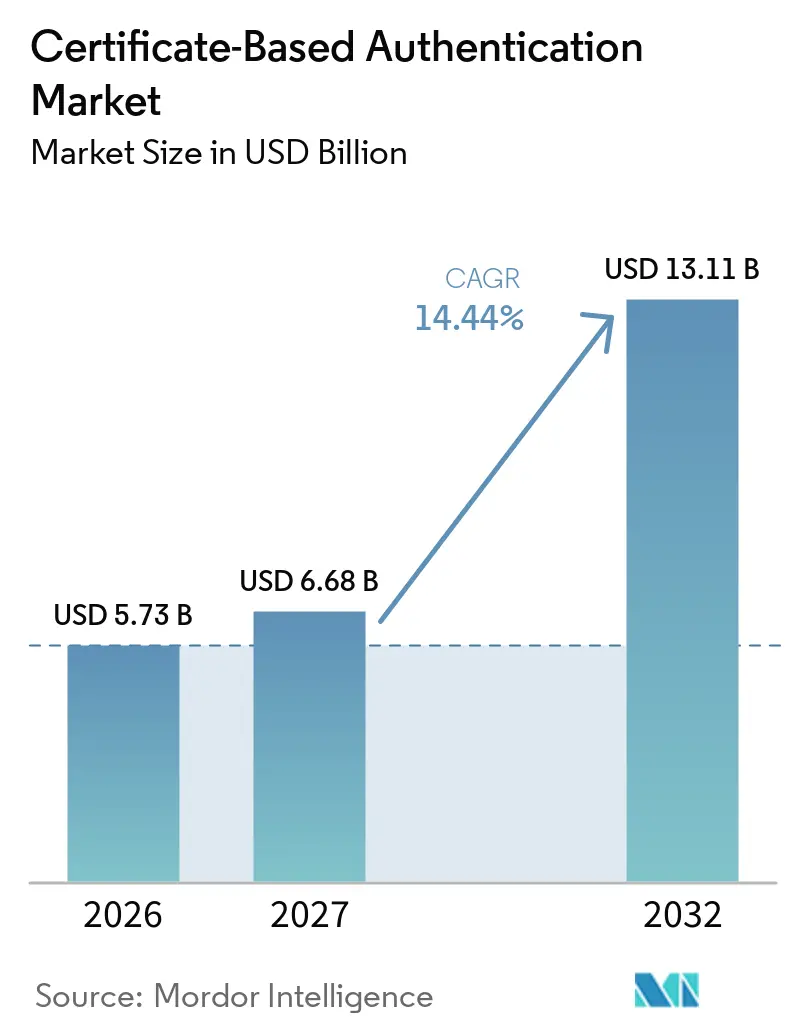
The certificate-based authentication market size is valued at USD 5.73 billion in 2026 and is projected to reach USD 13.11 billion by 2032, expanding at a CAGR of 14.44% over 2027-2032. The certificate-based authentication market is moving beyond a compliance function as enterprises, governments, and industrial operators replace weaker credentials with cryptographic identity. Rising certificate inventories and more frequent renewals are increasing the operational burden on internal teams. This places certificate lifecycle automation at the center of purchasing decisions and gives managed PKI providers a stronger role in enterprise security programs. Zero-trust adoption, machine identities in cloud and IoT settings, and shorter TLS validity periods are expected to support demand, while post-quantum readiness is increasing the value of providers that can support cryptographic modernization.
Key Report Takeaways
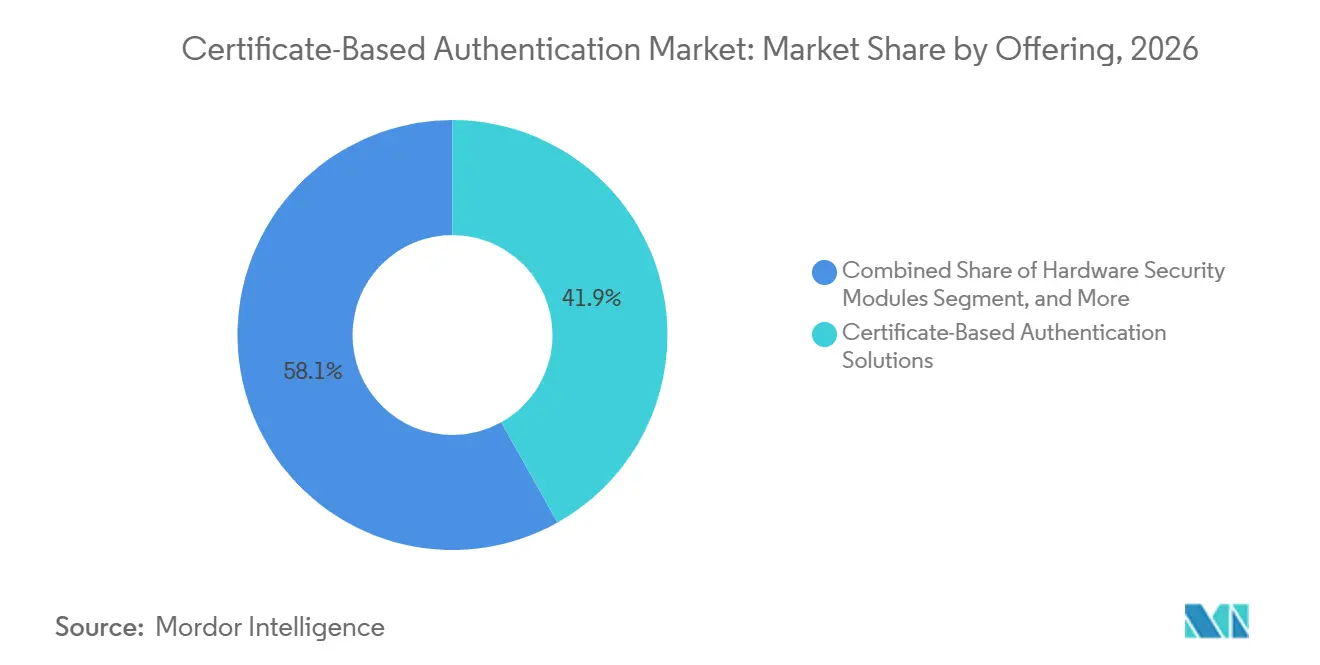
- By offering, Certificate-Based Authentication Solutions held 41.88% of the certificate-based authentication market share in 2026, while Certificate Lifecycle Management Platforms are expected to be the fastest-expanding sub-segment through 2032.
- By certificate type, SSL/TLS Certificates held 46.68% of the certificate-based authentication market share in 2026, while Device and IoT Certificates are expected to be the fastest-expanding certificate type through 2032.
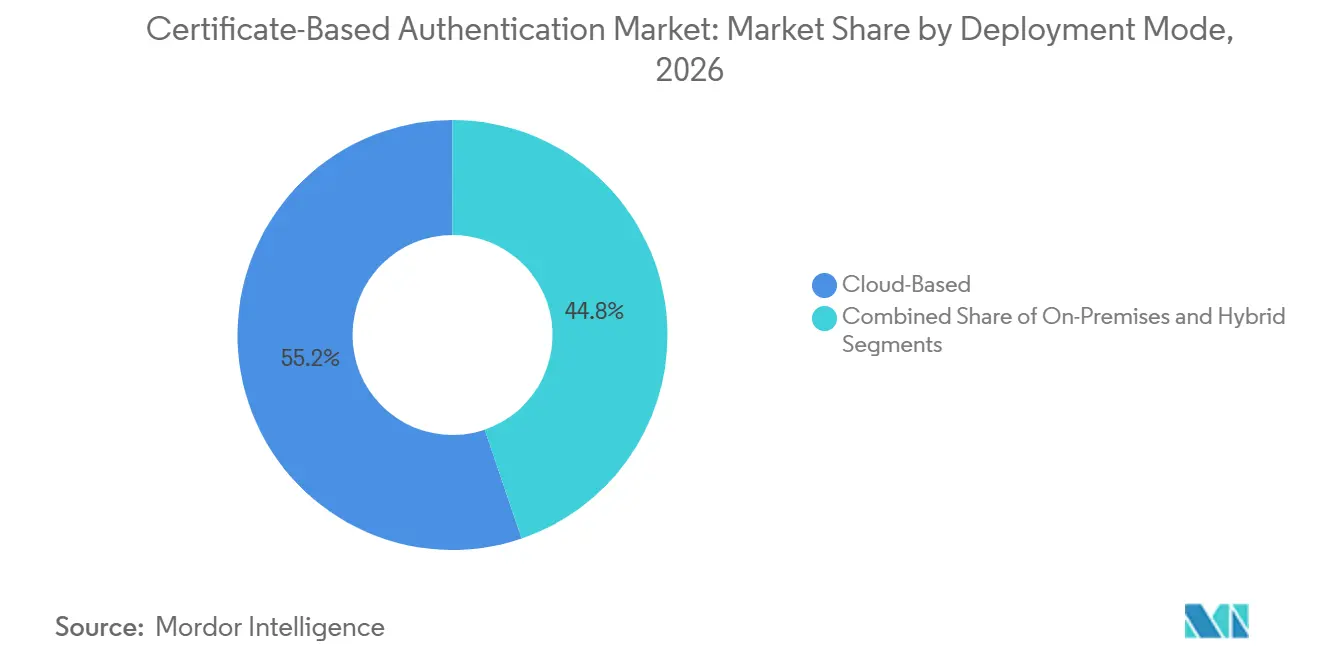
- By deployment mode, Cloud-Based deployments accounted for 55.21% of the certificate-based authentication market in 2026.
- By authentication use case, User Authentication held 15.47% of the segment in 2026, while Device Authentication is projected to expand at a 14.58% CAGR through 2032.
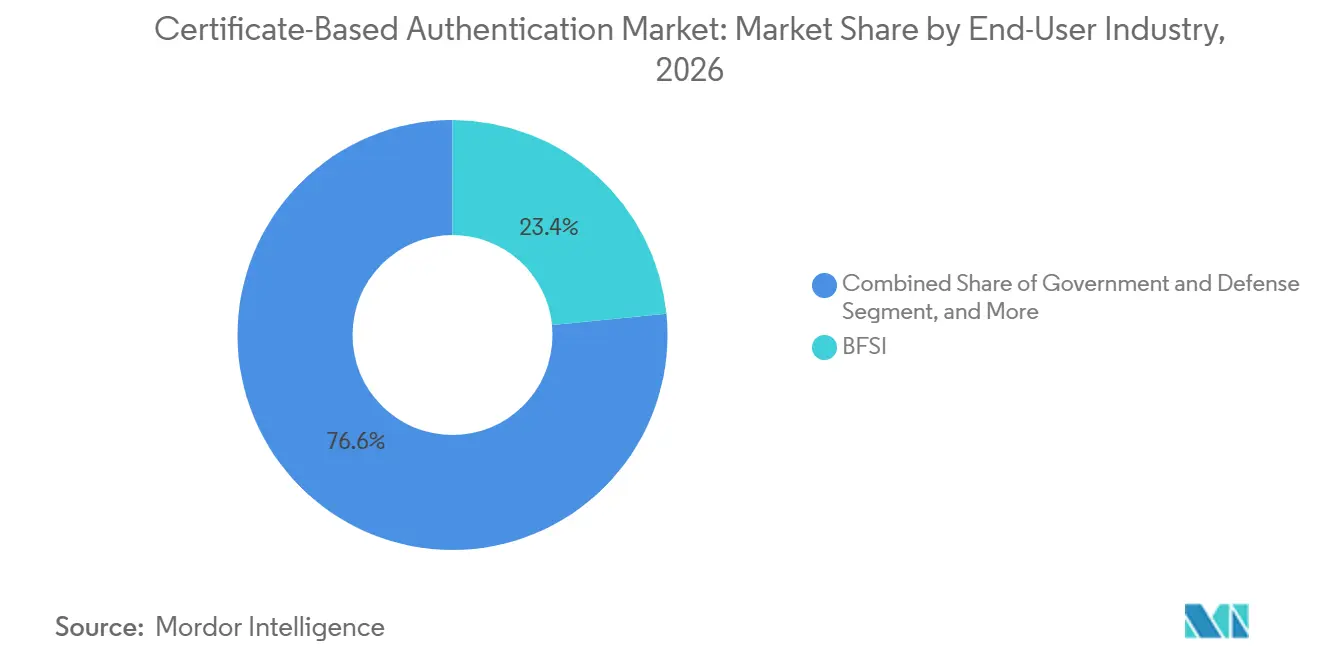
- By end-user industry, BFSI held 23.42% of the segment in 2026, while Government and Defense is projected to expand at a 14.98% CAGR through 2032.
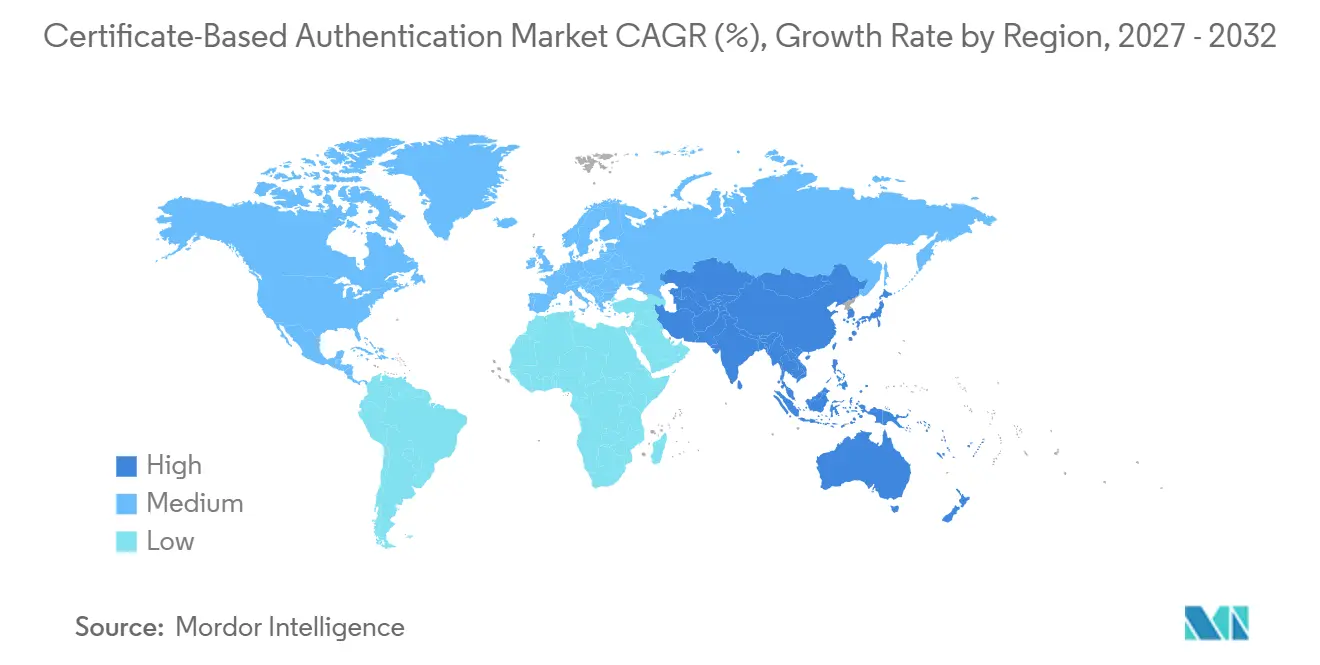
- By geography, North America accounted for 41.88% of the certificate-based authentication market in 2026, while Asia-Pacific is projected to expand at a 15.13% CAGR through 2032.
Note: Market numbers in this report are based on Mordor Intelligence's proprietary estimation framework, which combines nine months of actuals with Q4 projections for base year 2026.
Market Trends and Insights
Drivers Impact Analysis of Certificate-Based Authentication Market*
| Driver | (~) % Impact on CAGR Forecast | Geographic Relevance | Impact Timeline |
|---|---|---|---|
| Zero-Trust Adoption and Phishing-Resistant Access | +3.2% | Global, acute in North America and Europe | Short term (≤ 2 years) |
| Expansion of Machine Identities Across Cloud and IoT Environments | +2.8% | Global, Asia-Pacific core with spillover to the Middle East and Africa | Medium term (2-4 years) |
| Shortening Public TLS Certificate Lifecycles | +2.4% | Global, North America and Europe as first movers | Short term (≤ 2 years) |
| Strong Digital Identity and Data Protection Requirements | +2.0% | Global, concentrated in Europe, North America, and Asia-Pacific | Medium term (2-4 years) |
| Cryptographic Identity for Connected Vehicles, Industrial Assets, and Medical Devices | +1.6% | Global, Asia-Pacific and European industrial corridors | Long term (≥ 4 years) |
| National Digital Identity and Sovereign Public Key Infrastructure Programs | +1.2% | Global, concentrated in Asia-Pacific, the Middle East and Africa, and Europe | Long term (≥ 4 years) |
| Source: Mordor Intelligence | |||
Zero-Trust Adoption and Phishing-Resistant Access Requirements
Zero-trust architectures require authentication methods that can resist phishing at enterprise scale. Certificate-based mechanisms meet this need for employee, device, and workload access. A 2026 Okta and Yubico report found that 70% of respondents saw increased organizational phishing, while 88% of security leaders remained confident in their security posture.[1] A Portnox survey published in October 2025 found that 92% of CISOs had implemented, were implementing, or planned to implement passwordless authentication, compared with 70% in 2024.[2] U.S Federal guidance identifies PIV-based certificate authentication as a baseline under OMB M-22-09, and Executive Order 14144 expanded requirements for FIDO-compliant phishing-resistant authentication. These requirements support adoption in the certificate-based authentication market because stronger authentication becomes a security and compliance requirement rather than an optional upgrade.
Expansion of Machine Identities Across Cloud and IoT Environments
Machine identities are more numerous than human identities in many enterprise environments. X.509 certificates are a primary authentication method for workloads, containers, and connected devices. A February 2026 Ponemon Sullivan study reported an average of 114,591 internal certificates per organization, while 55% of respondents struggled to keep pace with increasing volumes.[3] NIST provides a reference architecture for trusted network-layer IoT device onboarding and lifecycle management. Scaling this approach across large device fleets requires automated certificate discovery, issuance, renewal, and revocation. This need supports lifecycle management spending within the certificate-based authentication market as industrial and cloud environments become more complex.
Shortening Public TLS Certificate Lifecycles
The CA/Browser Forum approved a phased reduction in the maximum validity period for public TLS certificates in April 2025. The validity period will progressively decline, increasing certificate renewal events for organizations with extensive web, API, and service inventories. Manual renewal practices may increase the risk of service interruptions as certificate renewal cycles become more frequent. Let’s Encrypt also announced plans to shorten certificate validity periods. These changes make automation a practical requirement for many buyers in the certificate-based authentication market.
Strong Digital Identity and Data Protection Requirements
Regulation in banking, health care, and public administration is increasing the use of high-assurance digital identity. eIDAS 2.0 requires European Union member states to provide at least 1 European Digital Identity Wallet by the end of 2026. India’s financial sector requirements include PKI use for inter-bank fund transfers and digital signature certificates for defined regulatory filings. ISO 17090-4:2026 specifies public key infrastructure and digital signature requirements for cross-border health care documents. ETSI standards and health care encryption requirements make certificate infrastructure relevant to compliance planning. These obligations support more durable spending in the certificate-based authentication market because critical identity controls cannot be deferred as easily as discretionary projects.
Restraints Impact Analysis of Certificate-Based Authentication Market*
| Restraint | (~) % Impact on CAGR Forecast | Geographic Relevance | Impact Timeline |
|---|---|---|---|
| Shortage of PKI and Cryptography Skills | -1.8% | Global, acute in South America, the Middle East and Africa, and Southeast Asia | Medium term (2-4 years) |
| High Cost of Hardware Security Modules and High-Assurance Deployments | -1.2% | Global, concentrated among SMEs in Asia-Pacific and South America | Short term (≤ 2 years) |
| Legacy Device Constraints and Intermittent Edge Connectivity | -0.9% | Global, acute in manufacturing, utilities, and health care | Long term (≥ 4 years) |
| Fragmented Trust Policies Across Multicloud and Cross-Border Environments | -0.7% | Global, acute in Europe and cross-border trade corridors | Medium term (2-4 years) |
| Source: Mordor Intelligence | |||
Shortage of PKI and Cryptography Skills
The shortage of PKI and cryptography professionals can delay deployment and weaken operational effectiveness. A Ponemon Sullivan study found that organizations often rely on small teams to manage PKI, while many lack sufficient in-house expertise. The study also indicated that organizations frequently outsource PKI activities to managed service providers. Sectigo reported significant skills gaps in post-quantum cryptography readiness across organizations. Organizations without adequate specialist capacity may postpone modernization initiatives and face increased remediation requirements when cryptographic migration becomes mandatory. This skills gap also creates opportunities for managed PKI services in the certificate-based authentication market.
High Cost of Hardware Security Modules and High-Assurance Deployments
Hardware security modules used for root CA operations can create a material barrier for mid-market buyers. Thales Luna Network HSM appliances carry substantial acquisition costs, while high-availability configurations require significantly higher investment before annual support costs. The same source indicates that cloud HSM deployments can offer a lower long-term total cost of ownership than comparable on-premises implementations. Cloud services can reduce the upfront financial burden for organizations that can use them. However, data residency requirements and high-assurance standards continue to limit migration options for some buyers. These costs can delay complex deployments in the certificate-based authentication market, particularly among smaller organizations.
*Our forecasts treat driver/restraint impacts as directional, not additive. The impact forecasts reflect baseline growth, mix effects, and variable interactions.
Certificate-Based Authentication Market Segment Analysis
By Offering:
Lifecycle Automation Platforms Gain Ground on Core SolutionsCertificate-Based Authentication Solutions held 41.88% of the offering segment in 2026. Organizations continue to prioritize core issuance, validation, certificate discovery, and governance functions because they remain central to cryptographic identity across users, systems, and connected assets. Certificate Lifecycle Management Platforms are expected to expand faster through 2032 as shorter certificate terms make manual tracking, assignment of ownership, and timely renewal less viable for large estates. Managed PKI Services address the needs of buyers that cannot maintain a dedicated PKI team or operate specialist infrastructure internally. Hardware Security Modules also benefit from post-quantum readiness programs, while Professional Services support health assessments, policy design, and modernization planning in the certificate-based authentication industry.
The certificate-based authentication market is also shaped by the relationship between certificate validity and operating workload. Each reduction in certificate duration increases the number of annual renewal events for a given certificate inventory, even when the number of applications and devices stays unchanged. This raises transaction volumes on lifecycle platforms and deepens integration requirements across certificate authorities, cloud tools, development systems, and business applications. Keyfactor’s May 2025 acquisition of InfoSec Global and CipherInsights combined cryptographic posture management and asset discovery with automated CLM and PKI capabilities. The transaction reflects vendor efforts to address discovery, automation, inventory visibility, and quantum-readiness needs through a wider platform.

By Certificate Type:
SSL/TLS Anchors Volume as Device and IoT Certificates AccelerateSSL/TLS Certificates held 46.68% of the certificate type segment in 2026. Their broad use covers website encryption, API security, customer-facing portals, and mutual TLS for microservices that communicate across distributed environments. The move to a 200-day maximum TLS validity period in March 2026 increases renewal activity, with further reductions set to reach 47 days by 2029. Client Authentication Certificates support phishing-resistant user access, while Code-Signing and Document-Signing Certificates support software integrity and signed business records. Secure Email Certificates are adapting to browser policy changes that separate clientAuth and serverAuth extended key usages.
Device and IoT Certificates are expected to be the fastest-expanding certificate type through 2032. Connected endpoints need verifiable cryptographic identity from manufacturing and initial provisioning through maintenance, renewal, and retirement during their operating life. China’s GB/T 47001-2025 standard, effective July 1, 2026, sets PKI-based V2X credential management requirements for intelligent and connected vehicles. This creates a regulatory basis for automotive certificate volumes in China, where connected vehicle deployment adds a large addressable device base. Similar requirements across industrial equipment and connected medical devices reinforce the move toward device-level identity. These applications broaden the certificate-based authentication industry beyond conventional web and employee credentials.
By Deployment Mode:
Cloud Consolidates Its Lead Across Public and Private PKICloud-Based deployments accounted for 55.21% of the deployment mode segment in 2026. The certificate-based authentication market size for cloud deployments benefits from lower infrastructure commitments, service flexibility, and the ability to accommodate uneven certificate renewal workloads. EverTrust estimated a 10-year cloud HSM total cost of ownership near USD 450,000, compared with USD 2.1 million for a comparable on-premises deployment. Cloud-native lifecycle platforms can accommodate more renewal activity as certificate lifetimes shorten and new connected assets are added. This flexibility reduces the need to purchase unused capacity in advance.
On-Premises deployments remain important in sectors with data sovereignty, air-gapped, or national security requirements. Critical infrastructure operators and defense contractors are key examples because they may require direct control over root keys and operational processes. Hybrid models can retain root CAs on-site while using cloud capacity for subordinate issuance, discovery, and lifecycle management. Bring Your Own Key designs support this division of responsibilities between internal security teams and external platforms. Qualified trust service providers in the European Union must meet BSI TR-03145 and ETSI security requirements regardless of deployment mode. This creates a common quality threshold for cloud and on-premises certificate services.
By Authentication Use Case:
Device Authentication Outpaces Human-Centric SegmentsUser Authentication held 15.47% of the authentication use case segment in 2026. It includes smartcard logins, derived PIV credentials, and certificate-backed FIDO authentication for people accessing business systems, secure networks, and sensitive data. Device Authentication is projected to expand at a 14.58% CAGR through 2032 as connected endpoints require verified identities for zero-trust access. Application and Workload Authentication covers service accounts and CI/CD workflows where mutual TLS can replace shared secrets. Network and Mutual TLS Authentication, API Authentication, and Code and Software Integrity certificates provide the credential layer for microservices, gateways, software supply chains, and automated service interactions.
FIDO passkeys can absorb demand that might otherwise have gone to dedicated client certificates. Organizations that replace passwords may defer some user certificate issuance while adding device and workload credentials more quickly across cloud and operational environments. NIST provides a reference architecture for network-layer IoT device onboarding that supports the operational model for device authentication. The difference between human and machine identity needs to be explained to achieve the faster outlook for Device Authentication. It shifts vendor attention toward certificate discovery, automated enrollment, fleet-wide renewal processes, and consistent revocation controls. The certificate-based authentication market must support long-lived industrial devices as well as fast-moving cloud workloads.
By End-User Industry:
Government and Defense Accelerates as BFSI Anchors Base DemandBFSI held 23.42% of the end-user industry segment in 2026. Banking and financial institutions require strong controls for high-value transactions, customer identity, payment infrastructure, and regulatory records. Government and Defense is projected to expand at a 14.98% CAGR through 2032 as national zero-trust programs, sovereign PKI investments, and e-government services continue. IT and Telecommunications use device and workload certificates for network authentication and service mesh security. Health care and life sciences demand is supported by ISO 17090-4:2026 requirements for cross-border health information exchange..
Government projects often move from budget approval to deployment over 12 to 24 months. This creates longer purchasing cycles but can support sustained procurement after modernization programs are announced and implementation stages begin. India’s RBI-related PKI requirements add an emerging-market layer to BFSI demand for inter-bank transfers and regulated digital signatures. Manufacturing, retail and e-commerce, energy and utilities are also adding demand as operational technology and information technology systems become more connected. These buyers require certificate controls for devices, applications, remote operational access, and the systems that exchange data between them. The certificate-based authentication market therefore serves a broader mix of regulated, transactional, and operational environments.
Geography Analysis
North America Certificate-Based Authentication Market
North America accounted for 41.88% of the certificate-based authentication market in 2026. The region has a mature enterprise PKI base, substantial cloud adoption, and a federal program that supports zero-trust implementation across civilian agencies. CISA guidance supports the implementation of zero-trust architecture across U.S. agencies. Federal direction includes phishing-resistant authentication and PIV-based certificate credentials under OMB M-22-09. Canada’s health care digitization, Mexico’s e-government expansion, and renewal needs within the installed base support regional demand as public certificate terms shorten.
APAC Certificate-Based Authentication Market
Asia-Pacific is projected to expand at a 15.13% CAGR through 2032. National digital identity programs are creating demand alongside rapid private-sector digitization and large populations of connected mobile and industrial users. Japan’s Digital Agency reported that My Number Card adoption exceeded 80% of the population in August 2026, and 1,431 private-sector businesses had integrated the JPKI Digital Authentication Service by September 2026. Malaysia’s MyDigital ID registrations increased from 1.8 million in the first quarter of 2025 to 2.8 million in the second quarter of 2025. China’s connected-vehicle standard and India’s financial-sector requirements create additional automotive and banking certificate demand.
EMEA and South America Certificate-Based Authentication Market
Europe holds the second-largest regional share in the certificate-based authentication market. eIDAS 2.0 requires each European Union member state to provide at least 1 European Digital Identity Wallet by the end of 2026, while Germany operates a multi-tier PKI for electronic identity documents that includes a Country Signing Certificate Authority and Country Verifying Certificate Authority. South America expands more slowly because national PKI standards remain fragmented, although Brazil’s digital government program provides potential demand. The Middle East and Africa are attracting managed PKI vendors as sovereign PKI programs advance and local specialist capacity remains limited.
Competitive Landscape
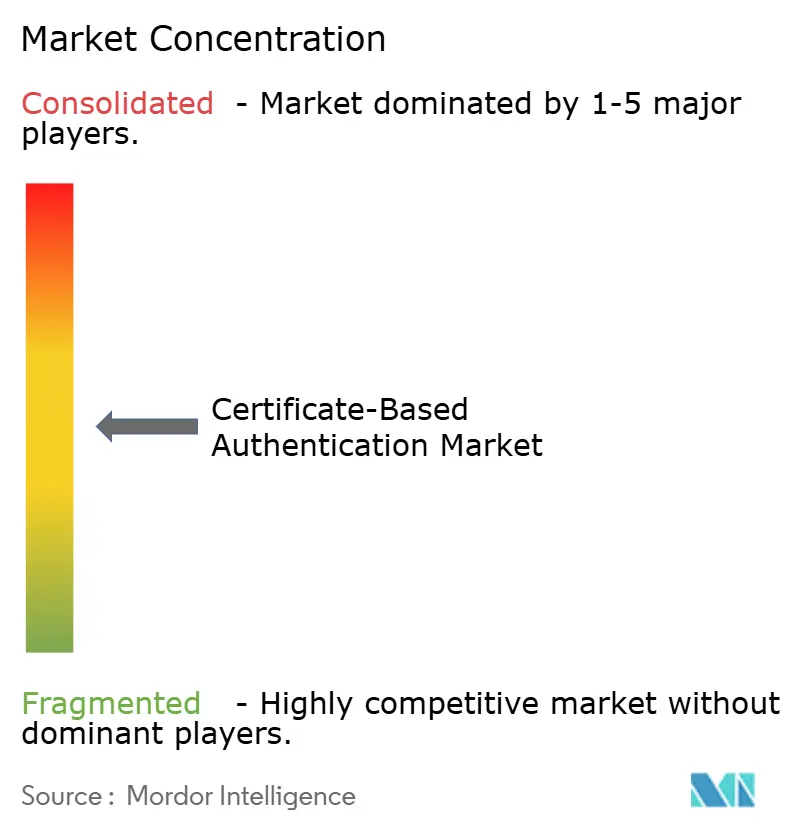
The certificate-based authentication market is moderately consolidated at the certificate authority layer and fragmented across lifecycle management, managed PKI, and hardware security. DigiCert, Sectigo, and GlobalSign are established public certificate authorities, while Keyfactor, Entrust, and AppViewX compete around automation, private PKI, and cryptographic agility. Cloud providers serve cloud-native use cases through managed certificate services that are integrated with broader infrastructure platforms. Smaller providers, including eMudhra, are extending certificate management capability to more enterprise and regulated buyers. Competition remains active because buyers often need interoperability across certificate authorities, clouds, applications, device fleets, and internal security systems.
Post-quantum migration, AI-related identity controls, and machine identity management are central areas of product differentiation. DigiCert launched Quantum Central and AI Trust Manager as modules of DigiCert ONE in 2026, targeting cryptographic risk assessment, post-quantum migration planning, and certificate governance for AI agents and model. AppViewX acquired Eos in March 2026 and launched Agent Identity Security in June 2026 to extend certificate lifecycle controls to autonomous AI workloads. These moves indicate that vendors are adapting certificate governance to emerging workload types and automation models. The commercial focus is moving from individual certificate issuance toward governance of cryptographic identity across the operating environment.
Acquisition activity is also changing the competitive structure of the certificate-based authentication market. Sectigo completed the migration of Entrust’s public certificate business in September 2025, moving more than 500,000 certificates to Sectigo Certificate Manager. Keyfactor’s acquisition of InfoSec Global and CipherInsights in May 2025 added cryptographic posture management and discovery capabilities. Hardware security certification and participation in CA/Browser Forum requirements provide barriers to entry in certificate issuance, while lifecycle automation remains open to differentiation through CA-agnostic connectivity and implementation speed.
Certificate-Based Authentication Industry Leaders
-
DigiCert, Inc.
-
Sectigo Limited
-
GoDaddy Operating Company, LLC
-
GlobalSign K.K.
-
Entrust Corporation
- *Disclaimer: Major Players sorted in no particular order
Certificate-Based Authentication Market Companies Covered in this Report
- DigiCert, Inc.
- Sectigo Limited
- GoDaddy Operating Company, LLC
- GlobalSign K.K.
- Entrust Corporation
- Keyfactor, Inc.
- CyberArk Software Ltd.
- Thales Group
- Microsoft Corporation
- Amazon Web Services, Inc.
- Google LLC
- International Business Machines Corporation
- HID Global Corporation
- AppViewX Inc.
- eMudhra Limited
- Ascertia Limited
- WISeKey International Holding Ltd.
- SSL.com LLC
- SwissSign AG
- Internet Security Research Group
- Asseco Data Systems S.A.
Recent Industry Developments in Certificate-Based Authentication Market
- October 2026: DigiCert launched Quantum Central and AI Trust Manager as distinct modules of DigiCert ONE, targeting cryptographic risk assessment, post-quantum migration planning, and digital certificate governance for AI agents and models.
- September 2026: eMudhra was appointed as a Validation Agent by the Global Legal Entity Identifier Foundation, integrating LEI application and renewal into its digital trust and PKI ecosystem and extending compliance-linked identity services to global financial market participants.
- June 2026: AppViewX launched Agent Identity Security following its March 2026 acquisition of Eos, combining automated CLM with AI-native identity control to provide discovery, governance, and monitoring for AI agents across enterprise environments.
- March 2026: AppViewX acquired Eos, an AI-native Identity Control Plane for AI agents and autonomous workloads, combining it with AppViewX's automated PKI and CLM capabilities to extend machine identity management to agentic workloads.
Global Certificate-Based Authentication Market Report Scope
The Certificate-Based Authentication (CBA) Market comprises security solutions that use digital certificates (X.509) issued and managed through Public Key Infrastructure (PKI) to authenticate users, devices, machines, and applications before granting access to networks, systems, or data. Unlike password or OTP-based methods, CBA relies on cryptographic trust between a certificate and its issuing Certificate Authority (CA), enabling mutual authentication (mTLS) for both client and server sides.
The Certificate-Based Authentication Market Report is Segmented by Offering (Certificate-Based Authentication Solutions, Certificate Lifecycle Management Platforms, Hardware Security Modules, Managed PKI Services, and Professional Services), Certificate Type (Client Authentication Certificates, Device and IoT Certificates, SSL/TLS Certificates, Secure Email Certificates, Code-Signing Certificates, and Document-Signing Certificates), Deployment Mode (Cloud-Based, On-Premises, and Hybrid), Authentication Use Case (User Authentication, Device Authentication, Application and Workload Authentication, Network and Mutual TLS Authentication, API Authentication, Secure Email Authentication, and Code and Software Integrity), End-User Industry (BFSI, Government and Defense, IT and Telecommunications, Healthcare and Life Sciences, Manufacturing and Industrial, Retail and E-Commerce, Energy and Utilities, and Other End-User Industries), and Geography (North America, South America, Europe, Asia-Pacific, and Middle East and Africa). The Market Forecasts are Provided in Terms of Value (USD).
Segmentation Overview
| Certificate-Based Authentication Solutions |
| Certificate Lifecycle Management Platforms |
| Hardware Security Modules |
| Managed PKI Services |
| Professional Services |
| Client Authentication Certificates |
| Device and IoT Certificates |
| SSL/TLS Certificates |
| Secure Email Certificates |
| Code-Signing Certificates |
| Document-Signing Certificates |
| Cloud-Based |
| On-Premises |
| Hybrid |
| User Authentication |
| Device Authentication |
| Application and Workload Authentication |
| Network and Mutual TLS Authentication |
| API Authentication |
| Secure Email Authentication |
| Code and Software Integrity |
| BFSI |
| Government and Defense |
| IT and Telecommunications |
| Healthcare and Life Sciences |
| Manufacturing and Industrial |
| Retail and E-Commerce |
| Energy and Utilities |
| Other End-User Industries |
| North America | United States |
| Canada | |
| Mexico | |
| South America | Brazil |
| Argentina | |
| Rest of South America | |
| Europe | United Kingdom |
| Germany | |
| France | |
| Italy | |
| Rest of Europe | |
| Asia-Pacific | China |
| Japan | |
| India | |
| South Korea | |
| Southeast Asia | |
| Rest of Asia-Pacific | |
| Middle East and Africa | Saudi Arabia |
| United Arab Emirates | |
| South Africa | |
| Egypt | |
| Rest of Middle East and Africa |
| By Offering | Certificate-Based Authentication Solutions | |
| Certificate Lifecycle Management Platforms | ||
| Hardware Security Modules | ||
| Managed PKI Services | ||
| Professional Services | ||
| By Certificate Type | Client Authentication Certificates | |
| Device and IoT Certificates | ||
| SSL/TLS Certificates | ||
| Secure Email Certificates | ||
| Code-Signing Certificates | ||
| Document-Signing Certificates | ||
| By Deployment Mode | Cloud-Based | |
| On-Premises | ||
| Hybrid | ||
| By Authentication Use Case | User Authentication | |
| Device Authentication | ||
| Application and Workload Authentication | ||
| Network and Mutual TLS Authentication | ||
| API Authentication | ||
| Secure Email Authentication | ||
| Code and Software Integrity | ||
| By End-User Industry | BFSI | |
| Government and Defense | ||
| IT and Telecommunications | ||
| Healthcare and Life Sciences | ||
| Manufacturing and Industrial | ||
| Retail and E-Commerce | ||
| Energy and Utilities | ||
| Other End-User Industries | ||
| By Geography | North America | United States |
| Canada | ||
| Mexico | ||
| South America | Brazil | |
| Argentina | ||
| Rest of South America | ||
| Europe | United Kingdom | |
| Germany | ||
| France | ||
| Italy | ||
| Rest of Europe | ||
| Asia-Pacific | China | |
| Japan | ||
| India | ||
| South Korea | ||
| Southeast Asia | ||
| Rest of Asia-Pacific | ||
| Middle East and Africa | Saudi Arabia | |
| United Arab Emirates | ||
| South Africa | ||
| Egypt | ||
| Rest of Middle East and Africa | ||
Key Questions Answered in the Report
What is the certificate-based authentication market size?
The certificate-based authentication market is valued at USD 5.73 billion in 2026 and is projected to reach USD 13.11 billion by 2032 at a 14.44% CAGR.
What is driving demand for certificate-based authentication?
Zero-trust programs, phishing-resistant access requirements, rising machine identities, and shorter TLS certificate lifetimes are key demand factors.
Which deployment model leads certificate-based authentication adoption?
Cloud-Based deployments held 55.21% of the deployment mode segment in 2026, supported by flexible scaling and lower infrastructure commitments.
Which use case is expanding most quickly?
Device Authentication is projected to expand at a 14.58% CAGR through 2032 as connected endpoints require verified cryptographic identities.
Which end-user sector has the fastest outlook?
Government and Defense is projected to expand at a 14.98% CAGR through 2032, supported by national PKI investments and zero-trust mandates.
Which region has the fastest forecast?
Asia-Pacific is projected to expand at a 15.13% CAGR through 2032, supported by digital identity programs and rapid private-sector digitization.