
Cerium (IV) Oxide Market Size and Share
Market Overview
| Study Period | 2022 - 2032 |
|---|---|
| Market Size (2027) | USD 1.35 Billion |
| Market Size (2032) | USD 1.91 Billion |
| Growth Rate (2027 - 2032) | 7.13 % |
| Fastest Growing Market | Asia-Pacific |
| Largest Market | Asia-Pacific |
| Market Concentration | Medium |
Major Players *Disclaimer: Major Players sorted in no particular order Image © Mordor Intelligence. Reuse requires attribution under CC BY 4.0. | |
Cerium (IV) Oxide Market Analysis by Mordor Intelligence
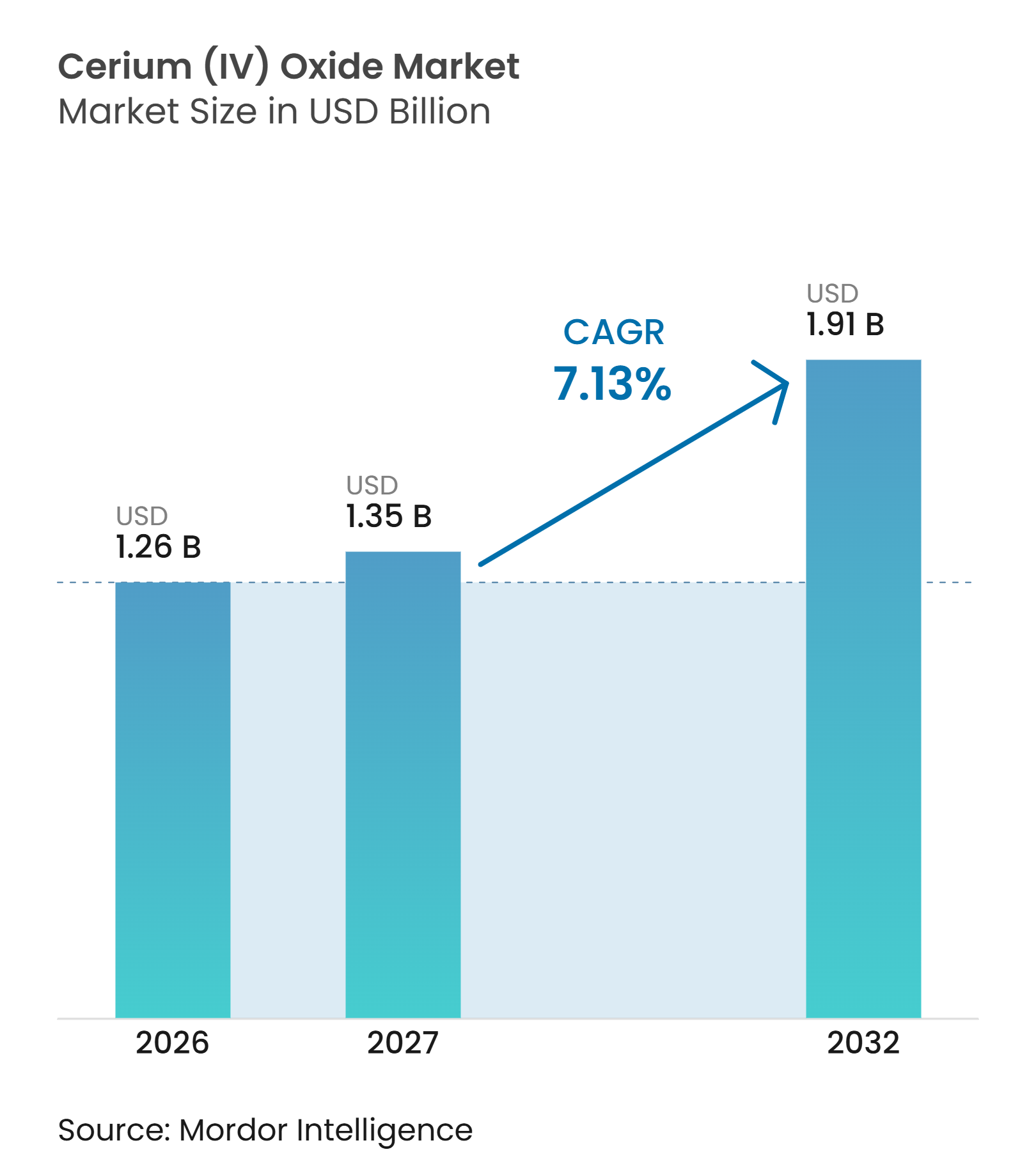
The Cerium (IV) Oxide Market size was valued at USD 1.26 billion in 2026 and is estimated to grow from USD 1.35 billion in 2027 to reach USD 1.91 billion by 2032, at a CAGR of 7.13% during the forecast period (2027-2032). The cerium (IV) oxide market is supported by tighter vehicle-emission requirements, expanding semiconductor fabrication, and demand for high-specification polishing materials. Demand is moving toward grades with controlled purity and particle size because advanced uses cannot rely on standard polishing powder. Cerium is widely available in rare-earth deposits, but refined supply remains concentrated in China, which makes processing capacity and product qualification more important than ore availability. Supply decisions also remain linked to neodymium-praseodymium magnet economics because cerium and lanthanum are co-products of rare-earth separation. This link can create inventory shifts and different pricing conditions for technical-grade and high-purity material in the cerium (IV) oxide market.
Key Report Takeaways
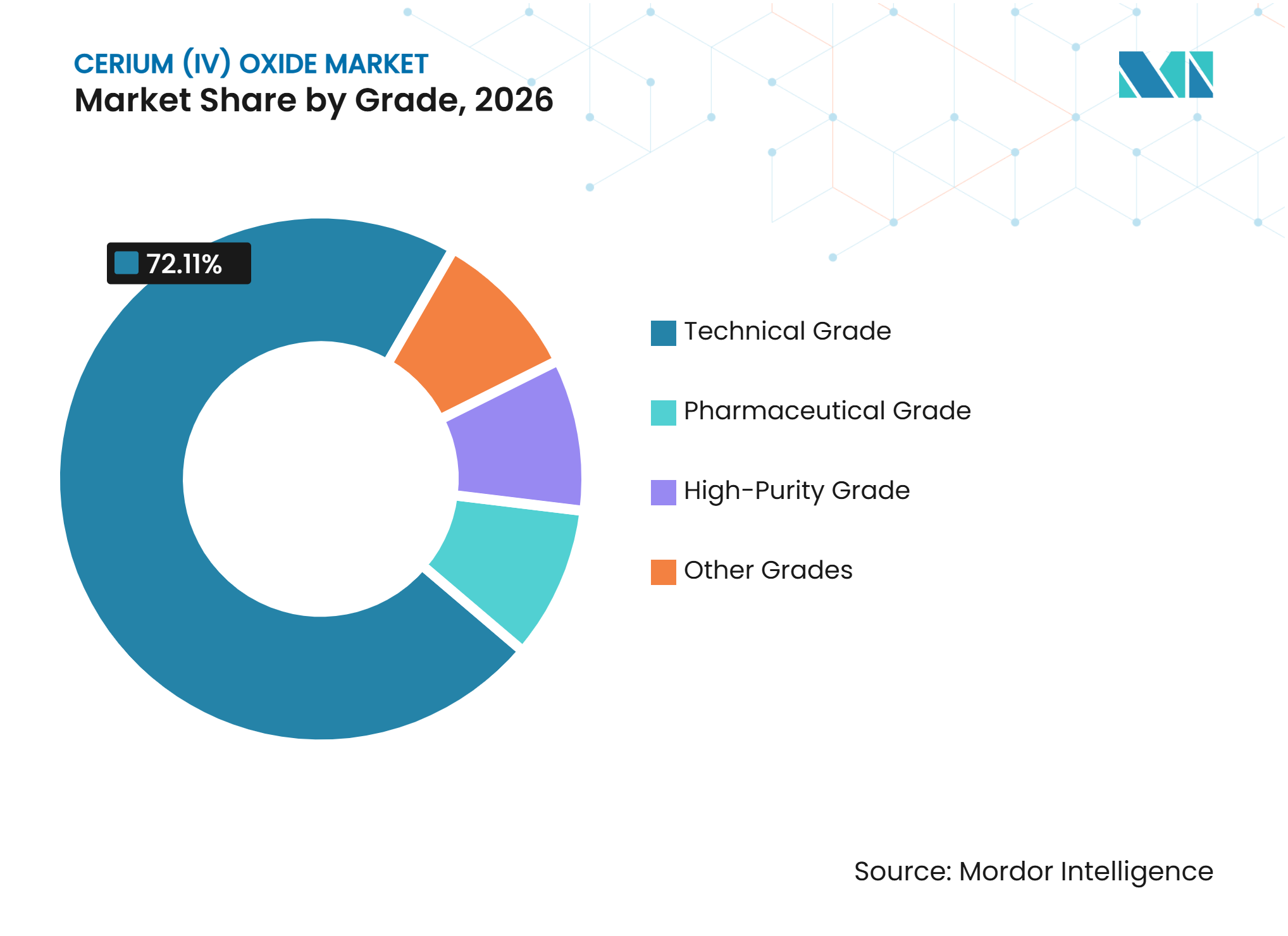
- By grade, technical grade held 72.11% of the cerium (IV) oxide market share in 2026, while high-purity grade is projected to advance at a 7.89% CAGR through 2032.
- By particle size, sub-micron cerium oxide held 50.34% of the cerium (IV) oxide market share in 2026, while nanoparticle cerium oxide is projected to advance at an 8.16% CAGR through 2032.
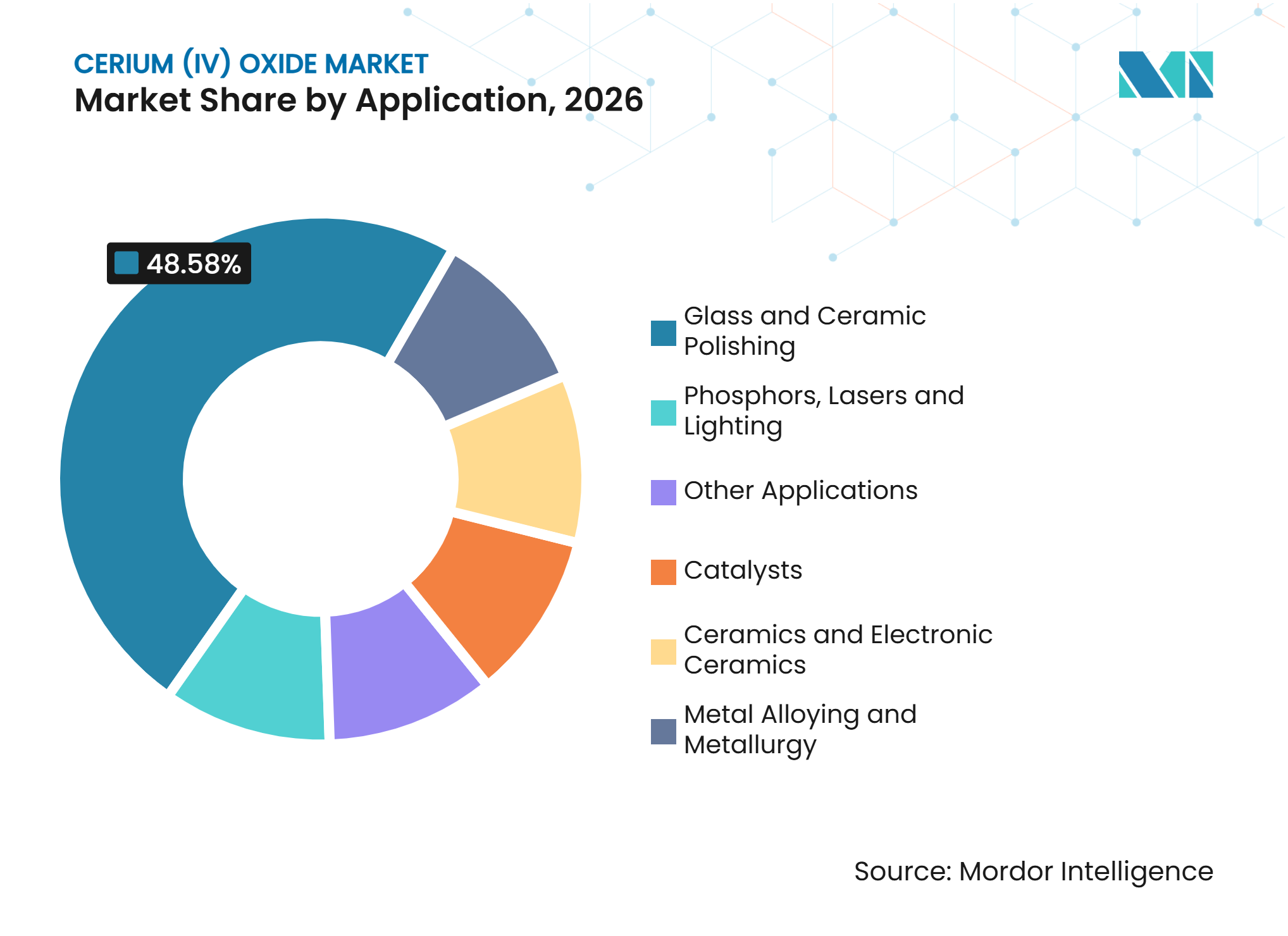
- By application, glass and ceramic polishing held 48.58% of the cerium (IV) oxide market share in 2026, while ceramics and electronic ceramics are projected to advance at an 8.45% CAGR through 2032.
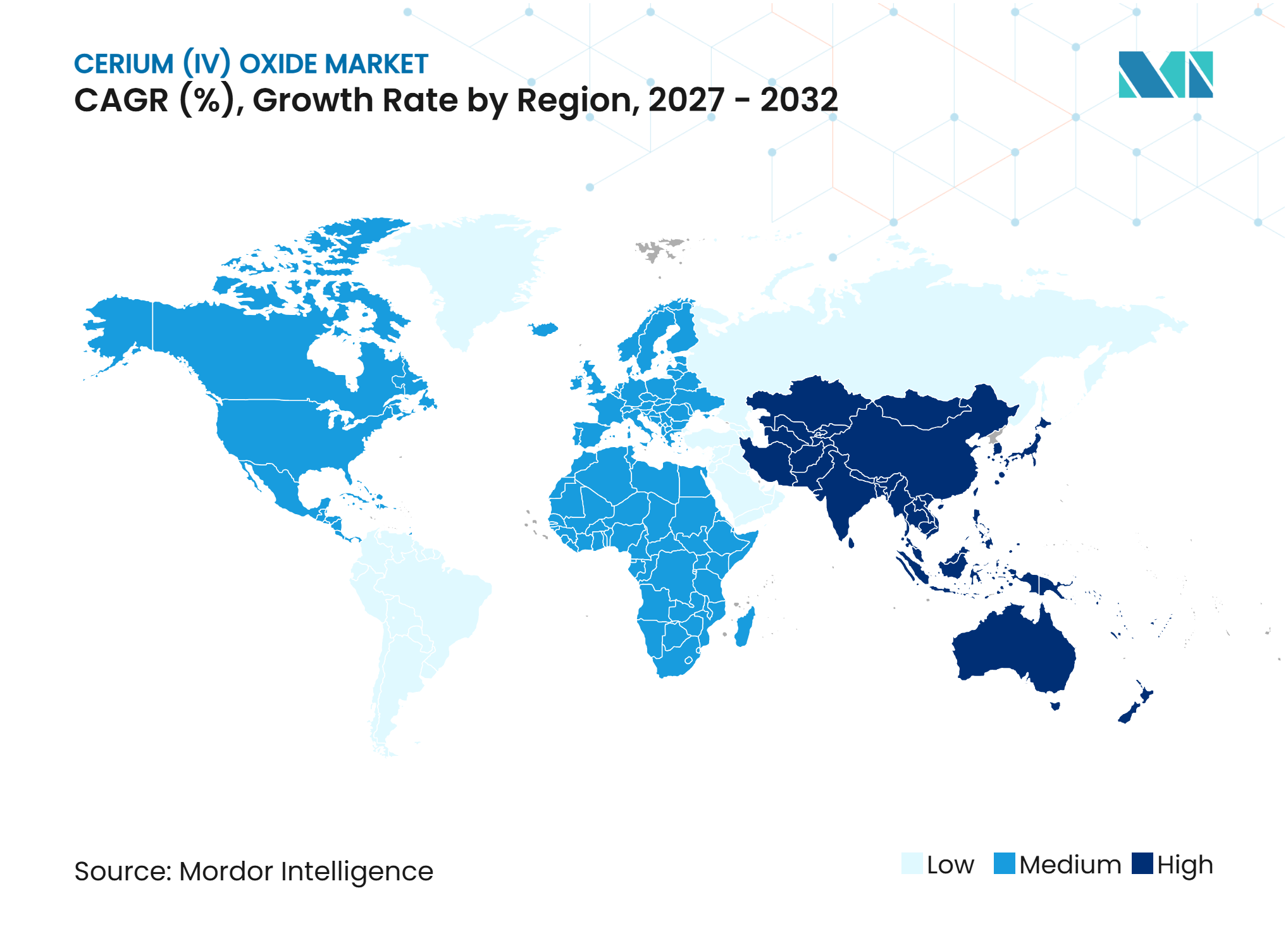
- By geography, Asia-Pacific held 43.67% of the cerium (IV) oxide market share in 2026 and is projected to advance at an 8.33% CAGR through 2032.
Note: Market numbers in this report are based on Mordor Intelligence's proprietary estimation framework, which combines nine months of actuals with Q4 projections for base year 2026.
Market Trends and Insights
Drivers Impact Analysis of Cerium (IV) Oxide Market*
| Driver | (~) % Impact on CAGR Forecast | Geographic Relevance | Impact Timeline |
|---|---|---|---|
| Stricter Vehicle Emission Standards and Catalyst Loading Requirements | +1.8% | Global, acute near-term pressure in EU and China | Short term (≤ 2 years) |
| Semiconductor Miniaturization and High-Uniformity CMP Demand | +1.6% | APAC core (Taiwan, South Korea, Japan), spillover to North America | Medium term (2-4 years) |
| Precision Optics, Photomasks and Display-Glass Polishing | +1.3% | APAC core, North America and EU | Medium term (2-4 years) |
| High-Purity Ceria Demand in Advanced Ceramics and Energy Materials | +1.1% | APAC core, spillover to North America and EU | Long term (≥ 4 years) |
| UV-Protection Requirements in Automotive, Solar and Specialty Glass | +0.8% | Global, early gains in China, EU, and Southeast Asia | Medium term (2-4 years) |
| Source: Mordor Intelligence | |||
Stricter Vehicle Emission Standards and Catalyst Loading Requirements
Euro 7 entered into force under Regulation (EU) 2024/1257, with application from November 29, 2026, for new passenger-car and light-commercial-vehicle types[1]. The regulation reinforces demand for catalyst systems that can maintain oxygen-storage performance while meeting tighter nitrogen oxide and particle-number requirements. Cerium oxide is a central oxygen-storage component in three-way catalysts, so higher performance requirements can raise demand for catalyst-grade material. The July 2025 light-duty vehicle implementing-act update accelerated reformulation work among catalyst suppliers. A 2025 study reported that a 10% increase in ceria loading improved nitrogen oxide conversion efficiency by 3% to 4% under the conditions examined. China’s continuing emissions roadmap supports the same demand base, giving the cerium (IV) oxide market support beyond Europe.
Semiconductor Miniaturization and High-Uniformity CMP Demand
Chemical Mechanical Planarization (CMP) requires stable removal rates and low surface defects as semiconductor designs become more complex. Advanced logic production in Taiwan, South Korea, and Japan continues to support demand for CMP materials used in dielectric and shallow-trench-isolation processes. High-purity cerium oxide slurries are used where polishing quality is more important than the lowest material cost. A September 2025 study found that amine-functionalized CeO₂ nanoparticles improved shallow-trench-isolation CMP removal rates by 23% while reducing scratching defects. This performance requirement supports the shift toward controlled nanoparticle formulations in the cerium (IV) oxide market. It also raises the importance of dispersion stability, contamination control, and documentation during supplier qualification.
Precision Optics, Photomasks and Display-Glass Polishing
Photomasks for extreme ultraviolet lithography, organic light-emitting diode panels, and mini light-emitting diode displays require tightly controlled polishing steps. Cerium oxide is suited to these uses because it can produce smooth surfaces on optical glass and quartz substrates. High-purity synthetic quartz photomasks require low surface roughness, which limits substitution by silica or alumina without changes to production processes. Shenghe Resources Holding Co., Ltd. reported that its Leshan polishing-powder project was 63% complete in the third quarter of 2025 and targeted commissioning in the first quarter of 2026. The project shows how producers are adding capacity for higher-value polishing applications rather than relying only on bulk material sales.
High-Purity Ceria Demand in Advanced Ceramics and Energy Materials
Gadolinium-doped ceria and samarium-doped ceria are used as electrolyte materials in intermediate-temperature solid oxide fuel cells and solid oxide electrolysis cells. These materials can support operation between 500 °C and 700 °C, compared with 800 °C to 1,000 °C for conventional yttria-stabilized zirconia systems. Lower operating temperatures can reduce system stress and broaden potential use in stationary power, data centers, and hydrogen production. Research published in 2025 reported ionic conductivity for gadolinium-doped and samarium-doped ceria electrolytes at 2 to 3 times the level of conventional yttria-stabilized zirconia in the 500 °C to 700 °C range. The U.S. Department of Energy announced USD 275 million for critical-mineral supply-chain projects in November 2025, including rare-earth separation and high-purity oxide processing[2].
Restraints Impact Analysis of Cerium (IV) Oxide Market*
| Restraint | (~) % Impact on CAGR Forecast | Geographic Relevance | Impact Timeline |
|---|---|---|---|
| Chinese Processing Concentration and Export-Control Exposure | -1.4% | Global, acute vulnerability in North America and EU | Short term (≤ 2 years) |
| Cerium Stockpiling from Rare-Earth Magnet-Led Separation Economics | -1.0% | Global; primary surplus in China, secondary in Australia | Medium term (2-4 years) |
| Substitution by Silica, Alumina, Diamond and Silicon-Carbide Abrasives | -0.7% | Global, most acute in North America and EU price-sensitive segments | Long term (≥ 4 years) |
| Source: Mordor Intelligence | |||
Chinese Processing Concentration and Export-Control Exposure
China accounted for 60% of global rare-earth production and 90% of refining capacity in a November 2025 European Parliament assessment. This concentration creates a procurement challenge for buyers that need qualified cerium oxide and cannot move supply quickly to another processor. China’s Ministry of Industry and Information Technology issued Interim Measures for Rare Earth Resources Management in August 2025, which formalized centralized quota allocation. Cerium was not included in the April 2025 export-control announcement, which covered samarium, gadolinium, terbium, dysprosium, lutetium, scandium, and yttrium. The practical concern is the possibility of broader resource-flow controls for supply chains that have limited short-term options. The United States remained more than 95% import-reliant for rare-earth element consumption in the 2025 United States Geological Survey (USGS) assessment.
Cerium Stockpiling from Rare-Earth Magnet-Led Separation Economics
Rare-earth separation produces cerium and lanthanum alongside neodymium-praseodymium products, and output ratios are determined by ore composition. Magnet demand can therefore raise cerium output even when cerium demand does not increase at the same rate. China Northern Rare Earth (Group) High-Tech Co., Ltd. reported that lanthanum and cerium sales exceeded production in 2025, drawing down inventory as domestic polishing and catalyst demand absorbed material. Lynas Rare Earths Ltd. reduced lanthanum and cerium output in fiscal year (FY) 2025 to protect neodymium-praseodymium margins. These actions show that cerium supply responds to broader refinery economics rather than solely to cerium demand. Inventory cycles can affect technical-grade availability and make cost planning harder for buyers in the cerium (IV) oxide market.
*Our forecasts treat driver/restraint impacts as directional, not additive. The impact forecasts reflect baseline growth, mix effects, and variable interactions.
Cerium (IV) Oxide Market Segment Analysis
By Grade:
Technical Grade Anchors Revenue, High-Purity Grade ExpandsTechnical grade held 72.11% of the cerium (IV) oxide market share in 2026. It serves glass and ceramic polishing, conventional automotive catalysts, and industrial ultraviolet-absorbing glass applications. Large Chinese processing facilities produce this grade at scale, and its pricing usually follows broader rare-earth oxide conditions. The broad buyer base makes technical grade the demand foundation of the cerium (IV) oxide industry. Pharmaceutical grade has a smaller role because biocompatibility and endotoxin-control requirements restrict the qualified supplier base. Its high specification requirements support higher unit values than standard technical material.
High-purity grade is projected to advance at a 7.89% CAGR through 2032 as semiconductor CMP, solid oxide electrolytes, and advanced phosphors require low levels of transition-metal contamination. TREIBACHER INDUSTRIE AG supplies Auerpol cerium oxide powders through ISO 9001- and ISO 14001-certified processes for demanding polishing applications. Qualification lead times, analytical controls, and traceability records raise switching costs in this part of the cerium (IV) oxide market. Other grades include tailored blends and doped powders such as gadolinium-doped and samarium-doped ceria.



By Particle Size:
Sub-Micron Cerium Oxide Leads, Nanoparticle Cerium Oxide Expands FastestSub-micron cerium oxide held 50.34% of the cerium (IV) oxide market share in 2026. It balances cost and performance for optical glass, flat-panel display substrates, and established semiconductor polishing processes. Its particle-size range supports predictable polishing behavior without the higher processing complexity of nanoparticles. Micron-sized cerium oxide remains relevant to float-glass polishing and decorative ceramics, where volumes are high and surface-finish needs are less demanding. This category typically serves cost-sensitive uses with moderate removal-rate requirements. Its position reflects the continuing importance of established polishing applications to the cerium (IV) oxide market.
Nanoparticle cerium oxide is projected to advance at an 8.16% CAGR through 2032 because its higher surface area can improve catalytic behavior and CMP selectivity. The September 2025 research on surface-modified CeO₂ nanoparticles showed a 23% improvement in shallow-trench-isolation CMP material-removal rates. American Elements offers CeO₂ nanoparticles in 10 nm to 100 nm sizes and purity grades from 99% to 99.9999%. Producers must maintain particle reproducibility and dispersion stability across the product shelf life. These requirements create a capability barrier for smaller suppliers. They also make particle engineering a stronger differentiator than raw chemical composition in high-value uses.
By Application:
Glass and Ceramic Polishing Lead Demand, Ceramics and Electronics Ceramics Strengthen GrowthGlass and ceramic polishing held 48.58% of the cerium (IV) oxide market size in 2026. It is used in optical glass, flat-panel displays, automotive glass, and architectural glazing. The segment benefits from a wide customer base and long-established processing methods. High-specification optical uses are difficult to shift to alternative abrasives because surface quality affects downstream product performance. Catalysts also represent an important outlet for cerium oxide in automotive converters, fluid catalytic cracking promoters, and selective catalytic reduction systems. Metal alloying and metallurgy, phosphors, lasers and lighting, and ultraviolet-absorbing glass create additional demand across industrial and consumer applications.
Ceramics and electronic ceramics are projected to advance at an 8.45% CAGR through 2032. Growth is tied to solid oxide fuel cells, solid oxide electrolysis cells, multilayer ceramic capacitors, piezoelectric components, and electric-vehicle powertrain electronics. The European Patent Office revoked Solvay’s doped-ceria patent in January 2025, opening the technical field for competing gadolinium-doped and samarium-doped ceria formulations. This change may lower a barrier to entry for ceramics specialists. The application mix gives the cerium (IV) oxide market both stable polishing demand and faster-growing materials demand. It also supports investment in high-purity precursor production and application-specific powder design.

Geography Analysis
Asia-Pacific
Asia-Pacific held 43.67% of the cerium (IV) oxide market share in 2026 and is projected to advance at an 8.33% CAGR through 2032. China provides the region’s large rare-earth processing base, while Taiwan, South Korea, and Japan create demand for high-purity CMP and display-glass grades. China Northern Rare Earth (Group) High-Tech Co., Ltd. reported inventory destocking that lifted lanthanum and cerium sales above production. India’s flat-glass and solar-glass activities add an emerging demand source. Vietnam and Malaysia support a further electronics-manufacturing demand base for display glass and precision optics. The region combines scale in refining with close access to semiconductor and display manufacturing.
North America
North America’s demand is shaped by efforts to reduce exposure to imported rare-earth processing. The U.S. Department of Energy announced a USD 134 million funding opportunity in December 2025 for domestic rare-earth supply-chain development. This followed the USD 275 million critical-minerals funding announcement in November 2025. These initiatives support separation and high-purity oxide processing that could address supply gaps over time. Semiconductor facilities in Arizona, Texas, and Oregon require material with controlled particle-size distribution and low contamination levels. Neo Performance Materials sold its Chinese rare-earth separation assets in March 2025 and directed production through its Silmet facility in Estonia. This approach may help buyers meet allied-sourcing preferences while domestic facilities expand.
Europe and Emerging Regions
Europe’s regulatory influence includes the Critical Raw Materials Act, which identifies cerium as a strategic raw material, and Euro 7 emission standards. Solvay re-inaugurated its rare-earth processing line in La Rochelle, France, in April 2025, strengthening European-jurisdiction supply for cerium oxide. ISO-based quality systems and origin documentation carry increasing weight for regional buyers in optical, catalyst, and electronics applications. Brazil and Argentina hold rare-earth mineral resources, but processing ambitions remain at an early stage. The Middle East and Africa are mainly import markets for technical-grade product used in glass and steel. Saudi Arabia’s petrochemical and specialty-glass activity is a visible demand node, while South African monazite deposits could become more relevant if allied-source beneficiation expands. This mixed geography group has strategic potential but still has limited downstream processing capacity.
Competitive Landscape
Market Concentration
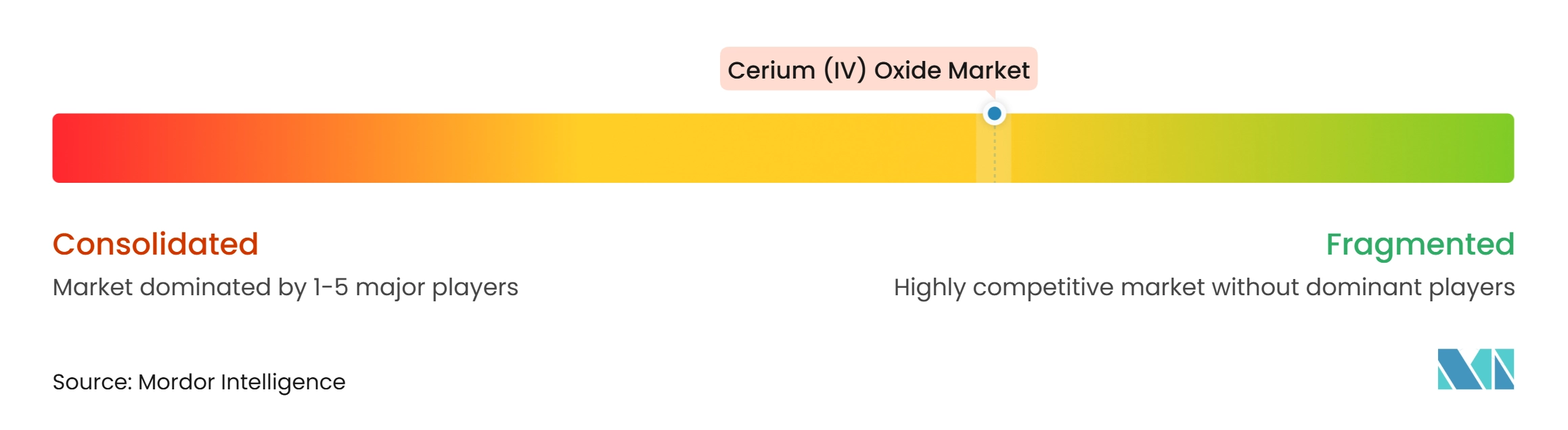
The cerium (IV) oxide market is moderately concentrated, with top players including Solvay, China Northern Rare Earth (Group) High-Tech Co., Ltd., Lynas Rare Earths Ltd., Aluminium Corporation of China, and TREIBACHER INDUSTRIE AG. Chinese state-affiliated producers have integrated mining-to-oxide systems that support cost and throughput advantages. China Northern Rare Earth (Group) High-Tech Co., Ltd., China Rare Earth Resources And Technology Co., Ltd., China Southern Rare Earth Group Co., Ltd., and Ganzhou Rare Earth Group Co., Ltd. operate within this wider Chinese processing structure. The resulting concentration affects the availability of standard oxide products and the speed at which foreign buyers can diversify. China’s dominance in global rare-earth refining remains the central competitive constraint for non-Chinese producers. Competition outside China focuses more on product qualification, technical support, and supply-chain location.
Lynas Rare Earths Ltd. and Solvay are important non-Chinese capacity holders. Lynas adjusted lanthanum and cerium production in FY2025 to prioritize neodymium-praseodymium margins, showing the effect of integrated product economics on its strategy. Solvay’s La Rochelle restart in April 2025 expanded European processing capability. Shenghe Resources Holding Co., Ltd. acquired Peak Rare Earths Limited in September 2025, extending its upstream access and complementing its Leshan polishing-powder project. These moves reflect efforts to secure material supply, expand specialty capacity, and serve buyers seeking different sourcing options. The cerium (IV) oxide market rewards producers that can provide reliable quality records alongside material availability.
TREIBACHER INDUSTRIE AG differentiates with Ceroxid and Auerpol products, ISO 9001 and ISO 14001 certification, and application support for glass, ceramics, catalysts, and nuclear uses. Neo Performance Materials uses its Silmet refinery in Estonia to position supply for European and North American customers. IBU-tec advanced materials AG offers IBUpart CeO₂ powders, as customer demand has shifted toward battery materials. American Elements offers high-purity and nanoparticle formats across a broad catalog. Shandong Desheng Rare Earth Materials Co., Ltd. and Yiyang Hongyuan Rare Earth Co., Ltd. supply cerium oxide products, including high-purity material. Smaller specialists can compete where they consistently meet purity, logistics, and documentation requirements. The competitive field therefore separates bulk oxide suppliers from firms serving demanding CMP, optics, catalyst, and energy-material applications.
Cerium (IV) Oxide Industry Leaders
-
Solvay
-
China Northern Rare Earth (Group) High-Tech Co., Ltd.
-
Lynas Rare Earths Ltd
-
Aluminium Corp
-
TREIBACHER INDUSTRIE AG
- *Disclaimer: Major Players sorted in no particular order
Cerium (IV) Oxide Market Companies Covered in this Report
- Aluminium Corp
- American Elements
- China Northern Rare Earth (Group) High-Tech Co., Ltd.
- China Rare Earth Resources And Technology Co., Ltd.
- China Southern Rare Earth Group Co., Ltd.
- Ganzhou Rare Earth Group Co., Ltd.
- IBU-tec advanced materials AG
- Lynas Rare Earths Ltd
- Nanophase Technologies Corporation
- Neo Performance Materials
- Shandong Desheng Rare Earth Materials Co., Ltd.
- Shenghe Resources Holding Co., Ltd.
- Solvay
- TREIBACHER INDUSTRIE AG
- Yiyang Hongyuan Rare Earth Co., Ltd.
Recent Industry Developments in Cerium (IV) Oxide Market
- August 2026: China Northern Rare Earth (Group) High-Tech Co., Ltd. began stable batch supply of nano-cerium oxide precision-polishing slurry through its subsidiary Tianjiao Qingmei after production-line validation with optical-industry customers. The development advanced downstream use of cerium oxide in precision optical polishing, including applications in automotive optics, machine vision, and electronic components.
- November 2025: The U.S. Department of Energy announced up to USD 275 million in funding for pilot-scale projects to recover critical minerals from coal-based feedstocks, industrial by-products and waste streams, including technologies for mineral separation and recovery. The funding creates opportunities for domestic rare-earth recovery and processing infrastructure, potentially supporting future U.S. cerium oxide production capacity.
Global Cerium (IV) Oxide Market Report Scope
Cerium (IV) oxide, also known as ceria (CeO₂), is an inorganic rare-earth compound valued for its oxygen storage capacity, catalytic activity, thermal stability, and polishing properties. It is widely used in glass and precision optics polishing, automotive catalysts, advanced ceramics, electronic materials, and metallurgical applications. Its ability to switch between oxidation states supports its use in applications requiring oxidation-reduction reactions and oxygen management.
The Cerium (IV) Oxide Market is segmented by grade, particle size, application, and geography. By grade, the market is segmented into technical grade, pharmaceutical grade, high-purity grade, and other grades. By particle size, the market is segmented into micron-sized cerium oxide, sub-micron cerium oxide, and nanoparticle cerium oxide. By application, the market is segmented into glass and ceramic polishing, catalysts, ceramics and electronic ceramics, metal alloying and metallurgy, phosphors, lasers and lighting, and other applications. The report also covers the market size and forecasts for cerium (IV) oxide in 15 countries across major regions. For each segment, the market sizing and forecasts have been done on the basis of value (USD).
Segmentation Overview
| Technical Grade |
| Pharmaceutical Grade |
| High-Purity Grade |
| Other Grades |
| Micron-Sized Cerium Oxide |
| Sub-Micron Cerium Oxide |
| Nanoparticle Cerium Oxide |
| Glass and Ceramic Polishing |
| Catalysts |
| Ceramics and Electronic Ceramics |
| Metal Alloying and Metallurgy |
| Phosphors, Lasers and Lighting |
| Other Applications |
| Asia-Pacific | China |
| India | |
| Japan | |
| South Korea | |
| ASEAN Countries | |
| Rest of Asia-Pacific | |
| North America | United States |
| Canada | |
| Mexico | |
| Europe | Germany |
| United Kingdom | |
| France | |
| Italy | |
| NORDIC Countries | |
| Rest of Europe | |
| South America | Brazil |
| Argentina | |
| Rest of South America | |
| Middle East and Africa | Saudi Arabia |
| South Africa | |
| Rest of Middle East and Africa |
| By Grade | Technical Grade | |
| Pharmaceutical Grade | ||
| High-Purity Grade | ||
| Other Grades | ||
| By Particle Size | Micron-Sized Cerium Oxide | |
| Sub-Micron Cerium Oxide | ||
| Nanoparticle Cerium Oxide | ||
| By Application | Glass and Ceramic Polishing | |
| Catalysts | ||
| Ceramics and Electronic Ceramics | ||
| Metal Alloying and Metallurgy | ||
| Phosphors, Lasers and Lighting | ||
| Other Applications | ||
| By Geography | Asia-Pacific | China |
| India | ||
| Japan | ||
| South Korea | ||
| ASEAN Countries | ||
| Rest of Asia-Pacific | ||
| North America | United States | |
| Canada | ||
| Mexico | ||
| Europe | Germany | |
| United Kingdom | ||
| France | ||
| Italy | ||
| NORDIC Countries | ||
| Rest of Europe | ||
| South America | Brazil | |
| Argentina | ||
| Rest of South America | ||
| Middle East and Africa | Saudi Arabia | |
| South Africa | ||
| Rest of Middle East and Africa | ||
Key Questions Answered in the Report
What is the size of the cerium (IV) oxide market?
The cerium (IV) oxide market size was valued at USD 1.26 billion in 2026 and is estimated to grow from USD 1.35 billion in 2027 to reach USD 1.91 billion by 2032, at a CAGR of 7.13% during the forecast period (2027-2032).
What is driving demand for cerium (IV) oxide?
Tighter vehicle-emission rules, semiconductor CMP requirements, display and optical polishing, and advanced ceramics support demand.
Which grade held the largest share in 2026?
Technical grade held 72.11% of the cerium (IV) oxide market share in 2026, supported by polishing, catalysts, and industrial glass uses.
Which application is projected to grow fastest through 2032?
Ceramics and electronic ceramics are projected to advance at an 8.45% CAGR through 2032, supported by fuel cells, electrolysis, and electronic components.