
Ceramic Opacifier Market Size and Share
Market Overview
| Study Period | 2021 - 2031 |
|---|---|
| Market Size (2026) | USD 1.93 Billion |
| Market Size (2031) | USD 2.44 Billion |
| Growth Rate (2026 - 2031) | 4.84 % |
| Fastest Growing Market | Asia-Pacific |
| Largest Market | Asia-Pacific |
| Market Concentration | Low |
Major Players *Disclaimer: Major Players sorted in no particular order Image © Mordor Intelligence. Reuse requires attribution under CC BY 4.0. | |
Ceramic Opacifier Market Analysis by Mordor Intelligence
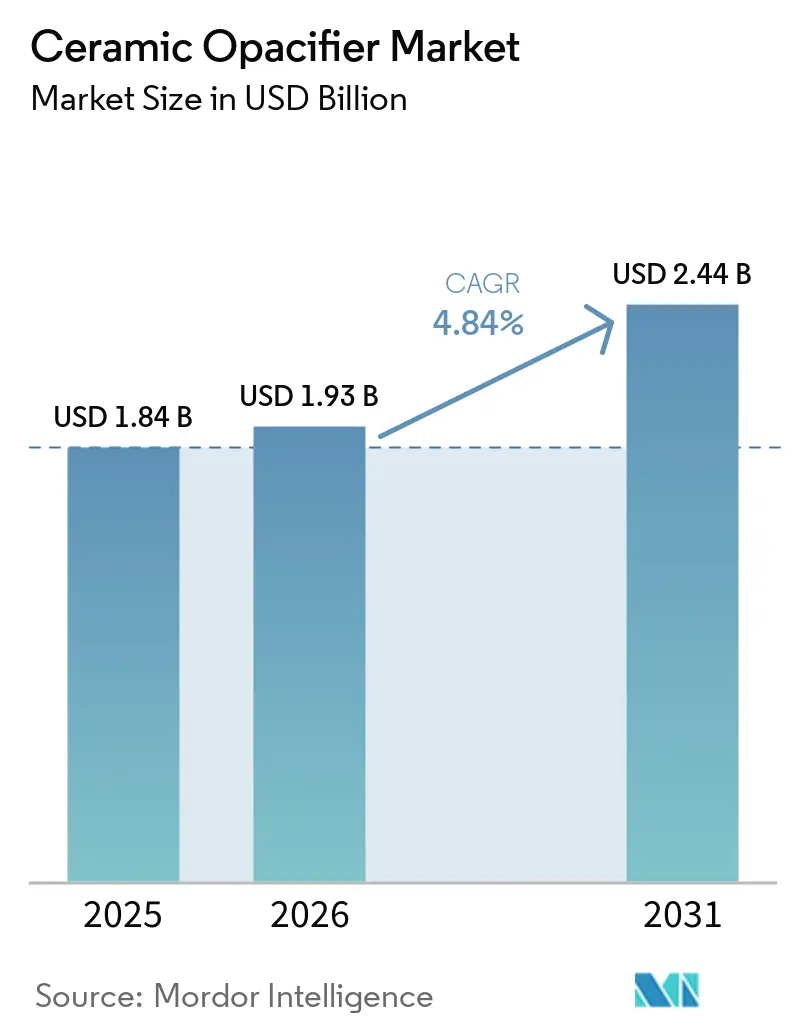
The Ceramic Opacifier Market size was valued at USD 1.84 billion in 2025 and is estimated to grow from USD 1.93 billion in 2026 to reach USD 2.44 billion by 2031, at a CAGR of 4.84% during the forecast period (2026-2031). Ceramic tile output is expanding across developing Asian manufacturing centers, while advanced surface decoration is raising requirements for whiteness and particle consistency. Digital glaze systems require more tightly controlled opacifier inputs than conventional production lines. Technical ceramic components are also supporting demand for grades with high purity and stable performance. Competition is increasingly shaped by access to zircon feedstocks, milling capability, and the ability to meet premium specifications. The ceramic opacifier market, therefore, offers opportunities for suppliers that can provide consistent materials close to growing tile and sanitaryware production hubs.
Key Report Takeaways
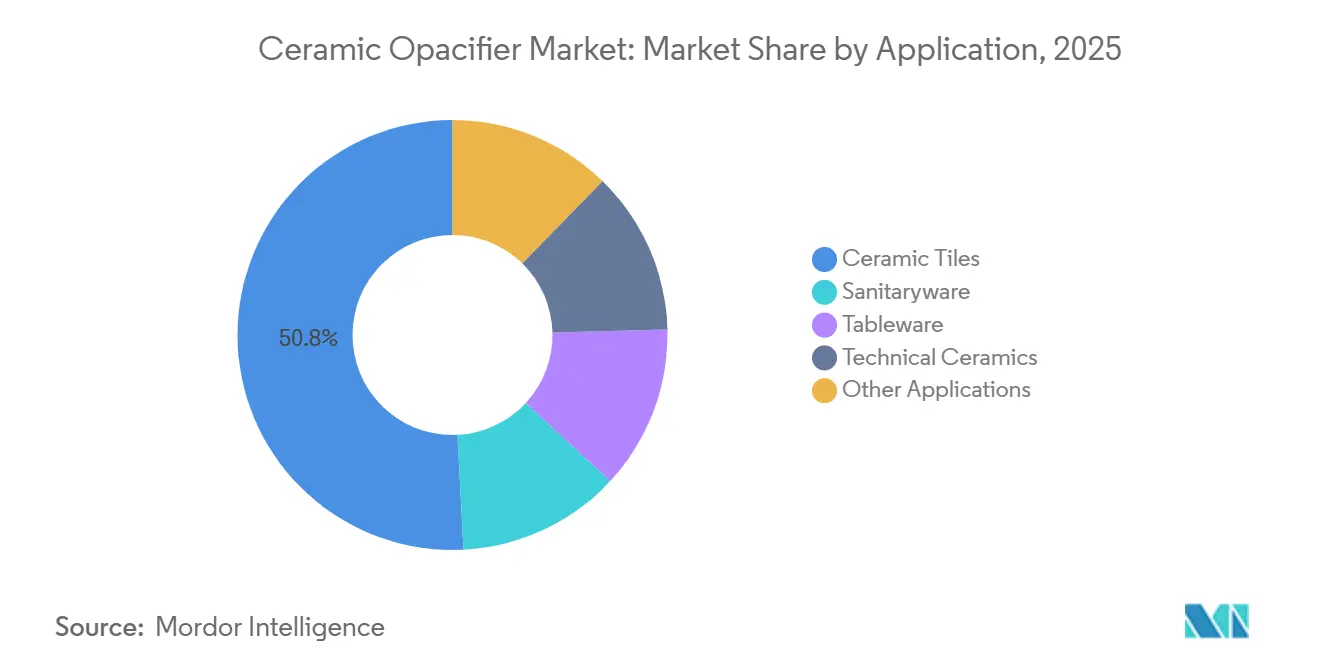
- By product type, zirconium silicate opacifiers held 66.13% of the ceramic opacifier market share in 2025, while zirconium dioxide opacifiers are projected to advance at a 5.45% CAGR through 2031.
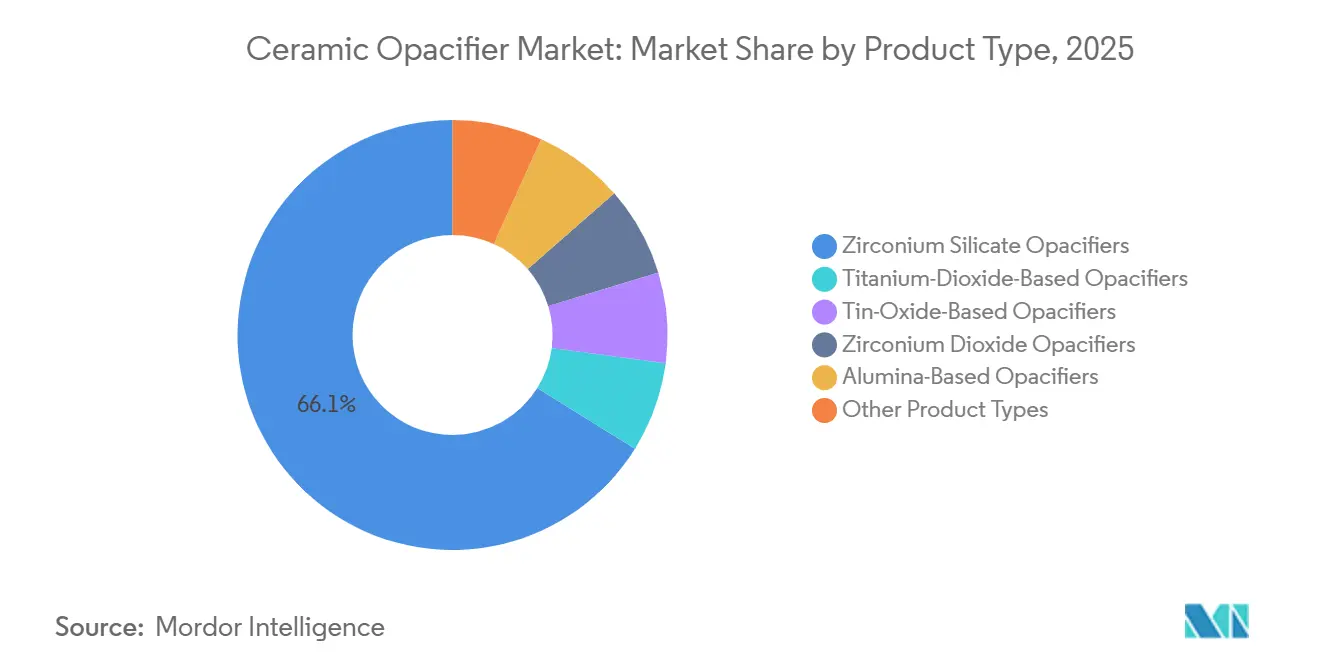
- By application, ceramic tiles held 50.81% of the ceramic opacifier market share in 2025, while technical ceramics are projected to advance at a 5.81% CAGR through 2031.
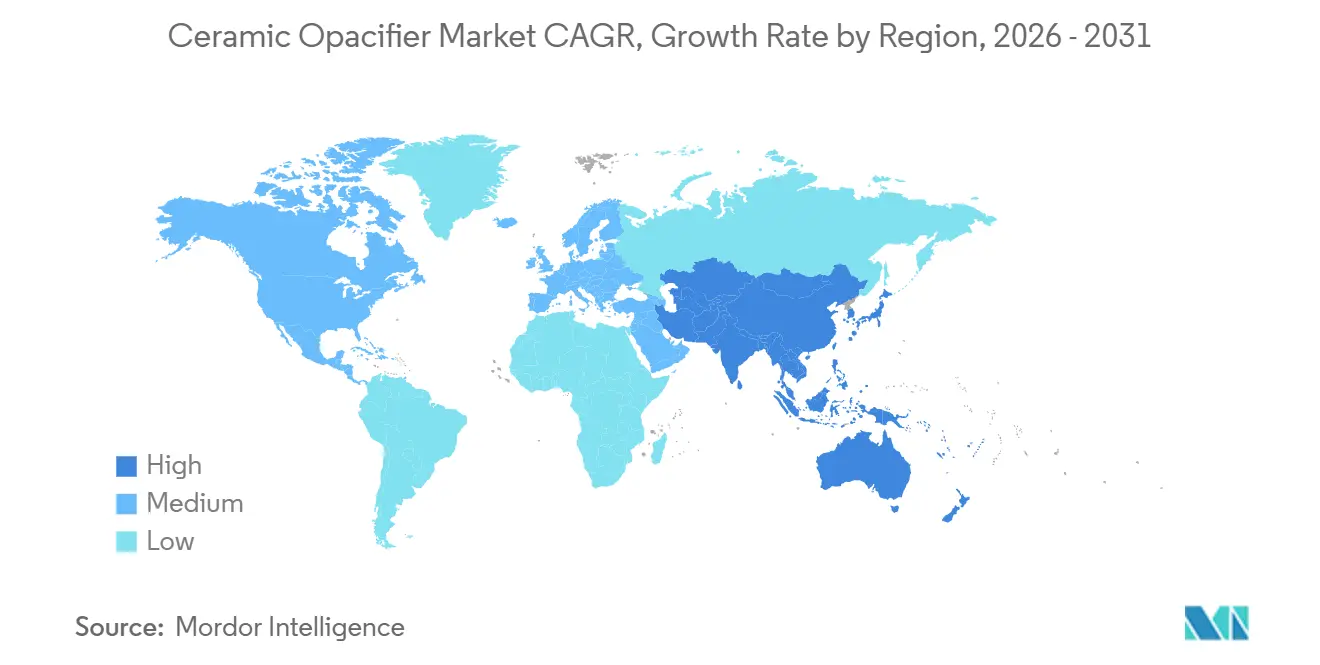
- By geography, Asia-Pacific held 47.97% of the ceramic opacifier market share in 2025 and is projected to advance at a 5.77% CAGR through 2031.
Note: Market size and forecast figures in this report are generated using Mordor Intelligence’s proprietary estimation framework, updated with the latest available data and insights as of January 2026.
Global Ceramic Opacifier Market Trends and Insights
Drivers Impact Analysis*
| Driver | (~) % Impact on CAGR Forecast | Geographic Relevance | Impact Timeline |
|---|---|---|---|
| Expansion of Ceramic Tile and Sanitaryware Production | +1.5% | Global, led by India, Vietnam, Indonesia, and China | Medium term (2-4 years) |
| Growth in Premium White and High-Gloss Ceramic Surfaces | +1.2% | APAC core, spillover to Europe and North America | Medium term (2-4 years) |
| Rising Adoption of Digital Tile Printing | +0.9% | Global; strongest in Italy, Spain, China, and Indonesia | Short term (≤ 2 years) |
| Demand for Advanced Technical Ceramic Components | +0.6% | East Asia, North America, and Europe | Long term (≥ 4 years) |
| Submicron Particle Engineering for Lower Opacifier Dosage | +0.4% | Global; early gains in Guangdong, Fujian, and Morbi clusters | Long term (≥ 4 years) |
| Source: Mordor Intelligence | |||
Expansion of Ceramic Tile and Sanitaryware Production
Global tile production totaled 15.9 billion square meters in 2023 and is forecast to exceed 17.8 billion square meters by 2028. India is forecast to add more than 800 million square meters of output over 5 years, against projected domestic demand growth of 778 million square meters. New production lines create recurring demand for zirconium silicate and alumina-based opacifiers in glaze batches. Opacifier loading typically ranges from 8% to 12% by weight in these batches. SCGD allocated THB 2.5 billion (approximately USD 74 million) in investment for 2026 and focused on adding 6.6 million square meters of glazed porcelain tile capacity in Vietnam[1]SCGD, “SCGD Unveils Its 2026 Business Plan, Accelerating Expansion in Vietnam and ASEAN,” SCGD News Channel, scgnewschannel.com. The move toward larger 60 cm×120 cm tiles also requires more uniform opacity across a wider surface, which raises the need for controlled glaze formulations.
Growth in Premium White and High-Gloss Ceramic Surfaces
Premium sanitaryware is increasing the importance of stable whiteness and surface gloss in glaze formulations. Ultra-white ceramic bodies require close control of iron content because iron can reduce whiteness after firing. High-purity zirconium silicate grades with more than 65% zirconium dioxide can reduce total dosage by 20% compared with standard grades while maintaining L* values of at least 90. These grades can command a 30% to 50% price premium because they support tighter visual specifications. Premium white and high-gloss ceramic surfaces are creating a greater revenue pull than standard tile volumes where higher-grade formulations are used. Submicron particle engineering also helps producers lower dosage per unit area while maintaining opacity, if they can sustain product consistency at industrial throughput.
Rising Adoption of Digital Tile Printing
Digital processes decorated 75% of ceramic tiles globally in 2025, according to Xaar. Digital systems allow design changes, shorter runs, and more complex natural-material effects than screen-based workflows. These systems require fine formulations with narrow particle-size distributions to protect printhead performance and support stable jetting. D50 particle sizes below 3 to 5 μm are important for digital glaze applications. This requirement limits the suitability of broad-distribution commodity zirconium silicate in advanced lines. The ceramic opacifier market is consequently shifting toward micronized and surface-treated grades that work with varied glaze systems and firing profiles.
Demand for Advanced Technical Ceramic Components
Multi-layer ceramic capacitors, ceramic substrates for power electronics, and solid oxide fuel cells require materials that combine thermal resistance, electrical insulation, and controlled optical performance. Electronics miniaturization, electric vehicle powertrain components, 5G infrastructure, and semiconductor equipment are supporting this requirement. Zirconium dioxide opacifiers meet tighter purity and particle-size needs than standard zirconium silicate in several advanced applications. Tosoh Corporation has maintained investment in high-purity zirconia powder development for advanced ceramic uses. These applications support a pricing difference between electronics-grade and standard tile-grade materials. The ceramic opacifier market benefits where suppliers can meet the impurity and distribution requirements of power electronics, battery thermal management, and solid oxide electrolyzer components.
Restraints Impact Analysis*
| Restraint | (~) % Impact on CAGR Forecast | Geographic Relevance | Impact Timeline |
|---|---|---|---|
| Zircon Sand Price Volatility | -1.1% | Global; sourced primarily from Australia and South Africa | Short term (≤ 2 years) |
| Substitution by Titanium Dioxide and Tin Oxide | -0.8% | Global; more pronounced in low-cost Asian production centers | Medium term (2-4 years) |
| High-Temperature Milling and Calcination Capacity Constraints | -0.5% | Primarily outside China; Europe and North America most exposed | Medium term (2-4 years) |
| Source: Mordor Intelligence | |||
Zircon Sand Price Volatility
Zircon supply conditions are limiting visibility for independent processors in the ceramic opacifier market. ILUKA RESOURCES LIMITED suspended production at its SR2 processing facility and Cataby mine in Western Australia and set 2026 zircon production guidance at 180,000 metric tons. The guidance was lower than the more than 270,000 metric tons produced in 2025. ILUKA RESOURCES LIMITED reported an average realized zircon price of USD 1,615 per metric ton in the September 2025 quarter[2]Iluka Resources Limited, “September 2025 Quarter Activities Report,” Iluka Resources, iluka.com. Capacity constraints in high-temperature milling and calcination can extend lead times for premium grades, particularly outside China. Processors with secured supply contracts or upstream integration are better placed to manage these disruptions, while independent suppliers can face margin pressure.
Substitution by Titanium Dioxide and Tin Oxide
Titanium dioxide and tin oxide remain alternatives to zirconium silicate in selected ceramic formulations. Titanium dioxide can provide opacity at 6% to 8% loading, while tin oxide can provide it at 3% to 5% loading, compared with 10% to 15% for full-white zirconium silicate formulations. Titanium dioxide can create inconsistent matte surfaces at higher loadings, which limits its use in high-gloss porcelain and sanitaryware. Tin oxide remains costly for broad use and is more relevant to niche tableware and art-glaze applications. Integrated titanium dioxide producers can still compete in cost-sensitive residential tile segments, especially in Southeast Asia. These alternatives constrain pricing where performance requirements are less demanding, but they do not fully replace zircon-based grades in premium applications.
*Our forecasts treat driver/restraint impacts as directional, not additive. The impact forecasts reflect baseline growth, mix effects, and variable interactions.
Segment Analysis
By Product Type: Zirconium Silicate Opacifiers Lead While Zirconium Dioxide Opacifiers Gain Use in Premium Applications
Zirconium silicate opacifiers held 66.13% of the ceramic opacifier market revenue in 2025. Their position reflected broad use in ceramic tiles, sanitaryware, tableware, and engobe applications. Fine-grade zirconium silicate with a D50 particle size of 1.2 μm can deliver comparable whiteness with 50% to 70% lower loading by weight than alumina-based alternatives. Grades containing more than 65% zirconium dioxide can lower total dosage by 20% against standard grades while maintaining L* values of at least 90. The product remains suitable for standard tile and sanitaryware glaze systems because it combines opacity with thermal stability. The ceramic opacifier industry relies on these materials for conventional high-volume glaze applications because they balance thermal stability, performance, and formulation economics. Alumina-based opacifiers remain relevant in cost-sensitive porcelain body whitening applications. Tin-oxide-based opacifiers are used in specialty food-contact and art ceramics where warm-tone whiteness has value.
Zirconium dioxide opacifiers are projected to advance at a 5.45% CAGR through 2031. Their growth is linked to electronics and advanced ceramics that need high purity, narrow particle distributions, and controlled optical behavior. Their superior opacity per unit dosage is relevant where standard zirconium silicate cannot meet the required tolerances. Standard zirconia powders with 95% to 97% zirconium dioxide purity were priced between USD 2.5 and USD 5.5 per kilogram. Premium materials for electronic ceramics and high-brightness optical coatings carried 30% to 50% premiums. Tosoh Corporation and Treibacher Industrie AG have focused on high-purity materials for these higher-value uses. Titanium-dioxide-based opacifiers retain a role in low-cost tile and enamel coatings where crystallization-based opacity is acceptable. Across product types, buyers are moving toward finer particle sizes and higher chemical purity to meet digital inkjet and advanced ceramic requirements.



By Application: Ceramic Tiles Lead While Technical Ceramics Support Higher-Value Demand
Ceramic tiles held 50.81% of the ceramic opacifier market size in 2025. The segment is supported by the scale of tile production and consistent opacifier use in glaze batches. Loading generally ranges from 8% to 20% by weight, depending on the glaze system and whiteness target. Producers must adjust loading to the desired whiteness, surface finish, and firing profile. Larger 60 cm×120 cm formats require close control of opacity because visual variation is easier to detect on broad surfaces. Uniformity is especially important in premium collections where a mismatch can affect product acceptance. Digital inkjet deposition further requires inputs with narrow particle-size distributions, including D50 values below 3 to 5 μm. This raises procurement standards among tile producers in Western Europe, China, and India. Tableware and other applications provide a stable demand from food-contact ceramics and refractory uses.
Technical ceramics are projected to advance at a 5.81% CAGR through 2031. Electric vehicle powertrain components, power electronic substrates, battery management system housings, and solid oxide fuel cells require zirconia-based materials with low contamination levels. These applications need a combination of thermal resistance, electrical insulation, and controlled optical behavior. The segment also requires particle-size distributions below 5 μm for selected applications. International Electrotechnical Commission standard IEC 62368-1 and International Organization for Standardization standard ISO 13356 establish relevant material requirements in electronics and surgical zirconia applications. European Union Registration, Evaluation, Authorisation and Restriction of Chemicals (REACH) and Restriction of Hazardous Substances rules also limit the use of restricted substances in ceramic inputs. Sanitaryware is benefiting from residential construction in Asia, the Middle East, and Africa, where whiteness and gloss are important purchase considerations. The ceramic opacifier market has a higher-value opportunity in applications that require more rigorous material consistency than standard glaze production. This demand favors materials that can maintain purity and consistent particle characteristics.
Geography Analysis
Asia-Pacific held 47.97% of the ceramic opacifier market size in 2025 and is projected to advance at a 5.77% CAGR through 2031. China remains the main regional demand center because of its concentrated tile and sanitaryware manufacturing base. Its domestic mineral processing capacity and zircon sand imports support this production base. India, Vietnam, Indonesia, and Thailand are expanding manufacturing capacity and increasing demand for processed zircon materials. Kajaria Ceramics confirmed plans to raise its tile capacity from 82.70 million square meters to 104 to 105 million square meters by mid-2027, backed by an INR 385 crore investment (approximately USD 46 million). The new lines at Gailpur and Srikalahasti are designed for 35,000 to 37,000 square meters per day, compared with 15,000 to 17,000 square meters previously. These investments are focused on 60 cm×120 cm formats, which require consistent glaze coverage. The ceramic opacifier market benefits as these lines require dependable access to suitable micronized materials.
Vietnam is becoming an important demand center as producers add glazed porcelain capacity. SCGD’s 2026 program targets 6.6 million square meters of additional capacity in the country. The investment responds to demand, moving from conventional tiles toward higher-quality products. Imported opacifier grades remain important in parts of Southeast Asia, which supports local supply opportunities. This dependence creates scope for processors that can provide stable grades closer to regional tile plants. South Korea and Japan add high-value demand through semiconductor and electronics applications. Europe remains an important ceramic opacifier market because Italy, Spain, and Germany have premium tile, sanitaryware, and advanced ceramics production. Italian glaze and frit producers and Spanish exporters depend on controlled zirconium silicate and zirconia grades for whiteness, gloss, and glaze consistency. Wienerberger signed an agreement to acquire Italcer Group in February 2026, extending its position in high-end ceramic solutions produced in Italy and Spain. Italcer generated 75% of its revenue internationally, which gives the combined business broader access to export-oriented premium ceramics. The ceramic opacifier market is supported in Europe by demand for materials that meet precise surface and consistency requirements.
North American demand is shaped by renovation activity and precision ceramics used in defense, semiconductor, and electric vehicle applications. These uses favor high-purity grades that can command price premiums. The region’s industrial demand is therefore more exposed to performance specifications than to conventional tile volumes. South America and the Middle East and Africa are smaller corridors with different demand drivers. Brazil exported 24.1 million square meters of ceramic tiles in the third quarter of 2025, up 5.1% from the same period in 2024, while domestic sales reached 197.3 million square meters. Its principal opacifier-grade suppliers included Mexico, Germany, the United Kingdom, China, and Slovakia. Brazil’s growing tile export capability is increasing import demand for opacifier grades. Saudi Arabia’s construction pipeline and Gulf Cooperation Council hospitality investment are supporting tile and sanitaryware consumption. South Africa remains important to the zircon supply chain through Rio Tinto’s Richards Bay Minerals operations. Emerging producers such as Uzbekistan are creating additional demand nodes for processed grades. These varied conditions give the ceramic opacifier market multiple demand channels outside its largest regions.

Competitive Landscape
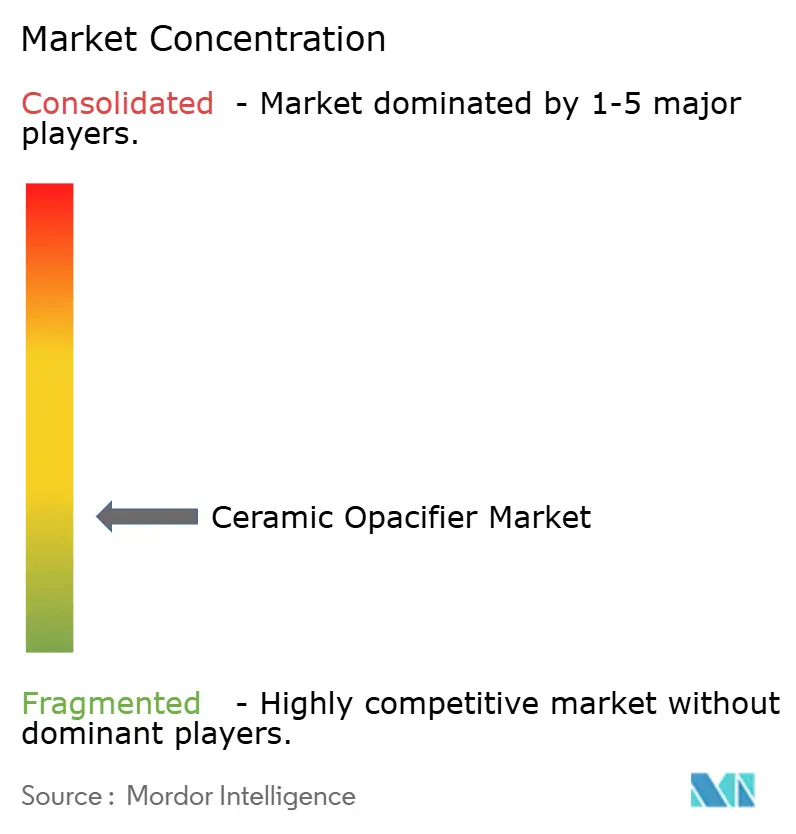
The ceramic opacifier market is highly fragmented, with the top five players including Imerys, Sibelco, ILUKA RESOURCES LIMITED, Tronox Holdings Plc, and Rio Tinto. Their product portfolios serve customers who value uniform material behavior and documented quality. The same requirements are important when ceramic manufacturers operate digital glaze systems or produce large-format surfaces. Premium producers must maintain stable whiteness across larger ceramic surfaces. They also need materials that remain consistent across varied glaze compositions. This requirement can increase the importance of precise milling and classification processes. It can also favor established suppliers with experience in demanding ceramic formulations. Chinese producers, including Guangdong Orient Zirconic Ind Sci & Tech Co., Ltd. and Shandong Golden Sun Zirconium Industry Co., Ltd., compete through volume, scale, and proximity to the largest ceramic consumer base. Suppliers without upstream access must manage exposure through contracts, inventory discipline, or other supply arrangements. Long-term supply agreements can provide greater stability during periods of tightening availability.
Producers of standard grades compete mainly on delivered cost and reliable supply to tile and sanitaryware manufacturers. Their customers require products that can be used consistently in established glaze recipes. Higher-value competition centers on narrow particle distributions, surface treatment, and purity certification for electronics, ceramics, and premium sanitaryware. These capabilities allow suppliers to address applications where standard materials are not sufficient. The performance gap is most visible where customers need defect-free optical results and tight impurity control. These customers also require suppliers to maintain consistent results across repeated production runs. Sibelco completed its acquisition of Zircon Minerals in June 2025, which expanded its zircon raw material portfolio. This move improved its access to feedstock while zircon availability was tightening. The ceramic opacifier market also rewards processors that can align technical specifications with reliable supply. Independent processors are more exposed when feedstock costs rise or premium capacity is limited. Their competitive position can change when material availability becomes less predictable. The ceramic opacifier industry, therefore, favors established processors that can combine regulatory capability, consistent feedstock access, and precision milling capacity.
Ceramic Opacifier Industry Leaders
Imerys
Sibelco
ILUKA RESOURCES LIMITED
Tronox Holdings Plc
Rio Tinto
- *Disclaimer: Major Players sorted in no particular order

Recent Industry Developments
- August 2026: Kajaria Ceramics confirmed plans to increase its tile production capacity from 82.70 million square meters to approximately 104–105 million square meters by May–July 2027, primarily to serve demand for large-format tiles. The capacity expansion supports higher consumption of ceramic opacifiers used in glazed and vitrified tile formulations to achieve whiteness, opacity, and surface quality.
- January 2026: Tronox Holdings Plc announced the permanent closure of its 46,000-metric-ton-per-year titanium dioxide pigment plant in Fuzhou, China, citing weak domestic demand, high sulfur costs, and excess Chinese titanium dioxide capacity. The reduction in titanium dioxide pigment capacity may influence the supply landscape for titanium-dioxide-based ceramic opacifiers, which are used to provide opacity and whiteness in ceramic glazes.


Global Ceramic Opacifier Market Report Scope
Ceramic opacifiers are materials added to ceramic formulations to reduce transparency and produce a white, opaque, or light-diffusing appearance. They improve the visual characteristics and surface finish of ceramic products while supporting consistent coloration and coverage.
The Ceramic Opacifier Market is segmented by product type, application, and geography. By product type, the market is segmented into zirconium silicate opacifiers, zirconium dioxide opacifiers, alumina-based opacifiers, titanium-dioxide-based opacifiers, tin-oxide-based opacifiers, and other product types. By application, the market is segmented into ceramic tiles, sanitaryware, tableware, technical ceramics, and other applications. The report also covers the market size and forecasts for ceramic opacifiers in 15 countries across major regions. For each segment, the market sizing and forecasts have been done on the basis of value (USD).
| Zirconium Silicate Opacifiers |
| Zirconium Dioxide Opacifiers |
| Alumina-Based Opacifiers |
| Titanium-Dioxide-Based Opacifiers |
| Tin-Oxide-Based Opacifiers |
| Other Product Types |
| Ceramic Tiles |
| Sanitaryware |
| Tableware |
| Technical Ceramics |
| Other Applications |
| Asia-Pacific | China |
| India | |
| Japan | |
| South Korea | |
| ASEAN Countries | |
| Rest of Asia-Pacific | |
| North America | United States |
| Canada | |
| Mexico | |
| Europe | Germany |
| United Kingdom | |
| France | |
| Italy | |
| NORDIC Countries | |
| Rest of Europe | |
| South America | Brazil |
| Argentina | |
| Rest of South America | |
| Middle East and Africa | Saudi Arabia |
| South Africa | |
| Rest of Middle East and Africa |
| By Product Type | Zirconium Silicate Opacifiers | |
| Zirconium Dioxide Opacifiers | ||
| Alumina-Based Opacifiers | ||
| Titanium-Dioxide-Based Opacifiers | ||
| Tin-Oxide-Based Opacifiers | ||
| Other Product Types | ||
| By Application | Ceramic Tiles | |
| Sanitaryware | ||
| Tableware | ||
| Technical Ceramics | ||
| Other Applications | ||
| By Geography | Asia-Pacific | China |
| India | ||
| Japan | ||
| South Korea | ||
| ASEAN Countries | ||
| Rest of Asia-Pacific | ||
| North America | United States | |
| Canada | ||
| Mexico | ||
| Europe | Germany | |
| United Kingdom | ||
| France | ||
| Italy | ||
| NORDIC Countries | ||
| Rest of Europe | ||
| South America | Brazil | |
| Argentina | ||
| Rest of South America | ||
| Middle East and Africa | Saudi Arabia | |
| South Africa | ||
| Rest of Middle East and Africa | ||


Key Questions Answered in the Report
What is the size of the ceramic opacifier market?
The ceramic opacifier market stands at USD 1.93 billion in 2026 and is projected to reach USD 2.44 billion by 2031.
What is driving demand for ceramic opacifiers?
Tile and sanitaryware capacity expansion, premium white finishes, digital decoration, and technical ceramics are supporting demand.
Which product type led the revenue share in 2025?
Zirconium silicate opacifiers led with a 66.13% revenue share in 2025 because of their broad use in tile and sanitaryware glazes.
Which application is expected to grow fastest through 2031?
Technical ceramics are projected to advance at a 5.81% CAGR through 2031, supported by electronics and electric vehicle component needs.
Page last updated on:





