
Ceramic Armor Materials Market Size and Share
Market Overview
| Study Period | 2021 - 2031 |
|---|---|
| Market Size (2026) | USD 3.35 Billion |
| Market Size (2031) | USD 4.82 Billion |
| Growth Rate (2026 - 2031) | 7.58 % |
| Fastest Growing Market | Asia-Pacific |
| Largest Market | North America |
| Market Concentration | Low |
Major Players *Disclaimer: Major Players sorted in no particular order Image © Mordor Intelligence. Reuse requires attribution under CC BY 4.0. | |
Ceramic Armor Materials Market Analysis by Mordor Intelligence
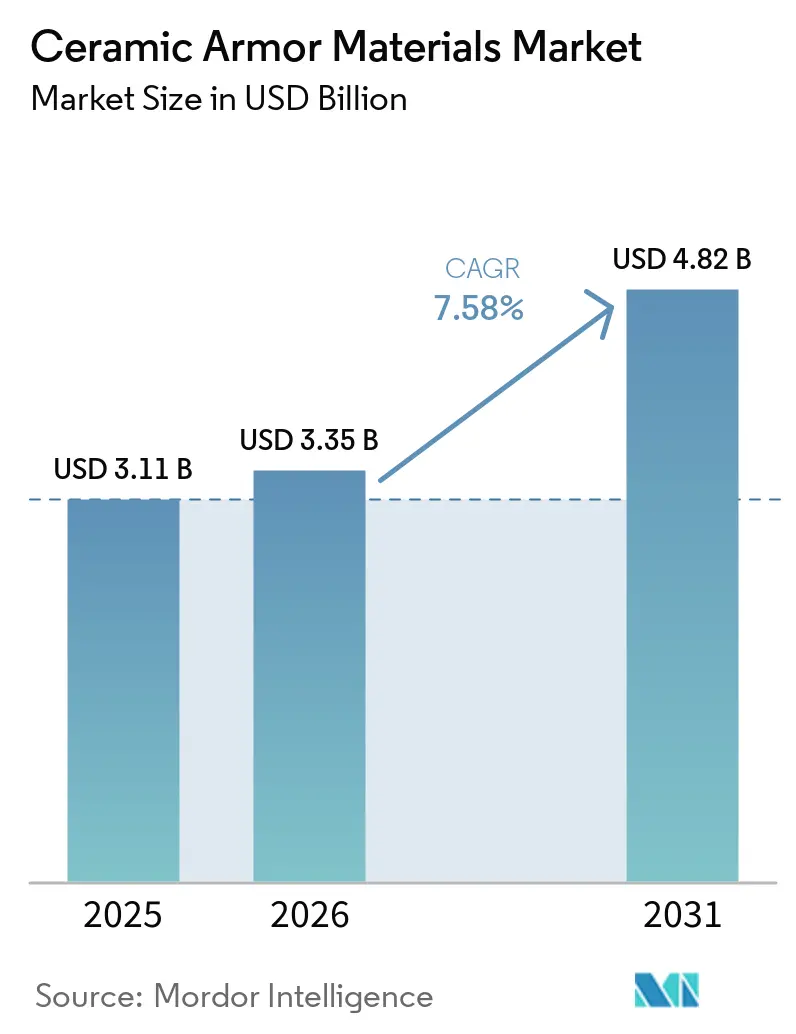
The Ceramic Armor Materials Market size was valued at USD 3.11 billion in 2025 and is estimated to grow from USD 3.35 billion in 2026 to reach USD 4.82 billion by 2031, at a CAGR of 7.58% during the forecast period (2026-2031). Rising defense budgets are supporting the procurement of systems that protect personnel, vehicles, and aircraft. Global military expenditure reached USD 2.887 trillion in 2025, while European and Asian spending increased strongly, which supported longer procurement cycles for protective equipment. The ceramic armor materials market is also being shaped by contracts that place greater importance on lower weight, multi-hit performance, and armor-piercing protection. These requirements favor suppliers that can produce high-density materials and complete certified armor panels. The ceramic armor materials market faces constraints from costly processing, limited production capacity, brittle fracture, and differing test requirements across countries.
Key Report Takeaways
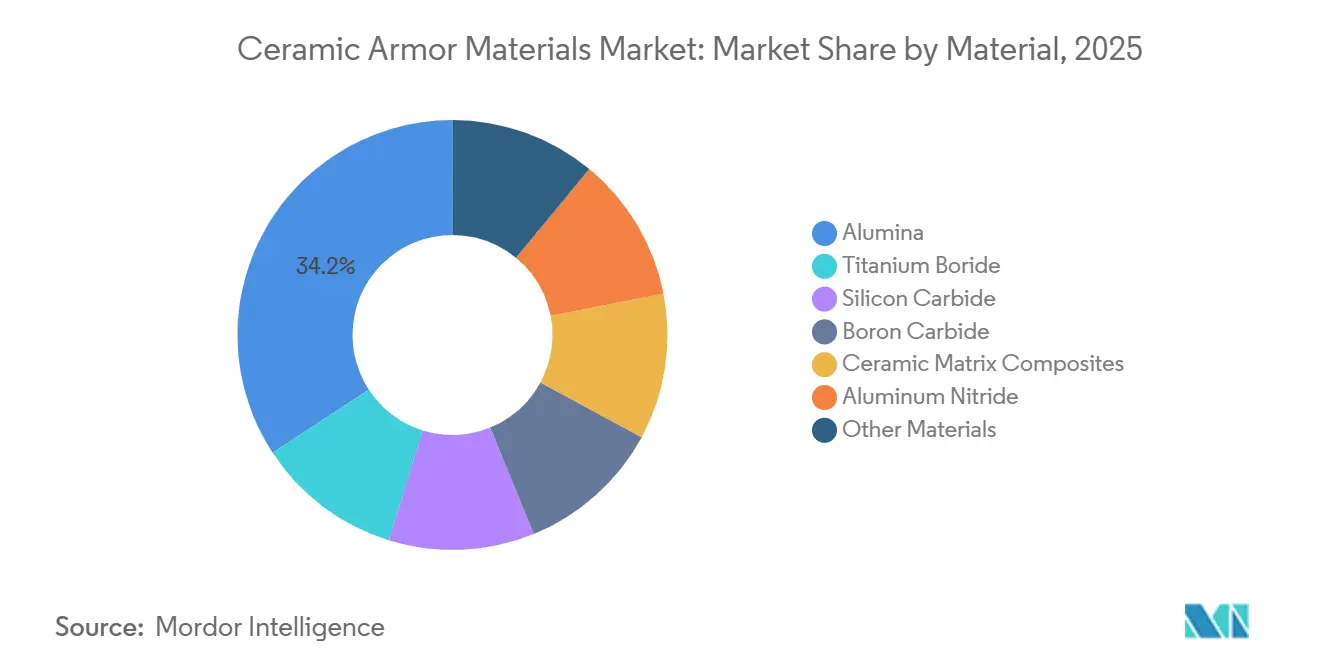
- By material, alumina held 34.23% of the ceramic armor materials market share in 2025, while silicon carbide is projected to advance at an 8.43% CAGR through 2031.
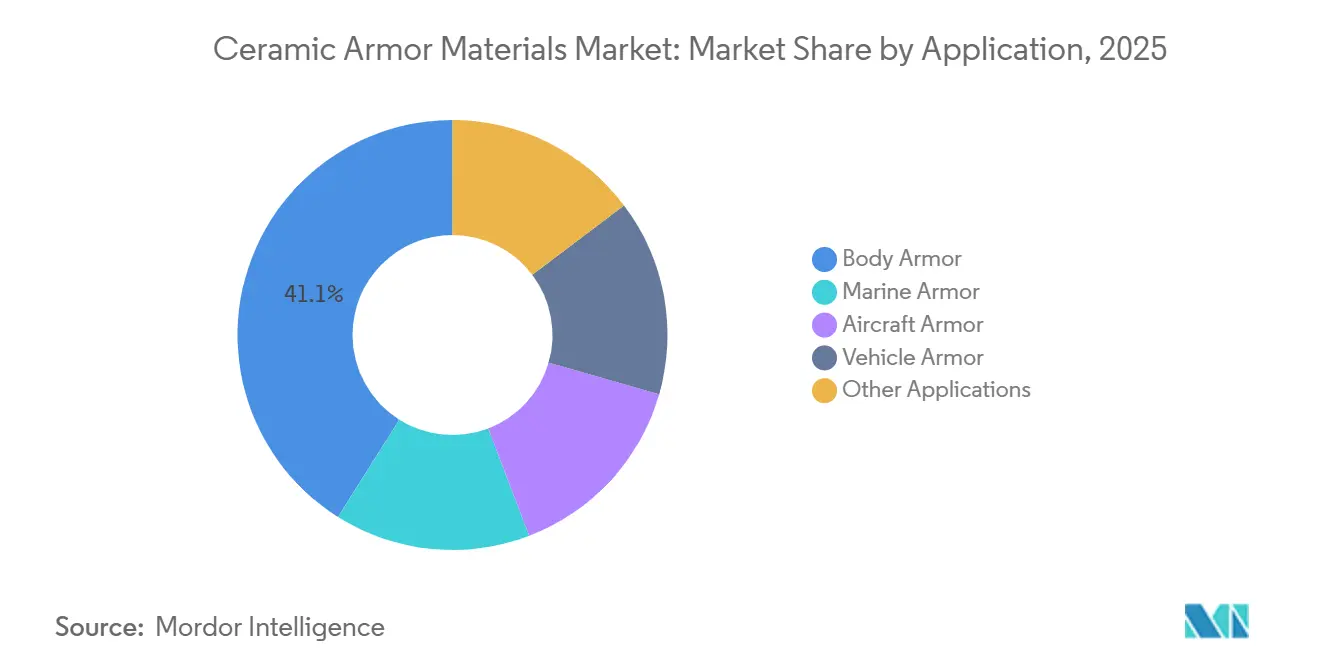
- By application, body armor held 41.06% of the ceramic armor materials market share in 2025 and is projected to advance at an 8.75% CAGR through 2031.
- By geography, North America held 30.57% of the ceramic armor materials market share in 2025, while Asia-Pacific is projected to advance at an 8.66% CAGR through 2031.
Note: Market size and forecast figures in this report are generated using Mordor Intelligence’s proprietary estimation framework, updated with the latest available data and insights as of January 2026.
Global Ceramic Armor Materials Market Trends and Insights
Drivers Impact Analysis*
| Driver | (~) % Impact on CAGR Forecast | Geographic Relevance | Impact Timeline |
|---|---|---|---|
| Defense Modernization and Platform Survivability Requirements | +2.5% | Global, with concentrated near-term gains in North America and Europe | Short term (≤ 2 years) |
| Demand for Lightweight Protection and Soldier Mobility | +2.1% | Global, with accelerating adoption in APAC and Middle East | Medium term (2-4 years) |
| Rising Asymmetric Warfare, Terrorism, and Cross-Border Threats | +1.8% | APAC, Eastern Europe, and MEA; spillover to global procurement | Short term (≤ 2 years) |
| Multi-Hit and Armor-Piercing Protection Requirements | +1.4% | North America and Europe; standard compliance driven | Medium term (2-4 years) |
| Indigenous Defense Manufacturing and Local Content Programs | +1.0% | India, South Korea, Türkiye, South Africa | Long term (≥ 4 years) |
| Source: Mordor Intelligence | |||
Defense Modernization and Platform Survivability Requirements
NATO (the North Atlantic Treaty Organization) members committed to a new defense investment plan in 2025, placing added attention on capabilities that strengthen deterrence and defense[1]North Atlantic Treaty Organization, “Defence Expenditures and NATO’s 5% Commitment,” NATO, nato.int. The plan created a firmer basis for multi-year spending on soldier protection and armored platforms. Germany's military expenditure rose 24% to USD 114 billion in 2025, which marked its first year above 2% of gross domestic product since 1990. The ceramic armor materials market benefits when fleet upgrades seek both improved protection and lower vehicle weight. Standardization Agreement (STANAG) 4569 requirements are drawing attention on materials that can meet higher protection levels without relying solely on rolled homogeneous armor. This direction creates opportunities for producers that have qualified products for vehicle-mounted, personal, and aerospace applications.
Demand for Lightweight Protection and Soldier Mobility
The ceramic armor materials market is gaining support from procurement programs that treat weight as a contract qualification requirement. The United States Army awarded USD 65.5 million for 72,179 Lightweight Small Arms Protective Inserts in September 2025, and the plates were 30% lighter than earlier systems. Silicon carbide has a density of 3.0 to 3.2 grams per cubic centimeter, compared with steel at 7.8 grams per cubic centimeter, supporting lower armor weight where the design allows it[2]E. Cano-Morales et al., “Silicon Carbide Ceramics for Armor Applications: A Review of Sintering Methods and Additive Systems,” Molecules, pmc.ncbi.nlm.nih.gov. A 2026 review reported that spark plasma-sintered silicon carbide can exceed 99% of theoretical density and reach a hardness of 35 gigapascals. The same review described the link between silicon carbide processing, density, hardness, and ballistic performance. The ceramic armor materials market, therefore, has a clear opening in programs that seek lighter equipment without reducing ballistic protection.
Rising Asymmetric Warfare, Terrorism, and Cross-Border Threats
Modern conflict is broadening demand beyond standard torso plates toward modular protection that covers more areas of the body. Ukraine's Ministry of Defence reported in 2025 that more than 90% of battlefield wounds came from shrapnel and fragmentation rather than direct fire. This pattern encourages requirements for armor systems that protect the forearms, shins, and other exposed areas. Taiwan signed a contract for 160,000 ceramic body armor plates in February 2025. Taiwan also announced the procurement of 48,000 boron carbide plates for armor-piercing threats in August 2025. The ceramic armor materials market must serve both baseline protection needs and higher-threat requirements, which leads buyers to use different materials in the same protection program.
Multi-Hit and Armor-Piercing Protection Requirements
Armor-piercing ammunition and repeated-impact requirements are raising the performance threshold for ceramic armor. A 2026 peer-reviewed study found that hybrid ceramic, metal, and ultra-high-molecular-weight polyethylene panels using boron carbide achieved STANAG 4569 Level 3 protection with 26% to 37% lower areal density than reference configurations. This result supports the use of layered armor designs where vehicles need protection without excessive added mass. The ceramic armor materials market is separating into higher-threat programs that use silicon carbide and boron carbide composites and broader programs that continue to use alumina. National Institute of Justice Standard 0101.07 includes multi-hit and durability protocols that affect how suppliers demonstrate performance. These protocols can favor producers with current certifications and tested product designs. The resulting qualification process is a demand driver for advanced materials, even though it also raises the cost of market entry.
Restraints Impact Analysis*
| Restraint | (~) % Impact on CAGR Forecast | Geographic Relevance | Impact Timeline |
|---|---|---|---|
| High Cost and Energy Intensity of Advanced Ceramic Processing | -1.8% | Global, most acute in emerging market procurement contexts | Medium term (2-4 years) |
| Brittle Failure, Edge Chipping, and Multi-Hit Degradation | -1.2% | Global, amplified in high-operational-tempo deployment programs | Medium term (2-4 years) |
| Qualification Cycles and Fragmented Ballistic Standards | -0.6% | North America and Europe; secondary impact in APAC | Long term (≥ 4 years) |
| Source: Mordor Intelligence | |||
High Cost and Energy Intensity of Advanced Ceramic Processing
High-density silicon carbide and boron carbide often require hot pressing or spark plasma sintering. These routes can require temperatures above 1,800 °C and pressures of 20 to 80 megapascals, which raises energy use and equipment costs compared with pressureless-sintered alumina. This cost structure can limit the use of premium armor materials in procurement programs with fixed per-plate budgets. The ceramic armor materials market also faces a capacity constraint because hot-press furnace expansion requires major capital investment. The lead times are 18 to 24 months between furnace ordering and commissioning. Procurement increases can therefore outpace certified production capacity and create delivery backlogs. Buyers may use alumina as an interim option when an advanced ceramic supply is not available on time.
Brittle Failure, Edge Chipping, and Multi-Hit Degradation
Ceramic armor can fracture under high-energy impact, which limits its ability to withstand repeated ballistic events. A 2026 review reported that boron carbide can undergo localized amorphization above 20 gigapascals during high-velocity impact, reducing its energy absorption efficiency after the first event. This behavior can increase replacement needs during sustained operations. It can also raise lifecycle costs for organizations that maintain a higher replacement cadence to avoid degraded protection. The same review described research into functionally graded silicon carbide and boron carbide composites, as well as graphene-reinforced ceramic matrices, to improve fracture behavior. Edge chipping during handling and installation can also raise rejection rates and total program costs.
*Our forecasts treat driver/restraint impacts as directional, not additive. The impact forecasts reflect baseline growth, mix effects, and variable interactions.
Segment Analysis
By Material: Alumina Leads Established Procurement, While Silicon Carbide Gains Use
Alumina held 34.23% of the ceramic armor materials market share in 2025, supported by established manufacturing capacity and lower procurement costs. The ceramic armor materials market size for alumina is supported by programs that prioritize certified volume supply over the lowest possible weight. Alumina hardness typically ranges from 14 to 16 gigapascals and can support National Institute of Justice Level III and Level IV requirements in tiled and monolithic formats. This combination of established capacity, known processing methods, and accepted protection performance allows buyers to use alumina where their principal need is a dependable plate supply for a large program. It also keeps alumina relevant when procurement schedules place more value on available certified capacity than on the highest possible protection-to-weight result. In these settings, the material choice reflects the need to balance ballistic performance, the number of plates required, the delivery timeline, and the funds assigned to the protection program. Its mature production base remains important for large defense contracts because it can support recurring requirements for body armor and vehicle applications.
Silicon carbide is projected to advance at an 8.43% CAGR through 2031. Its hardness of 20 to 30 gigapascals and density of 3.0 to 3.2 grams per cubic centimeter support a strong protection-to-weight balance. Spark plasma-sintered silicon carbide can exceed 99% theoretical density and reach a flexural strength of 850 megapascals. These properties are relevant to body armor and vehicle armor specifications that require lower areal weight. Boron carbide remains relevant in programs where low weight and high-threat protection are central requirements. Taiwan's procurement of 48,000 boron carbide plates in August 2025 is capable of stopping 7.62-millimeter armor-piercing rounds. That program illustrates why procurement can maintain a role for boron carbide even when its processing and lifecycle considerations limit its broad use. The material is most relevant where operational requirements place a high value on minimizing the weight carried by the user or added to the platform. Boron carbide can lose efficiency after severe impact because of localized amorphization, which limits its use in some repeated-hit settings. Ceramic matrix composites, titanium boride, and aluminum nitride serve specialized roles within the ceramic armor materials market. Ceramic matrix composites can support thermal and mechanical durability in aircraft floor protection. Titanium boride can be used in hybrid vehicle armor tiles. Aluminum nitride can support transparent ballistic-optical elements in sensor-integrated armor systems. The ceramic armor materials market includes these materials because platform requirements differ substantially across aircraft, vehicles, personnel protection, and sensor applications.



By Application: Body Armor Supports Market Demand and Fastest Growth
Body armor held 41.06% of the ceramic armor materials market share in 2025 and is projected to advance at an 8.75% CAGR through 2031. Demand comes from military, law enforcement, and government security users who replace protective equipment as threats and standards change. The ceramic armor materials market size for body armor is also supported by programs that seek to reduce soldier load. The United States Army's September 2025 order for 72,179 Lightweight Small Arms Protective Inserts showed the importance of lighter personal protection systems in current procurement. This order showed that lighter armor was being evaluated as part of system performance, rather than being treated only as a preferred design feature. It also links the materials decision to the wider operational issue of mobility, since lower plate weight can reduce the burden carried by personnel. The procurement focus on weight sits alongside the need for current multi-hit and durability evidence, which limits the number of products that can serve higher-specification requirements. The United Kingdom's Personal Hard Armour Framework, established in November 2025, has a potential value of up to GBP 250 million over 8 years through November 2033. The framework pre-certifies suppliers and provides a mechanism for low-volume and surge requirements. These structures can concentrate orders among suppliers that already meet the required performance standards.
Vehicle armor drives demand because fleet modernization requires protection upgrades without excessive weight growth. Ceramic materials can help vehicle designers manage the balance between survivability, mobility, and payload. An agreement was reached for silicon carbide composite armor in the initial production series of Türkiye's Altay main battle tank. This type of program shows the relevance of ceramic protection, where a vehicle must add survivability without undermining its movement or payload requirements. It also places value on suppliers that can provide a repeatable material solution after development rather than only a laboratory result. The requirements for vehicle armor differ from body armor because panel dimensions, attachment methods, and interactions with the vehicle structure can affect the final design. Aircraft armor and marine armor are application areas with demanding ballistic, thermal, and structural requirements. Aircraft installations require close attention to airframe weight and integration limits. Marine systems must consider larger protection zones and platform-specific operating conditions. The ceramic armor materials market can benefit when suppliers offer material systems suitable for more than one platform type.
Geography Analysis
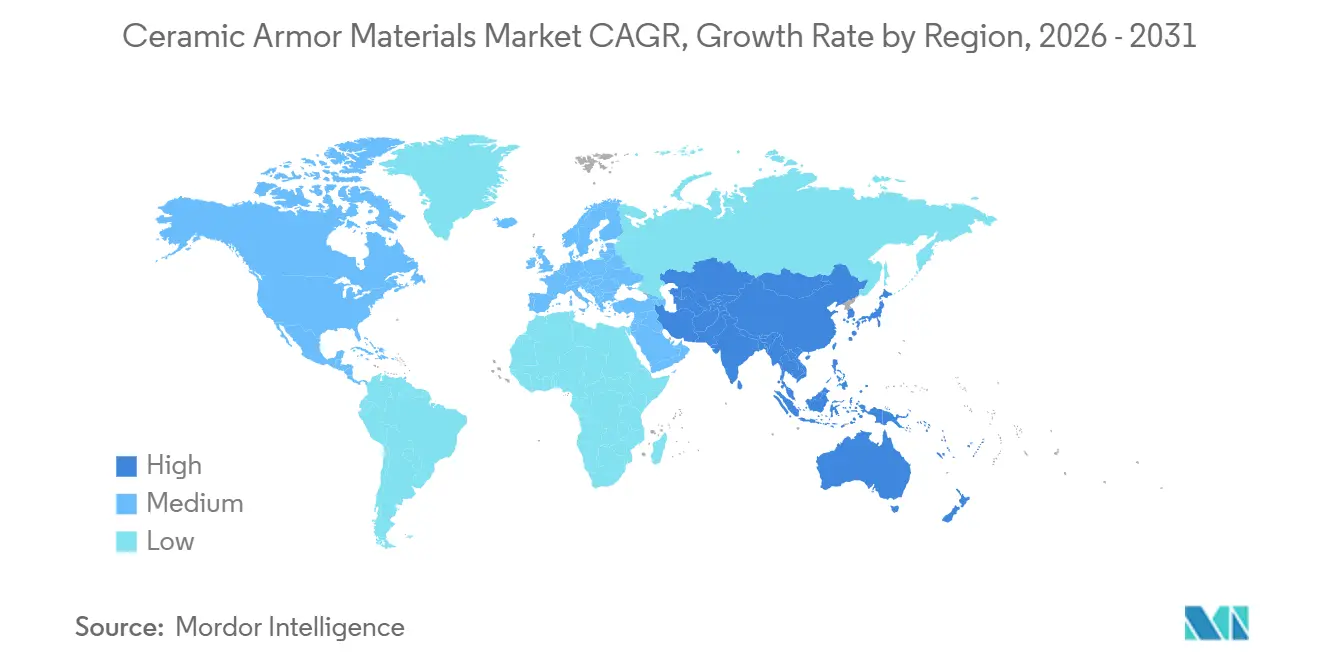
North America held 30.57% of the ceramic armor materials market share in 2025. The region benefits from sustained United States spending on soldier and vehicle protection programs. Domestic sourcing requirements for United States defense programs support demand for certified local production. Canada issued a solicitation for Canadian-produced back-face protection plates in July 2026, reflecting a regional focus on supply security. These sourcing requirements can limit the role of lower-cost foreign products where they do not meet domestic production conditions. They also give qualified local suppliers a clearer route to participate in regional personal-protection contracts. The ceramic armor materials market is also supported by European procurement because European NATO members increased defense spending in 2025. European NATO members and Canada spent USD 574 billion in 2025 after a real increase of 17%, according to the Stockholm International Peace Research Institute (SIPRI). European buyers are placing greater weight on supply-chain independence and STANAG-qualified products.
Asia-Pacific is projected to advance at an 8.66% CAGR through 2031. Military spending across Asia and Oceania reached USD 681 billion in 2025, up 8.1% from the preceding year. China, India, Japan, South Korea, and the Association of Southeast Asian Nations countries are contributing to higher regional defense activity. India's military expenditure reached USD 92.1 billion in 2025, an 8.9% increase. Japan's spending reached USD 62.2 billion in 2025, up 9.7%, and China's reached USD 336 billion, up 7.4%. These spending patterns support demand for personnel and platform protection, although the material selected can vary by national program and local supply conditions. Local manufacturing programs can shape which suppliers qualify for these opportunities. The ceramic armor materials market in the region is, therefore, influenced by both security needs and domestic production goals.
South America and the Middle East and Africa represent smaller demand areas, but defense modernization is sustaining procurement activity. Saudi Arabia spent USD 83.2 billion on its military in 2025, while Türkiye spent USD 30 billion. Brazil and Argentina are leading procurement centers in South America, where national-content programs can support demand for armored vehicle upgrades. South Africa remains an important technical manufacturing base in sub-Saharan Africa. Procurement in these regions commonly references the National Institute of Justice and STANAG 4569 standards, which direct buyers toward certified suppliers. This approach makes certification a practical requirement even where procurement volumes are lower than in North America, Europe, or Asia-Pacific. The ceramic armor materials market has a measured opportunity in these locations because premium materials can face budget limits. Demand is strongest where local production, fleet renewal, and high-threat protection requirements occur together.

Competitive Landscape
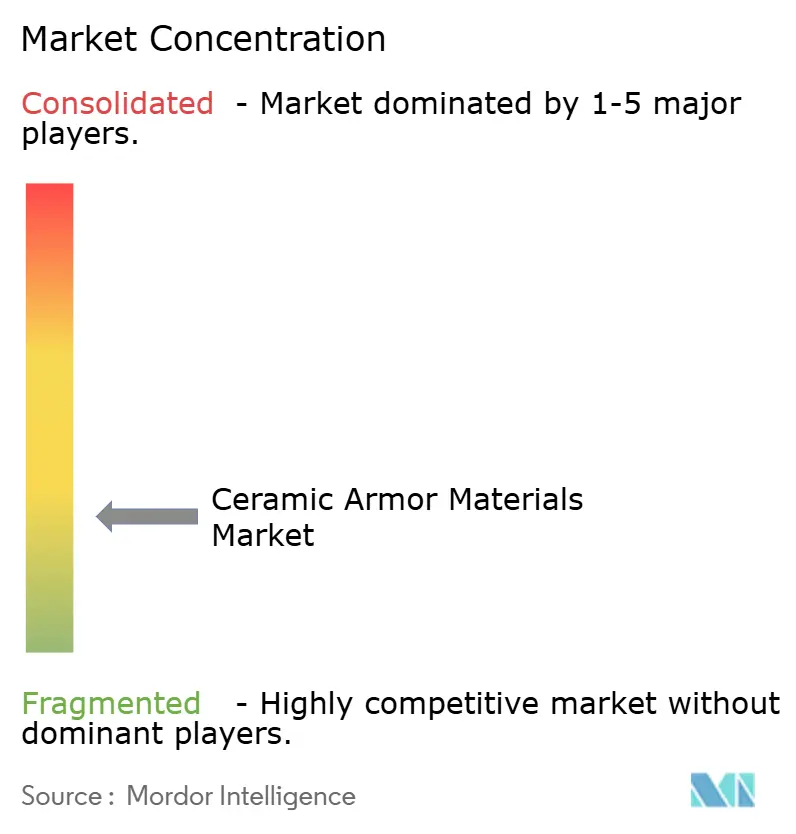
The ceramic armor materials market is highly fragmented, with the top five players including Saint-Gobain, CoorsTek, Inc., 3M, CeramTec GmbH, and Morgan Advanced Materials plc. Competitive strength depends on sintering expertise, access to high-purity feedstock, and certifications across several ballistic standards. Suppliers also benefit when they can control the chain from powder preparation to the delivery of qualified panels. This capability can reduce procurement risk for buyers who need consistent performance across body armor and vehicle programs. It can also shorten the coordination required between a material producer, a panel fabricator, and an armor-system integrator. High-purity silicon carbide and boron carbide feedstock can create a supply risk when export restrictions limit access to material. The ceramic armor materials market, therefore, rewards secure feedstock relationships and qualified production capacity.
Schunk Technical Ceramics’s Qitin Armor platform is a cross-platform offering for body armor, aircraft underbody protection, and helicopter pilot seats. These examples show why suppliers are expanding their product coverage across several protection applications. A broader product scope can allow the same supplier to serve related procurement needs without requiring a buyer to establish separate material qualification processes for every platform. Defense prime contractors such as Rheinmetall AG and General Dynamics act as demand anchors through platform programs, even when they are not the ceramics manufacturers. Their selection and qualification decisions influence which material suppliers receive longer production orders. A 2026 peer-reviewed study found that ceramic, metal, and ultra-high-molecular-weight polyethylene combinations can reduce areal density by 26% to 37% compared with reference designs. This technical work indicates that material competition remains active across ceramic and hybrid armor systems.
Specialized suppliers also focus on areas where standard silicon carbide and alumina panels may not provide the required solution. Surmet Corp. is a supplier addressing silicon nitride and transparent armor applications. ArmorWorks Enterprises, LLC and Safariland, LLC compete in body armor integration through system design, fit, and configuration. These positions show that competition does not occur only at the level of ceramic powder or plate manufacturing. It also occurs through panel design, platform integration, local qualification, and the ability to supply complete protection systems. National Institute of Justice Standard 0101.07 is affecting competition because updated multi-hit and durability protocols require current testing evidence. Recently qualified suppliers may gain access to programs that older certifications cannot support. Smaller producers can still face a difficult path because certification across the National Institute of Justice, STANAG 4569, and national standards can extend commercialization by 18 to 36 months. Price pressure from lower-cost alumina suppliers also limits margins in volume procurement.
Ceramic Armor Materials Industry Leaders
Saint-Gobain
CoorsTek, Inc.
3M
CeramTec GmbH
Morgan Advanced Materials plc
- *Disclaimer: Major Players sorted in no particular order

Recent Industry Developments
- July 2026: Carborundum Universal Limited (CUMI) was selected by the Defence Research and Development Organisation (DRDO) as an armor solutions partner for the Vikram VT21 infantry combat vehicle, strengthening its role in advanced ceramic-based armor systems. The partnership supported demand for engineered ceramic composite panels designed to provide lightweight ballistic protection for military vehicles.
- June 2026: Team Wendy Ceradyne secured delivery orders under the U.S. Army’s Next Generation Integrated Head Protection System contract for combat helmets. The program supports continued demand for qualified ballistic ceramics and advanced composite materials used in lightweight military head-protection systems.


Global Ceramic Armor Materials Market Report Scope
Ceramic armor materials are advanced ceramic materials designed to provide lightweight protection against high-impact threats. They offer high hardness, strength, and resistance to penetration while reducing the weight of protective systems.
The Ceramic Armor Materials Market is segmented by material, application, and geography. By material, the market is segmented into alumina, silicon carbide, boron carbide, ceramic matrix composites, titanium boride, aluminum nitride, and other materials. By application, the market is segmented into body armor, aircraft armor, marine armor, vehicle armor, and other applications. The report also covers the market size and forecasts for ceramic armor materials in 15 countries across major regions. For each segment, the market sizing and forecasts have been done on the basis of value (USD).
| Alumina |
| Silicon Carbide |
| Boron Carbide |
| Ceramic Matrix Composites |
| Titanium Boride |
| Aluminum Nitride |
| Other Materials |
| Body Armor |
| Aircraft Armor |
| Marine Armor |
| Vehicle Armor |
| Other Applications |
| Asia-Pacific | China |
| India | |
| Japan | |
| South Korea | |
| ASEAN Countries | |
| Rest of Asia-Pacific | |
| North America | United States |
| Canada | |
| Mexico | |
| Europe | Germany |
| United Kingdom | |
| France | |
| Italy | |
| NORDIC Countries | |
| Rest of Europe | |
| South America | Brazil |
| Argentina | |
| Rest of South America | |
| Middle East and Africa | Saudi Arabia |
| South Africa | |
| Rest of Middle East and Africa |
| By Material | Alumina | |
| Silicon Carbide | ||
| Boron Carbide | ||
| Ceramic Matrix Composites | ||
| Titanium Boride | ||
| Aluminum Nitride | ||
| Other Materials | ||
| By Application | Body Armor | |
| Aircraft Armor | ||
| Marine Armor | ||
| Vehicle Armor | ||
| Other Applications | ||
| By Geography | Asia-Pacific | China |
| India | ||
| Japan | ||
| South Korea | ||
| ASEAN Countries | ||
| Rest of Asia-Pacific | ||
| North America | United States | |
| Canada | ||
| Mexico | ||
| Europe | Germany | |
| United Kingdom | ||
| France | ||
| Italy | ||
| NORDIC Countries | ||
| Rest of Europe | ||
| South America | Brazil | |
| Argentina | ||
| Rest of South America | ||
| Middle East and Africa | Saudi Arabia | |
| South Africa | ||
| Rest of Middle East and Africa | ||


Key Questions Answered in the Report
What is the size of the ceramic armor materials market?
The ceramic armor materials market stands at USD 3.35 billion in 2026 and is projected to reach USD 4.82 billion by 2031.
What is driving demand for ceramic armor materials?
Defense modernization, lower-weight protection needs, and multi-hit and armor-piercing requirements are supporting demand.
Which material held the largest share in 2025?
Alumina held 34.23% of revenue in 2025 because it has an established manufacturing base and supports large procurement programs.
Which material is projected to grow fastest through 2031?
Silicon carbide is projected to advance at an 8.43% CAGR through 2031 because of its protection-to-weight performance.
Page last updated on:





