
Cell-to-Pack Battery Market Size and Share
Market Overview
| Study Period | 2022 - 2032 |
|---|---|
| Market Size (2027) | USD 26.37 Billion |
| Market Size (2032) | USD 62.56 Billion |
| Growth Rate (2027 - 2032) | 18.86 % |
| Fastest Growing Market | North America |
| Largest Market | Asia-Pacific |
| Market Concentration | Medium |
Major Players *Disclaimer: Major Players sorted in no particular order Image © Mordor Intelligence. Reuse requires attribution under CC BY 4.0. | |
Cell-to-Pack Battery Market Analysis by Mordor Intelligence
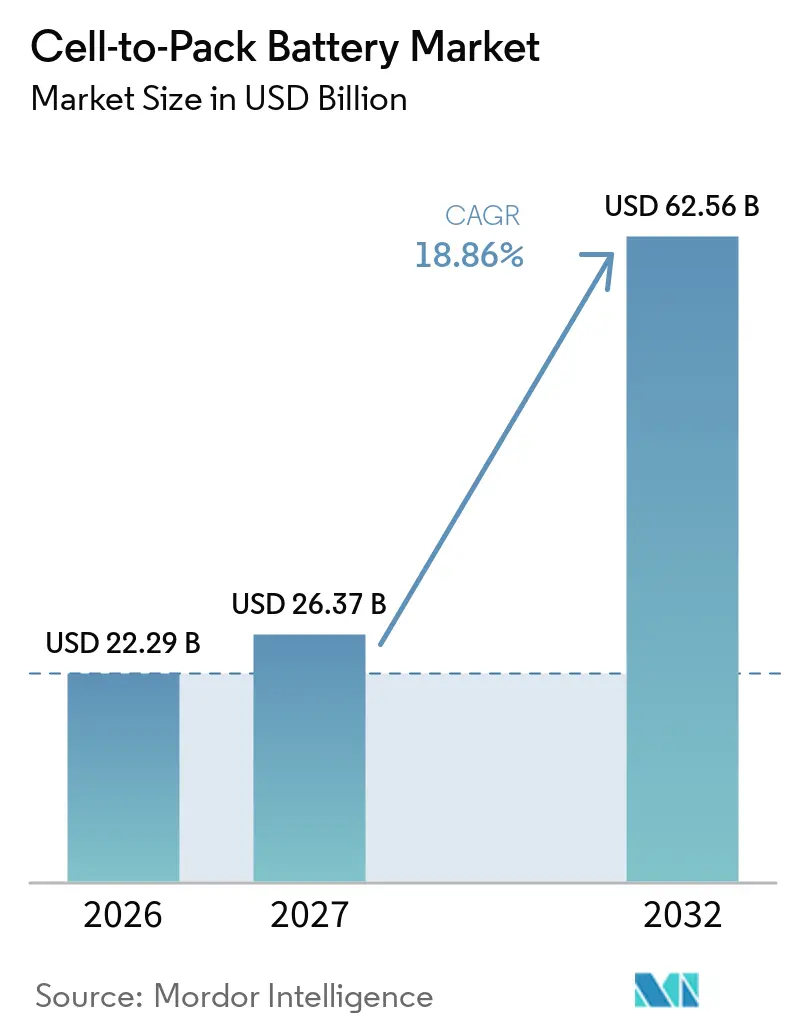
The Cell-to-Pack Battery Market size is expected to increase from USD 22.29 billion in 2026 to USD 26.37 billion in 2027 and reach USD 62.56 billion by 2032, growing at a CAGR of 18.86% over 2027-2032. The cell-to-pack battery market is shifting from module-based packs toward direct cell integration, which increases usable pack volume and reduces component requirements. CATL reports that its Qilin design reaches 72% volumetric utilization, compared with 55% for its first-generation cell-to-pack (CTP) system.[1] This design change makes battery cost, energy density, and production engineering closely connected rather than separate decisions. Electric vehicles remain the main demand base, while stationary storage creates a second route for pack designs that prioritize capacity and footprint. Competition increasingly depends on cell design, thermal control, manufacturing scale, and the ability to meet safety rules across regions.
Key Report Takeaways
- By battery form, prismatic cells held 64.3% of the cell-to-pack battery market share in 2026 and are forecast to grow at a 19.3% CAGR through 2032.
- By battery chemistry, lithium iron phosphate held 56.6% of the cell-to-pack battery market share in 2026 and is forecast to grow at a 20.2% CAGR through 2032.
- By battery technology, Blade Battery Technology held 39.7% of the cell-to-pack battery market share in 2026 and is forecast to grow at a 19.1% CAGR through 2032.
- By application, electric vehicles held 85.2% of the cell-to-pack battery market share in 2026 and are projected to grow at a 19.5% CAGR through 2032.
- By geography, Asia-Pacific held 57.4% of the cell-to-pack battery market share in 2026, and North America is projected to grow at a 22.3% CAGR through 2032.
Note: Market numbers in this report are based on Mordor Intelligence's proprietary estimation framework, which combines nine months of actuals with Q4 projections for base year 2026.
Market Trends and Insights
Drivers Impact Analysis of Cell-to-Pack Battery Market*
| Driver | (~) % Impact on CAGR Forecast | Geographic Relevance | Impact Timeline |
|---|---|---|---|
| Module Elimination and Pack Cost Reduction | +4.8% | Global, concentrated in China with expansion to North America and Europe | Short term (≤ 2 years) |
| EV Range and Volumetric Energy Density Needs | +3.5% | Global, particularly Europe and North America | Medium term (2-4 years) |
| LFP Commercialization and Vertical Integration | +3.2% | Asia-Pacific, with expansion to North America and Europe | Short term (≤ 2 years) |
| Commercial Vehicle Electrification and Fleet Cost Pressure | +2.1% | China, Europe, India, and the North American heavy-truck segment | Medium term (2-4 years) |
| Government Emissions Targets and EV Incentives | +2.6% | North America, Europe, China, and India | Medium term (2-4 years) |
| Localized Battery Supply Chains and Factory Utilization | +1.8% | North America and Europe | Long term (≥ 4 years) |
| Source: Mordor Intelligence | |||
Module Elimination and Pack-Level Cost Reduction
The cell-to-pack battery market benefits when manufacturers remove the module layer and reduce assembly steps. CATL states that its CTP design can remove around 370 components from a pack, reducing material needs and assembly work. Samsung SDI presented CTP designs at InterBattery 2025 with a stated 20% cost reduction and 15% weight reduction against comparable module-to-pack configurations.[2] These savings require producers to relocate mechanical protection and thermal containment functions from the module to the cell and pack system. That requirement favors suppliers with integrated cell engineering and battery management capabilities. CATL’s increase from 55% to 72% volumetric utilization shows why engineering performance can widen the gap between leading suppliers and smaller manufacturers.[3]
EV Range and Volumetric Energy-Density Requirements
The cell-to-pack battery market expands as automakers seek more usable capacity without increasing vehicle weight. LG Energy Solution states that its pouch-cell CTP process raises space utilization from 40-50% in module-to-pack systems to 65-72% in CTP systems.[4] Higher space utilization can support longer range within the same vehicle package. Tesla reported that it uses 4680 cells in packs for certain Model Y variants and had installed 40 GWh of annual 4680 capacity in Texas by the end of 2025. The deployment shows that CTP approaches are moving beyond China into major North American vehicle programs. CALB reported 55% year-over-year growth in 2025 EV battery revenue to RMB 30.3 billion, connecting its growth to demand for high-energy and fast-charging battery designs.
Lithium Iron Phosphate (LFP) Commercialization and Vertical Integration
The cell-to-pack battery market is supported by LFP chemistry because it combines lower material cost with a favorable thermal profile. BYD states that its Blade Battery recorded 30-60 degrees Celsius in its nail-penetration test, compared with more than 500 degrees Celsius for a ternary battery tested under the same method. This performance allows pack designers to reduce thermal management materials while maintaining a safety-focused design. BYD introduced its second-generation Blade Battery in March 2026 with flash charging that moved from 10% to 97% state of charge in 9 minutes at normal temperature. China’s 2024 lithium-ion battery standardization conditions set energy-density and cycle-life requirements that large-format LFP cells can meet. The result is a stronger business case for LFP in standard electric vehicles and energy storage systems.
Commercial-Vehicle Electrification and Fleet Total Cost of Ownership (TCO) Pressure
The cell-to-pack battery market has a clear route into commercial vehicles because fleet buyers weigh equipment cost, durability, and charging time. Gotion’s G-Line commercial-vehicle battery reached 175 Wh/kg at pack level and carries a stated warranty of 12 years or 10,000 cycles. CALB’s ZHIYUAN series supports 2C fast charging and a stated 2-million-kilometer life for heavy trucks. These specifications fit depot charging and high-mileage operating patterns. Lithium Iron Phosphate (LFP) cell-to-pack designs also suit commercial use because their cycle stability and temperature resilience can reduce replacement frequency. The format is therefore relevant where buyers compare lifetime operating costs rather than only vehicle range.
Restraints Impact Analysis of Cell-to-Pack Battery Market*
| Restraint | (~) % Impact on CAGR Forecast | Geographic Relevance | Impact Timeline |
|---|---|---|---|
| Thermal Propagation and Reduced Physical Barriers | -1.5% | Global, particularly China and markets applying UN ECE R100 | Medium term (2-4 years) |
| Production-Line Requalification Costs | -1.2% | North America and Europe | Medium term (2-4 years) |
| Pack Repairability and End-of-Life Disassembly Complexity | -0.8% | Europe, with broader global expansion | Long term (≥ 4 years) |
| Overcapacity and Price Competition | -2.1% | China, with spillover into global markets | Short term (≤ 2 years) |
| Source: Mordor Intelligence | |||
Thermal-Runaway Propagation and Reduced Physical Barriers
The cell-to-pack battery market faces a safety challenge because removing module casings can create a more direct thermal path between cells. China released GB 38031-2025 in April 2025, with updated thermal-propagation test requirements relevant to cell-to-pack (CTP) battery packs. CATL’s non-propagation technology and Samsung SDI’s No-TP system address this issue through material choices, cell placement, and pack design. Certification requires extensive testing across cell chemistries and vehicle programs. The work raises development costs and extends the qualification period for new entrants. It also makes safety engineering a core competitive requirement rather than a final validation step.
Overcapacity and Price Competition Compressing Supplier Returns
The cell-to-pack battery market is exposed to pressure from battery manufacturing capacity that has grown faster than near-term demand in China. China’s Ministry of Industry and Information Technology convened manufacturers in 2025 to address disorderly price competition and capacity expansion. Lower average selling prices reduce margins for suppliers without sufficient volume or upstream integration. SK On reported a KRW 931.9 billion operating loss for 2025, citing lower Inflation Reduction Act manufacturing credits and asset impairment related to its BlueOval SK restructuring. This means higher output does not necessarily translate into stronger profitability. Suppliers with weak returns may delay investment in new cell-to-pack platforms, increasing the difference in capability between scale leaders and the wider supplier base.
*Our forecasts treat driver/restraint impacts as directional, not additive. The impact forecasts reflect baseline growth, mix effects, and variable interactions.
Cell-to-Pack Battery Market Segment Analysis
By Battery Form:
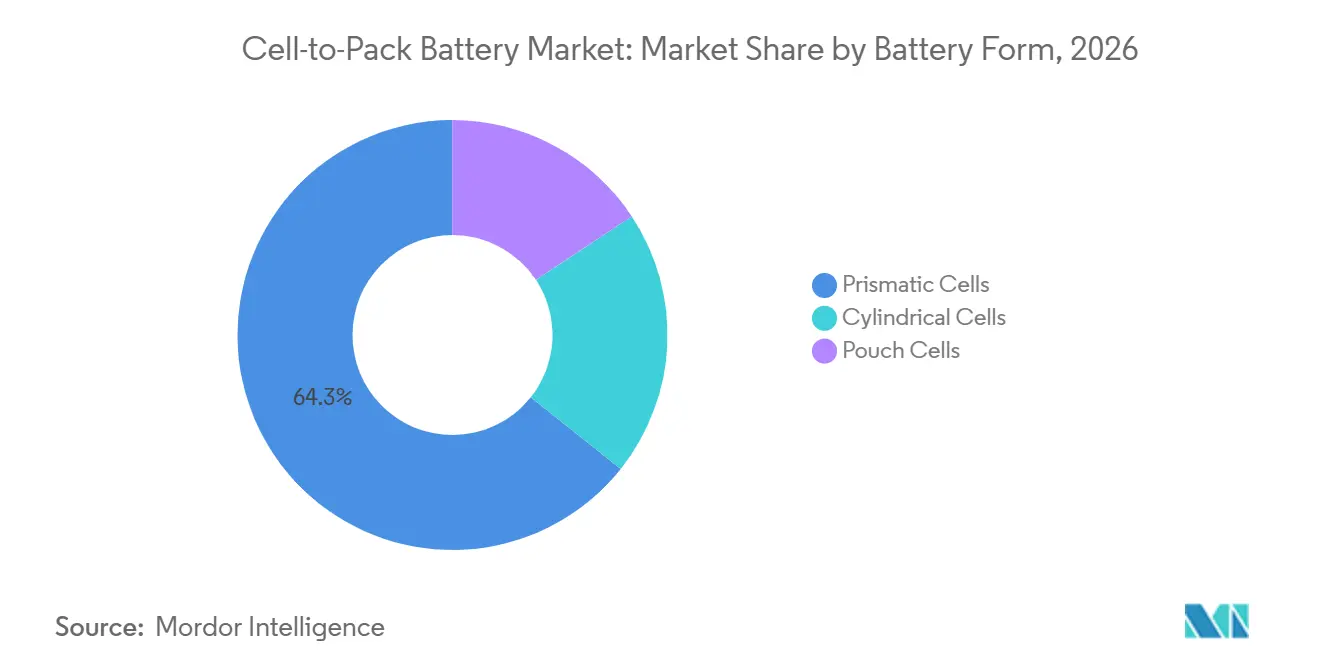
Prismatic Cells Dominate the CTP TransitionPrismatic cells held 64.3% of the cell-to-pack battery market share in 2026 and are projected to grow at a 19.3% CAGR through 2032. Their aluminum can house provides structural rigidity that can replace part of the support normally supplied by a module casing. This makes it easier to manage compression and tolerance in a direct cell-to-pack arrangement. Samsung SDI showed top-terminal and side-terminal prismatic CTP packs at InterBattery 2025 and described space efficiency gains above 60% against conventional module-to-pack designs. LG Energy Solution plans to convert selected lines to lithium manganese-rich prismatic cells in 2026, extending the format into more vehicle price categories.
Pouch cells remain relevant because they can use CTP layouts that raise space utilization to 65-72%. They are suited to high-density applications where packaging flexibility is important. Cylindrical cells serve applications where tabless winding and dry-electrode production support a differentiated manufacturing approach. Tesla uses 4680 cells in certain Model Y packs, while Panasonic began mass production at its De Soto, Kansas facility in July 2025. REPT BATTERO reported that a CTP project for a European original equipment manufacturer (OEM) entered mass production and export in 2025, adding prismatic production for markets outside China.

By Battery Chemistry:
LFP Anchors the Commercial CTP Value CaseLithium iron phosphate held 56.6% of the Global Cell-to-Pack Battery Market in 2026. Chemistry combines a cobalt-free material base with a thermal profile that supports cell-to-pack engineering. BYD reports that its Blade Battery design extends LFP use into fast-charging applications. This helps reduce the practical difference between LFP CTP packs and NMC module-based packs in mainstream passenger vehicles. EVE Energy reported that it ranked second globally in energy-storage battery shipments in 2025, with prismatic LFP products supporting its storage portfolio. China’s standards also recognize the performance progress of large-format LFP cells.
NMC retains a role in premium and long-range electric vehicles where high gravimetric energy density remains important. Samsung SDI uses NCA-based solutions in data center backup and performance-oriented electric vehicle applications. Sodium-ion battery development is also gaining attention as suppliers broaden their product choices. CATL described Naxtra sodium-ion batteries in its 2025 annual report. CALB reported progress on a 450 Wh/kg all-solid-state prototype in 2025. NCA continues to serve specific supply relationships, including Panasonic’s work with Tesla and Samsung SDI’s Energy Storage System (ESS) portfolio.
By Battery Technology:
Blade Battery Technology Leads Integration InnovationBlade Battery Technology held 39.7% of the cell-to-pack battery market share in 2026. Its high-aspect-ratio cell shape supports close in-pack stacking without a separate module frame. The design combines LFP chemistry with direct cell integration and places safety and cost reduction in the same product architecture. BYD’s published materials describe the Blade Battery as a core part of its battery and vehicle integration strategy. The technology has become a reference point for LFP-based pack development. Its commercial presence has encouraged competitors to pursue alternative direct-integration designs.
Conventional CTP integration allows manufacturers to remove modules while retaining existing prismatic or pouch cell tooling. This can lower the capital burden of adopting cell-to-pack production. Advanced architectures, including CATL’s Qilin and Tesla’s structural approach, integrate thermal management and structural functions further into the cell-pack interface. LiSER and other emerging technologies remain focused on specialized applications such as electric vertical takeoff and landing aircraft and marine systems. CALB’s R46 cylindrical cell reached 310 Wh/kg for eVTOL customers. These approaches broaden the range of applications in which pack-level integration can be applied.
By Application:
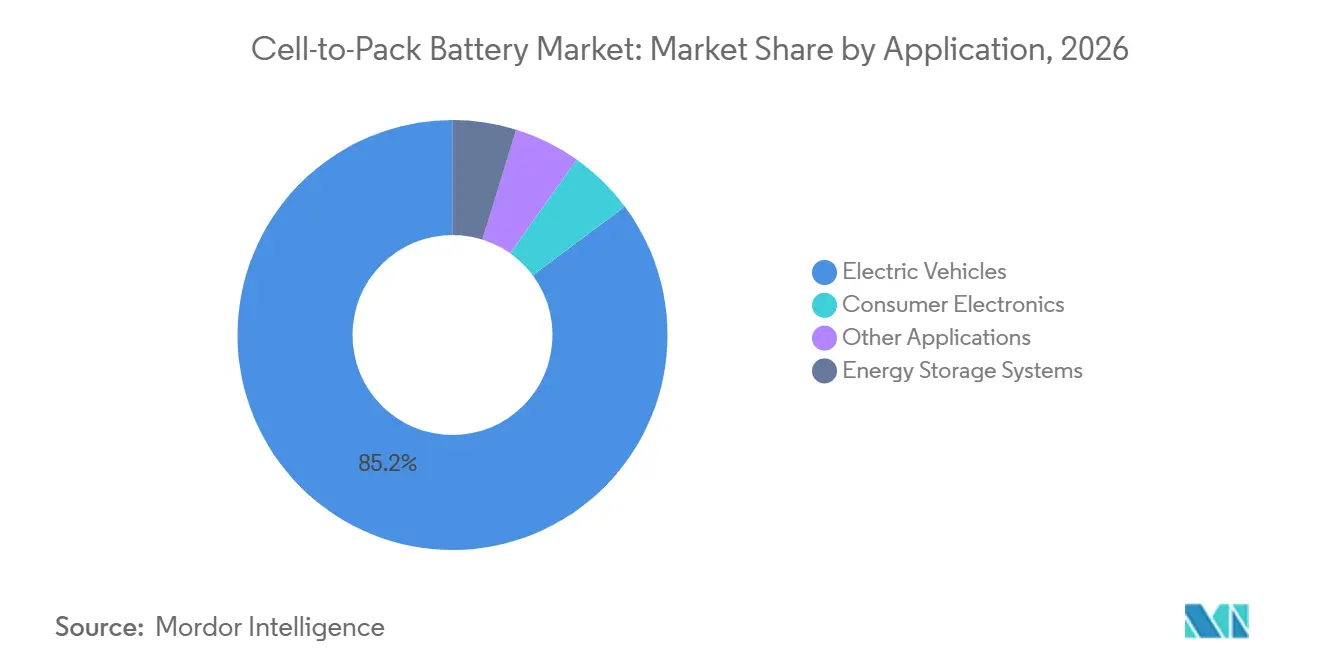
EVs Propel CTP Adoption at ScaleElectric vehicles held 85.2% of the Global Cell-to-Pack Battery Market in 2026 and are forecast to grow at a 19.5% CAGR through 2032. Vehicle platforms create demand volumes that allow battery suppliers to spread the fixed cost of CTP engineering across large production runs. This scale supports lower cell and pack costs over time. SK On signed a 99.4 GWh battery supply agreement with Nissan in March 2025, covering 1 million electric vehicles. The agreement shows how battery supply contracts can secure long production horizons for qualified suppliers. Consumer electronics remain smaller but give pouch-cell CTP designs a route into compact applications.
Energy storage systems are the second largest application and provide a separate source of demand for high-capacity packs. CATL introduced the 9-MWh TENER Stack for stationary storage. REPT BATTERO’s Powtrix 6.25 MWh system also applies high-density pack principles to stationary storage. Other applications include eVTOL and marine systems, where suppliers such as CALB, EVE Energy, and Gotion are active. These uses have different cycles, safety, and packaging requirements from road vehicles. They offer suppliers additional paths to apply cell-to-pack design work.
Geography Analysis
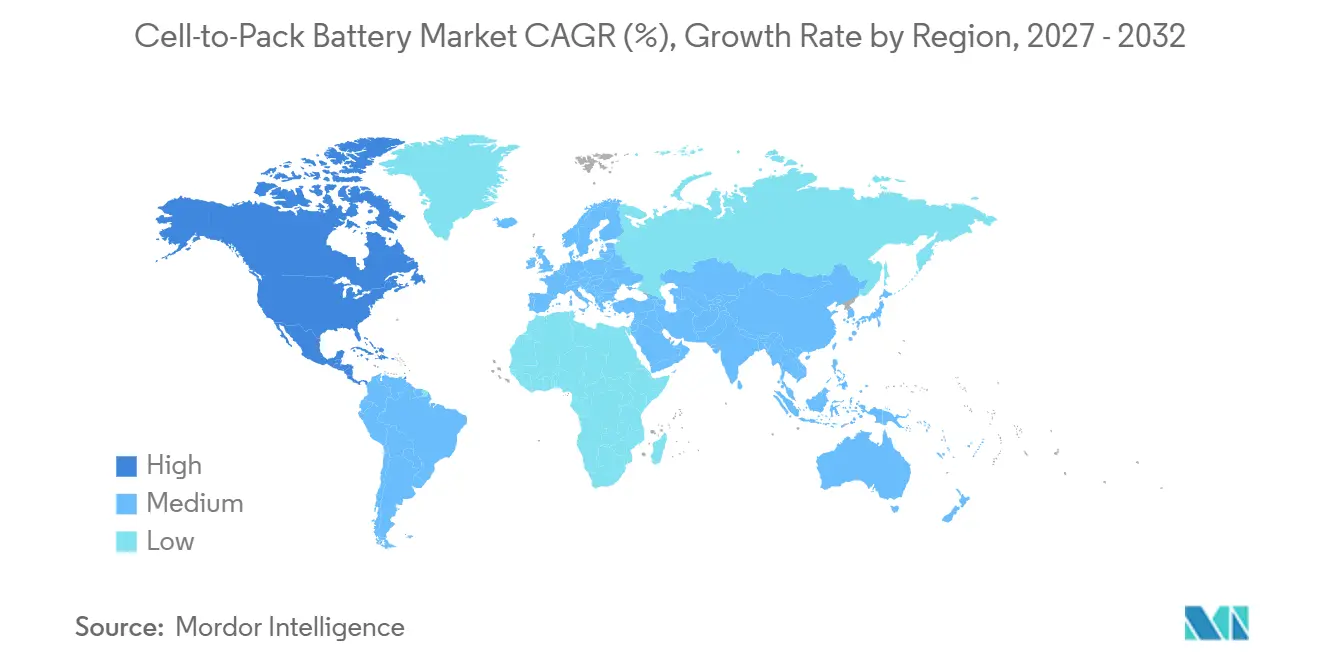
Asia-Pacific accounted for 57.4% of the Global Cell-to-Pack Battery Market in 2026. China brings cathode materials, separators, cells, and pack assembly together in an integrated domestic supply chain. Its 2024 lithium-ion battery industry standards and GB 38031-2025 safety requirements set performance and compliance conditions for local production. Japan and South Korea supply global Original Equipment Manufacturer (OEM) programs, while Panasonic began mass production at its 32 GWh De Soto facility in July 2025. Southeast Asia is becoming a secondary assembly location, as SVOLT produced its 10,000th Thailand battery pack in June 2025 and EVE Energy completed its Malaysian small-cylinder factory in early 2025.
North America is forecast to grow at 22.3% CAGR through 2032, the fastest regional rate in the cell-to-pack battery market. U.S. Department of Energy support included up to USD 725 million for domestic critical-material manufacturing in January 2025. The department also announced a USD 7.5 billion loan to StarPlus Energy in December 2024 for lithium-ion battery factories in Indiana. SK On’s 2025 loss reflected, in part, a decline in Inflation Reduction Act manufacturing credits, showing the effect of policy changes on regional manufacturers. The company expanded into U.S. Battery Energy Storage System (BESS) with Lithium Iron Phosphate (LFP) batteries in September 2025, while Panasonic plans at least 2 additional 4680 plants and targets 200 GWh of North American capacity by March 2031.
Europe occupies the third geographic position in the cell-to-pack battery market, with ACC’s Billy-Berclau Douvrin Gigafactory operating a 15 GWh Block 1 and commissioning Block 2 in 2026. The European Union’s batteries regulation establishes traceability and sustainability requirements across the value chain. The Battery Passport requirement for EV batteries begins in February 2027, favoring suppliers that can manage integrated cell-to-pack data. South America, the Middle East, and Africa are earlier-stage markets where renewable-energy storage projects drive more demand than electric vehicle volumes.
Competitive Landscape
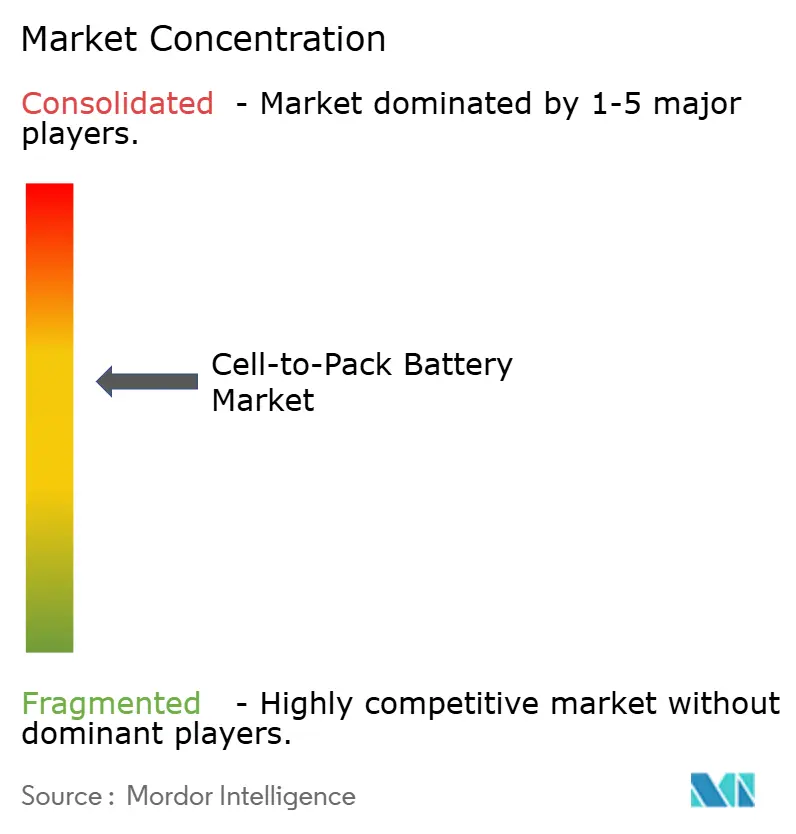
The cell-to-pack battery market is moderately consolidated, with CATL and BYD leading output through proprietary CTP architectures. CATL’s annual report describes continued upgrades across CTP and CTC technology portfolio CATL.COM. Chinese suppliers benefit from domestic material supply, manufacturing scale, and local electric vehicle demand. These advantages support continuous product development and cost control. Non-Chinese producers face higher costs and fragmented supply chains, as shown by SK On’s KRW 931.9 billion operating loss in 2025.
Non-Chinese producers are responding through localized production, energy-storage expansion, and safety differentiation. LG Energy Solution is building its North American LFP and prismatic product position, with a 140 GWh ESS order backlog and more than 300 GWh of 46-series cylindrical orders. Samsung SDI positions prismatic offerings in ESS and has presented CTP designs focused on pack safety and space efficiency. Panasonic’s De Soto factory provides a regional production base for cylindrical cells. CATL’s Qilin platform and BYD’s Blade Battery remain leading examples of vertically integrated CTP design.
The cell-to-pack battery market also has opportunities in solid-state integration, commercial vehicle packs, and storage-specific designs. SVOLT expects large-scale supply of a semi-solid-state battery for a BMW Mini platform in 2027, while Gotion completed a 0.2 GWh all-solid-state pilot line in 2025. CALB reported a 450 Wh/kg all-solid-state prototype in 2025, and REPT BATTERO ranked first in global residential energy-storage battery shipments that year. Digital battery management and thermal-simulation tools are becoming another basis for differentiation.
Cell-to-Pack Battery Industry Leaders
-
Contemporary Amperex Technology Co., Limited (CATL)
-
BYD Company Limited
-
LG Energy Solution Ltd.
-
CALB Group Co., Ltd.
-
Gotion High-Tech Co., Ltd.
- *Disclaimer: Major Players sorted in no particular order
Cell-to-Pack Battery Market Companies Covered in this Report
- Amperex Technology Limited
- Automotive Cells Company (ACC)
- BYD Company Limited
- CALB Group Co., Ltd.
- Contemporary Amperex Technology Co., Limited (CATL)
- Envision AESC Group Ltd.
- EVE Energy Co., Ltd.
- Farasis Energy (Ganzhou) Co., Ltd.
- Gotion High-Tech Co., Ltd.
- Jiangsu Zenergy Battery Technologies Group Co., Ltd.
- LG Energy Solution Ltd.
- Mercedes-Benz Group AG
- Panasonic Holdings Corporation
- REPT BATTERO Energy Co., Ltd.
- Samsung SDI Co., Ltd.
- SK On Co., Ltd.
- Sunwoda Electronic Co., Ltd.
- SVOLT Energy Technology Co., Ltd.
- Tesla, Inc.
- XPeng Inc.
Recent Industry Developments in Cell-to-Pack Battery Market
- October 2026: ACC marked a production milestone of 5 million "Made in France" battery cells at the Billy-Berclau Douvrin Gigafactory, representing 40,000 vehicles already fitted with ACC batteries, as Block 1 operates on a 5x8 shift pattern 7 days a week, and Block 2 commissioning progresses.
- March 2026: BYD unveiled the 2nd-generation Blade Battery alongside its FLASH Charging Technology, achieving 10% to 97% state of charge in 9 minutes at normal temperature and 20% to 97% in 12 minutes at minus 30 degrees Celsius, setting a new record for mass-produced EV charging speed and extending the LFP CTP platform's competitive viability in premium vehicle segments.
- January 2026: SK On reported a full-year 2025 operating loss of KRW 931.9 billion on revenues of KRW 7 trillion, citing a decline in Inflation Reduction Act (IRA) Advanced Manufacturing Production Credits and a large asset impairment from the BlueOval SK joint-venture restructuring with Ford.
- September 2025: REPT BATTERO confirmed its CTP project for a European original equipment manufacturer (OEM) entered mass production and export in Q3 2025, alongside low-cost CTP conversion from aluminum to steel pack structure, adding a European-market CTP revenue stream to its primarily Energy Storage System (ESS)-focused portfolio.
Global Cell-to-Pack Battery Market Report Scope
A Cell-To-Pack (CTP) battery is an electric vehicle battery architecture in which individual battery cells are placed directly into the main pack housing, eliminating the traditional intermediate module layer.
The cell-to-pack battery market is segmented into battery form, battery chemistry, battery technology, application, and geography. By battery form, the market is divided into prismatic cells, pouch cells, and cylindrical cells. By battery chemistry, the market is segmented into lithium iron phosphate (LFP), nickel manganese cobalt (NMC), nickel cobalt aluminum (NCA), sodium-ion batteries, and other battery chemistries. By battery technology, the market is segmented into blade battery technology, lithium slim energy reserve (LiSER) Technology, conventional cell-to-pack integration, advanced cell-to-pack architectures, and other emerging technologies. By application, the market is divided into electric vehicles, energy storage systems, consumer electronics, and other applications. The report also covers the market size and forecasts for the global cell-to-pack battery market across 26 countries in key regions. For each segment, the market sizing and forecasts have been provided on the basis of value (USD).
Segmentation Overview
| Prismatic Cells |
| Pouch Cells |
| Cylindrical Cells |
| Lithium Iron Phosphate (LFP) |
| Nickel Manganese Cobalt (NMC) |
| Nickel Cobalt Aluminum (NCA) |
| Sodium-Ion Batteries |
| Other Battery Chemistries |
| Blade Battery Technology |
| Lithium Slim Energy Reserve (LiSER) Technology |
| Conventional Cell-to-Pack Integration |
| Advanced Cell-to-Pack Architectures |
| Other Emerging Technologies |
| Electric Vehicles |
| Energy Storage Systems |
| Consumer Electronics |
| Other Applications |
| North America | United States |
| Canada | |
| Mexico | |
| Europe | Germany |
| France | |
| Italy | |
| Spain | |
| United Kingdom | |
| Netherlands | |
| Norway | |
| Russia | |
| Rest of Europe | |
| Asia-Pacific | China |
| India | |
| Japan | |
| Australia | |
| Indonesia | |
| Malaysia | |
| Thailand | |
| Rest of Asia-Pacific | |
| South America | Brazil |
| Argentina | |
| Colombia | |
| Rest of South America | |
| Middle East and Africa | Saudi Arabia |
| United Arab Emirates | |
| Egypt | |
| Oman | |
| Nigeria | |
| Rest of Middle East and Africa |
| By Battery Form | Prismatic Cells | |
| Pouch Cells | ||
| Cylindrical Cells | ||
| By Battery Chemistry | Lithium Iron Phosphate (LFP) | |
| Nickel Manganese Cobalt (NMC) | ||
| Nickel Cobalt Aluminum (NCA) | ||
| Sodium-Ion Batteries | ||
| Other Battery Chemistries | ||
| By Battery Technology | Blade Battery Technology | |
| Lithium Slim Energy Reserve (LiSER) Technology | ||
| Conventional Cell-to-Pack Integration | ||
| Advanced Cell-to-Pack Architectures | ||
| Other Emerging Technologies | ||
| By Application | Electric Vehicles | |
| Energy Storage Systems | ||
| Consumer Electronics | ||
| Other Applications | ||
| By Geography | North America | United States |
| Canada | ||
| Mexico | ||
| Europe | Germany | |
| France | ||
| Italy | ||
| Spain | ||
| United Kingdom | ||
| Netherlands | ||
| Norway | ||
| Russia | ||
| Rest of Europe | ||
| Asia-Pacific | China | |
| India | ||
| Japan | ||
| Australia | ||
| Indonesia | ||
| Malaysia | ||
| Thailand | ||
| Rest of Asia-Pacific | ||
| South America | Brazil | |
| Argentina | ||
| Colombia | ||
| Rest of South America | ||
| Middle East and Africa | Saudi Arabia | |
| United Arab Emirates | ||
| Egypt | ||
| Oman | ||
| Nigeria | ||
| Rest of Middle East and Africa | ||
Key Questions Answered in the Report
What is the projected growth rate for cell-to-pack batteries?
The Global Cell-to-Pack Battery Market is forecast to grow at 18.86% CAGR from 2027 to 2032, reaching USD 62.56 billion by 2032.
Why are automakers adopting cell-to-pack designs?
Removing modules can reduce component count, weight, and pack cost while increasing usable battery volume.
Which battery form leads CTP adoption?
Prismatic cells led with 64.3% share in 2026 and are projected to grow at a 19.3% CAGR through 2032.
Why is LFP important for direct cell integration?
LFP provides lower material cost and a thermal profile that supports safety-focused CTP pack designs.
Which region is growing fastest for cell-to-pack batteries?
North America is forecast to expand at a 22.3% CAGR through 2032, supported by domestic manufacturing investment.
What limits wider use of CTP batteries?
Thermal-propagation testing, production-line qualification costs, repairability, and price pressure can slow adoption.