
CCUS Absorption Market Size and Share
Market Overview
| Study Period | 2022 - 2032 |
|---|---|
| Market Size (2027) | USD 5.44 Billion |
| Market Size (2032) | USD 10.28 Billion |
| Growth Rate (2027 - 2032) | 13.56 % |
| Fastest Growing Market | Asia-Pacific |
| Largest Market | North America |
| Market Concentration | Medium |
Major Players *Disclaimer: Major Players sorted in no particular order Image © Mordor Intelligence. Reuse requires attribution under CC BY 4.0. | |
CCUS Absorption Market Analysis by Mordor Intelligence
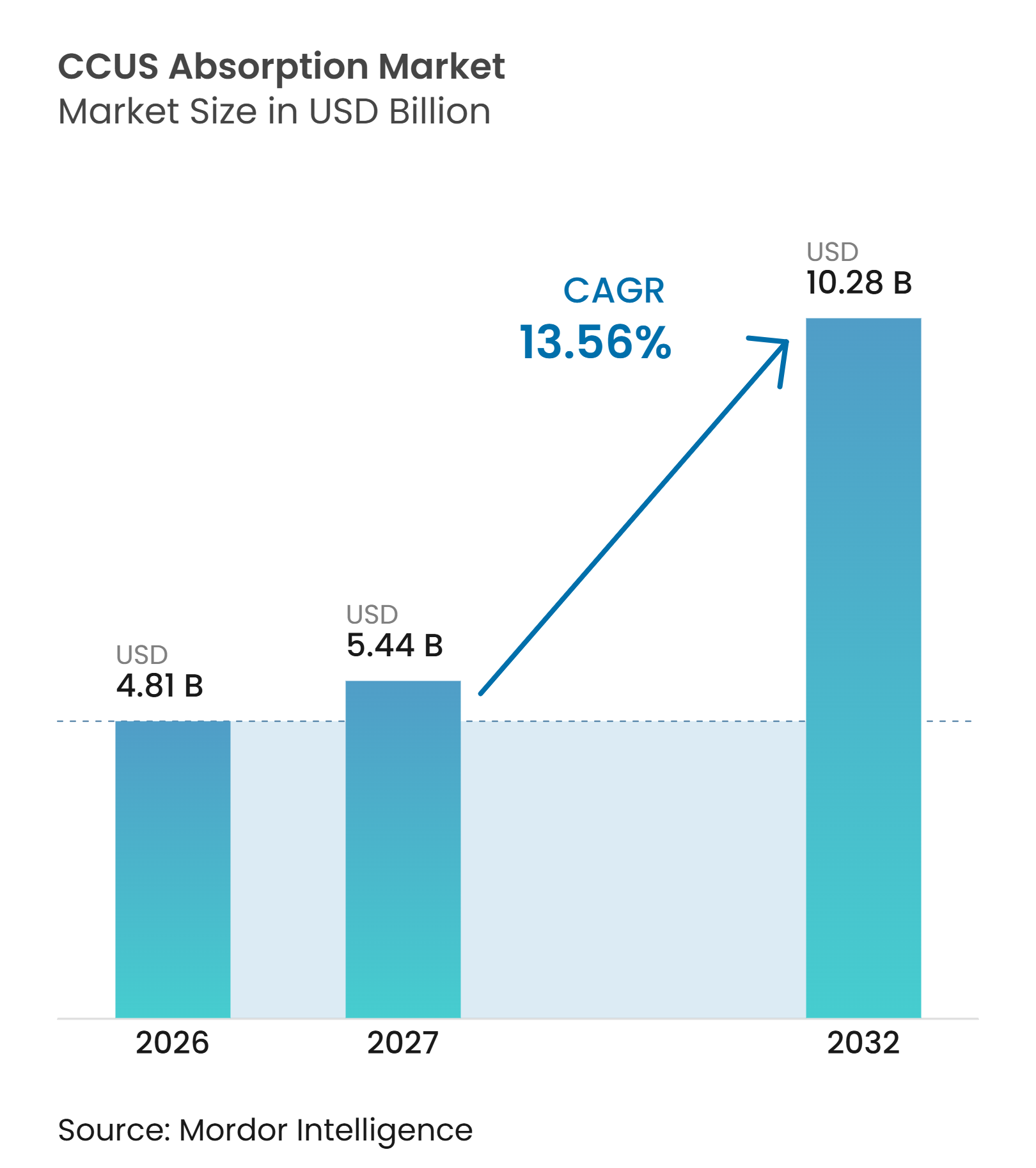
The CCUS absorption market size was valued at USD 4.81 billion in 2026 and is estimated to grow from USD 5.44 billion in 2027 to USD 10.28 billion by 2032, at a CAGR of 13.56% during the forecast period (2027-2032). Legally binding decarbonization requirements, carbon pricing, and public risk-sharing are shifting capture projects from discretionary capital decisions to planned investments at hard-to-abate sites. The EU Emissions Trading System covers 40% of the European Union's greenhouse gas emissions. It has raised more than EUR 175 billion (~USD 195.88 billion) since 2013, maintaining a compliance incentive for industrial operators with few lower-cost alternatives. In the United States, the Section 45Q credit can provide up to USD 85 per metric ton of CO2 stored geologically for qualifying projects that begin construction by 2032, improving project economics at facilities where capture would otherwise not meet return requirements. Shared transport and storage hubs are also changing procurement, as technology suppliers increasingly need proven multi-site integration capability alongside solvent performance. Energy use, cross-chain contracts, and uncertain blue hydrogen offtake continue to slow some final investment decisions in the CCUS absorption market.
Key Report Takeaways
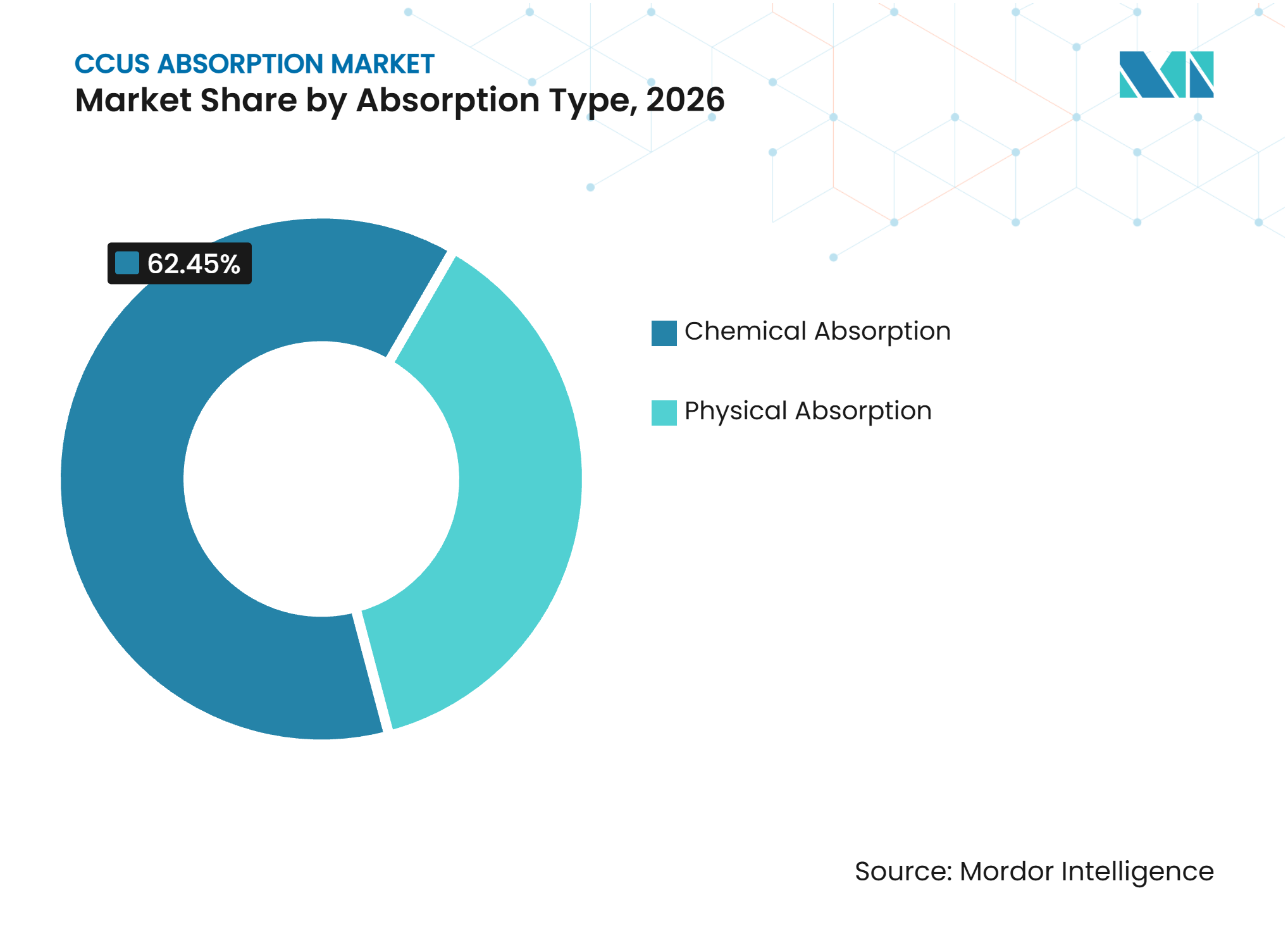
- By absorption type, chemical absorption held 62.45% of the CCUS absorption market share in 2026, while physical absorption is forecast to grow at a 14.12% CAGR through 2032.
- By solvent type, amine-based solvents held 55.12% of the CCUS absorption market share in 2026, while alkali-based chemicals are forecast to expand at a 14.56% CAGR through 2032.
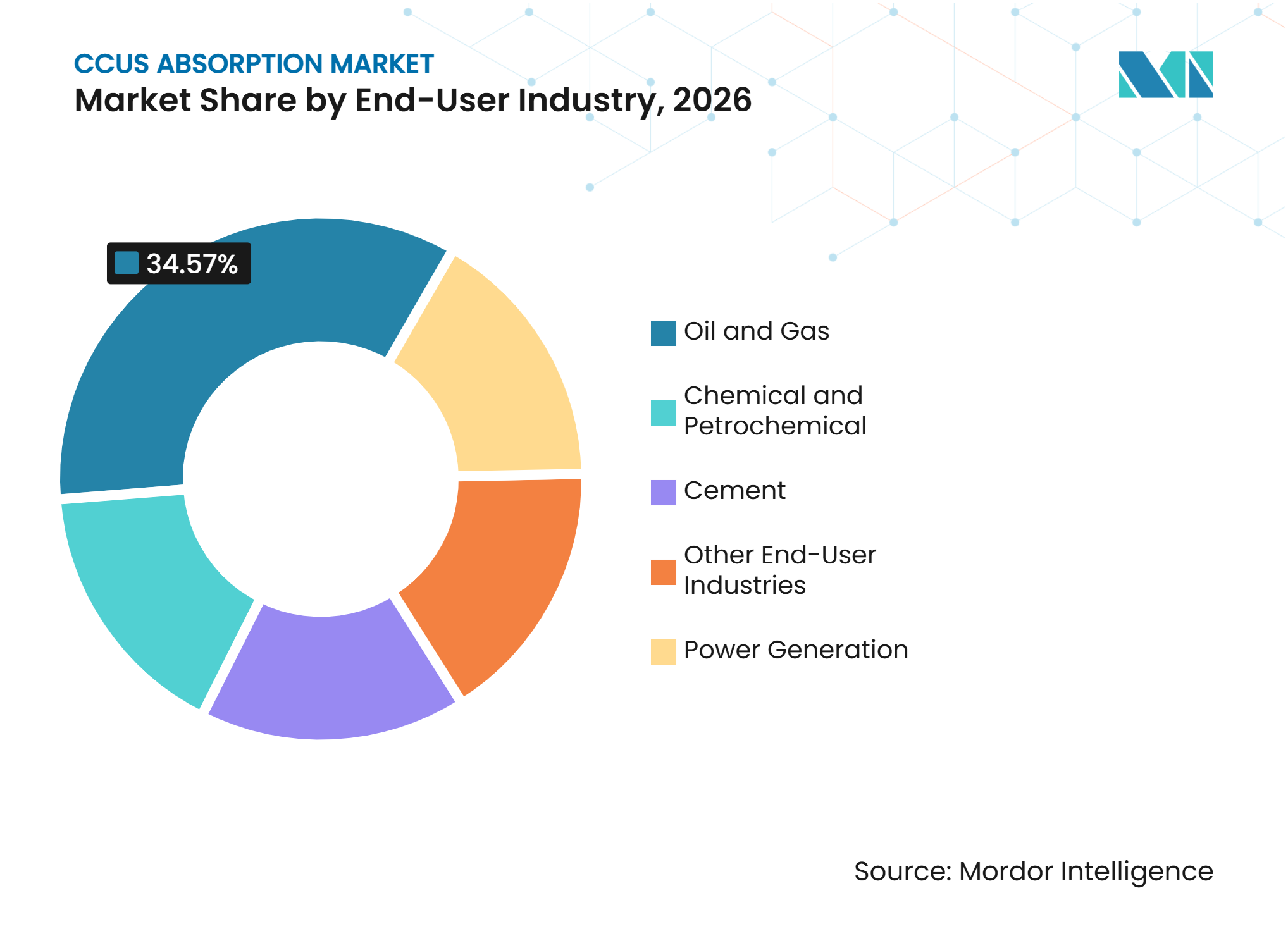
- By end-user industry, oil and gas accounted for 34.57% of the CCUS absorption market share in 2026, while cement is forecast to grow at a 15.68% CAGR through 2032.
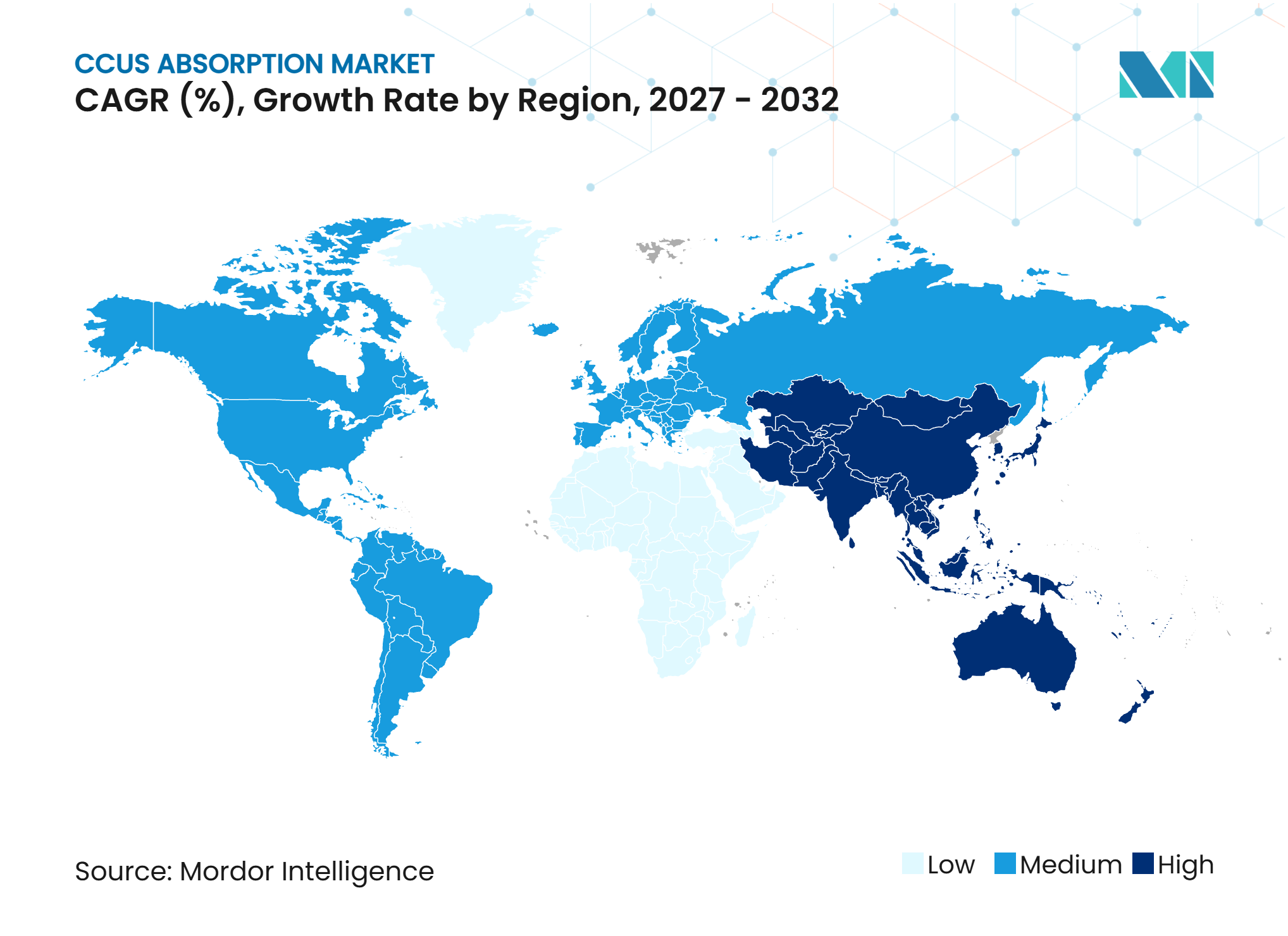
- By geography, North America held 36.33% of the CCUS absorption market share in 2026, while Asia-Pacific is forecast to expand at a 15.23% CAGR through 2032.
Note: Market numbers in this report are based on Mordor Intelligence's proprietary estimation framework, which combines nine months of actuals with Q4 projections for base year 2026.
Market Trends and Insights
Drivers Impact Analysis of CCUS Absorption Market*
| Drivers | (~) % Impact on CAGR Forecast | Geographic Relevance | Impact Timeline |
|---|---|---|---|
| Industrial Decarbonization Mandates and Carbon Pricing | +3.5% | Global, strongest in the EU, North America, Japan, and South Korea | Medium term (2-4 years) |
| CCUS Hubs and Shared Transport and Storage Models | +2.5% | North America, Europe, and emerging Asia-Pacific hubs | Medium term (2-4 years) |
| Tax Credits, Contracts for Difference, and Public Risk Sharing | +2.8% | North America, the EU, and Japan | Short term (≤ 2 years) |
| Expansion of Blue Hydrogen and Low-Emission Fuels | +1.5% | North America, Europe, and Asia-Pacific | Medium term (2-4 years) |
| Retrofit Demand from Hard-to-Abate Industrial Sites | +2.0% | Global, with the highest concentration in the EU and East Asia | Long term (≥ 4 years) |
| Source: Mordor Intelligence | |||
Industrial Decarbonization Mandates and Carbon Pricing
Industrial decarbonization mandates create sustained demand for the CCUS absorption market by requiring emissions reductions without specifying a particular technology route. Absorption is often the practical option for industrial flue gases with high CO2 concentrations. The EU Emissions Trading System covers 40% of the European Union's total greenhouse gas emissions, creating ongoing compliance pressure for industrial operators. The EU Net-Zero Industry Act sets a 50 million metric tons per year CO2 injection capacity target for 2030 and requires oil and gas producers to contribute storage capacity based on their production levels. This increases available storage capacity and supports demand for capture at industrial sources. South Korea's CCUS Industry Promotion Bill, which took effect in February 2025, established a legal and business support framework for CCUS activities.
Tax Credits, Contracts for Difference, and Public Risk Sharing
Public risk-sharing measures support the CCUS absorption market by converting technical potential into predictable project revenue. The Section 45Q direct-pay option allows eligible project sponsors to access the full USD 85-per-metric-ton geological storage credit for projects that begin construction by 2032. This structure expands access beyond sponsors that can use tax equity. Final regulations for the Section 45V clean hydrogen credit took effect on January 10, 2025, and require certification of lifecycle greenhouse gas emissions for qualifying hydrogen production. Capture equipment can therefore be important for blue hydrogen projects seeking higher credit tiers. Japan selected 9 projects under its Advanced Carbon Capture and Storage (CCS) program in fiscal 2024, targeting 20 million metric tons of annual CO2 storage by 2030 through integrated support from capture to storage. Government-backed Contracts for Difference in the United Kingdom have also enabled project execution at CCS clusters where tax incentives alone would not resolve revenue uncertainty.
CCUS Hubs and Shared Transport and Storage Models
Shared transport and storage systems improve the economics of the CCUS absorption market by spreading pipeline and storage costs among multiple emitters. This lowers the minimum viable capture scale and gives mid-sized facilities access to infrastructure that previously favored large integrated operators. Northern Lights reached a final investment decision for Phase 2 in March 2025, with Equinor, Shell, and TotalEnergies committing NOK 7.5 billion (~USD 0.81 billion) to expand injection capacity from 1.5 million to at least 5 million metric tons per year by 2028. The expansion is supported by a 15-year commercial agreement with Stockholm Exergi for biogenic CO2. Phase 1 became operational in August 2025 as an open-access third-party transport and storage facility, with its 1.5 million metric ton annual capacity fully contracted. Providers with standardized equipment interfaces and experience in multi-site delivery are likely to benefit as hub-based projects become more common.
Expansion of Blue Hydrogen and Low-Emission Fuels
Blue hydrogen and other low-emission fuel projects create a new source of demand for the CCUS absorption market, as capture units are incorporated into plant design. Physical solvent systems are especially relevant where synthesis gas is processed at elevated pressure. Section 45V regulations place lifecycle emissions certification at the center of clean hydrogen eligibility in the United States, strengthening the commercial case for capture equipment at qualifying facilities. However, demand remains exposed to uncertain hydrogen offtake pricing, which can delay final investment decisions when capture capacity is designed around co-production. This risk differs from that of established CO2-enhanced oil recovery projects because it depends on demand for a newer fuel value chain.
Restraints Impact Analysis of CCUS Absorption Market*
| Restraints | (~) % Impact on CAGR Forecast | Geographic Relevance | Impact Timeline |
|---|---|---|---|
| Solvent Regeneration Energy Penalty | -1.5% | Global, most acute where fossil heat dominates | Medium term (2-4 years) |
| Cross-Chain Coordination and Contract Risk | -1.2% | Europe, North America, and emerging Asia-Pacific hubs | Short term (≤ 2 years) |
| Uncertain Offtake for Hydrogen and Carbon Dioxide Removal | -1.0% | North America and Europe | Medium term (2-4 years) |
| Source: Mordor Intelligence | |||
Solvent Regeneration Energy Penalty
Amine regeneration remains a significant operational constraint for the CCUS absorption market. Chemical absorption typically requires 2.5 to 4 gigajoules of thermal energy per metric ton of CO2 recovered. At sites using fossil-sourced steam, 15% to 25% of gross CO2 avoided is consumed by the capture process itself. This reduces the quantity eligible for monetization under tax-credit and emissions-trading structures. Operating costs are also tied to natural gas prices, which adds uncertainty to the financing of long-life capture assets. Mitsubishi Heavy Industries (MHI) began operating a pilot plant using its KS-21 solvent at Korea Electric Power Corporation's (KEPCO) Himeji No. 2 Power Station in May 2025, reporting lower regeneration energy consumption and amine emissions than its prior KS-1 formulation.
Cross-Chain Coordination and Contract Risk
CCUS projects require alignment across capture, CO2 conditioning, transport, and storage. These activities involve different cost structures, liability arrangements, regulations, and counterparty risks. BASF shelved the Kairos Carbon Capture and Storage (CCS) investment in Antwerp in March 2025, despite EUR 500 million (~USD 559.67 million) in committed EU Innovation Fund support, demonstrating how commercial misalignment can halt a funded project. The EU CCS Directive requires monitoring plans, 5-year permit reviews, and financial provisions for post-closure CO2 management. These obligations extend liability across counterparties over decades. As a result, contract design can lengthen engineering and financing stages, even where the technology and funding are in place.
*Our forecasts treat driver/restraint impacts as directional, not additive. The impact forecasts reflect baseline growth, mix effects, and variable interactions.
CCUS Absorption Market Segment Analysis
By Absorption Type:
Chemical Processes Lead While Physical Absorption Builds in High-Pressure ApplicationsChemical absorption held 62.45% of the CCUS absorption market share in 2026. The segment is supported by the established use of amine-based post-combustion systems in natural gas processing, refining, power generation, and industrial sites. These systems can achieve CO2 capture rates of 90% or more from dilute flue gas at near-atmospheric pressure. BASF reports more than 500 reference plants for its OASE technology, reflecting a substantial installed base. Standardized engineering, operational data, and established solvent supply chains support further retrofit use.
Physical absorption is forecast to grow at a CAGR of 14.12% from 2027 to 2032. Blue hydrogen, pre-combustion, and natural gas sweetening projects favor physical solvents when operating pressure and CO2 partial pressure are high. Rectisol and Selexol can provide energy and capital advantages under those conditions. New hydrogen and ammonia plants can select physical systems from the design stage, while existing fossil-fuel assets often continue to use chemical absorption. Carbon Clean's CycloneCC combines rotating packed beds with an amine-promoted buffer-salt solvent, reducing the equipment footprint by up to 50% at mid-scale industrial sites.



By Solvent Type:
Amine-Based Solvents Retain the Installed Base as Alkali Systems ExpandAmine-based solvents held 55.12% of the CCUS absorption market share in 2026. Their position reflects more than three decades of commercial CCS use with monoethanolamine, diethanolamine, and proprietary blends. MHI had delivered 18 commercial plants using its KM CDR Process and Advanced KM CDR Process, with two plants under delivery as of December 2025. This reference base supports supplier selection where buyers require demonstrated capture performance. Standard designs also allow amines to serve a wide range of flue-gas compositions.
Alkali-based chemicals are forecast to grow at a CAGR of 14.56% from 2027 to 2032. Potassium carbonate, chilled ammonia variants, and mixed-salt processes suit high CO2 partial-pressure streams from cement kilns and steel blast furnaces. Their lower regeneration-energy requirements can improve economics where fuel and steam costs are high. Baker Hughes' Mixed Salt Process and Capsol Technologies' ambient-pressure chilled ammonia system are included in the Global CCS Institute's 2025 technology compendium. Ionic liquids, thermomorphic solvents, enzyme-accelerated carbonate systems, and amino acid salts remain emerging options that require regulatory approval and financing confidence for wider deployment.
By End-User Industry:
Oil and Gas Remain the Largest User as Cement Demand RisesOil and gas accounted for 34.57% of the CCUS absorption market share in 2026. Decades of CO2-enhanced oil recovery had created CO2-handling infrastructure before current policy-driven deployment accelerated. Large emissions at individual facilities can support capture investments that smaller industrial sites cannot justify. Major operators, including ExxonMobil, Chevron, and Shell, are pursuing facility retrofits and carbon storage development. Power generation, chemical production, and petrochemicals also contribute to demand, particularly for ammonia and methanol plants that use acid-gas removal.
Cement is forecast to grow at a CAGR of 15.68% from 2027 to 2032, the highest rate among end-user industries. Limestone calcination accounts for 60% of the cement sector's CO2 output through a chemical reaction, so electrification and fuel switching cannot fully address this source. The IEA reported that planned near-zero-emissions cement capacity for 2030 had grown 30% to 35 million metric tons, but remained below the required pace. MHI and Worley received the December 2025 contract for the United Kingdom's first cement-plant CO2 capture project at Heidelberg Materials' Padeswood facility[1]. The facility is designed to capture 800,000 metric tons per year and connect to the HyNet cluster.

Geography Analysis
North America
North America held 36.33% of the CCUS absorption market share in 2026. Section 45Q tax credits, established CO2 pipeline infrastructure, and more than 20 million metric tons per year of capture capacity in the United States lower the incremental transport cost of new projects. The Houston Ship Channel CCS hub involves ExxonMobil, Chevron, Linde, and 8 additional industrial partners, targeting up to 50 million metric tons of annual capture by 2030. Canada contributes through carbon pricing and oil sands decarbonization commitments, while Mexico remains at an earlier stage of feasibility assessment. Fluor is carrying out late-stage engineering for gas-fired power, blue hydrogen, waste-to-energy, and cement projects across North America and Europe.
Asia-Pacific
Asia-Pacific is forecast to expand at a 15.23% CAGR from 2027 to 2032, making it the fastest-growing region in the CCUS absorption market. In February 2025, Japan designated a sea area offshore of Tomakomai City as its first specified area under the CCS Business Act, initiating commercial storage licensing. Its 9 JOGMEC-backed Advanced CCS Projects are pursuing 20 million metric tons of annual storage capacity by 2030 across 6 industrial regions. South Korea's CCUS Industry Promotion Bill and subsequent KRW 300 billion loan program provide a legal and financing framework for commercial deployment. China's Green Technology Promotion Catalog sets a 50,000-metric-ton annual capture threshold for eligible coal-fired power and petrochemical projects, linking green finance to equipment procurement[2].
Europe, South America, and the Middle East and Africa
Europe is supported by the EU Net-Zero Industry Act target of 50 million metric tons of annual CO2 injection capacity by 2030. Northern Lights Phase 2 extends Norwegian storage infrastructure, while the United Kingdom's HyNet and East Coast Cluster continue under government support. In August 2025, the Northern Endurance Partnership awarded Halliburton a contract to monitor the Endurance saline aquifer, with an initial annual injection capacity of 4 million metric tons, starting as early as 2027. South America is at an early stage, although MHI received a 2025 study contract for CO2 capture modules on Petrobras offshore vessels. Activity in the Middle East and Africa is building on national oil company decarbonization mandates and experience with CO2-enhanced oil recovery.
Competitive Landscape
Market Concentration
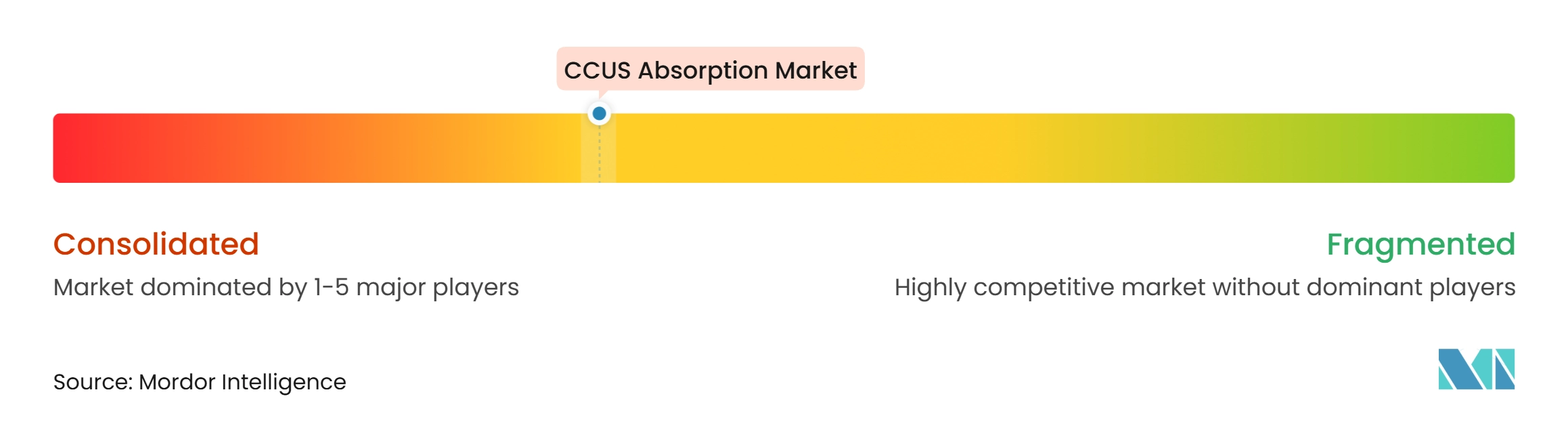
The CCUS absorption market is moderately consolidated. BASF, MHI, Linde, and Honeywell hold positions in amine and physical-solvent process routes. BASF reports more than 500 reference plants for its OASE portfolio, and MHI has delivered 18 commercial plants using the KM CDR Process and Advanced KM CDR Process by December 2025. Suppliers compete on energy consumption, solvent stability, and amine emissions. MHI's KS-21 solvent began operation at Korea Electric Power Corporation (KEPCO)'s Himeji pilot plant in May 2025 and is designed to reduce regeneration energy use and amine emissions compared with KS-1.
Fluor, Aker Solutions, and JGC Holdings compete through delivery capability across sectors and geographies. Fluor is developing 13 additional commercial-scale Econamine FG Plus units, expected to add more than 20 million metric tons of annual capture capacity when operating. Aker Solutions received the 2025 Phase 2 Northern Lights contract, positioning it for expansion of open-access storage infrastructure. BASF and ANDRITZ signed an October 2025 OASE blue license agreement for a planned waste-to-energy project in Aarhus, designed to capture 435,000 metric tons annually. Shared hubs make multi-site integration and delivery experience more important factors in supplier selection.
Carbon Clean factory-tested its CycloneCC C1 technology at commercial scale in May 2025, with a capacity of 285 metric tons of CO2 per day. Carbon Clean and MODEC entered an agreement in June 2025 to develop post-combustion capture for floating production, storage, and offloading vessels. Honeywell's 2025 carbon capture-as-a-service platform targets mid-sized industrial firms through bundled equipment, monitoring, and credit integration.
CCUS Absorption Industry Leaders
-
Exxon Mobil Corporation
-
Shell plc
-
Equinor ASA
-
Fluor Corporation
-
Linde PLC
- *Disclaimer: Major Players sorted in no particular order
CCUS Absorption Market Companies Covered in this Report
- Air Liquide
- Aker Solutions
- BASF
- Carbon Clean Solutions Limited
- Carbon Engineering
- Chevron Corporation
- Climeworks
- Equinor ASA
- Exxon Mobil Corporation
- Fluor Corporation
- Halliburton
- Honeywell International Inc.
- JGC Holdings Corporation
- Linde PLC
- Mitsubishi Heavy Industries, Ltd.
- Shell plc
Recent Industry Developments in CCUS Absorption Market
- December 2025: Mitsubishi Heavy Industries and Worley were jointly awarded the contract for the United Kingdom's first cement plant CO2 capture project at Heidelberg Materials' Padeswood facility in Wales. The project uses MHI's Advanced KM CDR Process to capture approximately 800,000 metric tons of CO2 per year through amine-based absorption. The captured CO2 will be transported via pipeline to the HyNet CCUS cluster for permanent storage in depleted gas fields off Liverpool, with operations targeted for 2029 under United Kingdom Track 1 cluster sequencing.
- October 2025: BASF and ANDRITZ signed a license agreement for OASE blue amine absorption technology to capture approximately 435,000 metric tons of CO2 per year from flue gases at a waste-to-energy facility in Aarhus, Denmark. Project implementation is conditional on the facility securing financing from the Danish CCS Fund.
Global CCUS Absorption Market Report Scope
CCUS absorption refers to the chemical or physical process of capturing carbon dioxide (CO₂) emissions from industrial flue gases or ambient air by dissolving or binding them into a liquid or solid solvent. This process is a key component of carbon capture, utilization, and storage (CCUS) systems, which are designed to reduce CO₂ emissions from industrial sources such as power plants, cement factories, and steel mills.
The CCUS absorption market is segmented by absorption type, solvent type, end-user industry, and geography. By absorption type, the market is segmented into chemical absorption and physical absorption. By solvent type, the market is segmented into amine-based solvents, alkali-based chemicals, physical solvents, and emerging capture chemicals. By end-user industry, the market is segmented into oil and gas, power generation, chemical and petrochemical, cement, and other end-user industries. The report also covers market sizes and forecasts for CCUS absorption across 15 countries in major regions. The market sizes and forecasts are provided in terms of value (USD).
Segmentation Overview
| Chemical Absorption |
| Physical Absorption |
| Amine-Based Solvents |
| Alkali-Based Chemicals |
| Physical Solvents |
| Emerging Capture Chemicals |
| Oil and Gas |
| Power Generation |
| Chemical and Petrochemical |
| Cement |
| Other End-User Industries |
| Asia-Pacific | China |
| India | |
| Japan | |
| South Korea | |
| ASEAN Countries | |
| Rest of Asia-Pacific | |
| North America | United States |
| Canada | |
| Mexico | |
| Europe | Germany |
| United Kingdom | |
| France | |
| Italy | |
| NORDIC Countries | |
| Rest of Europe | |
| South America | Brazil |
| Argentina | |
| Rest of South America | |
| Middle East and Africa | Saudi Arabia |
| South Africa | |
| Rest of Middle East and Africa |
| By Absorption Type | Chemical Absorption | |
| Physical Absorption | ||
| By Solvent Type | Amine-Based Solvents | |
| Alkali-Based Chemicals | ||
| Physical Solvents | ||
| Emerging Capture Chemicals | ||
| By End-User Industry | Oil and Gas | |
| Power Generation | ||
| Chemical and Petrochemical | ||
| Cement | ||
| Other End-User Industries | ||
| By Geography | Asia-Pacific | China |
| India | ||
| Japan | ||
| South Korea | ||
| ASEAN Countries | ||
| Rest of Asia-Pacific | ||
| North America | United States | |
| Canada | ||
| Mexico | ||
| Europe | Germany | |
| United Kingdom | ||
| France | ||
| Italy | ||
| NORDIC Countries | ||
| Rest of Europe | ||
| South America | Brazil | |
| Argentina | ||
| Rest of South America | ||
| Middle East and Africa | Saudi Arabia | |
| South Africa | ||
| Rest of Middle East and Africa | ||
Key Questions Answered in the Report
What is current market size of CCUS Absorption Market?
The CCUS absorption market size was valued at USD 4.81 billion in 2026 and is estimated to grow from USD 5.44 billion in 2027 to USD 10.28 billion by 2032, at a CAGR of 13.56% during the forecast period (2027-2032).
Which solvent category is growing fastest?
Alkali-based chemicals are projected to grow at a 14.56% CAGR through 2032, supported by high CO2 partial pressure applications in the cement and steel industries.
Why is cement a high-growth application for CO2 capture?
Cement is forecast to grow at 15.68% CAGR by 2032, because calcination emissions cannot be fully eliminated through electrification or fuel switching.
Which region leads to demand for CCUS absorption systems?
North America held a 36.33% share in 2026, supported by Section 45Q incentives, existing CO2 infrastructure, and large industrial hubs.