
Cashew Market Analysis by Mordor Intelligence
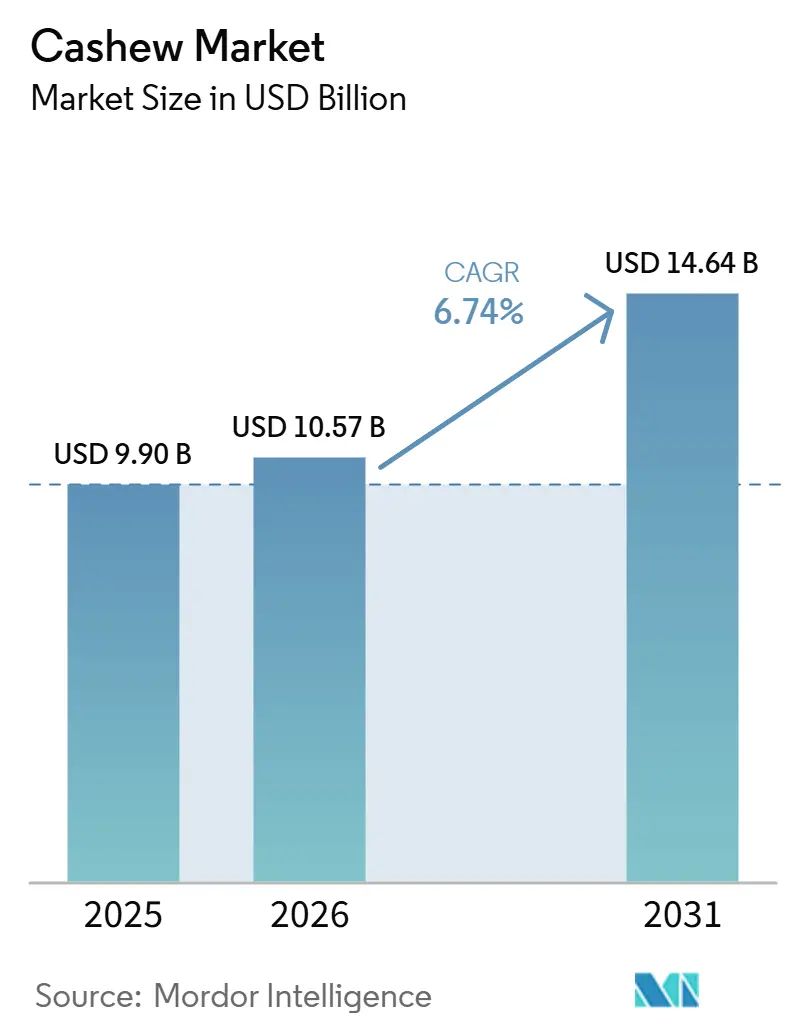
The cashew market size is expected to grow from USD 9.9 billion in 2025 to USD 10.57 billion in 2026 and is forecast to reach USD 14.64 billion by 2031 at 6.74% CAGR over 2026-2031. Asia-Pacific supplied 62.5% of 2024 output, propelled by India’s 782,000 metric tons harvest and Vietnam’s 347,634 metric tons processing base [1]. Africa is accelerating on the back of Côte d'Ivoire's 1.04 million metric tons crop and expanding farm-gate incentives, while mechanized shelling in Vietnam and India is lifting kernel yields and stabilizing downstream margins. Tight raw-nut supplies drove prices from USD 1,000 to USD 1,500 per metric ton after West African weather setbacks, sharpening the cost focus of processors and amplifying the importance of multi-origin sourcing. United States tariff action against Vietnamese kernels has, in turn, opened premium shelf space for Indian and African exporters, reshaping traditional trade corridors.
Key Report Takeaways
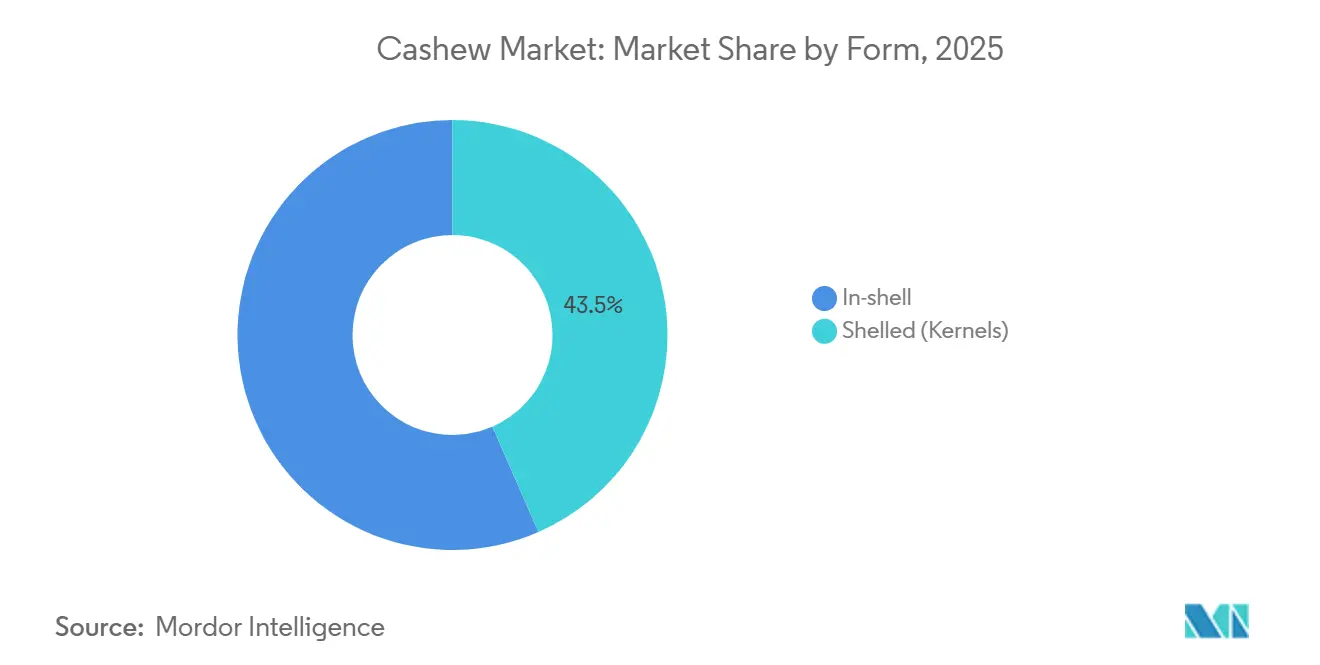
- By form, shelled (kernels) led with 43.5% of cashew commodity market share in 2025, while in-shell cashews are projected to expand at an 10.95% CAGR to 2031.
- By geography, Asia-Pacific commanded 61.9% of supply in 2025, whereas the Middle East is set to log the fastest regional growth at 7.25% CAGR to 2031.
Note: Market size and forecast figures in this report are generated using Mordor Intelligence’s proprietary estimation framework, updated with the latest available data and insights as of 2026.
Market Trends and Insights
Drivers Impact Analysis of Cashew Market*
| Driver | (~) % Impact on CAGR Forecast | Geographic Relevance | Impact Timeline |
|---|---|---|---|
| Rising consumption of cashew nuts as a healthy snack | +1.8% | North America and Europe | Medium term (2-4 years) |
| Increasing government incentives for tree-nut cultivation | +1.2% | West Africa, India, and Southeast Asia | Long term (≥ 4 years) |
| Growing United States cashew imports | +1.5% | North America | Short term (≤ 2 years) |
| Expanding vegan and flexitarian food-processing demand | +1.3% | Developed markets | Medium term (2-4 years) |
| Mechanized shelling boosts kernel recovery rates | +0.9% | Vietnam, India, and Africa | Long term (≥ 4 years) |
| Emerging use of cashew-shell liquid in niche chemicals | +0.8% | Global industrial hubs | Long term (≥ 4 years) |
| Source: Mordor Intelligence | |||
Rising Consumption of Cashew Nuts as a Healthy Snack
Global disposable income growth and increasing awareness of wellness are driving tree-nut snacking into mainstream retail markets. China’s tree-nut intake is rising 5% a year, with per-capita use forecast to reach 1 kilogram by 2030, nearly double 2023 levels [2]. United States and European retailers favor cashews for their creamy taste, spurring steady shelf turnover and allowing certified organic kernels to earn 15-20% premiums. Indian cities mirror the trend as disposable income rises, tightening global kernel inventories and underpinning robust price floors. These demand shifts reinforce positive momentum for the cashew commodity market.
Increasing Government Incentives for Tree-Nut Cultivation
West African governments are rolling out fertilizer subsidies, seedling distribution, and farm-gate price floors to lift smallholder incomes and diversify export baskets. Farm-gate price floors in Côte d’Ivoire climbed 7% year on year in 2025, and India’s National Horticulture Mission channels subsidized seedlings and credit to new orchards. Burkina Faso likewise raised its minimum purchase price to 385 CFA francs (USD 0.63) per kilogram to encourage production. Such policies extend planting into underutilized savannas and add long-term lift to raw-nut supply.
Expanding Vegan and Flexitarian Food-Processing Demand
Cashews are gaining traction as feedstock for plant-based cheese, creamer, and yogurt applications. Their natural emulsification capacity supports clean-label formulations without synthetic stabilizers. Content, letting brands create cheeses, creamers, and yogurts without gums or phosphates. Cashews’ 45% lipid and natural starch enable dairy-free cheeses, creamers, and yogurts without synthetic stabilizers. Pilot work shows cashew bases ferment 18% faster than almond alternatives and hold 12% higher viscosity, yielding smoother textures. The plant-based dairy segment is on track to surpass USD 8 billion in 2025, and cashews capture the fastest-growing share of new launches.
Mechanized Shelling Boosting Kernel Recovery Rates
Processing hubs in Vietnam and India report kernel-grade recovery gains of 2 to 4% points after adopting optical sorting and deep-learning grading systems. Automated lines reduce breakage, enhance food-safety consistency, and offset rising labor costs, which supports sustained margins for integrated processors. AI-guided optical sorters lifted Vietnamese kernel yields from 48% to 52% on identical raw-nut lots, adding 8% revenue per ton while lowering breakage events by 30%. Indian processors report similar gains, allowing them to absorb a 9% rise in labor costs and stay within European quality thresholds.
Restraints Impact Analysis of Cashew Market*
| Restraint | (~) % Impact on CAGR Forecast | Geographic Relevance | Impact Timeline |
|---|---|---|---|
| Climate volatility in key West African belts | −1.4% | West Africa | Short term (≤ 2 years) |
| Stringent food-quality and pesticide-residue regulations | −0.8% | Global exporters | Medium term (2-4 years) |
| Competition for arable land in Asia-Pacific | −0.6% | India and Southeast Asia | Long term (≥ 4 years) |
| Labor shortages in manual shelling hubs | −0.7% | India, Vietnam, and Africa | Medium term (2-4 years) |
| Source: Mordor Intelligence | |||
Climate Volatility in Key West African Belts
Rainfall in Côte d’Ivoire’s Zanzan region fell 112 mm since the 1990s while heat days climbed 17%, reducing nut set and driving raw-nut prices from USD 1,000 to USD 1,500 per ton during the 2024 shortfall. Average rainfall in Côte d’Ivoire’s Zanzan zone fell 112 millimeters between 1981 and 2020, while heat days above 35 °C increased 17%, cutting nut set and driving raw-nut prices from USD 1,000 to USD 1,500 per metric ton during the 2024 shortfall. Limited adoption of mulching and shade trees leaves yields exposed and magnifies supply risk for processors.
Stringent Food-Quality and Pesticide-Residue Regulations
European Union maximum residue limits and the United States Food Safety Modernization Act (FSMA) traceability rules are raising compliance costs for emerging exporters. Smaller processors struggle to finance laboratory testing, nudging the cashew market toward larger, well-capitalized suppliers that can certify chain of custody documentation. The European Union lowered endosulfan limits to 0.05 mg/kg in 2024, and the United States traceability mandates, effective 2026, will require electronic data capture at every node [3]. Compliance testing adds USD 20–25 per metric ton, a burden that pushes smaller exporters toward cooperative models or exit.
*Our forecasts treat driver/restraint impacts as directional, not additive. The impact forecasts reflect baseline growth, mix effects, and variable interactions.
Cashew Market Segment Analysis
By Form:
In-Shell Surge and Kernel Dominance Shape the MarketThe shelled (kernels) segment accounted for 43.5% of the cashew market share in 2025, converting raw nuts into high-margin whole whites for export snack channels. Vietnamese and Indian processors moved more than USD 5.8 billion in kernel exports last year, underscoring the economic gravity of ready-to-eat grades in the cashew commodity market. Deepening mechanization raised average kernel recovery rates from 48% to 52%, which in turn lifted the cashew commodity market size captured by processors even when raw-nut arrivals fluctuated. The segment also benefits from Vietnam’s proximity to Cambodian supply, where an outlay of USD 1.0 billion on raw nuts in 2024 kept factories fed and export contracts intact. Stable demand in the United States, Germany, and the Netherlands provided a predictable off-take that anchors processor investment plans.
In-shell cashews delivered the fastest trajectory with an 10.95% CAGR outlook through 2031, supported by direct-to-consumer online retailers that highlight freshness and minimal processing. Start-ups in the North American and European markets hand-cracked products that command a 25% price premium over equivalent kernel weights. Burkina Faso’s 2025 export ban on raw nuts may tighten global in-shell supply in the near term, motivating artisan roasters to establish forward contracts with Ghanaian and Nigerian farmers. Increased interest in home roasting and transparent sourcing places in-shell offerings in the spotlight, reshaping product portfolios for distributors who once depended solely on processed kernels. Together, these dynamics indicate that processors and growers able to toggle between in-shell and kernel sales stand to optimize revenues across demand cycles, reinforcing resilience within the broader cashew market.

Geography Analysis
North America, APAC and Africa Cashew Market
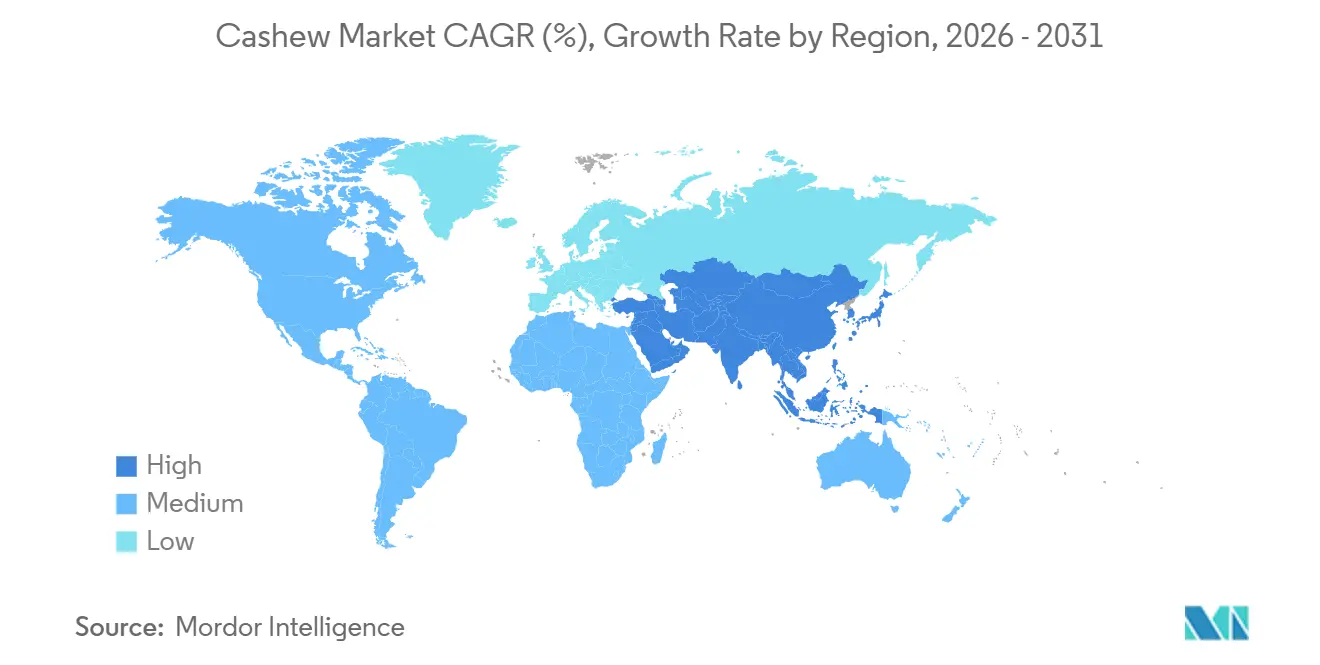
Asia-Pacific holds 61.90% of global output in 2025, and the region’s cashew market size is forecast to expand at a 7.18% CAGR through 2031. India’s 782,000 metric tons harvest feeds both a rapid 7% annual rise in domestic snacking and large kernel shipments into the United States' natural-foods aisle. Vietnam processed 347,634 metric tons, previously importing nearly 790,000 metric tons from Cambodia, Guinea-Bissau, and Tanzania to keep its high-capacity plants running. Mechanized shelling lines in Binh Phuoc recently reached throughputs of 20 metric tons per day, enabling processors to preserve competitive freight terms even after a 9% wage climb. Chinese demand forms an additional pillar, per-capita nut consumption is on the path to hit 1 kilogram by 2030, nearly doubling the 2023 baseline.
EMEA, North America and APAC Cashew Market
The Middle East will log the highest regional import growth at 7.25% CAGR as Gulf consumers migrate toward premium nut-based snacks and plant-based milk. New roasting facilities in Dubai and Riyadh have contracted multi-year supply agreements with Indian exporters to guarantee year-round inventory. North America relies almost entirely on imports, and the 46% tariff on Vietnamese kernels has already redirected procurement toward India and West Africa, keeping the cashew commodity market fluid. Europe advances at 4.15% CAGR on robust demand for fair-trade and organic labels, with Germany operating as a continental hub through Hamburg and Rotterdam ports. Combined, these regional storylines show that diversified supply and processing footprints remain essential to meet expanding global appetites for cashew-based foods and materials.
Africa Cashew Market
Africa generated 23.55% of the world supply but posted the quickest climb at 6.45% CAGR, anchored by Côte d’Ivoire’s 1.04 million metric tons crop. Government price guarantees and subsidized seedling programs moved to plant into Guinea and Benin savannas, and the Prosper Cashew project in Côte d’Ivoire, Ghana, and Nigeria delivered on-site training that increased processing yields by 3 percentage points. Local conversion, however, still captures only about 10% of raw nuts, leaving most value addition offshore. Climate volatility remains the key regional risk, a 112-millimeter rainfall shortfall in the Zanzan zone triggered a 50% leap in farm-gate prices during 2024.
Recent Industry Developments in Cashew Market
- July 2025: Ghana’s MA-CASH (Maximising Gains from Cashew Production for Youth Development) program began converting 1.6 million metric tons of cashew apples into juice and compost, reducing orchard waste.
- April 2025: The United States imposed a 46% tariff on Vietnamese kernels while keeping Indian kernels at 26%, prompting United States importers to diversify sourcing.
- June 2024: AgDevCo, a specialized investor in agriculture, revealed the details of its most recent investment in Cashew Coast, a rapidly expanding cashew nut processing company in Côte d'Ivoire. Cashew Coast employs 750 people and receives its raw materials from over 7,000 smallholder farmers.
Global Cashew Market Report Scope
Cashew nuts are edible kidney-shaped nuts, rich in oil and protein, and are roasted and shelled before being eaten. Raw cashew nuts (in-shell) have been considered while collecting data for production. The Global Cashew Nut Market is Segmented by Grade (White Wholes, Scorched Wholes, Dessert Wholes, White Pieces, Scorched Pieces, and Dessert Pieces) and Geography (North America, Europe, Asia-Pacific, South America, and Africa). The report offers the market sizing in terms of volume in metric tons and value in USD.
By Geography (Production Analysis (Volume), Consumption Analysis (Volume and Value), Import Analysis (Volume and Value), Export Analysis (Volume and Value), and Price Trend Analysis)
| North America | United States |
| Canada | |
| Mexico | |
| South America | Brazil |
| Argentina | |
| Peru | |
| Europe | Germany |
| United Kingdom | |
| Netherlands | |
| France | |
| Spain | |
| Asia-Pacific | India |
| Vietnam | |
| China | |
| Indonesia | |
| Philippines | |
| Australia | |
| Thailand | |
| Middle East | United Arab Emirates |
| Turkey | |
| Saudi Arabia | |
| Oman | |
| Africa | Côte d'Ivoire |
| Tanzania | |
| Nigeria | |
| Ghana | |
| Mozambique |
| By Geography (Production Analysis (Volume), Consumption Analysis (Volume and Value), Import Analysis (Volume and Value), Export Analysis (Volume and Value), and Price Trend Analysis) | North America | United States |
| Canada | ||
| Mexico | ||
| South America | Brazil | |
| Argentina | ||
| Peru | ||
| Europe | Germany | |
| United Kingdom | ||
| Netherlands | ||
| France | ||
| Spain | ||
| Asia-Pacific | India | |
| Vietnam | ||
| China | ||
| Indonesia | ||
| Philippines | ||
| Australia | ||
| Thailand | ||
| Middle East | United Arab Emirates | |
| Turkey | ||
| Saudi Arabia | ||
| Oman | ||
| Africa | Côte d'Ivoire | |
| Tanzania | ||
| Nigeria | ||
| Ghana | ||
| Mozambique | ||
Key Questions Answered in the Report
What is the projected value of the cashew market in 2031?
The cashew market is likely to reach USD 14.64 billion by 2031.
Which form leads cashew product sales today?
Shelled kernels hold 43.45% of the cashew market share because they fit premium snack formats.
Why are cashews popular in plant-based dairy?
Their natural fat and starch create a creamy texture that ferments well, enabling cheese, creamer, and yogurt without synthetic stabilizers.
How are tariffs shaping current trade flows?
A 46% duty on Vietnamese kernels has shifted U.S. orders toward Indian and West African suppliers that face lower tariffs.
What climate risks threaten supply?
Reduced rainfall and higher heat days in West African belts cut yields and can spike raw-nut prices by up to 50%.