
Cargo Insurance Market Size and Share
Market Overview
| Study Period | 2020 - 2031 |
|---|---|
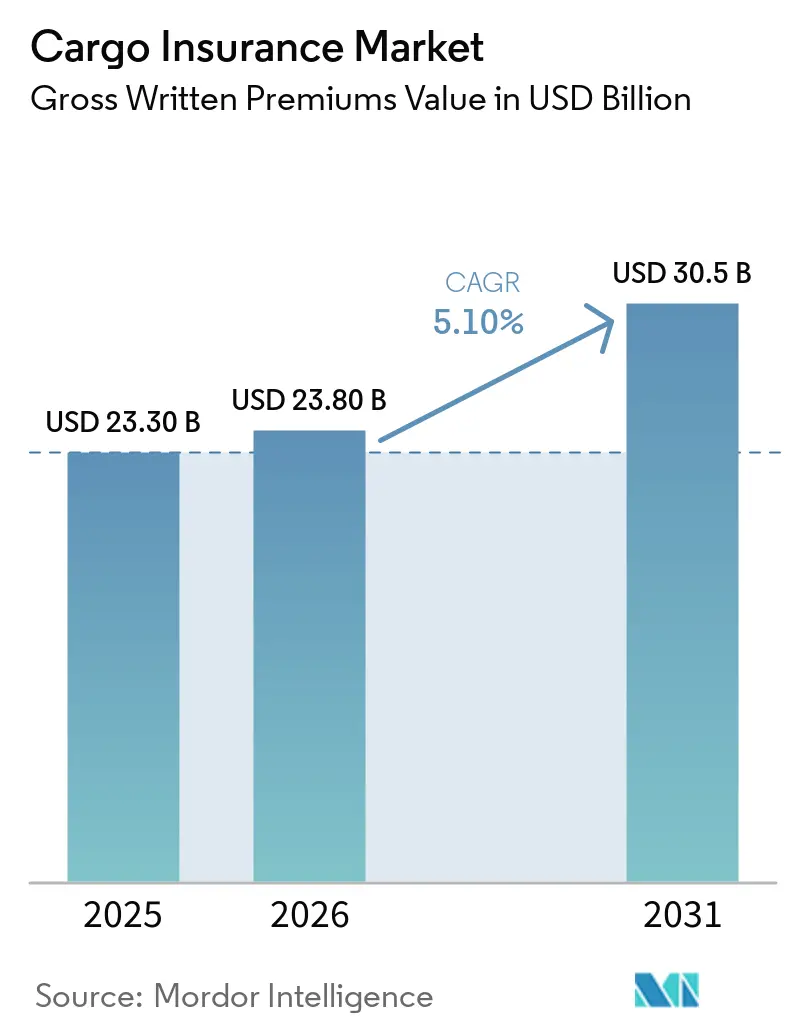
| Market Size (2026) | USD 23.80 Billion |
| Market Size (2031) | USD 30.5 Billion |
| Growth Rate (2026 - 2031) | 5.10 % |
| Fastest Growing Market | Asia-Pacific |
| Largest Market | Asia-Pacific |
| Market Concentration | Low |
Major Players *Disclaimer: Major Players sorted in no particular order Image © Mordor Intelligence. Reuse requires attribution under CC BY 4.0. | |
Cargo Insurance Market Analysis by Mordor Intelligence
The cargo insurance market, measured in terms of gross written premiums, was valued at USD 23.30 billion in 2025, is estimated at USD 23.80 billion in 2026, and is projected to reach USD 30.5 billion by 2031, registering a CAGR of 5.10% from 2026 to 2031. The cargo insurance market growth is supported by cross-border trade, supply-chain resilience investments, and increasing shipments of high-value and temperature-sensitive goods such as semiconductors and pharmaceuticals. Global merchandise trade volume increased 4.6% in 2025, although the World Trade Organization expects growth to moderate to 1.9% in 2026 amid tariff friction and geopolitical disruptions. Cargo premiums reached USD 22.64 billion in 2024, up 1.6% year on year, while improving loss ratios supported the technical attractiveness of the cargo insurance business. However, maritime corridor disruptions, cargo theft, fraud, sanctions exposure, and concentrated risks at ports are increasing underwriting complexity and demand for broader coverage across ocean, air, inland, storage, and conflict-related risks. Digital distribution and shipment-level data are also expanding access to cargo insurance, particularly for smaller shipments, while growing underwriting capacity is placing pressure on standard rates and increasing the importance of specialist capacity for complex risks.
Key Report Takeaways
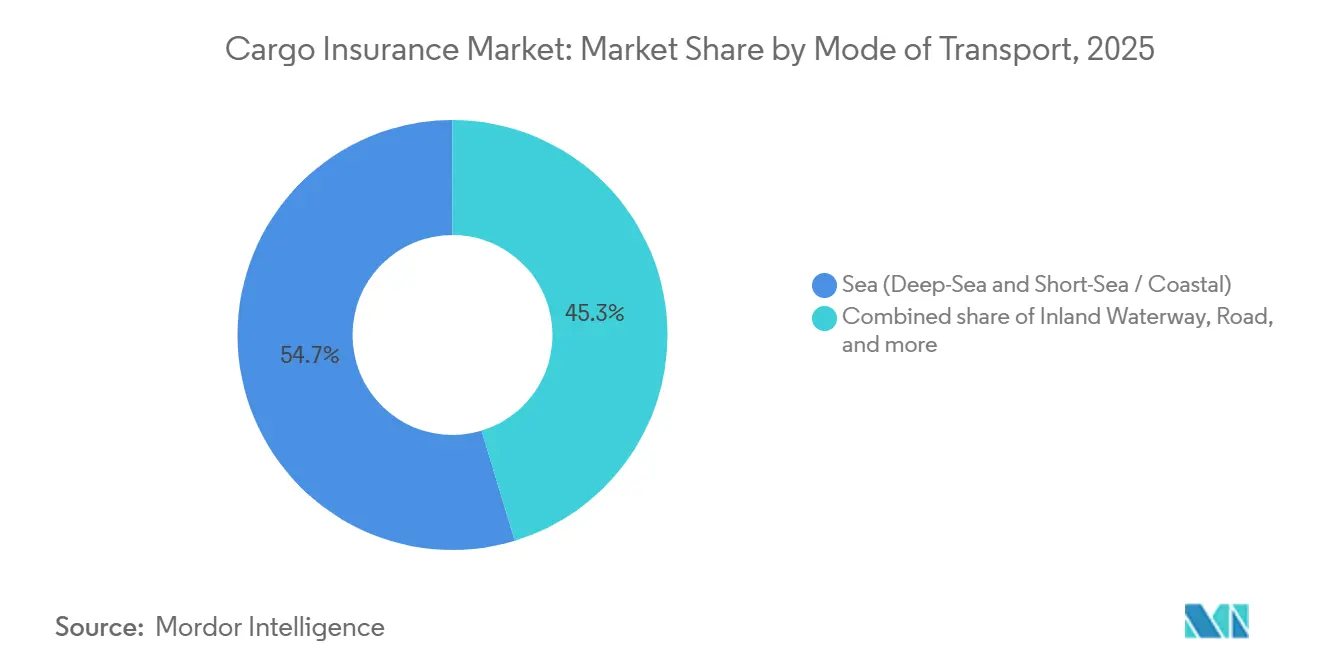
- By mode of transport, sea captured 54.7% of the cargo insurance market share in 2025, while air is projected to grow at 7.8% CAGR through 2031.
- By cargo profile, containerized cargo captured 47.6% of the cargo insurance market share in 2025, while project and heavy-lift cargo is projected to grow at 7.4% CAGR through 2031.
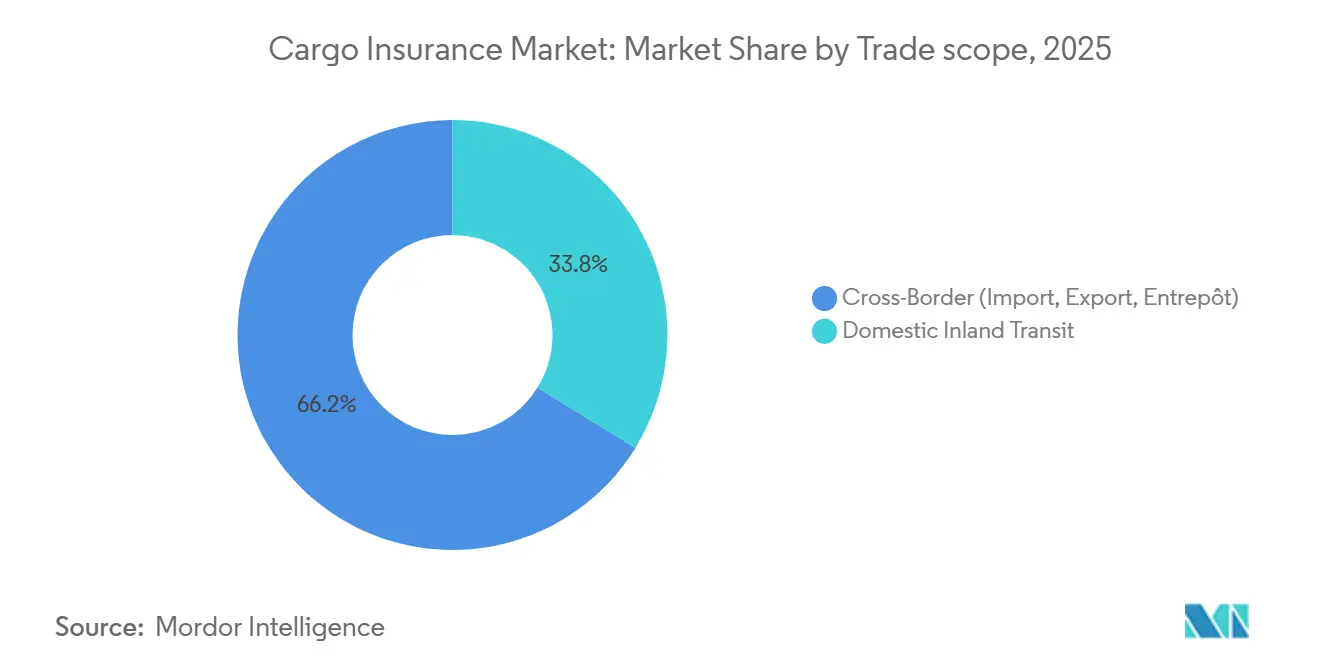
- By trade scope, cross-border shipments captured 66.2% of the cargo insurance market share in 2025, while domestic inland transit is projected to grow at 6.4% CAGR through 2031.
- By distribution channel, brokers and agents captured 74.1% of the cargo insurance market share in 2025, while online and digital platforms are projected to grow at 13.5% CAGR through 2031.
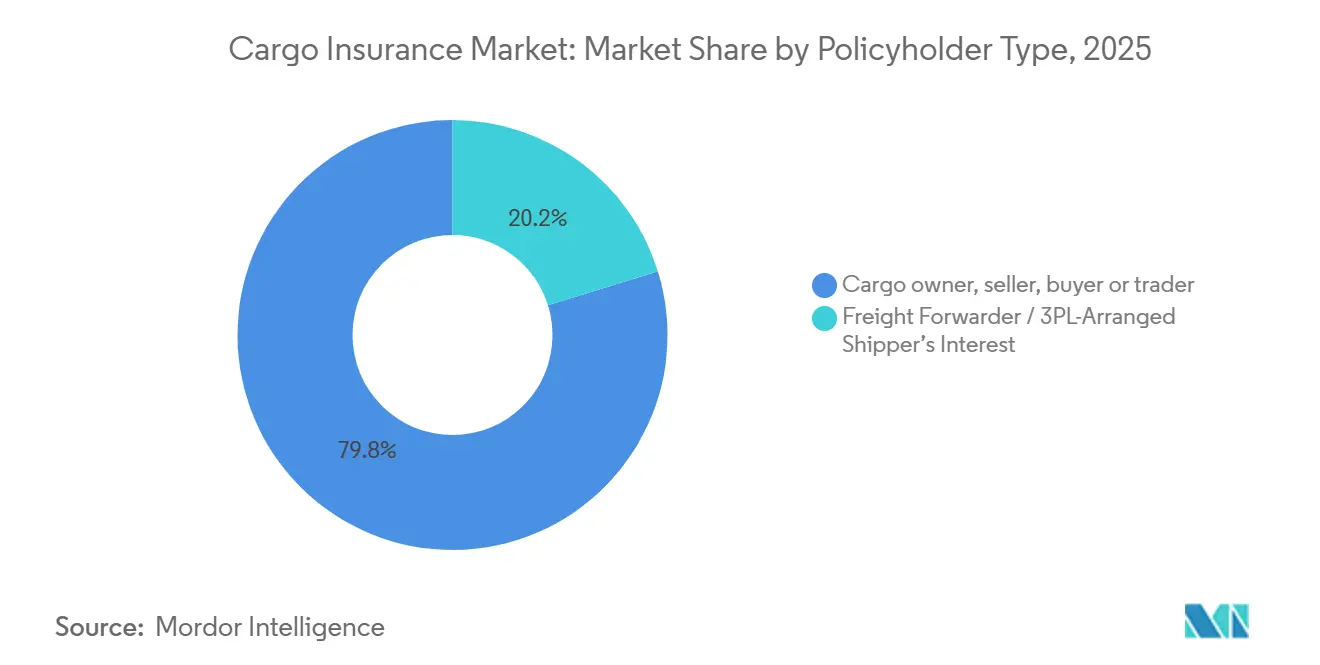
- By policyholder type, cargo owners, sellers, buyers, and traders captured 79.8% of the cargo insurance market share in 2025, while freight forwarders and third-party logistics providers, who arranged shippers’ interest policies, are projected to grow at 8.1% CAGR through 2031.
- By end-user industry, electronics and high-value manufactured goods captured 20.4% of the cargo insurance market share in 2025, while retail, consumer goods, and e-commerce are projected to grow at 8.4% CAGR through 2031.
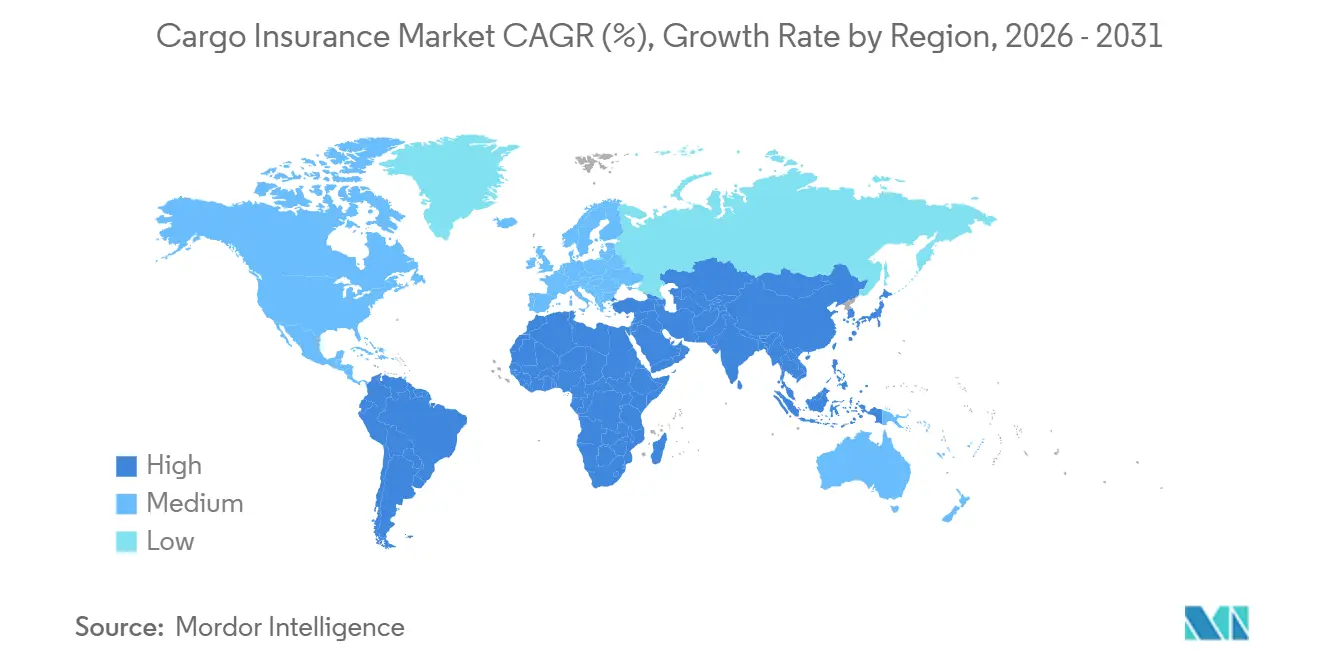
- By geography, Asia-Pacific captured 39.5% of the cargo insurance market share in 2025 and is projected to grow at 6.8% CAGR through 2031.
Note: Market size and forecast figures in this report are generated using Mordor Intelligence’s proprietary estimation framework, updated with the latest available data and insights as of January 2026.
Global Cargo Insurance Market Trends and Insights
Drivers Impact Analysis*
| Driver | (~) % Impact on CAGR Forecast | Geographic Relevance | Impact Timeline |
|---|---|---|---|
| Expansion of Cross-Border Trade and E-Commerce Shipments | +1.5% | Global, strongest in Asia-Pacific, North America, and the European Union | Short term (≤ 2 years) |
| Supply-Chain Complexity and Resilience Spending | +1.2% | Global, the strongest spillover in North America and the European Union | Medium term (2-4 years) |
| Growth of High-Value, Time-Sensitive, and Temperature-Controlled Cargo | +0.7% | Asia-Pacific, North America, and the European Union, with spillover to the Middle East and Africa | Medium term (2-4 years) |
| Digital Underwriting, Real-Time Visibility, and Automated Claims | +0.6% | Global, with early gains in core Asia-Pacific markets and the London market | Long term (≥ 4 years) |
| Embedded, Parametric, and Usage-Based Cargo Insurance Adoption | +0.4% | Global, with early adoption in North America and the European Union | Medium term (2-4 years) |
| Geopolitical Disruptions and Rising War-Risk Exposure Across Trade Routes | +0.5% | Global, particularly the Middle East, Red Sea, Black Sea, and other strategic maritime corridors | Short term (≤ 2 years) |
| Source: Mordor Intelligence | |||
Expansion of Cross-Border Trade and E-Commerce Shipments
Cross-border trade remains a major source of premium growth for the cargo insurance market. Global merchandise trade volume rose 4.6% in 2025, and worldwide merchandise exports reached USD 26.3 trillion. Trade-volume growth is estimated at 1.9% in 2026 as tariff friction and Middle East energy disruption weigh on shipments[1]. Higher shipment activity increases the number of cargo movements that require cover across origin, transit, destination, and storage points. Tariff-led front-loading in early 2026 also changed shipment timing, raising insured values and concentrating exposures at gateway ports. Cross-border e-commerce also creates frequent low-value parcel movements, where cover may be bought based on cost rather than replacement value. This pattern can leave large aggregate exposures in the shipper’s interest portfolios when losses affect many parcels at once.
Supply-Chain Complexity and Resilience Spending
Supply-chain resilience spending is changing the way corporations purchase cargo cover. A May 2026 survey by KPMG found that most companies allocated 11-15% of revenue to supply-chain operations, compared with 5-10% in 2024. The same survey found that 73% planned a comprehensive operating-model transformation within 36 months, while 51% identified risk management as the main objective. This spending supports demand for multinational programs that combine ocean cargo, inland transit, war-risk buyback, and digital shipment visibility. Zurich notes that multinational cargo programs can help businesses coordinate protection across complex supply chains[2]. These programs allow risk managers to align policy terms across countries rather than arrange isolated cover for each route. Nearshoring and route diversification extend a shipper’s exposure beyond a single ocean leg into several transport stages.
Growth of High-Value, Time-Sensitive, and Temperature-Controlled Cargo
The cargo insurance market benefits from the increasing share of high-value and time-sensitive freight. Air freight is the fastest-growing transport mode at a 7.8% CAGR through 2031 because it carries products with high insured values per kilogram. Pharmaceuticals represent more than USD 1 trillion in annual goods, and biologics and cell and gene therapies require controlled cold-chain logistics. IAG Cargo reported a 21% year-over-year increase in perishable cargo volumes during the first half of 2025. In September 2025, IAG Cargo added SkyCell 1500X active containers with 270 hours of independent temperature runtime to its pharmaceutical service[3]. Temperature deviations, contamination, and regulatory seizure can all affect the cover required for pharmaceutical cargo. Insurers with detailed commodity and loss information can price temperature, handling, and transit risks more accurately than insurers using broad commodity classifications.
Digital Underwriting, Real-Time Visibility, and Automated Claims
Digital underwriting is changing access to smaller and more frequent cargo risks. Parsyl launched Chauncey for Brokers in March 2026 to automate elements of the marine cargo submission process. The company stated that the tool had automated more than 80 tasks and reduced submission-to-quote time by 70%[4]. Real-time tracking and sensor data can give underwriters a clearer view of shipment conditions during transit. This information supports faster claims handling and can help insurers develop embedded, parametric, and usage-based products. It can also improve the information available when a shipment is delayed, damaged, or diverted. Digital records can support a more consistent review of route, cargo, and shipment conditions before a policy is issued. The same information can help brokers identify missing details before they submit a risk to an underwriter. The cargo insurance market is likely to distinguish more clearly between risks that can be processed through standardized data and risks that require specialist review.
Restraints Impact Analysis*
| Restraint | (~) % Impact on CAGR Forecast | Geographic Relevance | Impact Timeline |
|---|---|---|---|
| Regulatory Fragmentation and Documentation Complexity | -0.7% | Global, most acute on multimodal routes across several jurisdictions | Medium term (2-4 years) |
| Cyber Fraud, Cargo Theft, and Data-Quality Risk | -0.6% | North America and the European Union, with spillover to the Asia-Pacific | Short term (≤ 2 years) |
| Accumulation Risk at Ports, Canals, Hubs, and Battery-Cargo Corridors | -0.5% | Global, highest at Asia-Pacific and European Union gateway ports, and the Gulf corridor | Short term (≤ 2 years) |
| Climate-Driven Physical Damage and Extreme-Weather Volatility | -0.4% | Global, particularly hurricane-exposed North America, flood-prone Asia-Pacific and European trade corridors | Medium term (2–4 years) |
| Source: Mordor Intelligence | |||
Regulatory Fragmentation and Documentation Complexity
Cargo cover operates across carrier liability conventions that can apply different limits and dispute processes. Multimodal shipments can involve road, sea, and air conventions during a single journey, which can leave uncertainty at handover points. The Joint War Committee expanded its Listed Areas in March 2026 to include the Persian Gulf, Strait of Hormuz, and Gulf of Oman. This added notification and premium adjustment requirements for underwriters with cargo exposure in the region. Sanctions screening under the Office of Foreign Assets Control, the European Union, and the United Kingdom Office of Financial Sanctions Implementation rules also requires continuing checks across the trade chain. These rules apply to counterparties, shipment routes, and the goods being moved. They can delay the placement process when trade documentation is incomplete or requires further review. These duties can create a heavier administrative burden for smaller exporters and can sustain underinsurance in emerging markets.
Cyber Fraud, Cargo Theft, and Data-Quality Risk
Cyber-enabled cargo theft is an immediate underwriting concern for the cargo insurance market. The Federal Bureau of Investigation Internet Crime Complaint Center reported USD 725 million in estimated cargo theft losses in the United States and Canada during 2025. The reported figure was 60% higher than in 2024, while average loss per theft increased 36% to USD 273,990. Criminals use digital freight platforms, forged identities, and compromised email systems to target shipments. These methods allow theft to occur before a shipment reaches the carrier or after its details have been altered. Munich Re Specialty found that nearly 30% of United States incidents were fraud-driven and that 22% of global incidents involved insider participation. Incomplete commodity, routing, and counterparty information can make these losses harder to prevent and price.
*Our forecasts treat driver/restraint impacts as directional, not additive. The impact forecasts reflect baseline growth, mix effects, and variable interactions.
Segment Analysis
By Mode of Transport: Sea Holds Premium Volume While Air Raises Value per Policy
Sea transport held 54.7% of the overall cargo insurance market in 2025. Ocean shipping carries 80% of global merchandise trade volume, which supports a large base of open-cover business for marine underwriters. Large ocean accounts can be managed through established accumulation limits and policy schedules. Road, rail, and inland waterway transport support domestic movement and regional freight corridors. These modes are gaining relevance where manufacturing moves closer to final markets and where cross-border trucking replaces longer ocean routes. The result is a broader set of transit points that need to be reflected in policy declarations and exposure management.
Air transport is projected to grow at 7.8% CAGR through 2031, the fastest rate among transport modes. Semiconductors, biologics, and precision industrial equipment increase the insured value attached to air shipments. Such cargo can carry insurance values that are 3-5 times higher per kilogram than standard containerized goods. The 2026 Strait of Hormuz disruption redirected some cargo from sea routes to air and overland alternatives. This movement increased war-risk charges and raised air-mode premium exposure within a short period. The cargo insurance market, therefore, requires flexible capacity across transport modes when major routes become disrupted. Air coverage also requires attention to handling, packaging, temperature, and declared-value controls.
By Cargo Profile: Containerized Cargo Leads While Project Cargo Requires Bespoke Cover
Containerized cargo held 47.6% of the segment in 2025. Standardized container shipping enables insurers to use container-level accumulation limits and consistent reporting practices. Dry bulk and liquid bulk business covers energy, agriculture, and petrochemical flows. These classes are often managed through survey requirements and cargo-specific policy conditions. Their underwriting approach differs from the all-risk protection commonly sought for higher-value manufactured goods. Containerized business remains central because it combines large shipment volumes with established reporting and declaration processes.
Project, heavy-lift, and out-of-gauge cargo is projected to grow at 7.4% CAGR through 2031. Wind turbine blades, transformer equipment, and large battery storage assets require tailored transport and insurance arrangements. The standard Institute Cargo Clauses do not address every exposure created by unusual dimensions, long transit periods, and specialized handling. IUMI noted in March 2026 that project sites can concentrate high-value out-of-gauge inventory at ports for long periods. This can increase the size of a single event loss in congested terminals. The cargo insurance industry needs detailed site, route, and handling assessments for these shipments. Coverage decisions also depend on whether specialized lifting equipment and storage conditions are available at each stage.
By Trade Scope: Cross-Border Business Leads While Domestic Transit Expands
Cross-border shipments accounted for 66.2% of the overall cargo premium base in 2025. Import, export, and entrepôt movements carry multi-jurisdiction documentation requirements and may require cover across carriers and storage stages. Insured values can also be affected by currency exposure and changing commodity prices. These factors make cross-border cargo more complex to arrange and administer than a single domestic transit. The breadth of these exposures supports its leading position within the cargo insurance market. Shippers also need cover to remain consistent when cargo passes between carriers, ports, warehouses, and final inland destinations.
Domestic inland transit is forecast to grow at 6.4% CAGR through 2031. E-commerce distribution, nearshored manufacturing, and growing rail corridors in China, India, and North America support this growth. Maersk states that standard war-risk cover can stop at the port gate, leaving inland truck and rail movements exposed to spillover conflict risk. Specialist underwriters are responding with inland war-risk extensions. Carrier liability limits for road freight can also leave a gap between statutory recovery and cargo value. This supports demand for complementary all-risk policies. Inland cover is therefore important where the insured journey continues beyond a major port or airport.
By Distribution Channel: Brokers Lead While Digital Platforms Improve Access
Brokers and agents held 74.1% of the distribution segment in 2025. Their position reflects the importance of claims advocacy, risk advice, and multinational program design for complex placements. Brokers remain particularly relevant for project cargo, high-value electronics, and pharmaceutical risks. These risks need individual information and policy terms that do not fit a standardized online form. The cargo insurance market continues to rely on broker relationships for large and technically difficult accounts. Their role is strongest where insured values, commodity details, and liability arrangements require direct discussion with underwriters.
Online and digital platforms are expected to grow at 13.5% CAGR through 2031. Their expansion is linked to coverage embedded in freight booking systems, logistics software, and online checkout flows. FIATA partnered with Otonomi in 2026 to provide freight forwarders with instant delay and cargo insurance quotes using air waybill or bill of lading information. The arrangement moves some policy issuance from a manual exchange to a data-led process. Digital channels can make smaller risks more economical to serve. They do not replace the specialist judgment needed for complex cargo exposures.
By Policyholder Type: Cargo Owners Lead While Forwarder-Arranged Cover Grows Fastest
Cargo owners, sellers, buyers, and traders held 79.8% of the policyholder segment in 2025. Large corporations commonly use annual open-cover programs placed through specialist marine brokers. This structure allows regular shipments to be declared under a consistent policy framework. It also gives the policyholder control over insured values, terms, and claims support. Cargo owners, therefore, remain the main buyers of direct protection in the cargo insurance market. Their established shipping volumes also make annual policy structures practical for repeated movements across several trade lanes.
Freight forwarder and third-party logistics provider arranged shipper’s interest policies are forecast to grow at 8.1% CAGR through 2031. Forwarders use embedded cargo protection to differentiate their booking and logistics services. TT Club introduced Shipper’s Interest Cargo Insurance for freight forwarder members in the United Arab Emirates in February 2026. The pay-on-use and per-consignment structure removes minimum-premium barriers for smaller books. Adverse selection remains a risk if coverage is mainly selected for high-value shipments without full commodity disclosure. Insurers need accurate shipment information to ensure premium growth supports loss performance.
By End-User Industry: Electronics Lead While Retail and E-Commerce Broaden Demand
Electronics and high-value manufactured goods held 20.4% of the end-user segment in 2025. Their leading position reflects high unit values and sensitivity to static, vibration, and handling damage. Semiconductor production is concentrated in several Asia-Pacific manufacturing centers, which can create material accumulation exposures. Pharmaceuticals, chemicals, food, beverages, and agricultural products also create important premium pools. Their requirements vary between temperature, contamination, regulatory, and handling exposures. The range of commodity exposures means policy terms need to reflect the handling requirements of the goods being transported.
Retail, consumer goods, and e-commerce are projected to grow at 8.4% CAGR through 2031. Marketplace-led parcel shipments and high shipment frequency are expanding the number of goods in transit. Buyers increasingly expect shipment protection to be available during checkout. This makes coverage a more visible part of the purchase and fulfillment process. Energy and bulk commodities move at high volumes but often carry tight margins. Automotive and industrial equipment are important for out-of-gauge and roll-on roll-off cover. Construction and infrastructure owners are also creating specialist demand as renewable energy and data center projects require equipment to move between sites.
Geography Analysis
Asia-Pacific held 39.5% of the cargo insurance market size in 2025 and is projected to grow at 6.8% CAGR through 2031. Asia generated 60% of worldwide cargo premium growth in 2024. China contributed USD 3.99 billion in cargo premiums in 2024, while Japan contributed USD 1.33 billion and India contributed USD 422 million. China’s position is supported by e-commerce exports, return-shipping insurance programs, and intra-Asian manufacturing trade. India is expanding port capacity through the planned Vadhavan Port, which is expected to add 23.2 million twenty-foot equivalent units of container-handling capacity. This will increase the scale of domestic accumulation exposure. New manufacturing routes in the region also require insurers to assess the risk profile of ports, inland connections, and warehousing locations. Regional growth, therefore, reflects both trade expansion and the need for coverage suited to more varied logistics networks.
Vietnam, Indonesia, Thailand, Malaysia, and Singapore are gaining relevance as manufacturing diversification creates new trade routes. These routes require cargo insurance structures that reflect changing corridor exposures and local logistics practices. Europe remains a historic center for marine cargo underwriting capacity, including London, Hamburg, and Nordic markets. IUMI data showed European ultimate loss ratios improved from above 65% to below 45% between 2018 and 2024. This improvement supported technical profitability and attracted new managing general agents and insurtech capacity. KRAVAG reported 9.2% premium income growth in 2025 to nearly EUR 2 billion (USD 2.2 billion). European underwriters remain important where multinational programs require specialized capacity and established claims support. Their expertise remains relevant for complex international placements that involve several carriers and legal regimes.
North America faces a different set of pricing pressures. IUMI warned that United States tariffs could raise insured cargo values and accumulation risk by up to 50% at major gateway ports. Shippers may need to raise declared values to avoid underinsurance where commodity prices change. The Middle East and Africa have strategic importance beyond their present premium base. Allianz Commercial estimated that the 2026 Strait of Hormuz disruption stranded 1,150 cargo-carrying vessels, representing USD 125 billion in vessel and cargo value. The event showed that a single chokepoint can immobilize energy and general cargo within days. It also showed the limits of accumulation models that assume normal operating conditions. Emergency capacity arrangements demonstrate the importance of specialist war-risk cover when normal transit routes are unavailable. The cargo insurance market must account for how quickly a regional event can affect global cargo flows.
Competitive Landscape
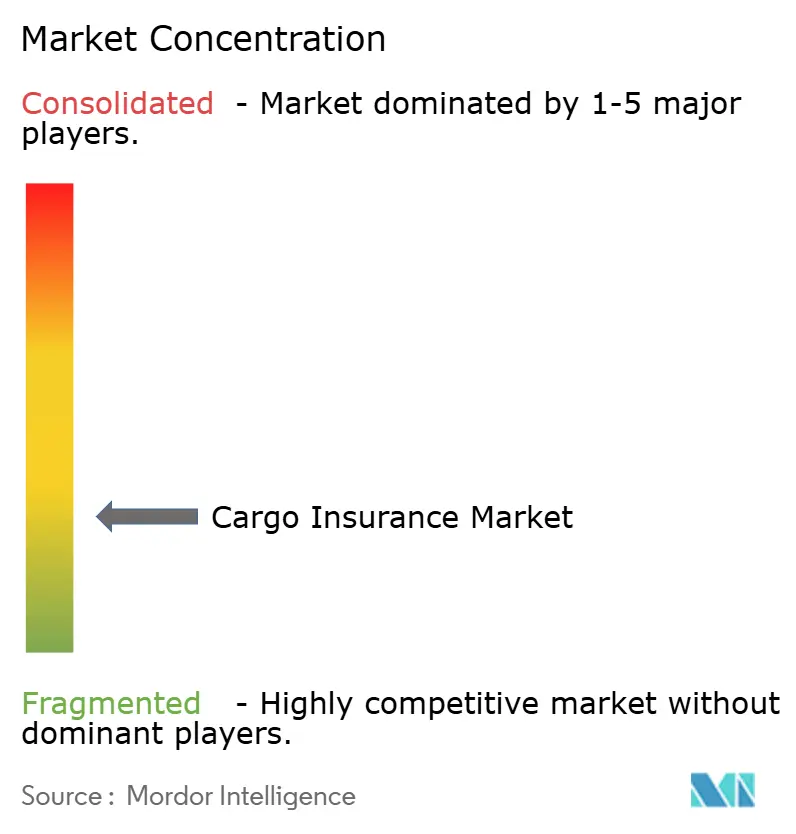
The cargo insurance market is fragmented. Allianz, Chubb, AXA XL, Lloyd’s syndicates, Zurich, and Tokio Marine maintain substantial portfolios across ocean, air, and inland cargo lines. These carriers combine a broad geographic reach with capacity for large accounts and complex cover. IUMI reported that additional capacity was encouraging some underwriters to accept larger risks at tighter premiums. This creates rate pressure for standard cargo business. Smaller mutual insurers, managing general agents, and insurtech providers compete by focusing on defined products, geographies, and customer groups. Their participation gives buyers more choices where the risk is too small, too specialized, or too data-intensive for a conventional placement. The difference between standard cargo and complex cargo business remains important to competitive positioning.
Technology is a key competitive factor outside the largest accounts. Parsyl uses data-led tools to reduce the time needed for broker submissions and quotations. FIATA’s 2026 partnership with Otonomi supports rapid digital quotes for forwarders handling delay and cargo risks. These models are relevant to pharmaceutical cold-chain, freight forwarding, and cargo-delay business. Larger insurers are also using partnerships to add technical capabilities and specialized distribution. Compliance with International Maritime Organization International Maritime Dangerous Goods requirements, Safety of Life at Sea verified gross mass rules, and sanctions rules is increasingly part of underwriting workflows. This links digital capability with risk control because underwriting decisions depend on complete shipment and counterparty data. It also raises the value of service providers that can place cover without losing the detail required for specialist risks.
Chubb acted as lead underwriter for the USD 40 billion DFC Gulf Maritime Insurance Facility, which expanded in April 2026. The facility added Travelers, Liberty Mutual, Berkshire Hathaway Specialty, AIG, Starr, and CNA as participants and covered eligible war hull, protection, and indemnity, and cargo risks. TT Club and the United Kingdom P&I Club signed a framework agreement in July 2026 to merge by February 20, 2027, subject to regulatory and member approvals. The agreement would create a larger global marine mutual insurance group. Competition, therefore, combines scale in capacity-intensive placements with specialized service in smaller and data-led segments. These developments show why established capital and specialist distribution can operate alongside one another in the cargo insurance market.
Cargo Insurance Industry Leaders
-
Allianz SE
-
American International Group, Inc.
-
Zurich Insurance Group
-
AXA XL
-
Chubb Limited
- *Disclaimer: Major Players sorted in no particular order
Recent Industry Developments
- July 2026: TT Club and the United Kingdom P&I Club signed a framework agreement to merge by February 20, 2027, subject to regulatory and member approvals. Their joint offer to acquire shared management company Thomas Miller Holdings is backed by a majority of shareholders, with completion expected in Q4 2026, creating one of the largest global marine mutual insurance groups.
- April 2026: The United States DFC and Chubb expanded the Gulf Maritime Insurance Facility from USD 20 billion to USD 40 billion. The facility added Travelers, Liberty Mutual, Berkshire Hathaway Specialty, AIG, Starr, and CNA as participants. It covers war hull, protection and indemnity, and cargo risks for eligible vessels.
- March 2026: Parsyl launched “Chauncey for Brokers,” a chat-based risk-submission tool for marine cargo brokers. The tool automated more than 80 internal tasks and reduced submission-to-indicative-quote time by 70%.
- February 2026: TT Club launched Shipper’s Interest Cargo Insurance for United Arab Emirates-based freight forwarder members. The pay-on-use, per-consignment policy supports smaller forwarder books that were previously affected by minimum-premium barriers.
Global Cargo Insurance Market Report Scope
| Sea (Deep-Sea and Short-Sea / Coastal) |
| Inland Waterway |
| Road |
| Rail |
| Air |
| Containerized Cargo |
| Dry Bulk Cargo |
| Liquid Bulk Cargo |
| Break-Bulk and General Cargo |
| Project, Heavy-Lift and Out-of-Gauge |
| Rolling Cargo / Ro-Ro |
| Cross-Border (Import, Export, Entrepôt) |
| Domestic Inland Transit |
| Brokers and Agents |
| Direct Insurers |
| Online and Digital Platforms |
| Cargo Owner, Seller, Buyer or Trader |
| Freight Forwarder / 3PL-Arranged Shipper’s Interest |
| Food, Beverage, and Agri-Commodities |
| Energy and Bulk Commodities |
| Chemicals and Pharmaceuticals |
| Automotive and Industrial Equipment |
| Electronics and High-Value Manufactured Goods |
| Retail, Consumer Goods, and E-Commerce |
| Construction and Infrastructure Project Owners |
| Others |
| North America | United States |
| Canada | |
| Mexico | |
| South America | Brazil |
| Argentina | |
| Rest of South America | |
| Europe | United Kingdom |
| Germany | |
| France | |
| Italy | |
| Spain | |
| Rest of Europe | |
| Asia-Pacific | China |
| Japan | |
| India | |
| South Korea | |
| Australia | |
| Indonesia | |
| Thailand | |
| Malaysia | |
| Singapore | |
| Vietnam | |
| Rest of Asia-Pacific | |
| Middle East and Africa | Saudi Arabia |
| United Arab Emirates | |
| Turkey | |
| South Africa | |
| Egypt | |
| Rest of Middle East and Africa |
| By Mode of Transport | Sea (Deep-Sea and Short-Sea / Coastal) | |
| Inland Waterway | ||
| Road | ||
| Rail | ||
| Air | ||
| By Cargo Profile | Containerized Cargo | |
| Dry Bulk Cargo | ||
| Liquid Bulk Cargo | ||
| Break-Bulk and General Cargo | ||
| Project, Heavy-Lift and Out-of-Gauge | ||
| Rolling Cargo / Ro-Ro | ||
| By Trade Scope | Cross-Border (Import, Export, Entrepôt) | |
| Domestic Inland Transit | ||
| By Distribution Channel | Brokers and Agents | |
| Direct Insurers | ||
| Online and Digital Platforms | ||
| By Policyholder Type | Cargo Owner, Seller, Buyer or Trader | |
| Freight Forwarder / 3PL-Arranged Shipper’s Interest | ||
| By End-User Industry | Food, Beverage, and Agri-Commodities | |
| Energy and Bulk Commodities | ||
| Chemicals and Pharmaceuticals | ||
| Automotive and Industrial Equipment | ||
| Electronics and High-Value Manufactured Goods | ||
| Retail, Consumer Goods, and E-Commerce | ||
| Construction and Infrastructure Project Owners | ||
| Others | ||
| By Geography | North America | United States |
| Canada | ||
| Mexico | ||
| South America | Brazil | |
| Argentina | ||
| Rest of South America | ||
| Europe | United Kingdom | |
| Germany | ||
| France | ||
| Italy | ||
| Spain | ||
| Rest of Europe | ||
| Asia-Pacific | China | |
| Japan | ||
| India | ||
| South Korea | ||
| Australia | ||
| Indonesia | ||
| Thailand | ||
| Malaysia | ||
| Singapore | ||
| Vietnam | ||
| Rest of Asia-Pacific | ||
| Middle East and Africa | Saudi Arabia | |
| United Arab Emirates | ||
| Turkey | ||
| South Africa | ||
| Egypt | ||
| Rest of Middle East and Africa | ||
Key Questions Answered in the Report
What is the projected size of the cargo insurance market by 2031?
The cargo insurance market is forecast to reach USD 30.5 billion by 2031, expanding at a 5.1% CAGR from 2026.
Which transport mode leads cargo insurance demand?
Sea transport led with 54.7% share in 2025, supported by the large volume of goods moved through ocean shipping.
Which cargo insurance channel is growing fastest?
Online and digital platforms are projected to grow at 13.5% CAGR through 2031 as coverage becomes embedded in logistics systems.
Why is air cargo cover expanding quickly?
Air cargo is forecast to grow at 7.8% CAGR through 2031 because pharmaceuticals, semiconductors, and precision equipment carry high insured values.
Which region leads global cargo insurance demand?
Asia-Pacific held 39.5% share in 2025 and is projected to grow at 6.8% CAGR through 2031. China, Japan, and India were important contributors to regional cargo premium growth.
What risks are changing cargo insurance terms?
Cyber-enabled theft, fraud, sanctions requirements, port accumulation, and disruption in the Strait of Hormuz are affecting underwriting and coverage design. These risks can affect insured values, claims experience, and the availability of specialist capacity.