
Carbon-Neutral Materials Market Size and Share
Market Overview
| Study Period | 2021 - 2031 |
|---|---|
| Market Size (2026) | USD 157.16 Million |
| Market Size (2031) | USD 248.09 Million |
| Growth Rate (2026 - 2031) | 9.56 % |
| Fastest Growing Market | Asia-Pacific |
| Largest Market | Asia-Pacific |
| Market Concentration | Medium |
Major Players *Disclaimer: Major Players sorted in no particular order Image © Mordor Intelligence. Reuse requires attribution under CC BY 4.0. | |
Carbon-Neutral Materials Market Analysis by Mordor Intelligence
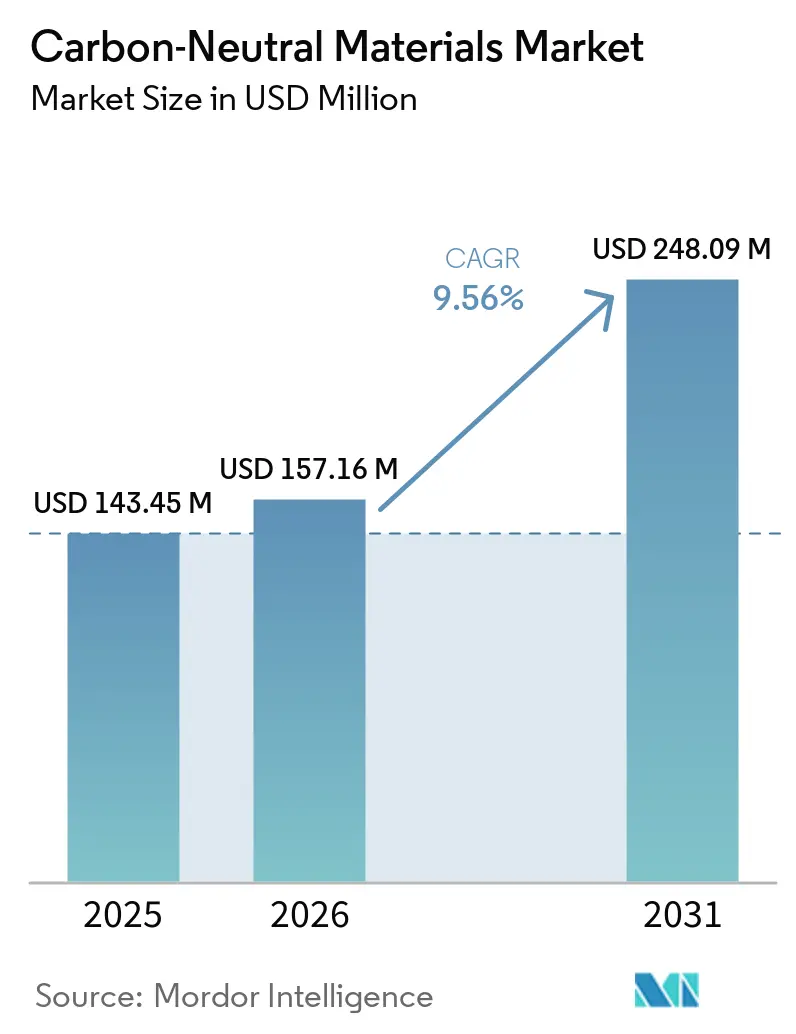
The Carbon-Neutral Materials Market size was valued at USD 143.45 million in 2025 and is estimated to grow from USD 157.16 million in 2026 to reach USD 248.09 million by 2031, at a CAGR of 9.56% during the forecast period (2026-2031). The carbon-neutral materials market is being shaped by procurement rules that turn lower embodied-carbon performance into a contract requirement for public projects. The European Union’s Net-Zero Industry Act guidance issued in July 2026 requires contracting authorities to consider non-price criteria, including sustainability and resilience, in relevant procurement decisions. Carbon-neutral materials suppliers are also facing a more formal reporting environment as product carbon data moves from voluntary disclosure toward a condition of building and manufacturing specifications. This favors companies that can provide certified environmental data, secure lower-carbon feedstocks, finance plant upgrades, and maintain performance consistency for customers. It also increases the value of product documentation because specifications, tender reviews, and customer purchasing decisions may rely on the same verified carbon information. The carbon-neutral materials market, therefore, presents opportunities for integrated producers, specialized material suppliers, and technology providers that can reduce emissions without disrupting product performance.
Key Report Takeaways
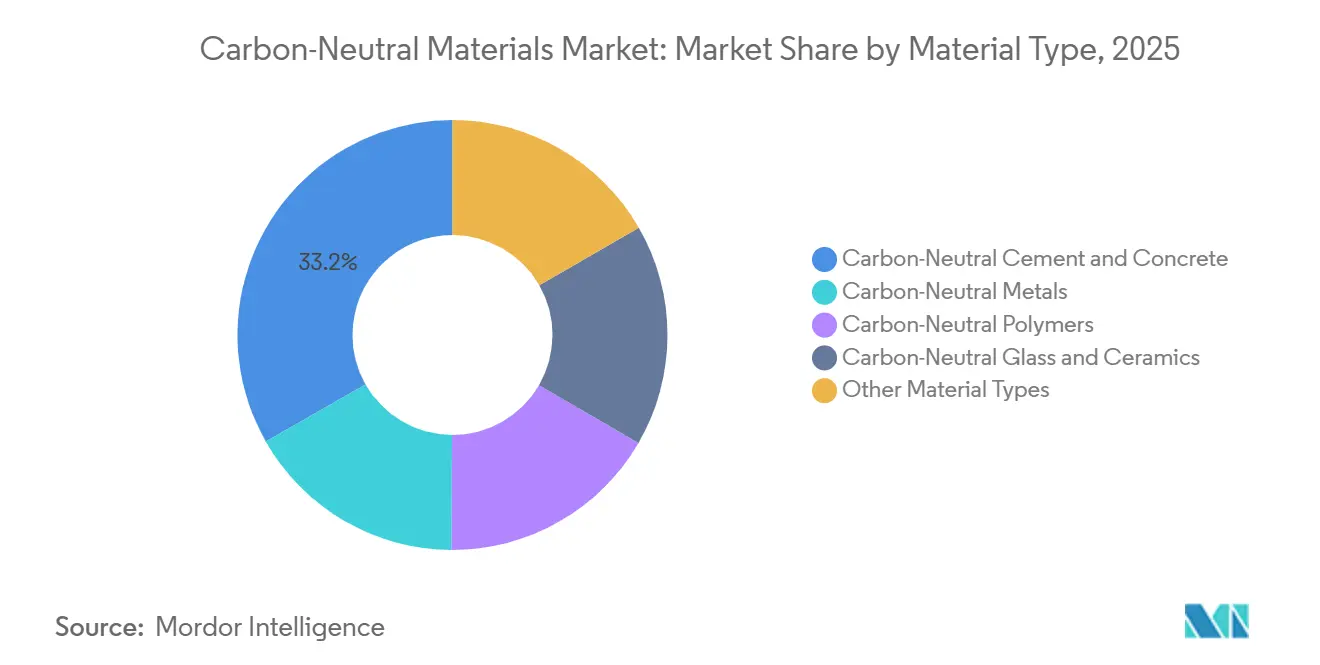
- By material type, carbon-neutral cement and concrete held 33.24% of the carbon-neutral materials market share in 2025, while carbon-neutral polymers are projected to advance at a 10.34% CAGR through 2031.
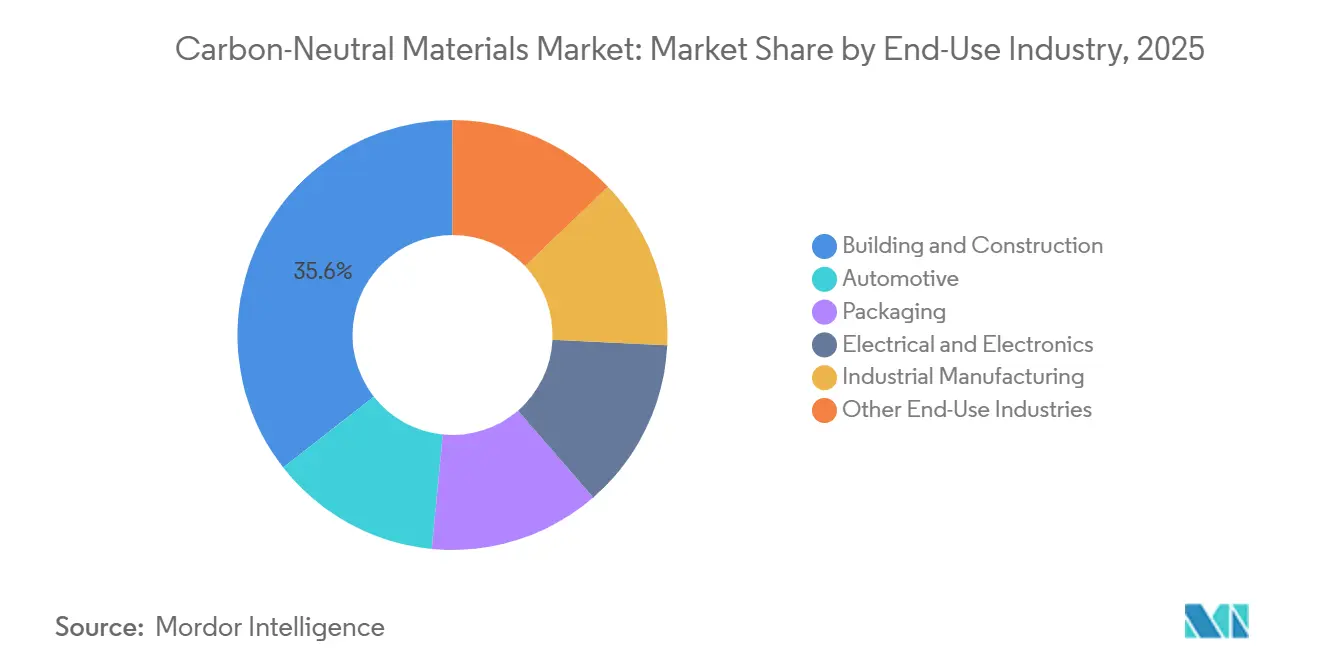
- By end-use industry, building and construction held 35.57% of the carbon-neutral materials market share in 2025, while automotive is projected to advance at a 10.78% CAGR through 2031.
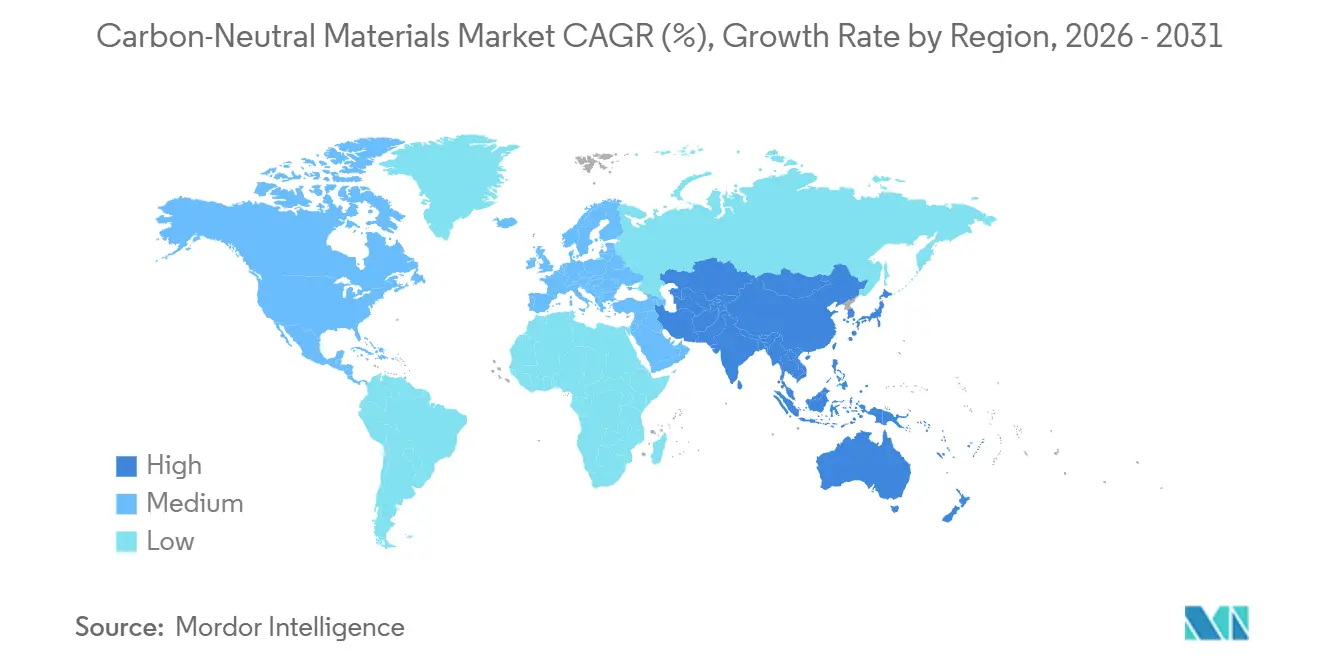
- By geography, Asia-Pacific held 37.72% of the carbon-neutral materials market share in 2025 and is projected to advance at a 10.11% CAGR through 2031.
Note: Market size and forecast figures in this report are generated using Mordor Intelligence’s proprietary estimation framework, updated with the latest available data and insights as of January 2026.
Market Trends and Insights
Drivers Impact Analysis of Carbon-Neutral Materials Market*
| Driver | (~) % Impact on CAGR Forecast | Geographic Relevance | Impact Timeline |
|---|---|---|---|
| Regulatory Decarbonization Mandates and Buy-Clean Procurement | +2.8% | Global, with concentrated impact in North America and EU | Short term (≤ 2 years) |
| Green-Building Certification and Embodied-Carbon Disclosure | +2.1% | North America, EU, APAC (Japan, South Korea, Australia) | Short term (≤ 2 years) |
| Corporate Scope 3 Commitments and Sustainable Product Premiums | +1.7% | Global, led by EU and North America multinationals | Medium term (2–4 years) |
| Carbon-Capture, Utilization and Mineralization Scale-Up | +1.3% | North America, EU, APAC core | Medium term (2–4 years) |
| Digital Product Passports and Verifiable Material Traceability | +0.9% | EU (primary), with spillover to export-dependent APAC and North America | Medium term (2–4 years) |
| Source: Mordor Intelligence | |||
Regulatory Decarbonization Mandates and Buy-Clean Procurement
Legally binding procurement rules are supporting adoption across the carbon-neutral materials market. California’s Buy Clean California Act applied Global Warming Potential (GWP) limits to structural steel, concrete reinforcing steel, flat glass, and insulation in public works from January 1, 2025. Washington State extended comparable requirements from July 1, 2025, to state construction contracts over 100,000 gross square feet. In July 2026, European Commission guidance under the Net-Zero Industry Act directed authorities to use non-price criteria in public procurement[1]. These measures make environmental product declarations central to supplier qualification. Producers that establish verified product data can use that documentation across a growing set of public procurement processes.
Green-Building Certification and Embodied-Carbon Disclosure
Green-building systems are making embodied-carbon performance more important in project specifications. Leadership in Energy and Environmental Design version 5 (LEED v5) became mandatory for new project registrations on July 1, 2026, and its Whole Building Life Cycle Assessment requirement applies to every project in the cited rating system. California finalized reporting requirements that require manufacturers of Phase 1 building materials to submit embodied-carbon information for the 2026 calendar year. The revised Energy Performance of Buildings Directive requires life cycle GWP disclosure for new buildings above 1,000 square meters from January 2028 and for all new buildings from 2030. This connects factory-level carbon measurement with the documentation needed for building compliance. The carbon-neutral materials market benefits when suppliers can provide consistent environmental product declarations early in project design and construction, and buyers can compare verified data before material selection.
Corporate Scope 3 Commitments and Sustainable Product Premiums
Automotive and industrial buyers are increasing demand for materials that support Scope 3 Category 1 emissions targets. The Organisation for Economic Co-operation and Development (OECD) reported in 2025 that steel users, including automotive groups, had incorporated hydrogen-based procurement into their supply-chain decarbonization strategies. This creates distinct purchasing requirements for polymers, steel, aluminum, glass, and cement. Consumer packaged goods companies need certified lower-carbon plastics and glass, while capital-goods manufacturers focus on steel and aluminum. Suppliers that align product certification with these application-specific needs can serve customers seeking traceable emissions reductions. The carbon-neutral materials market is therefore likely to reward targeted commercial approaches rather than a uniform low-carbon product offer.
Carbon-Capture, Utilization and Mineralization Scale-Up
Carbon capture, utilization, and mineralization (CCUM) offer a route to reduce cement and concrete process emissions. Heidelberg Materials AG began construction planning for its GeZero project in Geseke, Germany, in 2026, and the project is designed to capture 700,000 metric tons of carbon dioxide per year. The project is intended to support fully decarbonized cement production by 2029. CCUM is particularly relevant because calcination emissions cannot be eliminated through fuel switching alone. Concrete mineralization systems can also support lower cement use while keeping established mix specifications. The carbon-neutral materials market gains a practical deployment pathway when capture technology, transport, storage, verified product performance, and customer acceptance are developed together.
Restraints Impact Analysis of Carbon-Neutral Materials Market*
| Restraint | (~) % Impact on CAGR Forecast | Geographic Relevance | Impact Timeline |
|---|---|---|---|
| Green Premium and High Conversion Capital Intensity | -2.4% | Global, most pronounced in North America and developing APAC markets | Short term (≤ 2 years) |
| Feedstock Scarcity and Fragmented Low-Carbon Supply Chains | -1.6% | Global, with acute impacts in APAC and MEA | Medium term (2–4 years) |
| Performance Certification and Fragmented Standards | -1.0% | Global, with highest impact in cross-border trade corridors | Medium term (2–4 years) |
| Source: Mordor Intelligence | |||
Green Premium and High Conversion Capital Intensity
The price difference between lower-carbon and conventional materials remains a barrier to adoption in the carbon-neutral materials market. The China Council for International Cooperation on Environment and Development found that green premiums for building materials such as cement and glass reached 139% above conventional production costs in recent years. Capital requirements are especially challenging for producers converting established industrial assets. SSAB AB secured funding in green financing in April 2025 for its fossil-free mini-mill in Luleå, Sweden. Access to public support, long-term offtake agreements, and structured financing can determine whether a plant conversion moves forward. This can favor companies with established lender relationships over companies relying only on corporate balance sheets.
Feedstock Scarcity and Fragmented Low-Carbon Supply Chains
Reliable access to bio-based, recycled, and fossil-free feedstocks remains a structural constraint for polymer and metal producers. The International Energy Agency (IEA) reported that supply disruptions in 2026 affected mineral processing costs and highlighted the concentration of critical material supply chains[2]. The agency also reported that China processed more than 70% of lithium, cobalt, graphite, and rare earths in the supply chains covered by its 2026 assessment. This concentration can raise costs and complicate supply planning for low-carbon production. Producers need multi-year offtake arrangements and geographic diversification instead of relying on spot purchases. These measures can improve supply resilience but may increase procurement complexity in the carbon-neutral materials market and require closer coordination between procurement, production, and customer teams.
*Our forecasts treat driver/restraint impacts as directional, not additive. The impact forecasts reflect baseline growth, mix effects, and variable interactions.
Carbon-Neutral Materials Market Segment Analysis
By Material Type:
Carbon-Neutral Cement and Concrete Anchor Scale While Carbon-Neutral Polymers Drive Premium GrowthCarbon-neutral cement and concrete held 33.24% of total revenue in 2025. The carbon-neutral materials market relies on this material group because construction is exposed to embodied-carbon requirements, public procurement rules, and the need for producers to document product-level carbon performance. Cement manufacturing produces substantial process emissions from calcination, so it has become a priority for regulation, plant conversion, and carbon-capture investment. HOLCIM reported that ECOPlanet low-carbon cement represented 36% of cement net sales in 2025, while ECOPact green concrete accounted for 31% of ready-mix concrete net sales. These results showed that a branded lower-carbon offer can gain demand when it is supported by certification, sales coverage, and project specifications.
Carbon-neutral polymers are projected to advance at a 10.34% CAGR through 2031. The segment is supported by automaker emissions targets, European product rules, and demand for materials that meet performance requirements in demanding applications. BASF launched Ultramid LowPCF and Ultramid ZeroPCF polyamide grades in June 2025 for automotive, electronics, and industrial uses without requiring customer reformulation. Braskem’s October 2025 life-cycle assessment updates covered its bio-based polyethylene portfolio and reported a net carbon dioxide benefit of 4.7 kilograms of carbon dioxide equivalent per kilogram for polyethylene (PE) wax. International Sustainability and Carbon Certification PLUS (ISCC PLUS) is becoming important for biomass-balanced material claims and can become a supply-chain entry requirement rather than only a product differentiator.

By End-Use Industry:
Building and Construction Maintains Scale Leadership as Automotive Redefines Material SpecificationsBuilding and construction held 35.57% of total revenue in 2025. The carbon-neutral materials market is closely tied to this segment because construction is exposed to Buy-Clean mandates, LEED v5 requirements, European building disclosure rules, and public tender processes that increasingly require validated environmental data. Construction procurement cycles can extend over several years, which gives certified suppliers more predictable demand after environmental product declaration requirements enter tender documents. Cement and concrete serve major structural applications, while metals support structural requirements, and lower-carbon flat glass serves curtainwall and glazing systems. Packaging, electrical and electronics, and industrial manufacturing also represent meaningful demand, where environmental product declaration-linked procurement expanded into nonconstruction contracts.
Automotive is projected to advance at a 10.78% CAGR through 2031. The carbon-neutral materials market serves this segment through high-performance polymers used in battery enclosures, thermal management systems, and lightweight interior panels, as well as lower-carbon steel for vehicle structures. These uses require materials that meet demanding functional requirements. The OECD stated in 2025 that automotive-related steel users had integrated hydrogen projects into supply-chain decarbonization plans. The recast European Union End-of-Life Vehicles Regulation is expected to require minimum recycled-content thresholds for new vehicles.
Geography Analysis
APAC Carbon-Neutral Materials Market
Asia-Pacific held 37.72% of total revenue in 2025 and is projected to advance at a 10.11% CAGR through 2031. The carbon-neutral materials market in the region reflected demand from China, India, Japan, and South Korea, as well as extensive cement, steel, chemicals, and manufacturing capacity. India’s infrastructure pipeline can support demand for certified construction materials, while Japan and South Korea have strengthened embedded-carbon reporting and industrial decarbonization activity. In June 2026, POSCO Holdings Inc. completed a 2.5-million-metric-ton electric arc furnace at Gwangyang Works, which was designed to reduce carbon dioxide emissions by up to 75% compared with conventional blast furnace production. The scale of regional manufacturing gives suppliers a large potential base for lower-carbon product qualification and deployment.
North America and Europe Carbon-Neutral Materials Market
North America retained its position through federal and state Buy-Clean programs and electric arc furnace capacity. The carbon-neutral materials market in the region benefits from clearer public construction qualification requirements, which require producers to prepare verifiable environmental product data. California and Washington State established these requirements for public construction materials. Europe remained supported by the Carbon Border Adjustment Mechanism, Innovation Fund programs, and digital product documentation. The European Commission launched the Digital Product Passport Registry in July 2026 under Regulation (EU) 2024/1781, creating technical infrastructure for verified material traceability.
MEA and South America Carbon-Neutral Materials Market
South America remained at an earlier stage, with Braskem’s I’m green bio-based polymer platform in Brazil serving as an important export asset. The Middle-East and Africa also remained at an earlier stage of mandatory embodied-carbon adoption, although Saudi Arabia’s Vision 2030 construction pipeline and South Africa’s green infrastructure commitments were creating initial demand signals. The carbon-neutral materials market can expand in these regions as procurement standards become more specific and reporting capability develops alongside production capacity. The carbon-neutral materials market will depend on local project requirements, available feedstocks, and suppliers’ ability to meet certification needs. Cross-border suppliers will need product data that meets destination-market requirements. These conditions can favor early partnerships between local project developers, material producers, and certification providers.
Competitive Landscape
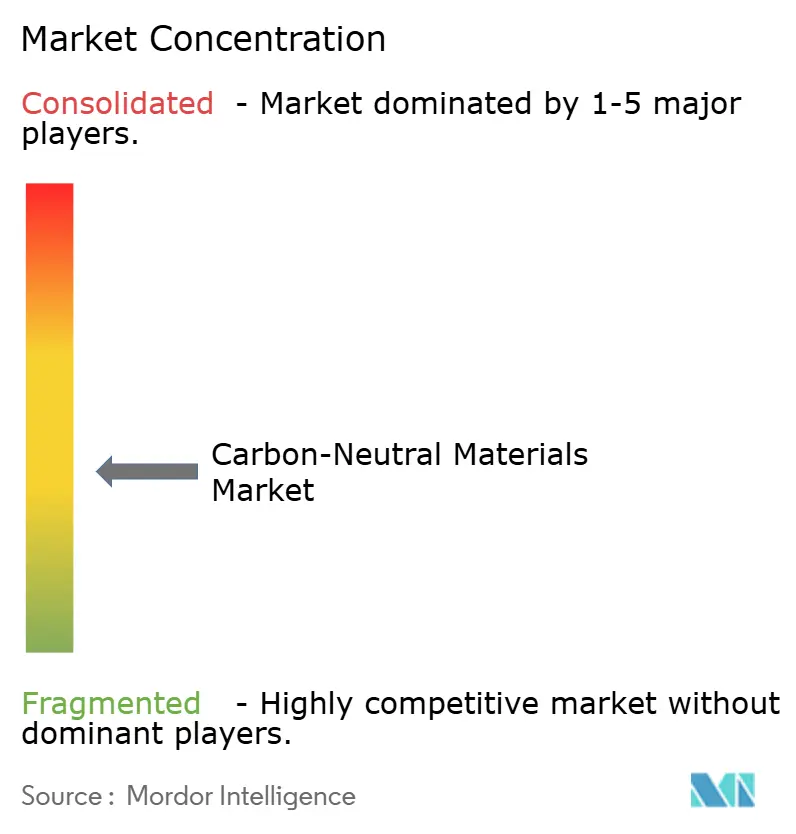
The carbon-neutral materials market is moderately concentrated, with the top five players including HOLCIM, Heidelberg Materials AG, ArcelorMittal, Saint-Gobain, and BASF. BASF, Covestro AG, Braskem, and LG Chem compete through product carbon footprint, polymer technology, and certification coverage. Competition is increasing as buyers seek more verified lower-carbon materials and compare suppliers on evidence as well as price. Companies with product data, production assets, and established customer relationships can respond more quickly to these requirements.
Integrated producers are investing in large plant projects that address different material pathways. The carbon-neutral materials market is being shaped by these projects because they can add certified supply for major construction and manufacturing customers. ArcelorMittal confirmed a EUR 1.3 billion (approximately USD 1.55 billion) investment in an electric arc furnace at Dunkirk, France, with commissioning targeted for 2029. HOLCIM broke ground on its EUR 400 million (approximately USD 476 million) OLYMPUS project in Greece, designed to produce 2 million metric tons of near-zero cement annually from 2029. SSAB AB and Heidelberg Materials AG announced an April 2026 project to develop electric arc furnace slag into a supplementary cementitious material, using a steelmaking by-product as a lower-carbon binder input.
Specialized companies are pursuing carbon dioxide mineralization, lower-carbon polymers, glass, and ceramics, where lower-capital approaches can complement major industrial projects. The carbon-neutral materials market can also support focused entrants that solve a specific certification, mineralization, or feedstock problem. Vateris and Paebbl are developing carbon-storing concrete applications with lower capital requirements than complete carbon-capture retrofits. BASF and Braskem have expanded certified polymer offerings for automotive and packaging customers, combining lower product carbon footprints with documented life-cycle data. European carbon border measures can favor suppliers with verifiable domestic or regional lower-carbon supply chains.
Carbon-Neutral Materials Industry Leaders
-
HOLCIM
-
Heidelberg Materials AG
-
ARCELORMITTAL
-
Saint-Gobain
-
BASF
- *Disclaimer: Major Players sorted in no particular order
Carbon-Neutral Materials Market Companies Covered in this Report
- ARCELORMITTAL
- BASF
- Braskem
- Cemex S.A.B DE C.V.
- Covestro AG
- Heidelberg Materials AG
- HOLCIM
- LG Chem
- Nucor Corporation
- POSCO Holdings Inc.
- Saint-Gobain
- Sika AG
- SSAB AB
- Tata Steel Limited
- thyssenkrupp AG
Recent Industry Developments in Carbon-Neutral Materials Market
- April 2026: SSAB and Heidelberg Materials launched a project to develop electric arc furnace (EAF) slag into a supplementary cementitious material (SCM), creating a lower-carbon alternative binder for cement. The initiative supports circular use of industrial by-products while reducing the carbon footprint of cement and construction materials.
- February 2026: ArcelorMittal confirmed a EUR 1.3 billion (approximately USD 1.55 billion) investment in a 2-million-metric tons-per-year EAF at Dunkirk, France, with commissioning targeted for 2029 and emissions of around 0.6 metric tons of CO₂ per metric ton of steel. The project supports the shift toward lower-carbon steel production and increases the availability of materials with reduced embodied carbon.
Global Carbon-Neutral Materials Market Report Scope
Carbon-neutral materials are materials produced, processed, or sourced with measures that minimize or offset associated greenhouse gas emissions across their lifecycle. They support efforts to reduce the carbon footprint of products and manufacturing processes while enabling industries to progress toward lower-emission production systems.
The Carbon-Neutral Materials Market is segmented by material type, end-use industry, and geography. By material type, the market is segmented into carbon-neutral cement and concrete, carbon-neutral metals, carbon-neutral polymers, carbon-neutral glass and ceramics, and other material types. By end-use industry, the market is segmented into building and construction, automotive, packaging, electrical and electronics, industrial manufacturing, and other end-use industries. The report also covers the market size and forecasts for carbon-neutral materials in 15 countries across major regions. For each segment, the market sizing and forecasts have been done on the basis of value (USD).
Segmentation Overview
| Carbon-Neutral Cement and Concrete |
| Carbon-Neutral Metals |
| Carbon-Neutral Polymers |
| Carbon-Neutral Glass and Ceramics |
| Other Material Types |
| Building and Construction |
| Automotive |
| Packaging |
| Electrical and Electronics |
| Industrial Manufacturing |
| Other End-Use Industries |
| Asia-Pacific | China |
| India | |
| Japan | |
| South Korea | |
| Rest of Asia-Pacific | |
| North America | United States |
| Canada | |
| Mexico | |
| Europe | Germany |
| United Kingdom | |
| France | |
| Italy | |
| Rest of Europe | |
| South America | Brazil |
| Argentina | |
| Rest of South America | |
| Middle-East and Africa | Saudi Arabia |
| South Africa | |
| Rest of Middle-East and Africa |
| By Material Type | Carbon-Neutral Cement and Concrete | |
| Carbon-Neutral Metals | ||
| Carbon-Neutral Polymers | ||
| Carbon-Neutral Glass and Ceramics | ||
| Other Material Types | ||
| By End-Use Industry | Building and Construction | |
| Automotive | ||
| Packaging | ||
| Electrical and Electronics | ||
| Industrial Manufacturing | ||
| Other End-Use Industries | ||
| By Geography | Asia-Pacific | China |
| India | ||
| Japan | ||
| South Korea | ||
| Rest of Asia-Pacific | ||
| North America | United States | |
| Canada | ||
| Mexico | ||
| Europe | Germany | |
| United Kingdom | ||
| France | ||
| Italy | ||
| Rest of Europe | ||
| South America | Brazil | |
| Argentina | ||
| Rest of South America | ||
| Middle-East and Africa | Saudi Arabia | |
| South Africa | ||
| Rest of Middle-East and Africa | ||
Key Questions Answered in the Report
What is the size of the carbon-neutral materials market?
The carbon-neutral materials market stands at USD 157.16 million in 2026 and is projected to reach USD 248.09 million by 2031.
What is driving demand for carbon-neutral materials?
Buy-clean procurement rules, building disclosure requirements, and corporate Scope 3 targets are increasing demand for certified lower-carbon products.
Which material type led the market demand in 2025?
Carbon-neutral cement and concrete held 33.24% of total revenue in 2025.
Which end-use industry is projected to grow fastest through 2031?
Automotive is projected to advance at a 10.78% CAGR through 2031, supported by demand for lower-carbon polymers and metals.