
Carbon Nanotube Reinforced Polymers Market Size and Share
Market Overview
| Study Period | 2022 - 2032 |
|---|---|
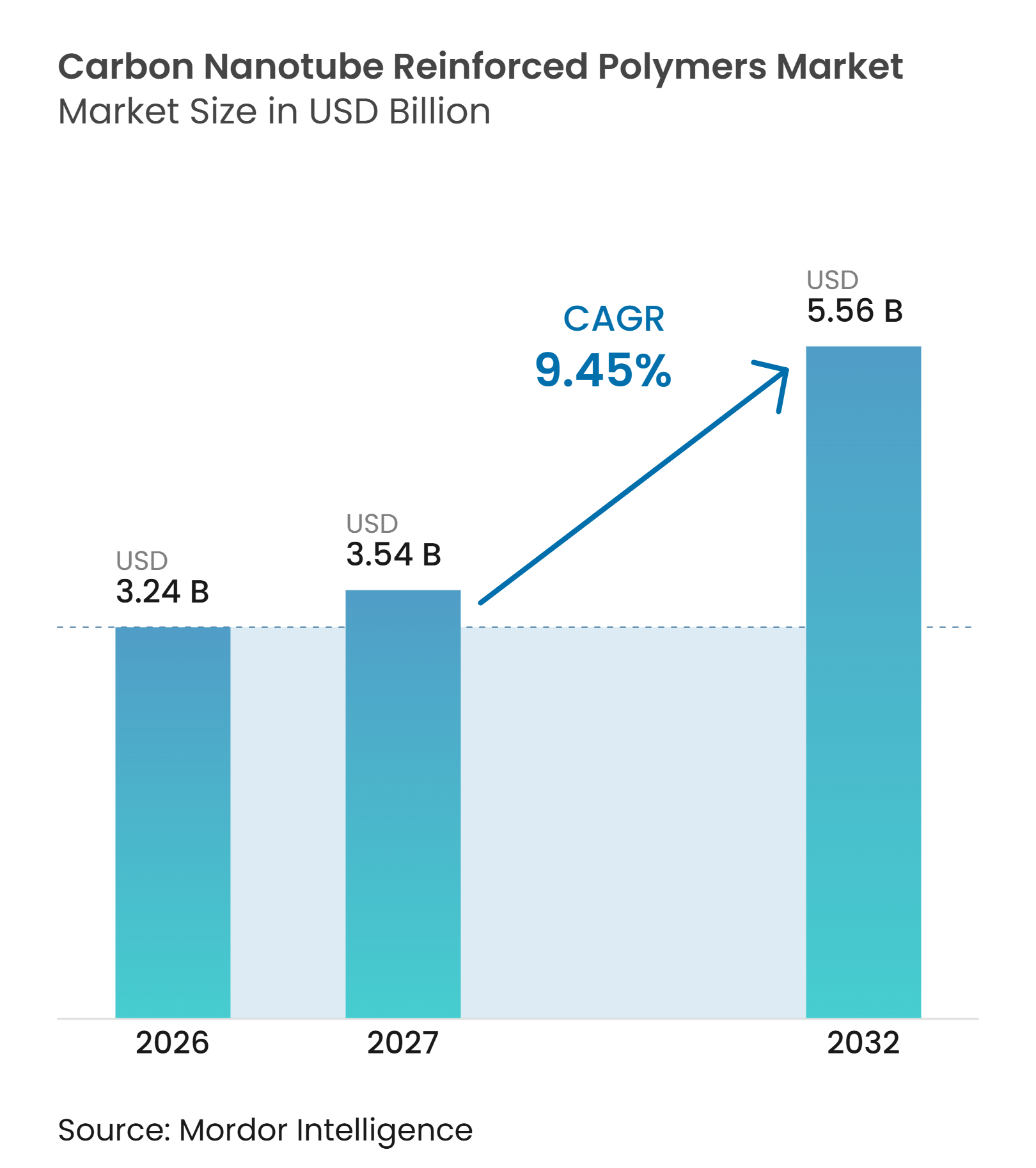
| Market Size (2027) | USD 3.54 Billion |
| Market Size (2032) | USD 5.56 Billion |
| Growth Rate (2027 - 2032) | 9.45 % |
| Fastest Growing Market | Asia-Pacific |
| Largest Market | Asia-Pacific |
| Market Concentration | Low |
Major Players *Disclaimer: Major Players sorted in no particular order Image © Mordor Intelligence. Reuse requires attribution under CC BY 4.0. | |
Carbon Nanotube Reinforced Polymers Market Analysis by Mordor Intelligence
The Carbon Nanotube Reinforced Polymers market size was valued at USD 3.24 billion in 2026 and is estimated to grow from USD 3.54 billion in 2027 to USD 5.56 billion by 2032, at a CAGR of 9.45% during the forecast period (2027-2032). Electrification is increasing demand for conductive polymer additives in batteries, power electronics, and related infrastructure. Manufacturers are replacing heavier metal and glass components with lightweight composites in mobility and aerospace applications. Commercial-scale production of single-walled carbon nanotubes is improving the availability of materials for higher-performance compounds. The same end uses often require conductivity, electromagnetic shielding, and lower component weight, supporting demand across multiple applications. Producers are responding with investments in nanotube production, dispersion technology, and masterbatch capacity.
Key Report Takeaways
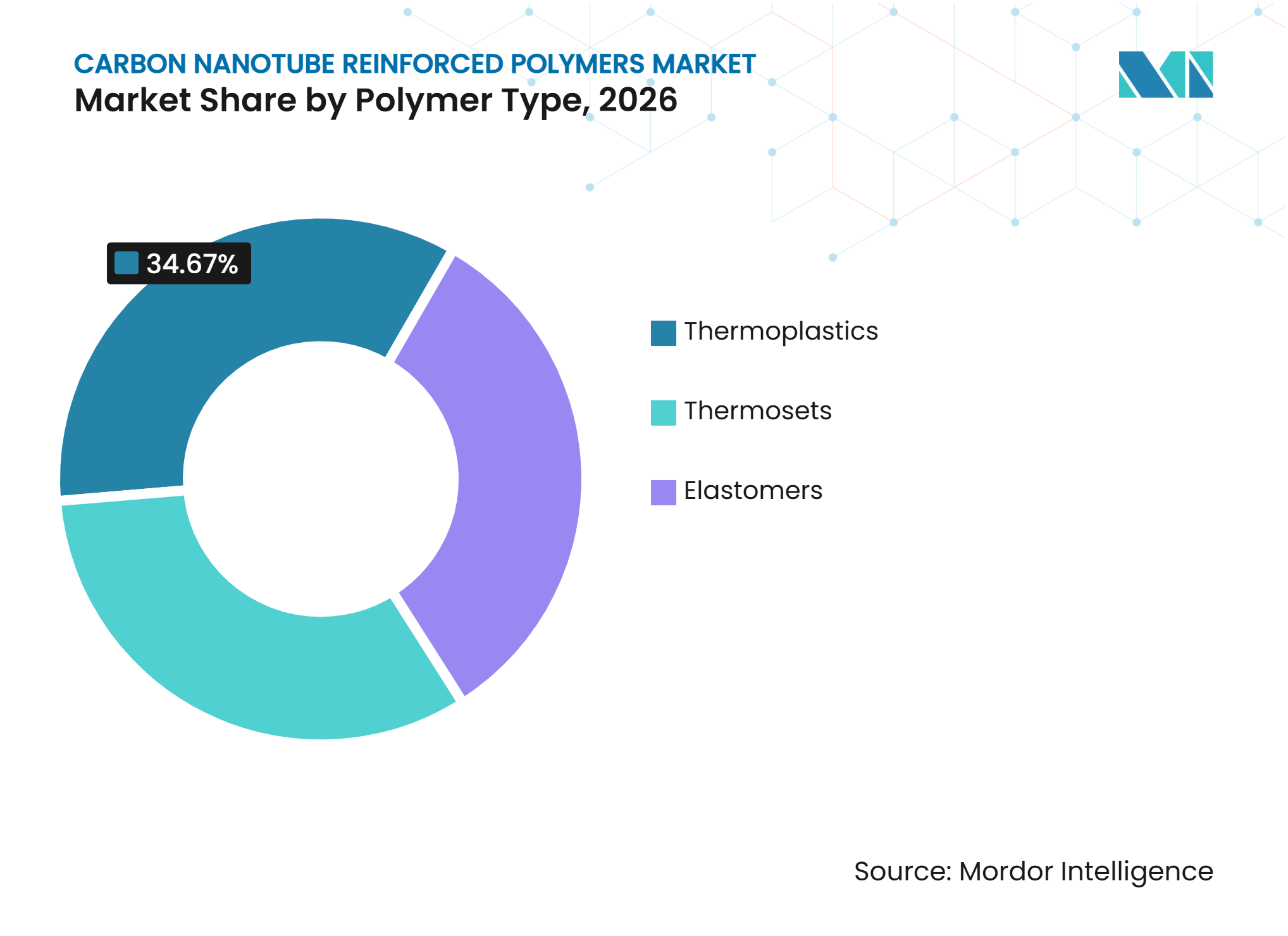
- By polymer type, thermoplastics held a 34.67% share in 2026, while thermosets are forecast to grow at a 10.14% CAGR through 2032.
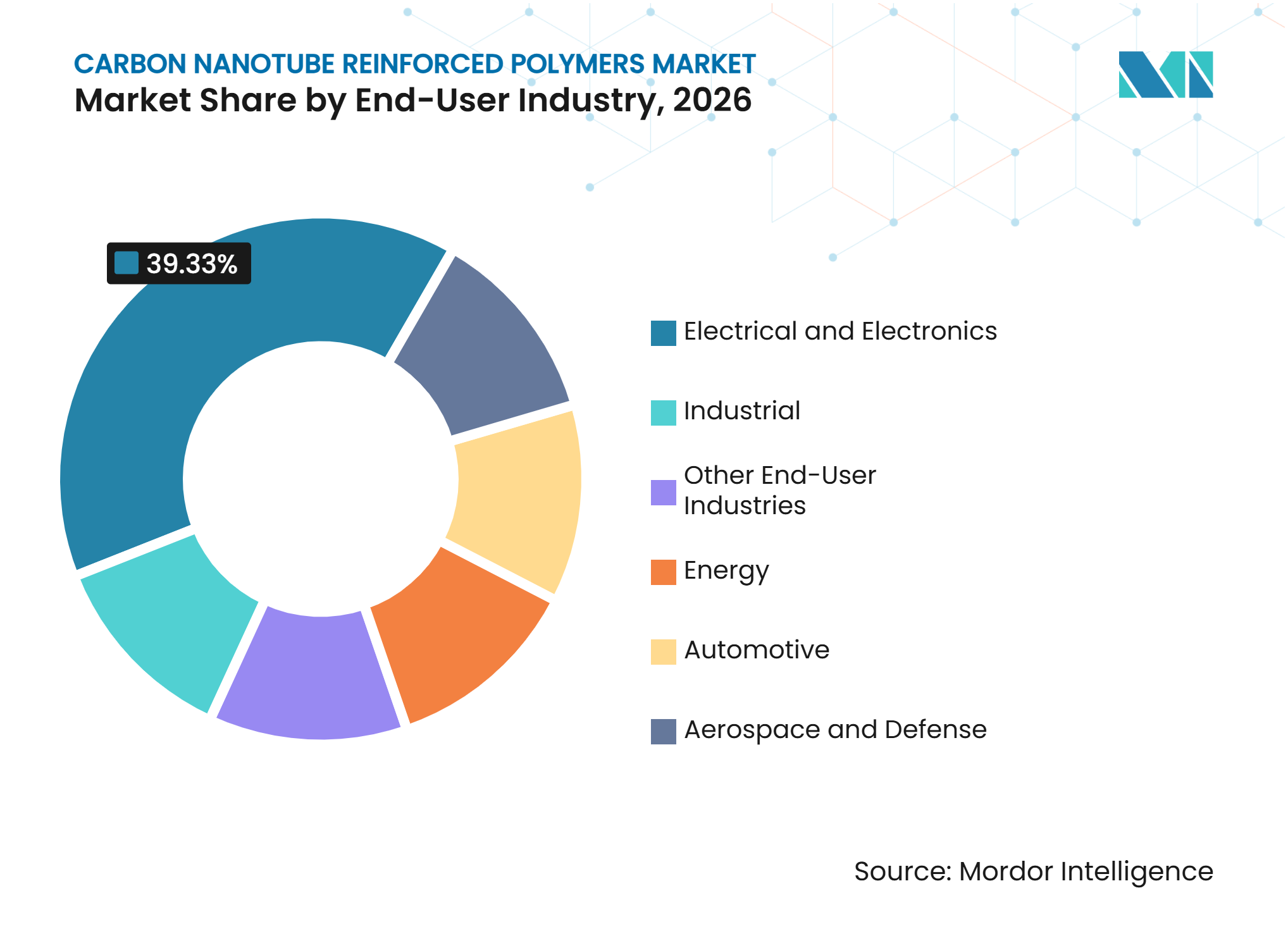
- By end-user industry, electrical and electronics held a 39.33% share in 2026, while energy is forecast to grow at a 10.67% CAGR through 2032.
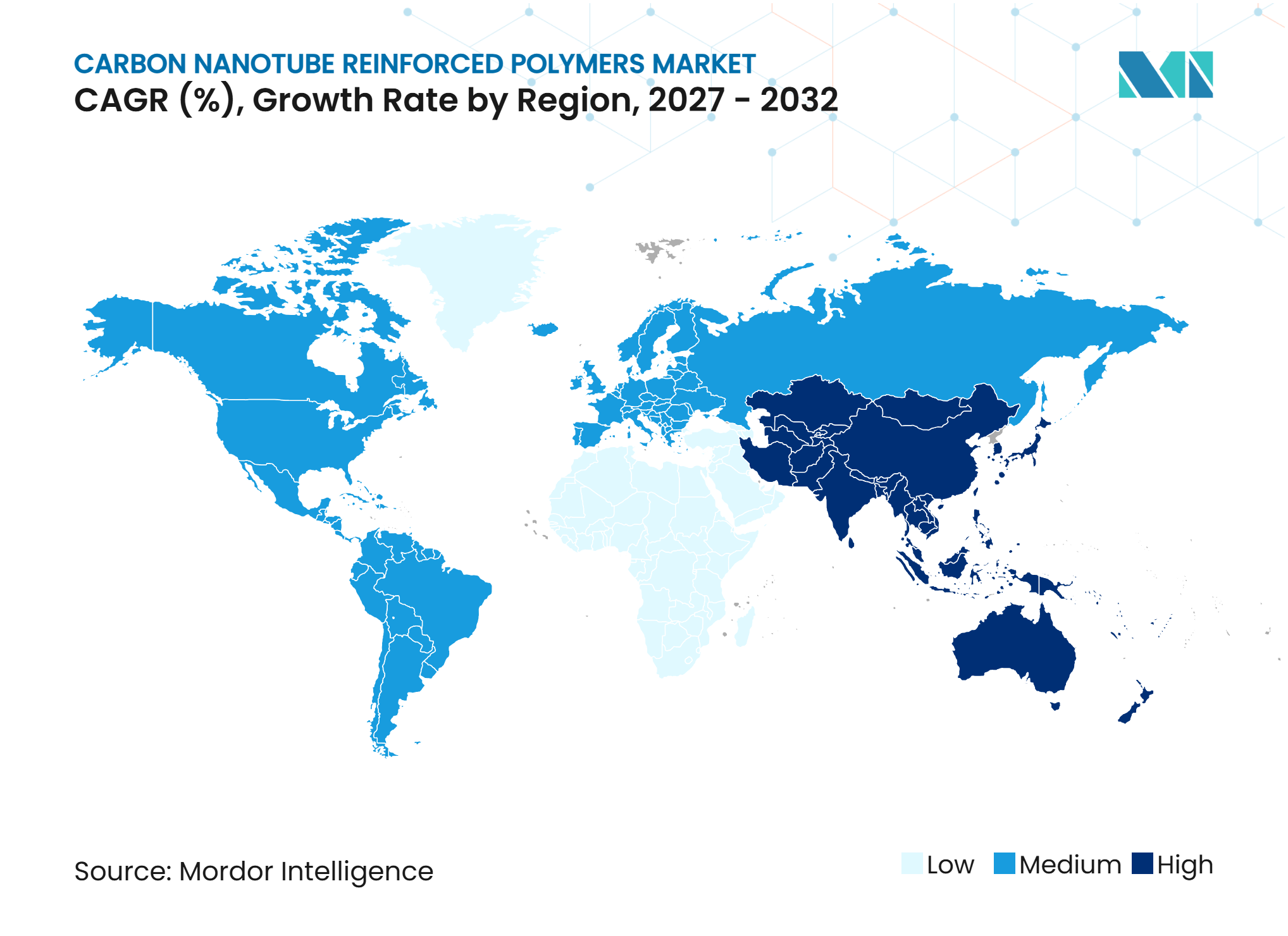
- By geography, Asia-Pacific accounted for 56.12% of the market in 2026 and is forecast to grow at a CAGR of 10.43% through 2032.
Note: Market numbers in this report are based on Mordor Intelligence's proprietary estimation framework, which combines nine months of actuals with Q4 projections for base year 2026.
Market Trends and Insights
Drivers Impact Analysis of Carbon Nanotube Reinforced Polymers Market*
| Drivers | (~) % Impact on CAGR Forecast | Geographic Relevance | Impact Timeline |
|---|---|---|---|
| Lightweight multifunctional performance in mobility and aerospace | +2.1% | Global, concentrated in North America, Europe, and Japan | Medium term (2-4 years) |
| Conductive polymer demand for Electromagnetic Interference (EMI), Electrostatic Discharge (ESD), and thermal management | +2.3% | Global, strongest in China, South Korea, Japan, and North America | Short term (≤ 2 years) |
| Energy storage and battery conductive-network requirements | +2.5% | Asia-Pacific, North America, and the EU | Short term (≤ 2 years) |
| Low-loading property gains and process compatibility improvements | +1.4% | Global | Medium term (2-4 years) |
| Discrete, dispersed, and functionalized CNTs for additive manufacturing | +1.0% | North America, the EU, and emerging Asia-Pacific activity | Long term (≥ 4 years) |
| Source: Mordor Intelligence | |||
Energy Storage and Battery Conductive-Network Requirements
Battery electrodes are a major application for nanotube conductive networks because the networks maintain electron pathways during repeated charge and discharge cycles. Carbon black does not always provide the same network stability at equivalent loading levels. Jiangsu Cnano reported shipments of 1,500 metric tons of CNT slurry for solid-state and semi-solid-state battery customers from January through August 2025. Single-walled products represented 70% of that shipment quantity, indicating demand beyond pilot-stage cell programs. China produced 1,175 GWh of lithium-ion batteries in 2024, representing 32.60% year-on-year growth. The EU Battery Regulation requires performance and sustainability disclosures, which increases the value of measures that can improve battery cycle life. Larger battery quantities can also improve the economics of dispersion pastes used in the carbon nanotube reinforced polymers market.
Conductive Polymer Demand for EMI, ESD, and Thermal Management
Electronics producers require polymer housings with reliable shielding at processable viscosities. This requirement has strengthened the role of the carbon nanotube reinforced polymers market in high-frequency electronics, where conventional carbon-black grades can fall short. IEC TS 62607-11-1:2025 provides a near-field probe method for measuring the shielding effectiveness of nanomaterials, thereby giving procurement teams a common basis for product specifications and laboratory testing[1]. Avient states that its Stat-Tech grades can achieve electrostatic discharge performance with nanotube loadings below 2% by weight, compared with stainless-steel fiber loadings of 8% to 15% for comparable applications, thereby reducing component weight in wafer trays and server enclosures. Thermal management also supports adoption, as power electronics require polymer substrates capable of dissipating heat from wide-bandgap semiconductors.
Lightweight Multifunctional Performance in Mobility and Aerospace
Mobility and aerospace customers use CNT-filled polymers when a single component must provide lower weight, electrical control, and structural performance. Toray reported JPY 300 billion in revenue from its carbon-fiber composite materials segment in FY2024, with aerospace revenue increasing 15% as aircraft build rates recovered. That recovery supports qualification work for thermoset epoxy and bismaleimide systems that use functionalized nanotubes for toughening. CNT-reinforced polyamide and polypropylene can serve as structural parts, ESD-safe fuel-system parts, and EMI-shielding housings in electric vehicles. Such functional consolidation can lower part count while reducing the need for separate shielding layers. The carbon nanotube reinforced polymers market benefits where manufacturers require more than one performance attribute from a polymer component.
Low-Loading Property Gains and Process Compatibility Improvements
Masterbatch technology has improved the processing economics of CNT-filled compounds. Arkema states that its Graphistrength multiwall CNT masterbatches can deliver electrostatic dissipation at concentrations 5 to 10 times lower than those of carbon black while delivering equivalent performance. Its 2025 annual filing describes production capability of up to 400 tons per year at its industrial pilot. Lower filler levels allow compounders to use standard twin-screw equipment without the viscosity penalties associated with high-loading carbon black. Arkema also offers CNT grades in fluoroelastomer, nitrile, and EPDM matrices, which can support EV battery seals, antistatic belts, and flexible shielding gaskets at CNT loadings of 1% to 5%. The range of compatible host materials broadens the base of processors in the carbon nanotube reinforced polymers market.
Restraints Impact Analysis of Carbon Nanotube Reinforced Polymers Market*
| Restraints | (~) % Impact on CAGR Forecast | Geographic Relevance | Impact Timeline |
|---|---|---|---|
| Dispersion, viscosity, and scale-up complexity | -1.2% | Global, particularly North America and the EU | Short term (≤ 2 years) |
| High production cost and batch-to-batch specification variability | -1.0% | Global, particularly cost-sensitive Asia-Pacific segments | Medium term (2-4 years) |
| Nanomaterial health, environmental, and end-of-life scrutiny | -0.7% | EU, United States, and Japan | Medium term (2-4 years) |
| Source: Mordor Intelligence | |||
Dispersion, Viscosity, and Scale-Up Complexity
Uniform dispersion remains a material-processing challenge in the Carbon Nanotube Reinforced Polymers market. At higher loading levels, nanotube bundles can reform, creating electrical and mechanical variations within a compound. This variation poses difficulties for precision electronics and other quality-sensitive applications. In November 2025, LG Chem filed an international patent application for a low-viscosity, time-stable CNT dispersion system. The formulation uses hydrogenated nitrile-butadiene rubber, polyethylene glycol-family polymers, and alkanolamine compounds[2]. The filing indicates that stable industrial dispersion remains commercially important. Laboratory ultrasonic processes do not always transfer directly to continuous twin-screw or high-shear production lines.
High Production Cost and Batch-to-Batch Specification Variability
Catalytic chemical vapor deposition requires close control of catalyst chemistry, reactor temperature, and carbon feedstock purity. Changes in these conditions can alter nanotube diameter, aspect ratio, surface defects, and final electrical percolation behavior. Aerospace programs face added costs because incoming materials require extensive qualification before production. In 2025, LG Chem paused construction of its CNT-4 plant in Daesan following changes in electric-vehicle demand expectations. The planned plant was rated at 3,200 tons per year. This decision demonstrates that established producers can face commercial risk when CNT pricing competes with carbon-black conductive pastes. Cost consistency remains important for the wider adoption of Carbon Nanotube Reinforced Polymers.
*Our forecasts treat driver/restraint impacts as directional, not additive. The impact forecasts reflect baseline growth, mix effects, and variable interactions.
Carbon Nanotube Reinforced Polymers Market Segment Analysis
By Polymer Type:
Thermoplastics Lead While Thermosets Gain in Aerospace and Energy UsesThermoplastics accounted for 34.67% of the Carbon Nanotube Reinforced Polymers market share in 2026. Their position reflects high-output uses in ESD packaging, conductive automotive parts, and electronics enclosures. Masterbatch processing is well-suited to injection molding and extrusion, giving thermoplastics a practical advantage for processors. China's Standardization Administration (SAC) opened a 2025 standard project for CNT-modified polystyrene materials. The project covers anticipated uses in semiconductor trays, automotive electronics, and new-energy vehicles. Clearer performance benchmarks from this project can support product qualification and benefit the Carbon Nanotube Reinforced Polymers market.
Thermosets are forecast to expand at a CAGR of 10.14% through 2032. Cross-linked matrices provide dimensional stability for structural aerospace composites and high-voltage battery enclosures. CNT-functionalized epoxy systems can increase interlaminar shear strength by 15% to 30% at loadings below 2%, thereby reducing weight and part count compared with glass-fiber alternatives. Elastomers offer a third option for EV seals, anti-static conveyors, and flexible EMI shielding. Their vulcanizable matrices can combine conformability and conductivity where rigid thermoplastics or thermosets may not be suitable. The Carbon Nanotube Reinforced Polymers market therefore serves distinct processing and performance requirements across the three polymer groups.



By End-User Industry:
Electrical and Electronics Lead While Energy Expands FastestElectrical and electronics represented 39.33% of the market in 2026. The segment has developed through ESD packaging, EMI-shielded enclosures, and semiconductor manufacturing trays. A 2025 Applied Sciences study examined the in-situ polymerization of polystyrene and polyester using multiwalled CNTs for IC-tray applications. The study found thermal stability and electrical performance benefits at CNT loadings of 1% to 2%. These applications require controlled surface resistivity and repeatable compound quality. The installed base in electronics manufacturing provides the Carbon Nanotube Reinforced Polymers market with a broad platform for applications.
Energy is forecast to grow at a CAGR of 10.67% through 2032. Growth reflects demand for battery conductive pastes and CNT-enhanced polymer parts that can reinforce battery-module housing while supporting inter-cell EMI isolation. In July 2025, Imerys Graphite and Carbon and Jiangsu Cnano announced a strategic partnership to combine carbon black with multiwalled CNTs for use as additives in lithium-ion EV batteries. Automotive demand also benefits from lightweighting and electrification trends, including polyamide components that can replace some metal brackets. Aerospace and defense demand remains smaller but may offer long-cycle opportunities as material certification advances. Industrial uses include anti-static conveyors, chemical-resistant coatings, and flexible sensors, which can absorb a range of CNT grades with different performance specifications.

Geography Analysis
Asia-Pacific
Asia-Pacific held 56.12% of the carbon nanotube reinforced polymers market share in 2026 and is forecast to expand at a CAGR of 10.43% through 2032. China has a large domestic battery and CNT production base. Jiangsu Cnano is expanding cathode-material capacity in Sichuan to support supply for advanced battery platforms. MIIT policy gives carbon nanotubes priority within China's frontier-materials program. Japan contributes specialized materials through Resonac and Zeon. Resonac's work on VGCF-CNT combinations supports electrode development, while Zeon's investment in SiAT connects SWCNT technology with conductive-paste scale-up. South Korea remains important because its battery manufacturing ecosystem drives recurring demand for conductive additives. Regional suppliers can leverage close links among nanotube production, paste formulation, and cell manufacturing to shorten development cycles.
North America
North America is building domestic capacity for battery-grade CNT materials. Cabot received a USD 50 million award from the US Department of Energy for a commercial-scale facility to produce battery-grade CNT and conductive additive dispersion, as confirmed in its FY2025 annual report. The investment aims to reduce exposure to imported CNT materials. Cabot also launched LITX 95F conductive carbon in July 2025 for residential, commercial, and industrial energy-storage systems. Avient supplies conductive compounds and continuous-fiber thermoplastic systems for aerospace, defense, and consumer electronics. The US EPA's TSCA framework for certain multiwall CNT chemistries adds to the compliance workload for importers and processors. Domestic formulators with established compliance processes can use this environment to support local sourcing strategies.
Europe, South America, and Middle East and Africa
Europe is a demand center where compliance requirements influence CNT-polymer product design. OCSiAl signed a long-term lease in Luxembourg in November 2025 for a planned USD 300 million graphene nanotube production hub, with staged operations expected from 2028 to 2030. ECHA's nanoform rules require detailed registration information from manufacturers and importers, which can increase costs but also promote consistent, well-documented product grades. OCSiAl already operates a European facility opened in 2024. In South America, demand is linked to Brazil's automotive supply chain and Argentina's lithium-processing activity. Demand in the Middle East and Africa is connected to Saudi Arabia's industrial diversification and the development of composite manufacturing. These regions are smaller markets but represent future demand potential for structural grades used in infrastructure and defense.
Competitive Landscape
Market Concentration
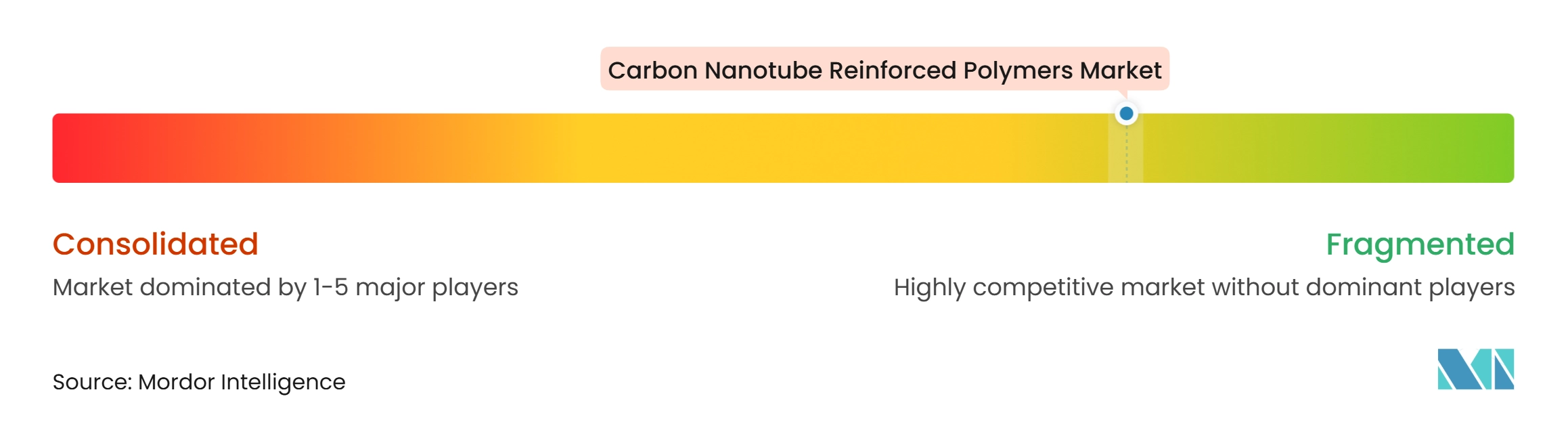
The carbon nanotube reinforced polymers market is fragmented. OCSiAl, Jiangsu Cnano Technology, and Cabot hold major positions in raw CNT production. Many specialty formulators create application-specific polymer grades. This structure drives competition across raw-material scale, dispersion quality, and customer qualification. OCSiAl operates through licensed production partners and distributors across more than 50 countries. Jiangsu Cnano is expanding from CNT powder and paste into cathode-material production. The market is therefore more concentrated among feedstock suppliers than among the many compounders serving end uses.
Several companies are moving toward vertical integration. Arkema develops Graphistrength CNTs for battery electrodes, along with PVDF binders and lithium salts, to support customers requiring integrated battery-material solutions. OCSiAl's Luxembourg investment reflects supply-chain expansion in a key demand region. LG Chem's 2025 CNT-dispersion patent application indicates that formulation knowledge is becoming a proprietary competitive tool. Zeon's SiAT investment provides a route into downstream conductive-paste capacity. These developments shift competition toward performance reliability and access to processing know-how.
White space remains in CNT-reinforced elastomers for EV sealing systems and functionalized resin systems for additive manufacturing. Smaller specialists can compete in these areas through formulation expertise and faster development cycles. Compliance requirements under REACH nanoform rules and the Toxic Substances Control Act (TSCA) present challenges for firms with limited regulatory resources and can strengthen the position of established suppliers with documented materials. A verified combined market share for the top players is not available; however, the market structure remains consistent with concentrated upstream production and fragmented downstream formulation. Buyers are likely to evaluate suppliers on dispersion consistency, technical service, regulatory documentation, and supply security. Company investments indicate that battery materials and conductive compounds remain priority areas.
Carbon Nanotube Reinforced Polymers Industry Leaders
-
LG Chem
-
OCSiAl
-
Birla Carbon
-
Cabot Corporation
-
Arkema
- *Disclaimer: Major Players sorted in no particular order
Carbon Nanotube Reinforced Polymers Market Companies Covered in this Report
- Arkema
- Avient Corporation
- Birla Carbon
- Cabot Corporation
- CARBICE CORPORATION
- Carbon Solutions, Inc.
- Cheap Tubes
- Jiangsu Cnano Technology Co., Ltd.
- LG Chem
- LyondellBasell Industries N.V.
- Mechnano
- OCSiAl
- Resonac Corporation
- TORAY INDUSTRIES, INC.
- Zeon Corporation
Recent Industry Developments in Carbon Nanotube Reinforced Polymers Market
- July 2026: A new US Environmental Protection Agency (EPA) Significant New Use Rule (SNUR) under the Toxic Substances Control Act (TSCA) for a specific class of multi-walled carbon nanotubes (MWCNTs) entered into force on September 22, 2026 (published as 91 FR 46742). The rule requires any manufacturer, importer, or processor of the covered MWCNT chemistry to notify the EPA at least 90 days before commencing a designated significant new use, extending regulatory oversight as carbon nanotube reinforced polymer applications diversify.
- November 2025: OCSiAl signed a long-term land lease with the State of Luxembourg, initiating development of its graphene nanotube production hub in Differdange. The facility represents a USD 300 million investment, is expected to create more than 300 jobs, and is planned to commence operations in stages from 2028 to 2030. This positions Europe as a strategic carbon nanotube reinforced polymer manufacturing center and reduces European OEMs' reliance on Asian supply.
Global Carbon Nanotube Reinforced Polymers Market Report Scope
Carbon Nanotube Reinforced Polymers (CNTRPs) are composite materials produced by embedding carbon nanotubes (CNTs), which are cylindrical carbon structures, into a polymer matrix. CNTs are known for their high tensile strength, low weight, and electrical conductivity, which make them effective reinforcing agents in polymer systems.
The carbon nanotube reinforced polymers market is segmented by polymer type, end-user industry, and geography. By polymer type, the market is segmented into thermoplastics, thermosets, and elastomers. By end-user industry, the market is segmented into electrical and electronics, energy, automotive, aerospace and defense, industrial, and other end-user industries. The report also covers market sizes and forecasts for carbon nanotube reinforced polymers across 15 countries in major regions. The market sizes and forecasts are provided in terms of value (USD).
Segmentation Overview
| Thermoplastics |
| Thermosets |
| Elastomers |
| Electrical and Electronics |
| Energy |
| Automotive |
| Aerospace and Defense |
| Industrial |
| Other End-User Industries |
| Asia-Pacific | China |
| India | |
| Japan | |
| South Korea | |
| ASEAN Countries | |
| Rest of Asia-Pacific | |
| North America | United States |
| Canada | |
| Mexico | |
| Europe | Germany |
| United Kingdom | |
| France | |
| Italy | |
| NORDIC Countries | |
| Rest of Europe | |
| South America | Brazil |
| Argentina | |
| Rest of South America | |
| Middle East and Africa | Saudi Arabia |
| South Africa | |
| Rest of Middle East and Africa |
| By Polymer Type | Thermoplastics | |
| Thermosets | ||
| Elastomers | ||
| By End-User Industry | Electrical and Electronics | |
| Energy | ||
| Automotive | ||
| Aerospace and Defense | ||
| Industrial | ||
| Other End-User Industries | ||
| By Geography | Asia-Pacific | China |
| India | ||
| Japan | ||
| South Korea | ||
| ASEAN Countries | ||
| Rest of Asia-Pacific | ||
| North America | United States | |
| Canada | ||
| Mexico | ||
| Europe | Germany | |
| United Kingdom | ||
| France | ||
| Italy | ||
| NORDIC Countries | ||
| Rest of Europe | ||
| South America | Brazil | |
| Argentina | ||
| Rest of South America | ||
| Middle East and Africa | Saudi Arabia | |
| South Africa | ||
| Rest of Middle East and Africa | ||
Key Questions Answered in the Report
What is current market size of Carbon Nanotube Reinforced Polymers Market?
The Carbon Nanotube Reinforced Polymers market size was valued at USD 3.24 billion in 2026 and is estimated to grow from USD 3.54 billion in 2027 to USD 5.56 billion by 2032, at a CAGR of 9.45% during the forecast period (2027-2032).
Which polymer type leads carbon nanotube reinforced polymers?
Thermoplastics led with a 34.67% share in 2026 because they suit high-volume ESD packaging, automotive components, and electronics enclosures.
Which end-user application is growing fastest for CNT-reinforced polymers?
Energy is projected to grow at a 10.67% CAGR through 2032, supported by conductive battery networks and battery-module components.
Which region leads in demand for carbon nanotube reinforced polymers?
Asia-Pacific held a 56.12% share in 2026 and is forecast to expand at a 10.43% CAGR through 2032.