
Canada Used Car Market Size and Share
Market Overview
| Study Period | 2019 - 2031 |
|---|---|
| Forecast Data Period | 2026 - 2031 |
| Base Year Market Size (2025) | USD 17.82 Billion |
| Market Size (2026) | USD 18.90 Billion |
| Market Size (2031) | USD 26.19 Billion |
| Growth Rate (2026 - 2031) | 6.74 % |
| Market Concentration | Low |
Major Players *Disclaimer: Major Players sorted in no particular order Image © Mordor Intelligence. Reuse requires attribution under CC BY 4.0. | |
Canada Used Car Market Analysis by Mordor Intelligence
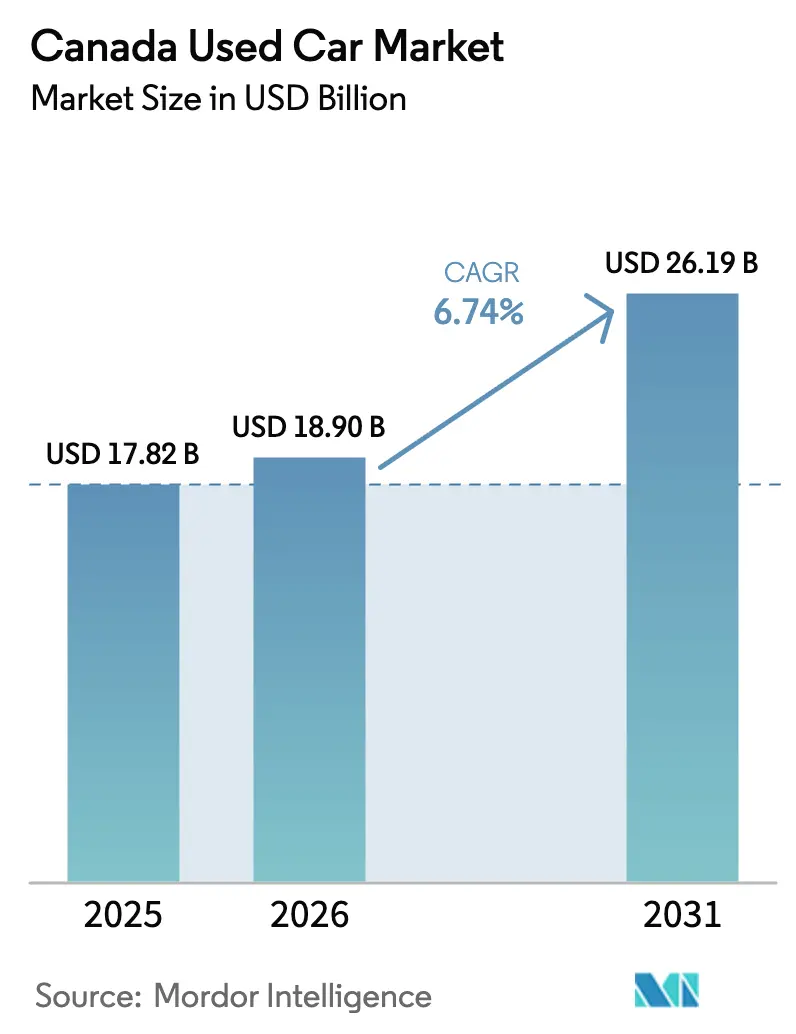
The Canadian used car market size was valued at USD 17.82 billion in 2025 and estimated to grow from USD 18.90 billion in 2026 to reach USD 26.19 billion by 2031, at a CAGR of 6.74% during the forecast period (2026-2031). Structural growth stems from organized digital platforms rather than a mere rebound from pandemic-era supply shocks. The spread of AI-powered search tools, used by 17% of shoppers in 2025, has compressed research cycles and rewarded retailers that publish real-time pricing and inspection data. At the same time, battery-health diagnostics have alleviated residual-value concerns surrounding used EVs, while OEM-backed certified pre-owned (CPO) programs convert lease returns into high-margin inventory. Consolidation among franchise groups, such as AutoCanada, alongside FINTRAC’s new anti-money laundering rules, is reducing compliance costs while improving overall trust. Demand fundamentals remain solid because public transit coverage outside the cores of Toronto, Montréal, and Vancouver is still limited, thereby anchoring private-vehicle ownership.
Key Report Takeaways
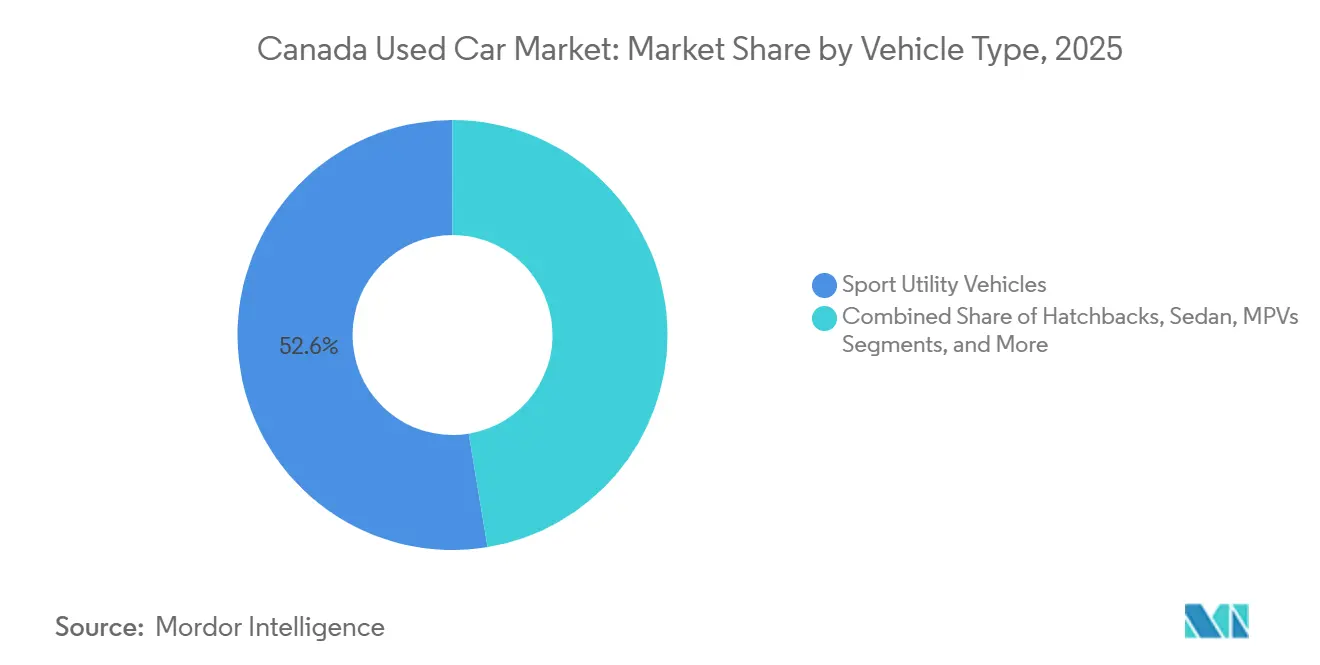
- By vehicle type, sports utility vehicles captured 52.61% of 2025 sales; the same sub-segment is projected to post a 9.44% CAGR over 2026-2031.
- By vehicle age, 3-to-5-year units held 40.32% share in 2025, while the 0-to-2-year bracket is on track for an 11.22% CAGR through 2031.
- By price segment, the USD 10,000-to-USD 14,999 band accounted for 37.58% of 2025 volume; inventory priced up to USD 30,000 is expected to advance at a 7.14% CAGR in the forecast period.
- By vendor type, organized dealers accounted for 62.18% of transactions in 2025 and are forecasted to expand at a 6.89% CAGR between 2026 and 2031.
- By fuel type, petrol units led with a 61.27% share in 2025, whereas electric vehicles represented the fastest-growing segment with a 10.2% CAGR to 2031.
- By sales channel, online digital classifieds held a 55.06% share in 2025, while pure-play e-retailers are projected to rise at a 12.75% CAGR from 2026 to 2031.
Note: Market size and forecast figures in this report are generated using Mordor Intelligence’s proprietary estimation framework, updated with the latest available data and insights as of January 2026.
Companies active in Canada may frequently operate across several geographies, linking regional presence to global strategy. Mordor Intelligence captures the entire market landscape of the global used car industry and how these positions are distributed.
Canada Used Car Market Trends and Insights
Drivers Impact Analysis*
| Driver | (~) % Impact on CAGR Forecast | Geographic Relevance | Impact Timeline |
|---|---|---|---|
| OEM CPO Expansion | +1.5% | National, led by major franchise hubs | Medium term (2-4 years) |
| Price Advantage vs New | +1.3% | National, acute in Alberta and Saskatchewan | Short term (≤ 2 years) |
| Online Marketplace Shift | +1.2% | National, concentrated in Ontario, Québec, British Columbia metros | Short term (≤ 2 years) |
| Vehicle History Transparency | +0.9% | National, strongest in organized-dealer segment | Short term (≤ 2 years) |
| Battery Diagnostics Confidence | +0.8% | British Columbia, Québec, Ontario | Medium term (2-4 years) |
| Incentive Stacking Credits | +0.6% | Québec, British Columbia | Long term (≥ 4 years) |
| Source: Mordor Intelligence | |||
Expansion of OEM-Backed Certified Pre-Owned Programs
Brands like Toyota, Honda, BMW, and Subaru, along with several others, have expanded their Certified Pre-Owned (CPO) programs, channeling off-lease returns into digital storefronts nationwide. These initiatives, which offer multi-point inspections and factory warranties, are helping Canada's used car market experience significant growth in the 0- to 2-year-old segment. AutoCanada, a consolidated group, showcases a cross-brand CPO inventory online, enabling shoppers in Winnipeg to reserve a unit in Calgary and finalize paperwork remotely. In contrast, independent dealers without original equipment manufacturer affiliations are struggling with margin compression, as they are unable to match the warranty economics. Looking ahead, CPO penetration is poised to expand beyond luxury brands, infiltrating mainstream sedans and crossovers, thereby further solidifying the dominance of organized dealers.
Favorable Price Differential Versus New Vehicles amid Inflation
Average used car prices remain significantly lower than comparable new-model MSRPs. The Bank of Canada has maintained a restrictive policy rate, which has led to increased financing rates and strained household budgets. Budget-conscious shoppers are focusing on a specific price range, which holds a significant share of sales. Dealers in Alberta and Saskatchewan are adjusting their inventory accordingly, prioritizing older, higher-mileage SUVs and pickups that are still mechanically reliable. Price transparency tools that convert sticker values into monthly payments have become critical in aiding sales conversions.
Accelerating Consumer Shift to Online Marketplaces
Digital classified portals dominate a significant share of transactions, while pure-play e-retailers are growing at a much faster rate compared to traditional dealer sites [1]“2025 Year-End Used Vehicle Market Analysis,”, AutoTrader.ca, AutoTrader.ca. Many buyers are utilizing AI-driven filters to sort inventory by payment, fuel economy, and collision history, significantly reducing their research time. Online transactions in automotive retail are expected to continue growing, supported by advancements such as electronic lien releases and odometer certifications [2]“Digital Transformation of Vehicle Titling,”, Transport Canada, tc.gc.ca. Dealers relying on phone-based negotiations risk losing market share to platforms that offer features such as click-to-delivery, extended return windows, and bundled financing. As data transparency becomes standard, profit margins are increasingly shifting toward ancillary products—such as service contracts and gap insurance—rather than vehicle markups.
Growing Availability of Vehicle-History and Inspection Transparency
CARFAX Canada identified odometer rollbacks in a significant portion of the units it inspected, emphasizing why buyers are willing to pay a premium for certified vehicles. To address these concerns, the Ontario Motor Vehicle Industry Council (OMVIC) has mandated that Ontario dealers perform VIN-based recall lookups. Additionally, new anti-money laundering (AML) regulations now require identity verification for transactions involving large amounts of cash. In response, digital vendors have introduced high-resolution inspection PDFs that provide detailed metrics, such as brake pad thickness and paint meter readings. Organized sellers absorb the inspection fee as part of their acquisition costs, while peer-to-peer sellers often avoid this expense, resulting in reduced traffic. Consequently, transparency has shifted from being a compliance requirement to a key driver of revenue.
Restraints Impact Analysis*
| Restraint | (~) % Impact on CAGR Forecast | Geographic Relevance | Impact Timeline |
|---|---|---|---|
| Limited Late-Model Stock | -0.9% | National, 0-to-5-year supply | Medium term (2-4 years) |
| Dealer and Portal Competition | -0.7% | National, highest in Toronto, Montréal, Vancouver | Short term (≤ 2 years) |
| Odometer and Condition Concerns | -0.4% | National, peer-to-peer channels | Short term (≤ 2 years) |
| Patchwork Digital Transfer Rules | -0.3% | Ontario, Québec, British Columbia, Alberta | Long term (≥ 4 years) |
| Source: Mordor Intelligence | |||
Intensifying Competition from Large Dealer Groups and Classifieds Portals
AutoCanada’s extensive network, HGregoire’s multi-province presence, and Facebook Marketplace's zero-listing-fee model are intensifying competition for independent yards that lack scale advantages. Larger players benefit from financing inventory at lower costs, while classified sites attract price-sensitive buyers who avoid documentation fees, further compressing margins for smaller entities. Mid-tier generalists face a critical decision: specialize in a niche or exit through acquisition. This competitive churn is expected to reduce the number of dealers while concentrating market volume among tech-enabled competitors.
Patch-Work Provincial Rules on Fully-Digital Vehicle Transfers
Ontario’s Ontario Motor Vehicle Industry Council (OMVIC), Québec’s SAAQ, British Columbia’s VSA, and Alberta’s Alberta Motor Vehicle Industry Council (AMVIC) each dictate unique disclosure and titling protocols [3]“Dealer Disclosure Requirements,”, OMVIC, omvic.on.ca. Digital signatures, lien releases, and odometer certifications remain provincial pilots rather than national standards. Financial Transactions and Reports Analysis Centre of Canada's (FINTRAC’s) federal AML overlay adds another layer of compliance. Platforms that master a single province’s rule set scale faster than those chasing all ten jurisdictions, at least until harmonization arrives.
*Our forecasts treat driver/restraint impacts as directional, not additive. The impact forecasts reflect baseline growth, mix effects, and variable interactions.
Segment Analysis
By Vehicle Type: Sport Utility Vehicles Drive Market Evolution
Sport utility vehicles (SUVs) owned 52.61% of the 2025 volume and will widen their lead with a 9.44% CAGR through 2031, propelled by cargo flexibility, perceived safety, and winter traction. This slice translates to the largest single share of the Canadian used car market size and is already running ahead of consumer search interest, signaling a slight oversupply that nonetheless clears quickly. Sedans slide as original equipment manufacturers discontinue mid-size nameplates, while hatchbacks maintain relevance mainly inside dense city cores. Trucks hold an outsized share in Alberta and Saskatchewan, underscoring the need for regional inventory strategies.
Dealers are advised to allocate a significant portion of their lot space to crossovers and body-on-frame sport utility vehicles (SUVs). They should also maintain a supply of sedans within an affordable price range, while limiting hatchback purchases in non-metropolitan areas. Certified Pre-Owned (CPO) programs are increasingly endorsing off-road-capable models. This trend enables sellers to demand higher prices without compromising on sales speed. As a result, the strong sales of sport utility vehicles solidify the segment's status as the primary profit driver across various provinces.



By Vehicle Age: CPO Programs Anchor the 0-to-5-Year Bracket
The 3-to-5-year cohort held a 40.32% share in 2025, the most significant slice of the Canadian used car market share, while the 0-to-2-year band posted an 11.22% CAGR to 2031, driven by expanding original equipment manufacturer Certified Pre-Owned (CPO) networks. Organized dealers leverage warranty transferability and reduced mechanical risks to command significant premiums. While supply gaps continue to curtail immediate volumes, consolidated franchises effectively navigate these challenges, ensuring steady pipelines through returns from captive finance leases.
As scarcity drives up auction prices, independent dealers often overbid or shift focus toward higher-mileage vehicles. This trend underscores the increasing importance of instant trade-in platforms, which streamline the appraisal and pickup processes, making them crucial sources for inventory. Looking ahead, the youngest vehicle categories are expected to yield the highest gross margins, while older segments will play a critical role in stabilizing volumes during periods of economic uncertainty.
By Price Segment: Middle Market Anchors Volume
Units priced USD 10,000-USD 14,999 held 37.58% of 2025 sales, confirming that affordability, not aspiration, governs Canadian demand. Inventory priced up to the USD 30,000 is expected to grow at a 7.14% CAGR, supported by Certified Pre-Owned sedans and sport utility vehicles that offer sizeable savings versus new models while preserving brand cachet. High policy rates continue to elevate monthly payments, limiting the pool of potential buyers.
Inventory strategies emphasize maintaining a significant portion of stock within an affordable price range. Prairie dealers focus on offering options for cost-sensitive households, while metro stores prioritize premium Certified Pre-Owned units and provide transparent payment calculators to engage potential buyers effectively.
By Vendor Type: Organized Dealers Consolidate Share
Organized vendors captured 62.18% of deals in 2025 and are projected to track a 6.89% CAGR through 2031. Consolidators such as AutoCanada exploit centralized inventory and shared marketing to lower the cost per sale. Peer-to-peer sites continue to attract shoppers, but concerns over fraud and the lack of warranties weaken customer loyalty over time. Additionally, compliance with Anti-Money Laundering (AML) regulations benefits larger players who can distribute their legal expenses more effectively.
The competitive landscape now focuses on transparent inspections, AI-driven pricing strategies, and efficient delivery services. Independent stores must either align with branded networks or specialize in niche import models to remain competitive.
By Fuel Type: Petrol Dominates, Electric Accelerates
Petrol maintains a 61.27% share in 2025, yet electric vehicles and hybrids comprise the fastest-growing slice, pacing a 10.2% CAGR. Used Tesla Model 3 units have become an attractive option for cost-driven buyers, offering significant savings compared to new vehicles. Organized listings now include standardized battery-health certificates, providing clarity on state-of-charge retention and easing buyer concerns.
Dealers are encouraged to maintain a balanced petrol stock nationwide, incorporate a mix of electric vehicles and hybrids in regions like British Columbia and Québec, and minimize diesel usage outside of commercial fleets. Establishing certification partnerships for electric vehicle batteries is becoming crucial to attract early-majority shoppers.

By Sales Channel: Pure-Play E-Retailers Disrupt Classifieds
In 2025, online platforms accounted for 55.06% of all transactions. Among these, pure-play e-retailers led the charge, boasting a rapid growth rate of 12.75% CAGR. This growth highlights the increasing consumer preference for convenience and digital-first solutions. Canada Drives has revolutionized the car-buying experience, managing everything from title and financing to delivery, turning what was once a multi-day process into a smooth, half-hour digital transaction. This streamlined approach has set a benchmark for efficiency in the automotive e-commerce space. While offline dealers still cater to buyers wanting test drives, they've adapted by incorporating "reserve online, pick up in store" features to stay competitive. These hybrid models demonstrate the evolving strategies of traditional dealers as they strive to maintain their market share in a rapidly digitizing landscape.
Transport Canada predicts that online sales will play a significant role in auto retail by 2030, driven by a growing consumer preference for the convenience of digital platforms. This shift is expected to significantly reshape the traditional auto retail landscape, creating opportunities for innovation in customer engagement and sales strategies. Meanwhile, compliance costs from FINTRAC are benefiting larger players, steering the market towards a hybrid model that blends digital exploration with local delivery. This model not only enables a seamless customer experience but also ensures adherence to regulatory requirements, positioning capitalized players to leverage their resources effectively in this evolving market.
Geography Analysis
Ontario dominates the market, driven by the Greater Toronto Area’s population density and suburban commuting patterns. Ontario Motor Vehicle Industry Council (OMVIC)’s stringent disclosure regime increases dealer compliance costs but enhances consumer trust, reinforcing the dominance of organized dealers. Québec follows closely, though its French-language contracts and fluctuating ZEV rebates present challenges for national rollout plans. British Columbia also holds a significant share, supported by its mild climate and strong EV infrastructure, which sustains demand for used EVs.
Alberta and Saskatchewan collectively hold a notable share, with full-size pickups accounting for a significant portion of provincial listings, due to the resource sector's preference for utility vehicles. Operating cost differences and tighter dealer real estate markets result in higher average prices in Ontario and British Columbia compared to the Prairie provinces. Manitoba and the Atlantic provinces, with smaller market shares, depend on inter-provincial e-commerce to address inventory shortages.
Digital transfer regulations remain fragmented across provinces. Ontario is piloting electronic lien releases, British Columbia is testing digital odometer certificates, and Québec enforces independent French workflows. Federal AML regulations introduce a nationwide ID verification requirement for high-value cash transactions, creating hurdles for smaller, independent dealers. Platforms that align inventory with provincial preferences—such as SUVs in Ontario, trucks in Alberta, and EVs in British Columbia—while ensuring compliance with local regulations, are better positioned to outperform those adopting a generalized national approach.
The used car market is assessed by Mordor Intelligence through a multi-layered geographic lens, covering other regions such as Africa, along with detailed country-level analysis for Brazil, South Africa, Netherlands, Tanzania, Portugal, Egypt, Ethiopia, and Hong Kong.
Regulatory Landscape
Canada's used-car market operates under a layered framework of federal import and vehicle compliance rules alongside province-by-province retailing and titling requirements. At the federal level, the Used or Second-hand Motor Vehicles Regulations (SOR/98-42) set conditions for importing used vehicles, and the broader automotive standards regime is coordinated through Innovation, Science and Economic Development Canada (ISED) in alignment with Transport Canada under the Motor Vehicle Safety Act, alongside Canadian Environmental Protection Act, 1999-linked emissions requirements. Regulatory attention around electrification also feeds into used-market dynamics, including a time-bound federal quota program for electric vehicle imports of 24,500 units during the March to August 2026 window.
At the retail transaction level, compliance and disclosure are governed mainly by provincial bodies and processes, which adds operational complexity for cross-province digital sellers. This patchwork is reinforced by federal anti-money laundering oversight from FINTRAC, increasing the focus on identity and transaction verification and raising the relative compliance burden for smaller, unorganized sellers compared with scaled dealer groups that can standardize controls across multiple locations.
Value Chain Analysis
Used-vehicle supply in Canada is sourced primarily through consumer trade-ins and direct purchases, off-lease and fleet defleets, auction channels, and imported used units governed by federal rules such as SOR/98-42. The remarketing ecosystem is supported by industry bodies including the Automotive Remarketing Alliance (ARA) and the Used Car Dealers Association of Ontario (UCDA). Pricing and risk management also depend on third-party data and condition tools, including vehicle-history and valuation providers used by dealers and platforms. Inventory is reconditioned through dealer service lanes and collision networks, then merchandised through a mix of OEM-franchised and independent dealer storefronts, digital classifieds, and pure-play e-retailers that bundle financing, warranty, and delivery.
Demand generation and conversion increasingly run through platform partnerships and digital performance marketing. Dealer groups pursue scale economics in leads and attribution, and AutoCanada illustrates this with its return to a national partnership with AutoTrader in April 2026, following an earlier preferred-partner arrangement with CarGurus (July 2025), both aimed at standardizing inventory visibility across provinces. Downstream, financing and F&I products, warranties, and post-sale service and collision repair take a larger share of total gross profit, particularly as vehicle margins compress under competitive portal pricing and tight late-model supply.
Competitive Landscape
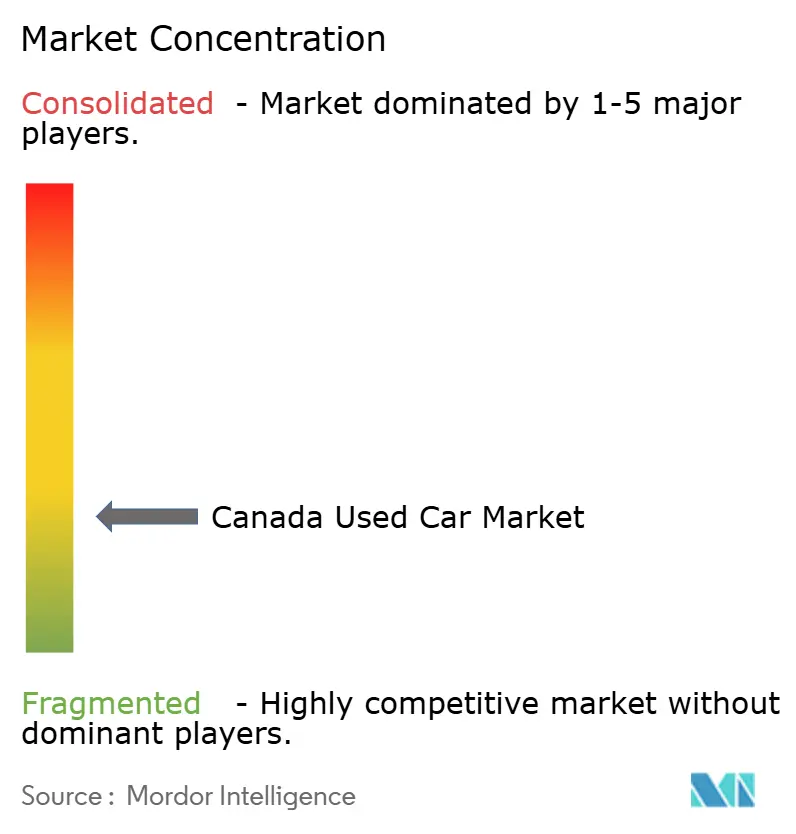
The market remains moderately fragmented, with no single player dominating the national market. However, the leading dealer groups collectively account for a significant portion of the organized volume. AutoCanada, with the largest store network, utilizes shared CRM platforms to facilitate cross-province test drives. Similarly, HGregoire and Go Auto adopt this approach, acquiring independent dealers to achieve scale advantages.
Classified portals like AutoTrader and Kijiji Autos generate revenue through subscription fees, avoiding inventory risks, while Canada Drives and Clutch take on balance-sheet exposure to secure comprehensive margins. Technological advancements, such as AI-driven price guidance and integrated inspection PDFs, have become standard. There is potential in consolidated CPO marketplaces that provide curated, cross-OEM certified stock, catering to shoppers who compare brands like Toyota, Honda, and Subaru.
Regulatory compliance introduces additional challenges. Ontario Motor Vehicle Industry Council (OMVIC) penalizes non-compliant dealers, Financial Transactions and Reports Analysis Centre of Canada (FINTRAC) conducts audits for Anti-Money Laundering (AML) compliance, and provincial digital transfer pilots have distinct data format requirements. These compliance costs often pressure smaller dealers to accept acquisition offers, driving further market consolidation.
Canada Used Car Industry Leaders
AutoCanada
Kijiji Autos
Canada Drives
CarGurus
TRADER Corporation
- *Disclaimer: Major Players sorted in no particular order

Market Opportunities and Future Outlook
Inventory acquisition and retention-led operating models stand out as a clearer opportunity in Canada, given ongoing tightness in late-model supply and the rising share of inventory sourced directly from consumers. UCDA survey results point to differences in sourcing, with franchised dealers reporting 65.4% of inventory coming directly from consumers and independent dealers relying on auctions for 50.6%, leaving room for tools that improve appraisal accuracy, tighten trade-in workflows, and retain service customers as future sellers. Organized dealers also have a path to expand higher-trust merchandising, including inspection documentation, battery-health diagnostics for used EVs, and CPO-like reconditioning standards, to shift more volume away from peer-to-peer channels where odometer and condition concerns persist.
Platform and policy-linked shifts also create specific areas where operators can act. Dealer groups are consolidating marketplace partnerships to improve group-level economics and attribution, as shown by AutoCanada aligning nationally with AutoTrader. At the same time, classifieds continue to seek differentiation through trust and verification features. On the policy side, the CUSMA review initiated in July 2026 creates an 18 to 36 month window of sensitivity around cross-border trade conditions that can influence pricing and trade-in flows, encouraging operators to diversify sourcing, strengthen cross-province logistics, and increase transparency to protect conversion. For electrified vehicles, expanding off-lease EV availability and more standardized battery assessment practices support broader used-EV retailing in provinces with higher EV adoption, while petrol vehicles continue to anchor national volumes.
Recent Industry Developments
- July 2026: AutoCanada acquired a collision repair business in Stratford, Ontario, formerly Fix Auto Stratford, now ACX Stratford, expanding Ontario collision platform. The launch increases collision capacity within the Canada used-car ecosystem, enabling higher-margin inventory through an integrated service network.
- July 2026: AutoCanada completed the sale of three British Columbia dealerships (Island Chevrolet Buick GMC, Abbotsford Volkswagen, Chilliwack Volkswagen) to focus on core regional clusters. The portfolio reweighting concentrates capital in core markets and reduces cross-province risk, strengthening the Canadian footprint.
- June 2026: AutoCanada closed sale of Toyota of Lincolnwood (Illinois) as part of a US exit plan. The cross-border realignment frees liquidity and debt capacity to accelerate Canadian asset investments while pruning non-core US exposure.


Research Methodology Framework and Report Scope
Market Definition and Coverage
For this study, the Canada used car market is the value generated from transactions of pre-owned passenger vehicles in Canada across dealer and consumer selling routes, including vehicle types commonly bought for personal mobility.
Scope exclusions: We exclude brand-new vehicle sales and most non-vehicle revenue streams that can be bundled by sellers, such as standalone servicing, insurance, and unrelated aftermarket parts.
Segmentation Overview
- By Vehicle Type
- Hatchbacks
- Sedans
- Sport Utility Vehicles
- Multi-Purpose Vehicles
- Others (convertibles, coupes, crossovers, sports cars)
- By Vehicle Age
- 0 - 2 Years
- 3 - 5 Years
- 6 - 8 Years
- 9 - 12 Years
- Above 12 Years
- By Price Segment
- Under USD 5,000
- USD 5,000 - 9,999
- USD 10,000 - 14,999
- USD 15,000 - 19,999
- USD 20,000 - 29,999
- USD 30,000 and Above
- By Vendor Type
- Organized
- Unorganized
- By Fuel Type
- Petrol
- Diesel
- Hybrid
- Electric
- LPG / CNG / Others
- By Sales Channel
- Online
- Digital Classified Portals
- Pure-play e-Retailers
- OEM-Certified Stores
- Offline
- OEM-Franchised Dealers
- Multi-brand Independent Dealers
- Physical Auction Houses
- Online
Data Sources, Market Sizing, and Validation
Desk Research
Desk research was used to set the market boundaries and to build the starting pool of vehicles, pricing, and turnover signals that later get tested in interviews. We relied on public Canadian data series and industry releases to understand fleet size, used vehicle turnover, consumer affordability, and the direction of prices.
Sources used include official and non-paywalled references such as Statistics Canada tables, Transport Canada vehicle and safety publications, Bank of Canada rate history, and provincial motor vehicle registration guidance (where available), along with resources from associations such as CADA and public materials from auction and listing platforms. We also reviewed company filings and investor materials for large retail groups, plus credible press coverage for market events that change supply or pricing. In a few places, paid subscriptions were used only for company financial intelligence, shipment-level import-export checks for certain vehicle flows, and patent databases for diagnostics and inspection tooling signals. The sources listed here are illustrative, and many other references were also used to collect, validate, and clarify data points.
Primary Interviews and Surveys
Primary work was run to validate how used vehicle demand is shifting by vehicle age and fuel type, and to confirm practical pricing behavior at the retail and wholesale levels. We spoke with dealership groups, independent dealers, wholesale intermediaries, lenders and warranty providers, and also channel participants tied to online and offline selling. The objective was to avoid inferring Canada-wide patterns from a single province.
The most useful inputs were the gaps desk research cannot settle cleanly, such as typical reconditioning cost ranges, retail-to-wholesale spreads, and how quickly inventory turns under different interest rate and supply conditions.
Distribution of primary research fieldwork respondents
| Company type | Respondent position |
|---|---|
| Top tier: 33% | CXOs: 16% |
| Mid tier: 51% | Functional/Unit leaders: 36% |
| Smaller Players: 16% | Managers: 48% |
Market-Sizing & Forecasting
Sizing starts with a top-down build that reconstructs the addressable used-vehicle value pool from Canada-specific indicators, then it is checked with selective bottom-up approximations so the totals stay realistic. In practice, we convert vehicle parc and turnover signals into annual transactions, and then apply price and mix assumptions by age band and vehicle type before comparing the results with what sellers and intermediaries report.
Key inputs used to keep the model grounded include used vehicle transaction velocity, average selling price movement by age and fuel type, availability of late-model supply (including off-lease returns), interest rate and loan term direction that affects monthly affordability, and inventory days-on-lot signals that explain when pricing power strengthens or softens. When a direct data point is missing, we fill gaps using proxy relationships that respondents can validate, such as using price indices and mix shifts to infer blended ASP rather than assuming a flat uplift.
For forecasting, scenario analysis is applied around a core view, because supply normalization and rate changes can move volumes and prices in different directions. The assumptions are then adjusted only after interview feedback aligns with the observed signals, so the final curve is not driven by a single aggressive or conservative input.
Data Validation & Update Cycle
Outputs are validated through top-down and bottom-up cross-checks, then reviewed again to catch outliers before final sign-off. We compare results with independent market signals such as listings and inventory direction, financing conditions, and the implied transaction count versus parc turnover, which helps reveal when a price or volume assumption is too stretched.
If a variance is large, the driver is isolated and re-tested, and then related participants are re-contacted to confirm whether the change is real or a timing artifact. Reports are refreshed annually, and interim updates are made when material events occur that can shift supply, pricing, or consumer demand. Before delivery, a fresh review pass is completed so clients receive the latest updated view.
Mordor Intelligence's Canada Used Car Market Sizing Compared With Other Published Estimates
Published market sizes for used cars in Canada can look far apart, even when they are discussing similar buyer behavior, because underlying scope and the way pricing is counted are not always consistent. Differences most often show up when a source focuses on dealer revenue versus total vehicle transaction value, or when the sample is limited to newer model years.
By tracking transaction value drivers and refreshing mix and price assumptions with January 2026 checks, Mordor Intelligence keeps the estimate tied to the full Canada used-vehicle pool rather than a dealer-industry revenue view or a restricted newer-vehicle sample.
Benchmark comparison
| Source | Market Size | Gaps in Research Methodology |
|---|---|---|
| Mordor Intelligence | USD 17.82 B (2025) | |
| Industry Data Platform A | USD 23.80 B (2025) | Uses reported spending from a restricted vehicle sample (2015 or newer and under 200,000 km), then scales results, which can lift the value by leaning toward newer and higher-priced mix and also uses a different currency base before conversion. |
| Industry Database B | USD 18.80 B (2026) | Represents the used car dealer industry revenue and can include non-vehicle revenue lines like parts, repair, financing, and insurance, and it does not aim to capture consumer-to-consumer value where it sits outside dealer books. |
The spread mostly comes from what is being counted as the market, which is why aligning the scope to vehicle transaction value and verifying mix and price steps matters. When scope is kept consistent across channels and the timing of currency and price inputs is made explicit, the resulting market size becomes easier to reproduce and to use for planning.


Key Questions Answered in the Report
How large is the Canada used car market in 2026?
The Canada used car market size stood at USD 18.90 billion in 2026 and is forecast to grow at a 6.74% CAGR through 2031.
Which segment of used vehicles sells fastest in Canada?
SUVs move quickest, holding 52.61% share in 2025 and benefiting from a 9.44% CAGR that reflects enduring demand for cargo utility and all-weather capability.
Why are late-model used cars in short supply?
Pandemic-era production shortages and longer ownership cycles have constrained the flow of 0–5-year-old vehicles into the used market, tightening inventory and supporting higher prices.
What is driving online growth in Canadian used-vehicle sales?
A rise in AI-enabled search tools, digital titling pilots, and consumer appetite for click-to-door delivery propels pure-play e-retailers at a 12.75% CAGR.
How will provincial EV incentives affect used-EV demand?
Incentive volatility creates quarter-to-quarter swings, but long-term phase-out mandates mean time-bound rebates will periodically reignite demand, especially in Québec and British Columbia.
Page last updated on:





