
Canada Travel Agency Services Market Size and Share
Market Overview
| Study Period | 2021 - 2031 |
|---|---|
| Forecast Data Period | 2026 - 2031 |
| Base Year Market Size (2025) | USD 9.45 Billion |
| Market Size (2026) | USD 10.34 Billion |
| Market Size (2031) | USD 15.35 Billion |
| Growth Rate (2026 - 2031) | 8.22 % |
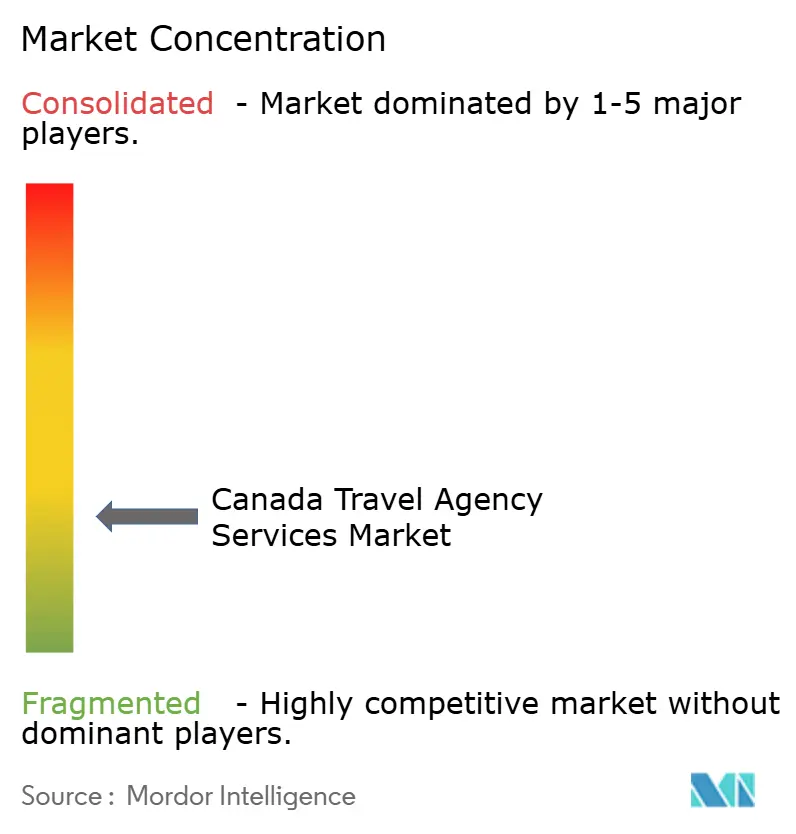
| Market Concentration | Low |
Major Players *Disclaimer: Major Players sorted in no particular order Image © Mordor Intelligence. Reuse requires attribution under CC BY 4.0. | |
Canada Travel Agency Services Market Analysis by Mordor Intelligence
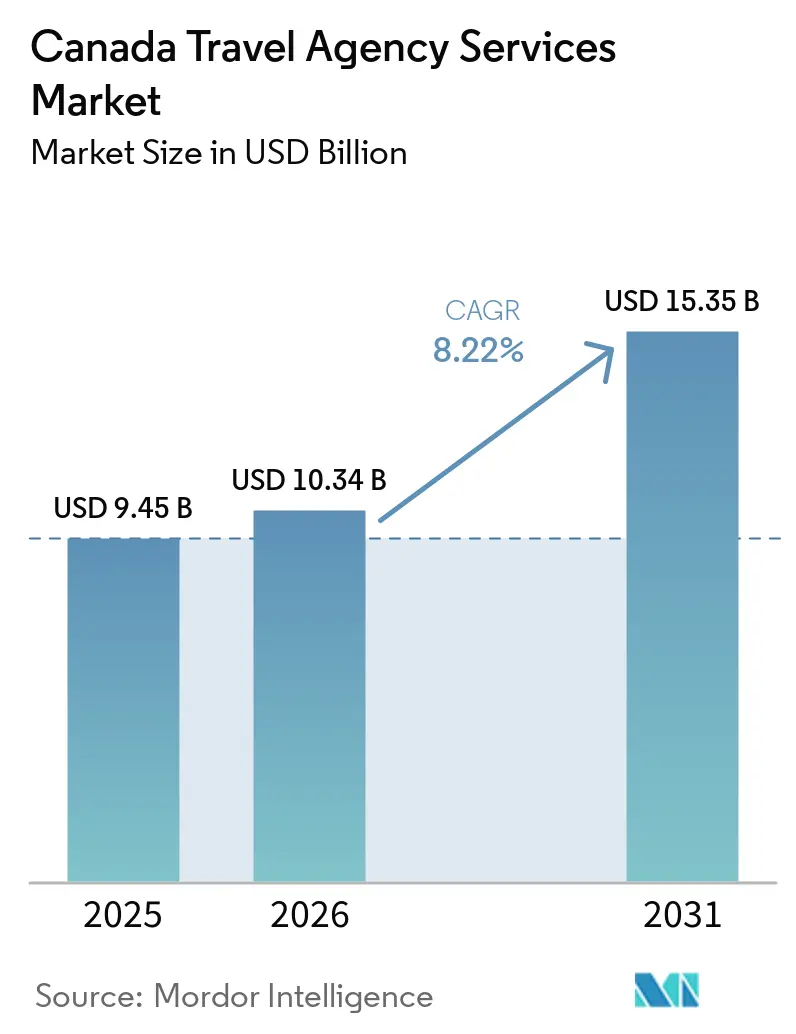
The Canada travel agencies market is projected to reach USD 9.45 billion in 2025, USD 10.34 billion in 2026, and USD 15.35 billion by 2031, growing at a CAGR of 8.22% from 2026 to 2031. Travel agencies are shifting from ticket issuance to offering itinerary design, destination advice, and bundled trip management for complex journeys. In 2024, travel agency operating revenue reached a record CAD 2.9 billion (USD 2.12 billion), with 57.7% of sales from non-United States foreign destinations, highlighting the demand for complex itineraries. Canadians made 42.9 million trips abroad in 2024, total domestic and inbound tourism expenditures in Canada reaching approximately CAD 127.7 billion (USD 93.27 billion)[1]. A shift away from United States trips in 2025 is driving demand toward Europe, the Caribbean, and Asia, where trips often require more planning, supplier coordination, and traveler support, benefiting agencies. The market remains fragmented, with no operator holding over 5% share, creating opportunities for niche specialists, regional networks, and hybrid digital advisor models to expand.
Key Report Takeaways
- By service type, airline ticketing held 30.34% of the Canada Travel Agency Services Market in 2025, while cruises is projected to record the fastest growth at a 9.11% CAGR through 2031.
- By booking mode, OTAs held 53.51% of the Canada Travel Agency Services Market in 2025 and recorded the highest projected CAGR at 9.90% through 2031.
- By trip purpose, leisure accounted for 65.74% of the Canada Travel Agency Services Market in 2025, while corporate and MICE is projected to advance at an 8.90% CAGR through 2031.
- By traveler type, domestic travelers held 62.83% share of the Canada Travel Agency Services Market in 2025, while international travelers are forecast to grow at a 9.28% CAGR through 2031.
- By geography, Ontario captured 36.49% of the Canada Travel Agency Services Market in 2025, while British Columbia is projected to record the fastest provincial CAGR at 9.69% through 2031.
Note: Market size and forecast figures in this report are generated using Mordor Intelligence’s proprietary estimation framework, updated with the latest available data and insights as of January 2026.
Canada Travel Agency Services Market Trends and Insights
Drivers Impact Analysis*
| Driver | (~) % Impact on CAGR Forecast | Geographic Relevance | Impact Timeline |
|---|---|---|---|
| Rising advisor-managed international travel demand | +1.4% | Global, with concentration in Ontario and British Columbia | Medium term (2-4 years) |
| Cruise and all-inclusive package momentum | +1.2% | British Columbia, Atlantic Canada, Quebec | Medium term (2-4 years) |
| Growing demand for personalized complex itineraries | +1.1% | National, with premium gains in Toronto, Vancouver, Montreal | Long term (≥ 4 years) |
| Expansion of digital booking and hybrid advisor workflows | +1.0% | National, with accelerated adoption in Ontario and British Columbia | Short term (≤ 2 years) |
| Expansion of digital booking and hybrid advisor workflows | +0.8% | National, with early gains in home-based advisor markets | Medium term (2-4 years) |
| Home-based advisor model scaling national selling capacity | +0.7% | National | Medium term (2-4 years) |
| Source: Mordor Intelligence | |||
Rising advisor-managed international travel demand
Canadian travel agencies are leveraging the gap between international travel volume and the demand for planning, documentation, and disruption management services. Overseas arrivals to Canada increased by 7.5% in 2025, reaching 6.8 million, while Canadians made 42.9 million outbound trips in 2024, highlighting a significant opportunity for advisor-led sales. Overseas visitor spending in Canada totaled USD 28.5 billion in 2024, an 11.7% year-over-year rise, with a portion flowing through tour operator packages and agency-managed group travel. A decline in Canadian residents' return trips from the United States in late 2025 further shifted planning toward complex non-United States destinations. As destination preferences evolve, travel advisors play a critical role in itinerary planning, insurance, rebooking, and supplier coordination. A 2024 Expedia Group study found that 50% of Canadians used the same travel advisor for five years, compared to 38% globally, indicating strong advisor loyalty in Canada.
Cruise and all-inclusive package momentum
Canada's travel agencies market is growing due to increased demand for cruises and packaged vacations, which remain resilient compared to point-to-point travel. Cruise passenger volumes in Canada reached 1.32 million in 2024 and 1.2 million passengers with 301 ship visits in 2025, indicating sustained cruise activity at major homeports. A growing share of cruise demand is coming from Canadian travelers, reflecting rising domestic interest in expedition and specialty cruises. Cruise sales in 2025 rose by 9% for ocean cruises and 8% for luxury cruises, showing agencies benefit from higher volumes and booking values. Expedition itineraries are emerging as a fast-growing category within global cruise demand, supporting the growth outlook for cruises in Canada. This trend also drives all-inclusive vacation sales, as advisors use bundled leisure products to secure commissions and simplify booking decisions for families and travelers.
Growing demand for personalized complex itineraries
Travel agencies in Canada are focusing on complex trips, prioritizing custom leisure planning and multi-element bookings. Nearly two-thirds of Canadian agencies experienced year-over-year booking growth in 2024, with 75% of advisors expressing optimism about the sector. Canadian outbound travelers spent an average of USD 2,299 per overseas trip in 2024, staying 13.2 nights on average, favoring advisor-led itinerary designs over self-service bookings. A luxury-focused travel division launched in 2025 targets private touring, river cruising, and bespoke FIT itineraries, with projected sales of CAD 530 million (USD 387.09 million) in 2025, up from CAD 465 million (USD 339.62 million) in 2024. A projected 23% increase in Chinese visitor receipts by 2026, following a CAD 1.15 billion (USD 0.84 billion) forecast for 2025, is being driven by visa changes and the return of organized tour groups. The Canadian travel agencies market is witnessing growing demand for advisors skilled in combining transport, guided tours, cultural access, and destination-specific planning into cohesive packages.
Expansion of digital booking and hybrid advisor workflows
The Canada travel agencies market is transitioning to a hybrid model where technology supports search, comparison, and transactions, while advisors focus on trust, conversion, and itinerary quality. KAYAK launched 'Ask AI' in Canada in April 2026, introducing a conversational planning interface with live results for flights, hotels, and car rentals, reflecting investments in assisted planning over self-service booking. KAYAK's CIBC platform expanded in December 2025, enabling more Canadian consumers to access Expedia's inventory through a loyalty-linked banking interface[2]. Expedia Group enhanced its B2B platform in 2025 with new APIs and insurance API testing on Expedia TAAP, equipping advisor channels with advanced selling tools. EXPEDIA GROUP TTAND introduced a new ITC Booking Engine and partnered with Farenexus to integrate GDS and NDC access, demonstrating mid-market host networks' adoption of hybrid workflows within the Canada travel agencies market.
Restraints Impact Analysis*
| Restraint | (~) % Impact on CAGR Forecast | Geographic Relevance | Impact Timeline |
|---|---|---|---|
| OTA and supplier-direct disintermediation | -0.9% | National, most acute in Ontario and British Columbia | Medium term (2-4 years) |
| Elevated airfares and trip-cost inflation | -0.8% | National | Short term (≤ 2 years) |
| NDC and airline content fragmentation | -0.6% | National | Medium term (2-4 years) |
| Advisor recruitment and succession constraints | -0.5% | National, with acute shortages in Atlantic Canada and Quebec | Long term (≥ 4 years) |
| Source: Mordor Intelligence | |||
OTA and supplier-direct disintermediation
Disintermediation continues to challenge the Canada travel agencies market as suppliers and major online platforms increasingly pursue direct customer relationships. A survey reported that 29% of Canadian advisors in 2025 identified direct supplier marketing as a key concern, while 24% cited online travel agencies (OTAs) as a significant issue. The issue extends beyond traditional OTAs; for example, CIBC's collaboration with Expedia integrates travel bookings into banking and rewards systems, complicating customer acquisition for independent agencies. A 2024 industry summary noted a 15% decline in travel agency business entities, from 6,134 in January 2020 to 5,351 in January 2024, reflecting the industry's adaptation to digital competition. However, remaining firms have become more productive, focusing on areas where human support is essential. While disintermediation has slowed growth, it has not stopped the expansion of Canada's travel agency market.
Elevated airfares and trip-cost inflation
High travel costs are limiting transaction volumes in Canada's travel agency market, despite rising customer spending per trip. High airfares and additional fees are identified as major challenges in 2024. A November 2025 survey found that 43% of travel advisors cited persistent high travel costs as their primary concern. A significant share of travel buyers expected reduced spending, while more than half anticipated lower transaction volumes due to high costs and policy uncertainties. Agency operating expenses have increased faster than revenue in 2024, reflecting inflation’s impact on both travelers and agencies. While agencies may earn more per transaction on expensive trips, they are facing reduced booking frequency, particularly for discretionary travel. Demand is shifting toward Caribbean and Mexico packages, which are advisor-friendly but typically have lower ticket values than long-haul intercontinental trips.
*Our forecasts treat driver/restraint impacts as directional, not additive. The impact forecasts reflect baseline growth, mix effects, and variable interactions.
Segment Analysis
By Service Type: Cruises Outpacing All Categories from a Lower Base
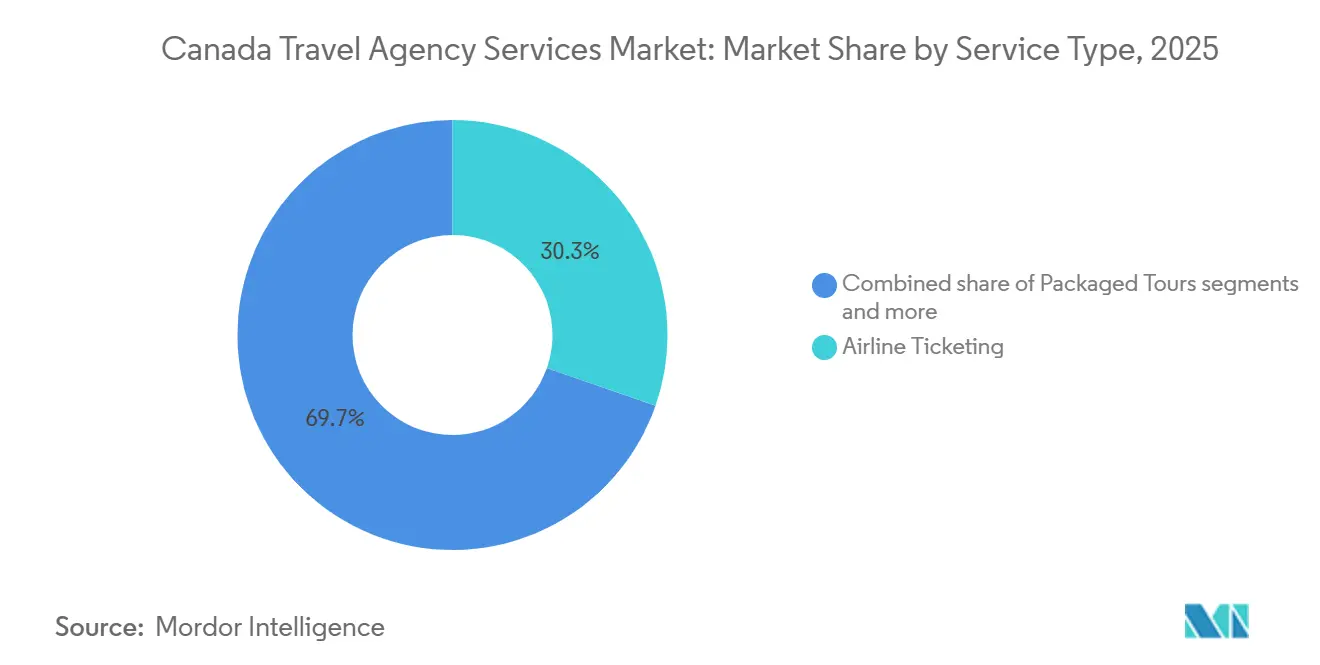
Airline ticketing accounted for 30.34% of the Canadian travel agency market size in 2025, making it the largest service type by value. Airline seat sales represented 35.1% of travel agency revenue in 2024, confirming air travel's central role despite a broader sales mix. This segment's scale is tied to Canada’s large outbound travel base, with 42.9 million trips abroad in 2024 driving demand for ticketing, fare consolidation, group travel, and multi-leg itineraries. Packaged tours ranked as the second-largest service type overall. Within the broader sector, Canadian tour operators generated CAD 9.6 billion (USD 7.01 billion) in total operating revenue for 2024, with packaged tours specifically contributing 62.8% (or roughly CAD 6.03 billion (USD 4.40 billion)) of that amount. The industry relies on these bundled leisure products to convert destination demand into higher-margin travel arrangements.
Cruises are projected to grow at a 9.11% CAGR through 2031, making them the fastest-growing service line in the Canadian travel agency market. The Port of Vancouver recorded 301 ship visits and 1.2 million passengers during the 2025 season, highlighting strong cruise demand. Growth is supported by increasing interest in specialized cruise offerings. Lodging reservations and travel insurance are expanding as agencies address hotel booking complexities in major cities and rising post-pandemic interest in trip protection. Other transportation and ancillary services, though smaller, are gaining importance as advisors bundle transfers, rail, shore excursions, and related add-ons to sustain margins in the Canadian travel agency industry.

By Booking Mode: OTAs Dominating but Hybrid Closing the Gap
OTAs accounted for 53.51% of Canada's travel agency market in 2025, making them the largest booking method by value. Expedia Group's Q4 2025 results reported significant booking growth and strong performance in its travel agent platform, highlighting the role of digital players in serving both direct consumers and advisor-mediated demand. OTAs are projected to grow at a 9.90% CAGR through 2031, driven by loyalty ecosystems, brand recognition, and online shopping behavior. Offline channels remain relevant due to advisor trust, destination expertise, and after-sales support, especially for complex or high-value bookings.
Hybrid agencies are the most adaptable format in Canada's travel agency market, combining digital convenience with advisor-led conversions. A leading travel agency expanded its physical presence in Canada with a flagship Toronto store in 2025 and plans for 20 to 25 more locations over five years, showing the continued value of selective retail presence. Host agencies and virtual advisor networks are expanding through home-based sellers, booking engines, and shared platforms. Technology-driven travel platforms and financial services-backed travel channels demonstrate that distribution is no longer confined to purely online or offline models. Hybrid capabilities are bridging traditional mode definitions, even as OTA volumes dominate.
By Trip Purpose: Corporate and MICE Accelerating from a High Spending Base
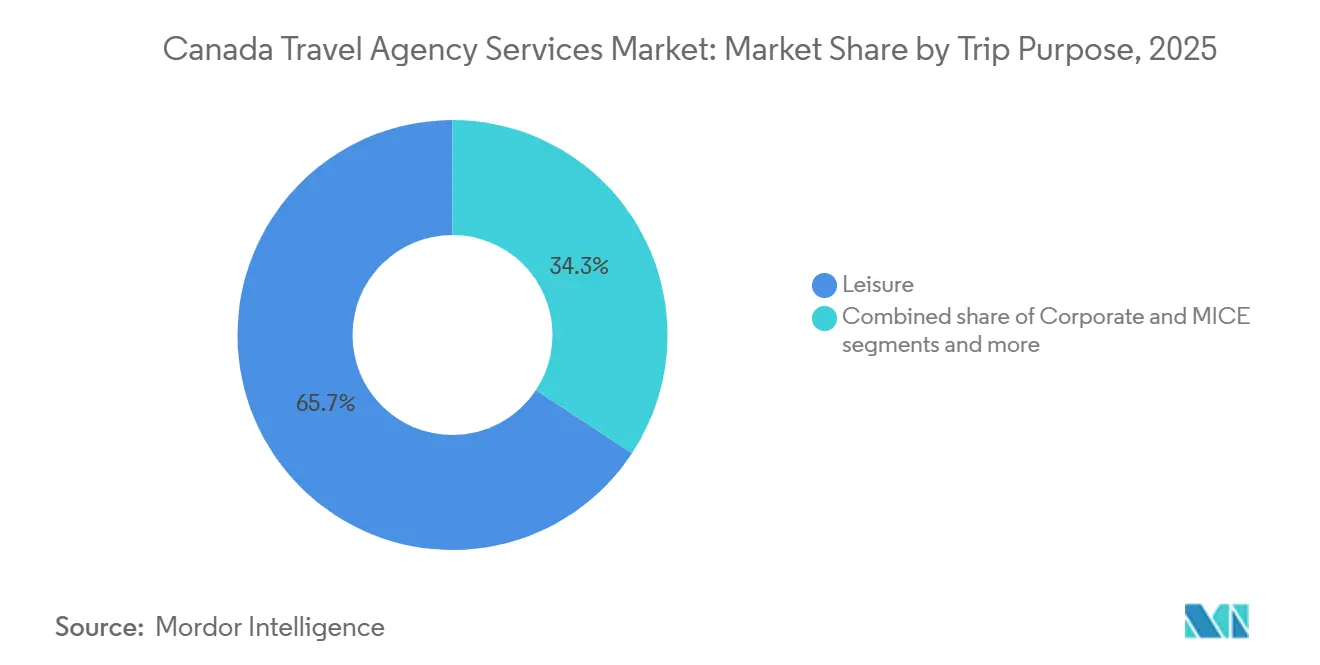
Leisure accounted for 65.74% of Canada's travel agency market in 2025, remaining the largest trip purpose segment. Demand stemmed from all-inclusive vacations, cruises, escorted tours, and FIT bookings, supported by advisor curation and supplier bundling. Visitor spending in Quebec reached CAD 19 billion (USD 13.88 billion) in 2025, a 4.8% increase from 2024, highlighting the strong role of agency networks in leisure travel distribution. FIT and custom itineraries grew as advisors used destination expertise and certifications to justify service fees. Leisure continued as the primary volume driver, despite faster growth in other trip purposes[3].
Corporate and MICE are projected to grow at an 8.90% CAGR through 2031, making them the fastest-growing trip purpose segment. Canada is ranked among the top global business travel markets, with business travel spending rising 9.6% in 2025 and total business travel and meetings spending expected to reach CAD 40.1 billion (USD 29.29 billion) in 2026. A major global travel management company completed a significant acquisition in 2025, reflecting strategic interest in this segment. Flight Centre’s Corporate Traveller Canada and FCM Travel Canada are competing for managed travel accounts, particularly in the SME and enterprise sectors. As in-person meetings normalize, agencies with strong account management, policy support, and expense integration are well-positioned to capture more of the corporate travel market.
By Traveler Type: International Growth Outpacing Domestic Despite Volume Headwinds
Domestic travelers accounted for 62.83% of the Canadian travel agency market share in 2025, making them the largest traveler type by volume-linked value. Canadian residents spent CAD 30.5 billion (USD 22.28 billion) on domestic tourism in Q3 2025, an 11.1% year-over-year increase. Summer 2025 tourism revenue reached nearly CAD 60 billion (USD 43.82 billion) between May and August, with 89% of regions experiencing growth. This demand was driven by changing consumer preferences, trade-related sentiment, and increased interest in domestic destinations. Domestic travel remained a key stabilizer for the Canadian travel agency market during a period of shifting outbound behavior.
International travelers are projected to grow at a 9.28% CAGR through 2031, making them the faster growth driver. Overseas arrivals rose 7.5% in 2025, with Q3 overseas visitor spending reaching CAD 5.7 billion (USD 4.16 billion), up 9.7%, and an average of CAD 2,169 (USD 1,584.15) per trip. Destination Canada revised its 2026 tourism spending growth forecast to 6.0%, up from 5.4%, indicating a stronger outlook for inbound and international trip planning services. Chinese travelers represent a significant opportunity, with organized group tours resuming. A Vancouver-based operator reported a fourfold increase in bookings for China circuits from February to May 2026 compared to the same period in 2025[4]. International travelers are expected to contribute a larger share of incremental growth in the Canadian travel agency market over the next several years.
Geography Analysis
Ontario held 36.49% of Canada’s travel agency market in 2025, the largest provincial share by value. Ontario accounted for 41.8% of visitor trips in 2024 and supported 715,800 tourism jobs, the highest among provinces. Toronto generated USD 4.3 billion in business travel revenue and USD 586 million in tax contributions in 2024. A mix of corporate demand, population size, and inbound travel makes Ontario a key revenue center. Flight Centre’s flagship store in Toronto reflects demand for advisor-supported travel planning.
British Columbia is projected to grow at a 9.69% CAGR through 2031, driven by cruise and overseas travel trends. Statistics Canada noted 26.7% of overseas trips to Canada in 2024 were to British Columbia, the highest share nationally. The Port of Vancouver’s 2025 cruise season generated USD 1.1 billion in economic impact, reinforcing its role in cruise distribution. Quebec, with CAD 19 billion (USD 13.88 billion) in visitor spending and Transat Distribution Canada’s retail presence, was the second-largest provincial market in 2025. Ontario leads in scale, British Columbia in growth, and Quebec in leisure distribution.
Alberta and the Rest of Canada contribute specialized demand. Alberta’s corporate travel, tied to Calgary and Edmonton’s energy sector, showed high spending, with Canadians averaging CAD 1,760 (USD 1,285.43) per business trip in 2024. Atlantic Canada is growing with increased cruise activity and improved European air access. While smaller markets, they expand opportunities for specialist agencies, host networks, and regional consolidators, as noted by Statistics Canada and federal tourism strategies.
Competitive Landscape
Canada's travel agencies market is highly fragmented, with no operator holding a significant share. This fragmentation drives competition while limiting dominance by larger firms. Expedia Group competes with agencies and supports them through its TAAP platform. Its recent results showed strong bookings growth, driven by direct channels and travel agent platform activity. Booking Holdings remains a key digital player, with competition in Canada shaped by channel reach and platform capabilities rather than local market share. Fragmentation allows niche cruise specialists, luxury advisors, host agencies, and regional corporate travel firms to coexist with global online brands.
The mid-market includes hybrid and network-based operators combining brand strength, advisor support, and selective technology investments. Flight Centre Travel Group Canada focuses on targeted store expansion while maintaining home-based and virtual teams, prioritizing high-demand areas over national rollout. Transat Distribution Canada, with a substantial number of outlets, introduced AI-linked training and succession support to enhance advisor productivity and network continuity. OPENJAW TTAND’s scale and its acquisition by Travel Counsellors reflect the growing role of home-based advisory networks in the market.
Competition centers on technology, consolidation, and specialized distribution rather than price. Expedia Group expanded its B2B platform with new APIs and insurance integration testing. KAYAK launched Ask AI in Canada, focusing on smarter search, ancillary sales, and guided conversion. In corporate travel, Amex GBT’s acquisition of CWT and Direct Travel’s acquisition of ATPI highlight the importance of scale for multinational account coverage and service platform integration. Trevello’s acquisition of Gifted Travel Network and Travel Counsellors’ acquisition of TTAND demonstrate ongoing consolidation in host agency ecosystems as the market evolves.
Canada Travel Agency Services Industry Leaders
-
Booking Holdings Inc.
-
Expedia Group, Inc.
-
H.I.S. Canada Travel Inc. / TravelBrands
-
Transat Distribution Canada
-
Direct Travel Canada
- *Disclaimer: Major Players sorted in no particular order
Recent Industry Developments
- April 2026: KAYAK launched "Ask AI" in Canada, a conversational booking tool integrating live flight, hotel, and rental car searches within a chat interface. Available on iOS and Android, it is the first conversational AI product designed for Canadian travelers at scale, introduced ahead of pre-FIFA World Cup travel planning.
- March 2026: Travel Counsellors acquired The Travel Agent Next Door, a Canadian home-based host agency network with 1,689 advisors and projected 2025 sales of CAD 530 million (USD 387.1 million). The acquisition expands Travel Counsellors to seven international markets, with the combined entity expected to reach GBP 1.5 billion (USD 2.02 billion) TTV within the next 12 months.
- September 2025: American Express Global Business Travel acquired CWT for approximately USD 540 million, forming one of the largest business travel management companies with a client portfolio spanning Canada’s enterprise managed travel segment.
- September 2025: Direct Travel acquired ATPI, its long-term strategic partner, forming an entity managing over USD 6 billion in annual travel volume. The deal accelerates the global rollout of Direct Travel's Avenir Travel Edition platform for corporate clients and strengthens Direct Travel Canada's corporate and MICE (Meetings, Incentives, Conferences, and Exhibitions) capabilities.
Canada Travel Agency Services Market Report Scope
| Airline Ticketing |
| Packaged Tours |
| Cruises |
| Lodging Reservations |
| Travel Insurance |
| Other Transportation and Ancillary Services |
| Online Travel Agencies (OTAs) |
| Offline/Traditional Agencies |
| Hybrid Agencies |
| Leisure | All-inclusive Vacations |
| Cruises | |
| Escorted Tours | |
| FIT and Custom Itineraries | |
| Corporate and MICE | SME and Enterprise Managed Travel |
| Meetings, Incentives, Conferences and Events |
| Domestic Travelers |
| International Travelers |
| Ontario |
| Quebec |
| British Columbia |
| Alberta |
| Rest of Canada |
| By Service Type | Airline Ticketing | |
| Packaged Tours | ||
| Cruises | ||
| Lodging Reservations | ||
| Travel Insurance | ||
| Other Transportation and Ancillary Services | ||
| By Booking Mode | Online Travel Agencies (OTAs) | |
| Offline/Traditional Agencies | ||
| Hybrid Agencies | ||
| By Trip Purpose | Leisure | All-inclusive Vacations |
| Cruises | ||
| Escorted Tours | ||
| FIT and Custom Itineraries | ||
| Corporate and MICE | SME and Enterprise Managed Travel | |
| Meetings, Incentives, Conferences and Events | ||
| By Traveler Type | Domestic Travelers | |
| International Travelers | ||
| By Geography | Ontario | |
| Quebec | ||
| British Columbia | ||
| Alberta | ||
| Rest of Canada | ||
Key Questions Answered in the Report
What is the size outlook for Canada travel agencies in 2026 and 2031?
The Canada travel agencies market is valued at USD 10.34 billion in 2026 and is forecast to reach USD 15.35 billion by 2031, growing at an 8.22% CAGR.
Which booking channel leads travel agency sales in Canada?
OTAs are the largest booking mode with 53.51% share in 2025, and they are also the fastest growing channel with a 9.90% CAGR through 2031.
Which service category is growing the fastest in Canada travel planning?
Cruises are the fastest growing service type with a projected 9.11% CAGR through 2031, supported by strong demand through Vancouver and rising interest in premium and expedition trips.
Why are advisors still relevant when digital booking is expanding?
Advisors remain important because complex international trips, custom itineraries, cruises, and managed corporate travel still require support that self service tools do not fully replace.
Which province contributes the most to agency revenues?
Ontario leads with 36.49% share in 2025 because it combines the country’s largest visitor base, major corporate travel demand, and the deepest advisor network.
What is the biggest long term challenge for agencies in Canada?
Recruitment and succession remain key challenges, since many agencies rely on experienced advisors and are investing in training and transition programs to sustain future growth.