
Canada Student Accommodation Market Size and Share
Market Overview
| Study Period | 2021 - 2032 |
|---|---|
| Forecast Data Period | 2027 - 2032 |
| Base Year Market Size (2026) | USD 1.78 Billion |
| Market Size (2027) | USD 1.91 Billion |
| Market Size (2032) | USD 2.69 Billion |
| Growth Rate (2027 - 2032) | 7.05 % |
| Market Concentration | Low |
Major Players *Disclaimer: Major Players sorted in no particular order Image © Mordor Intelligence. Reuse requires attribution under CC BY 4.0. | |
Canada Student Accommodation Market Analysis by Mordor Intelligence
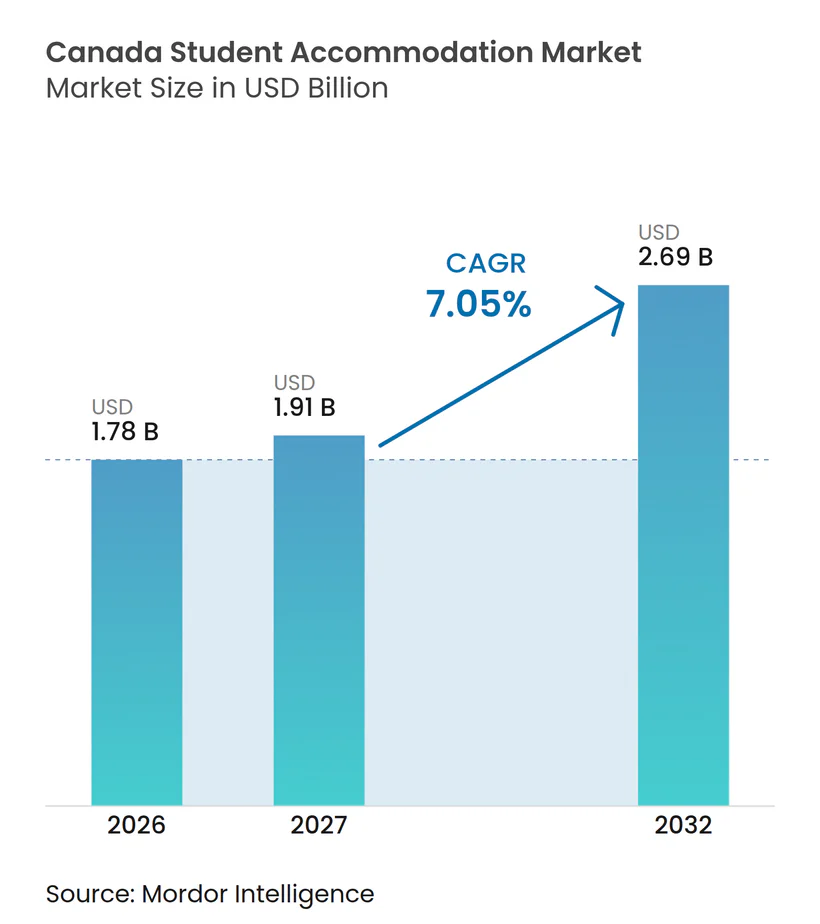
The Canada Student Accommodation Market size is projected to be USD 1.78 billion in 2026, USD 1.91 billion in 2027, and reach USD 2.69 billion by 2032, growing at a CAGR of 7.05% from 2027 to 2032.
A persistent shortage of purpose-built beds supports occupancy and pricing for professionally managed residences near large universities. Canada has 2.21 million postsecondary students and 169,000 purpose-built beds in its 24 largest student markets, leaving a substantial gap between student demand and dedicated supply. The Canada student accommodation market is also attracting institutional capital and university partnerships, which can bring forward projects when university operating budgets are constrained. Federal limits on study permits reduce near-term international demand, particularly in locations with strong college exposure, while domestic enrollment growth provides support at universities. Development costs, land prices, and approval timelines continue to restrict supply in Ontario and British Columbia, preserving the imbalance that shapes the Canada student accommodation market.
Key Report Takeaways
- By room type, private rooms held 45.8% of the Canada student accommodation market share in 2026, while entire-place or studio units are projected to grow at a CAGR of 7.98% through 2032.
- By student type, domestic students accounted for 54.6% of the Canada student accommodation market share in 2026, while international students are forecast to grow at a CAGR of 7.55% through 2032.
- By institution type, universities accounted for 84.5% of the Canada student accommodation market size in 2026, while other institution types are forecast to grow at a CAGR of 7.49% through 2032.
- By province, Ontario held 43.1% of the Canada student accommodation sector share in 2026, while Alberta is forecast to grow at a CAGR of 7.89% through 2032.
Note: Market numbers in this report are based on Mordor Intelligence's proprietary estimation framework, which combines nine months of actuals with Q4 projections for base year 2026.
Market Trends and Insights
Drivers Impact Analysis of Canada Student Accommodation Market*
| Drivers | (~) % Impact on CAGR Forecast | Geographic Relevance | Impact Timeline |
|---|---|---|---|
| Limited Purpose-Built Student Accommodation Supply | +3.5% | Global, concentrated in Ontario, British Columbia, Quebec, and Alberta | Long term (≥ 4 years) |
| Institutional Investment in Student Housing | +1.5% | National, with lead gains in Ontario, British Columbia, and Alberta | Medium term (2-4 years) |
| University Partnerships With Private Developers | +0.8% | Ontario, Alberta, Quebec | Medium term (2-4 years) |
| Tight Conventional Rental Markets | +0.7% | Ontario, British Columbia, Alberta core markets | Short term (≤ 2 years) |
| Preference for Secure, Amenity-Rich Housing | +0.4% | National | Long term (≥ 4 years) |
| Domestic Student Mobility Between Provinces | +0.3% | Alberta, Ontario, Atlantic Canada | Medium term (2-4 years) |
| Source: Mordor Intelligence | |||
Structural Supply Deficit Sustains Long-Run Demand
Canada’s supply of dedicated student housing remains materially below the needs of its postsecondary population. Forum Asset Management reported 169,000 purpose-built beds across the 24 largest student markets for 2.21 million students[1]. The Canada student accommodation market therefore relies heavily on conventional rental homes and university residences that do not meet all demand. Forum also reported that 64% of existing purpose-built supply is university-controlled, while universities face a USD 7.2 billion deferred maintenance backlog. This combination limits the ability of older campus residences to absorb additional enrollment and directs demand toward new private and partnership-led projects.
Institutional Investment Supports Professional Supply
Large investment platforms are expanding their role in Canadian student housing. Forum Real Estate Income and Impact Fund acquired Alignvest Student Housing real estate investment trust (REIT)’s 17-property, 7,159-bed portfolio in January 2025[2]. Brookfield Asset Management later committed up to USD 100 million to Forum Real Estate Income and Impact Fund to support the portfolio integration. Larger owners can apply operating systems across several properties and may have more capacity to fund upgrades or new developments. Forum reported that its portfolio used artificial intelligence-enabled leasing tools during 2025, which raises expectations for leasing response, revenue management, and resident service. This funding base gives the Canada student accommodation market a broader group of buyers and development partners.
University Partnerships Expand Delivery Options
University partnerships are creating a route to add beds without requiring institutions to finance and manage every project themselves. Toronto Metropolitan University partnered with Cedar Podium and the Building Ontario Fund on a 1,370-bed residence in Toronto, supported by USD 59.8 million in provincial funding. Fengate Asset Management and Tilbury Properties also reached financial close in 2025 on a 311-bed residence at Lambton College in Sarnia. These structures allow universities to contribute land, leases, or demand visibility while private partners provide development and operating capacity. The arrangement can improve project feasibility when lending conditions make stand-alone development harder. It also widens the pipeline beyond the largest university-owned residence systems.
Tight Rental Markets Reinforce Purpose-Built Demand
The conventional rental market remains an important alternative for students who cannot access campus residences. Statistics Canada reported higher room asking rents in several cities in the third quarter of 2025, including Sherbrooke, Fredericton, and Winnipeg[3]. In Alberta, this pressure coincides with rising student populations and record applications for housing at Calgary institutions. Purpose-built residences can offer furnishing, services, predictable lease conditions, and closer access to campus facilities. These attributes remain relevant where students face limited rental listings or need a residence before arriving in a new city. The Canada student accommodation market benefits when on-campus housing and nearby rental supply both remain constrained.
Restraints Impact Analysis of Canada Student Accommodation Market*
| Restraints | (~) % Impact on CAGR Forecast | Geographic Relevance | Impact Timeline |
|---|---|---|---|
| International Study Permit Restrictions | -0.8% | Ontario, British Columbia, Nova Scotia | Short term (≤ 2 years) |
| Elevated Construction and Land Acquisition Costs | -0.6% | Ontario, British Columbia, spill-over to Quebec | Long term (≥ 4 years) |
| Municipal Zoning Restrictions and Planning Approvals | -0.4% | Ontario, British Columbia | Medium term (2-4 years) |
| High Accommodation Fees Relative to Student Budgets | -0.2% | National, most acute in Toronto and Vancouver | Short term (≤ 2 years) |
| Source: Mordor Intelligence | |||
International Permit Restrictions Limit Near-Term Demand
Federal policy has reduced the near-term pool of new international students. Immigration, Refugees and Citizenship Canada set a 2026 cap of 309,670 study permit application spaces and planned for 155,000 new student arrivals. Statistics Canada reported that international university enrollment declined 6.1% in 2024/25, while domestic university enrollment increased 1.8%. The effect differs by institution, because universities and colleges serve different student profiles and have different levels of international enrollment. Properties near research universities have more support from domestic enrollment and may be less exposed than accommodation that serves college clusters. Compliance requirements for designated learning institutions also make enrollment planning more important for operators and their university partners.
Construction Costs Restrict New Project Feasibility
High building, land, and financing costs limit the number of student housing projects that can proceed. The Canada Mortgage and Housing Corporation found that access to capital for land acquisition was a leading barrier for rental development in 2025. Its survey also reported that specialized housing developers expected significant tariff-related construction cost increases. The University of Victoria reported that the deferral of provincial funding moved its 510-bed residence from a planned 2029 completion to 2034. Such delays extend the period during which local demand must rely on existing residences and the secondary rental market. Cost discipline and access to public financing will remain central to expanding the Canada student accommodation market.
*Our forecasts treat driver/restraint impacts as directional, not additive. The impact forecasts reflect baseline growth, mix effects, and variable interactions.
Canada Student Accommodation Market Segment Analysis
By Room Type:
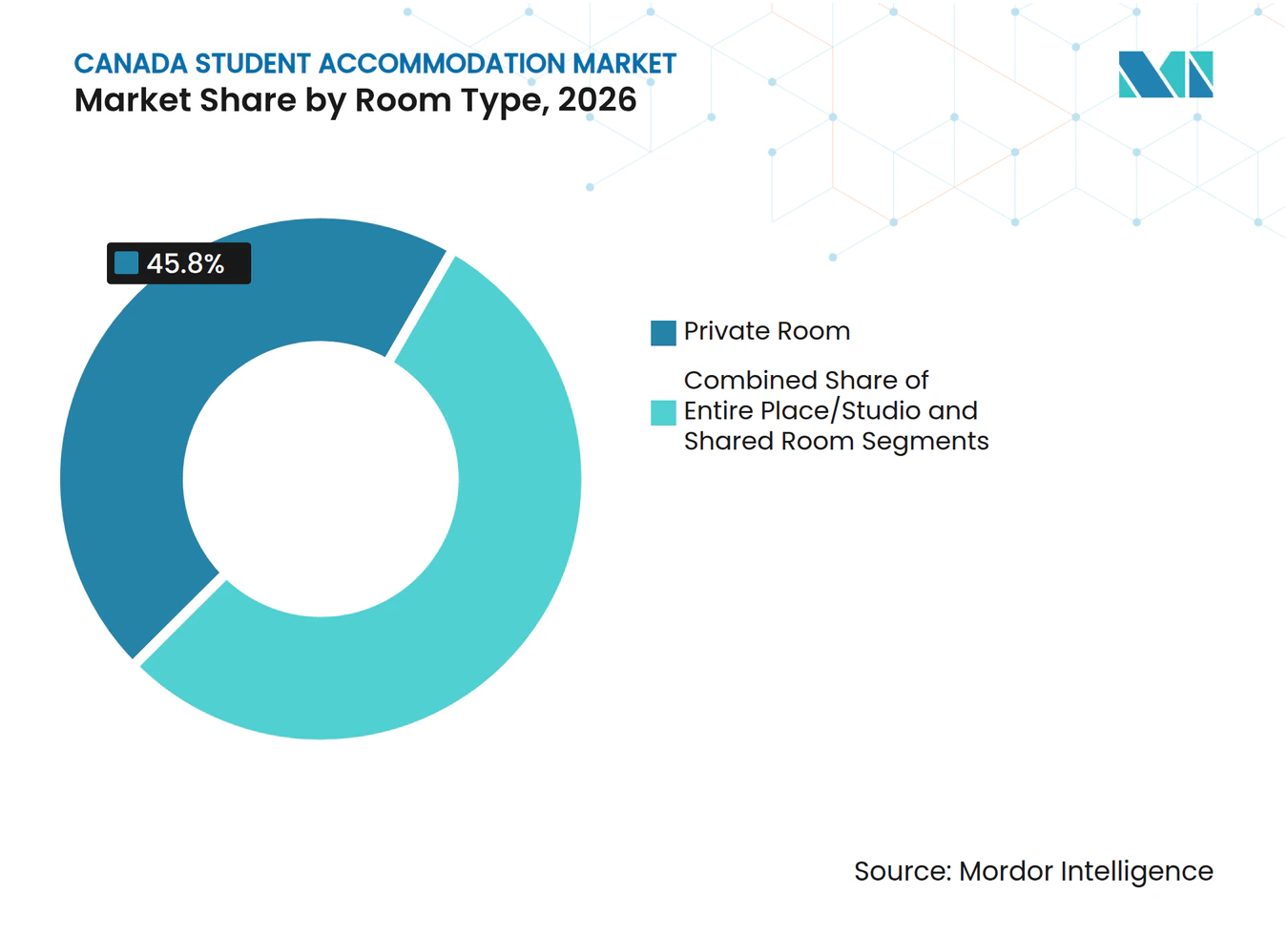
Private Rooms Lead as Students Seek PrivacyPrivate rooms held 45.8% of the Canada student accommodation sector share in 2026, making them the leading room format. This position reflects the balance they offer between personal space and a cost below a self-contained studio. Private rooms also allow operators to provide shared study, fitness, and social areas while keeping the bedroom private. This format can suit domestic students, students moving between provinces, and students who want access to campus without taking a full apartment lease. The Canada student accommodation market size tied to private rooms is supported by this broad customer base. Shared rooms retain a role for students with tighter budgets, especially first-year students who prioritize lower accommodation costs. However, shared rooms face a more difficult position when students have access to private alternatives. Their appeal depends on pricing, location, and the quality of common areas.
Entire place and studio units are forecast to record the highest growth rate at a 7.98% CAGR through 2032. These units meet demand from graduate students and domestically mobile students who need a self-contained home. Furnished studios can also appeal to international students who want fewer setup costs after arrival. Operators can use a mixed room strategy to serve students with different budgets within one property. Forum’s use of artificial intelligence-enabled leasing tools across its portfolio shows how large operators are seeking to match room configurations with demand more quickly. This capability can help owners set rents and manage availability across private rooms, shared rooms, and studios. A portfolio with several formats may reduce the risk of depending on a single student group. New supply is likely to favor layouts that protect privacy while retaining shared building services.



By Student Type:
Domestic Students Provide a Stable BaseDomestic students represented 54.6% of the Canada student accommodation sector share in 2026. Statistics Canada reported that domestic university enrollment increased by 20,976 students, or 1.8%, in 2024/25. This growth offers a stable demand base during a period of reduced international student arrivals. Students moving between provinces can have a greater need for residence or rental housing because they cannot commute from their existing homes. Alberta and Ontario benefit from this mobility through large university systems and continued population growth. Domestic students may also be more likely to compare residence options with local rental housing before making a decision. Operators therefore need pricing, lease length, and amenity packages that remain practical for students supported by family income or part-time work. This group provides an important base for buildings near universities with growing provincial recruitment.
International students are projected to be the faster-growing student segment at a 7.55% CAGR through 2032. Their immediate outlook remains affected by permit limits, yet university-focused demand has different conditions from college-focused demand. Immigration, Refugees and Citizenship Canada is directing its program through a multi-year framework that also addresses designated learning institution compliance. International students often place value on furnished homes, bundled utilities, and clear move-in arrangements. These preferences create scope for purpose-built properties with all-inclusive service packages. The Canada student accommodation market can serve both domestic and international cohorts through flexible room mixes rather than separate buildings. Such flexibility is useful when policy changes alter the timing or composition of student arrivals. It also helps operators maintain occupancy across academic cycles.
By Institution Type:
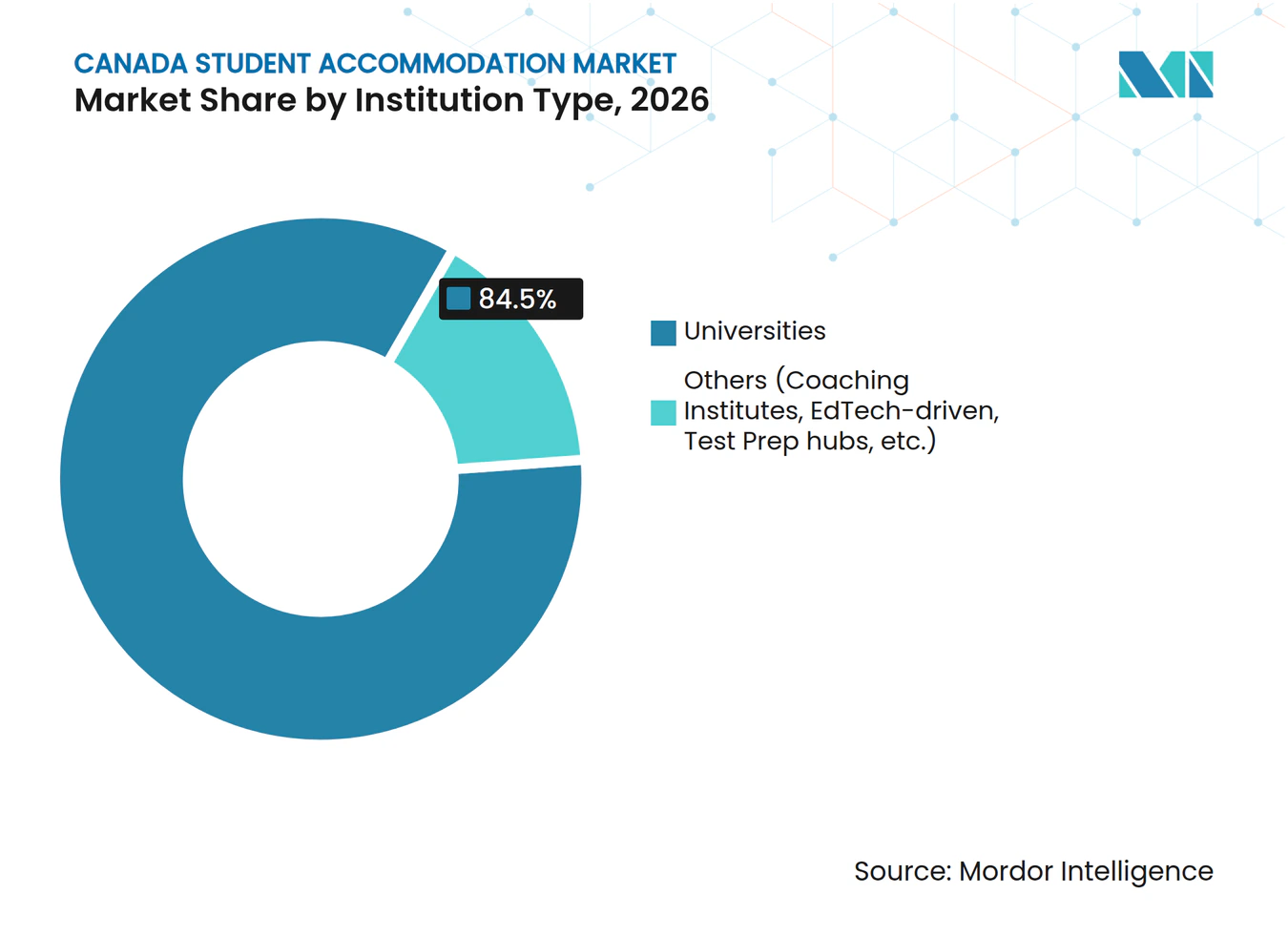
Universities Remain the Core Demand CenterUniversities accounted for 84.5% of the Canada student accommodation market size in 2026. Their scale, research activity, and established residence systems give them a central role in dedicated student housing demand. Forum reported that full-time enrollment across the top 20 universities served by its portfolio rose 3.2% in the 2025/26 academic year. The University of Guelph recorded a 7.5% increase in that portfolio’s reported enrollment figures. University areas can offer clearer demand visibility for developers because enrollment, campus plans, and residence capacity are regularly tracked. These locations also support partnerships where institutions provide land or long-term demand commitments. The Canada student accommodation market retains its strongest foundation around large public universities with limited nearby supply. Their need for safe, accessible residences also supports ongoing project discussions with private developers.
Other institution types are forecast to grow at a 7.49% CAGR through 2032. This group includes coaching institutes, education technology learning centers, and test preparation locations. These learners may need shorter leases, flexible arrival dates, and furnished accommodation. The product requirement can differ from a conventional university residence built around a full academic year. A dedicated offer for this group remains limited in many urban corridors. Canada Mortgage and Housing Corporation formally included student rental housing in its glossary in 2025, reflecting greater recognition of the category within housing policy. However, project developers still need to work through municipal zoning and institutional requirements that vary by location. Flexible leases and transparent pricing can help providers reach this smaller but growing demand pool.

Geography Analysis
Ontario
Ontario held 43.1% of the Canada student accommodation sector share in 2026 and remains the largest provincial geography. Its large research universities create recurring demand for on-campus, affiliated, and privately managed housing. The province’s constrained rental markets can push students toward purpose-built residences when they offer location certainty and bundled services. Toronto Metropolitan University, Cedar Podium, and the Building Ontario Fund are developing a 1,370-bed residence supported by USD 59.8 million in provincial funding. The project demonstrates a delivery model that combines an institution, a private developer, and provincial support. Manulife Investment Management and Cedar Podium are also developing a 389-bedroom zero-carbon student housing project near Queen’s University. The project targets Canada Green Building Council Zero Carbon Design certification, showing that environmental standards are becoming part of new project positioning. Bill 185 also reduces planning friction for housing on institutional land, giving regulatory influence to the province’s broader supply response. Ontario’s opportunity remains strong, but high construction and land costs require developers to secure dependable financing and institutional partners.
Alberta
Alberta is projected to grow at a 7.89% CAGR through 2032. Enrollment growth in Edmonton and Calgary supports demand that is less dependent on international student arrivals than in some other provinces. Edmonton’s needs assessment indicates a sizable increase in students at its largest postsecondary institutions by 2028/29. The city’s downtown incentive uses federal Housing Accelerator Fund capital to encourage new student units. This is a practical local policy response because the program connects grants to building permit deadlines. The University of Calgary Properties Group’s partnership with Truman adds a further example of institutional land and private capital working together. Alberta rental housing starts increased 37% in 2025 compared with 2024, which provides a more supportive setting for new construction. A functioning development pipeline can help the province respond to demand without relying only on the secondary rental market. Operators can differentiate in Alberta by offering convenient locations, furnished units, and services that suit students moving from other provinces.
Quebec, British Columbia, and the Rest of Canada
Quebec is using non-profit development to add purpose-built student housing in Montreal. UTILE, a non-profit student housing developer, began construction on the 285-unit Griffintown project in 2025 and the 149-apartment Des Carrières project in 2026, with both buildings targeting summer 2027 occupancy. This model combines public and private funding and places affordability within project design. British Columbia faces a different pattern because the University of Victoria’s 510-bed project has moved to 2034 after funding was withdrawn. The delay prolongs the need for accommodation in Victoria’s existing residence and rental stock. Smaller university cities also show pressure in room rents, including Sherbrooke, Fredericton, and Winnipeg in the third quarter of 2025. These locations show that the Canada student accommodation market is not limited to the largest metro areas. Local institutions, municipalities, and non-profit providers can use tailored delivery structures where large institutional capital has not yet scaled.
Competitive Landscape
Market Concentration
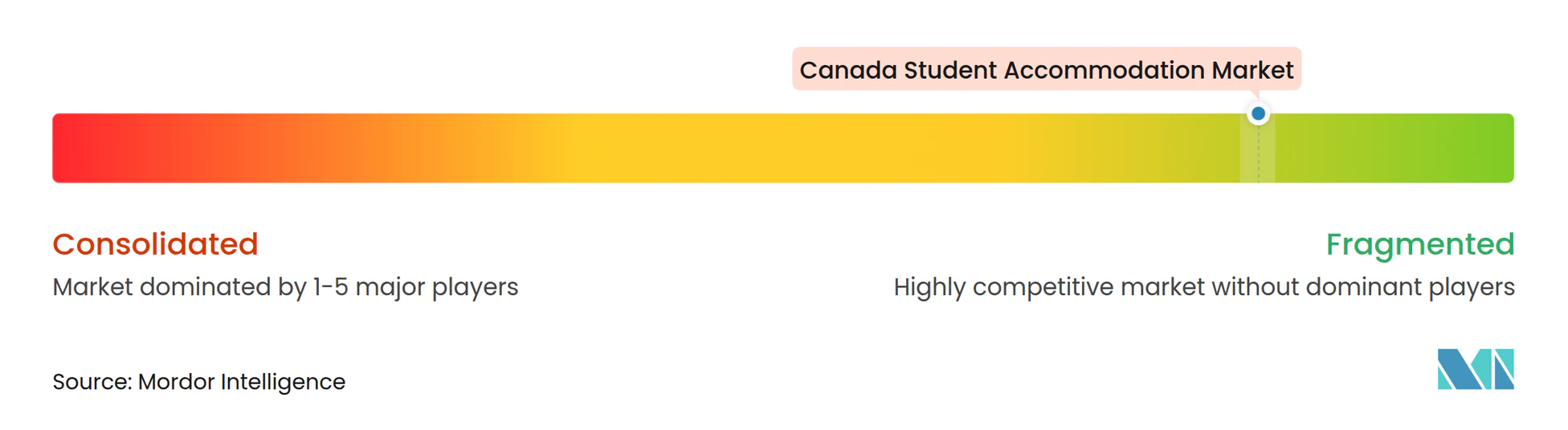
The Canada student accommodation market is fragmented, although large platforms are expanding through acquisitions and operating scale. Forum Real Estate Income and Impact Fund held approximately 11,200 beds and USD 2.1 billion in gross asset value as of the first quarter of 2026. Its acquisition of Alignvest Student Housing REIT added 17 properties and 7,159 beds across 7 university markets. The deal strengthened Forum’s position but did not create a dominant national operator because supply remains spread across universities, smaller owners, and regional developers. The Forum’s reported leasing technology gives a scaled platform an operational advantage in lead conversion and occupancy management. Competition therefore combines portfolio scale with local relationships and the ability to operate specialized buildings.
Capital formation is becoming a competitive factor alongside development capability. Forum Student Living Fund I filed a preliminary initial public offering prospectus in April 2026 for USD 28.8 million to USD 54 million in units linked to 4 income-producing properties in Ontario. Brookfield’s investment commitment adds another source of capital to Forum’s platform. Developers such as Cedar Podium, Tilbury Properties, and Fengate compete through partnership-led projects that address university or public-sector requirements. Tilbury completed the 452-bed Rodzik Hall residence at the University of Windsor in 2025. Fengate and Tilbury also achieved financial close on the Lambton College project, which is scheduled for 2027 occupancy. These moves show that specialist developers can compete even where large owners have greater acquisition capacity.
Partnership structures create room for several types of competitors in the Canada student accommodation market. Canada Mortgage and Housing Corporation’s Apartment Construction Loan Program includes a student housing stream that requires rent increase limits for at least 10 years from first occupancy. This program can support projects that meet public affordability requirements while securing institutional financing. UTILE uses a non-profit model in Montreal, while university-linked developers use land and long-term institutional relationships in Ontario and Alberta. No operator holds a dominant share of national supply, as housing remains distributed across university, private, and non-profit owners. Competitive outcomes will depend on access to capital, planning approvals, operational quality, and the ability to deliver properties that align with local enrollment patterns.
Canada Student Accommodation Industry Leaders
-
Campus Living Centres
-
Forum Asset Management
-
Canadian Student Living
-
The Marq
-
Canadian Campus Communities
- *Disclaimer: Major Players sorted in no particular order
Canada Student Accommodation Market Companies Covered in this Report
- Campus Living Centres
- Forum Asset Management
- Canadian Student Living
- The Marq
- Canadian Campus Communities
- Campus Suites
- Envie Student
- Domus Student Housing
- Rez-One
- London Property Corp.
- UTILE
- GEC Living
- Varsity Communities
- Knightstone Capital Management
- Alignvest Student Housing REIT
- Harrington Housing
- CampusOne
- Parkside Student Residence
- CAPREIT Student Housing
- University Apartments
Recent Industry Developments in Canada Student Accommodation Market
- May 2026: UTILE, the City of Montreal, and the Association étudiante de Polytechnique broke ground on UTILE Des Carrières, a 149-apartment, 235-bed non-profit student housing project in Montreal’s Plateau-Mont-Royal district, representing a USD 34.6 million investment with a Desjardins first-mortgage loan of USD 28.1 million. Targeted occupancy is fall 2027.
- April 2026: Forum Asset Management filed a preliminary initial public offering (IPO) prospectus for Forum Student Living Fund I, targeting a minimum of USD 28.8 million and a maximum of USD 54 million in Class A and Class F units focused on 4 income-producing purpose-built student accommodation properties in Ontario. This is the first publicly marketed retail investment vehicle for Canadian purpose-built student accommodation, broadening the capital base and signaling sector maturation.
- March 2026: Forum Real Estate Income and Impact Fund’s fourth-quarter 2025 report described a portfolio of 32 properties with approximately USD 2.1 billion in gross asset value. Full-time enrollment at the top 20 universities served by its assets rose 3.2% for the 2025/26 academic year.
Canada Student Accommodation Market Report Scope
Segmentation Overview
| Entire Place/Studio |
| Private Room |
| Shared Room |
| Domestic |
| International |
| Universities |
| Other Institution Types (Coaching Institutes, EdTech-Driven, Test Prep Hubs, etc.) |
| Ontario |
| Quebec |
| British Columbia |
| Alberta |
| Rest of Canada |
| By Room Type | Entire Place/Studio |
| Private Room | |
| Shared Room | |
| By Student | Domestic |
| International | |
| By Institution Type | Universities |
| Other Institution Types (Coaching Institutes, EdTech-Driven, Test Prep Hubs, etc.) | |
| By Province | Ontario |
| Quebec | |
| British Columbia | |
| Alberta | |
| Rest of Canada |
Key Questions Answered in the Report
What is driving demand for student accommodation in Canada?
A shortage of dedicated beds near major institutions is a central factor. Canada had 2.21 million postsecondary students and 169,000 purpose-built beds across its 24 largest student markets in 2026. Limited university residence capacity, constrained nearby rentals, and delays in new construction keep purpose-built options important for many students. This demand is strongest where large institutions operate within dense urban neighborhoods that offer few suitable rental alternatives for incoming students.
What is the projected growth rate for Canadian student housing?
The Canada student accommodation market is projected to grow at a 7.05% CAGR from 2027 to 2032. The forecast reflects durable demand for dedicated accommodation while supply remains limited in major university locations. Institutional capital, university partnerships, and purpose-built operating models are helping address this need, but they do not remove the shortfall quickly.
Which room type has the largest share in Canada?
Private rooms led with a 45.8% share in 2026. Entire place and studio units are expected to post the highest CAGR of 7.98% through 2032, reflecting demand for privacy, furnishing, and self-contained living among some student groups.
Which student group has the largest share of accommodation demand?
Domestic students accounted for 54.6% of value in 2026. Their demand base is supported by a 1.8% increase in domestic university enrollment in 2024/25, and students who move between provinces often require residence or rental accommodation near their institution.
Which province leads Canada’s student accommodation sector?
Ontario led with a 43.1% share in 2026, supported by its large university base and constrained urban rental markets. Partnership projects and planning measures for institutional land aim to improve the pipeline, though delivery costs remain a constraint. Ontario therefore remains a key location for investors and operators that can combine local development knowledge with long-term institutional relationships.
Which province is expected to grow fastest through 2032?
Alberta is forecast to grow at a 7.89% CAGR through 2032. Its outlook is supported by enrollment growth and local incentives for new student housing. University-linked development partnerships and a more active rental construction environment also support the province’s delivery capacity. These conditions give Alberta a clearer path to add beds as students seek accommodation near expanding campuses in Edmonton and Calgary.