
Canada Prefabricated Product Logistics Market Size and Share
Market Overview
| Study Period | 2020 - 2031 |
|---|---|
| Forecast Data Period | 2026 - 2031 |
| Base Year Market Size (2025) | USD 0.99 Billion |
| Market Size (2026) | USD 1.04 Billion |
| Market Size (2031) | USD 1.35 Billion |
| Growth Rate (2026 - 2031) | 5.48 % |
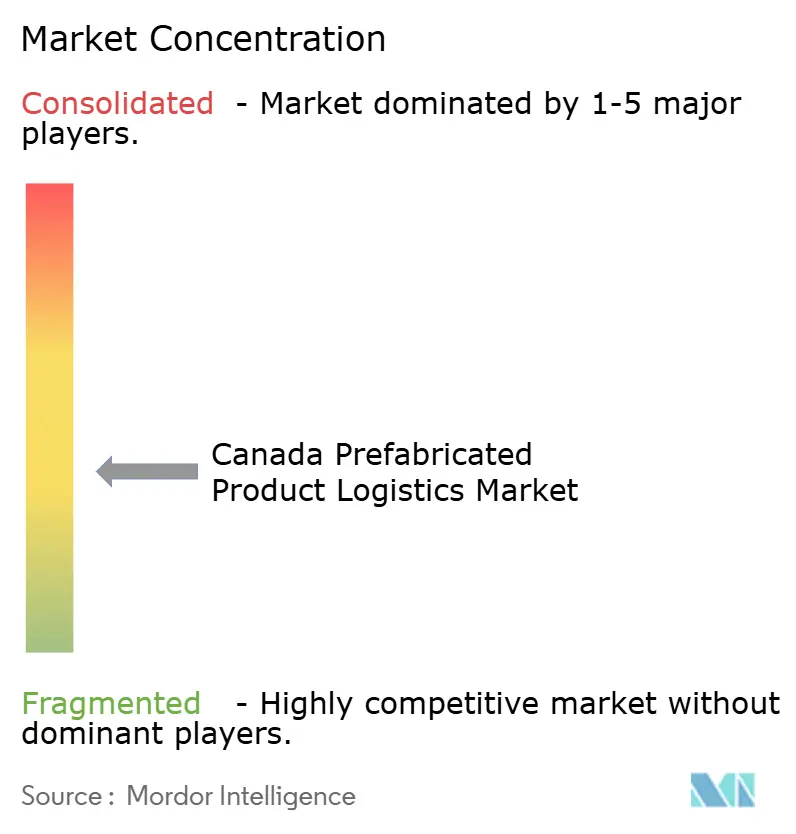
| Market Concentration | Medium |
Major Players *Disclaimer: Major Players sorted in no particular order Image © Mordor Intelligence. Reuse requires attribution under CC BY 4.0. | |
Canada Prefabricated Product Logistics Market Analysis by Mordor Intelligence
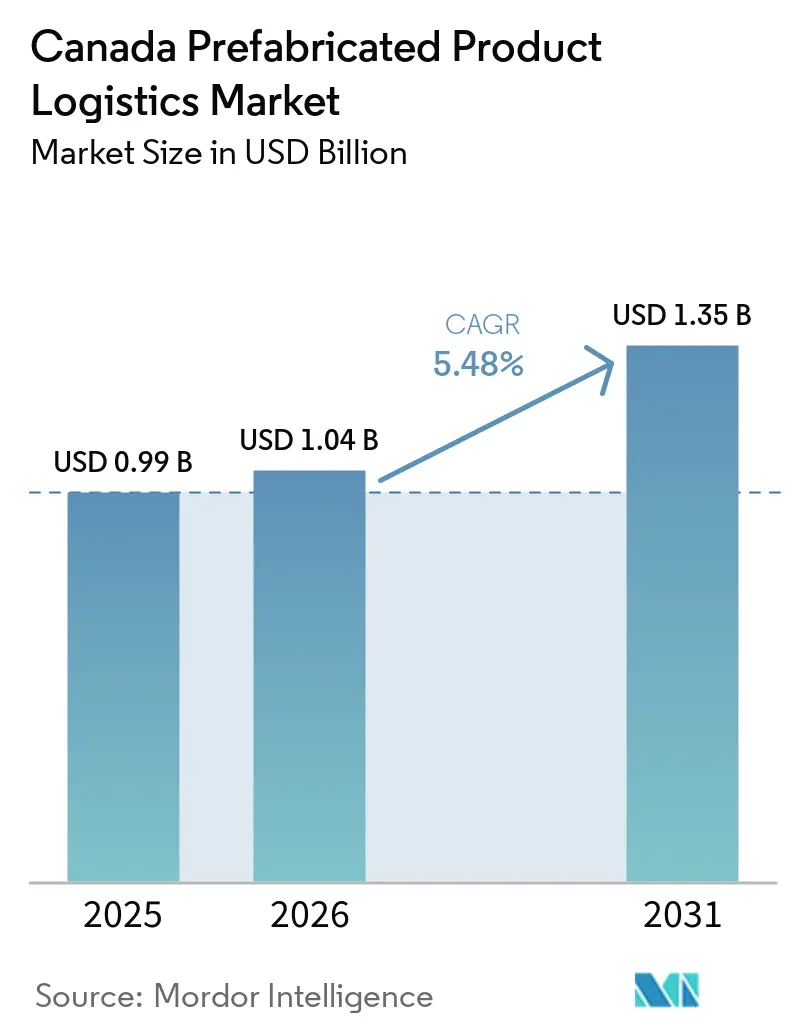
The Canada prefabricated product logistics market size was valued at USD 0.99 billion in 2025 and estimated to grow from USD 1.04 billion in 2026 to reach USD 1.35 billion by 2031, at a CAGR of 5.48% during the forecast period (2026-2031).
Factory-built housing, modular industrial facilities, and panelized building systems requires logistics networks that can move oversized loads in sequence while preventing delays and damage. Federal housing policy placed modern construction methods within a longer-term housing agenda, which supported demand for specialized transport and handling. Repeating supply agreements supported more predictable freight volumes and gave carriers a clearer basis for investing in dedicated equipment. The Canada prefabricated product logistics market also faced limits from driver availability, uneven provincial permitting, and weather-related disruption on northern and prairie routes. These conditions favored providers that combined transport capacity with route planning, permit management, tracking, and site coordination.
Key Report Takeaways
- By service, transportation held 68.50% of the Canada prefabricated product logistics market share in 2025, while value-added services recorded the highest projected CAGR at 7.10% through 2031.
- By product type, modular buildings held 46.20% of the Canada prefabricated product logistics market size in 2025, while panelized and componentized systems recorded the highest projected CAGR at 6.98% through 2031.
- By application, residential buildings held 47.55% of the Canada prefabricated product logistics market share in 2025, while commercial buildings recorded the highest projected CAGR at 7.23% through 2031.
Note: Market size and forecast figures in this report are generated using Mordor Intelligence’s proprietary estimation framework, updated with the latest available data and insights as of January 2026.
Canada Prefabricated Product Logistics Market Trends and Insights
Drivers Impact Analysis*
| Driver | (~) % Impact on CAGR Forecast | Geographic Relevance | Impact Timeline |
|---|---|---|---|
| Accelerating Modular Housing Deliveries | +1.6% | National, concentrated in British Columbia, Alberta, and Ontario | Short term (≤ 2 years) |
| Growth in Industrial and Commercial Prefabrication | +1.1% | Alberta industrial sites, Ontario data centers and healthcare | Medium term (2-4 years) |
| Time-Certain Transport and Site Sequencing Demand | +0.8% | National | Medium term (2-4 years) |
| Infrastructure Spending for Northern Logistics | +0.7% | Northwest Territories, Nunavut, Northern Alberta, and British Columbia | Long term (≥ 4 years) |
| Outsourcing of Permitting and Route Engineering | +0.5% | National, with early gains in Alberta and Saskatchewan | Short term (≤ 2 years) |
| Digitized Tracking for Oversized Loads | +0.4% | National | Medium term (2-4 years) |
| Source: Mordor Intelligence | |||
Accelerating Modular Housing Deliveries Across Canada
Federal housing programs made factory-built housing a more durable source of freight demand for the Canada prefabricated product logistics market. Build Canada Homes was established in September 2025, with planned cash expenditures of USD 9.4 billion through 2031. The Parliamentary Budget Office described the program’s role in the outlook for housing programs under Budget 2025. In February 2026, Build Canada Homes sought firms that could support modular supply agreements and prioritized multiyear arrangements, giving manufacturers and logistics providers a recurring planning base. The Alberta partnership covered at least 1,460 affordable homes using modern construction methods, reinforcing western transport corridors. These agreements shifted part of the freight requirement from isolated project movements toward repeated volumes that supported specialized lowbed and flat-deck investment.
Growth in Prefabricated Industrial and Commercial Construction Pipelines
Industrial and commercial projects generated demand for the Canada prefabricated product logistics market through a different set of transport needs than housing. Oil sands maintenance, mine expansions, and energy-related projects used process equipment that required heavy-haul moves and precise installation schedules. These movements involved longer routes, heavier loads, and tighter site sequencing than many residential deliveries. Mammoet completed the Jansen headframe replacement in Saskatchewan during April 2026, moving prefabricated sections from Alberta and installing a 2,090-tonne structure with self-propelled modular transporters and crawler cranes. Healthcare and public infrastructure also supported modular construction in rural and remote areas where labor and site logistics were constrained.[1]Natural Resources Canada, “Canada Invests in Arctic Infrastructure to Bring Critical Minerals to Market and Strengthen Northern Communities,” Government of Canada, canada.ca CMHC selected 11 Quebec projects totaling 336 units for summer 2026 delivery under its Highly Prefabricated Multi-Housing Initiative.
Demand for Time-Certain, Damage-Controlled Transport and Site Sequencing
Prefabricated projects shortened on-site work because modules and panels arrived ready for installation. This placed greater responsibility on carriers within the Canada prefabricated product logistics market to meet delivery windows and maintain load conditions. A late or damaged unit could leave installation crews idle and disrupt subsequent work. Customers, therefore, used service-level terms covering delivery times, condition checks, real-time tracking, and responsibility for damage. Value-added services grew at 7.10% annually through 2031 because inspections, site-sequencing coordination, and liability protocols became central to project delivery. The 2026 interprovincial trucking memorandum established a common information standard for oversized permit applications, supporting more consistent information exchange across jurisdictions.
Infrastructure Spending Supporting Remote and Northern Project Logistics
Northern infrastructure spending created a longer-term project pipeline for the Canada prefabricated product logistics market. Remote projects often relied on prefabrication because they had limited local labor, severe weather conditions, and narrow construction windows. Budget 2025 announced USD 1.1 billion for the First and Last Mile Fund to connect mining and resource projects to transport corridors. The Parliamentary Budget Office estimated federal infrastructure spending at USD 115 billion from 2025-26 to 2029-30. The Mackenzie Valley Highway commitment of USD 292 million supported year-round overland access in the Northwest Territories.[2]“Federal Infrastructure Spending Update,” Parliamentary Budget Office, pbo-dpb.ca Expanded all-season access could improve the practicality of route-specific fleet deployment for remote deliveries.
Restraints Impact Analysis*
| Restraint | (~) % Impact on CAGR Forecast | Geographic Relevance | Impact Timeline |
|---|---|---|---|
| Backhaul Imbalance on Specialized Returns | -0.4% | National, most acute in Western Canada | Medium term (2-4 years) |
| Shortage of Oversize Freight Drivers and Escort Crews | -0.3% | National, concentrated in Alberta and British Columbia | Short term (≤ 2 years) |
| Provincial Permit Complexity and Corridor Bottlenecks | -0.3% | National, particularly multijurisdictional corridors | Short term (≤ 2 years) |
| Weather Disruption on Long-Haul Deliveries | -0.2% | Prairie provinces and Northern Canada | Short term (≤ 2 years) |
| Source: Mordor Intelligence | |||
High Backhaul Imbalance on Specialized Return Movements
Specialized modular transport often moved loaded in one direction and returned with little or no cargo. Lowbed trailers, multi-axle transporters, and wide-load convoys had limited return-use options once a project delivery was complete. This pattern was particularly difficult in Western Canada, where activity clustered around selected construction and resource corridors. The Canada prefabricated product logistics market, therefore, had fewer opportunities to build efficient circular routes than standard freight networks. Empty return movements reduced fleet utilization and made further capacity additions less attractive to operators.[3] “It All Moves by Truck,” Statistics Canada, statcan.gc.ca Until demand created dependable return loads, this constraint kept cost pressure high for specialized carriers.
Limited Availability of Skilled Oversize Freight Drivers and Escort Crews
Oversized-load transport depended on drivers and escort crews with specialized licensing, route-reading capability, and safety experience. Statistics Canada reported 13,310 vacant transport truck driver positions in the first quarter of 2026, compared with 11,780 in the first quarter of 2025. Nearly 30% of these vacancies had been advertised for 90 days or longer. Trucking HR Canada reported in May 2026 that the number of drivers actively seeking employment declined by 900 from April 2025. Provincial licensing requirements and safety compliance requirements further narrowed the qualified candidate pool for heavy-haul operators. The shortage restricted how quickly the Canada prefabricated product logistics market could add specialized capacity.
*Our forecasts treat driver/restraint impacts as directional, not additive. The impact forecasts reflect baseline growth, mix effects, and variable interactions.
Segment Analysis
By Service: Transportation Anchors Volume as Value-Added Services Expand
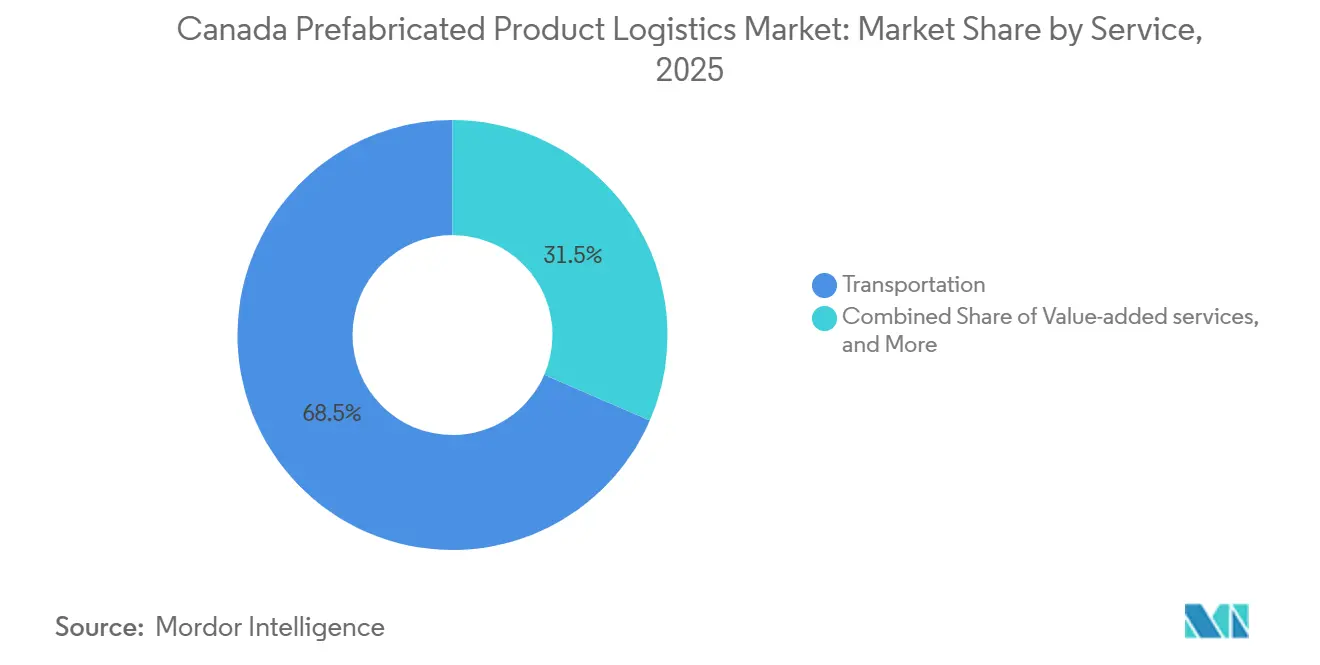
Transportation held 68.50% of the Canada prefabricated product logistics market share in 2025. The share reflected the direct need to move modules, panels, and components from factories to project sites. Road transport remained the main mode for prefabricated construction because it served a wide range of origin and destination locations. Volumetric modules in British Columbia and Alberta commonly moved on flat-deck or lowbed trailers. Panelized systems moved on standard flatbeds and could reach sites that were not suitable for full-sized modules. Rail provided an alternative for longer panel and component movements where transit timing allowed.
Value-added services recorded the highest projected CAGR at 7.10% through 2031 in the Canada prefabricated product logistics market. Warehousing and storage supported staging before just-in-time delivery to sites with limited lay-down space. Air transport served time-sensitive deliveries to remote northern sites, while marine and inland waterways supported large sections bound for coastal or barge-accessible locations. Customers sought pre-delivery inspection, installation-sequencing coordination, insurance verification, and damage-liability processes. Providers that supplied tracking records, schedule documentation, and site-level coordination held an advantage over standard freight carriers. The 2026 trucking memorandum supported this operating model through a common information standard for interprovincial oversized permit applications.



By Product Type: Modular Buildings Lead While Panelized Systems Gain Ground
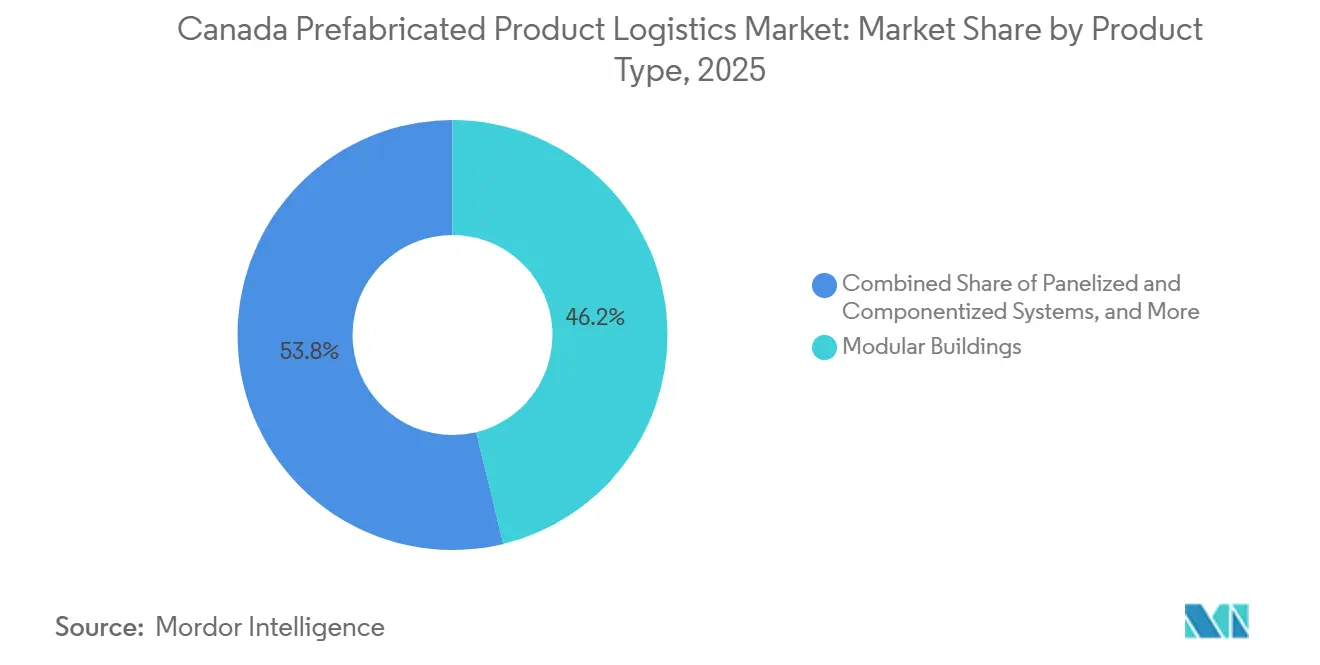
Modular buildings held 46.20% of the Canada prefabricated product logistics market size by product type in 2025. This market size position reflected demand for volumetric units in residential, workforce, and resource-sector construction. Modular building movements were more transport-intensive because units often exceeded legal road widths. Such loads required permits, pilot vehicles, restricted travel hours, and route engineering.[4]“2026 Canadian Permanent Modular Construction Industry Report,” Modular Building Institute, modular.org Alberta, British Columbia, and Manitoba supported substantial modular transport activity through mining camp housing, Indigenous community projects, and suburban development. Policy support covered healthcare, education, and affordable housing applications, with a significant role for rural and remote locations.
Panelized and componentized systems recorded the highest projected CAGR at 6.98% through 2031. These products could travel on standard flatbeds without the escort and restricted-hours obligations associated with many volumetric modules. This gave them access to a broader carrier base and supported urban deliveries where oversize rules were more restrictive. The Canada prefabricated product logistics industry benefited because panels also reached sites that could not accept full modules. Other prefab types included pre-engineered steel structures and precast concrete panels. These products supplied stable volumes for commercial and infrastructure work, particularly in Ontario and Quebec.
By Application: Residential Volume Supports Commercial Growth
Residential buildings accounted for 47.55% of the Canada prefabricated product logistics market share in 2025. Housing demand across Canadian provinces kept factory-built housing within the construction pipeline. Build Canada Homes and CMHC programs created a multiyear base for modular and panelized housing movements. The Alberta and Build Canada Homes partnership covered at least 1,460 affordable homes using modern construction methods. This activity supported recurring movements between manufacturing locations and residential project sites. Residential projects also required deliveries that aligned with site availability and installation sequencing.
Commercial buildings recorded the highest projected CAGR at 7.23% through 2031. Data centers, healthcare facilities, modular retail pods, and light industrial units increasingly use factory-built systems to shorten project delivery. Commercial modules were heavier and more varied in geometry than many residential units. They also had tighter delivery requirements tied to commissioning schedules. These characteristics raised the value of specialized equipment and condition-controlled transport within the Canada prefabricated product logistics market. The other application category, including infrastructure, education, and military construction, provided specialized demand at remote government and resource locations.
Geography Analysis
Western Canada was the most active area for the Canada prefabricated product logistics market. Alberta’s Industrial Heartland and Edmonton-to-north construction corridors produced heavy-haul demand for process equipment, workforce housing, and industrial structures. Mammoet Canada Western moved two 670-tonne ethylene oxide reactors to Shell’s Scotford facility in 2025 with a total gross weight of 1.76 million kilograms. British Columbia added mountain passes, coastal ferry routes, and Greater Vancouver delivery restrictions to the operating challenge. These conditions required route-engineering capability across varied terrain and transport modes.
Ontario and Quebec represented the largest combined construction areas, and prefabricated adoption increased related logistics volumes. Ontario’s major urban centers generated modular residential and institutional deliveries that needed restricted delivery windows around the Greater Toronto Area and Ottawa transit corridors. Quebec selected 11 projects totaling 336 units for summer 2026 delivery through the Highly Prefabricated Multi-Housing Initiative. Urban density limited site access and delivery hours, which supported demand for coordinated service providers. Construction activity in these provinces supported a high volume of factory-to-site movements.
Northern Canada included the Northwest Territories, Nunavut, Yukon, and remote northern areas of Ontario and Quebec. Prefabricated construction was practical in these locations because on-site labor was limited, weather was severe, and some communities depended on seasonal ice roads or air freight. The Canadian Northern Economic Development Agency has listed stronger northern supply chains and logistics capacity among its 2026 priorities. Federal infrastructure spending and improving all-season access support a future expansion of specialized transport routes. The Canada prefabricated product logistics market may gain from these corridors as access improved. Existing western heavy-haul providers were positioned to serve remote projects because they already managed complex routes and specialized loads.
Competitive Landscape
The Canada prefabricated product logistics market was moderately fragmented and operated across 3 distinct provider groups. Pan-Canadian carriers such as TFI International and Mullen Group had advantages in scale, route density, and fleet investment capacity. Their standard operations were not always designed for oversized units and sequenced modular deliveries. Heavy-haul specialists such as Mammoet Canada Western supplied self-propelled modular transporters, strand jacks, and route-engineered multi-axle configurations. Mammoet’s April 2026 work at BHP’s Jansen mine showed the technical capability required for large prefabricated project moves. Multinational logistics firms had warehousing and general freight capabilities, while their specialized oversize participation remained more limited.
Mullen Group completed the acquisition of Lac La Biche Transport Ltd., effective January 1, 2026, and acquired the remaining 70% of Thrive Fluid Management Group Ltd., effective February 1, 2026. These acquisitions expanded its energy-sector and specialized-industrial logistics capabilities in Western Canada. In July 2026, Mullen Group reported revenue of USD 439 million and added USD 36 million to its 2026 capital program. Mammoet also completed the March 2026 Unit 4 phase of Bruce Power’s Major Component Replacement program, providing lifting, transport, and jack-and-slide services. These moves illustrated the importance of specialized equipment, industrial project experience, and regional network reach. The Canada prefabricated product logistics market rewarded carriers that could pair equipment with operating discipline.
Integrated offerings created a clear point of differentiation in the Canada prefabricated product logistics market. Carriers that managed heavy-haul transport, permits, chain-of-custody tracking, and installation sequencing offered a more complete service than commodity freight operators. The 2026 federal-provincial-territorial memorandum supported common information standards for oversized permit applications. Better permit information could reduce administrative friction on cross-provincial routes over time. Operators competed on route knowledge, availability of specialized crews, safety controls, and the ability to meet strict delivery schedules. Mullen’s acquisition activity and Mammoet’s large-project execution showed 2 routes to stronger positioning within the Canada prefabricated product logistics industry.
Canada Prefabricated Product Logistics Industry Leaders
Mullen Group Ltd.
TFI International Inc.
Mammoet Canada Western Ltd.
Manitoulin Transport
Day & Ross
- *Disclaimer: Major Players sorted in no particular order

Recent Industry Developments
- April 2026: Mammoet Canada Western completed the replacement of a headframe at BHP's Jansen potash mine in Saskatchewan, transporting prefabricated sections from Alberta and installing a 2,090-tonne structure using self-propelled modular transporters and crawler cranes. The modular approach reduced on-site labor requirements and allowed parallel workstreams to shorten the project schedule relative to conventional construction methods.
- March 2026: Mammoet Canada Western returned to Bruce Power's Ontario nuclear facility to execute the Unit 4 phase of the Major Component Replacement program, providing lifting, transport, and jack-and-slide services using a 1,600-tonne PTC-35 ring crane. The six-month operation included deploying self-propelled modular transporters to move decommissioned steam generators into long-term storage.
- March 2026: Titanium Transportation Group completed its management-led going-private transaction, with all shares acquired at CAD 2.22 (USD 1.60) per share, a 41% premium to the pre-announcement close by TTNM Management Acquisition Limited and Trunkeast Investments Canada. The company was subsequently delisted from the Toronto Stock Exchange, removing a publicly traded Canadian specialized carrier from market-visible financial reporting.
- August 2025: DSV opened Canada's largest multi-client logistics hub in Innisfil, Ontario, spanning approximately 1.3 million square feet with solar panels covering roughly 16% of the roof and direct Highway 400 access. The facility was the largest among DSV's 22 Canadian locations, created over 200 permanent jobs, and is positioned as a strategic distribution node for Ontario freight.


Canada Prefabricated Product Logistics Market Report Scope
| Transportation | Road |
| Rail | |
| Air | |
| Sea and Inland Waterways | |
| Warehousing and Storage | |
| Value-Added Services |
| Modular Buildings |
| Panelized and Componentized Systems |
| Other Prefab Types |
| Residential Buildings |
| Commercial Buildings |
| Others |
| By Service | Transportation | Road |
| Rail | ||
| Air | ||
| Sea and Inland Waterways | ||
| Warehousing and Storage | ||
| Value-Added Services | ||
| By Product Type | Modular Buildings | |
| Panelized and Componentized Systems | ||
| Other Prefab Types | ||
| By Application | Residential Buildings | |
| Commercial Buildings | ||
| Others |


Key Questions Answered in the Report
What was the size of Canada prefabricated product logistics in 2026?
The sector was valued at USD 1.04 billion in 2026 and was forecast to reach USD 1.35 billion by 2031 at a 5.48% CAGR. Its logistics requirement included factory dispatch, specialized linehaul, regional staging, and site delivery. Demand covered housing, industrial modules, and panelized systems moving between production sites and installation locations.
Which service generated the largest revenue share?
Transportation held 68.50% of revenue in 2025 because factory-built units and components needed direct movement from production sites to project locations. Road carried most volumetric modules and panels. Rail, air, and marine transport served selected longer-distance, time-sensitive, coastal, and remote-area moves.
Which product category grew fastest through 2031?
Panelized and componentized systems recorded the highest projected CAGR at 6.98% through 2031. They could travel on standard flatbeds and avoided many escort, route engineering, and restricted-hours requirements. This made them suitable for urban sites where wider volumetric deliveries faced operating restrictions.
What application had the highest growth rate?
Commercial buildings recorded the highest projected CAGR at 7.23% through 2031. Data centers, healthcare facilities, modular retail pods, and light industrial units used factory-built delivery models. Their delivery requirements included heavier loads, stricter timing, and detailed site coordination.
What factors restricted specialized prefab transport capacity?
Backhaul imbalance, limited availability of qualified oversize-load drivers and escorts, permit complexity, and weather disruption constrained capacity growth. The first quarter of 2026 had 13,310 vacant transport truck driver positions. Nearly 30% of the vacancies had been advertised for 90 days or longer.
Which regions generated major freight activity?
Western Canada was the most active area because Alberta supported industrial heavy-haul activity and British Columbia added mountain, ferry, and urban delivery complexity. Ontario and Quebec supported institutional and residential volumes. Northern Canada relied on prefabrication, where labor, weather, and access conditions constrained site construction.
Page last updated on:





