
Market Overview
| Study Period | 2021 - 2031 |
|---|---|
| Forecast Data Period | 2026 - 2031 |
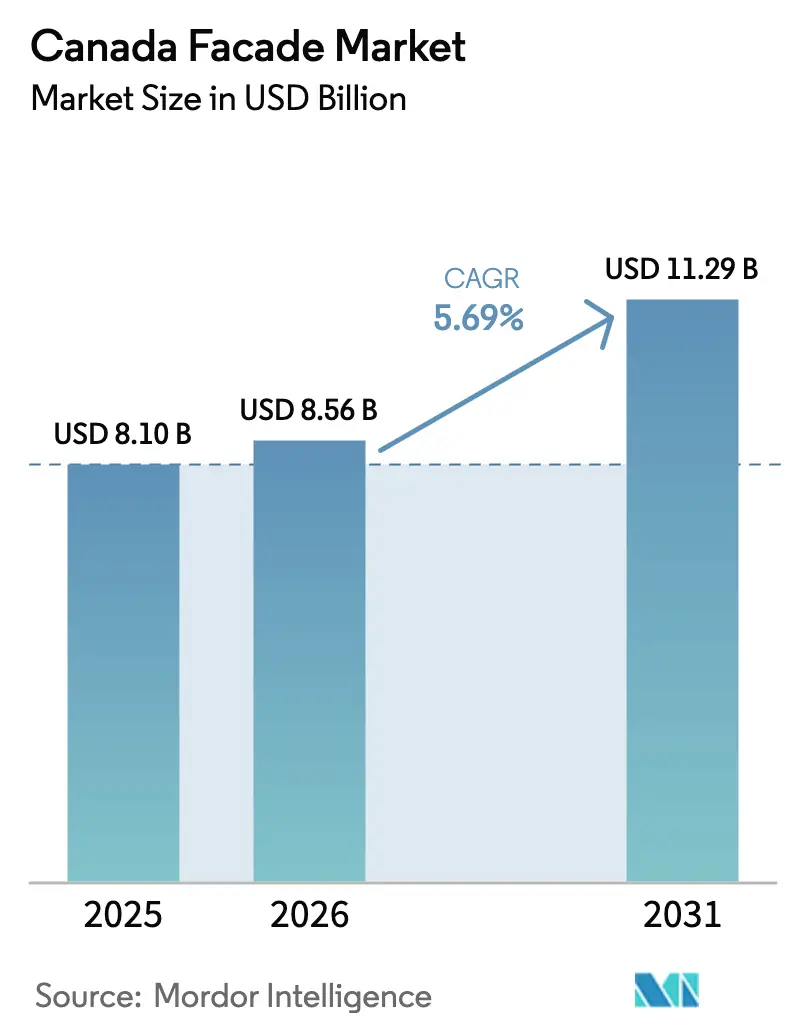
| Base Year Market Size (2025) | USD 8.10 Billion |
| Market Size (2026) | USD 8.56 Billion |
| Market Size (2031) | USD 11.29 Billion |
| Growth Rate (2026 - 2031) | 5.69 % |
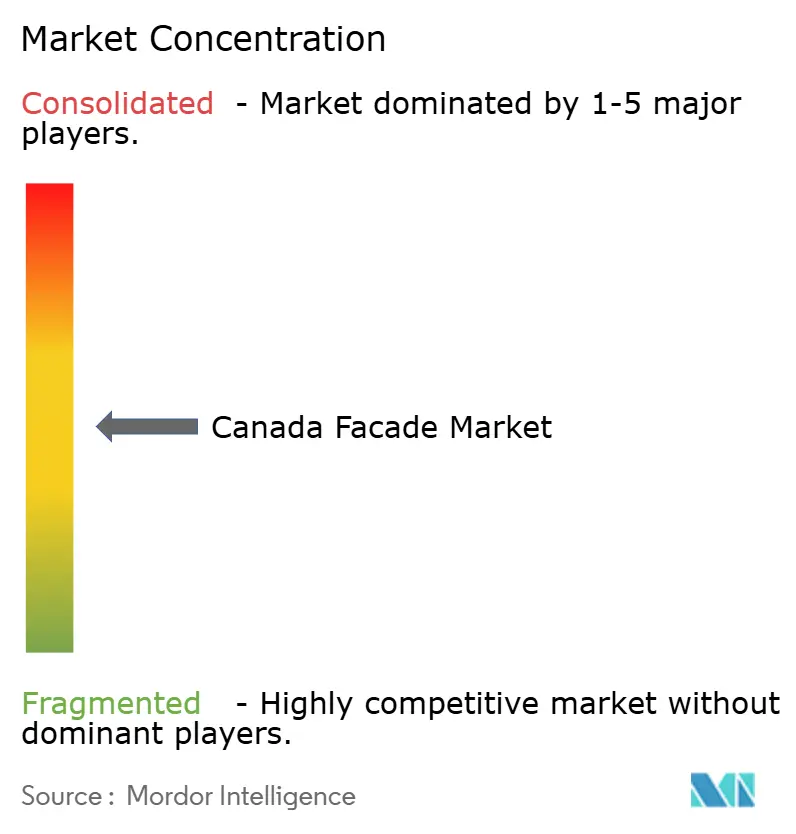
| Market Concentration | Medium |
Major Players *Disclaimer: Major Players sorted in no particular order Image © Mordor Intelligence. Reuse requires attribution under CC BY 4.0. | |
Canada Facade Market Analysis by Mordor Intelligence
Canada facades market size in 2026 is estimated at USD 8.56 billion, growing from 2025 value of USD 8.10 billion with 2031 projections showing USD 11.29 billion, growing at 5.69% CAGR over 2026-2031. Performance-based energy codes, federal retrofit incentives, and a nationwide housing boom are expanding specification budgets and accelerating project pipelines. Rapid urban densification in Toronto and Vancouver is lifting demand for high-performance curtain walls and non-ventilated envelopes that satisfy NECB 2020 tiered efficiency targets. Supply chain tightness in architectural glass and aluminum continues to pressure bids, yet contractors are mitigating exposure through prefabricated panels and price-escalation clauses. Skilled-labor shortages remain the most immediate drag on project schedules, prompting owners to favor modular assemblies that reduce on-site hours and lessen certification bottlenecks. Opportunistic investors are also targeting deep-retrofit portfolios, expecting carbon-based asset valuations to solidify over the next decade.
Key Report Takeaways
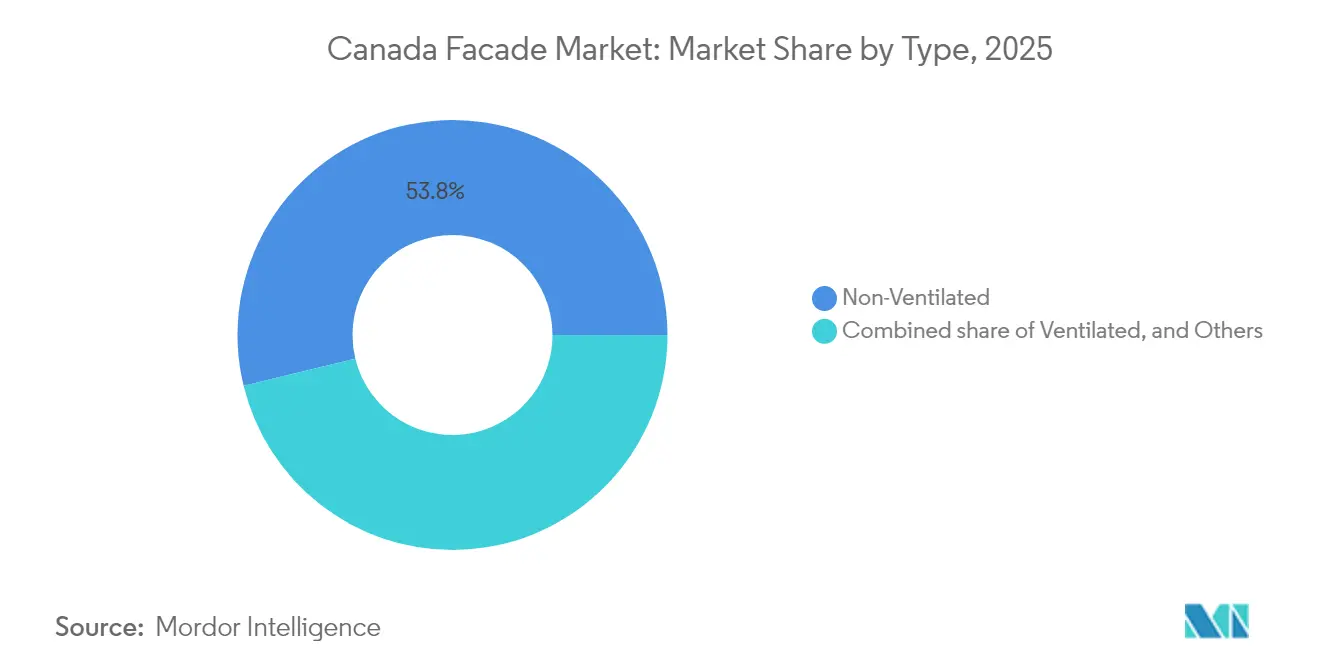
- By type, non-ventilated systems led with 53.80% of the Canada facades market share in 2025; the segment is advancing at a 6.19% CAGR through 2031.
- By façade system type, curtain wall assemblies captureda 44.60% share in 2025, while their high-rise focus supports a 6.28% CAGR to 2031.
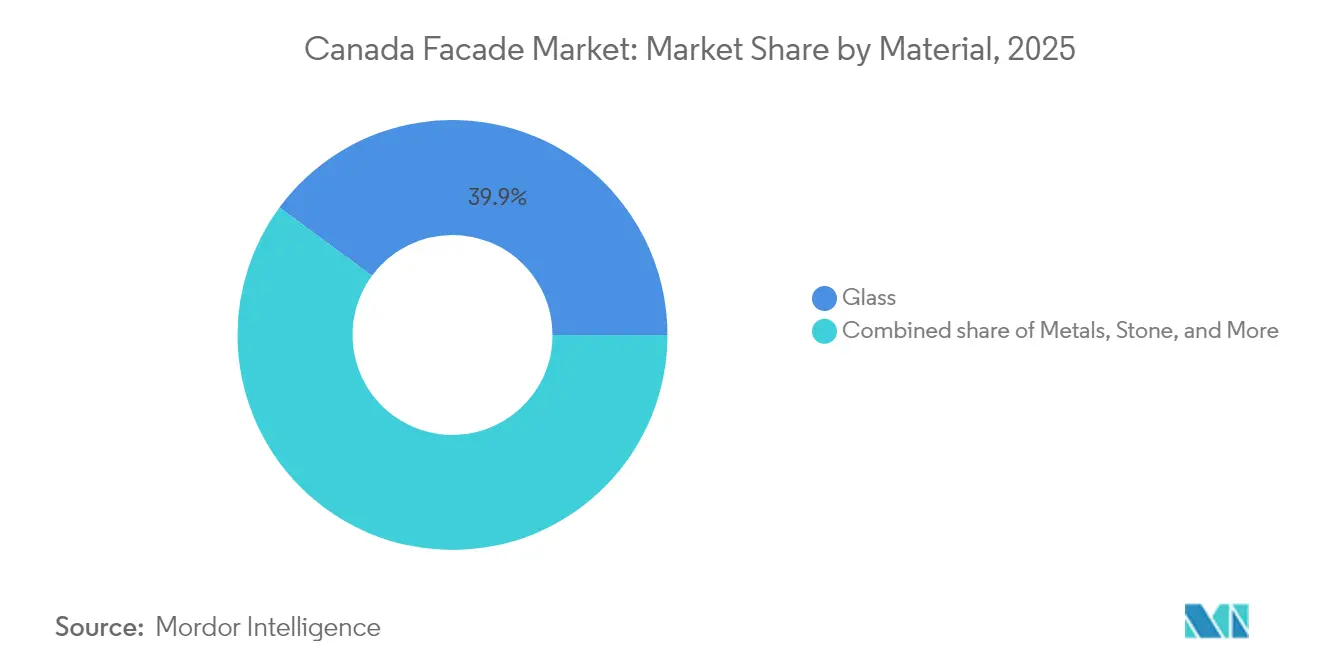
- By material, glass commanded 39.90% of the Canada facades market size in 2025 and is projected to grow at a 5.93% CAGR on the back of low-e and dynamic glazing adoption.
- By installation, new-construction projects accounted for a 55.50% share in 2025, with the category pacing a 6.25% CAGR amid federal housing targets.
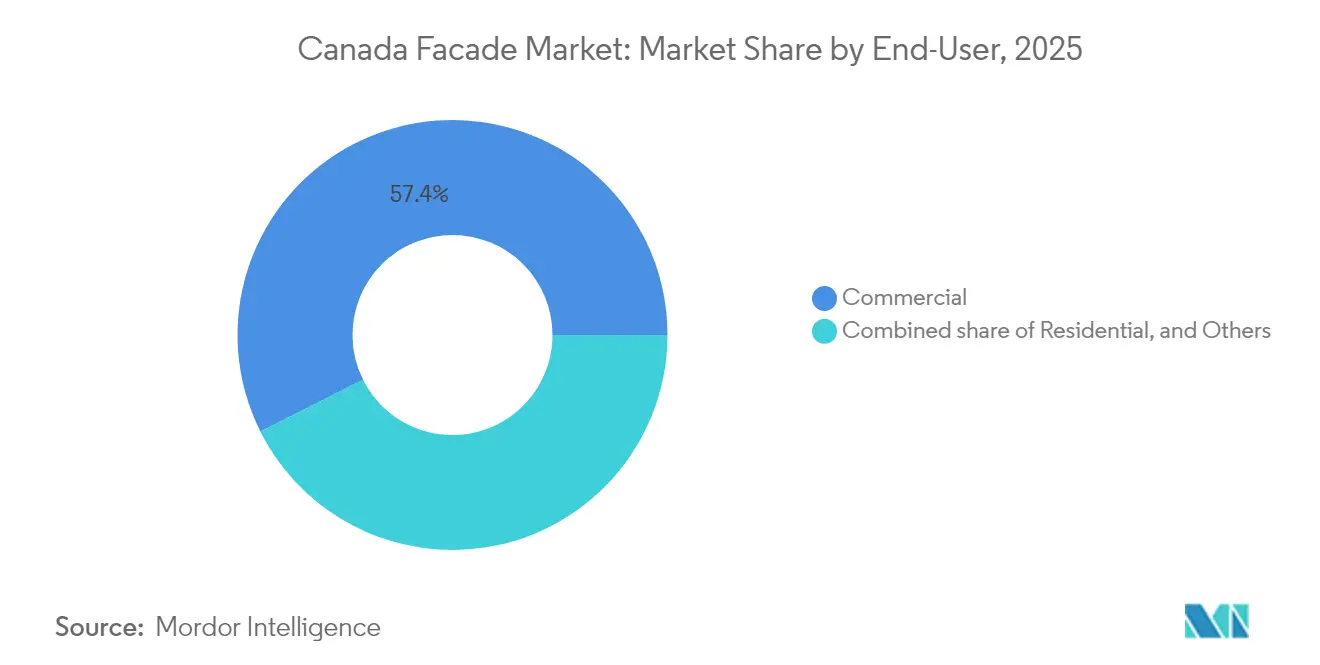
- By end-user, commercial buildings held a 57.40% share in 2025 and are expanding at a 6.38% CAGR as offices, retail, and institutional owners pursue net-zero retrofits.
- By geography, Ontario dominated with a 33.00% share in 2025; however, British Columbia’s policy environment is fueling faster 6.52% CAGR growth in Ontario, edging out other provinces by 2031
Note: Market size and forecast figures in this report are generated using Mordor Intelligence’s proprietary estimation framework, updated with the latest available data and insights as of 2026.
Canada Facade Market Trends and Insights
Drivers Impact Analysis*
| Driver | % Impact on CAGR Forecast | Geographic Relevance | Impact Timeline |
|---|---|---|---|
| Surge in high-rise residential projects in GTA & Metro Vancouver | +1.2% | Ontario & British Columbia, spillover to Alberta | Short term (≤ 2 years) |
| Stricter NECB 2020 / Tiered Net-Zero codes adoption | +0.9% | National, with early adoption in BC, Ontario | Medium term (2-4 years) |
| Aging 1970-1990 building stock driving façade retrofits | +0.8% | National, concentrated in urban centers | Long term (≥ 4 years) |
| Federal "Greener Homes" & CMHC deep-retrofit grants | +0.7% | National, higher uptake in Quebec, Ontario | Medium term (2-4 years) |
| Mass-timber mid-rise boom needing hybrid façade solutions | +0.5% | British Columbia, expanding to Ontario, Quebec | Long term (≥ 4 years) |
| Municipal zero-carbon mandates (Toronto, Vancouver) | +0.4% | Toronto, Vancouver, spreading to other major cities | Medium term (2-4 years) |
| Source: Mordor Intelligence | |||
High-Rise Residential Projects in GTA & Metro Vancouver
Toronto’s One Bloor West and Vancouver’s cluster of zero-emission towers are redefining skyline profiles and stretching curtain-wall engineering limits. Developers in both metros are now specifying four-sided structural-glazed façades with triple low-e glass to withstand extreme wind pressures and meet Tier 4 airtightness thresholds[1]ConstructConnect, “Canada’s first supertall building: One Bloor West reaches major milestone,” canada.constructconnect.com. Contractors are forward-purchasing mullion stock to hedge aluminum volatility and reserving crane slots up to 18 months ahead, tightening supply across Canada facade market projects in smaller cities. Lending trends favor large multi-phase schemes, giving envelope suppliers predictable volume but concentrating risk in two metropolitan hubs. Provincial housing pledges for 1.5 million new units in Ontario and 0.5 million in British Columbia secure a multiyear pipeline; however, unionized labor shortages could delay occupancy certificates and escalate contractual penalties[2]CBC News, “Construction labour crunch leaves Canada in need of boosting ranks of home builders,” cbc.ca.
Stricter NECB 2020 / Tiered Net-Zero Codes Adoption
Whole-building airtightness testing and reduced assembly U-values embedded in NECB 2020 have made energy performance a core procurement criterion rather than an optional upgrade. Provinces deploying Tier 4 requirements (60% energy reduction versus baseline) are spurring orders for vacuum-insulated panels, thermally broken anchors and high-spectral-selectivity glazing. Disparate provincial timelines complicate national catalog strategies, forcing manufacturers to carry multiple SKUs for identical profile lines. The Reconciliation Agreement on Construction Codes aims to align compliance by 2025, promising a unified market specification that could cut design iteration costs by up to 15%. Third-party consultants are capitalizing on code complexity, providing integrated envelope modeling, blower-door calibration and commissioning services.
Aging 1970-1990 Building Stock Driving Façade Retrofits
Nearly half of Canadian rental units were constructed before energy codes became mainstream, and their thin aluminum frames and single glazing leak thermal energy and moisture. Owners are adopting Prefabricated Exterior Energy Retrofit (PEER) panels that combine insulation, cladding, and fenestration in a single lift, slashing install time from weeks to days [3]Natural Resources Canada, “Prefabricated Exterior Energy Retrofit Project Guide,” natural-resources.canada.ca. Community-housing pilots reveal heat-loss reductions of 65% and airtightness gains of 75% post-retrofit, results that are spurring provincial grant extensions beyond 2026. Heritage-age mid-century assets, once considered demolition candidates, are now earmarked for deep-energy retrofits that respect original façades while integrating fibrous-insulation cores and low-carbon cladding skins.
Federal Greener Homes & CMHC Deep-Retrofit Grants
More than 524,000 homeowner applications under the Canada Greener Homes program have accelerated demand for ENERGY STAR windows, triple-pane doors and integrated blinds. The USD 40,000 interest-free loan product finances whole-envelope overhauls and is steering small contractors toward volume-based purchasing agreements with facade component distributors. CMHC’s Greener Neighbourhoods Pilot validates the Energiesprong model, opening a pipeline for mass-customized panel production that could bring scale to retrofit supply. While new applications closed in several provinces due to budget exhaustion, industry lobbying seeks program renewal in 2026 to prevent job losses across window-fabrication corridors in Ontario and Quebec.
Restraints Impact Analysis*
| Restraint | % Impact on CAGR Forecast | Geographic Relevance | Impact Timeline |
|---|---|---|---|
| Volatile aluminium & architectural glass prices | -0.6% | National, with higher impact in import-dependent regions | Short term (≤ 2 years) |
| Shortage of CSA-certified façade installers & inspectors | -0.8% | National, acute in Ontario, British Columbia, Nova Scotia | Medium term (2-4 years) |
| Rising insurance premiums for combustible cladding | –0.4% | National; higher risk-loading in high-rise urban cores | Medium term (2–4 years) |
| Patchwork demolition-waste bylaws complicating retrofits | –0.3% | Municipal hot-spots in British Columbia, Ontario, Quebec | Long term (≥ 4 years) |
| Source: Mordor Intelligence | |||
Volatile Aluminum & Architectural Glass Prices
Industrial Product Price Index data show non-ferrous metals up 7.6% year-over-year, squeezing margins on unitized curtain walls whose frame cost can exceed 40% of total assembly value[4]Statistics Canada, “Industrial product and raw materials price indexes, June 2025,” www150.statcan.gc.ca. Canadian buyers resisted 46% of manufacturer price increases in 2024, forcing a shift to escalation clauses pegged to LME averages. Tariff uncertainty on U.S. imports prompted some fabricators to reroute supply through European rolling mills, adding lead-time risk amid tight project schedules. Larger contractors hedge procurement through futures and swap agreements, but mid-tier installers lack financial instruments, exposing them to spot-price hikes that can erode entire project profits.
Shortage of CSA-Certified Façade Installers & Inspectors
Construction vacancy rates hover near 80,000 jobs, and 22% of the current workforce will retire by 2035. Ontario alone needs 100,000 additional tradespeople to hit housing targets, yet only 5,000 apprentices enroll annually in relevant programs. Curtain-wall crews require CSA A440 certification, and inspector backlogs are stretching occupancy timelines by up to six weeks in peak quarters. Contractors now “labor hoard,” paying full wages during slow periods to guarantee crews for upcoming projects, a tactic that inflates overhead costs and diminishes market efficiency. Immigration pathways and Temporary Foreign Worker permits offer relief, but housing shortages for new arrivals limit immediate scalability.
*Our forecasts treat driver/restraint impacts as directional, not additive. The impact forecasts reflect baseline growth, mix effects, and variable interactions.
Segment Analysis
By Type: Non-Ventilated Systems Drive Energy Performance
Non-ventilated assemblies accounted for 53.80% of the Canada facades market size in 2025 as designers prioritized airtightness and thermal continuity under NECB 2020. The segment’s 6.19% CAGR underscores owner preference for lower maintenance and simplified detailing when compared with back-ventilated rainscreens. Ventilated designs remain essential in high-precipitation coastal zones where pressure-equalized cavities mitigate moisture ingress. Hybrid panels integrating switchable air cavities emerged in 2025 pilot projects, promising seasonal flexibility between ventilated and non-ventilated modes.
Mass-timber mid-rise buildings, especially in British Columbia, favor lightweight non-ventilated panels that preserve wood’s thermal mass and limit concealed cavity fire risk. Prefabrication hubs in the Greater Toronto Area now ship cassette-style cladding sections complete with pre-glazed openings, reducing crane swings and on-site labor hours. Over the forecast horizon, embedded sensors in non-ventilated skins will feed commissioning data back to asset managers, a feature expected to sharpen warranty terms and reduce lifecycle carbon calculations.



By Façade System Type: Curtain Walls Lead Premium Segment
Curtain walls dominated the category with a 44.60% share, reflecting their ubiquity on Canada's facade market skyline projects and their 6.28% CAGR trajectory. Four-sided structural glazing, larger IGUs, and thermally broken unitized frames are now standard above 40 stories, shifting project specifications toward multinational fabricators with strong engineering support. Rainscreen cladding commands mid-rise and retrofit niches, aided by regional fabricators who can pivot quickly to local aesthetic codes.
Ontario’s supertall SkyTower integrates tuned-damper curtain wall segments to manage lateral drift, a first for Canadian residential towers. In Vancouver, point-fixed glass façades fitted with vacuum panels deliver R-values exceeding NECB Tier 4 targets without sacrificing daylight. “Others” in this category—such as photovoltaic curtain walls—are expected to outpace the broader segment post-2028 once feed-in tariffs stabilize.
By Material: Glass Dominance Reflects Architectural Preferences
Glass held a 39.90% share in 2025, a testament to the country’s daylighting ethos and tenant demand for unobstructed views. Despite embodied-carbon scrutiny, double-skin façades with automated blinds are enabling compliance with NECB 2020 while sustaining generous window-to-wall ratios. Metal follows as the default framing and cladding choice for industrial facilities where durability and insurance premiums drive specification.
High-selectivity coatings, inert gas fills and thermochromic layers are pushing center-of-glass U-values below 0.6 W/m²-K. AGC and Saint-Gobain both unveiled triple-silver low-e products optimized for Canadian HDD zones, enhancing the competitive landscape for premium glazing. Fiber-reinforced polymers are gaining traction in edge restraints for their lower thermal bridging and corrosion resistance, particularly in coastal British Columbia projects.
By Installation: New Construction Leads Despite Retrofit Growth
New-builds represented 55.50% of the Canada facades market size in 2025, buoyed by over USD 22.2 billion in building investment recorded for March 2025. High-rise condos and institutional expansions dominate volume, yet retrofit CAGRs inch upward as Greener Homes loans unlock capital for deep-envelope upgrades. Developers of purpose-built rentals now integrate façade prefabrication into pro-formas to offset rising interest rates and labor premiums.
Retrofit specialists are leveraging laser scanning and digital twins to produce panelized overlays that anchor to existing spandrels without intrusive demolition, shrinking tenant displacement time. Accelerated depreciation schedules for energy-efficient capital improvements further tilt ROI calculations toward envelope upgrades over purely mechanical interventions.
By End-User: Commercial Sector Drives Premium Demand
Commercial facilities captured a 57.40% share in 2025 and propelled a 6.38% CAGR amid office tower repositioning, retail-center facelifts, and hospital megaprojects. The Peter Gilgan Mississauga Hospital alone will consume 70,000 m² of curtain wall glass, illustrating how a handful of institutional jobs can sway annual material demand.
Residential demand is tied closely to provincial housing starts and municipal inclusionary zoning policies that sometimes mandate green-building certifications, nudging budget-constrained condo projects toward cost-optimized rainscreens. Industrial and data-center users are adopting insulated metal panels with integrated vapor barriers to satisfy temperature and humidity control requirements, widening supplier portfolios.
Geography Analysis
Ontario remained the epicenter with 33.00% of the Canada facades market share in 2025, fueled by the Greater Toronto Area’s super-tall pipeline and the province’s 1.5 million-home target. Provincial policy supports net-zero new builds by 2040, compelling developers to specify triple-glazed assemblies and thermally broken anchors. The province’s 6.52% CAGR through 2031 reflects both volume and a pivot toward premium specifications.
British Columbia is Canada’s policy laboratory for zero-carbon construction, and Vancouver’s 2025 mandate for near-zero-emission buildings is already redirecting supplier R&D budgets toward ultra-low-U glass and mass-timber-friendly cladding connections. Demolition bylaws that require 90% material recycling are accelerating the adoption of demountable façades designed for end-of-life disassembly. The province’s growth is amplified by a mass-timber mid-rise boom, necessitating hybrid façade solutions that pair light metal rainscreens with timber fire-stop details.
Quebec benefits from Saint-Gobain’s USD 126 million electrification of its Ste-Catherine wallboard line, positioning the province as a hub for low-carbon envelope materials. Provincial targets call for 860,000 new housing units by 2030, and Hydro-Québec’s low-cost renewable power supports electrification of façade manufacturing hubs. Alberta and the rest of Canada collectively absorb resource-sector capital and distributed infrastructure projects, offering steady but less concentrated opportunities for façade suppliers.
Regulatory Landscape
Canada's facade requirements are shaped by national model codes issued through the National Research Council of Canada (NRC) and the Canadian Board for Harmonized Construction Codes (CBHCC). The National Building Code of Canada (NBCC) 2025 and the National Energy Code of Canada for Buildings (NECB) 2025 update envelope expectations by expanding objectives tied to greenhouse gas emissions, incorporating projected 50-year climate data (including temperature and wind), and strengthening provisions that address thermal bridging at envelope penetrations. Energy modeling software requirements also reference ASHRAE 140-2023 criteria.
Because adoption is provincial and territorial, compliance pathways vary by jurisdiction, including formal amendments such as Quebec's Order in Council O.C. 236-2026. NBCC 2025 also introduces a dedicated section on energy performance requirements for alterations to existing and heritage buildings, which raises the specification bar for retrofit-oriented facades, including glazing, insulation continuity, and anchoring details, alongside new-build compliance.
Value Chain Analysis
The Canada facade value chain typically begins with architects, facade consultants, and engineering teams providing design-assist, envelope modeling, and constructability input aligned to NECB/NBCC requirements. Upstream materials flow from glass and framing/cladding manufacturers through fabricators that build unitized curtain wall or panelized rainscreen assemblies, supported by distributors for sealants, fasteners, thermal breaks, and ancillary components. Specialized firms, such as Permasteelisa in bespoke unitised facades, operate across engineering, fabrication, and installation for complex high-rise projects.
Downstream execution centers on envelope trade contractors that manage procurement, installation, commissioning coordination, and warranty delivery. Large North American contractors such as Flynn Group spanning glazing and cladding scopes across commercial projects rely on established shop and jobsite processes to deliver façade systems. Post-installation services include inspection, maintenance, repair, and replacement cycles, often organized through national service networks and digital job management, which becomes especially relevant for retrofit portfolios with staged façade interventions under occupied-building constraints.
Competitive Landscape
The Canadian Façade Market is moderately fragmented: multinational glazing giants dominate super-tall curtain walls, while domestic cladding contractors compete aggressively in retrofit and mid-rise segments. Saint-Gobain’s USD 880 million purchase of Bailey Group added 12 regional plants and broadened its metal envelope portfolio. Kingspan’s leadership shuffle and the upcoming Mattoon insulated-panel plant underscore the firm’s North American growth trajectory.
Prefabrication and digital design are primary battlegrounds. Contractors deploying generative BIM and robotic welding lines can cut shop-floor cycle times by 35%, enabling rapid turnaround on congested project schedules. Environmental disclosures are now a big differentiator, with CarbonLow™ wallboard and low-carbon glass securing LEED and CaGBC credits that sway public-sector tenders.
Local content rules remain a flashpoint. The Ontario Glass and Metal Association’s plea to revoke a USD 140 million hospital façade award to a U.S. firm highlights political sensitivities around domestic employment and supply resilience. Firms that maintain CSA certification programs and apprenticeship pipelines are increasingly favored in public-private-partnership procurements.
Canada Facade Industry Leaders
Saint-Gobain Corporation
AGC Glass North America
Flynn Group of Companies
Enclos Corp.
Permasteelisa North America
- *Disclaimer: Major Players sorted in no particular order

Market Opportunities and Future Outlook
Code modernization creates a gap for higher-thermal-performance, airtight facade packages and the compliance services needed to demonstrate performance, particularly as NBCC 2025 expands envelope and energy-performance requirements and adds a dedicated pathway for alterations to existing and heritage buildings. That shift supports demand for thermally broken details, tighter thermal-bridge control at penetrations, and verified modeling workflows, including tools that meet ASHRAE 140-2023 criteria. It also broadens opportunity for suppliers able to bundle tested assemblies with design-assist and commissioning support.
Retrofit delivery models are also gaining operational traction in Canada as prefabricated exterior energy retrofit approaches move from guidance to procurement practice, consistent with the report's emphasis on retrofit drivers and incentives. On the supply side, product and capacity moves in high-performance glazing, including Saint-Gobain's COOL-LITE SKN 155 series launch and AGC's FINEO vacuum insulating glass production scale-up, support deeper specifications for low-U and solar-control envelopes. Contractors offering integrated facade systems, such as Flynn Group solutions positioned for high-thermal-performance walls, are better positioned to reduce onsite labor exposure and schedule risk in constrained urban labor markets.
Recent Industry Developments
- June 2026: Saint-Gobain Glass launched COOL-LITE SKN 155 and SKN 155 II for facade applications, highlighting high performance glazing options. The launch expands high performance glazing options influencing bid specs and competition among façade suppliers.
- June 2026: AGC Group scaled up production for FINEO vacuum insulating glass targeting facade and renovation market segments. The capacity addition strengthens AGC's position in energy-efficient envelope solutions and supply resilience for retrofit projects.
- June 2026: Saint-Gobain North America highlighted use of Saint-Gobain solutions in Place Banque Nationale du Canada project with Broccolini. The project level deployment demonstrates demand and collaborative ecosystem with key integrators to capture mid/high-rise opportunities.


Research Methodology Framework and Report Scope
Market Definition and Coverage
For this study, the Canada facade market is defined as the value of facade systems supplied and installed on buildings. This covers exterior cladding and curtain wall solutions used to protect the envelope and deliver thermal, moisture, and aesthetic performance.
Scope exclusions: This sizing does not count interior wall finishes, structural frames that are not part of the facade assembly, or standalone roofing and waterproofing products sold outside facade packages.
Segmentation Overview
- By Type
- Ventilated
- Non-Ventilated
- Others
- By Façade System Type
- Rainscreen Cladding
- Curtain Wall Systems
- Others
- By Material
- Glass
- Metal
- Plastic & Fibres
- Stone
- Others
- By Installation
- New Construction
- Renovation & Retrofit
- By End-User
- Commercial
- Residential
- Others
- By Region
- Ontario
- Quebec
- British Columbia
- Alberta
- Rest of Canada
Data Sources, Market Sizing, and Validation
Desk Research
Desk research started with mapping Canada construction activity and the building stock that typically uses facade packages, then matching those segments with materials and system choices described in public specifications. We referenced public sources such as Statistics Canada building permits and construction price data, National Research Council Canada publications linked to the National Building Code and NECB, and provincial code and energy program documentation that affects retrofit timing.
To ground the material side, we also used sources such as Canada Border Services Agency trade statistics, Natural Resources Canada information on energy efficiency and retrofits, and peer-reviewed building science papers that discuss envelope performance and failure modes in cold climates. Company filings, investor presentations, and reputable industry press were checked for capacity changes, backlog commentary, and pricing direction, and a paid subscription for company financials, patents, and shipment level trade views was used selectively to fill gaps. The desk research sources listed here are illustrative only, and additional public and subscription sources were also used for data collection, cross-checks, and clarification.
Primary Interviews and Surveys
Primary work focused on validating how projects are specified and priced across Canada, especially the split between new construction and renovation and retrofit activity. We spoke with contractors, facade designers, distributors, and material specialists so the model reflects real bid structures, typical system mixes, and the timing between specification and installation.
Coverage was balanced across major provinces and smaller markets, since cold climate performance requirements and local permitting practices can shift material choices and installed costs. Inputs from the field were used to confirm adoption levels for curtain wall and rainscreen cladding, realistic waste and rework factors, and how inflation and lead times are being handled in contracts.
Distribution of primary research fieldwork respondents
| Company type | Respondent position |
|---|---|
| Top tier: 37% | CXOs: 16% |
| Mid tier: 47% | Functional/Unit leaders: 38% |
| Smaller Players: 16% | Managers: 46% |
Market-Sizing & Forecasting
Sizing was built using a top-down and bottom-up combination, where construction activity by province and building type is translated into a facade demand pool and then converted into value using typical system mixes and installed price ranges. On the top-down side, building permits, refurbishment indicators, and renovation intensity were used to reconstruct how much envelope area and system spend is being pulled into the market each year.
Those totals were then checked with selective bottom-up approximations, such as supplier and contractor roll ups for key materials, sampled project budgets, and volume times average selling price logic for common assemblies. When direct data was thin, gaps were handled through range-based assumptions that were validated in interviews, then narrowed using observed import trends for glass and aluminum-related inputs and construction cost indices.
For forecasting, scenario analysis was used around housing starts, non-residential investment, and retrofit program momentum, and it was supported by expert views on how code tightening affects specification upgrades. Variables used in the model include the share of projects using curtain wall versus rainscreen cladding, renovation and retrofit penetration, installed cost movement by material, lead time-driven schedule shifts, and regional construction concentration in provinces like Ontario and Quebec.
Data Validation & Update Cycle
Outputs were validated through stepwise checks that compare the modeled totals with independent signals such as construction spending direction, trade flows for relevant facade inputs, and the implied installation workload against typical contractor capacity. Large variances were reviewed in analyst peer checks, and assumptions were revisited when results conflicted with what was heard in the field or with what public data suggested.
Reports are refreshed annually, and interim updates are made when material events can move pricing, demand timing, or supply availability. Before delivery, we do a final pass to capture the latest public releases and re-contact sources if a key variable shifts outside expected ranges.
Mordor Intelligence's Canada Facade Market Sizing Compared With Other Published Estimates
Published estimates for Canada facade value can look far apart, even when the topic sounds the same, because the market boundary is often set differently and then priced with different installation and material assumptions. The biggest swings usually come from what is counted as a facade system, whether renovation and retrofit is treated as a full system replacement or a partial upgrade, and how prices are translated into USD for the chosen year.
By refreshing installed system mixes, renovation and retrofit weighting, and the USD conversion timing each update, Mordor Intelligence keeps the Canada facade total tied to what is specified and installed as facade packages, rather than including broader envelope items such as windows, exterior doors, insulation, and air and water barriers.
Benchmark comparison
| Source | Market Size | Gaps in Research Methodology |
|---|---|---|
| Mordor Intelligence | USD 8.10 B (2025) | |
| Industry Publisher A | USD 2.80 B (2024) | This estimate appears to focus on facade over-cladding only, which can exclude full curtain wall packages and several non-ventilated systems, and it also anchors to a different base year that changes the price level. |
| Consultancy B | USD 4.80 B (2026) | This view likely narrows the scope to a smaller set of facade categories and may apply conservative installed cost assumptions, which can understate higher value commercial curtain wall work in major metros. |
The spread in the table is mainly explained by scope boundaries and how renovation and retrofit work is counted, followed by year selection and installed cost logic. When the model ties demand to project activity and then checks the implied value against material and contractor reality, the resulting market size is easier to repeat and to explain for planning decisions.


Key Questions Answered in the Report
What is the forecast value of the Canada facades market in 2031?
The market is projected to reach USD 11.29 billion by 2031.
How fast is the Canada facades market expected to grow?
It is forecast to expand at a 5.69% CAGR between 2026 and 2031.
Which façade system currently holds the largest share in Canada?
Curtain wall assemblies lead with a 44.60% revenue share as of 2025.
Why are non-ventilated façades popular in Canada?
They align with NECB 2020 airtightness requirements and offer simplified maintenance, driving their 53.80% share.
Which province shows the fastest façade market growth?
Ontario posts a 6.52% CAGR through 2031, outpacing other regions due to ambitious housing targets.
Page last updated on:





