
Canada Electric Vehicle Battery Manufacturing Market Size and Share
| Study Period | 2019 - 2030 |
| Forecast Data Period | 2025 - 2030 |
| Historical Data Period | 2019 - 2023 |
| Market Size (2025) | USD 57.50 Million |
| Market Size (2030) | USD 155.60 Million |
| CAGR (2025 - 2030) | 22.03% |
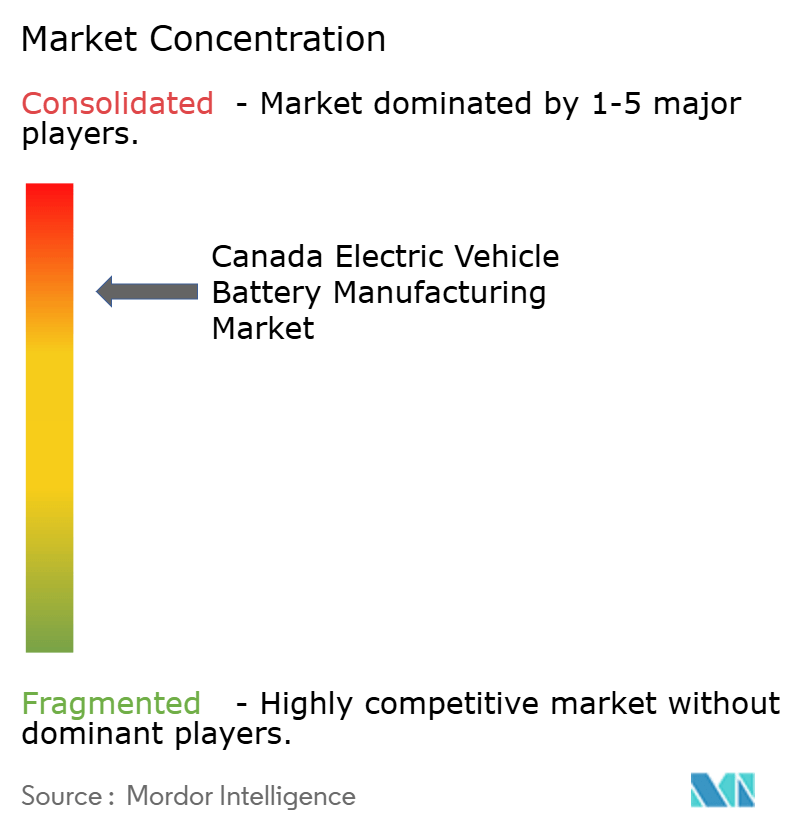
| Market Concentration | High |
Major Players *Disclaimer: Major Players sorted in no particular order |
Canada Electric Vehicle Battery Manufacturing Market Analysis by Mordor Intelligence
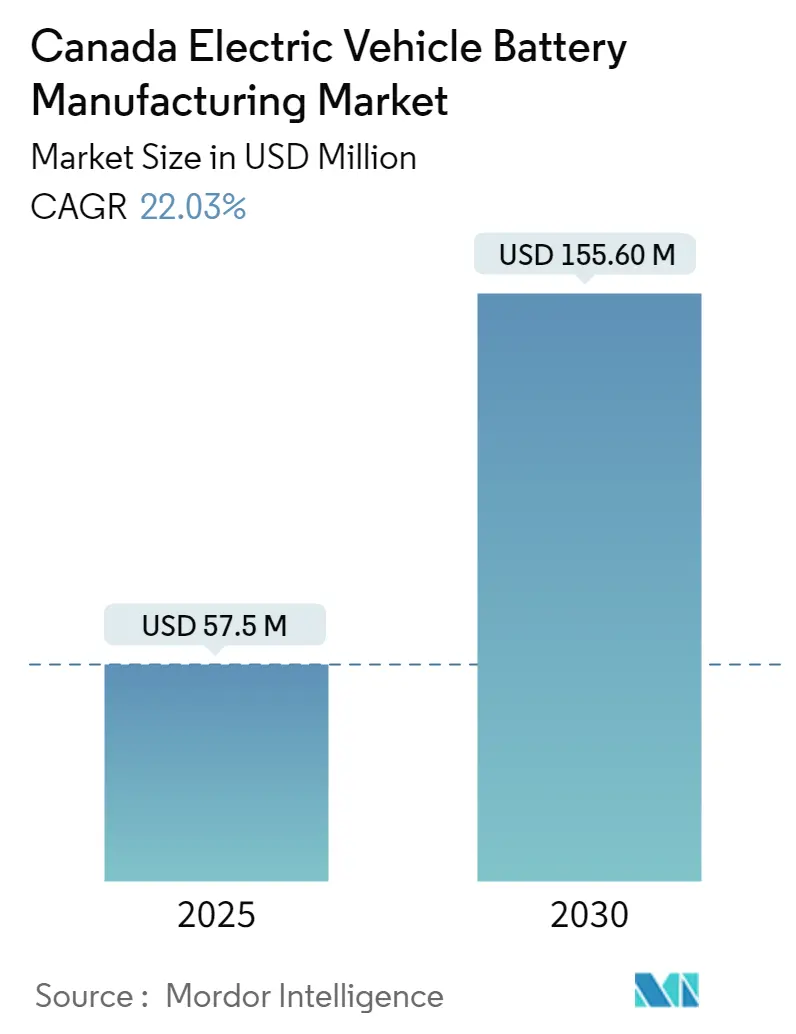
The Canada Electric Vehicle Battery Manufacturing Market size is estimated at USD 57.50 million in 2025, and is expected to reach USD 155.60 million by 2030, at a CAGR of 22.03% during the forecast period (2025-2030).
- Over the medium term, rising investments to enhance the battery production capacity and the decline in the cost of raw battery materials are expected to drive the demand for electric vehicle battery manufacturing during the forecast period.
- On the other hand, as the number of EVs across the region increases, so does the challenge of recycling and disposing of used batteries, which can significantly restrain the growth of the electric vehicle battery manufacturing market.
- Nevertheless, the long-term ambitious targets for electric vehicles like scaling up production capacity, enhancing technological advancements, and reducing costs are expected to create significant opportunities for the electric vehicle battery manufacturing market in the near future.
Canada Electric Vehicle Battery Manufacturing Market Trends and Insights
Lithium-Ion Battery Type Dominate the Market
- Lithium-ion (Li-ion) batteries have revolutionized the electric vehicle (EV) market, driving innovations in battery production. Their key attributes, such as high energy density, long cycle life, and swift charging, make them the preferred choice for today's EVs.
- Moreover, lithium-ion rechargeable batteries surpass other technologies due to their excellent capacity-to-weight ratio. Although they tend to be more expensive than alternatives, major players in the market are boosting R&D investments and ramping up production, heightening competition and pushing prices down.
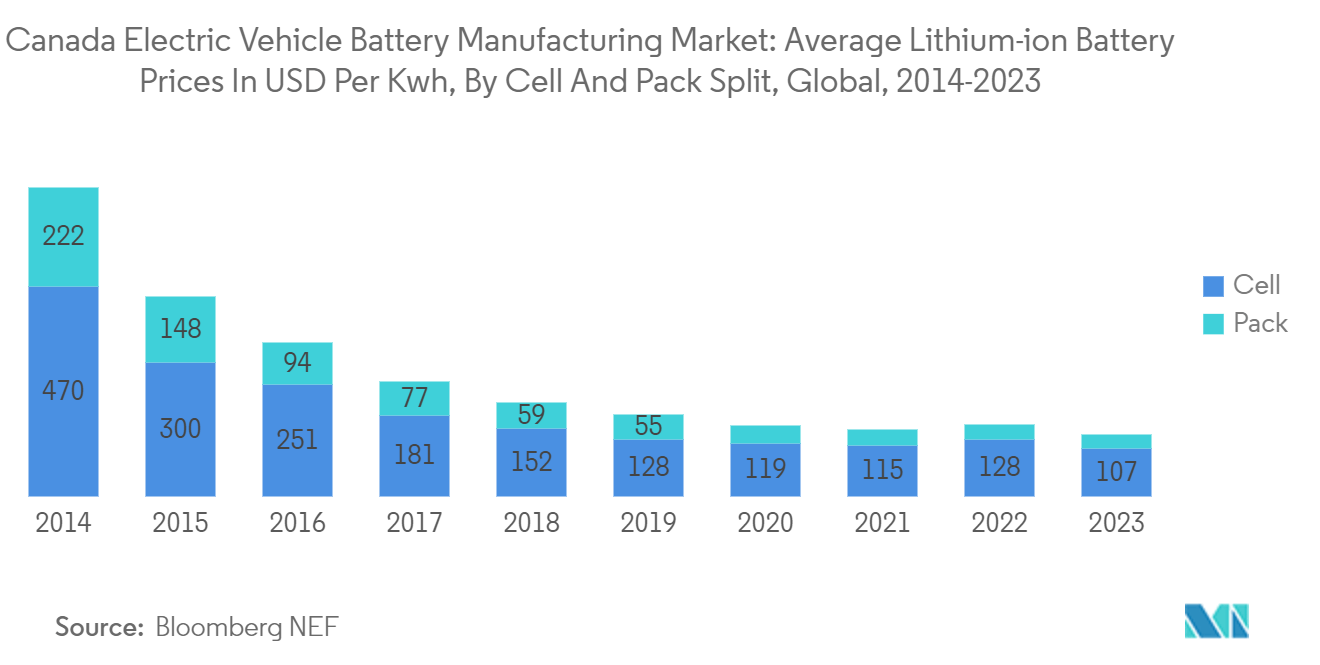
- Despite rising average battery pack prices for EVs and battery energy storage systems (BESS), 2023 witnessed a significant drop, with prices falling to USD 139/kWh, a 13% decrease. Projections suggest this downward trajectory will persist, with prices anticipated to reach USD 113/kWh by 2025 and further decline to USD 80/kWh by 2030, driven by continuous technological and manufacturing innovations.
- Globally, governments are rolling out policies and incentives to accelerate electric vehicle (EV) adoption and bolster Lithium-ion battery production. Responding to the surging demand, these governments are not only making substantial investments but are also spearheading battery production initiatives in their regions.
- For example, in 2023, E3 Lithium Ltd. obtained USD 27 million in funding to set up a demonstration plant in Alberta, targeting battery-grade lithium production. This lithium variant is crucial for hybrid electric vehicles (HEVs) and electric vehicles (EVs). The plant is poised to play a pivotal role in ramping up lithium production, catering to the automotive industry's rising demand, especially for sustainable transportation solutions.
- The surging demand for Li-ion batteries has catalyzed the emergence of large-scale production hubs, dubbed Gigafactories. These facilities are engineered to produce battery cells en masse, ensuring they can meet the burgeoning demand from the electric vehicle (EV) sector. Major regional players are launching multiple projects to enhance their lithium-ion battery production capabilities, anticipating a significant uptick in EV battery demand soon.
- As an illustration, in September 2023, Northvolt, a Swedish lithium-ion battery manufacturer, announced plans for a USD 5.2 billion gigafactory in Quebec, Canada. This strategic move is set to amplify Northvolt's production capabilities in response to the surging lithium-ion battery demand. The first phase of the Northvolt Six factory is set to break ground in 2024, with operations kicking off in 2026. Such initiatives are poised to boost the country's battery production in the upcoming years.
- Consequently, these ventures and strategies are set to bolster lithium-ion battery output and significantly ramp up EV battery manufacturing capacity during the forecast period.


Passengers Cars Segment to Witness Significant Growth
- Canada's automotive sector is making a decisive shift towards electric vehicles (EVs), driven by a global push for sustainability and a commitment to reducing carbon emissions. A key element of this transformation is the intensified focus on the production and refinement of electric vehicle batteries. This shift is not only altering the landscape for passenger cars in Canada but also influencing various facets of the market.
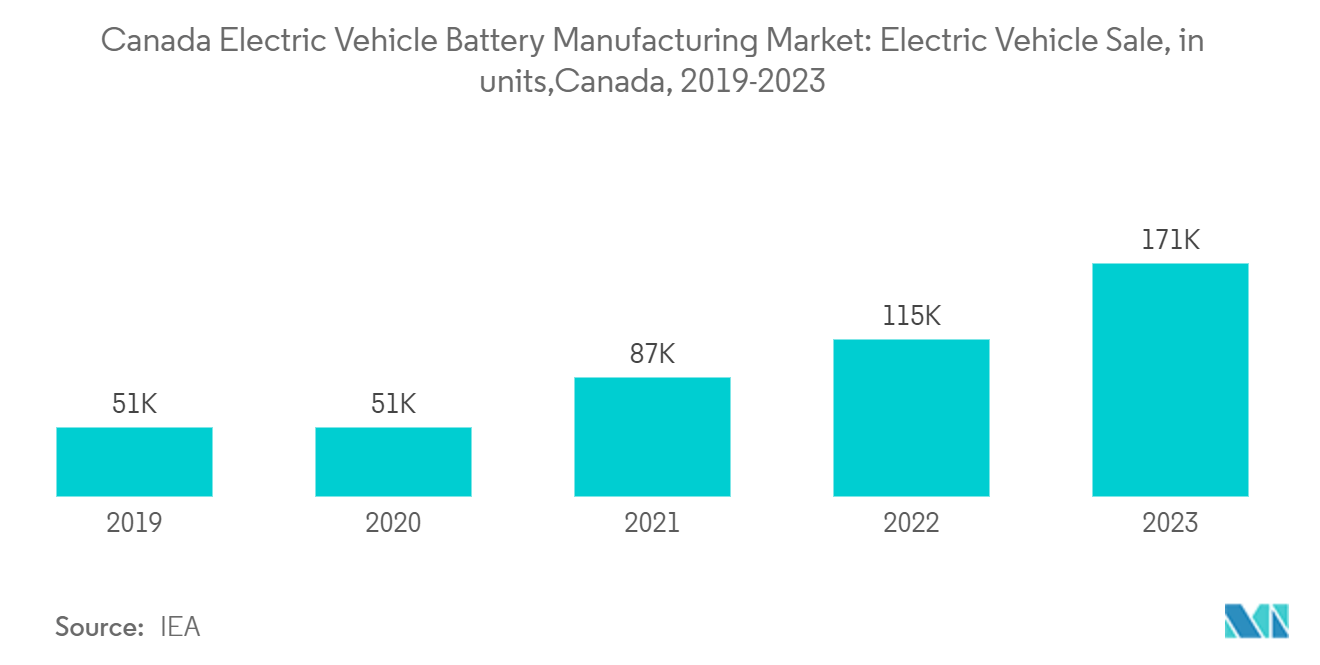
- Moreover, Canada is embracing clean energy and emphasizing the transition to electric vehicles, a priority for numerous companies. EV sales in Canada have surged dramatically. For example, in 2023, the International Energy Agency (IEA) reported that Canada sold 0.171 million electric vehicles, marking a 48.69% increase from 2022 and a 2.4-fold rise since 2019. With this momentum, especially with recent Canadian government initiatives, EV sales are poised to climb in the coming years, driving a heightened demand for EV battery production.
- In its bid to tackle air pollution and reduce reliance on fossil fuels, Canada is vigorously promoting the adoption of electric vehicles (EVs), extending this push to a broader range of passenger cars. The government's multifaceted strategy encompasses financial incentives, infrastructure development, and public awareness campaigns, all designed to facilitate this transition.
- For instance, in 2023, the federal government introduced a program offering up to USD 5,000 for the purchase or lease of zero-emission vehicles (ZEVs). This initiative has already seen participation from over 180,000 individuals and businesses. Additionally, provinces like Quebec and British Columbia have set ZEV sales targets, further accelerating the shift towards electric and hybrid vehicles. Such measures are poised to boost the demand for passenger cars in the region and, consequently, the need for battery manufacturing in the coming years.
- Furthermore, the emphasis on electric vehicle (EV) battery production is catalyzing technological advancements in the passenger car industry. Cutting-edge battery technologies, especially solid-state batteries, promise to elevate the performance, range, and safety of EVs. Notably, Canadian entities, spanning research institutions to corporations, are leading these innovations, making significant waves in the global battery technology arena.
- For instance, in March 2024, the Ontario Battery and Electrochemistry Research Centre (OBEC) unveiled its next-generation electric vehicle batteries, including those for plug-in hybrids. These new batteries boast advantages over traditional Li-ion counterparts, being more affordable, safer, and longer-lasting. Such breakthroughs are set to boost the production of advanced lithium-ion batteries for passenger cars and elevate the region's battery manufacturing demand in the coming years.
- Given these developments, it's clear that Canada's initiatives and projects are not only bolstering EV demand but are also set to significantly amplify the need for EV battery manufacturing in the foreseeable future.

Competitive Landscape
Canada's electric vehicle battery manufacturing market is moderately consolidated. Some of the key players (not in particular order) are Northvolt AB, LG Energy Solution, Electrovaya Inc., EnerSys, and Panasonic Holdings Corporation, among others.
Canada Electric Vehicle Battery Manufacturing Industry Leaders
EnerSys
Panasonic Holdings Corporation
Northvolt AB
LG Energy Solution
Electrovaya Inc.
- *Disclaimer: Major Players sorted in no particular order

Recent Industry Developments
- April 2024: Honda Motor announced a substantial investment of CAD 15 billion (USD 11 billion) to set up new EV and battery production plants in Ontario. This move, which supplements its existing facilities, highlights Honda's plans in a rising demand for EVs in North America. It also showcases the company's vision to bolster its presence in the electric vehicle sector.
- October 2023: Volkswagen unveiled plans to construct a battery manufacturing plant, committing a substantial USD 7 billion investment within an industrial park. The plant is expected to span approximately 370 acres, equivalent to the size of more than 210 soccer or football fields. This significant investment underscores Volkswagen's commitment to expanding its electric vehicle production capabilities and strengthening its position in the global as well as local markets.


Canada Electric Vehicle Battery Manufacturing Market Report Scope
EV Battery Manufacturing refers to producing batteries specifically designed for electric vehicles (EVs). This involves several stages, including the sourcing of raw materials, the production of battery cells, and the assembly of these cells into battery packs that can be integrated into EVs.
Canada's electric vehicle battery manufacturing market is Segmented by Battery Type, Battery Form, Vehicle Type, and Propulsion Type. By battery type, the market is segmented into Lithium-Ion Battery, Lead-Acid Battery, Nickel Metal Hydride Battery, and Others. By battery form, the market is segmented into Prismatic, Pouch, and Cylindrical. By vehicles, the market is segmented into Passenger Cars, Commercial Vehicles, and Others. By propulsion, the market is segmented into Battery Electric Vehicles, Hybrid Electric Vehicles, and Plug-In Hybrid Electric Vehicles. The Report Offers the Market Size and Forecasts in Revenue (USD) for all the Above.
| Lithium-ion |
| Lead-Acid |
| Nickel Metal Hydride Battery |
| Others |
| Prismatic |
| Pouch |
| Cylindrical |
| Passenger Cars |
| Commercial Vehicles |
| Others |
| Battery Electric Vehicle |
| Hybrid Electric Vehicle |
| Plug-in Hybrid Electric Vehicle |
| Battery | Lithium-ion |
| Lead-Acid | |
| Nickel Metal Hydride Battery | |
| Others | |
| Battery Form | Prismatic |
| Pouch | |
| Cylindrical | |
| Vehicle | Passenger Cars |
| Commercial Vehicles | |
| Others | |
| Propulsion | Battery Electric Vehicle |
| Hybrid Electric Vehicle | |
| Plug-in Hybrid Electric Vehicle |


Key Questions Answered in the Report
How big is the Canada Electric Vehicle Battery Manufacturing Market?
The Canada Electric Vehicle Battery Manufacturing Market size is expected to reach USD 57.50 million in 2025 and grow at a CAGR of 22.03% to reach USD 155.60 million by 2030.
What is the current Canada Electric Vehicle Battery Manufacturing Market size?
In 2025, the Canada Electric Vehicle Battery Manufacturing Market size is expected to reach USD 57.50 million.
Who are the key players in Canada Electric Vehicle Battery Manufacturing Market?
EnerSys, Panasonic Holdings Corporation, Northvolt AB, LG Energy Solution and Electrovaya Inc. are the major companies operating in the Canada Electric Vehicle Battery Manufacturing Market.
What years does this Canada Electric Vehicle Battery Manufacturing Market cover, and what was the market size in 2024?
In 2024, the Canada Electric Vehicle Battery Manufacturing Market size was estimated at USD 44.83 million. The report covers the Canada Electric Vehicle Battery Manufacturing Market historical market size for years: 2019, 2020, 2021, 2022, 2023 and 2024. The report also forecasts the Canada Electric Vehicle Battery Manufacturing Market size for years: 2025, 2026, 2027, 2028, 2029 and 2030.
Page last updated on:
Canada Electric Vehicle Battery Manufacturing Market Report
Statistics for the 2025 Canada Electric Vehicle Battery Manufacturing market share, size and revenue growth rate, created by Mordor Intelligence™ Industry Reports. Canada Electric Vehicle Battery Manufacturing analysis includes a market forecast outlook for 2025 to 2030 and historical overview. Get a sample of this industry analysis as a free report PDF download.





