
Canada Hybrid Electric Vehicle Battery Market Size and Share
| Study Period | 2019 - 2030 |
| Forecast Data Period | 2025 - 2030 |
| Historical Data Period | 2019 - 2023 |
| Market Size (2025) | USD 0.26 Billion |
| Market Size (2030) | USD 0.55 Billion |
| CAGR (2025 - 2030) | 16.38% |
| Market Concentration | Low |
Major Players *Disclaimer: Major Players sorted in no particular order |
Canada Hybrid Electric Vehicle Battery Market Analysis by Mordor Intelligence
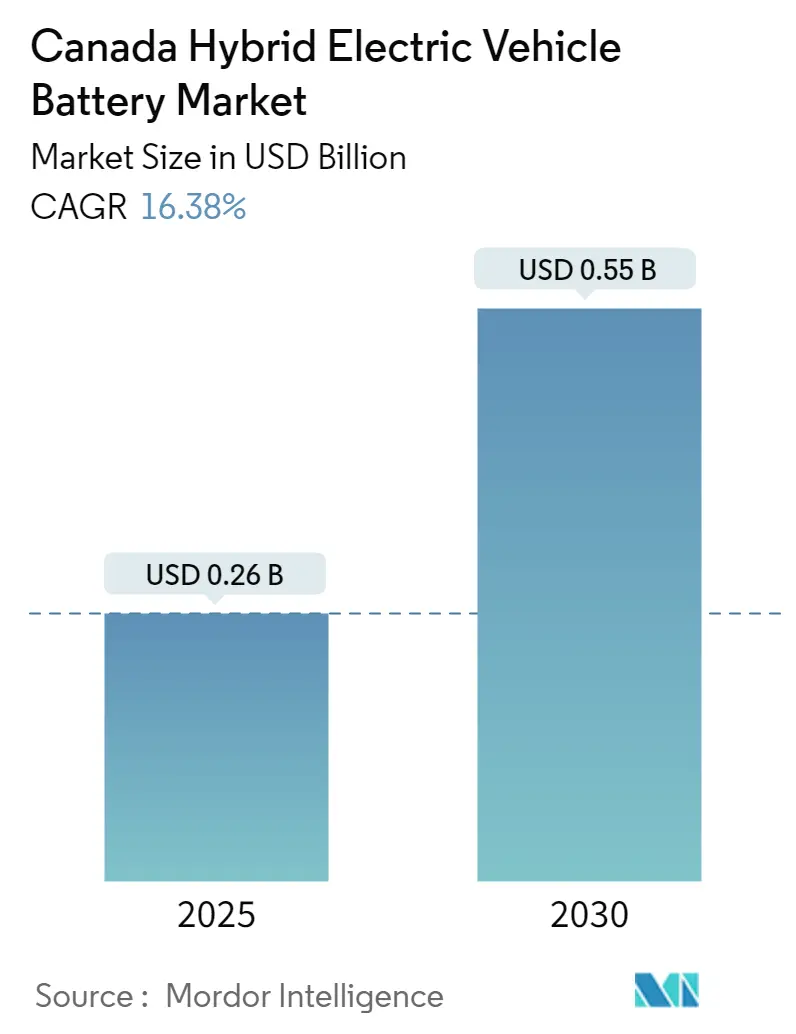
The Canada Hybrid Electric Vehicle Battery Market size is estimated at USD 0.26 billion in 2025, and is expected to reach USD 0.55 billion by 2030, at a CAGR of 16.38% during the forecast period (2025-2030).
- Over the medium term, rising adoption of electric vehicles (EV) and declining lithium-ion battery prices are expected to drive the demand for hybrid electric vehicle batteries during the forecast period.
- On the other hand, the lack of raw material reserves can significantly restrain the growth of the hybrid electric vehicle battery market.
- Nevertheless, technological advancements in battery materials like higher energy density, faster charging times, improved safety, and longer lifespan are expected to create significant opportunities for hybrid electric vehicle battery market players in the near future.
Dynamics observed within Canada present a country level view when set against the broader international context. The hybrid electric vehicle battery market analysis by Mordor Intelligence provides that expanded global perspective.
Canada Hybrid Electric Vehicle Battery Market Trends and Insights
Lithium-Ion Battery Type Dominate the Market
- The lithium-ion hybrid electric vehicle battery market in Canada is a dynamic arena, teeming with both opportunities and challenges. Lithium-ion hybrid EV batteries are outpacing other battery technologies in popularity, primarily due to their advantageous capacity-to-weight ratio. Their adoption is further fueled by superior performance attributes, such as longevity, low maintenance, an extended shelf life, and a notable decrease in price.
- While lithium-ion batteries typically command a higher price point than their counterparts, key market players are heavily investing in R&D and scaling up production. These moves not only enhance battery performance but also intensify competition, leading to a downward trend in lithium-ion battery prices.
- In 2023, lithium-ion battery prices saw a notable dip, settling at USD 139/kWh — a drop of over 13%. With ongoing technological innovations and manufacturing optimizations, projections suggest a further decline, targeting USD 113/kWh by 2025 and an ambitious USD 80/kWh by 2030.
- Canada is swiftly emerging as a pivotal hub in the lithium-ion battery production arena, especially for hybrid and electric vehicles (EVs). This ascent is largely attributed to strategic investments and robust government backing aimed at fortifying the nation's critical minerals supply chain and battery manufacturing capabilities.
- Leading corporations are channeling substantial investments into lithium-ion battery production for hybrid electric vehicles (HEVs) and electric vehicles in the region. A case in point: in April 2024, Honda, the renowned Japanese automaker, unveiled an ambitious USD 11 billion investment in Canada. This venture encompasses a sprawling new assembly plant for EV batteries and vehicles, including HEVs. Set to commence operations in 2028, this facility is poised to significantly boost lithium production, catering to the surging demand for HEV batteries during the forecast period.
- Canadian government policies are pivotal in shaping the landscape for lithium-ion and hybrid electric vehicle (HEV) batteries. Through a series of proactive policies, the government has not only stimulated demand for lithium-ion batteries but also championed the adoption of EVs nationwide.
- For example, in 2023, E3 Lithium Ltd. secured a USD 27 million grant to set up a lithium production demonstration plant in Alberta. This facility is geared towards producing battery-grade lithium, a vital component for HEV and EV manufacturing. Such strategic initiatives are set to amplify hybrid EV production and, consequently, the demand for lithium-ion batteries in the coming years.
- With these investments and projects, the trajectory for hybrid EV production in Canada looks promising, signaling a robust demand for lithium-ion batteries in the forecast period.


Passengers Cars Segment to Witness Significant Growth
- Canada's automotive landscape is undergoing a transformation, with electric and hybrid vehicles (EVs and HEVs) taking center stage. The nation is not only advancing in the development of these vehicles but is also becoming a key player in battery manufacturing, all fueled by a commitment to sustainable transportation and a governmental push towards electric mobility.
- Sales of hybrid passenger cars have surged in recent years. Data from Statistics Canada highlights this trend: in Q1 2024, new registrations hit 34,930 units, marking a 52.4% jump from Q1 2023. Given this momentum, it's anticipated that sales will continue to rise, driven by increasing regional demand.
- To bolster the adoption of hybrid electric vehicles (HEVs), including passenger cars, Canada has rolled out a series of government initiatives. These efforts align with a larger goal: curbing air pollution and reducing reliance on fossil fuels.
- As an example, in 2023, the federal government introduced a program offering up to USD 5,000 for the purchase or lease of electric vehicles (EVs). This initiative has already seen over 180,000 beneficiaries, spanning both individuals and businesses. Furthermore, provinces like Quebec and British Columbia have set EV sales targets, further accelerating the shift towards electric and hybrid vehicles. Such measures are poised to boost the demand for hybrid passenger cars and, consequently, HEV batteries in the coming years.
- Globally, companies are heavily investing in R&D for battery technologies, electric drivetrains, and other pivotal components for hybrid and electric vehicles. Numerous car projects are in the pipeline, set to debut in the near future.
- Take Subaru, for instance. In November 2023, they unveiled plans for a Forester Hybrid featuring a 2.5-liter naturally aspirated flat-four engine, slated for a 2026 global launch, including markets in the U.S. and Canada. Such moves underscore the growing momentum for hybrid passenger cars and the corresponding demand for hybrid batteries.
- These developments not only highlight the viability of HEV battery solutions for passenger vehicles but also signal a robust demand trajectory for HEV batteries in Canada in the foreseeable future.


Coverage of the hybrid electric vehicle battery market by Mordor Intelligence spans a wide geographic footprint, with regional analysis available for Europe, Asia, and Middle East and Africa, alongside detailed country-level intelligence for United States, Germany, India, China, France, and United Kingdom, each shaped by local operating conditions.
Competitive Landscape
The Canada hybrid electric vehicle battery market is semi-fragmented. Some key players (not in particular order) are LG Energy Solution, Electrovaya Inc., Exide Industries Ltd, EnerSys, and Panasonic Holdings Corporation, among others.
Canada Hybrid Electric Vehicle Battery Industry Leaders
Panasonic Holdings Corporation
EnerSys
Electrovaya Inc.
LG Energy Solution
Exide Industries Ltd
- *Disclaimer: Major Players sorted in no particular order


Recent Industry Developments
- October 2023: Volkswagen revealed plans to invest USD 7 billion in constructing a battery manufacturing plant within an industrial park. Spanning approximately 370 acres, the facility's footprint is comparable to over 210 soccer or football fields.
- September 2023: Swedish lithium-ion battery manufacturer Northvolt has unveiled its intention to establish a USD 5.2 billion gigafactory in Quebec, Canada. Construction on the Northvolt Six factory's initial phase is slated to commence this year, with operations projected to kick off in 2026.


Canada Hybrid Electric Vehicle Battery Market Report Scope
A Hybrid Electric Vehicle (HEV) battery is a rechargeable energy storage system that powers the electric motor of a hybrid vehicle. HEVs combine a conventional internal combustion engine (ICE) with an electric propulsion system. The battery in an HEV is crucial for capturing and storing energy, particularly during regenerative braking, and for providing additional power during acceleration.
Canada's hybrid electric vehicle battery market is Segmented by Battery Type and Vehicle Type. By battery type, the market is segmented into Lithium-Ion Battery, Lead-Acid Battery, Sodium-Ion Battery, and Others. By vehicle type, the market is segmented into Passenger Cars and Commercial Vehicles. The Report Offers the Market Size and Forecasts in Revenue (USD) for all the Above.
| Lithium-ion Battery |
| Lead-Acid Battery |
| Sodium-ion Battery |
| Others |
| Passenger Cars |
| Commercial Vehicles |
| Battery Type | Lithium-ion Battery |
| Lead-Acid Battery | |
| Sodium-ion Battery | |
| Others | |
| Vehicle Type | Passenger Cars |
| Commercial Vehicles |


Key Questions Answered in the Report
How big is the Canada Hybrid Electric Vehicle Battery Market?
The Canada Hybrid Electric Vehicle Battery Market size is expected to reach USD 0.26 billion in 2025 and grow at a CAGR of 16.38% to reach USD 0.55 billion by 2030.
What is the current Canada Hybrid Electric Vehicle Battery Market size?
In 2025, the Canada Hybrid Electric Vehicle Battery Market size is expected to reach USD 0.26 billion.
Who are the key players in Canada Hybrid Electric Vehicle Battery Market?
Panasonic Holdings Corporation, EnerSys, Electrovaya Inc., LG Energy Solution and Exide Industries Ltd are the major companies operating in the Canada Hybrid Electric Vehicle Battery Market.
What years does this Canada Hybrid Electric Vehicle Battery Market cover, and what was the market size in 2024?
In 2024, the Canada Hybrid Electric Vehicle Battery Market size was estimated at USD 0.22 billion. The report covers the Canada Hybrid Electric Vehicle Battery Market historical market size for years: 2019, 2020, 2021, 2022, 2023 and 2024. The report also forecasts the Canada Hybrid Electric Vehicle Battery Market size for years: 2025, 2026, 2027, 2028, 2029 and 2030.
Page last updated on:
Canada Hybrid Electric Vehicle Battery Market Report
Statistics for the 2025 Canada Hybrid Electric Vehicle Battery market share, size and revenue growth rate, created by Mordor Intelligence™ Industry Reports. Canada Hybrid Electric Vehicle Battery analysis includes a market forecast outlook for 2025 to 2030 and historical overview. Get a sample of this industry analysis as a free report PDF download.





