
Cables and Accessories Market Size and Share
Market Overview
| Study Period | 2022 - 2032 |
|---|---|
| Market Size (2027) | USD 140.39 Billion |
| Market Size (2032) | USD 184.16 Billion |
| Growth Rate (2027 - 2032) | 5.58 % |
| Fastest Growing Market | Asia-Pacific |
| Largest Market | Asia-Pacific |
| Market Concentration | Low |
Major Players *Disclaimer: Major Players sorted in no particular order Image © Mordor Intelligence. Reuse requires attribution under CC BY 4.0. | |
Cables and Accessories Market Analysis by Mordor Intelligence
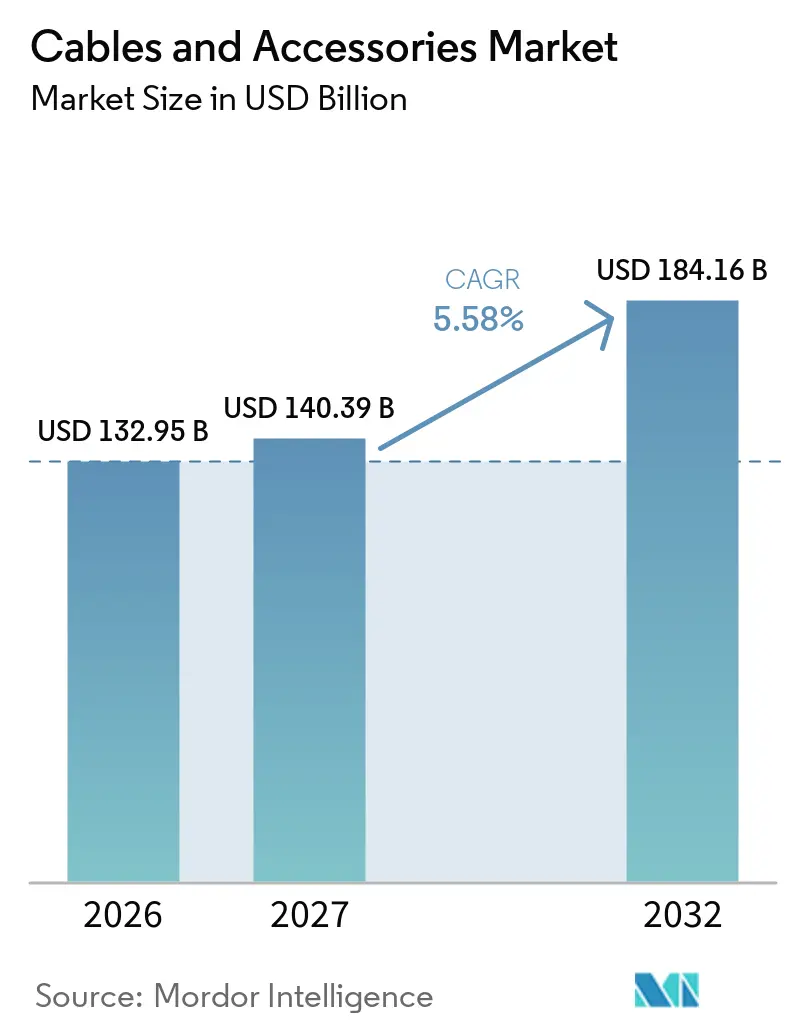
The Cables And Accessories Market size is expected to increase from USD 132.95 billion in 2026 to USD 140.39 billion in 2027 and reach USD 184.16 billion by 2032, at a CAGR of 5.58% over 2027-2032. Grid renewal, offshore wind, data center construction, and wider electrification are increasing demand at the same time. This overlap is placing pressure on a supply chain that remains limited for high-voltage and submarine systems. Utilities and project developers are responding with longer procurement schedules and indexed supply agreements. Manufacturers with tested high-voltage products, certified installation teams, and cable-laying capacity are in a stronger position to secure complex projects. The cables and accessories market is therefore being shaped by both higher infrastructure spending and the availability of qualified supply.
Key Report Takeaways
- By product type, cables held 82.3% of the cables and accessories market share in 2026, while the cables segment is forecast to grow at a 5.9% CAGR through 2032.
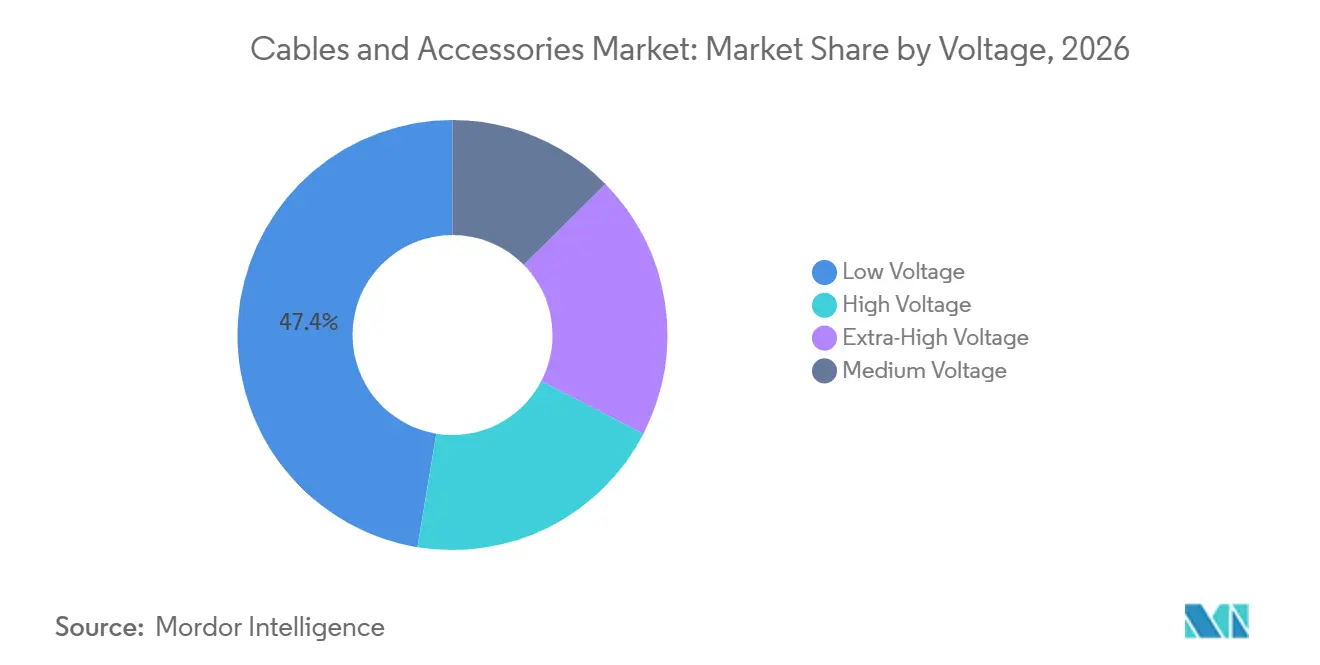
- By voltage, low voltage cables accounted for 47.4% of revenue in 2026, while extra-high voltage cables are projected to record the highest CAGR of 6.5% through 2032.
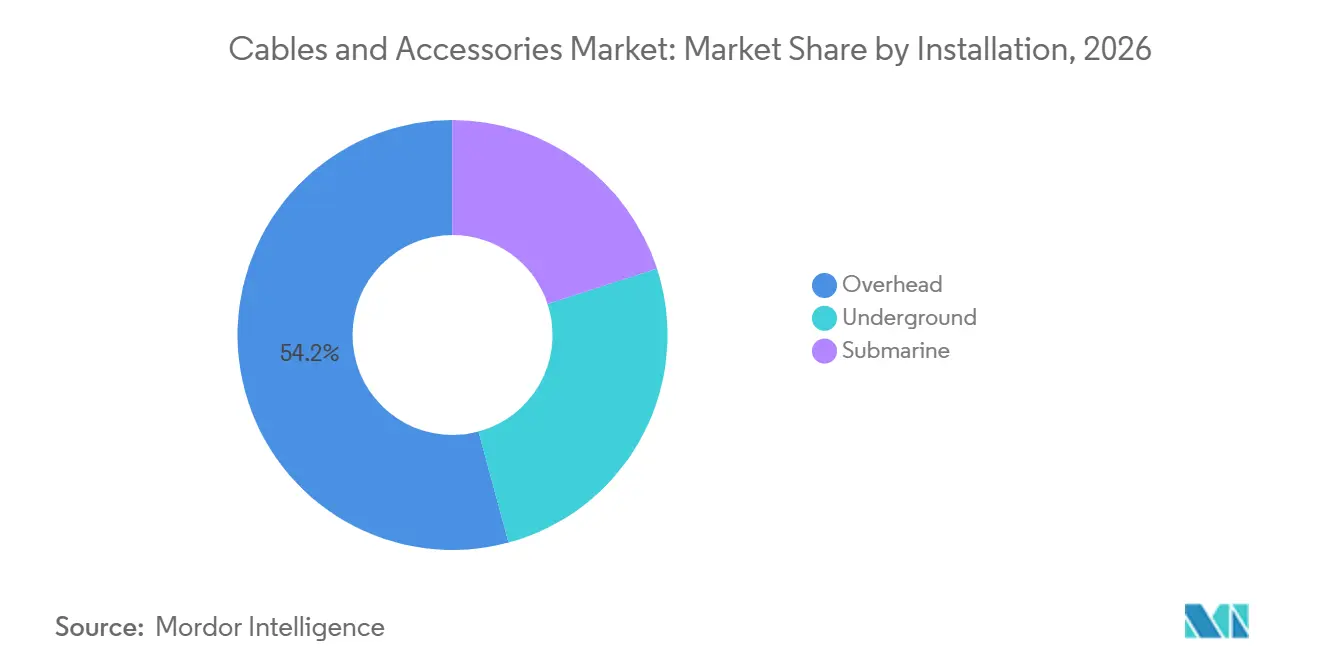
- By installation, overhead networks accounted for 54.2% of revenue in 2026, while underground installation is forecast to expand at a 6.1% CAGR through 2032.
- By application, power transmission and distribution held 30.3% of revenue in 2026, while renewable energy is projected to grow at an 8.2% CAGR through 2032.
- By geography, Asia-Pacific captured 45.3% of revenue in 2026 and is forecast to grow at a 7.3% CAGR through 2032.
Note: Market numbers in this report are based on Mordor Intelligence's proprietary estimation framework, which combines nine months of actuals with Q4 projections for base year 2026.
Market Trends and Insights
Drivers Impact Analysis of Cables and Accessories Market*
| Driver | (~) % Impact on CAGR Forecast | Geographic Relevance | Impact Timeline |
|---|---|---|---|
| Grid Modernization and Replacement of Aging T&D Infrastructure | +1.2% | Global, concentrated in North America, Europe, and Asia-Pacific | Short term (≤ 2 years) |
| Offshore Wind, HVDC Interconnectors and Renewable Energy Integration | +1.1% | Europe, Asia-Pacific, and Middle East and Africa | Medium term (2-4 years) |
| Data Centers, AI Workloads and Fiber-Optic Bandwidth Expansion | +0.8% | North America, Europe, and Asia-Pacific | Short term (≤ 2 years) |
| Electrification of Transport, Buildings and Industry | +0.7% | Global, led by Europe and Asia-Pacific | Medium term (2-4 years) |
| Smart-Grid, Sensorized Accessory and Predictive-Maintenance Adoption | +0.5% | North America and Europe | Medium term (2-4 years) |
| Undergrounding, Resilience and Urban-Design Requirements | +0.6% | North America, Europe, and Asia-Pacific urban areas | Long term (≥ 4 years) |
| Source: Mordor Intelligence | |||
Grid Modernization and Replacement of Aging Transmission and Distribution (T&D) Infrastructure
Grid modernization is increasing procurement for conductors, power cables, joints, and related network equipment. U.S. investor-owned utilities planned USD 1.1 trillion in grid enhancement and expansion over 5 years, according to the Edison Electric Institute, a utility association. In September 2026, the U.S. Department of Energy announced USD 5.25 billion for 31 projects in 26 states through its Speed to Power initiative.[1] The projects are expected to rebuild or reconductor more than 1,500 miles of transmission lines and deploy grid-enhancing technologies across almost 21,000 miles.[2] Reconductoring uses established rights-of-way and favors high-capacity conductor specifications, which can create concentrated buying periods. The cables and accessories market benefits because utilities need both new cable capacity and compatible equipment for existing networks.
Offshore Wind, High Voltage Direct Current (HVDC) Interconnectors and Renewable Energy Integration
Offshore wind and interconnector projects require specialized submarine cables and high-voltage direct current systems. Larger turbines and longer transmission distances are raising the technical requirements for export cable systems. Higher voltage systems also require compatible joints, terminations, and testing procedures. The cable and accessory requirements increase when project owners move to new voltage classes. The cables and accessories market gains from this shift because more project value is concentrated in products that require tested designs and experienced installation. The need for qualified production and installation capacity can also lengthen purchasing cycles for complex offshore work.
Data Centers, AI Workloads and Fiber-Optic Bandwidth Expansion
Data center construction creates demand for power cables and optical fiber in the same facilities. The International Energy Agency expects electricity use from accelerated servers, mainly associated with artificial intelligence, to grow at 30% annually.[3] This raises the electrical infrastructure needed within and around large campuses. Prysmian committed EUR 1.25 billion, equivalent to USD 1.4 billion, to more than double U.S. fiber and optical cable capacity by 2031.[4] The company also disclosed hyperscaler supply agreements with more than EUR 10 billion in projected cumulative incremental value through 2035. These investments show how digital infrastructure can support demand across several cable categories in the cables and accessories market.
Electrification of Transport, Buildings and Industry
Electrification is widening the base of demand for low- and medium-voltage cable systems. The European Investment Bank Group committed more than EUR 75 billion, equivalent to USD 81.5 billion, over 3 years for large-scale electrification of industry, buildings, and transport. The program includes grids and storage needed to manage higher electricity demand. Electric vehicle charging and building upgrades require distribution connections and flexible cable assemblies. Industrial electrification also requires cables that can operate reliably in demanding operating conditions. This gives the cables and accessories market exposure to demand that extends beyond major transmission projects.
Restraints Impact Analysis of Cables and Accessories Market*
| Restraint | (~) % Impact on CAGR Forecast | Geographic Relevance | Impact Timeline |
|---|---|---|---|
| Copper, Aluminum and Polymer-Input Price Volatility | -0.8% | Global | Short term (≤ 2 years) |
| High-Voltage Manufacturing, Vessel and Installation Capacity Constraints | -0.7% | Europe, North America, and global supply chains | Medium term (2-4 years) |
| Permitting, Landfall, Environmental and Cross-Border Approval Delays | -0.6% | Europe and North America | Long term (≥ 4 years) |
| Qualification, Testing and Compatibility Burden for Advanced Accessories | -0.4% | Global | Medium term (2-4 years) |
| Source: Mordor Intelligence | |||
Copper, Aluminum and Polymer-Input Price Volatility
Raw material costs can affect margins when contracts do not fully pass through price changes. Copper, aluminum, and polymer compounds are important inputs in cable manufacturing. Suppliers must also manage differences between metal-price clauses and other material costs in distributor contracts. This can make fixed-price project work less attractive when input prices rise. Indexed agreements are becoming more important for utilities, engineering firms, and manufacturers. The cables and accessories market is better positioned where contract terms reflect the cost structure of the products supplied.
High-Voltage Manufacturing, Vessel and Installation Capacity Constraints
High-voltage and submarine projects depend on qualified factories, installation vessels, and specialized field personnel. These resources are limited compared with demand for offshore wind and HVDC projects. Prysmian reached its 18% transmission margin target in 2025, 3 years ahead of its original target, reflecting the value of its qualified capacity. Installation also depends on trained jointers and crews that can work to project-specific requirements. Cable delivery does not complete a project if the necessary connection work cannot be scheduled. These constraints can delay revenue recognition across the cables and accessories market even when project demand remains strong.
*Our forecasts treat driver/restraint impacts as directional, not additive. The impact forecasts reflect baseline growth, mix effects, and variable interactions.
Cables and Accessories Market Segment Analysis
By Product Type:
Cables Lead Revenue While Accessories Add System ValueCables accounted for 82.3% of the cables and accessories market share in 2026 and are forecast to grow at a 5.9% CAGR through 2032. Their broad use across voltage levels and installation environments explains their leading position. Power cables provide the largest volume across distribution, construction, and industrial applications. Submarine cable systems carry higher revenue per kilometer because they require specialized manufacturing and installation. Communication and data cables are also gaining from data center investment. Prysmian’s U.S. capacity program shows the scale of current interest in fiber and optical products. Specialty cable demand comes from industrial automation, oil and gas, and marine uses. These applications require products that meet specific operating and flex-cycle requirements. This product range gives the cables and accessories market exposure to both volume demand and technically demanding projects.
Cable accessories represented 17.7% of revenue in 2026. Their importance rises as high-voltage and HVDC projects require project-specific joints, terminations, and connectors. Each transition to a new voltage class can require fresh qualification and compatible connection equipment. PFISTERER received a German patent in June 2026 for a pluggable HVDC connector designed for voltages up to 525 kV. The design is intended to reduce installation time in offshore converter stations and repair joints. Accessories also support network monitoring when they include sensor technology. Their role is therefore larger than their revenue share suggests. This part of the cables and accessories industry can create recurring relationships when utilities use monitoring information over the operating life of a network.
By Voltage:
Low Voltage Leads Revenue While Extra-High Voltage Grows FastestLow voltage cables held 47.4% of revenue in 2026. They serve residential, commercial, industrial, and infrastructure applications. Their broad use makes demand less dependent on a small number of large projects. Medium voltage cables connect substations with industrial users, data center campuses, and renewable assets. High voltage cables support long-distance transmission and large utility projects. Extra-high voltage cables have the highest projected CAGR at 6.5% through 2032. The cables and accessories market size for this class is being supported by offshore connections and long-distance transmission requirements. NKT qualified its 525 kV cross-linked polyethylene (XLPE) subsea cable for 90°C operation in August 2026. The qualification supports higher transmission capacity within the same cable cross-section.
High-voltage systems depend on compliance with technical requirements for testing and system compatibility. International Electrotechnical Commission (IEC) 62895 applies toHVDC cable systems, while IEC 60840 applies to high-voltage land cable systems. These requirements can act as a market-entry barrier for large projects. Suppliers without the required qualifications cannot easily compete for extra-high voltage tenders. The result is a smaller set of qualified suppliers at the highest end of the voltage range. This supports tighter capacity and more structured bidding conditions. The cables and accessories market is consequently more concentrated on extra-high voltage products than in lower-voltage products. Capacity additions may change this position after commissioning, but approval and testing requirements will remain relevant.
By Installation:
Overhead Networks Lead While Underground Systems Build MomentumOverhead installation accounted for 54.2% of the cables and accessories market share in 2026. It remains cost-effective in lower-density areas and is well suited to reconductoring work. The U.S. Department of Energy’s Speed to Power initiative supports upgrades to existing transmission routes. Existing rights-of-way can reduce the time needed to add capacity compared with new routes. This favors high-capacity conductor products in the near term. It also supports accessory demand for network upgrades and interconnections. The International Energy Agency (IEA) stated that annual grid investment needs to increase by 50% from a USD 400 billion baseline through 2030 to meet electricity demand. This spending requirement supports the position of overhead projects in the cables and accessories market.
Underground installation is forecast to grow at a 6.1% CAGR through 2032. It is gaining interest in dense cities and regions exposed to wildfire, storms, or typhoons. Underground systems require specialized insulation, joints, terminations, civil works, and route planning. These requirements raise the value of the installed system. They also make project preparation longer and more complex than many overhead upgrades. Submarine installation remains smaller in volume but has high unit value because offshore systems use specialized assemblies. Each assembly must meet route, voltage, and installation requirements. These conditions give underground and submarine projects an important role in the broader cables and accessories market.
By Application:
Power Transmission and Distribution Leads While Renewable Energy Expands FastestPower transmission and distribution accounted for 30.3% of revenue in 2026. Utilities are replacing aging assets and adding capacity for new electricity loads. This creates demand across transmission, distribution, and related connection equipment. Industrial projects also require screened instrumentation cables and flexible products. Data centers need integrated power and fiber systems from internal connections to medium-voltage distribution. These requirements are often purchased as coordinated systems rather than separate commodity products. The cables and accessories market share held by transmission and distribution reflects this broad role in electricity networks. The category provides the base demand for large utility procurement programs. It also links demand from construction, industrial facilities, and grid modernization.
Renewable energy is forecast to grow at an 8.2% CAGR through 2032, the fastest rate among the applications listed. Offshore wind requires export cables, array cables, and compatible high-voltage accessories. Solar developments use direct-current collection circuits, while battery storage requires grid interconnection. Electric vehicle charging is also creating demand for distribution cables and flexible assemblies. IEC 61851-23 covers conductive charging equipment for voltages up to 1,000 V AC or 1,500 V DC. The International Energy Agency also describes charging infrastructure requirements in its Global EV Outlook 2026. This range of projects supports sustained application growth within the cables and accessories market.
Geography Analysis
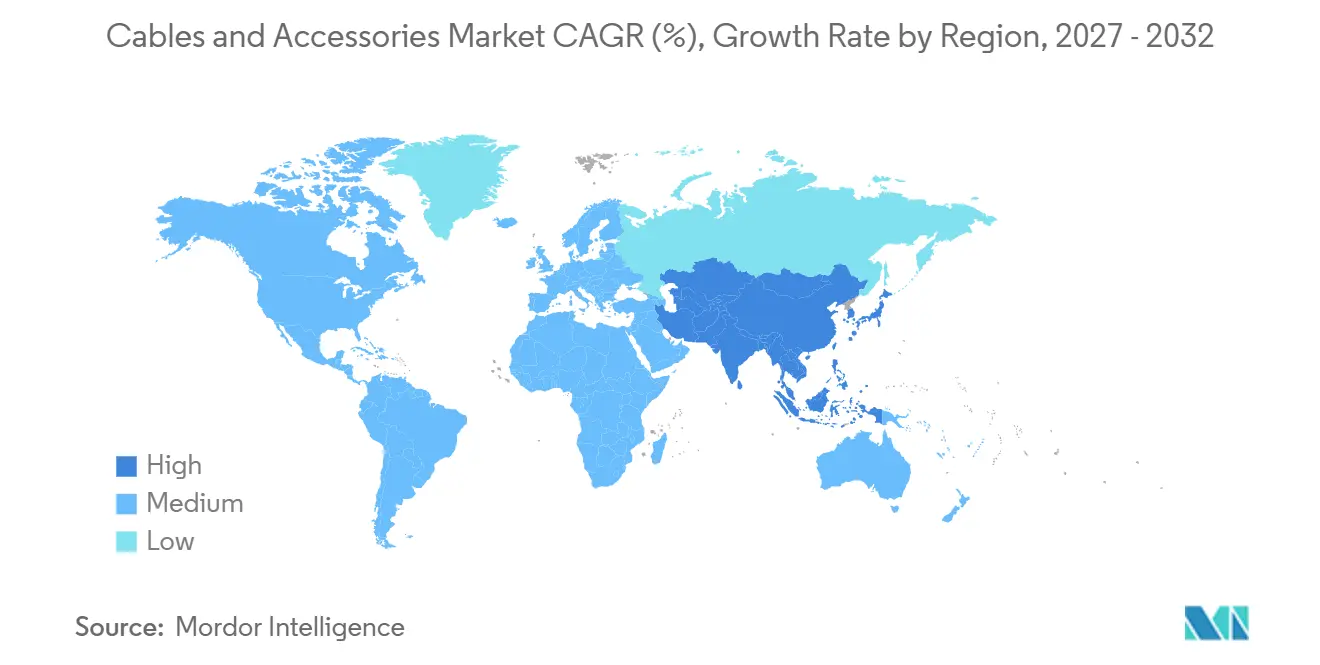
Asia-Pacific held 45.3% of the cables and accessories market share in 2026 and is projected to grow at a 7.3% CAGR through 2032. China remains the largest national source of demand in the region because it combines renewable expansion with extensive grid investment. Its solar and wind project pipeline supports demand for medium-voltage inter-array cables, high-voltage transmission systems, and accessories. India has a different demand profile because distribution gaps remain large relative to its needs. Its target of 500 GW of non-fossil fuel capacity by 2030 supports requirements across several voltage levels. Vietnam, Indonesia, and Thailand are also expanding grid systems ahead of local high-voltage manufacturing capacity. These markets may continue to require imported extra-high voltage systems. The region’s scale and varied project mix make it central to the cables and accessories market.
Europe is a major center for HVDC and offshore wind cable development. TenneT Germany invested EUR 10 billion, equivalent to USD 10.8 billion, in grid infrastructure in 2025, 46% more than EUR 6.9 billion, equivalent to USD 7.4 billion, in 2024. The company planned a further low-double-digit percentage increase in 2026. Nexans secured a framework agreement worth more than EUR 1 billion, equivalent to USD 1.1 billion, from RTE in March 2025 for HVDC cable supply for French offshore wind projects. Poland’s grid program and the Biscay Gulf interconnector add to regional activity. NKT completed its first cable pull-ins at Lemóniz, Spain, in March 2026 for the Biscay Gulf Interconnector. Europe remains important because projects demand qualified systems as well as significant cable volumes.
North America is expanding as utility capital programs support transmission and distribution investment. Avangrid announced USD 18.5 billion for electric and gas network infrastructure through 2028. The U.S. Department of Energy is also supporting reconductoring and power delivery upgrades. Wildfire mitigation is increasing interest in underground systems and related accessories. South America is emerging as an import market for extra-high voltage products through offshore oil, mining electrification, and wind projects. The Middle East and Africa are growing through investment in Saudi Arabia and the United Arab Emirates, while Morocco and Egypt are developing as interconnection hubs. Together, these regions widen the project base for the cables and accessories market.
Competitive Landscape
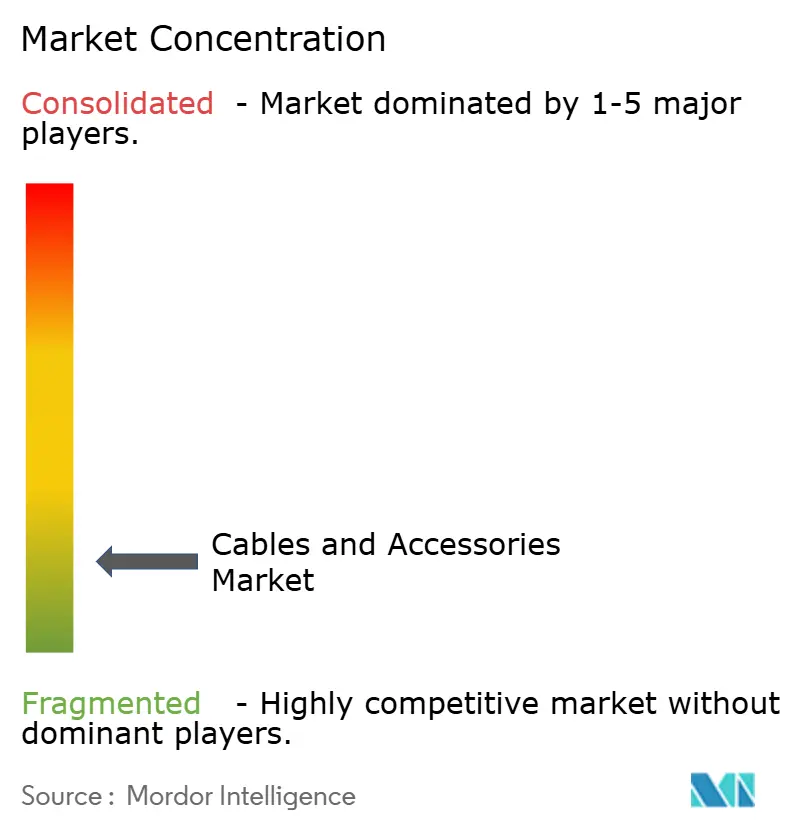
The cables and accessories market is fragmented. Prysmian, Nexans, and NKT hold strong positions in extra-high voltage and submarine systems because they have certifications, manufacturing capacity, and installation capabilities. Their order books extend 3 to 5 years in the high-voltage segment. Medium- and low-voltage products are more fragmented across regional suppliers. Hengtong, ZTT, APAR Industries, Southwire, and Tele-Fonika Kable compete in these categories through price, delivery, and local compliance. The high-voltage segment places greater importance on proven technical capability. This creates a gap between suppliers of complex transmission systems and suppliers of standard cable products. Prysmian raised its 2026 adjusted EBITDA guidance to EUR 2.8 billion to EUR 2.9 billion after its strongest quarterly performance on record.
Leading companies are investing in capacity, technical qualifications, and integrated project delivery. Prysmian has committed EUR 1.25 billion, equivalent to USD 1.4 billion, to expand U.S. fiber and optical cable capacity by 2031. Nexans qualified a 525 kV HVDC mass-impregnated cable system for water depths of 3,000 meters in August 2026. This qualification opens options for deepwater project routes. NKT qualified a 525 kV HVDC XLPE subsea power cable system for operation at 90°C in August 2026. These moves show that product performance and delivery capability are central to competition in the cables and accessories market. They also help suppliers address project needs that cannot be met by standard cables.
Accessories are becoming a more important area of differentiation. Nexans Smart Cable Guard and Prysmian digital solutions use sensor-based approaches to monitor cable condition. These products can support partial-discharge monitoring and planned maintenance. PFISTERER’s 525 kV HVDC connector patent shows the focus on reducing installation time and improving connection design. The high-voltage end of the cables and accessories market is concentrated among suppliers with the required qualifications and assets. Lower-voltage categories remain more fragmented because production and compliance barriers are lower. This split explains why leading suppliers pursue capacity, technology, and installation strategies at the same time.
Cables and Accessories Industry Leaders
-
Prysmian S.p.A.
-
Nexans SA
-
LS Cable & System Ltd.
-
Sumitomo Electric Industries, Ltd.
-
NKT A/S
- *Disclaimer: Major Players sorted in no particular order
Cables and Accessories Market Companies Covered in this Report
- ABB Ltd.
- APAR Industries Limited
- Dubai Cable Company Pvt. Ltd.
- Elsewedy Electric Co.
- Eland Cables Ltd.
- Encore Wire Corporation
- Furukawa Electric Co., Ltd.
- Hengtong Group
- LEONI AG
- LS Cable & System Ltd.
- Nexans SA
- NKT A/S
- Prysmian S.p.A.
- Southwire Company, LLC
- Sumitomo Electric Industries, Ltd.
- Taihan Electric Wire Co., Ltd.
- TE Connectivity Ltd.
- Tele-Fonika Kable S.A.
- ZTT Group
- 3M Company
Recent Industry Developments in Cables and Accessories Market
- August 2026: Nexans completed qualification of a 525 kV HVDC mass-impregnated cable system for a water depth of 3,000 meters, opening deepwater routes previously excluded from project engineering.
- August 2026: NKT qualified its 525 kV HVDC Cross-linked polyethylene (XLPE) subsea cable for 90°C operation using LE0650DC, which was co-developed with Borouge International and enables higher transmission capacity from the same cable cross-section.
- June 2026: NKT’s Champlain Hudson Power Express project in North America reached commercial operation, delivering renewable power to New York City through HVDC transmission.
- June 2026: PFISTERER received a German patent for its HVDC pluggable connector designed for up to 525 kV.
Global Cables and Accessories Market Report Scope
The Cables and Accessories Market covers the global industry involved in the manufacturing, distribution, and installation of electrical wire, fiber optic lines, and supporting hardware used to transmit power and data. This market includes physical cabling systems ranging from low-voltage copper building wires to high-voltage underground power transmission lines and telecommunication fiber optics, along with accessories required to install, connect, protect, and maintain them. Accessories include cable joints, terminations, splices, connectors, glands, and cross-bonding equipment, ensuring electrical continuity, mechanical protection, and insulation integrity across grid networks.
The global cables and accessories market report is segmented by product type into cables and cable accessories, and by voltage into low, medium, high, and extra-high categories. Based on installation, the market is divided into overhead, underground, and submarine methods, while applications span power transmission and distribution, renewable energy, telecommunications, industrial, and other sectors. The report also covers the market size and forecasts for the global cables and accessories market across 26 countries in key regions. For each segment, the market sizing and forecasts have been provided on the basis of value (USD).
Segmentation Overview
| Cables | Power Cables |
| Communication and Data Cables | |
| Control and Instrumentation Cables | |
| Specialty Cables | |
| Submarine Cables | |
| Other Cables | |
| Cable Accessories | Cable Joints and Splices |
| Cable Terminations | |
| Cable Connectors | |
| Cable Lugs | |
| Cable Glands | |
| Cable Cleats and Clamps | |
| Other Cable Accessories |
| Low Voltage |
| Medium Voltage |
| High Voltage |
| Extra-High Voltage |
| Overhead |
| Underground |
| Submarine |
| Power Transmission and Distribution |
| Power Generation |
| Telecommunications and Data Centers |
| Renewable Energy |
| Oil and Gas |
| Industrial |
| Transportation and Railways |
| Construction and Infrastructure |
| Mining and Metals |
| Marine and Offshore |
| EV Charging Infrastructure |
| Other Applications |
| North America | United States |
| Canada | |
| Mexico | |
| Europe | Germany |
| France | |
| Italy | |
| Spain | |
| United Kingdom | |
| Poland | |
| Russia | |
| Rest of Europe | |
| Asia-Pacific | China |
| India | |
| Japan | |
| South Korea | |
| Australia | |
| Indonesia | |
| Vietnam | |
| Thailand | |
| Rest of Asia-Pacific | |
| South America | Brazil |
| Argentina | |
| Chile | |
| Rest of South America | |
| Middle East and Africa | Saudi Arabia |
| United Arab Emirates | |
| Egypt | |
| South Africa | |
| Morocco | |
| Rest of Middle East and Africa |
| By Product Type | Cables | Power Cables |
| Communication and Data Cables | ||
| Control and Instrumentation Cables | ||
| Specialty Cables | ||
| Submarine Cables | ||
| Other Cables | ||
| Cable Accessories | Cable Joints and Splices | |
| Cable Terminations | ||
| Cable Connectors | ||
| Cable Lugs | ||
| Cable Glands | ||
| Cable Cleats and Clamps | ||
| Other Cable Accessories | ||
| By Voltage | Low Voltage | |
| Medium Voltage | ||
| High Voltage | ||
| Extra-High Voltage | ||
| By Installation | Overhead | |
| Underground | ||
| Submarine | ||
| By Application | Power Transmission and Distribution | |
| Power Generation | ||
| Telecommunications and Data Centers | ||
| Renewable Energy | ||
| Oil and Gas | ||
| Industrial | ||
| Transportation and Railways | ||
| Construction and Infrastructure | ||
| Mining and Metals | ||
| Marine and Offshore | ||
| EV Charging Infrastructure | ||
| Other Applications | ||
| By Geography | North America | United States |
| Canada | ||
| Mexico | ||
| Europe | Germany | |
| France | ||
| Italy | ||
| Spain | ||
| United Kingdom | ||
| Poland | ||
| Russia | ||
| Rest of Europe | ||
| Asia-Pacific | China | |
| India | ||
| Japan | ||
| South Korea | ||
| Australia | ||
| Indonesia | ||
| Vietnam | ||
| Thailand | ||
| Rest of Asia-Pacific | ||
| South America | Brazil | |
| Argentina | ||
| Chile | ||
| Rest of South America | ||
| Middle East and Africa | Saudi Arabia | |
| United Arab Emirates | ||
| Egypt | ||
| South Africa | ||
| Morocco | ||
| Rest of Middle East and Africa | ||
Key Questions Answered in the Report
What is the projected size of the global cables and accessories sector by 2032?
It is projected to reach USD 184.16 billion by 2032, growing at a 5.58% CAGR from 2027.
Which product category led revenue in 2026?
Cables led with 82.3% of revenue in 2026 and are forecast to grow at a 5.9% CAGR through 2032.
Which voltage class is expected to grow fastest?
Extra-high voltage cables are projected to grow at a 6.5% CAGR through 2032.
Why are underground cable systems gaining demand?
Resilience needs, dense urban development, and limits on overhead routes are supporting underground installation, which is forecast to grow at a 6.1% CAGR.
Which application is forecast to expand fastest?
Renewable energy is forecast to expand at an 8.2% CAGR through 2032, supported by offshore wind, solar, storage, and grid interconnections.
Which region leads global revenue and growth?
Asia-Pacific held 45.3% of revenue in 2026 and is projected to grow at a 7.3% CAGR through 2032.