
Business Travel Insurance Market Size and Share
Market Overview
| Study Period | 2020 - 2031 |
|---|---|
| Market Size (2026) | USD 8.32 Billion |
| Market Size (2031) | USD 11.07 Billion |
| Growth Rate (2026 - 2031) | 5.86 % |
| Fastest Growing Market | Asia-Pacific |
| Largest Market | North America |
| Market Concentration | Low |
Major Players *Disclaimer: Major Players sorted in no particular order Image © Mordor Intelligence. Reuse requires attribution under CC BY 4.0. | |
Business Travel Insurance Market Analysis by Mordor Intelligence
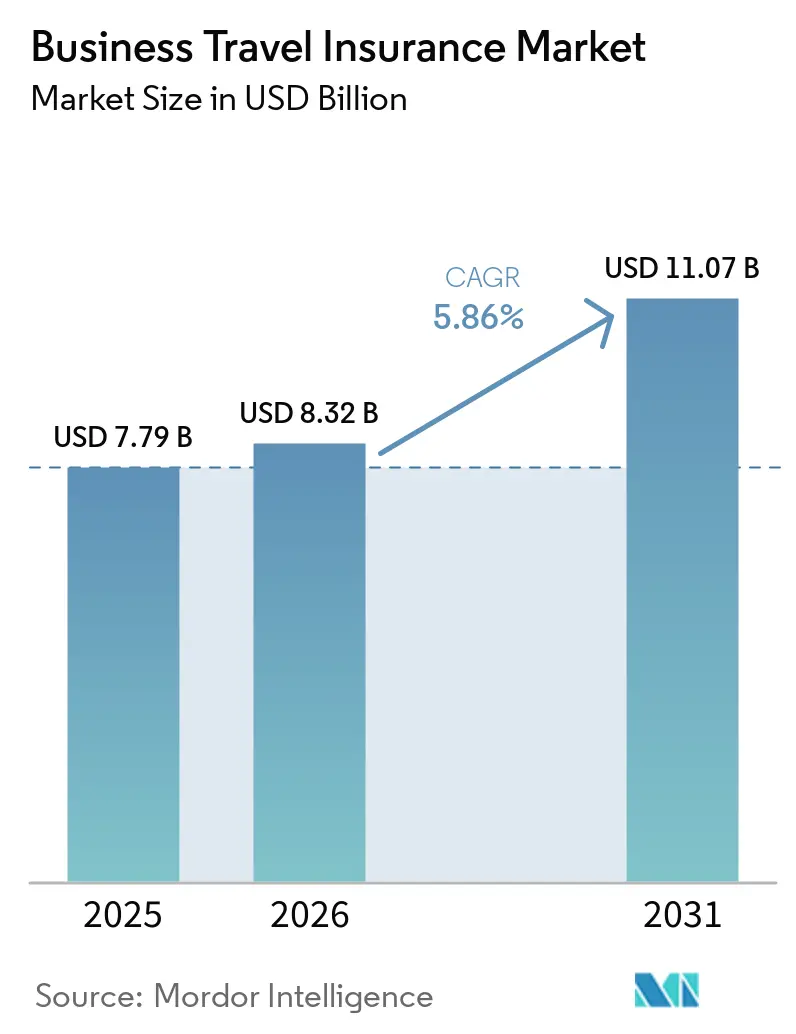
The Business Travel Insurance Market size is expected to increase from USD 7.79 billion in 2025 to USD 8.32 billion in 2026 and reach USD 11.07 billion by 2031, growing at a CAGR of 5.86% over 2026-2031.
Business travel spending reached USD 1.59 trillion in 2025 and is forecast to reach USD 1.71 trillion in 2026, which supports a broader base of insured corporate travel activity. International premium-class passengers totaled 109.7 million in 2025, rising 4.5% from 2024, and this travel pattern increases the financial exposure attached to international assignments. The average business trip cost was USD 1,128 in 2025, which makes the financial effect of a disrupted or medically complex trip more significant for employers. Corporate buyers are giving greater weight to clear coverage terms, assistance capacity, and policy designs that can be adapted to different traveler profiles. The Business travel insurance market, therefore, favors carriers that combine responsive assistance, straightforward policy language, and efficient claims processes.
Key Report Takeaways
- By insurance cover, annual multi-trip travel insurance captured 69.9% of the business travel insurance market share in 2025, while single-trip travel insurance is projected to grow at 7.1% CAGR through 2031.
- By coverage type, medical expenses, evacuation, and repatriation captured 53.5% of the business travel insurance market share in 2025, while political and security evacuation and other in-scope extensions are projected to grow at 10.3% CAGR through 2031.
- By application, international business travel accounted for 68.3% of the business travel insurance market share in 2025, while domestic business travel is projected to grow at 7.2% CAGR through 2031.
- By distribution channel, insurance brokers and agents held 46.7% of the business travel insurance market share in 2025, while travel management companies, airlines, OTAs, and other booking-path partners are projected to grow at 7.9% CAGR through 2031.
- By geography, North America captured 34.2% of the business travel insurance market share in 2025, while Asia-Pacific is projected to grow at 8.0% CAGR through 2031.
Note: Market size and forecast figures in this report are generated using Mordor Intelligence’s proprietary estimation framework, updated with the latest available data and insights as of January 2026.
Global Business Travel Insurance Market Trends and Insights
Drivers Impact Analysis*
| Driver | (~) % Impact on CAGR Forecast | Geographic Relevance | Impact Timeline |
|---|---|---|---|
| Cross-Border Business Travel Growth | +1.2% | Global, with the strongest uplift in Asia-Pacific and North America | Medium term (2-4 years) |
| Corporate Duty-of-Care Requirements | +1.1% | Global, with the greatest relevance in North America and Europe | Long term (≥ 4 years) |
| Travel Disruptions, Medical Emergencies, and Security Risks | +0.9% | Global, with high relevance in the Middle East, Asia-Pacific, and Latin America | Short term (≤ 2 years) |
| Demand for Comprehensive Protection and Assistance | +0.7% | North America, Europe, and Asia-Pacific, with expansion into the Middle East and Africa | Medium term (2-4 years) |
| Digital Distribution and Policy Administration | +0.4% | Global, with early gains in Asia-Pacific and North America | Long term (≥ 4 years) |
| Standardized Multi-Trip Coverage Demand | +0.2% | North America and Europe | Medium term (2-4 years) |
| Source: Mordor Intelligence | |||
Growth in International and Cross-Border Business Travel Activity
The business travel insurance market benefits from rising travel expenditure and from the larger financial exposure connected with each corporate journey. GBTA forecasts 1.84 billion business trips in 2026, with spending increasing 7.2% to USD 1.71 trillion[1]Global Business Travel Association, “Global Business Travel Spending to Hit Record USD 1.71 Trillion in 2026 While Trips Reach 1.84 Billion, Says GBTA Forecast,” Global Business Travel Association, gbta.org.. The forecast attributes this increase to higher airfares and longer average itineraries, rather than solely to higher traveler volumes. Asia-Pacific corporate travel expenditure is projected to reach USD 701 billion in 2026, supported by spending growth of 11.5% in Australia, 11.3% in South Korea, and 10.0% in Japan. These flows increase the value of policies that can support employees across borders and different health care systems. Carriers with established distribution and assistance capabilities in major Asia-Pacific travel centers are better placed to serve companies that are formalizing travel risk programs in the region.
Strengthening Corporate Duty-of-Care and Travel Risk Management Requirements
The business travel insurance market is supported by employers that treat traveler welfare as an operational and workforce matter. Zurich’s 2026 survey of 4,000 international business travelers across 8 countries found that 60% would leave an employer that did not prioritize their safety[2]Zurich Insurance Group, “Business Travel Outlook 2026, How to Navigate a New Era of Disruption,” Zurich Insurance Group, zurich.com.. The same survey found that 58% of respondents believed their employers could do more to protect traveler safety. These expectations make travel protection relevant to human resources, risk management, and procurement decisions. Zurich reported that air ambulance evacuations typically exceed USD 150,000, while complex cases can exceed USD 1 million. Employers that cannot absorb these costs have a reason to assess both the insurance limit and the operational assistance available under a policy.
Rising Demand for Comprehensive Corporate Travel Protection and Assistance Services
The business travel insurance market also reflects demand for policies that bring several travel-related protections into a single program. Medical expenses, evacuation, trip interruption, and support services can be important when an employer sends staff to multiple destinations. A broader policy can help employers avoid managing separate arrangements for routine disruptions and severe emergencies. Comprehensive programs are particularly relevant for organizations with frequent cross-border assignments and varied traveler risk profiles. They also allow employers to apply a more consistent standard of protection across employee groups. This preference supports products that combine insurance protection with assistance that can be activated during a trip.
Digitalization of Business Travel Insurance Distribution and Policy Administration
Digital distribution is widening the ways in which the business travel insurance market reaches smaller companies and occasional corporate travelers. Chubb launched Travel Pro in October 2025 as a parametric travel protection suite that can be integrated into airline and online travel agency booking flows through Chubb Studio[3]Chubb Limited, “Chubb Launches Travel Pro, a New Digital Protection for Travel Disruptions,” Chubb News, news.chubb.com.. The product provides automatic claims settlement for events including delays, baggage disruption, weather events, and medical emergencies. Booking-path distribution can reduce the steps needed to issue coverage and can make protection visible during travel planning. Digital policy administration can also provide travelers with faster access to policy documents and assistance details. The approach is most useful when digital processes remain clear and when travelers understand the limits of the coverage offered. It gives insurers another route to serve buyers who may not use a traditional broker for each journey.
Restraints Impact Analysis*
| Restraint | (~) % Impact on CAGR Forecast | Geographic Relevance | Impact Timeline |
|---|---|---|---|
| Cost of Comprehensive and High-Risk Coverage | -1.0% | Global, with the strongest effect on small and medium-sized enterprises and emerging markets | Short term (≤ 2 years) |
| Coverage Exclusions and Policy Complexity | -0.9% | Global, with greater impact in high-risk destinations | Medium term (2-4 years) |
| Limited Small and Medium-Sized Enterprise Awareness and Adoption | -0.6% | Emerging Asia-Pacific markets, Latin America, the Middle East, and Africa | Medium term (2-4 years) |
| Regulatory and Cross-Border Compliance Complexity | -0.3% | Europe, Asia-Pacific, and markets with opaque licensing frameworks | Long term (≥ 4 years) |
| Source: Mordor Intelligence | |||
High Cost of Comprehensive and High-Risk Business Travel Coverage
Premium affordability is a direct barrier for smaller organizations in the business travel insurance market. Small and medium-sized enterprises may not travel often enough to view a broad annual program as a necessary operating cost. Comprehensive protection can include medical evacuation, political evacuation, and disruption benefits, which can make the program more difficult to approve under tight budgets. The average business trip cost was USD 1,128 in 2025, so employers face both higher potential loss exposure and greater spending scrutiny[4]Global Business Travel Spending to Reach $1.57 Trillion in 2025 Amid Trade Policy Uncertainty and Economic Risk, According to New GBTA Forecast - Global Business Travel Association - GBTA. Modular and pay-per-trip options can make coverage easier to evaluate for organizations with less predictable travel. A clear explanation of the differences between formal corporate coverage and basic payment card benefits is also important during the purchase decision.
Coverage Exclusions and Complexity in Business Travel Insurance Policies
Policy complexity can limit confidence among buyers evaluating the Business travel insurance market. Employers need to understand how terms apply to cancellation, medical events, security risks, and travel to different jurisdictions. War, civil unrest, and denied-entry clauses can receive greater attention when companies plan trips to destinations with changing conditions. Unclear policy language can create a gap between what a buyer expects and what the policy actually provides. Carriers can reduce this friction by giving clients plain-language summaries and clear explanations of destination-specific requirements. Brokers also remain relevant when a company needs help comparing coverage limits, exclusions, and available extensions.
*Our forecasts treat driver/restraint impacts as directional, not additive. The impact forecasts reflect baseline growth, mix effects, and variable interactions.
Segment Analysis
By Insurance Cover: Annual Policies Drive Corporate Program Standardization
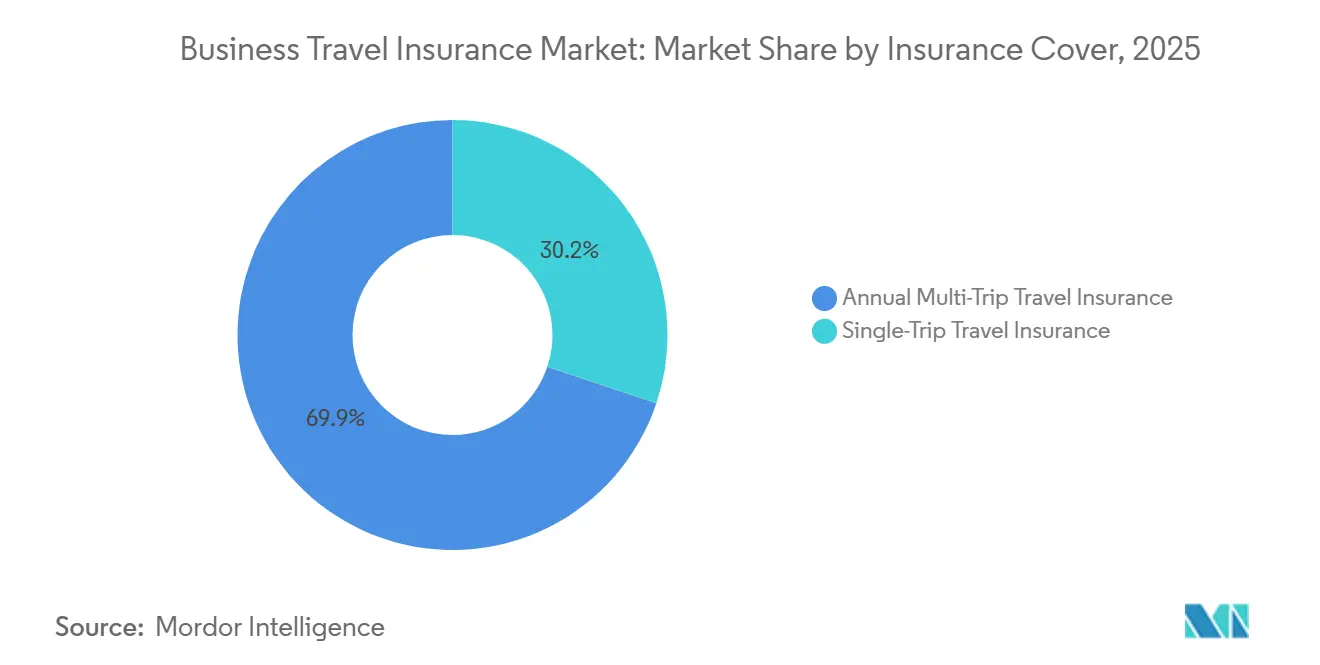
Annual multi-trip travel insurance captured 69.9% of the business travel insurance market share in 2025, making it the leading format. Multinational employers often use blanket annual programs to cover eligible employees through a single master policy. This structure reduces per-trip administration and can maintain consistent protection across different booking patterns. Large buyers commonly compare price, service capacity, and the ability to support travel across jurisdictions. Annual multi-trip policies, therefore, remain important for carriers seeking enterprise accounts and brokers managing formal procurement exercises.
Single-trip travel insurance is forecast to grow at a 7.1% CAGR through 2031, the fastest rate within the insurance cover segment. The format suits occasional business travelers and organizations that do not have sufficient travel volume for a multi-trip arrangement. It can also address independent professionals who travel for client assignments and need coverage for a defined journey. Digital booking-path offers make single-trip protection more accessible when a trip is confirmed. The business travel insurance market size is supported by demand across both occasional and frequent travel patterns, with single-trip and annual multi-trip policies serving complementary needs rather than competing directly.


By Coverage Type: Medical Evacuation Anchors Revenue, Geopolitical Extraction Accelerates
Medical expenses, evacuation, and repatriation accounted for 53.5% of the business travel insurance market share by coverage type in 2025. The category is supported by the potential cost of serious medical events away from an employee’s home location. Zurich stated that air ambulance evacuations typically exceed USD 150,000 and that complex cases can exceed USD 1 million. Trip cancellation, interruption, delay, and missed departure are other important categories because travel disruptions can affect multiple travelers. Baggage, money, documents, business equipment, personal accident, and AD&D complete the broader coverage portfolio.
Political and security evacuation and other in-scope extensions are forecast to grow at a 10.3% CAGR through 2031, the fastest rate among coverage categories. The category reflects employer demand for protection against more complex security conditions during cross-border travel. It differs from routine medical reimbursement because it may require real-time information, coordinated transport, and security support. Changing geopolitical conditions make it important for buyers to assess whether policies include relevant extensions and understand the applicable triggers. The business travel insurance market size is increasingly supported by policies that place greater emphasis on assistance and coordinated response alongside traditional indemnity.
By Application: International Travel Commands Premium, Domestic Travel Formalizes
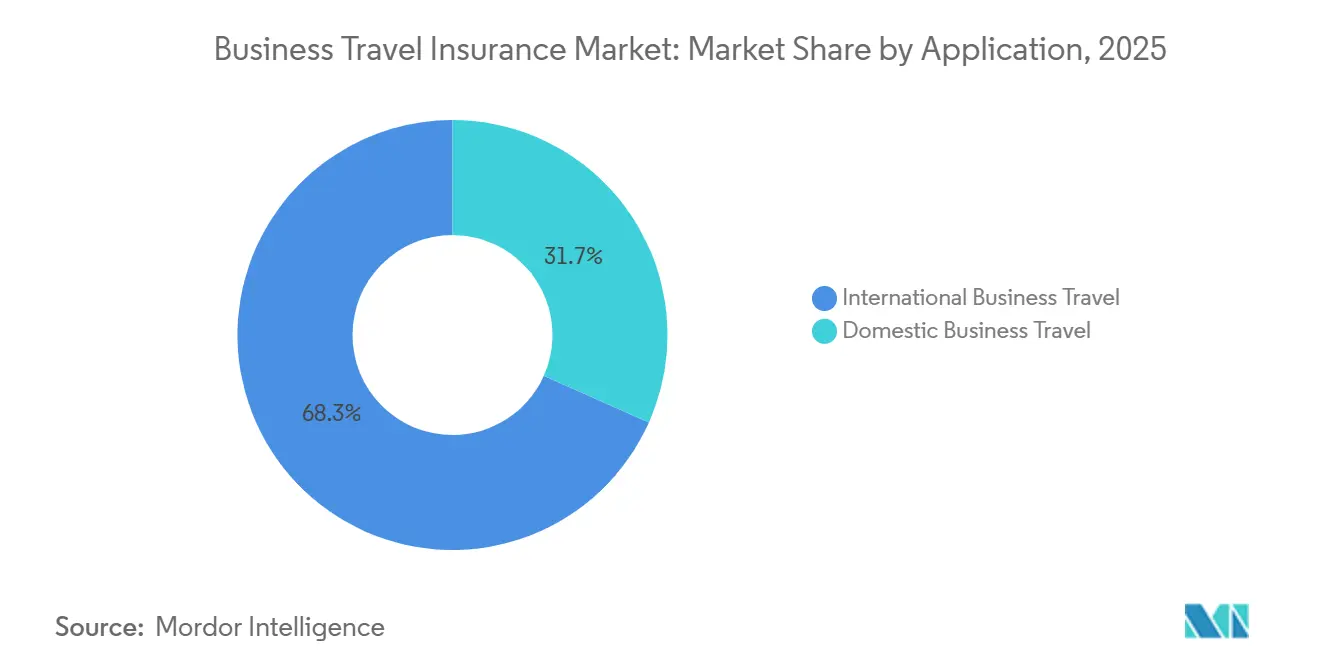
International business travel accounted for 68.3% of the business travel insurance market share by application in 2025. Cross-border assignments often involve longer travel periods, higher insured values, and more complex medical or evacuation requirements. IATA recorded 109.7 million international premium-class passengers in 2025, an increase of 4.5% from the prior year. North America had a premium-class share of 10.4% of total passengers, indicating a substantial base of higher-value corporate travel. GBTA reported that 42% of business travelers typically travel in premium cabins.
Domestic business travel is forecast to grow at a 7.2% CAGR between 2026 and 2031, the fastest rate within the application segment. Employers are increasingly applying duty-of-care practices to travel within a worker’s home country as well as to international assignments. This is particularly relevant in large countries where internal corporate trips are frequent and can involve long distances. Formal insurance programs can provide a more consistent approach to employee protection across domestic and international travel. The business travel insurance market size can therefore expand as employers extend existing travel standards to domestic journeys.
By Distribution Channel: Brokers Retain Complexity Premium, Booking-Path Channels Accelerate
Insurance brokers and agents held 46.7% of the business travel insurance market share by distribution channel segment in 2025, reflecting their role in designing, negotiating, and administering corporate travel programs that may span multiple countries and carriers. Brokers can support high-risk destination approvals, claims escalation, and comparisons of specialized policy terms. Their advisory role remains valuable when clients require political evacuation, cyber-incident response, or other nonstandard extensions. Complex multinational accounts can require a level of service that standard digital purchase journeys may not provide.
Travel management companies, airlines, OTAs, and other booking-path partners are forecast to grow at a 7.9% CAGR between 2026 and 2031. Their growth is supported by embedded insurance offered within corporate booking workflows. Chubb’s Travel Pro provides an example through API-based distribution and automatic settlement options. Booking-path partners can help insurers reach small companies and occasional travelers that traditional brokers may not serve economically. The business travel insurance market size is also supported by these expanding digital distribution models, while MGAs and delegated underwriters, affinity and bancassurance programs, and direct insurer sales serve other procurement needs.
Geography Analysis
North America held 34.2% of the business travel insurance market share in 2025, supported by the United States, where corporate travel spending is projected to reach USD 423 billion in 2026. The region has a broker-led procurement model that often places travel protection within broader corporate risk programs. An established duty-of-care environment supports demand for policies even without mandatory purchase requirements. Mexico contributes through nearshoring-related cross-border corporate travel. Corporate card access reached 69% in the region in 2025, while only half of cardholders were required to use the cards for work travel, leaving room for brokers to identify gaps in travel protection.
Europe remains a significant revenue area for the business travel insurance market because of dense cross-border travel between European countries. GBTA projects European business travel spending at EUR 389.9 billion (USD 405.5 billion) in 2026 and EUR 414.5 billion (USD 431.1 billion) in 2027. IATA recorded 39.7 million business and first-class passengers in Europe in 2025, making it the largest international premium-class travel region. DORA and NIS2 are shaping how European employers consider operational resilience and incident reporting. South America also showed rising corporate travel activity, as IATA recorded 22.1% growth in South American premium-class passengers in 2025, the highest regional gain.
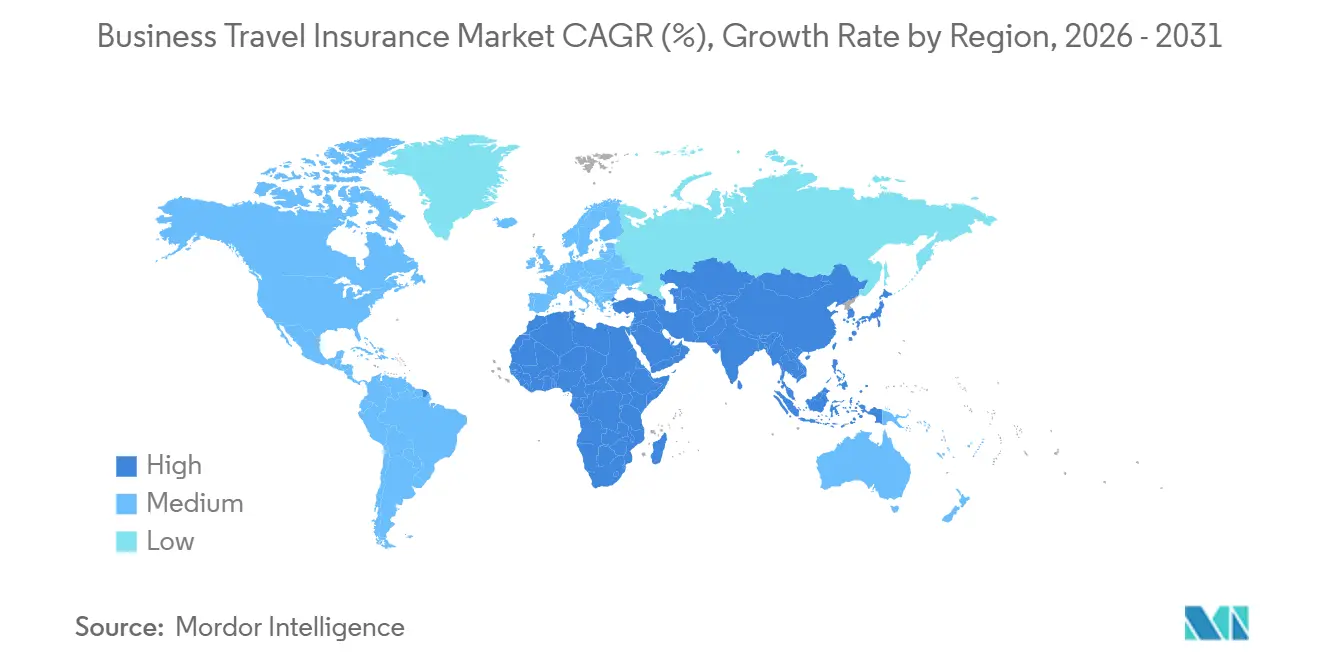
Asia-Pacific is forecast to grow at an 8.0% CAGR between 2026 and 2031, the fastest geographical rate in the business travel insurance market. Corporate travel spending in the region is forecast to reach USD 701 billion in 2026, representing more than 40% of global expenditure. Australia, South Korea, and Japan are projected to record spending growth of 11.5%, 11.3%, and 10.0%, respectively, in 2026. India and Southeast Asia are building larger volumes of insurable corporate travel. The business travel insurance market size is supported by these expanding travel flows, although growth prospects vary across markets. The Middle East and Africa face different conditions because GBTA expects Middle East business travel volume to decline 12.3% in 2026 due to regional conflict.

Competitive Landscape
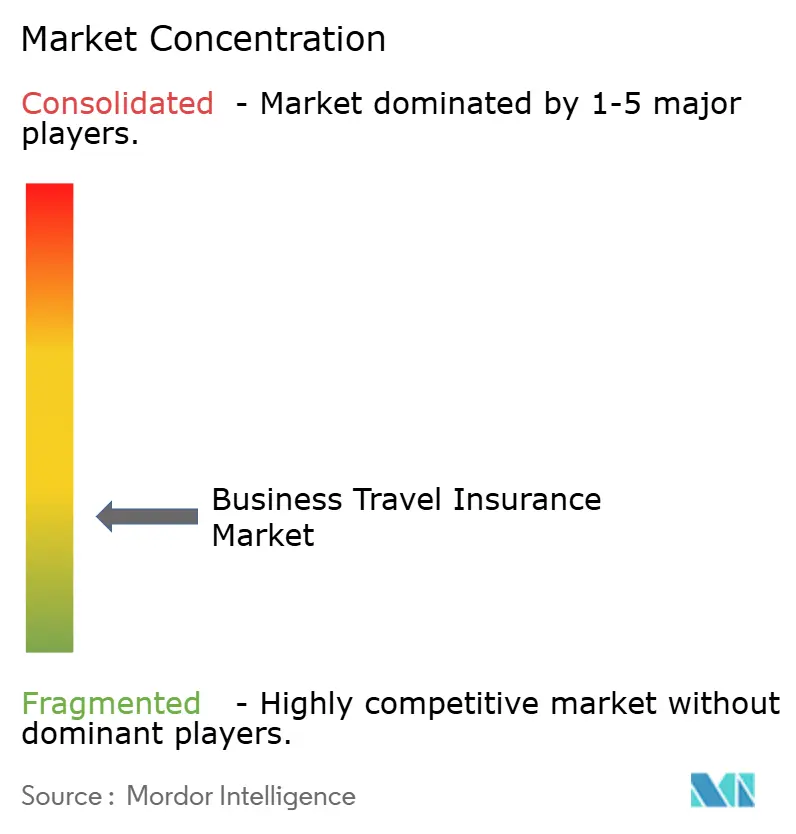
The business travel insurance market has fragmented concentration among global carriers with scale in distribution, assistance operations, and reinsurance. Allianz Partners, Zurich Cover-More, Chubb, Generali Global Assistance, and AXA Partners have established positions in corporate travel protection. Their capability rests on 24/7 assistance centers and the ability to support large client programs across countries. Zurich completed its USD 600 million acquisition of AIG’s global personal travel insurance business in December 2024, including Travel Guard. The combined operation served more than 20 million customers annually through 200 distribution partners and had annual gross written premiums of around USD 2 billion.
Leading companies are pursuing different operating models within the Business travel insurance market. Chubb has focused on embedded parametric products through Chubb Studio, including the Travel Pro launch in October 2025. Tokio Marine announced a strategic partnership with Berkshire Hathaway in March 2026, under which Berkshire Hathaway acquired a 2.49% stake for USD 1.8 billion. The partnership identified collaborative global merger and acquisition activity in reinsurance and insurance lines, with Australia and Canada among the priority areas. Sompo completed its acquisition of Aspen Insurance for USD 3.5 billion in February 2026, expanding its international commercial and reinsurance platform.
The business travel insurance market has opportunities in simpler products for small companies and in services that combine protection, travel data, and evacuation support. Booking-path distribution can help providers serve travelers who do not use a broker for each trip. Larger carriers have an advantage in global assistance capacity, while digital providers can compete on straightforward purchase and claims experiences. Mid-tier regional insurers may face greater pressure when they cannot match either global reach or digital efficiency. Policy clarity remains a competitive factor because corporate buyers compare exclusions and extensions more closely when assessing travel risk.
Business Travel Insurance Industry Leaders
Allianz SE
American International Group, Inc.
AXA S.A.
Zurich Insurance Group Ltd.
Chubb Limited
- *Disclaimer: Major Players sorted in no particular order

Recent Industry Developments
- August 2026: Travel Guard Singapore completed its underwriting transition to Zurich Insurance Group following Zurich's USD 600 million acquisition of AIG's global personal travel business in December 2024. The refreshed product range under Travel Guard Direct offers up to SGD 2 million (USD 1.48 million) in overseas medical coverage and unlimited emergency evacuation on premium plans, signaling Zurich Cover-More's intent to compete on benefit depth across Asia-Pacific markets.
- March 2026: Berkshire Hathaway announced a strategic partnership with Tokio Marine Holdings, acquiring approximately a 2.49% stake for USD 1.8 billion. The partnership targets collaborative global M&A across reinsurance and insurance lines, with Australia and Canada identified as priority expansion markets for Tokio Marine's international growth ambitions.
- February 2026: Sompo Holdings completed the acquisition of Aspen Insurance for USD 3.5 billion, materially expanding its reinsurance capacity and international commercial platform. Sompo's overseas insurance and reinsurance revenue rose 9.6% to USD 15 billion in FY2025, and the Aspen integration is expected to accelerate non-domestic revenue growth in FY2026.
- October 2025: Chubb launched Travel Pro at the World Aviation Festival in Lisbon, a parametric, digital-first travel insurance suite embedded via API into airline and OTA booking workflows through Chubb Studio®. Travel Pro delivers automatic claims settlement for flight delays, baggage disruptions, adverse weather, and medical emergencies, payable via airline miles, lounge access, virtual cards, or direct debit.


Global Business Travel Insurance Market Report Scope
| Single-Trip Travel Insurance |
| Annual Multi-Trip Travel Insurance |
| Medical Expenses, Evacuation and Repatriation |
| Trip Cancellation, Interruption, Delay and Missed Departure |
| Baggage, Money, Documents and Business Equipment |
| Personal Accident / AD&D |
| Political / Security evacuation and Other In-Scope Travel-Policy Extensions |
| Domestic Business Travel |
| International Business Travel |
| Direct Insurer Sales |
| Insurance Brokers and Agents |
| MGAs, Coverholders and Other Delegated Underwriters |
| Travel Management Companies, Airlines, OTAs and Other Booking-path Partners |
| Affinity, Commercial-card and Bancassurance Programmes |
| North America | United States |
| Canada | |
| Mexico | |
| South America | Brazil |
| Argentina | |
| Rest of South America | |
| Europe | United Kingdom |
| Germany | |
| France | |
| Italy | |
| Spain | |
| Rest of Europe | |
| Asia-Pacific | China |
| Japan | |
| India | |
| South Korea | |
| Australia | |
| Indonesia | |
| Thailand | |
| Malaysia | |
| Singapore | |
| Vietnam | |
| Rest of Asia-Pacific | |
| Middle East and Africa | Saudi Arabia |
| United Arab Emirates | |
| Turkey | |
| South Africa | |
| Egypt | |
| Rest of Middle East and Africa |
| By Insurance Cover | Single-Trip Travel Insurance | |
| Annual Multi-Trip Travel Insurance | ||
| By Coverage Type | Medical Expenses, Evacuation and Repatriation | |
| Trip Cancellation, Interruption, Delay and Missed Departure | ||
| Baggage, Money, Documents and Business Equipment | ||
| Personal Accident / AD&D | ||
| Political / Security evacuation and Other In-Scope Travel-Policy Extensions | ||
| By Application | Domestic Business Travel | |
| International Business Travel | ||
| By Distribution Channel | Direct Insurer Sales | |
| Insurance Brokers and Agents | ||
| MGAs, Coverholders and Other Delegated Underwriters | ||
| Travel Management Companies, Airlines, OTAs and Other Booking-path Partners | ||
| Affinity, Commercial-card and Bancassurance Programmes | ||
| By Geography | North America | United States |
| Canada | ||
| Mexico | ||
| South America | Brazil | |
| Argentina | ||
| Rest of South America | ||
| Europe | United Kingdom | |
| Germany | ||
| France | ||
| Italy | ||
| Spain | ||
| Rest of Europe | ||
| Asia-Pacific | China | |
| Japan | ||
| India | ||
| South Korea | ||
| Australia | ||
| Indonesia | ||
| Thailand | ||
| Malaysia | ||
| Singapore | ||
| Vietnam | ||
| Rest of Asia-Pacific | ||
| Middle East and Africa | Saudi Arabia | |
| United Arab Emirates | ||
| Turkey | ||
| South Africa | ||
| Egypt | ||
| Rest of Middle East and Africa | ||


Key Questions Answered in the Report
What is the projected value of business travel insurance by 2031?
The sector is forecast to reach USD 11.07 billion by 2031, growing from USD 8.32 billion in 2026 at a 5.9% CAGR.
What type of business travel insurance has the largest share?
Annual multi-trip travel insurance led insurance cover with 69.9% share in 2025.
Which coverage type is growing fastest for corporate travelers?
Political and security evacuation and other in-scope extensions are forecast to grow at 10.3% CAGR between 2026-2031.
Why do employers buy corporate travel protection?
Employers use it to address medical emergencies, evacuation needs, disruption, and duty-of-care responsibilities for traveling staff.
Which region is growing fastest for travel protection?
Asia-Pacific is forecast to grow at 8.0% CAGR between 2026-2031, supported by corporate travel spending projected at USD 701 billion in 2026.
How are insurers reaching small business travelers?
Providers are using booking-path distribution, embedded offers, modular coverage, and digital claims processes to reach smaller companies and occasional travelers.
Page last updated on:





