
Burial Insurance Market Size and Share
Market Overview
| Study Period | 2020 - 2031 |
|---|---|
| Market Size (2026) | USD 14.90 Billion |
| Market Size (2031) | USD 19.10 Billion |
| Growth Rate (2026 - 2031) | 5.10 % |
| Fastest Growing Market | Middle East and Africa |
| Largest Market | North America |
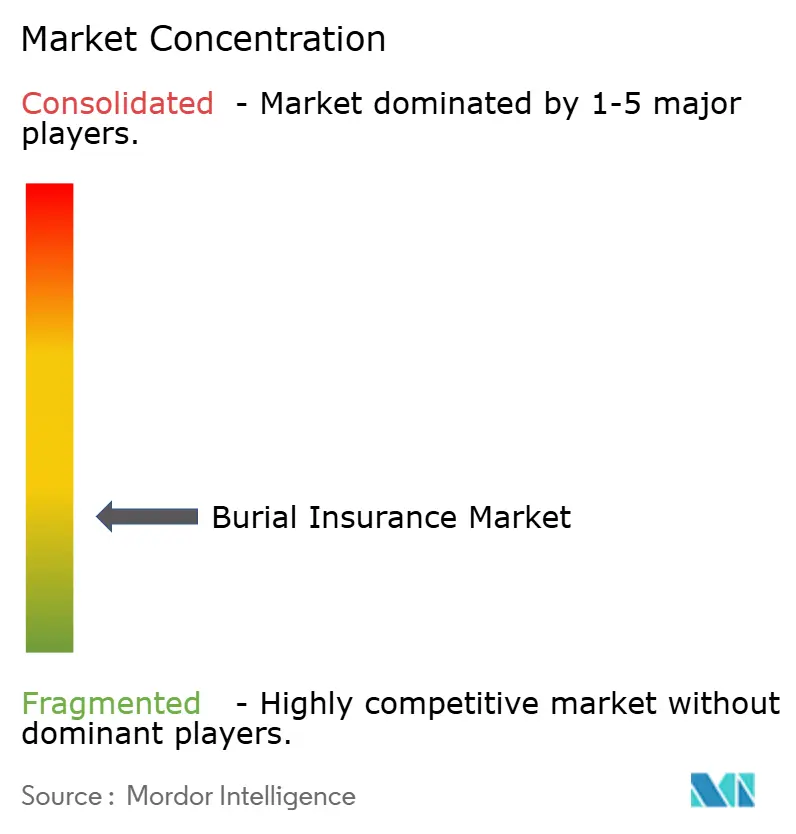
| Market Concentration | Low |
Major Players *Disclaimer: Major Players sorted in no particular order Image © Mordor Intelligence. Reuse requires attribution under CC BY 4.0. | |
Burial Insurance Market Analysis by Mordor Intelligence
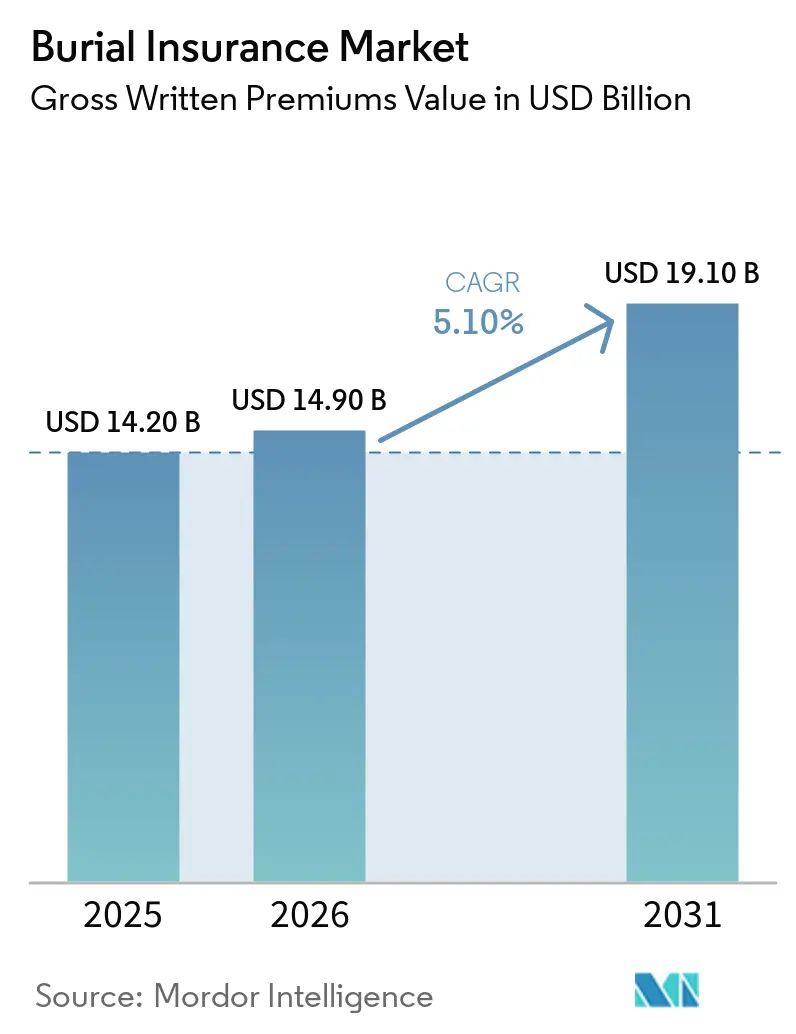
The Burial Insurance Market size in terms of gross written premiums value was valued at USD 14.20 billion in 2025 and is estimated to grow from USD 14.90 billion in 2026 to reach USD 19.10 billion by 2031, at a CAGR of 5.10% during the forecast period (2026-2031).
Population aging and rising funeral costs are increasing the need for policies that cover final expenses. Demand is supported by consumers who want to limit the financial burden on family members after death. In the United States, final expense and smaller-face-amount products helped whole life new annualized premium reach USD 6.4 billion in 2025, while policy count increased 12%. Carriers are adjusting their underwriting, distribution, and premium options to reach older buyers more efficiently. Regulatory requirements and affordability concerns remain important limits on the burial insurance market.
Key Report Takeaways
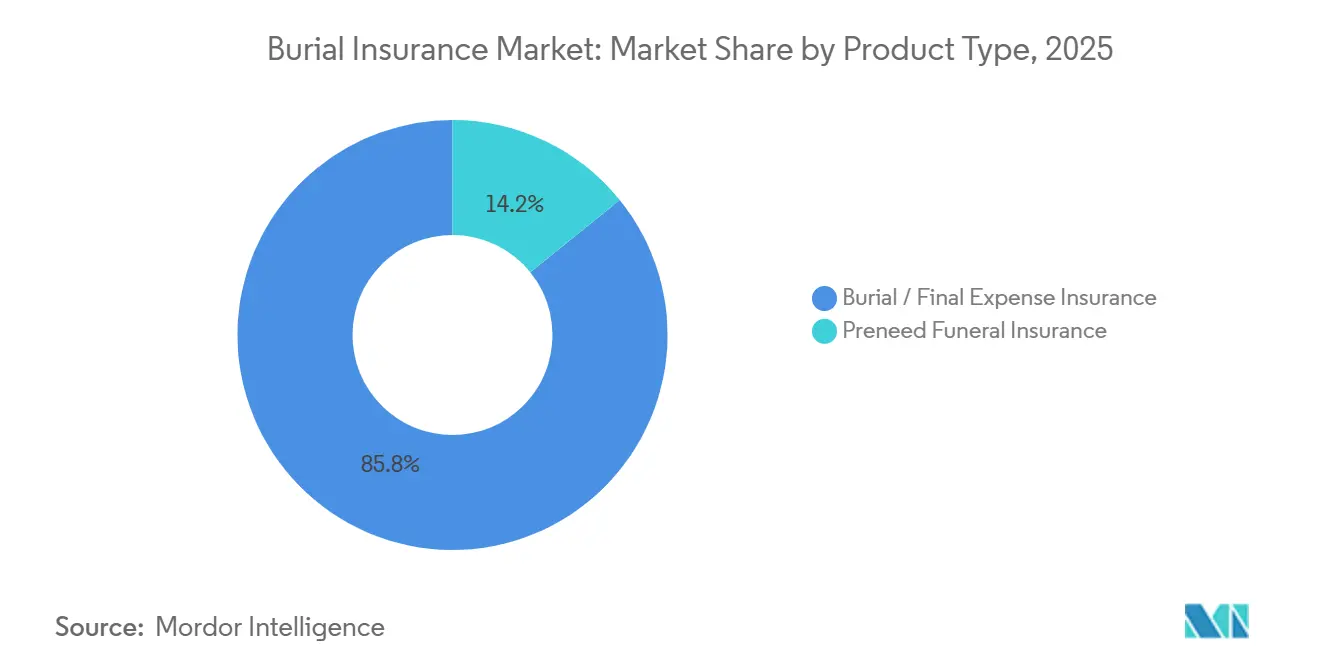
- By product type, burial and final expense insurance captured 85.8% of the burial insurance market share in 2025 and is projected to grow at a 5.3% CAGR through 2031.
- By contract form, individual policies held 87.3% of the burial insurance market share in 2025, while group and affinity policies are forecast to grow at a 6.4% CAGR through 2031.
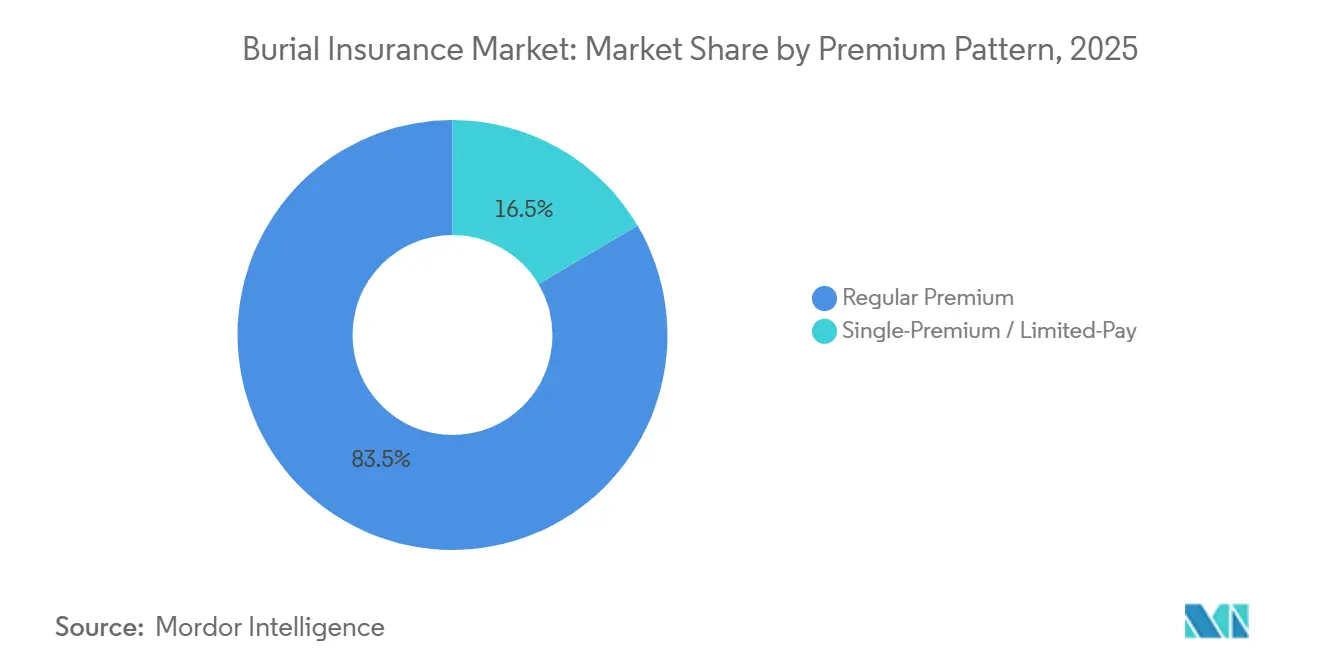
- By premium pattern, regular premium policies accounted for 83.5% of the burial insurance market share in 2025, while single-premium and limited-pay products are projected to grow at a 5.9% CAGR through 2031.
- By distribution channel, agents and brokers captured 64.6% of the burial insurance market share in 2025, while direct-to-consumer and digital distribution are projected to grow at a 9.2% CAGR through 2031.
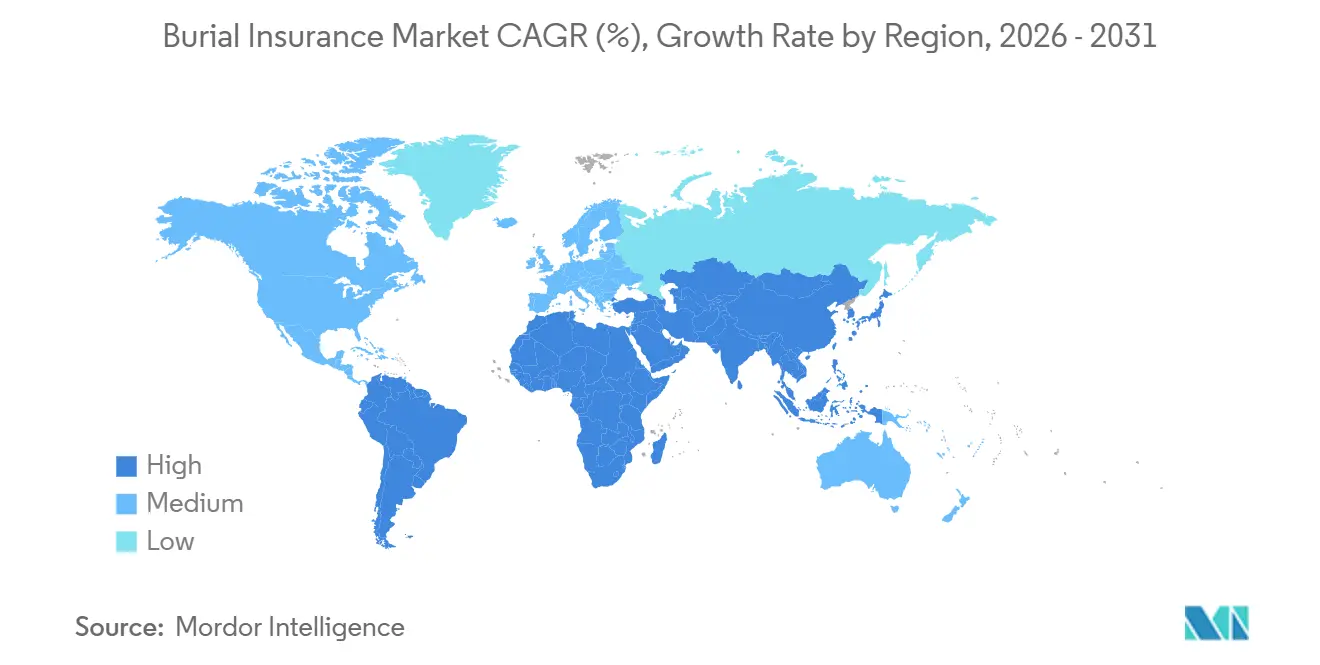
- By geography, North America held 58.4% of the burial insurance market share in 2025, while the Middle East and Africa are projected to grow at a 6.7% CAGR through 2031.
Note: Market size and forecast figures in this report are generated using Mordor Intelligence’s proprietary estimation framework, updated with the latest available data and insights as of January 2026.
Global Burial Insurance Market Trends and Insights
Drivers Impact Analysis*
| Driver | (~) % Impact on CAGR Forecast | Geographic Relevance | Impact Timeline |
|---|---|---|---|
| Aging Population Increasing Demand for Final-Expense Coverage | +1.5% | Global, led by North America, Europe, and Japan | Long term (≥ 4 years) |
| Rising Funeral and End-of-Life Service Costs | +0.8% | North America, Europe | Medium term (2-4 years) |
| Growing Consumer Focus on Pre-Planning Funeral Expenses | +0.6% | North America, the United Kingdom, and Australia | Medium term (2-4 years) |
| Expansion of Simplified-Issue and Guaranteed-Issue Products | +0.7% | Global | Short term (≤ 2 years) |
| Expansion of Agent, Funeral-Home and Direct Distribution Channels | +0.5% | North America, Asia-Pacific, the Middle East, and Africa | Medium term (2-4 years) |
| Growing Need for Affordable Financial Protection Among Older and Underserved Consumers | +0.4% | North America, South America, the Middle East, and Africa | Long term (≥ 4 years) |
| Source: Mordor Intelligence | |||
Aging Population Accelerating Final-Expense Demand
The global share of people aged 65 and older exceeded the share aged 5 and younger for the first time between 2020 and 2025[1]. In the United States, people aged 65 and older represented 18.9% of the population in 2025 and are projected to represent 23.4% by 2060, while Japan’s share stood at 29.7% and South Korea’s share is projected to reach 41% by 2060. The worldwide share of people aged 65 is projected to rise from 10.3% in 2024 to 20.7% by 2074, and the population aged 80 and older is expected to more than triple. Half of whole life insurers reported policy sales gains during 2025, with many attributing growth to final expense products. Growing older populations increase the need for simple enrollment, clear benefit design, and smaller coverage amounts. The burial insurance market has a lasting demand base that extends beyond short-term changes in insurance purchasing.
Rising Funeral and End-of-Life Service Costs
The median cost of a funeral with burial and viewing was USD 8,300 in 2023, compared with USD 7,848 in 2021. Cemetery plots, headstones, and obituary costs can add USD 3,000 or more in many United States locations, while median burial costs increased 35% over the preceding decade. These increases can leave older policies with face values that do not cover expected household expenses. Coverage amounts between USD 10,000 and USD 25,000 are consequently more relevant to buyers planning for funerals or aging parents. Simpler underwriting and higher coverage ceilings can help carriers convert these customers into active policyholders. The effect is most visible in North America and Europe, where funeral spending and senior insurance demand are established.
Expansion of Simplified-Issue and Guaranteed-Issue Products
In a 2025 survey by Gen Re, 65% of life insurers reported material underwriting changes during the prior 12 months, including higher face-amount limits, automated data sources, and updated predictive models. National Life Group introduced RapidProtect in September 2025 as an instant-decision product without medical tests[2]. iPipeline’s iGO Evolve enables agents to bind life policies in under 30 minutes through automated underwriting. Simplified and guaranteed-issue products can broaden access for applicants who may not complete a full medical examination. Automated information can support risk assessment and pricing for people with common chronic conditions. The burial insurance industry is balancing lower enrollment friction with disclosure expectations and consumer protection.
Expansion of Distribution Channels Including Digital and Funeral-Home Pathways
Agents and brokers held 64.6% of market value in 2025, while direct-to-consumer and digital distribution are projected to grow at a 9.2% CAGR through 2031. eHealth added Mutual of Omaha Living Promise policies to its digital marketplace in April 2026, extending final expense products to Medicare-age consumers[3]. Funeral homes and preneed providers can reach consumers when the need for funeral planning is immediate. Foresters expanded accelerated underwriting in April 2026, raised fluidless limits to USD 2 million for applicants aged 18 to 60 and USD 1 million for applicants aged 61 to 65, and integrated iPipeline iGO e-App prescreening. Institutional, affinity, and bancassurance channels remain relevant in Brazil, while a broader channel mix can reach underserved consumers. This expansion is an important competitive factor for the burial insurance market.
Restraints Impact Analysis*
| Restraint | (~) % Impact on CAGR Forecast | Geographic Relevance | Impact Timeline |
|---|---|---|---|
| Low Consumer Awareness of Burial Insurance and Product Features | -0.7% | Global, most acute in Asia-Pacific and Middle East, and Africa | Long term (≥ 4 years) |
| High Premium-to-Coverage Ratios for Older and Higher-Risk Applicants | -0.5% | North America, Europe | Medium term (2-4 years) |
| Limited Affordability Among Lower-Income Target Customers | -0.4% | Middle East and Africa, South America, rural North America | Long term (≥ 4 years) |
| Waiting Periods, Graded Benefits, and Coverage Exclusions | -0.3% | Global | Short term (≤ 2 years) |
| Source: Mordor Intelligence | |||
Low Consumer Awareness as a Persistent Drag on Market Conversion
Many consumers do not distinguish burial insurance from prepaid funeral contracts, and some assume existing life policies will provide immediate final-expense funds. The Financial Conduct Authority identified confusion between funeral plans and over-50s life insurance as a material conduct risk in its Pure Protection Market Study. Plain-language communication can explain coverage amounts, premium structures, and claims processes more clearly. Clear disclosures are especially important for senior consumers considering smaller death benefits. State insurance commissioners increasingly expect insurers to meet senior-consumer disclosure standards. Limited affordability among lower-income households can still restrict conversion in the burial insurance market.
High Premium-to-Coverage Ratios Limiting Market Depth Among Older Applicants
Guaranteed-issue products commonly use graded benefits during the first 2 policy years, often returning premiums plus interest rather than the full death benefit, to limit adverse selection. This design can reduce value for applicants with shorter life expectancies and can restrict the reach of the burial insurance market. The Financial Conduct Authority’s 2025 review of the United Kingdom over-50s segment identified cancellation outcomes and affordability pressure as key concerns. Simplified-issue products can use automated data in place of full medical examinations, which may improve risk assessment while maintaining access for people with common health conditions. National Association of Insurance Commissioners nonforfeiture standards and state reserve requirements limit how rapidly insurers can revise premium schedules. These rules protect policyholders but can require multi-year actuarial work before major product redesigns.
*Our forecasts treat driver/restraint impacts as directional, not additive. The impact forecasts reflect baseline growth, mix effects, and variable interactions.
Segment Analysis
By Product Type: Final Expense Leads While Preneed Follows a Separate Regulatory Model
Burial and Final Expense Insurance held 85.8% of market value in 2025 and is projected to grow at a 5.3% CAGR through 2031. This segment accounted for the largest share because it offers portable beneficiary designation and coverage amounts tied to funeral costs. Whole life products, which underpin much of this category, reached USD 6.4 billion in new annualized premiums in the United States during 2025. The policy count increased 12% as carriers expanded smaller-face-amount portfolios. This product design gives customers flexibility when funeral arrangements or beneficiaries change.
Preneed Funeral Insurance uses a different model because it is assigned to a specific funeral home and is not portable across providers. It is also subject to state rules covering preneed trusts and insurance funding. Oklahoma HB1498, effective November 1, 2025, strengthened permit renewal, trust-fund reporting, and penalties for preneed operators. In the United Kingdom, funeral plan sales rose to 206,000 in 2025 after the Financial Conduct Authority’s authorization framework removed non-compliant providers. The burial insurance market size for this product category is shaped by a distinct compliance burden and provider relationship. The burial insurance industry must therefore manage different distribution and regulatory requirements across final expense and preneed products.
By Contract Form: Individual Policies Lead While Group and Affinity Programs Expand
Individual policies accounted for 87.3% of market value in 2025 because burial coverage is usually purchased for a personal end-of-life need. The segment remains central to the burial insurance market because buyers generally choose benefit amounts and beneficiaries individually. Individual plans can be tailored to a customer’s expected funeral spending and household circumstances. They also fit the agent-led sales approach that has historically served adults over 50. This structure gives insurers a large, established base but leaves them exposed to the cost of individual acquisition.
Group and Affinity is projected to grow at a 6.4% CAGR through 2031, the highest rate within contract form. Foresters Financial reported annualized weighted sales of USD 384.8 million in 2025, an increase of 14.5%. Its gross life insurance premiums reached USD 1.4 billion in 2025, up 2.8%. Employer and affinity platforms can help retain older workers whose protection needs differ from those of younger employees. Collective health profiles may also be more balanced than those of self-selected individual buyers. This underwriting feature can improve efficiency for insurers with group infrastructure in the burial insurance market.
By Premium Pattern: Regular Premiums Remain Standard While Limited-Pay Demand Grows
Regular Premium policies held 83.5% of market value in 2025 and remain aligned with Social Security or pension income patterns. These plans divide insurance payments into recurring amounts that can be easier for many retirees to budget. Their scale reflects the importance of affordability for the older households that make up the core customer base. Regular payments also allow insurers to maintain long-term relationships with policyholders. This premium format will remain important to the burial insurance market while fixed-income purchasing needs prevail.
Single-Premium and Limited-Pay products are projected to grow at a 5.9% CAGR through 2031. These products appeal to retirees who want to remove the risk of recurring payments. The 35% increase in median funeral costs over the past decade supports interest in paying for coverage before further cost increases occur. Single-premium whole life products must meet National Association of Insurance Commissioners model requirements for minimum nonforfeiture values. This adds actuarial complexity but can give consumers and regulators greater confidence in the product. The burial insurance market benefits when insurers can offer both recurring and upfront payment options.
By Distribution Channel: Agents Lead While Digital Channels Change Sales Economics
Agents and Brokers controlled 64.6% of market value in 2025, making them the leading distribution channel. Long-standing trust-based selling has supported their role with customers over 50. Personal guidance can be especially valuable when buyers are comparing limited benefits, premiums, and claims terms. This channel gives established insurers access to experienced producers and local relationships. The burial insurance market share held by agents also shows why digital adoption is changing, rather than replacing, the existing sales model.
Direct-to-Consumer and Digital distribution is projected to grow at a 9.2% CAGR through 2031. Digital enrollment can reduce agent commissions that may range from 50% to 90% of the first-year premium for simplified-issue products. Transamerica introduced FE Express Solution in September 2024, offering quote-to-policy processing in 10 minutes and coverage up to USD 50,000. Funeral homes and preneed providers also have a direct connection with people arranging services for deceased relatives. Institutional, Affinity, and Bancassurance channels remain smaller but are relevant in South America, where bancassurance is important in personal-line insurance. These channel options are expanding the reach of the burial insurance market.
Geography Analysis
North America accounted for 58.4% of the market value in 2025, supported by a mature final expense insurance system and a broad agent network. The region’s aging Baby Boomer population is in its peak demand period for funeral and end-of-life planning products. United States life insurance application activity ended 2025 with a year-to-date growth of 6.8% over 2024. Whole life applications among people aged 65 and older showed triple-digit growth during 2025. Globe Life reported USD 860.8 million in life insurance premium revenue during the second quarter of 2026, up 3% year over year. Canada has comparable aging demographics, while Mexico provides a longer-term opportunity for carriers with cross-border licensing capacity.
Europe held the second-largest regional position in the burial insurance market. The United Kingdom funeral plan sector recorded 206,000 new plan sales in 2025 following the Financial Conduct Authority’s authorization framework. The Financial Conduct Authority’s PS25/21 changes took effect on June 26, 2026, and simplified compliance requirements for authorized providers. Germany’s median population age of 46.5 provides a long-term base for senior life products. Italy, France, and Spain require local product approaches because funeral cost practices and attitudes toward planning differ. Regulatory alignment and consumer affordability will continue to influence the region’s opportunity.
Asia-Pacific and South America have different demand conditions within the burial insurance market. China’s population aged 60 and older reached 310 million at the end of 2024, equal to 22% of the population, and is projected to reach 30% by 2035. Japan and South Korea already have populations aged 65 and older above 20%, supporting senior-focused life insurance demand. India’s life insurance sector is projected to exceed USD 169 billion by 2029 at a 9% CAGR, supported by the September 2025 Goods and Services Tax exemption on life premiums. The Middle East and Africa are projected to lead geographic growth at a 6.7% CAGR through 2031 as family takaful and urban financial literacy expand. Swiss Re Institute projected real growth of 5.4% in total Middle East and Africa insurance premiums for 2025.
Competitive Landscape
The burial insurance market is fragmented worldwide, although revenue is concentrated in North America. Globe Life, Mutual of Omaha, and Lincoln Heritage have large individual policy portfolios in the region. Globe Life’s Liberty National division reported 10% growth in life underwriting margin during the second quarter of 2026. Globe Life Re LTD was formed in 2025 to improve capital efficiency across in-force and new life insurance blocks. Mutual of Omaha’s Living Promise retained its A+ Superior rating from AM Best in 2025. These factors support the ability of established carriers to retain policyholder trust and meet regulatory requirements.
Foresters Financial differentiates its offering through member benefits, including scholarships and community programs. Its North American insurance sales increased 14.5% in 2025, which shows the importance of member-based distribution. In April 2026, Foresters expanded accelerated underwriting limits and added iPipeline prescreening to reduce friction in the application process. In April 2026, eHealth added Mutual of Omaha final expense policies to its online marketplace. These moves show that firms are combining carrier relationships, automated underwriting, and digital enrollment. The burial insurance market is rewarding insurers that can lower acquisition costs without reducing customer understanding.
Automated underwriting can reduce issue costs, while digital enrollment can shorten the path from inquiry to policy issuance. iPipeline’s technology allows an underwriting outcome within a single agent session and supports policy binding in under 30 minutes. Lower-income seniors, digital buyers aged 50 to 65, and first-generation insurance buyers in Sub-Saharan Africa, Southeast Asia, and Latin America remain underserved. National Association of Insurance Commissioners model regulations and state solvency rules create compliance barriers for new entrants. Those requirements favor established companies that invest in regulatory capability. The burial insurance market, therefore, combines meaningful entry barriers with room for focused digital and affordability-led offerings.
Burial Insurance Industry Leaders
-
Globe Life Inc.
-
Gerber Life Insurance Company
-
Mutual of Omaha Insurance Company
-
Foresters Financial
-
Colonial Penn Life Insurance Company
- *Disclaimer: Major Players sorted in no particular order
Recent Industry Developments
- June 2026: The United Kingdom Financial Conduct Authority implemented the majority of simplified insurance and funeral plan requirements on June 26, 2026 (per PS25/21), reducing compliance costs for authorized funeral plan providers and reshaping product governance expectations across the United Kingdom and Ireland burial insurance landscape.
- April 2026: Effective April 26, 2026, Foresters raised fluidless underwriting limits to USD 2 million for applicants aged 18 to 60 and USD 1 million for applicants aged 61 to 65, integrating iPipeline iGO e-App prescreening to reduce submission-to-decision cycle time.
- April 2026: eHealth announced the addition of Final Expense life insurance plans through Mutual of Omaha to its online marketplace, extending digital reach for burial insurance into a platform primarily serving Medicare-age consumers.
- February 2026: iPipeline launched its AI-first digital platform on February 18, 2026, debuting with the iGO Evolve e-application module, enabling agents to bind life insurance policies in under 30 minutes via real-time automated underwriting.
Global Burial Insurance Market Report Scope
| Burial / Final Expense Insurance |
| Preneed Funeral Insurance |
| Individual |
| Group / Affinity |
| Regular Premium |
| Single-Premium / Limited-Pay |
| Agents / Brokers |
| Funeral Homes / Preneed Providers |
| Direct-to-Consumer / Digital |
| Institutional / Affinity / Bancassurance |
| North America | United States |
| Canada | |
| Mexico | |
| South America | Brazil |
| Argentina | |
| Rest of South America | |
| Europe | United Kingdom |
| Germany | |
| France | |
| Italy | |
| Spain | |
| Rest of Europe | |
| Asia-Pacific | China |
| Japan | |
| India | |
| South Korea | |
| Australia | |
| Indonesia | |
| Thailand | |
| Malaysia | |
| Singapore | |
| Vietnam | |
| Rest of Asia-Pacific | |
| Middle East and Africa | Saudi Arabia |
| United Arab Emirates | |
| Turkey | |
| South Africa | |
| Egypt | |
| Rest of Middle East and Africa |
| By Product Type | Burial / Final Expense Insurance | |
| Preneed Funeral Insurance | ||
| By Contract Form | Individual | |
| Group / Affinity | ||
| By Premium Pattern | Regular Premium | |
| Single-Premium / Limited-Pay | ||
| By Distribution Channel | Agents / Brokers | |
| Funeral Homes / Preneed Providers | ||
| Direct-to-Consumer / Digital | ||
| Institutional / Affinity / Bancassurance | ||
| By Geography | North America | United States |
| Canada | ||
| Mexico | ||
| South America | Brazil | |
| Argentina | ||
| Rest of South America | ||
| Europe | United Kingdom | |
| Germany | ||
| France | ||
| Italy | ||
| Spain | ||
| Rest of Europe | ||
| Asia-Pacific | China | |
| Japan | ||
| India | ||
| South Korea | ||
| Australia | ||
| Indonesia | ||
| Thailand | ||
| Malaysia | ||
| Singapore | ||
| Vietnam | ||
| Rest of Asia-Pacific | ||
| Middle East and Africa | Saudi Arabia | |
| United Arab Emirates | ||
| Turkey | ||
| South Africa | ||
| Egypt | ||
| Rest of Middle East and Africa | ||
Key Questions Answered in the Report
What is the projected value of the Burial insurance market by 2031?
The market is projected to reach USD 19.1 billion by 2031, rising from USD 14.9 billion in 2026 at a 5.1% CAGR.
Which Burial insurance product type leads demand?
Burial and Final Expense Insurance led with 85.8% of market value in 2025 and is projected to grow at a 5.3% CAGR through 2031.
Which distribution channel is growing fastest for burial insurance?
Direct-to-Consumer and Digital distribution is expected to grow at a 9.2% CAGR through 2031, the fastest rate among channels.
Why do older consumers purchase final expense coverage?
Coverage can help families manage funeral and related final expenses, which included a USD 8,300 median funeral cost in 2023 before several related costs.
Which region has the largest burial insurance base?
North America held 58.4% of market value in 2025, supported by an established agent network and aging population.
Which region is expected to grow fastest through 2031?
The Middle East and Africa is projected to grow at a 6.7% CAGR, supported by expanding family takaful structures and urban financial literacy.